Implications
Semi-intensive grazing systems in southern hemisphere are based on temperate pastures, usually supplemented with different carbohydrate sources to increase their digestibility and the use of N components. In this study, sheep were fed on fresh temperate forage in two stages supplemented or not with grain or a mixture of grain and molasses-based product. Supplementation improved organic matter digestibility of the diet but decreased forage NDF digestibility. Ruminal microbial protein synthesis or its efficiency was not enhanced by supplementation. However, the early phenological stage of the forage, with more protein, soluble sugars and greater cell-wall digestibility, led to higher rumen microbial synthesis.
Introduction
Supplementation of grazing ruminants with non-fibrous carbohydrates (NFCs) is used to meet high production requirements. Considering the conflict between sustainability of ruminant production systems and the increasing human food requirements, this practice should be revisited and its usefulness should be accurately evaluated. Excessive or inappropriate energy from carbohydrate sources can adversely affect the cellulolytic flora and fiber digestibility (Martin et al., Reference Martin, Brossard and Doreau2006).
Generally, NFC supplementation reduced ruminal NH3 and enhanced microbial protein synthesis (Bach et al., Reference Bach, Calsamiglia and Stern2005). Nevertheless, reports on NFC supplementation in which the base diet is composed of fresh temperate pastures are scarce and results not consistent with the aforementioned. Aguerre et al. (Reference Aguerre, Cajarville, Kozloski and Repetto2009), working on pasture supplemented with sorghum at levels of 0.5% to 1.5% of BW, observed a decrease in microbial protein synthesis in wethers but not in heifers. Amaral et al. (Reference Amaral, Kozloski, Santos, Castagnino, Fluck, Farenzena, Alves and Mesquita2011), supplementing ryegrass with cassava meal and corn gluten feed at a level of 7 g/kg in lambs, did not find changes in microbial protein synthesis but observed a decrease in the efficiency of the synthesis. García et al. (Reference García, Santini and Elizalde2000), in dairy heifers grazing oats supplemented with corn or barley grain at 1% of their BW, reported reduced ruminal NH3 concentration without changes in the production of microbial protein or the efficiency of its synthesis. These different results concerning microbial protein synthesis and its efficiency could be related to the vegetative stage (early or late) of the pasture, the level or the type of supplementation and the intake level. Moreover, in these studies, the ingestion of pasture was not restricted. It seems relevant to explore further the effect of supplementing fresh temperate pasture with NFC on microbial protein synthesis.
The aim of this study was to determine whether NFC supplementation affects fiber digestibility or microbial protein synthesis in restricted-fed sheep offered early or late vegetative fresh temperate forages. This study differed from others in that the sheep were fed with pre-set amounts of each food, including the pasture, and that the same pasture was used in two different periods.
Material and methods
The study was carried out in the Veterinary Faculty Experimental Farm, during mild winter. The experimental protocol was performed in accordance with international ethical guidelines and approved by the Ethical Committee of the Veterinary Faculty of Uruguay (protocol number FV-28.842).
Animals, diets and experimental design
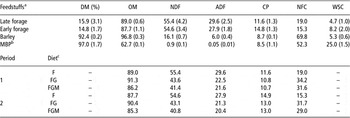
Eighteen adult non-pregnant, non-lactating Corriedale ewes (43 ± 4 kg initial BW) were housed in two lines of nine individual pens (1.10 × 0.55 m), located in a barn with natural lighting and controlled temperature and hygrometry. The basal diet was temperate pasture (90% Avena sativa and 10% Trifolium repens) without N fertilization, in early (3040 kg dry matter (DM)/ha, 25 days post-cut) or late (6240 kg DM/ha, 60 days post-cut) vegetative stage, cut fresh every day. A molasses-based product (MBP; Kalori 3000, KK Animal Nutrition Pty Ltd, Umbogintwini, Durban, South Africa) and rolled barley grain (Hordeum vulgare) were used as NFC supplements. Water was available ad libitum. The chemical composition of feedstuffs is shown in Table 1.
Chemical composition (% of DM) of feedstuffs (s.d. in parentheses) and of ingested diets for late (period 1) and early (period 2) forage periods

DM = dry matter; OM = organic matter; NFC = non-fibrous carbohydrates (calculated); WSC = water-soluble carbohydrates; MBP = molasses-based product; F = forage; FG = forage + barley grain; FGM = forage + barley grain + MPB experimental groups.
aForage data = daily (8 days/ period) measurements during the protocol; barley and MBP data = mean of four measurements.
bKalori 3000: sugar cane molasses + soluble condensed molasses + 6.2% Ca(OH)2.
cValues of ingested diets were calculated from the data of chemical composition and amount of each feedstuff ingested by each sheep.
Animals were randomly allocated into one of three groups (n = 6 each) receiving the following diets expressed as % of DM: 100% forage (group F), 70% forage + 30% barley grain (group FG) and 70% forage + 15% barley grain + 15% MBP (group FGM). Intake was individually fixed at a level of 40 g DM/kg BW0.75 daily (664 ± 99 g DM total intake). For each group two consecutive experimental periods, P1 and P2, were carried out, where P1 represents the late vegetative stage and P2 represents the early vegetative stage. The chemical composition of diets in both periods is shown in Table 1. The forage was distributed four times a day at 0900 h, 1300 h, 1800 h and 2300 h. In groups FG and FGM, the supplement was mixed with forage at 0900 h and 1800 h. For P2 and based on the results observed in P1, sheep were fitted with 30-cm long permanent ruminal polyethylene catheters (inner diameter = 5 mm, outer diameter = 10 mm), with a filter (in situ bags, 50 μ pore size nylon, R510, Ankom, NY, USA) around the intraruminal tip, for liquor extraction. The surgery was performed under local anesthesia (lidocaine at 2%, Fatro Fedagro, Montevideo, Uruguay) after sedation with 0.05 mg/kg i.v. of xylazine (Rompun®, Bayer, Buenos Aires, Argentina). Total duration of the experiment was 42 days as follows: 0 to 10 = adaptation to metabolic cages and P1 diets; 11 to 18 = P1 experimental period (11 to 15 = digestibility and N balance studies, 16 to 18 = microbial protein synthesis determination); 19 = ruminal catheterization; 20 to 33 = post-surgery recovery and adaptation to P2 diets; 34 to 42 = P2 experimental period (34 to 41 = 11 to 18 of P1, 42 = N-NH3 and pH studies determination of ruminal fluid).
To estimate apparent digestibility of diets, total feces and feed refusals were weighed daily and 10% aliquots taken and frozen until analyzed. Urine was separately collected using a retention catheter placed into the urinary bladder and connected to a plastic bag with 30 ml of 10% H2S04 to maintain the final urine pH below 3.0 (Fujihara et al., Reference Fujihara, Orskov, Reeds and Kyle1987). For the microbial protein determination, 30 ml subsamples of urine were collected daily and stored at −20°C for allantoin analyses. For ruminal pH and N-NH3 determinations, 10 ml of rumen fluid (ventral sac) was individually collected from the ruminal catheter by hourly syringe aspiration during 24 h. The pH was immediately measured (digital pHmeter, Cole Parmer, Vernon Hills, IL, USA) and the samples conserved in 10 ml of 20% NaCl and frozen until N-NH3 analyses. Animals were weighed at the end of the experiments.
Chemical analyses
After thawing, feed and feces were pre-dried at 60°C to a constant weight, and ground to pass a 1-mm screen (variable-speed rotor mill, Fritsch Pulverisette 14, Idar-Oberstein, Germany, with sieve ring 1-mm trapezoidal perforation). DM (method 934.01), OM (method 942.05), CP (N × 6.25; method 942.01) and ether extract (method 920.39) were determined according to the Association of Official Analytical Chemists (1990) methods, and NDF and ADF according to Robertson and Van Soest (Reference Robertson and Van Soest1981). ADF and NDF were assayed sequentially without sulfite and heat stable amylase, and the residual ash content was included in the ADF and NDF content. Each analysis was performed in triplicate. NFC content was calculated as OM – (CP + NDF + ether extract). Water-soluble carbohydrates were determined following the procedure described by Yemm and Willis (Reference Yemm and Willis1954). Allantoin was analyzed in urine by the colorimetric method proposed by Fujihara et al. (Reference Fujihara, Orskov, Reeds and Kyle1987). Determinations of N-NH3 were made by direct distillation with sodium tetraborate (Preston, Reference Preston1995).
Calculations and statistics
Digestibility coefficients for DM, OM, CP, NDF and ADF were calculated as: (g ingested – g feces)/g ingested. The digestible organic matter (OM) ingested (DOMI) was calculated as the OM digestibility coefficient × ingested OM (g). Retained N (g/day) was calculated as daily g of N ingested – g of N excreted (in feces and urine). Microbial protein synthesis was calculated according to the equation y = e(0.830+2.089x), proposed by Puchala and Kulasek (Reference Puchala and Kulasek1992), where y = microbial N entering into the duodenum (g/day) and x = urinary excretion of allantoin N (g/day). The efficiency of microbial protein synthesis (EMPS) in the rumen was expressed as g of microbial N/kg of DOMI.
Data were analyzed using the PROC MIXED procedure of SAS (Statistical Analysis System, SAS Institute, Cary, NC, USA). Digestibility, microbial protein production and retained N were analyzed as repeated measures using the sheep as subject for the repeated measurement, according to the model Yij = μ + Ti + Pj + (T × P)ij + eij, where μ was the general mean, Ti the fixed effect of the treatment, Pj the fixed effect of the period of measurement (1 or 2), (T × P)ij the interaction between treatment and period of measurement and eij the residual error. The dynamic of pH and N-NH3 in rumen (measured only in P2) were analyzed also as repeated measures, using the sheep as subject for the repeated measurement, according to the model: Yij = μ + Ti + Hj + (T × H)ij + eij, where μ was the general mean, Ti the fixed effect of the treatment, Hj the fixed effect of the hour of measurement (0000 to 2300 h), (T × H)ij the interaction between treatment and hour and eij the residual error. The means of the different treatments were compared using orthogonal contrasts, separating the effect of supplementation (F v. FG + FGM) and the supplement used (FG v. FGM). Data are reported as means ± s.e. (s.d. for pH and N-NH3). The statistical significance was declared at P < 0.05 and a tendency was noted between 0.05 and 0.1.
Results
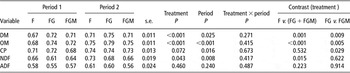
BW did not show significant variations during the experiment (P = 0.48). The coefficients of digestibility for DM, OM, CP, NDF and ADF for the three diets in both periods are shown in Table 2. No interaction between treatments and periods were observed. Compared to F diet, the DM and OM digestibility of the supplemented diets increased (P < 0.001), and were greater for FG than FGM diet (P = 0.009 and 0.005 for DM and OM, respectively). Digestibility of CP tended to be affected by treatments (P = 0.07). The digestibility of NDF (P = 0.015), but not of ADF, was reduced by supplementation without differences between supplements. When comparing periods, the mean values of the three treatments for the digestibility of DM (0.72), OM (0.76), CP (0.74) and NDF (0.69) were greater in P2 than in P1 (0.70, 0.71, 0.70 and 0.64, respectively; P ≤ 0.025).
Coefficient of digestibility of DM, OM, CP, NDF and ADF, in the three experimental groups for late (period 1) and early (period 2) forage periods
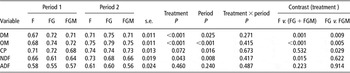
DM = dry matter; OM = organic matter; F = forage; FG = forage + barley grain; FGM = forage + barley grain + molasses-based product experimental groups.
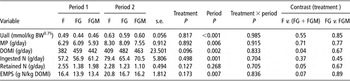
Urinary elimination of allantoin, microbial protein yield, EMPS based on DOMI and retained N are listed in Table 3, for the three treatments in both periods. No interaction between treatments and periods was observed. Microbial protein was not affected by treatments. The orthogonal contrasts analysis showed a tendency for a reduction in EMPS and retained N in supplemented groups, without differences between supplements. Microbial protein and EMPS were greater in P2 than in P1 (P < 0.006 and <0.007, respectively).
Urinary elimination of allantoin (Uall), estimated production of MP, DOMI, EMPS and retained N in the three experimental groups for late (period 1) and early (period 2) forage periods

MP = microbial protein; DOMI = digestible organic matter intake; EMPS = efficiency of microbial protein synthesis; F = forage; FG = forage + barley grain; FGM = forage + barley grain + molasses-based product experimental groups.
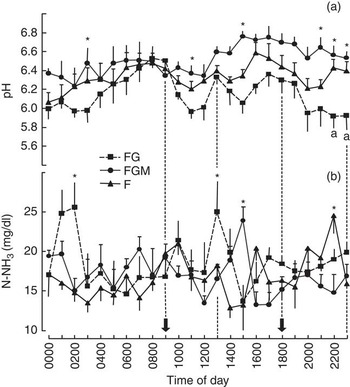
The ruminal pH values (24-h means and ranges, measured only in P2) were 6.33 for F, 6.15 for FG and 6.51 for FGM, with significant differences (P < 0.05) among treatments. The highest mean pH was achieved in the FGM group. The hourly evolution of pH (Figure 1a) showed similar pattern for each experimental treatment with no interaction hour × treatment (P > 0.05). In F and FG groups, pH dropped after meals. When pH was measured 7 to 10 h from the last meal (between 0600 h and 0900 h), mean values were high (∼6.4) and without differences among the three treatments (P = 0.73).
Mean ruminal pH (a) and N-NH3 concentration (b) for the three experimental treatments (F = forage, FG = forage + barley grain, FGM = forage + barley grain + molasses-based product) during the daytime in period 2 (n = 6 sheep per group). Vertical dashed lines indicate forage distribution; arrows indicate supplement distribution for FG and FGM groups; *P < 0.05 between supplemented groups; aP < 0.05 between F and FG.

The average values of the ruminal concentration of N-NH3 (measured only in P2) were 17.4, 18.5 and 18.0 mg/dl for F, FG and FGM groups, respectively, without any significant difference among treatments or sampling hours for the same treatment. The hourly evolution of N-NH3 for each treatment is observed on Figure 1b. Only few values were above 25 mg/dl, but at different times and not related to forage or supplement distribution.
Discussion
Digestibilities of DM and OM were greater in P2 and, although similar NDF concentrations were found in late and early forages, the NDF digestibility was also greater (11%) in P2. These effects can be attributed to the earlier phenological stage of the pasture. In both periods, NFC supplementation increased DM and OM digestibility but decreased NDF digestibility showing an interaction between NFC and forages. This concerned mainly hemicelluloses because ADF digestibility was not modified by the NFC supplementation. The observed greater digestibility for DM and OM in supplemented groups is consistent with the data found in the review by Poppi and McLennan (Reference Poppi and McLennan1995), and could be related to the inclusion of highly digestible compounds as grain or MBP. The depressed NDF digestibility by supplements may indicate a change in the microbial population profile, prevailing the soluble-carbohydrates users. The retention time of particles in the rumen should also be considered to explain digestibility results. As the study was carried out on restricted intake (without refusals), the reduction in digestibility should not be associated with changes in total food intake. However, NFC supplementation could decrease the retention time of particles in the rumen and thereby the digestibility. The fact that DM and OM digestibility were greater with barley grain alone than with barley grain + MBP, could be attributed to redirection of the enzymatic activity of microorganisms to the rapidly fermentable substrate of added molasses, as suggested by Obara et al. (Reference Obara, Dellow and Nolan1991), although the MBP had only 25% of water-soluble carbohydrates. Another possible explanation is the catabolite regulatory mechanism (‘catabolite repression’), well documented in rumen bacteria (Russell and Baldwin, Reference Russell and Baldwin1978).
The mean hourly rumen pH values measured in this study for group F agree with those reported by Cajarville et al. (Reference Cajarville, Pérez, Aguerre, Britos and Repetto2006) on fresh forage-fed sheep, and were reasonably within the range of 6.2 to 7.0 stated by Owens and Goetsch (Reference Owens and Goetsch1988) for ruminants fed on forage-based diets. Unexpected high pH values were observed in FGM treatment. One possible explanation for our result could be related to the high proportion of Ca(OH)2 (6.2%) of the Kalori 3000, that would alkalinize the rumen fluid. In fact, Ca(OH)2 solutions have been used for the treatment of lactic acidosis in goats (Cao et al., Reference Cao, English, Filippich and Inglis1987). Another explanation could be that, as the content in water-soluble carbohydrates of MBP (25%) was determined by analysis and its NFC content (52.3%) was calculated, the product could not have as much fermentable carbohydrate as the calculated NFC value would suggest.
The lower pH values observed in FG in this study are probably due to the rapidly fermentable starch present in the barley grain (reviewed by Peyraud and Apper-Bossard, Reference Peyraud and Apper-Bossard2006). It is unlikely that these changes affected the cellulolytic flora, as pH was below the critical value of 6.0 for less than 4 h (Calsamiglia et al., Reference Calsamiglia, Ferret and Devant2002). Another result, consistent with this idea, is that NDF digestibility was similarly reduced in both supplemented groups, meanwhile pH was only reduced in FG group. Calsamiglia et al. (Reference Calsamiglia, Cardozo, Ferret and Bach2008), working in vitro and Martin et al. (Reference Martin, Philippeau and Michalet-Doreau1999) working in vivo, attributed the reduction in NDF digestibility primarily to pH changes. Moreover, Huhtanen and Khalili (Reference Huhtanen and Khalili1992), working in vivo, reported that the use of supplementation of diets containing sucrose with sodium bicarbonate, resulted in higher carboxymethylcelulase and xylanase activities than sucrose diets without buffer. Martin and Michalet-Doreau (Reference Martin and Michalet-Doreau1995), working with barley-supplemented cows with or without infusions of bicarbonate salts observed that, although the density of microorganisms was similar, glycosidase activities were higher when buffer was added. In present experimental conditions, it seemed that the reduction of NDF digestion could be associated with other fermentation products related to the diets instead of pH reduction. This decrease may be probably related to a ‘substrate’ effect via a catabolite repression by molecules released during NFC hydrolysis (Huang and Forsberg, Reference Huang and Forsberg1990) or as proteinaceous inhibitor produced during glucose fermentation (Piwonka and Firkins, Reference Piwonka and Firkins1996).
The average concentrations of N-NH3 in rumen fluid observed for the three treatments were above the values of 5 mg/dl established by Satter and Slyter (Reference Satter and Slyter1974) for optimal microbial protein synthesis. It has been shown that fermentable carbohydrate supplementation reduces ruminal N-NH3 increasing its capture by microorganisms and its subsequent use in protein synthesis (Berzaghi et al., Reference Berzaghi, Herbein and Polan1996). However, Wiedmeier et al. (Reference Wiedmeier, Tanner, Bair, Shenton, Arambel and Walters1992), comparing the effect of molasses and a molasses by-product on digestibility and rumen fermentation in hay-fed cattle, obtained N-NH3 concentrations similar to those reported in this study without significant differences between treatments. Moreover, in sheep fed silage fodder, the daily intraruminal continuous infusion of 150, 300 and 450 g of sucrose (∼4 to 10 times the ingested sucrose in FGM group) did not change N-NH3 concentrations (Kim et al., Reference Kim, Lee and Kim2005).
Urinary excretion of allantoin was within the range of 6.4 to 10.6 mmol/day, reported by Pérez et al. (Reference Pérez, Balcells, Guada and Castrillo1997), in sheep fed different protein sources and supplemented with high and low levels of barley. Trevaskis et al. (Reference Trevaskis, Fulkerson and Gooden2001) also reported similar values (5.5 to 9.0 mmol/day) in sheep receiving forage and supplemented with barley. The reported increase in urinary excretion of purine bases, including allantoin, after energy supplementation (Chen et al., Reference Chen, Abdulrazak, Shand and Oskorv1992; Pérez et al., Reference Pérez, Balcells, Guada and Castrillo1997), was not observed in this study. Similarly, Jetana et al. (Reference Jetana, Abdullah, Halim, Jalaludin and Ho2000) did not find differences in the elimination of allantoin between control and supplemented (corn flour or paper pulp) forage-fed sheep.
The daily production of microbial protein estimated from urinary allantoin were within the range of 4.5 to 9.1 g/day observed by Chen et al. (Reference Chen, Abdulrazak, Shand and Oskorv1992). The values of EMPS related to DOMI were consistent with the 12.8 to 15.8 g N/kg DOMI reported by Chen et al. (Reference Chen, Abdulrazak, Shand and Oskorv1992). In both periods, the addition of rapidly fermentable energy sources did not improve microbial protein synthesis or EMPS. This raises the question of what other factors were limiting that would reduce the response to added fermentable carbohydrate. This result was consistent with the absence of effect on N-NH3 concentration and was in accordance with the fact that supplemented sheep showed a clear reduction of retained N. This reduction was not related to the amount of N ingested. Unexpectedly, the increase in the energy intake (assuming the DOMI as an index of the ingested energy) did not enhance the N retention. Although in a previous study (Tebot et al., Reference Tebot, Ibarra, Purtscher and Cirio2004) microbial protein synthesis was significantly increased by energy supplementation, the base diet was not fresh forage. Amaral et al. (Reference Amaral, Kozloski, Santos, Castagnino, Fluck, Farenzena, Alves and Mesquita2011) observed that starch supplementation did not improve the microbial protein entering the duodenum and even reduced the EMPS in lambs fed a diet based on ryegrass. Moreover, Aguerre et al. (Reference Aguerre, Cajarville, Kozloski and Repetto2009) reported that ruminal microbial protein synthesis decreased linearly with increased grain addition and that EMPS was not affected by energy supplementation in wethers fed on temperate fresh pasture.
In the studies aforementioned, the levels of carbohydrates supplementation and the ingested DM and OM varied greatly among treatments and, consequently, also varied the supply of fermentable substrates to ruminal microbes. In contrast, in this study, a fixed level of supplementation was used and the amount of DOMI was similar for FG and FGM treatments. This fact was reflected in ruminal pH and N-NH3 that did not show major changes that could have promoted changes in microbial protein production. The values of N-NH3 were not limiting for the protein synthesis, but we assume that both the energy expenditure and N were focused to the maintenance rather than microbial growth, as has also been suggested by Feng et al. (Reference Feng, Hoover, Miller and Blauwiekel1993) in lactating dairy cows.
When evaluating the NFC content in the diets as a rapid source of energy, different compounds and proportions could be included in this term, due to the large variations of sucrose, starch and pectin in food. As a consequence, increased dietary NFC does not necessarily mean better EMPS. Stokes et al. (Reference Stokes, Hoover, Miller and Manski1991), working with corn cobs as forage, found that bacterial efficiency rose when dietary NFC was increased from 25% to 37%, but only small improvements were observed at greater dietary NFC. Nevertheless, in this study, the NFC values for supplemented groups (29% to 39%) did not lead to a higher microbial protein synthesis. Bach et al. (Reference Bach, Yoon, Stern, Jung and Chester-Jones1999), working in vitro with grass and legumes as forages supplemented with soybean hulls, beet pulp and corn, reported that the increment in NFC resulted in a rise of glycogen content in microbial cells and a decrease in bacterial N. Similarly to this study Feng et al. (Reference Feng, Hoover, Miller and Blauwiekel1993), providing high and low NFC diets combined with rapidly or slowly degraded NDF on dairy cows, found that an increase from 29% to 39% of NFC in the diet resulted in a reduction in the EMPS. Although supplementation did not increase microbial protein yield, greater values for both measures and for DOMI were observed during P2 for all treatment groups. This could be due to the earlier phenological stage of the forage during P2. Early forage had lower NFC content and microbial protein synthesis and EMPS were greater when animals consumed this forage. A possible explanation for present results is that, even though both forages had similar NDF concentrations, the NDF digestibility was greater in forage in early phenological stage, leading to a higher energy availability in rumen. In addition, water-soluble carbohydrates and CP were greater in early than in late phenological stage of forage. In fact, Brito et al. (Reference Brito, Tremblay, Lapierre, Bertrand, Castonguay, Bélanger, Michaud, Benchaar, Ouellet and Berthiaume2009), feeding dairy cows with silage from alfalfa cut at sundown, with greater sugar concentration than when cut at sunup, observed an increased capacity of microbes to uptake N-NH3 and convert it to microbial protein. Therefore, it seems that the impact of the diets on microbial protein production and EMPS was mainly related to the pattern of supply of the forage fermentable carbohydrates (as also proposed by Hall and Huntington, Reference Hall and Huntington2008), and that the NFC supplementation and the consequent increased DOMI did not improve these parameters.
In conclusion, although supplementation with NFC increased digestibility of the diets and kept ruminal parameters within standard ranges, the digestibility of the cell walls was reduced. The microbial protein synthesis and its efficiency were not modified when supplementation increased the NFC of the diet. Instead, a clear increasing effect on both parameters was associated to the greater NDF digestibility and soluble sugars content of the early stage of the forage. Therefore, in our experimental conditions, NFC supplementation of temperate fresh forage did not lead to the expected increase in microbial protein synthesis. Present results suggest the need to redesign the strategies for efficient use of grain supplementation and environment-friendly feeding practices.
Acknowledgments
The authors thank the staff of the Block Quirúrgico y Técnicas Operatorias of the Facultad de Veterinaria of Montevideo for sheep surgery.