The last 10 years have witnessed a steady increase in the number of studies that have examined the effects of corrective feedback (CF) on second language (L2) learning. This includes both descriptive and experimental research examining a wide range of variables (e.g., type and amount of feedback, mode of feedback, learners' proficiency levels, attitudes toward feedback). One of the reasons for this increased interest in CF is related to the observation that although L2 learners in communicative classrooms attain relatively high levels of comprehension ability and, to some extent, fluency in oral production, they continue to experience difficulties with accuracy, particularly in terms of morphology and syntax (Harley & Swain, 1984; Lightbown, Halter, White, & Horst, 2002; Lightbown & Spada, 1990, 1994; Schmidt, 1983).
These low levels of grammatical accuracy have been interpreted as evidence against the sufficiency of comprehensible input and exclusively meaning-based instruction (Doughty & Williams, 1998; Long, 1991; Long & Robinson, 1998; Rutherford & Sharwood Smith, 1985; Sharwood Smith, 1981, 1991; Spada, 1997; Swain, 1985; L. White, 1987). This view has been further emphasized by Schmidt in his noticing hypothesis (1990, 2001). He pointed to the necessity of drawing learners' attention to the formal properties of language to help them notice L2 forms if they are to successfully learn them. As a result, form-focused instruction—both proactive and reactive—has been proposed as a way of drawing learners' attention to language form within communicative classrooms, and there is evidence to support this approach from a large number of instructional studies carried out over the past 20 years (e.g., Doughty, 2001; Doughty & Williams; Lightbown, 1998; Long, 1991, 1996; Spada). In a meta-analysis of the findings from 49 experimental and quasi-experimental studies published between 1980 and 1998 that investigated the effects of instruction on L2 learning, Norris and Ortega (2000) concluded that form-focused L2 instruction is beneficial and that explicit types of instruction are more effective than implicit types. Few of the analyzed studies investigated the effectiveness of CF as an isolated variable (i.e., separate from instruction) on L2 learning. However, this area of research is rapidly growing. In a recent analysis of 56 studies that examined only the effects of CF on L2 learning, Russell and Spada (2006) identified 15 that were suitable for a meta-analysis. They reached the following conclusion:
The findings of this meta-analysis support a beneficial role for CF overall. The results also indicate that while the accumulated knowledge of previous research on CF has laid the foundation for work in this area, much more work needs to be done. It is evident that without a sufficient accumulation of studies on any one of these variables and without researchers' attention to the constellation of moderating variables that could make a difference regarding CF effectiveness, we will not be able to establish clear patterns across studies. Thus, there is a need not only for a greater volume of studies on CF, but also for studies that investigate similar variables in a consistent manner. Currently the wide range of variables examined in CF research is spread rather thin; more work is needed to consolidate efforts and focus on those CF variables that appear to be particularly fruitful for future investigation (e.g., context, type of CF, focus of CF). (p. 32)
Thus, even though the research evidence supports the consensus of L2 teachers and researchers that a focus on the formal properties of the L2 through CF is beneficial, more research is needed before we can arrive at any conclusions about whether certain CF techniques are more effective than others. The purpose of this study is to contribute to this body of work by investigating the effects of two specific CF techniques—recasts and prompts—on L2 learners' written and oral ability.
THEORETICAL AND DESCRIPTIVE STUDIES OF CF
Inspired by research results in first language (L1) acquisition (Baker & Nelson, 1984; Farrar, 1990, 1992), some L2 researchers posit that recasts are beneficial for SLA (Doughty, 2001; Doughty & Varela, 1998; Doughty & Williams, 1998; Long, 1996). A recast is defined as a CF technique that reformulates the learner's immediately preceding erroneous utterance while maintaining his or her intended meaning (e.g., in response to “The boy has three toy,” a teacher might respond “The boy has three toys”). Recasts are thought to help L2 learners notice the discrepancy between their nonnativelike utterance and the targetlike reformulation. As noted earlier, the process of noticing this difference is considered to be essential to learning (Schmidt, 1990, 1993). Recasts are also believed to be an effective technique in light of psychological research that shows learners' attention to be limited, selective, and partially subject to voluntary control. VanPatten (1990) argued that learners cannot attend to and process both meaning and form at the same time. He showed, however, that L2 learners can consciously focus on form if the input is easily comprehended. Given that recasts juxtapose the correct and incorrect utterances while keeping the meaning constant, they are thought to free up processing resources by allowing the learner to attend to the form of the utterance.
In addition to offering psycholinguistic advantages, recasts also address some pedagogical concerns. For example, it has been argued that CF should be abandoned because it can have potential negative effects on learners' affect, thus endangering the flow of communication (Krashen, 1981; Truscott, 1999). Because recasts are implicit, unobtrusive, and perform the dual function of providing a correct model while maintaining a focus on meaning, many L2 researchers consider them to be the ideal CF technique (Doughty & Varela, 1998; Long, 1996).
However, recasts are not without their problems, and some of their disadvantages have also been discussed in the literature. Based on an analysis of the functional properties of recasts used in content-based L2 classrooms, Lyster (1998) observed that recasts and noncorrective repetitions had similar forms and functions and that they were used interchangeably, which rendered recasts ambiguous. In other words, the corrective nature of recasts was obscured by their formal and functional overlap with repetitions. This might be particularly true of classrooms in which a teacher's reformulation can be mistaken for a confirmation or disconfirmation of the content of the learner's message rather than of its form. Similar concerns about the ambiguity of recasts were raised earlier by Fanselow (1977) and Chaudron (1977). These concerns were further strengthened by the finding that learners in content-based L2 classrooms responded overtly to recasts less frequently than to other CF techniques (Lyster & Ranta, 1997).1
Other CF techniques, referred to as negotiation of form in Lyster and Ranta (1997) and as prompts in Lyster (2004)—namely elicitation, clarification requests, metalinguistic feedback, and repetition—were less frequently used but more successful in leading to uptake.
In their effort to document the frequency and distribution of different types of CF in relation to learner uptake (i.e., the learner's immediate response to CF), Lyster and Ranta (1997) observed six French immersion classrooms for a total of 18.3 hr. They found that teachers used six CF techniques (recasts, repetition, clarification requests, elicitation, metalinguistic feedback, and explicit correction) in response to students' incorrect utterances. A major part of the CF (i.e., 55%) was delivered through recasts. This is a finding that has been corroborated by research in noninstructional conversational interaction (Braidi, 2002; Oliver, 1995) and in L2 and foreign language classrooms (Doughty, 1994; Ellis, Basturkmen, & Loewen, 2001; Lochtman, 2000; Morris, 2002; Panova & Lyster, 2002; see Nicholas, Lightbown, & Spada, 2001, for a review).
Although plausible, it would be unwarranted to argue against the effectiveness of recasts only because they do not necessarily lead to immediate repair. As argued by several researchers (Braidi, 2002; Gass, 1997; Mackey & Philp, 1998; Oliver, 1995, 2000) and acknowledged by Lyster (1998), immediate repair is a questionable yardstick by which to judge learning because its absence cannot be taken as evidence of lack of learning. The argument is that incorporation is sometimes delayed or that opportunities for it to occur are impossible or inappropriate in interactions between speakers. Additionally, incorporation of the correct form following a recast does not necessarily signal interlanguage development. For instance, Gass (2003, p. 236) stated that repair following recasts might be a sign of “mimicking” (i.e., repetitions that do not involve any analysis or revision of L2 knowledge). Given that uptake, or its absence, does not provide sufficient information about the effectiveness of recasts or any other CF technique, experimental research is needed if claims about the effectiveness of CF are to be made with greater certainty. Using a pretest-posttest-control group design, the present study sought to respond to this need.
EXPERIMENTAL AND QUASI-EXPERIMENTAL STUDIES OF CF
There is a growing body of experimental and quasi-experimental research on the effects of recasts in SLA, and the results are far from conclusive. Long, Inagaki, and Ortega (1998) conducted two laboratory studies, one with Japanese and one with Spanish as the target languages, in order to compare the effects of recasts, models, and zero feedback. The experimental intervention targeted adjective ordering and fronted locative constructions for Japanese and object topicalization and adverb placement for Spanish. Findings for the Japanese study showed no significant differences between the experimental groups and the control group or between the two experimental groups (the recast group and the model group). As for the Spanish study, analyses of gain scores showed some significant short-term benefits for recasts over models and for the two treatments over the control group on adverb placement only. The failure to learn object topicalization in the Spanish experiment and the two target features in the Japanese experiment was attributed to a number of factors, including the way the model condition was implemented.3
Participants in the model condition were required to repeat the native speaker's model so that the researcher could perform the required action. According to Long et al., this requirement to reproduce the target form and, in the process, to produce output might have caused the learners to focus on form and, hence, acquire the target structures in the same way that the recast group did.
Mackey and Philp (1998) also investigated the effects of recasts in a laboratory study by introducing another independent variable: proficiency level. The 35 participants assigned to the three different conditions (i.e., recasts, interaction, and control) were classified according to their developmental readiness to acquire the target feature: word order in English question formation. This resulted in two proficiency groups (readies and unreadies). The results showed that the readies in the recast group were able to produce more questions at higher developmental levels than the readies in the interaction group. However, with the less advanced learners (i.e., unreadies), there were no differences between the recast and interaction groups. The differential effects of recasts in relation to learner proficiency level were treated as an indication that recasts might be effective only when a certain developmental readiness is attained, an argument that was advanced by Farrar (1990) in L1 learning and further supported in an L2 classroom study by Netten (1991).
Long et al. (1998), Mackey and Philp (1998), and others (Carroll & Swain, 1993;4
Carroll and Swain reported that recasts were not as effective as explicit CF.
It is important to note that laboratory studies of CF also serve an essential role in uncovering answers to questions in this and other domains of SLA research (for a specific example of how laboratory research on CF is essential, see Spada, 2005).
For the reasons outlined above, it has been argued that the effectiveness of recasts might be limited in the classroom as opposed to the laboratory setting, and there is empirical evidence to support this (Havranek, 1999; Lyster, 2004). There is also evidence indicating that the contribution of recasts can be increased when they are coupled with other CF techniques (Doughty & Varela, 1998). In what follows, this research is discussed in more detail.
Lyster (2004) investigated the effects of four different form-focused instruction (FFI) conditions—recasts + FFI, prompts + FFI (where prompts were defined as CF techniques that push learners to self-correct), FFI only, and control—on French immersion students' acquisition of grammatical gender. He used two written tasks (binary choice and text completion) and two oral tasks (object identification and picture description) in three testing sessions (pretest, immediate posttest, delayed posttest) to measure the effects of the treatments on the participants' knowledge of the target feature. Results indicated that the prompt + FFI group significantly outperformed the control in all measures at both posttests. The recast + FFI group was superior to the control in both written measures at both posttests and in both oral measures at the delayed posttest only. The recast + FFI group was at no time superior to FFI only and was inferior to prompt + FFI in both written tasks at both posttests. The limited effectiveness of recasts and the superiority of CF techniques that push the learners to self-correct were further reported by Havranek (1999) in a classroom study that investigated learners' ability to recall and benefit from recasts only, recasts followed by repetition, and elicitation. Results of this study revealed that the CF technique of recasts only was the least recalled and the least likely to lead to any L2 improvement. By contrast, prompts (referred to as elicitation) were more successful in both respects (i.e., they were recalled more often and were more facilitative of language development).
In a study that reported benefits for recasts, Doughty and Varela (1998) compared the effects of corrective recasts and a purely communicative condition in which no feedback about form was provided for the acquisition of past time reference. The participants' knowledge of the target forms was pretested once and posttested twice, once upon completion of the treatment and a second time 2 months later. The tests comprised an oral task and a written task. Analyses of the immediate posttest results indicated that the recast group showed significant gains on both the oral and the written measures, with the control group showing no progress on the oral measure and demonstrating a significant improvement on the written measure. Whereas the recast group lost some of the gains at the written delayed posttest, the control group did not show any change from one posttest to the other.
Based on these findings, Doughty and Varela (1998) concluded that the implementation of FFI via the use of corrective recasts in communicative classrooms is effective. However, as explained by Lyster (1998) and Nicholas et al. (2001), the favorable outcomes reported in Doughty and Varela cannot be attributed solely to recasts. Rather, it is more likely that the combination of the different techniques encompassed within the corrective recasts led to improvement in the target structure. Doughty and Varela operationalized corrective recasts as follows: When a student produced an error in past reference, the teacher repeated the student's incorrect utterance, putting emphasis on the incorrect form through rising intonation. Students were then given a chance to self-correct or peer-correct. Recasts were provided only when learners failed to provide the correct form. Once provided, the students were required to repeat the teachers' reformulation. Given that there was more than one variable at play in the corrective recasts (i.e., emphatic stress and intonation, a chance to self-correct, and repetition of correct form), it is difficult to know which proved more beneficial—the repetition with emphasis, the self-correction, the recast, or the repetition of the teacher's reformulation. Consequently, the results from the Doughty and Varela study, on the one hand, and Lyster (2004) and Havranek (1999) studies, on the other, cannot be directly compared because of a fundamental difference in the way recasts were operationalized.
This review of some of the L2 recast literature highlights a tension between theory and empirical findings. On the one hand, we have theoretical arguments that present recasts as an effective feedback technique because they are unobtrusive, implicit, and contingent on the learners' intended meaning. On the other hand, empirical research in classrooms has not yet provided clear-cut evidence to support this, especially in communicative classrooms. Empirical findings indicate that recasts facilitate L2 development especially when compared to a purely communicative program in which no CF is provided (Lyster, 2004). However, their effects depend on the learners' proficiency level (Mackey & Philp, 1998; Netten, 1991) and on the target grammatical structure (Long et al., 1998). Another important finding that emerges from the previously mentioned empirical research is that prompts can more positively affect learners' accuracy than recasts (Havranek, 1999; Lyster, 2004). Thus, the question that arises from these apparently contradictory findings is not whether recasts are effective, but whether recasts and other CF techniques are more effective depending on proficiency level, age group, grammatical feature, and teaching or learning context. For example, research shows that CF techniques that push learners to self-correct can be effective, particularly with low-proficiency learners. In a small-scale study, Nobuyoshi and Ellis (1993) reported that low-proficiency learners benefited from being pushed to self-correct or peer-correct more than low-proficiency learners who were not pushed. In light of these findings, it seems that combining the two CF techniques can be more effective because (a) recasts do not seem to be effective for all types of learners and (b) pushing learners to self-correct or peer-correct might not always be necessary. Thus, research should aim at finding out when we should utilize a particular CF technique to maximize L2 development. The present study was carried out to address this research objective.
THE CURRENT STUDY
Hypotheses
In light of previous research that has indicated that CF positively affects L2 development, the first hypothesis of this study posits the following:
1. Learners who are exposed to communicative activities that include a CF component will benefit more than those who are exposed to communicative activities only.
In accordance with research that has revealed (a) the limited effectiveness of recasts in terms of uptake and L2 development and (b) the superior effectiveness of techniques that push learners to self-correct or peer-correct (referred to as prompts in the present study), the second hypothesis postulates the following:
2. Prompts will be more effective than recasts in leading to L2 development.
Taking into consideration the results of previous research that have pointed to the differential effects of each CF technique—namely prompts and recasts—in relation to learner proficiency level, the third hypothesis is as follows:
3. Prompts will be more effective than recasts for both low- and high-proficiency learners.
Methodology
Research context.
The study was conducted in intensive English as a second language (ESL) programs in Montreal. Intensive ESL programs are offered in French language schools at either grade 5 or grade 6. Although there are different models of intensive ESL (Collins, Halter, Lightbown, & Spada, 1999), the most popular is the 5-month/5-month model. In this model, students study English all day, every day for 5 months of the school year. The remaining 5 months are devoted to the regular curriculum subjects (i.e., math, science, etc.) taught in French. During the ESL portion of the school year, students receive communicative instruction with an emphasis on meaning rather than form. In accordance with the Ministry of Education of Quebec's (MEQ) guidelines for ESL instruction that were in effect when the experimental programs were developed, intensive teachers emphasize fluency through activities that primarily target listening and speaking. This is sometimes done at the expense of the development of reading and writing skills and, especially, grammatical accuracy (Lightbown & Spada, 1994).
Schools.
The study was conducted in three classes in three primary schools in the Montreal area. These were selected after conducting preliminary observations in six intensive ESL classes in six schools. The goal of this observation was twofold: (a) to determine the extent to which the teachers' communicative orientations were comparable and (b) to determine the way in which the teachers provided CF.
The observer (the first author) used Part A of the communicative orientation of language teaching (COLT) observation scheme (Spada & Fröhlich, 1995) to achieve the first goal. COLT has been used to describe the instructional practices and procedures in approximately 50 intensive ESL classrooms as well as in many other L2 and foreign language classrooms. The results have indicated that the scheme effectively distinguishes between more or less communicatively oriented classrooms and characterizes these differences along several dimensions (e.g., activity type, participant organization, content [form/meaning], student modality). Using COLT Part A, 3 hr of classroom instruction from each teacher were observed and coded in real time by the researcher sitting at the back of the class. The results indicated that the six teachers had comparable teaching styles; that is, there was virtually no explicit instruction with regard to form and there was a clear emphasis on the expression of meaning via oral communicative activities. Although all teachers reported that some reading activities were done each week, these were not observed during the researcher's visits. These findings are consistent with those observed in other intensive ESL classrooms.
To determine whether and how teachers provided CF, a category was added to Part A of the COLT scheme to distinguish between the two types of feedback of particular interest to the study—namely recasts and prompts. All other techniques were grouped under the category “other.” Another category (“ignore”) was included to keep a record of the errors to which teachers did not react (see Appendix A). These data were collected during the same 3-hr period during which the COLT Part A categories were coded.6
It was not difficult to code for teacher feedback to errors in real time because individual learners normally take turns responding to teachers' questions in these classes. At times when several students spoke simultaneously, it was not always possible to catch the error. However, we did not consider this to be a problem because it was not our intention to do an exact count of the total number of student errors and teacher feedback moves. Rather, the goal was to focus on what type of CF the teacher tended to use most often after student errors.
The coding of the CF moves on the part of the teachers in the six classes revealed that five of them reacted to most of their students' oral errors, and one teacher ignored virtually all of them. The CF behaviors of the teachers were observed during different activities in each class. Among the five who provided CF, one teacher responded only with recasts, two used a variety of techniques, with prompts being the most frequent (i.e., between 40% and 50%),7
The remaining 60% and 50% of the CF moves in these classrooms were divided among recasts, explicit correction, and no CF (i.e., ignore).
Care was taken to assign teachers to the treatment conditions that were similar to and compatible with their normal CF behavior. This was done to avoid any salience that might be added to the treatments if teachers were asked to teach in a way that differed from their habitual teaching style. This was particularly important for the recast and control conditions.8
Recasts as defined in the CF literature (i.e., reformulations of the learners' immediately preceding erroneous utterances) typically provide an implicit response to errors. However, if a teacher who normally elicits the correct form from his students or who always ignores their errors asked them to recast, it is likely that this change in response would become salient and more noticeable in spite of its hypothesized implicitness. Therefore, the chances of having the students identify the target feature and pay extra attention to it might increase significantly. As for the control group, it was extremely important to find a teacher who ignored all errors because we felt that it was unethical to ask a teacher who normally provides CF not to do this.
Participants.
Sixty-four students from the three teachers' classes participated in the study. All participants were in grade 6, and they were in the second half of the school year (i.e., February to June).9
It is worth noting that not all participants were able to participate in every testing session because of personal or administrative reasons beyond our control. This problem was apparent especially at the time of the delayed posttest, which took place during the last week of the school year, when all teachers were busy evaluating their students. Consequently, the two experimental teachers could not schedule time periods long enough to administer all tests. In fact, T2 (the prompter) did not have enough time to orally test all of the students who participated in the pretest and the immediate posttest. The fact that we included two proficiency tests—the MEQ and the vocabulary test—at the delayed posttest further reduced the time available for the other language measures (i.e., written and oral).
The Target Feature.
The grammatical feature targeted in the study was possessive determiners (PDs) and, more precisely, third-person singular PDs: his and her.
Contrastive analyses of the English and French PD systems as well as previous research (Lightbown & Spada, 1990; Martens, 1988; J. White, 1996, 1998; Zobl, 1984, 1985) have shown that PDs can be problematic for Francophone ESL learners because English and French differ in the way gender is assigned to third-person singular PDs. Both French and English third-person PDs are marked for gender. However, the directionality of the agreement is different. Whereas PDs in English agree with the gender of the possessor, PDs in French agree with the gender of the determined noun. Judge and Healy (1983, p. 40) provided the following examples to illustrate the difference between the two languages.

Because livre “book” in the first example is masculine and singular, the masculine form son is used in spite of the fact that the possessor is feminine. Furthermore, the feminine sa is used in the second example, not in agreement with the possessor but because the determined noun is feminine. In contrast, English does not observe the grammatical gender or the number of the determined noun. Her is used in the two examples regardless of the noun that it qualifies. The only agreement that the PD has to observe in English is with the possessor, which is feminine and singular in this case.
The Instructional Intervention.
The instructional intervention10
The term instructional intervention is used in this study because, as defined by Spada (1997), form-focused instruction includes “pedagogical events which occur within meaning-based approaches to L2 instruction but in which a focus on language is provided in either spontaneous or predetermined ways” (p. 73). This implies that preplanned (i.e., proactive or preemptive) activities and reactive activities are both part of form-focused instruction. Given that the activities in the present study were of a proactive and reactive nature, we used the term instructional intervention to refer to both the teaching and CF components.
The instruction session, which was provided to the three participating groups, consisted of three phases. First, the three groups were taught a rule of thumb about third-person PDs (see Appendix A). In the second phase, the participants were involved in some semicontrolled practice of PDs in the form of cloze passages. In the final phase, students were involved in some control-free practice in which they had to use his and her to complete a task. Throughout the instruction session, teachers reminded the students of the rule of thumb whenever they made a PD error. The three-phase instruction session, which was the first step in the instructional intervention, lasted 45 min. The instruction session was included in the experimental intervention to control for previous knowledge. Given that prompts cannot be used to elicit forms that learners do not know (Lyster, 2004), an instruction session in which the target feature is explained was deemed necessary. To disentangle its effects from the effects of prompts, all three groups received the instruction.
After their PD instruction, the participants were involved in 11 practice sessions that consisted of a variety of communicative activities designed to maximize the chances of producing third-person PDs. These activities lasted between 330 and 495 min in total. During these activities, the experimental teachers were asked to provide either prompts or recasts to their students' PD errors depending on the experimental condition. The control-group teacher was asked not to react to those errors, which was consistent with her natural teaching style.
Teachers were given two booklets to assist them in their participation in the study. One of the booklets contained all of the teaching materials and was given to the three teachers. The second one, the CF booklet (given to the experimental-group teachers only), described the objectives of the study and provided a detailed description of the CF techniques to use during the experimental intervention (see Appendix A for the description of the CF techniques).11
The two experimental-group teachers were told that the study aimed at investigating the extent to which CF could help their students learn English PDs and overcome L1 transfer problems. No information was provided as to which CF techniques were being studied or which ones were hypothesized to be more effective than others. In fact, the experimental-group teachers were not aware that they had been asked to react to their students' errors in different ways. The control-group teacher was told that the study aimed at investigating the effect of instruction and practice on the acquisition of English PDs. Additionally, she was explicitly warned against correcting any errors during the experimental activities. As indicated in text, this was consistent with the control-group teacher's style.
Observation.
Unfortunately, the participating teachers did not agree to any video-recording or audio-recording of their classrooms, and they were also unwilling to have observers in the classroom on a regular basis because of the potential disruption that it might cause. Given these restrictions, several steps were taken to ensure that the instructional treatment was implemented as intended. First, the instructional packages developed for the teachers were tightly organized, containing specific directions as to how to implement the activities and the order in which to do so; second, the researcher was given permission to observe the first two activity sessions in each class to ensure that the teachers were following the instructions and consistently implementing the CF treatments; third, throughout the intervention, the researcher was in regular contact with the teachers by phone to respond to any questions and to ensure that there were no difficulties in implementing the activities and CF as specified. This was also determined in informal interviews with the teachers at the end of the pedagogical intervention. Finally, it is important to emphasize that the participating teachers were asked to implement activities that were very similar to those that they used on a regular basis in their classrooms (i.e., information gap activities, communicative games, etc.). Furthermore, as indicated previously, teachers were asked to provide their students with the type of CF (i.e., recasts, prompts, and zero feedback) that was observed to be consistent with their own natural styles. Although these efforts increased our confidence in the consistency of the instructional and CF treatments provided, the restrictions on observation placed some limitations on the study; these will be discussed in later sections.
Measurements.
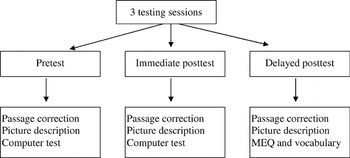
Students' developing knowledge of third-person singular PDs was tested immediately before the instructional intervention (pretest), immediately after it (immediate posttest), and 4 weeks later (delayed posttest).
In their meta-analysis of 49 experimental and quasi-experimental studies that investigated the effects of instruction on L2 learning between 1980 and 1998, Norris and Ortega (2000) reported that the majority of the studies (i.e., 65%) used “constrained constructed response measures” (i.e., measures that “required the application of L2 rules in highly focused and discrete ways” [p. 483]) as dependent variables, which might have biased the findings by favoring more explicit FFI types. This has been treated as a major weakness that FFI research has to overcome (Doughty, 2003). To address this methodological limitation and to maintain consistency with the communicative orientation in the intensive programs, we included two tasks that required simultaneous focus on form and meaning (a passage correction and an oral picture description task) to measure as many aspects of PD knowledge as possible, particularly because implicit and explicit CF techniques were being compared in the present study.12
Corrective feedback techniques were classified as either implicit or explicit according to DeKeyser's (1995) definitions. CF was considered explicit if students were provided with metalinguistic clues or guided to attend to some specific forms, which is the case for prompts. CF was considered to be implicit if no clues or guidance were provided to help the learner focus on the target forms, which is the case for recasts.
To control for the test-retest effect, three different sets of pictures, each comprised of six pictures, were used for each testing session (i.e., pretest, immediate posttest, and delayed posttest). However, care was taken to keep some pictures constant to allow for the effects of the treatment over time to show. Specifically, four pictures were kept constant between the pretest and the immediate posttest, and four were kept constant from the immediate posttest to the delayed posttest. Finally, to ensure comparable chances of using the two target PDs (viz. his and her), each of the three sets included three pictures about a girl and three pictures about a boy.
Other tests were administered at different points in the study to measure the learners' knowledge of PDs and their overall general proficiency. These included a computerized fill-in-the-blank task adapted and expanded from J. White (1996), a listening comprehension test developed by the MEQ to measure the English listening comprehension of secondary 3 (grade 9) students,13
This test has been used with hundreds of intensive ESL learners (Lightbown & Spada, 1997; Spada & Lightbown, 1989; J. White, 1996) as a general measure of English language proficiency.
Students are presented with a list of 120 real words and 60 pseudo-English words (180 words in total) and are required to read through the list and to put a check mark in front of any word they know. The instructions warn them against guessing, and the calculation of scores corrects for guessing.

Testing schedule.
RESULTS
Data Analyses
Data from the passage-correction and the picture-description tasks were analyzed in two ways. First, mean scores from each of the three participating groups were calculated and used for further statistical analyses. Second, to measure the effects of the two experimental CF treatments in relation to learners' readiness to acquire the target structure, each group was divided into two subgroups: low proficiency and high proficiency. Assigning learners to these subgroups was based on their performance on the pretest (i.e., the passage-correction and the picture-description tasks). Participants who obtained an accuracy rate of 50% or less on the pretest were assigned to the low-proficiency group. Learners who were assigned to the high-proficiency group obtained an accuracy rate of greater than 50%. This led to the creation of a subgroup pair for each condition: three low-proficiency–high-proficiency pairs. The low-proficiency subgroups that were formed from the recast group, prompt group, and control group are referred to as recast-low, prompt-low, and control-low, respectively. The high-proficiency subgroups are referred to as recast-high, prompt-high, and control-high. It is important to remember that the term proficiency, as used in the present study, does not refer to the learners' general language proficiency. Rather, it refers to their performance on the different pretests (i.e., written or oral). In other words, low-proficiency students are the low scorers (i.e., 50% or below) and high-proficiency learners are the high scorers (i.e., above 50%). This criterion applies to each test separately, which means that a learner could be classified as high proficiency on one test and low proficiency on the other test.
Whereas raw scores were used to analyze the participants' performance on the passage-correction task, accuracy ratios were used for the picture-description task. Given that the total PD use on the oral task varied considerably from one student to another, which rendered between-student and group comparisons impossible, an accuracy ratio for each of the students was calculated by dividing the number of correct third-person PD uses by the total PD use (i.e., both correct and incorrect). The obtained ratios were used to compute group mean accuracy scores and to run statistical analyses.
Pretest Results
Analyses of variance (ANOVAs) were run on the pretest data to establish the extent to which the three participating groups were comparable. Pretest among-group differences were considered to be significant when p ≤ .10. This probability value was opted for in an attempt to more rigorously ensure that the three groups were not pedagogically different from the outset, especially given that the study was conducted in a classroom context.
The three participating groups with their respective high- and low-proficiency subgroups revealed considerable uniformity in their oral PD performance at the time of the pretest. An ANOVA run on the oral pretest data showed that there were no statistically significant differences among the participating groups in terms of overall performance, F(2, 59) = 0.01, p = .99. In terms of performance by proficiency level, similar results were found for the high-proficiency learners, F(2, 27) = 0.04, p = .96, and for the low-proficiency ones, F(2, 28) = 0.24, p = .79. However, results from the passage-correction task differed from this overall pattern. An ANOVA comparing the participant groups revealed that differences among the three groups were statistically significant (p = .08). Post hoc Tukey pairwise comparisons revealed that the performance of the control group was significantly weaker than that of the recast and the prompt groups. Thus, the written data from the control group were eliminated from any further analyses. An ANOVA showed that the two experimental groups performed comparably, F(1, 42) = 2.54, p = .12.
Posttest Results
To measure the effects of the treatments, analyses of covariance (ANCOVAs), using the pretest as a covariate, were run on the immediate and delayed posttest data. Posttest among-group differences were considered significant when p ≤ .05.
Effects of the Different CF Treatments.
As explained previously, the findings for the written data are reported only for the two experimental groups.15
Although comparing the experimental groups without the control group did not permit us to tease apart the effects of the experimental instruction, on the one hand, and the potential effects of testing, maturation, and history, on the other hand, we decided that the experimental groups' written data deserved to be salvaged for three reasons. First, an ANOVA showed that there were no statistically significant differences between the two experimental groups at the time of the pretest. Second, if testing, maturation history, and other factors were to influence the outcomes of the study, chances were that they would influence both groups similarly. Third, data from the pretest provided a basis of comparison and a control for the posttest data, which enabled us to compare the effects of the two CF techniques.

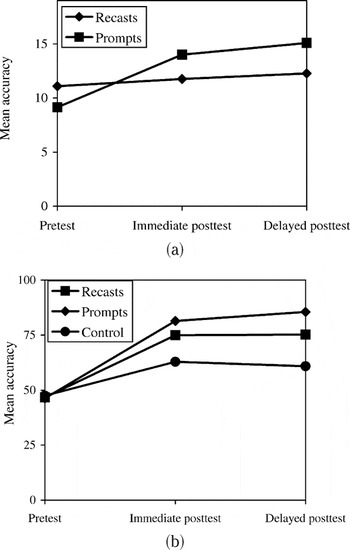
Task results from (a) the passage-correction task and (b) the oral picture-description task.
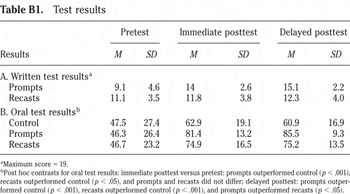
Results pertaining to the participants' use of PDs in the oral task showed that, overall, the students' knowledge of PDs underwent some change. However, consistent with the first hypothesis, the participants in the prompt group showed superior improvement both from the pretest to the immediate posttest and from the pretest to the delayed posttest. ANCOVA analyses revealed that the difference among the groups was significant on both the immediate posttest, F(2, 58) = 9.03, p < .001, and the delayed posttest, F(2, 44) = 13.26, p < .001. Post hoc Tukey pairwise comparisons indicated that the results from the oral picture description task are not as large as those from the passage correction; that is, the difference between the two experimental groups did not reach statistical significance (p = .29) at the immediate posttest. However, by the time of the delayed posttest, the difference was statistically significant (p < .05). As for the control group's performance, post hoc analyses revealed that each of the two experimental groups did significantly better than the control on both the immediate and delayed posttests. Results are graphically presented in Figure 2b and summarized in part B of Table B1 (see Appendix B).
Effects of the CF Treatments in Relation to Learners' Proficiency Level.
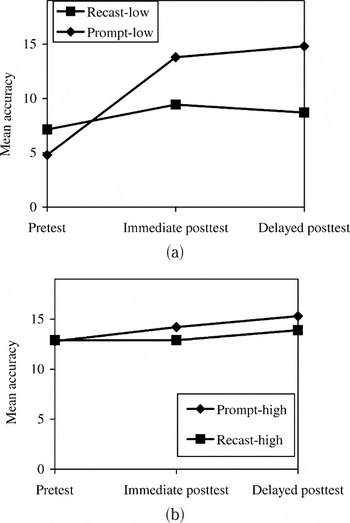
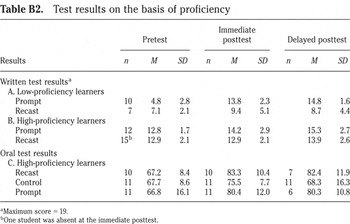
On the passage-correction task, results pertaining to the effects of the two experimental treatments on the low-proficiency participants indicated that both the prompt-low and recast-low benefited, with the prompt-low recording the greatest improvement (see Appendix B, part A of Table B2). An ANCOVA showed that the difference between the recast-low and prompt-low groups is statistically significant at the immediate posttest, F(1, 14) = 8.81, p < .05, and the delayed posttest, F(1, 14) = 18.04, p <.001. Figure 3a graphically illustrates the low-proficiency participants' performance on the three written tests.

Performance on the passage-correction task by (a) low-proficiency learners and (b) high-proficiency learners.
Results pertaining to the effects of the different treatments on the high-proficiency learners' knowledge of PDs, as reflected by their performance on the written immediate posttest, align with those of the low-proficiency students (see Appendix B, part B of Table B2). Once again, learners who were pushed to reevaluate their hypotheses (i.e., prompt-high) obtained a superior mean score on the immediate posttest than those whose errors were recast (i.e., recast-high). However, the difference between the two subgroups was not statistically significant, F(1, 23) = 1.96, p = .17. The same pattern was maintained on the delayed posttest (i.e., the prompt-high group outperformed the recast-high group, but the difference was not statistically significant, F(1, 24) = 1.97, p = .17). Results are displayed in Figure 3b.
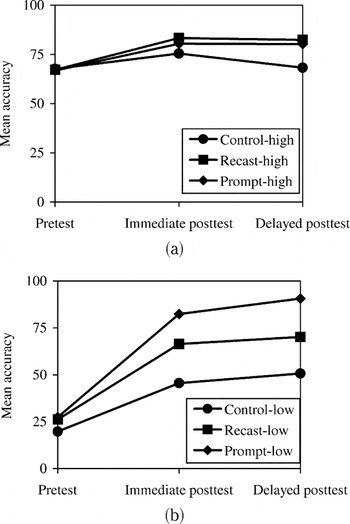
The patterns that emerged from the oral picture-description task parallel the written task findings. Results pertaining to the effects of the different CF treatments on the low-proficiency learners' knowledge of PDs in general revealed that prompt-low benefited more than recast-low at the immediate posttest and that both experimental groups did better than the control group. ANCOVA analyses indicated that the difference among the three groups at the immediate posttest was significant, F(2, 26) = 11.08, p < .001. Post hoc Tukey pairwise comparisons revealed that prompt-low significantly outperformed control-low (p < .001) and that recast-low was significantly superior to control-low as well (p = .05). However, the difference between the two experimental groups only approached significance (p = .07).
At the time of the delayed posttest, the difference between the two experimental groups, as shown by the post hoc Tukey pairwise comparisons, was found to be statistically significant (p < .05). Once again, the participants in control-low were significantly outperformed by those in prompt-low (p < .001) and recast-low (p < .05) at the delayed posttest. Figure 4a displays the three subgroups' performance at each of the three testing times.

Performance on the oral picture-description task by (a) low-proficiency learners and (b) high-proficiency learners.
As for the effects of the different CF techniques on the high-proficiency learners, an ANCOVA showed that the difference among prompt-high, recast-high, and control-high was not statistically significant on the immediate posttest, F(2, 28) = 1.55, p = .23. However, some differences began to appear among groups at the time of the delayed posttest. Whereas the control-high group lost some of the gains obtained at the immediate posttest, both experimental groups retained theirs. However, ANCOVA analyses showed that the difference among the groups at the delayed posttest was not statistically significant, F(2, 20) = 2.61, p = .10. Part C of Table B2 (see Appendix B) and Figure 4b illustrate the findings.
The General Proficiency Tests
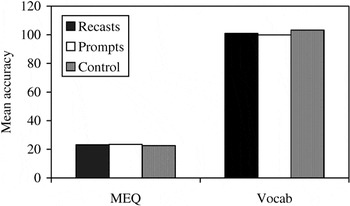
As explained previously, a vocabulary test and the MEQ test were administered at the time of the delayed posttest to obtain information about the participating groups' general abilities in English and the extent to which they were comparable. Results pertaining to the participants' performance on the MEQ test indicated considerable uniformity. ANOVA analyses confirmed that the three groups were comparable and that the difference in mean scores was not statistically significant, F(2, 68) = 0.28, p = .76. A similar pattern of results emerged from the vocabulary test. ANOVA analyses of the vocabulary test data revealed that there were no significant differences among the groups, F(2, 67) = 0.463, p = .63. Results from the two proficiency tests are graphically illustrated in Figure 5.

Performance on the general proficiency tests. The maximum score for the MEQ test is 32, and for the vocabulary test, the maximum is 120.
DISCUSSION
This study was motivated by a polarized debate about the ultimate role of recasts in L2 learning. Some researchers advocate recasts as an effective CF technique because they are implicit, unobtrusive, and contingent on the learner's intended meaning (Doughty, 2001; Doughty & Varela, 1998; Leeman, 2003; Long, 1996; Ohta, 2000; Oliver, 1995). Others, however, argue that recasts are ambiguous and, therefore, might be less effective, particularly in classrooms that provide primarily meaning-based instruction (Chaudron, 1977; Fanselow, 1977; Lyster, 1998; Lyster & Ranta, 1997). Some advocates of the latter position (Lyster, 1998, 2004; Lyster & Ranta) propose that prompts are a more effective technique. In light of this debate, the first two hypotheses stated that learners who received CF would benefit more than those who did not and that prompts would be more effective than recasts in leading to L2 development.
As explained in the Results section, data from the passage-correction task could not be used to test the first research hypothesis because the control group obtained significantly lower scores than the two experimental groups on the written pretest. Results from the oral picture-description task, however, showed that both experimental groups (i.e., recast and prompt) significantly outperformed the control group on the immediate and delayed posttests. As for the second research hypothesis, there is support for the benefits of prompts over recasts. On the passage-correction task, the prompt group outperformed the recast group on the immediate posttest and, more important, the gap between the two groups continued to grow at the time of the delayed posttest. The difference between the two groups was statistically significant on both posttests. The same pattern of results emerged from the oral data. Analyses of the oral data showed that the prompt group obtained higher means than the recast group at the time of the immediate and delayed posttests. Although these differences were not statistically significant on the first posttest, they reached statistical significance by the time of the second posttest. These findings echo those of Havranek (1999) and Lyster (2004).
Finally, results from the present study reveal that the potential benefit of any CF technique on L2 learning is dependent on the learners' proficiency level. In fact, two clear patterns emerged. All high-proficiency learners seemed to benefit equally from the two CF techniques as well as from the no-CF condition. However, low-proficiency learners benefited from the experimental conditions differently. First, low-proficiency learners who received CF, in the form of either recasts or prompts, benefited more than low-proficiency learners who did not receive any CF. Second, low-proficiency learners who received recasts did not benefit as much as low-proficiency learners who were pushed to self-correct. These latter findings confirm those of previous research on recasts (Mackey & Philp, 1998; Netten, 1991) and prompts (Lyster, 2004; Nobuyoshi & Ellis, 1993; Pica, 1988).
In summary, the findings from the present study provide support for the claim that embedding CF within communicative activities is more effective than participation in such activities without CF. Learners in the two experimental groups (i.e., prompts and recasts) benefited more than those who were in the control group (i.e., with no CF). Furthermore, comparisons of the results of the experimental groups indicated that prompts were more effective than recasts for the low-proficiency group (see Appendix B, parts B and C of Table B2). An analysis of the posttest results in relation to students' readiness to acquire the target feature (low vs. high proficiency) revealed that (a) prompts and recasts were more effective than no CF with low-proficiency learners, (b) prompts were more effective than recasts with low-proficiency learners, and (c) prompts and recasts were equally effective for high-proficiency learners. Two central factors are likely explanations for the superior effectiveness of prompts: (a) the explicitness and clarity of this CF technique and (b) the multiple opportunities to produce the target form in reaction to the teacher's corrective moves (i.e., uptake) that this CF technique provides. In the following subsections, these factors are discussed in relation to previous theoretical and experimental work on CF in SLA.
Explicitness
As described in the Methodology subsection, the teacher who was assigned to the prompts condition was asked to (a) immediately react to students' PD errors and (b) provide students with metalinguistic clues whenever a PD error occurred in order to help them reformulate their utterance. She was explicitly directed not to provide the correct form. These different moves made the prompts treatment explicit and salient for two reasons. First, they unambiguously indicated the presence of an error and, therefore, encouraged and directed students to think about alternative forms. Second, once the learners were aware of the fact that there was a problem in the form that they had used to express their meaning, they were given metalinguistic clues to help them identify the nature and locus of the error. These different moves both highlighted the teacher's corrective objective and helped learners “assign blame” (Pinker, 1989, p. 12)—the two conditions that Schmidt (1983, 1990) and Gass and Varonis (1994) classified as basic prerequisites for CF to work.
Although the teacher in the recast group provided reformulations immediately after PD errors, it was unlikely that the participants would perceive or treat them as CF moves in these highly communicative classrooms.16
In light of previous descriptive research conducted in similar contexts (Lyster, 1998; Lyster & Ranta, 1997), which showed that teachers used recasts to express corrective and noncorrective functions, the participants in this study might have treated the teacher's reformulations as alternative ways of saying the same thing (i.e., models).
Overall, the explicitness and saliency of prompts, on the one hand, and the implicitness of recasts, on the other hand, might be one of the major explanations for the significant differences between the two experimental groups.17
It is possible that some of the recasts might have been provided with more or less emphasis and, thus, were more or less salient and explicit. Given that we do not have access to recordings of the experimental intervention, one cannot rule out this possibility.
On the other hand, low-proficiency learners in the prompt-low group might have benefited from this CF technique because everything was sorted out for them. They knew that the teacher's reactions signaled the presence of an error. Furthermore, the metalinguistic clues probably helped them identify the nature and locus of that error. Their entire attention was, therefore, devoted to thinking about the PD rule (provided in the previous instructional phase) and producing the grammatical form. The fact that prompts in this study provided explicit metalinguistic information and elicited output makes it difficult to know whether the superiority of prompts was due to one or the other (or both). One could argue that the metalinguistic information provided in prompts not only aids noticing but also understanding, and it is the latter, rather than the opportunity to produce output, that makes this type of CF more effective.
Uptake
Uptake with repair is the second principal factor that might have contributed to the superior effects of prompts as a CF technique. Learners in the prompts group were pushed by their teachers to correct their ungrammatical utterances, which had the potential to lead to uptake 100% of the time. More importantly, all of the repairs were student-generated. The negative feedback booklet clearly explained that the prompter was under no circumstances supposed to provide the correct alternative form. As in any classroom context, some of the repairs might have been provided by classmates. However, and as Van den Branden (1997) pointed out, prompts always encourage the learner to take part in the process of repair, which puts him or her in the appropriate framework to at least acknowledge the suggested solution and, therefore, to notice it. So whether the reformulation was provided by the student who initially produced the error or by his or her peers, the learner was always forced to confront his or her errors and to revise the pertinent hypotheses. In the recast group, however, the teacher was the one who always provided the correct form. Students had neither an obligation nor an opportunity to draw on their own resources in order to try to come up with the correct grammatical form. Although it is true that the teacher's reformulations might have led to uptake in the recast group (especially if the recaster chose to provide isolated or partial recasts), unlike prompts, uptake following recasts is not necessarily evidence of hypothesis reevaluation, noticing, and L2 learning. As mentioned previously, even though learners' reactions to teachers' recasts might be the result of hypothesis testing or evaluation, they might also simply be repetitions that do not involve any analysis. Therefore, it is not only the quantity of uptake opportunities that might have led to the differences between the prompt group and the recast group but also the nature of the uptake opportunities.
Of course, it could be argued that the effects resulting from the two CF techniques investigated in this study should not be compared at all because prompts and recasts are fundamentally different, particularly with regard to the possibility for uptake to occur; that is, whereas CF in the form of prompts leads to uptake most of the time, recasts often do not generate or even permit uptake (Braidi, 2002; Chaudron, 1977; Lyster & Ranta, 1997; Oliver, 1995; Panova, 1999). Therefore, comparing these CF techniques might be somewhat like comparing apples and oranges. Our response to this argument is twofold. First, previous research has already shown that recasts do not lead to a large amount of uptake, especially when provided in meaning-oriented programs (Doughty, 1994; Lyster & Ranta; Panova; Panova & Lyster, 2002). Even if one were to design a study in which recasts would lead to uptake 100% of the time, this would run counter to what happens in normal classrooms. This would limit the ecological validity of the research findings as well as their external validity. Second, it has been noted that uptake following recasts is different from the uptake that follows prompt techniques. Whereas the former can be a sign of noticing and learning, it can also be a mere repetition of the teacher's reformulation. Uptake that follows prompts, however, always reflects a certain level of analysis and hypothesis reevaluation because it originates from and is provided by the student, not by the teacher. Therefore, even if L2 learners were required or requested to consistently repeat the teacher's reformulations, the results might not be different from those obtained in the present study. However, this, of course, is an empirical question.
Limitations and Future Research
One limitation of this study relates to the fact that there was no way to separate the effects of the instructional treatment from the effects of the teacher because there was one single teacher per experimental condition. To do so would have required at least three additional classes, which was not feasible.18
Another possible limitation of the study relates to the choice of the target feature. PDs were chosen in the present study because research revealed that they were problematic for Francophone ESL learners. However, the binary nature of the structure might have rendered it easy grammar and the kind of grammar for which implicit feedback like recasts is not likely to be beneficial. The question as to whether so-called hard or easy grammar is more amenable to different types of CF is an empirical question and more research is needed to investigate this. Other limitations discussed previously and that merit consideration in the design of future research relate to the absence of video-recording and tape-recording of the instructional intervention and of a control group for the written data. Furthermore, given that the prompts used in this study included both metalinguistic input and opportunities for output, it is difficult to know which of the two factors contributed to their superiority for some of the learners. Future research is needed to disentangle this confound.CONCLUSION
This study investigated the role of CF in L2 learning and compared the effects of two CF techniques: prompts and recasts. The results indicate that exposure to instruction and large doses of input is less effective than instruction and exposure plus CF. However, no simple answer can be formulated as to which feedback technique is more effective. Even though an analysis of the complete database revealed that prompts were more effective than recasts, analyses by proficiency level established two patterns. Prompts and recasts had comparable effects on the interlanguage of high-proficiency learners. In fact, even the control-group treatment, which did not involve a CF component, was as effective as the two experimental treatments for high-proficiency learners. Prompts, however, were observed to be more effective than recasts for low-proficiency participants. This implies that there is not one CF technique that is ideal or, as the title of this article suggests, one size does not fit all. The effectiveness of any CF technique needs to be evaluated in relation to learners' proficiency levels.19
As indicated earlier, proficiency, as operationalized in the present study, does not refer to the participants' general proficiency. Rather, it refers to their performance on the target feature at the pretest. General proficiency tests were administered at the delayed posttest only. This was because the general proficiency tests would have been too difficult for the learners had they been administered at the onset of the experimental intervention. It would be beneficial to design a study in which general proficiency measures can be administered prior to the instructional intervention.
APPENDIX A: Methodology

Recaster
Examples of what you should do.
For example, if a student says his hat is blue when describing a woman's hat, any of the following options can be adopted.
- Her hat.
- Okay. Her hat is blue.
- What colour did you say her hat was?
- Her hat is blue. What's the colour of her jacket?
- Ehh, her hat is blue, what else.
If the error outlined above occurs, you should never say:
- No. Her hat is blue.
- No. His is incorrect. You should say her hat.
- His hat? It's her hat.
- Whose hat is it? So what should we say?
- We don't say his hat in English. We say her hat.
- We say her hat because the possessor is feminine.
Prompter
Examples of what you should do.
For example, if a student says his hat is blue when describing a woman's hat, any of the following options can be adopted.
- No. Whose hat is it? So what should we say?
- His hat is blue? Is that correct in English?
- We don't say his hat in English. What do we say?
- His hat is blue? Who does the hat belong to?
- No. It's the woman's hat. So what should we say?
- His hat is incorrect.
If the error outlined above occurs, you should never say:
- His hat is incorrect. You should say her hat.
- No. Her hat is blue.
- We don't say his hat in English. We say her hat.
- We say her hat because the possessor is feminine.
- Her hat.
- Okay. Her hat is blue.
5. Birthday party excerpt

David is excited to see your friends. He is waving the right hand to greet them. His younger sister Diane is excited too. She has a party hat on the head. She has balloons in the hand. Diane thinks birthday party are super. His birthday is on July. She will have six years old.
APPENDIX B: Results
Table B1: Test results

Table B2: Test results on the basis of proficiency