INTRODUCTION
Beck's cognitive model emphasizes negative cognition and biased information processing in the development, maintenance, and recurrence of major depressive disorder (MDD; Beck, Reference Beck1967; Beck et al. Reference Beck, Rush, Shaw and Emery1979; Teasdale & Barnard, Reference Teasdale and Barnard1993; Segal et al. Reference Segal, Gemar and Williams1999; Nolen-Hoeksema, unpublished observations). According to Beck's (Reference Beck1967) model, negative automatic thoughts about the self, world, and future arise from underlying assumptions that are, in turn, products of depressogenic self-schemas. A large body of research supports the major constituents of Beck's cognitive model (for review see Clark et al. Reference Clark, Beck and Alford1999). In particular, depressed persons experience a disproportionate number of negative cognitions (Haaga et al. Reference Haaga, Dyck and Ernst1991; Ackermann-Engel et al. Reference Ackermann-Engel, DeRubeis, Dobson and Kendall1993), which are distinctive and specific to MDD (Clark et al. Reference Clark, Beck and Alford1998). However, there is a paucity of research directed at understanding the mechanism(s) governing the processes influencing the degree to which activated self-schemas result in the production of negative thoughts.
We posit the theory that inhibitory dysfunction may influence the degree to which activated self-schemas result in depressive cognition. The term inhibition is used here to describe an active process that tempers unwanted stimuli (external or internal) that compete for processing resources in the context of a limited capacity system (e.g. Hasher & Zacks, Reference Hasher and Zacks1988). Thus, deficient inhibition would fail to suppress or dampen activated depressive self-schemas leading to an increased frequency of negative thoughts. In this model inhibitory deficits are not depressogenic per se, but rather moderate the relationship between some of the major constructs of the cognitive model.
This hypothesis extends from previous findings that depressed persons demonstrate impairments on a variety of tasks that involve the inhibition of distracting elements (Raskin et al. Reference Raskin, Friedman and DeMascio1982; Lezak, Reference Lezak1983; Buchsbaum et al. Reference Buchsbaum, Lee, Haier, Wu, Green and Tang1988; Cornblatt & Lenzenweger, Reference Cornblatt and Lenzenweger1989; Everett et al. Reference Everett, Laplante and Thomas1989; Benoit et al. Reference Benoit, Fontin, Lemelin, Laplante, Thomas and Everett1992; Lemelin et al. Reference Lemelin, Baruch, Vincent, Laplante, Everett and Vincent1996; Linville, Reference Linville1996) and a disproportionate impairment in their ability to ignore distracting information when it is negatively valenced (McCabe & Gotlib, Reference McCabe and Gotlib1995; Segal et al. Reference Segal, Gemar, Truchon, Guirguis and Horowitz1995; Gotlib et al. Reference Gotlib, Krasnoperova, Yue and Joormann2004, Reference Gotlib, Neubauer and Joorman2005; Joormann, Reference Joormann2004; Goeleven et al. Reference Goeleven, De Raedt, Baert and Koster2006). Thus, inhibitory dysfunction is present in depression, and this deficit is likely valence-specific. Whether valence-specific inhibitory deficits are associated with increased negative cognition and whether such deficits are specific to depression per se, however, remains unexamined.
Furthermore, inhibition has been emphasized as a mechanism central to many different cognitive operations such as selective attention, memory and learning, and behavioural control (Harnishfeger, Reference Harnishfeger, Dempster and Brainerd1995; Nigg, Reference Nigg2000); consequently, definitions and empirical operationalizations have been elusive. Many theorists agree, however, that inhibition is not a unitary construct but instead consists of several separate but related processes (e.g. Nigg, Reference Nigg2000). Harnishfeger (Reference Harnishfeger, Dempster and Brainerd1995) draws on the distinction between cognitive and behavioural inhibition; the former is defined as the suppression of cognitive contents or processes and the latter as the inhibition of an overt motor response. The present hypothesis is that depressive cognition is due to a difficulty in suppressing mental events as opposed to a difficulty in suppressing behavioural or motor responses.
The current study compared the performance of depressed, healthy and non-depressed, anxious participants across two inhibition tasks. The prose distraction task (PDT; Connelly et al. Reference Connelly, Hasher and Zacks1991) has been used to examine the cognitive inhibitory function of elderly participants. The stop-signal task (SST; Logan et al. Reference Logan, Schachar and Tannock1997) has been used to examine the behavioural inhibition capabilities of children with attention deficit hyperactivity disorder. For the current study, both tasks were modified to include the presentation of emotionally valenced (i.e. negative, neutral, positive) self-referent adjectives. We hypothesized that the depressed participants would demonstrate impaired cognitive inhibition: (1) relative to healthy controls; (2) that was specific for negatively valenced stimuli (i.e. not reflect a general effect of emotion) in contrast to healthy and anxious controls, who would not demonstrate a valence-specific impairment; (3) would be associated with increased negative cognition and ruminative thinking; and (4) with no impairment on the behavioural inhibition task.
METHOD
Participants
Participants (ages 20–66 years) had at least 8 years of formal education, and reported that they spoke English as their primary language. Participants with MDD were 43 out-patients (20 medication-free, 12 on selective serotonin reuptake inhibitors (SSRIs), nine on other antidepressant medication, two missing medication data) who were seeking cognitive behaviour therapy and met DSM-IV (APA, 1994) diagnostic criteria for MDD (single=7, recurrent=36) as determined by the Structured Clinical Interview for DSM-IV Axis I disorders (SCID; First et al. Reference First, Spitzer, Gibbon and Williams1995). Twenty-eight of these participants met criteria for one or more co-morbid disorders including dysthymia (12%), panic disorder (7%), panic disorder with agoraphobia (5%), specific phobia (21%), social phobia (26%), generalized anxiety disorder (12%), obsessive-compulsive disorder (2%), anorexia nervosa (2%), or impulse control disorder not otherwise specified (NOS) (2%).
The healthy control (HC) group were 36 community volunteers who had neither current Axis I disorder nor a lifetime history of depression. The non-depressed anxious control (NDAC) group were 32 community volunteers (27 medication-free, one on an SSRI, two on other medication, two missing medication data) who met DSM-IV criteria for at least one of the following anxiety disorders: panic disorder (34%), panic disorder with agoraphobia (16%), specific phobia (25%), social phobia (34%), generalized anxiety disorder (59%), obsessive-compulsive disorder (6%), or anxiety disorder not otherwise specified (6%). These values sum to greater than 100% as several participants met criteria for multiple anxiety disorders. Importantly, the NDACs did not meet DSM-IV criteria for any depressive disorder. Both the HCs and NDACs were recruited from signs posted in Toronto hospitals and community newspaper advertisements offering monetary compensation.
Exclusion criteria for all three groups included: (a) a DSM-IV diagnosis of substance abuse/dependence (current or within the past 6 months), bipolar disorder or any schizophrenia spectrum disorder; (b) self-reported history of previous neurological injury/disease; (c) self-reported history of electroconvulsive therapy (ECT) within the past 6 months; or (d) a diagnosis of borderline personality disorder.
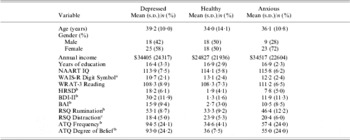
Individuals with MDD and controls were similar with respect to demographic characteristics, but reported more depression, more anxiety, more rumination and negative thinking, and had lower Digit Symbol scores than HCs and NDACs. In addition, the MDD group endorsed similar distraction scores as NDACs, with both groups distracting less than HCs (see Table 1).
Sociodemographic and clinical characteristics for depressed, healthy and anxious groups

Depressed (n=43), healthy (n=36), anxious (n=32).
NAART, North American Reading Test (Spreen & Strauss, Reference Spreen and Strauss1991); WAIS-R, Wechsler Adult Intelligence Scale – Revised (Wechsler, Reference Wechsler1981); WRAT-3, Wide Range Achievement Test – 3 (Wilkinson, Reference Wilkinson1993); HRSD, Hamilton Rating Scale for Depression (Hamilton, Reference Hamilton1960); BDI-II, Beck Depression Inventory (Beck et al. Reference Beck, Steer and Brown1996); BAI, Beck Anxiety Inventory (Beck & Steer, Reference Beck and Steer1993); RSQ, response styles questionnaire; ATQ, automatic thoughts questionnaire.
a p's <0·05; depressed<healthy=anxious; b p's<0·05; depressed>anxious>healthy; c p's<0·05; depressed=anxious<healthy.
Self-report measures of depressive cognition
Automatic thoughts questionnaire (Hollon et al. Reference Hollon and Kendall1980)
The automatic thoughts questionnaire (ATQ) is a 30-item scale that assesses the frequency of, and degree of belief in, negative automatic thoughts associated with depression. The scale has high internal consistency, is strongly correlated with depression severity (Harrell et al. Reference Harrell and Ryan1983), and is able to discriminate between depressed and non-depressed samples (Hollon et al. Reference Hollon and Kendall1980).
Response styles questionnaire (Nolen-Hoeksema, unpublished observations)
The response styles questionnaire (RSQ) measures dispositional responses (rumination and distraction) to depressed mood. The RSQ consists of the Rumination Response Scale (RRS; 21 items) and the Distraction Response Scale (DRS, 11 items). The RSQ has demonstrated good internal consistency (Nolen-Hoeksema & Morrow, Reference Nolen-Hoeksema and Morrow1991) and validity for predicting the onset of depression (Nolen-Hoeksema & Morrow, Reference Nolen-Hoeksema and Morrow1991; Nolen-Hoeksema et al. Reference Nolen-Hoeksema, Parker and Larson1994).
Experimental task stimuli
Emotional semantic stimuli were selected as follows. A list of emotionally valenced adjectives was compiled from a variety of sources including word lists from Myers (unpublished observations), Westra & Kuiper (Reference Westra and Kuiper1996), Bradley & Mathews (Reference Bradley and Mathews1988), Greenberg & Beck (Reference Greenberg and Beck1989), and Ingram and co-workers (Reference Ingram, Kendall, Smith, Donnell and Ronan1987), as well as clinical descriptions of depressive symptomatology. Ten hospital staff members with extensive experience in the treatment of depressive disorders (seven M.A.-level therapists, three research assistants with a B.A. in psychology) who worked in the Cognitive Behaviour Therapy Unit at the Centre for Addiction and Mental Health rated the adjectives for emotional valence on a seven-point rating scale, ranging from −3 (very negative) to 3 (very positive), with a midpoint of 0 (neutral). A mean rating score was calculated for each adjective and all of the adjectives were rank-ordered. Adjectives with means in the top third were considered positively valenced (e.g. helpful, useful), in the middle third were considered neutral (e.g. metallic, universal), and in the bottom third were considered negatively valenced (e.g. useless, inferior). Adjectives were then drawn from this subset that could be equated in terms of frequency of usage in the English language (Kucera & Francis, Reference Kucera and Francis1967), reading level (eighth grade) (Dale & O'Rourke, Reference Dale and O'Rourke1981) and length (mean length eight characters).
Experimental inhibition measures
Prose distraction task (Connelly et al. Reference Connelly, Hasher and Zacks1991)
In the prose distraction task (PDT) fourteen stories, each approximately 125 words in length, were used as reading text. All stories were printed on an 8·5 by 11-inch sheet of paper in standard font (Courier 10 pt). Embedded in nine of the stories were distracting words printed in italics. The distractors, four different emotionally valenced adjectives per story, occurred every 2–4 words, appearing 15 times each for a total of 60 distracting words per story. The same distractor never occurred twice in a row.
The procedure was similar to that of Connelly and colleagues (Reference Connelly, Hasher and Zacks1991). Briefly, participants were presented with each story face down, cued to turn the paper over and read the passage aloud, but told to ignore the distracting (i.e. italicized) material. The primary dependent variable was reading time. All participants were asked to read 13 stories: one practice, three control (i.e. no distractors), and nine experimental. The practice story was the same for all subjects. The order of the control, and experimental (i.e. three stories per condition – negative, neutral, positive) stories were blocked by condition. Four story orders were constructed according to a Latin square design and assigned as a between-group variable.
Stop-signal task (SST; Logan et al. Reference Logan, Schachar and Tannock1997)
The stimuli were presented on an IBM-compatible Pentium II personal computer, with a 17-inch VGA colour monitor. Software for this task was developed using Micro Electronics Laboratory (MEL; Psychology Software Tools Inc., Pittsburgh, PA, USA) which enabled stimuli presentation and recording of response latency and accuracy. Reaction times were recorded with a response box with buttons labelled with either ‘word’ or ‘non-word’.
Go-task stimuli were words/non-words presented in the centre of the screen for 1000 ms with each stimulus type (word/non-word) selected randomly to appear on 50% of the trials. The word/non-word was preceded by a 500-ms fixation point also presented in the centre of the screen, after which the screen was blank for 1000 ms. Words were the 40 self-referent trait adjectives used for the PDT. Non-words were created by changing one character within the word (e.g. lovagle). The changed character could not fall on the initial syllable. A vowel was changed to another vowel and a consonant was changed to a different consonant. Finally, all non-words were pronounceable. The stop signal was a 500-ms, 1000-Hz tone generated by the computer and delivered through headphones at a comfortable listening volume. Stop-signal delay was initially set at 250 ms and then adjusted dynamically depending on the subject's behaviour. If the subject correctly inhibited their response, the stop-signal delay was increased by 50 ms (making it harder to inhibit on the next stop trial). Conversely, if the subject failed to inhibit, the stop-signal delay was reduced by 50 ms (making it easier to inhibit on the next stop-signal trial). Separate staircase functions were employed for word and non-word conditions. The stop-signal delay was the average delay across the duration of the task. The dependent variables derived from the stop-signal task are: (a) the go reaction time – length of time from the onset of the imperative stimulus to the subject's response. This index is calculated from go trials only (i.e. trials without a presentation of the stop-signal); and, (b) the stop-signal reaction time – an index of inhibitory control defined as the mean go reaction time (calculated from the intervening go trials since the previous stop trial) minus the stop-signal delay (Tannock et al. Reference Tannock, Schachar and Logan1995).
Participants were asked to indicate whether a semantic stimulus presented on a computer screen was a word or non-word via a button-press (go trials) as quickly and as accurately as possible. Subjects were instructed to inhibit their response when stop-signals were presented (25% of trials). Participants completed this task for all three valences; order of valence presentation was counterbalanced. For each valence, the task was presented in nine blocks (24 trials, 18 go trials and 6 stop trials), the first of which was a practice block. Words and non-words occurred equally often in each block.
Procedure
Testing took place over three sessions, separated by approximately 1 week. In the first session, the experimenter obtained informed written consent, administered the SCID, the Hamilton Rating Scale for Depression (HRSD; Hamilton, Reference Hamilton1960) and assessed participants' eligibility to continue with the next two sessions.
In the second session, participants completed the Beck Depression Inventory-II (BDI-II; Beck et al. Reference Beck, Steer and Brown1996), the Beck Anxiety Inventory (BAI; Beck & Steer, Reference Beck and Steer1993), the ATQ and the RSQ. Participants also completed general cognitive measures including the reading subscale of the Wide Range Achievement Task (WRAT-3; Wilkinson, Reference Wilkinson1993), the North American Adult Reading Test (NAART; Spreen & Strauss, Reference Spreen and Strauss1991), which provided an estimate of IQ, and the WAIS-R (Wechsler Adult Intelligence Scale–Revised) Digit Symbol subtest (Wechsler, Reference Wechsler1981), to assess psychomotor speed. Participants then completed two of four experimental inhibition tasks. The order of the tasks was counter-balanced across participants. (In addition to the PDT and SST, we also took the opportunity to pilot-test a modified Negative Priming Task (NPT; Tipper & Baylis, Reference Tipper and Baylis1987) and a modified Fan Effect Task (FET; Gerard et al. Reference Gerard, Zacks, Hasher and Radvansky1991) that took participants approximately 80 minutes to complete. Because of the preliminary nature of these tasks, these data are not presented in this paper.)
In the third session, participants completed the BDI-II and the two remaining inhibition tasks. To help cover expenses (e.g. parking, travel), participants were reimbursed $10·00 per hour.
RESULTS
Prose distraction task
Reading times
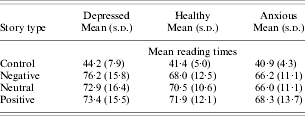
Mean reading times (in seconds) were calculated for the nine experimental (i.e. three stories with distractors for each valence) and three control stories (see Table 2). Four participants (one depressed, three healthy) did not complete this task.
Mean reading times (s) per story type for depressed, healthy and anxious groups

Depressed (n=42), healthy (n=33), anxious (n=32).
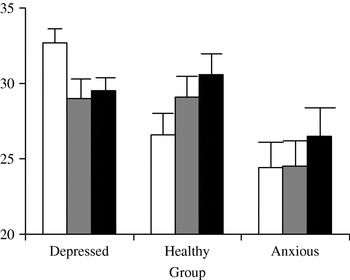
For subsequent analyses, we controlled for individual variability in overall reading speed by subtracting the reading times of control stories from experimental stories. Therefore, these adjusted scores represent the incremental reading time cost for prose material that includes distractors. Adjusted reading time scores were subjected to a 3 (Group)×4 (Order: 1–4)×3 (Valence) mixed-design analysis of variance (ANOVA) to compare the performance of the depressed versus control and anxious groups. This analysis revealed a significant main effect of Order [F(3, 94)=3·067, p<0·05, ηp2=0·089]. The main effects for Group [F(2, 94)=2·594, p=0·08, ηp2=0·052], and Valence [F(2, 93)=2·814, p=0·065, ηp2=0·057], were marginally significant. In addition, there was a significant interaction between Group and Valence [F(4, 188)=5·729, p<0·001, ηp2=0·109] (see Fig. 1), and between Order and Valence [F(6, 188)=7·124, p<0·001, ηp2=0·185]. However, neither the Order by Group nor the Order by Group by Valence interactions were significant (p's >0·20).
Mean adjusted prose reading times (s) as a function of valence for depressed, healthy and anxious groups. Error bars represent one standard error. □, Negative; , neutral; ■, positive.

A 2 (Group)×3 (Valence) mixed-design ANOVA was conducted to test the hypothesis that depressed versus control individuals would demonstrate less inhibition for negative material relative to neutral or positive material. The main effects for Group and Valence were not significant (p's >0·20). There was a significant Group by Valence interaction [F(2, 66)=9·202, p<0·001, ηp2=0·218]. Simple main effects analyses of valence for the depressed group demonstrated that stories containing negative distractors (mean=32·1 s) were read more slowly than those containing neutral [mean=28·9 s, t(41)=2·533, p<0·02, Cohen's d=0·25] or positive distractors [mean=29·4 s, t(41)=2·055, p<0·05, d=0·22] which did not significantly differ from each other. Conversely, healthy participants were quicker to read stories containing negative distractors (mean=26·6 s) compared with those containing neutral [mean=29·0 s, t(32)=−2·239, p<0·05, d=0·27] or positive [mean=30·4 s, t(41)=−3·648, p<0·01, d=0·39] distractors.
A 2 (Group)×3 (Valence) mixed-design ANOVA was conducted to test the hypothesis that depressed versus anxious individuals would demonstrate less inhibition for negative material relative to neutral or positive material. This analysis revealed a Group main effect [F(1, 65)=4·759, p<0·05, ηp2=0·068], and a significant Group by Valence interaction [F(2, 64)=5·275, p<0·01, ηp2=0·142]. The main effect for Valence [F(2, 64)=2·810, p=0·068, ηp2=0·081], was marginally significant. Planned comparisons between groups revealed that for stories containing negative distractors, the depressed group (mean=32·1 s) read more slowly than the anxious group [mean=24·7 s, t(69·7)=2·957, p<0·01, d=0·68]. This analysis also revealed that the difference in reading times for stories containing neutral distractors between the depressed (mean=28·9 s) and anxious (mean=24·6 s) group was marginally significant [t(69·8)=1·729, p=0·088, d=0·40]. The two groups did not differ with respect to stories containing positive material (p=0·34).
Correlations between inhibitory indices and depressive cognition
To evaluate whether PDT performance was associated with depressive cognition, two new variables were created to reflect the additional inhibitory requirements to ignore emotionally valenced material. A negative inhibitory index was constructed by obtaining a difference score between PDT reading times for stories with negative and neutral distractors. Similarly, a positive inhibitory index was constructed by obtaining a difference score between PDT reading times for stories with positive and neutral distractors. For one participant in the depressed group, the mean negative inhibitory index reading time was an outlier (defined as a reading time greater than 3·0 s.d.s away from the group's mean reading time) and was replaced by the 3·0 s.d. value (Gerrard et al. Reference Gerard, Zacks, Hasher and Radvansky1991).
The two inhibitory indices were correlated with the frequency subscale of the ATQ (ATQ-F) and the RSQ rumination (RSQ-R) and distraction (RSQ-D) subscales across the three groups. In the depressed group, the negative inhibitory index was significantly correlated with the ATQ-F (r=0·31, p<0·05) and the RSQ-R (r=0·36, p<0·05). [A regression analysis of whether inhibitory deficits predicted frequency of automatic thoughts controlling for BDI in the depressed group revealed that the standardized regression coefficients were virtually unchanged from the zero-order correlation coefficient (β=0·247 v. r=0·308, p=0·047). Similar results were obtained when predicting RSQ rumination scores (β=0·312 v. r=0·360, p=0·028).]
In contrast, both inhibitory indices among healthy and anxious participants remained uncorrelated with measures of depressive cognition. Interestingly, for the anxious group, both the negative (r=0·45, p<0·05) and positive (r=0·41, p<0·05) indices were significantly correlated with the RSQ-D. Further, by contrasting the standard normal deviates associated with the correlation coefficients across the three groups (Rosenthal, Reference Rosenthal1991), the correlations of the negative inhibitory index with the ATQ-F (Z=3·82, p<0·001) and RSQ-R (Z=3·62, p<0·001) were shown to be significantly stronger in the MDD versus the HC or NDAC groups.
Stop-signal task
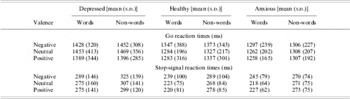
Individual participant trials were examined for outliers by eliminating individual participant trials with reaction times (RTs) greater than 3·0 s.d.s away from the individual's mean RT (Tabachnik & Fidell, Reference Tabachnick and Fidell1996). This resulted in the elimination of 1·32% of trials across the three groups as follows: depressed (0·46%), healthy control (0·52%), and anxious (0·34%). Fifteen participants (five in each group) did not complete this task. In addition, one anxious participant was excluded from the analysis because their overall go-task accuracy was less than 66% (Schachar et al. Reference Schachar, Mota, Logan, Tannock and Klim2000). Both go reaction times (GRTs) and stop-signal reaction times (SSRTs) (see Table 3) were characterized by significant heterogeneity of variance, outliers and significant skewness and kurtosis. The inverse transformation brought the GRT values and the natural logarithm transformation brought the SSRT values within acceptable ranges.
Stop-signal reaction times on word and non-word stimuli for depressed, healthy and anxious groups

Depressed (n=38), healthy (n=31), anxious (n=26).
Go reaction times
Transformed GRTs were analysed using a 3 (Group)×3 (Valence)×2 (Word/Non-word) mixed-design ANOVA. As expected, participants were significantly slower [F(1, 79)=42·110, p<0·001, ηp2=0·348], to identify non-words (mean=1374 ms) compared with words (mean=1343 ms). Furthermore, there was a significant Valence by Word/Non-word interaction [F(2, 78)=3·587, p<0·05, ηp2=0·084]. All participants were significantly slower at identifying negative (mean=1371 ms) versus neutral words (mean=1332 ms, p=0·054) and there was a trend to be slower for positive words (mean=1328 ms, p=0·10) whereas there were no valence differences for non-words, as might be expected.
Stop-signal reaction times
Transformed SSRTs were analysed using a 3 (Group)×3 (Valence)×2 (Word/Non-word) mixed-design ANOVA. Participants demonstrated significantly longer SSRTs [F(1, 79)=93·088, p<0·001, ηp2=0·541] for non-words (mean=288 ms) compared with words (mean=247 ms). No significant main effects or interactions were obtained for Group or Valence.
A 2 (Group)×3 (Valence)×2 (Task: PDT, SST) mixed-design ANOVA was conducted on standardized (i.e. z-transformation) adjusted reading times and word SSRTs to test the hypothesis that depressed participants would demonstrate disproportionate impairment on tasks of cognitive versus response inhibition. There was a significant Group by Valence by task interaction [F(1, 57)=4·846, p<0·05, ηp2=0·078]. The main effect for Group [F(1, 57)=3·444, p=0·069, ηp2=0·057], was marginally significant. The three-way interaction was broken down for each task. For the PDT, the 2 (Group)×3 (Valence) mixed-design ANOVA revealed a significant Group×Valence interaction [F(1, 65)=14·113, p<0·001] which is reported above. However, a similar analysis for the SST only revealed a main effect for Group [F(1, 58)=3·423, p=0·069, ηp2=0·056] that was marginally significant. Thus, there was a disproportionate impairment on the PDT compared with the SST.
DISCUSSION
This study examined four predictions regarding the inhibition of either irrelevant semantic stimuli or motor responses in clinically depressed, healthy control and non-depressed anxious participants. Contrary to our first prediction, a generalized performance deficit on the PDT between the groups was not demonstrated. However, as predicted, prose reading by depressed participants was significantly more disrupted for stories containing negatively valenced distractor words versus healthy controls whose reading, conversely, was fastest for stories containing negative distractors. Furthermore, anxious participants read negatively valenced PDT stories significantly faster than the depressed group. Finally, correlational analyses revealed that the degree of disruption in depressed persons' prose reading for stories containing negative information was associated with increased frequency of negative thinking and a ruminative response style. In contrast to the group performance differences on the PDT, there were no group performance differences in motor inhibition as measured by the SST.
One possible interpretation of the disruption in prose reading times by the presence of distracting text is that it is due to the participants' inability ‘to suppress task-irrelevant information occurring during the selection of task relevant information’ (Connelly et al. Reference Connelly, Hasher and Zacks1991, p. 539); that is, a cognitive inhibitory deficit. More importantly, our results are the first demonstration of a valence-specific performance deficit in prose reading. A similar pattern of results has been obtained using tasks that require the participant to ignore negatively valenced material (e.g. McCabe & Gotlib, Reference McCabe and Gotlib1993; Gotlib et al. Reference Gotlib, Neubauer and Joorman2005; Goeleven et al. Reference Goeleven, De Raedt, Baert and Koster2006). Furthermore, slower ink color naming for negative self-referent adjectives on the emotional Stroop task has been associated with a neurophysiological marker of inhibitory dysfunction (McNeely et al. Reference McNeely, Christensen, Lau, Yu and Alain2005). Alternatively, it may be that representations activated by the negative distractors were more strongly activated in the depressed versus control participants. Future research establishing equivalence of activation is required in order to rule out this possibility.
The demonstration that depressed persons' prose reading for stories containing negative information was correlated with increased negative cognition has potential implications for better understanding the cognitive model of depression (Beck et al. Reference Beck, Rush, Shaw and Emery1979). The cognitive model holds that the activation of latent negative self-schemas interacts with the cognitive system to negatively bias the processing of self-relevant information leading to the increased production of negative automatic thoughts (e.g. Miranda et al. Reference Miranda, Persons and Byers1990). One possibility is that individuals with poor inhibitory control are less able to attenuate the influence of activated schemas on the formation and maintenance of negative thoughts, resulting in robust negative thought production. Preliminary support for this notion comes from a study where the individuals who were most depressed and who endorsed the highest frequency of negative automatic thoughts showed the poorest cognitive inhibition as indexed by a neurophysiological marker of inhibitory dysfunction (McNeely et al., unpublished observations).
The absence of impaired performance by a heterogeneous anxious control group in this study argues against the possibility that the demonstrated performance deficits for the depressed group are due to general psychopathology alone (Garber & Hollon, Reference Garber and Hollon1991). Rather, this finding is consistent with the distinction between depression and anxiety in the characteristic information processing biases in attention and memory; depression is associated with a mood-congruent information processing bias versus an information processing bias for threat cues seen among patients with clinically significant anxiety (Williams et al. Reference Williams, Watts, MacLeod and Mathews1997). It remains to be determined whether individuals with anxiety disorders would manifest a similar pattern of performance deficits for threat-related or otherwise anxious stimuli.
Healthy control participants were faster to read PDT stories containing negative versus neutral and positive distractors. This finding is comparable to the demonstration of a ‘protective’ attentional bias in nondepressed individuals who avoided negative stimuli in favor of positive or neutral stimuli on a deployment-of-attention task (Gotlib et al. Reference Gotlib, McLachlan and Katz1988; McCabe & Gotlib, Reference McCabe and Gotlib1995). Furthermore, an attentional bias for positive versus sad stimuli has been demonstrated for manic patients using an affective shifting task (Murphy et al. Reference Murphy, Sahakian, Rubinsztein, Michael, Rogers, Robbins and Paykel1999).
The possibility that the results of this study were due to group differences in general information processing speed is unlikely. Adjusted reading times were calculated for the PDT to help control for any individual differences in reading speed. A more likely explanation is that some reduction in motor speed is to be expected in depressed individuals (Sobin & Sackheim, Reference Sobin and Sackheim1997; White et al. Reference White, Myerson and Hale1997). Nevertheless, the inability to randomly assign group membership prevents us from assigning causality and dismissing the potential confounding effects of extraneous variables. Furthermore, although there were slight differences in reading times as a function of story order on the PDT, the possibility that the obtained Group by valence interaction was due to an order effect is unlikely, as neither the Order by Group by Valence nor the Order by Group interactions were significant.
Finally, the association of depressed persons' prose reading for stories containing negative information with an increased ruminative response style is similar to Linville (Reference Linville1996) who demonstrated an association of a general inhibitory deficit on the negative priming task with rumination. The fact that our findings are inconsistent with Goeleven and co-workers (Reference Goeleven, De Raedt, Baert and Koster2006), who failed to demonstrate a similar relationship using an affective modification of the negative priming task (i.e. pictures of facial expressions), may be due to the differences in stimuli (words v. pictures) between studies given the verbal basis of ruminative thinking. Thus, the causal role of rumination in depressive relapse (Nolen-Hoeksema & Morrow, Reference Nolen-Hoeksema and Morrow1991) suggests potential implications for PDT performance deficits as a mechanism or risk factor for negative, ruminative thinking in recurrent depression. Kraemer and colleagues (Reference Kraemer, Kazdin, Offord, Kessler, Jensen and Kupfer1997) have proposed specific criteria for defining risk factor status in order to increase the consistency and precision with which this term is used: (1) Is the factor associated with the outcome – i.e. is it a correlate?; and (2) Does the factor precede the outcome – i.e. is it a risk factor? The results of this study establish PDT performance deficits as a correlate of MDD. Demonstrating that PDT performance deficits precede depression would provide support for these deficits as a risk factor.
ACKNOWLEDGEMENTS
This research was supported by Medical Research Council of Canada Grant 14715. We are grateful to Carrie Sniderman and Emily Haigh for their research assistance.
DECLARATION OF INTEREST
None.