Introduction
Most of the earthquake scales either measures the real-time seismic magnitude or the intensities of it (such as Richter Scale;1 Japan Meteorological Agency Seismic Intensities Scale, or Shindo Scale;2 and Modified Mercalli Intensities Scale3). However, none of them measure the real-time humanitarian impact based on needs of response from the point of social determinants of health,4 basic physiological needs,Reference Maslow5 critical infrastructure,6 economy,7 topography,Reference Harper8 population density,9 accessibility to the impact site,Reference Maslow5 and also corruption perception index.10 This poses a challenge to public health responders and humanitarian stakeholders, mainly in decision and policy making for disaster risk reduction, response, recovery, and reconstruction. This special report was presented at the 2nd National Pre-Hospital Care Conference and Championship, October 2018, Malaysia.Reference Yew, Arcos Gonzalez and Castro Delgado11
Report
The aim of this report is to analyze the real-time humanitarian impact needs and response to the 2018 earthquake and tsunami at Donggala and Palu, Sulawesi in Indonesia, using the new disaster metricsReference Yew, Castro Delgado, Heslop and Arcos González12,Reference Yew, Arcos Gonzalez and Castro Delgado13 titled the “YEW Disaster Severity Index” (DSI). As a benchmark in disaster response, the index is a comparison to be made with real-time relevant authorities’ response and humanitarian impact needs, based on the disaster metrics scoring.
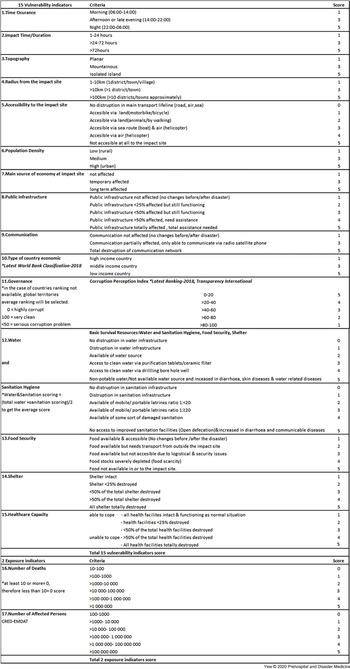
The new disaster metricsReference Yew, Castro Delgado, Heslop and Arcos González12,Reference Yew, Arcos Gonzalez and Castro Delgado13 tool, YEW DSI, was developed to estimate the humanitarian impact using a quantitative method in forming a full picture by integrating magnitude and intensities of a disaster. It uses a median score of three for 17 vulnerability and exposure indicators, median score percentage 100%, and medium YEW DSI scoring of four to five as baseline, indicating the ability to cope within local capacity.6 Therefore, scoring more than baseline coping capacity indicates external assistance or response is needed, with scoring criteria shown in Figure 1.
Fifteen Vulnerability and Two Exposure Indicators and Their Criteria. Fifteen Vulnerability and Two Exposure Indicators and Their Criteria.

A notification was received on the real-time major earthquake and tsunami that was activated by the Meteorological, Climatological, and Geophysical Agency (BMKG; Jakarta, Indonesia)14 via android application on September 28, 2018 and continued until September 29, 2018 with more than 40 aftershocks. The real-time disaster notification was triangulated with the BKMG15 official website for the earthquake with Richter Scale of ≥5.0, as well as the tsunami by the US Geological Survey (USGS; Reston, Virginia USA)16 site.
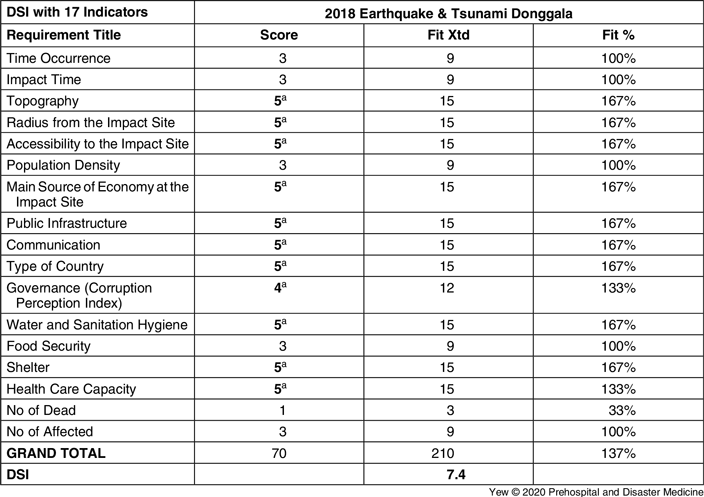
Donggala Impact Analysis (Table 1)
At Donggala, the earthquake measured 7.7 on the Richter Scale14–16 and VII on the Modified Mercalli Intensities,14–16 as well as the tsunami reported at the area. The humanitarian impact calculated within 12 hours of the incident scored a High Index of 7.4 on the YEW DSI,Reference Yew, Castro Delgado, Heslop and Arcos González12,Reference Yew, Arcos Gonzalez and Castro Delgado13 based on its scoring criteria from Figure 1. The 11 out of the total 17 vulnerability and exposure indicators that scored more than three, or a median score percentage of 100%, the baseline coping capacity,Reference Yew, Castro Delgado, Heslop and Arcos González12,Reference Yew, Arcos Gonzalez and Castro Delgado13 were: topography, radius from the impact site, accessibility to the impact site, main source of economy at the impact site, public infrastructure, communication, type of country, water and sanitation hygiene, governance (corruption perception index), shelter, and health care capacity.
Donggala Impact Analysis using Yew Disaster Severity Index (DSI)Reference Yew, Castro Delgado, Heslop and Arcos González12,Reference Yew, Arcos Gonzalez and Castro Delgado13

Note: Computed Donggala DSI Scores Analysis on September 29, 2018 at 22:00.
 $$\displaylines{{\rm{YEW\ DSI\ Formula}} = {{{\rm{Total\ 17\ indicators }}\left( {{\rm{vulnerability }} + {\rm{exposure}}} \right) \times 3} \over {8\left( {{\rm{best\ fit\ scale\ of\ DSI\ 1 \!\!- \!\!8}}} \right)}} \cr \hskip 32pt = 70 \times 3/8 ({\rm{best\ fit\ scale\ of\ DSI\ 1 \!\!- \!\!8}}) \cr \hskip 37pt = 210,\ {\rm{best\ fit\ DSI\ 7}} \approx {\rm{High\ DSI\ 7.4}}} $$
DSI Categories, based on Figure 1 scoring criteria:

a Overall, 11/17 indicators scored more than 3 or 100% median score percentage (Fit %), with a High DSI, more than the baseline coping capacity, indicating external assistance or response needed.
Donggala17 was located at an isolated island, scoring five with mountainous topography in Sulawesi, as its main roads were totally inaccessible. The nearest airport at Palu,17,18 part of its runway was damaged, indicating totally inaccessible to the impact site and scoring five. The only accessible and functioning airport was via Balikpapan, Kalimantan,17,18 the nearest island. The main road to Donggala17,18 town via Jalan Poros Palu Mamuju was also totally inaccessible. The earthquake and tsunami impacts were felt in more than 10 districts, and also at neighboring countries as reported by USGS16 and BMKG,14,15 thus scoring five for radius of the impact site indicator. Communication and power supply14,15 were totally cut off, scoring a maximum score of five. Most of the public or critical infrastructure and shelters were totally destroyed,17,18 scoring five for both indicators, evidenced with the buildings and shelters less than two-stories high. The tsunami14–16 had a reported wave height and velocity of approximately six meters with a wave speed of 800kph. Most of the affected population was trapped in a building due to its structure and height. As for health care capacity,Reference Yew, Castro Delgado, Heslop and Arcos González12,Reference Yew, Arcos Gonzalez and Castro Delgado13 the nearest hospitals were located at Palu17,18 town, thus scoring five. All 11 of the 17 indicators, as mentioned above, were plotted in the YEW DSIReference Yew, Castro Delgado, Heslop and Arcos González12,Reference Yew, Arcos Gonzalez and Castro Delgado13 scoring scale (Table 1) with 10 indicators that scored five, the maximum score of inability to cope within local capacity, and one indicator that scored four, above the baseline coping capacity. External assistance and disaster response were required based on the 11 indicator needs6,Reference Yew, Castro Delgado, Heslop and Arcos González12,Reference Yew, Arcos Gonzalez and Castro Delgado13 and a High DSI of 7.4 in Table 1.
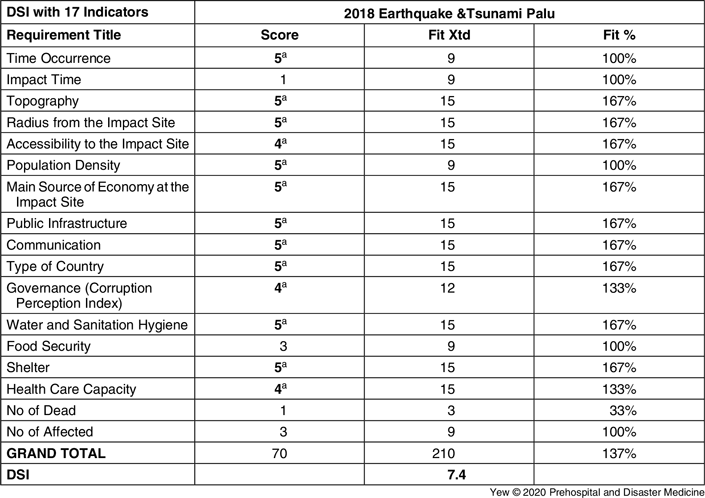
Palu Impact Analysis (Table 2)
The earthquake at Palu17 measured 7.5 on the Richter Scale14–16 and VI on the Modified Mercalli Intensities Scale, as well as the tsunami;14-16 its humanitarian impact calculated also showed a High Index of 7.4 (Table 2) on the YEW DSI.Reference Yew, Castro Delgado, Heslop and Arcos González12,Reference Yew, Arcos Gonzalez and Castro Delgado13 The 13 of the total 17 indicators scoring more than the baseline coping capacity,Reference Yew, Castro Delgado, Heslop and Arcos González12,Reference Yew, Arcos Gonzalez and Castro Delgado13 based on the scoring criteria of the YEW DSI,Reference Yew, Castro Delgado, Heslop and Arcos González12,Reference Yew, Arcos Gonzalez and Castro Delgado13 were: time occurrence and population density, with the remaining 11 indicators scoring the same as of Donggala. As Palu17 was the main town, it had a higher population density9,17 in the beach area, thus scoring five. Its topography17 consists of isolated island, scoring five, and planar at Talise Beach. The main bridge17,18 that connects the east and west of the Palu town was totally damaged and inaccessible. Palu airport’s17,18 runway was damaged, partially functioning, and accessible with smaller aircrafts, thus scoring four. The nearest accessible and fully functioning airport was via Balikpapan, Kalimantan.17,18
Palu Impact Analysis using Yew Disaster Severity Index (DSI)Reference Yew, Castro Delgado, Heslop and Arcos González12,Reference Yew, Arcos Gonzalez and Castro Delgado13

Note: Computed Palu DSI Scores Analysis on September 29, 2018 at 22:30.
 $$\displaylines{{\rm{YEW\ DSI\ formula}} = {{{\rm{Total\ 17\ indicators }}\left( {{\rm{vulnerability }} + {\rm{exposure}}} \right) \times 3 } \over {8\left( {{\rm{best\ fit\ scale\ of\ DSI\ 1\!\!-\!\!8}}} \right)}} \cr \hskip 28pt = 70 \times 3 /8\left( {{\rm{best\ fit\ scale\ of\ DSI\ 1\!\!-\!\!8}}} \right) \cr \hskip 33pt = 210,\ {\rm{best\ fit\ DSI\ 7}} \approx {\rm{High\ DSI\ 7.4}} } $$
DSI categories, based on Figure 1 scoring criteria:

a Overall, 13/17 indicators scored more than 3 or 100% median score percentage (Fit %), with a High DSI, more than the baseline coping capacity, indicating external assistance or response needed.
Most of the public or critical infrastructure and shelters were totally destroyed,17,18 scoring five for both indicators, which was the same as of Donggala with the tsunami14–16 wave height and velocity reported at approximately six meters with a wave speed of 800kph. Indonesia Tsunami Early Warning System14,15 was called off after approximately 30 minutes of activation, and the community came out for beach cultural festival celebration after the earthquake at Talise Beach. Tsunami Early Warning Evacuation Siren was silent when the tsunami hit Palu. Most of the hospitals17,18 located at east and west of Palu town were found either totally or partially damaged, with a score of four. Water and Sanitation and Hygiene facilities were totally damaged; only damaged latrines and non-potable water was available, thus indicating an inability to cope within local capacity6,18 in Palu17,18 and Donggala,17,18 scoring 4.5≈5.
Detailed Humanitarian Impact Analysis scoring based on YEW DSIReference Yew, Castro Delgado, Heslop and Arcos González12,Reference Yew, Arcos Gonzalez and Castro Delgado13 (Table 1 and Table 2), as well as the real-time data, were sent to relevant authorities19 on September 30, 2018 at 08:40. A State of Emergency18 for Palu and Donggala, Sulawesi was declared by the Governor for national response.19 The United Nations report and other nongovernmental organizations needs assessment reports only came out on October 2, 2018.20
Benchmarking the Response
The earthquake and tsunami at Palu and Donggala, with indicators and total scoring of an inability to cope within local capacity, were found to be almost an exact fit with the Indonesian Government’s four main priorities21 in Post-Disaster National Response, announced on October 2, 2018. The four main priorities follow.
The first priority21 was on search and relief of the disaster-affected victims and evacuation during the golden hours. This was done by collaborating and mobilizing governmental agencies, such as Indonesian National Agency of Search and Rescue (BASARNAS; Jakarta, Indonesia),22 Indonesian National Armed Forces (TNI; Jakarta, Indonesia),23 and Indonesian National Police (POLRI; Jakarta, Indonesia).24 The Ministry of Public Works and Public Housing of the Republic of Indonesia (PUPR; Jakarta, Indonesia)25 also deployed more excavation heavy equipment, giving accessibility to the disaster impact site and aiding the BASARNAS Team.
The second priority21 was setting up medical response services in terms of health care capacity for treating the affected victims. Mobile hospitals needed to be set up at the affected areas, and the Indonesian Military Sealift Command Hospital Ship23 needed to deploy to the disaster impact sites. Mobile hospital tents were also being set up at the partially damaged Palu airport by the TNI.23
The third priority21 was on fulfilment of basic needs and logistics for the affected victims, especially access to clean water and sanitation hygiene facilities. The TNI23 and POLRI24 were to be in charge of ensuring those basic needs were reachable to the affected communities.
The fourth priority21 was focusing on reconstruction and restoration of critical facilities and public infrastructure, especially vital facilities such as airports, roads, electricity, and fuel supply. This would then revive the economy at the impact site, paving the road to recovery.
The 2018 Indonesian earthquake and tsunami real-time disaster response priorities21 were almost an exact fit with the YEW DSI indicators, and the scoring of inability to cope within local capacity.6 The State of Emergency declaration18 indicated an inability to cope within local capacity, with external assistance and response needed. This was evidenced in a High DSI of 7.4 for both Donggala and Palu (Table 1 and Table 2) and national response18 deployed from Jakarta and Kalimantan, as well as international response, based on needs.
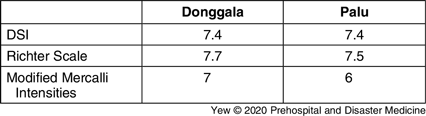
The magnitude intensities of the Richter Scale1 and the Modified Mercalli Scale3 reported for Palu and Donggala and the humanitarian impact in the disaster metrics calculated were highly significant, with Pearson correlation coefficient of 0.9280 (Table 3) using Microsoft Excel 2013 (Microsoft Corp.; Redmond, Washington USA) statistical analysis.26
Pearson Correlation Coefficient Result

Note: Strong Correlation Coefficient, R-value = 0.92805.
Discussion
The new disaster metricsReference Yew, Castro Delgado, Heslop and Arcos González12,Reference Yew, Arcos Gonzalez and Castro Delgado13 indicators and index scoring that has been applied to the 2018 Sulawesi earthquake and tsunami were able to calculate and project the impact within 12 hours after the incident. This can be used as a real-time guide in humanitarian impact by public health and humanitarian stakeholders, mainly in prehospital and disaster medicine response, reconstruction, and recovery, as well as preparedness in disaster risk reduction.
This special report showed statistically significant correlation between the Donggala and Palu earthquake magnitude reported in Richter Scale,1 intensities reported in Modified Mercalli Intensities,3 and its humanitarian impact calculated and reported in the YEW DSI.Reference Yew, Castro Delgado, Heslop and Arcos González12,Reference Yew, Arcos Gonzalez and Castro Delgado13 The new discovery of the correlation between the earthquake magnitude, intensities, and the humanitarian impact in this special case study could be added to the prehospital and disaster medicine knowledge-base for further research.
However, evidence is shown from a search of literature that there is a lack of real-time dataReference Li, Zhao, Murray, Song and Zhang27 for researchers and various stakeholders, which is the main gap in natural disaster impact needs and response. Concerns of the accessibility of real-time data from various sourcesReference Li, Zhao, Murray, Song and Zhang27–29 include: autonomy, global safety, and also factoring in the cost of corruption and increasing transparency of disaster risk reduction, response, and recovery.
Conclusion
The earthquake and tsunami at Donggala and Palu and their real-time humanitarian impact needs shown in the YEW DSI scored an inability to cope within local capacity, with outside assistance or response needed. Benchmarked response needs in the disaster metrics scored were found to be almost an exact fit benchmarking with the real-time Indonesian National Response’s four main priorities. The real-time analysis also showed a statistically significant correlation, 0.9280, of the new disaster metrics with the Richter Scale and the Modified Mercalli Scale. With this statistical correlation, it will increase transparency of policy and decision making by using an evidence-based tool in humanitarian impact analysis.
Conflicts of interest
none