The value of vegetable production was $14 billion and accounted for 10% of total agricultural product value in the United States in 2015 (NASS 2016). However, difficulty in controlling weeds constrains the future of domestic vegetable production. In 2008 Fennimore and Doohan (Reference Fennimore and Doohan2008) indicated that in excess of 20 minor-crop herbicides had been deregistered or removed from the market because of regulatory issues. For example, methyl bromide, used for insect, nematode, and weed control, is a regulated ozone-depleting compound and was phased out in the United States in 2005 (Boyd Reference Boyd2016; Carter et al. Reference Carter, Chalfant, Goodhue, Han and DeSantis2005; Deepak et al. Reference Deepak, Spreen and VanSickle1996). Use of pronamide on leaf lettuce (Lactuca sativa L.) was cancelled temporarily in 2009 because of a US Environmental Protection Agency decision to regulate use on that crop separately from its use on head lettuce, necessitating establishment of leaf lettuce–specific tolerances (Mou Reference Mou2011; Tickes Reference Tickes2012). As a result, vegetable farmers increasingly rely upon hand-weeding and cultivation for weed control, especially in leafy vegetables (Egel et al. Reference Egel, Welty and Miller2017). Weeding by hand is particularly expensive; for example, hand-weeding costs in green onion crops can reach $1,200 ha−1 yr−1 (B Buurma, personal communication). Few herbicides for vegetable production are likely to be registered in the future because of the limited market potential and high risk of crop injury (McErlich and Boydston Reference McErlich and Boydston2013). Research is needed to identify new herbicides for vegetables and develop data to support their registration.
Bicyclopyrone is a new herbicide that was developed to control large-seeded broadleaf weeds in corn (Zea mays L.). It is one of four ingredients in Acuron™ (Syngenta Crop Protection) and kills weeds by inhibiting the enzyme 4-hydroxyphenylpyruvate dioxygenase. Recent efforts indicate that many vegetable crops have some tolerance to BCP. Cucumber (Cucumis sativus L. ‘Thunder’) and zucchini (Cucurbita pepo L. ‘Noche’) tolerated BCP applied PRE at 56 g ai ha−1 in a low–organic matter (low-OM) (2.23%) and low–cation exchange capacity (CEC) (11.52 mEq/100 g soil) soil. Leek (Allium ampeloprasum L. ‘Giant Musselburg’), green onion (Allium cepa L. ‘SSR B10’), knob onion (Allium cepa L. ‘Casper’), and broccoli (Brassica oleracea. ‘Arcadia’) tolerated late POST (LPOST) application at 37 g ha−1. Bicyclopyrone PRE controlled redroot pigweed (Amaranthus retroflexus L.), hairy nightshade (Solanum physalifolium Rusby), common lambsquarters (Chenopodium album L.), shepherd’s-purse [Capsella bursa-pastoris (L.) Medik], and witchgrass (Panicum capillare L.), species that are problematic in vegetables (Peachey Reference Peachey2015). Bicyclopyrone is the newest in the triketone family of herbicides that also includes mesotrione, tembotrione, benzobicyclon, and sulcotrione.
The objective of this research was to determine how onion, carrot (Daucus carota L. subsp. sativus), radish (Raphanus sativus L.), and dill (Anethum graveolens L.) growing in muck soil responded to BCP applied PRE, POST, and post-directed (POST-DIR). We also wanted to determine if BCP could control hairy galinsoga, prostrate pigweed, and common purslane––species especially problematic in vegetable production in the eastern United States.
Methods and Materials
Sensitivity of Several Vegetable Crops to BCP
Field experiments were conducted at the Ohio Agricultural Research and Development Center (OARDC) Muck Crops Agricultural Research Station located near Willard, OH (41°00′39.0′′ N 82°43′57.6′′ W) in the summer of 2013 and 2014. The soil was a Linwood muck that contained 47.8% OM and had a pH of 5.7. The field was plowed and disked to create a smooth seedbed for vegetable planting. The experimental design was a randomized complete block with four replications. Plots were 3.6 m wide and 6 m (2013) or 4.6 m (2014) long. Each plot contained two seedbeds (1.8 m wide), with three lines of vegetables per seedbed (six vegetable rows per plot). Vegetable line spacing was 46 cm, with 88-cm row middles, and 2.54 cm between seedlings within each row. Experiments were conducted in August each year. Crops included dill (‘Dukat’), radish (‘Crimson Giant’), garden carrot (‘Scarlet Nantes’), and bulb onion (‘Tokyo Long’). Pest management, fertilization, irrigation, and weed control, as recommended by OSU Extension to optimize crop growth, were used (Egel et al. Reference Egel, Welty and Miller2017). Hand-weeding was conducted to minimize the potential for interference resulting from variable weed control in different treatments. Bicyclopyrone was applied PRE, POST, and POST-DIR at 37.5 and 50.0 g ha−1. S-metolachlor, a local standard treatment for many vegetables, was applied to control plots at 1,070 g ai ha−1 in 2013 and at 1,420 g ha−1 in 2014. The higher rate was used in 2014 to further reduce the need for weeding by hand in the control plots. Bicyclopyrone PRE was applied within 24 h of seeding, while POST and POST-DIR treatments were applied to emerged crops 16 d after seeding. Applications were made in early morning with a hand-held CO2-pressurized sprayer. For PRE and POST applications, four nozzles (TeeJet TTJ60-1102 nozzles; TeeJet Technologies, Wheaton, IL) were spaced 48 cm apart on a 1.4-m-wide boom. For POST-DIR application, a single nozzle (XR8002VS) equipped with a trapezoid shield was used to apply herbicide treatments between crop rows. Yields were not taken.
Crop tolerance was evaluated every week using a scale of 0 to 100 (0=no damage, 100=plant death). Injury symptoms evaluated included leaf bleaching, tissue necrosis, and plant stunting. Years, blocks, and all the interactions containing them were considered random effects. Application timing, BCP rate, and crop variety were considered fixed effects. Data from 2 yr were presented separately because of a significant year-by-treatment interaction. Data were subjected to ANOVA using the PROC GLM (SAS 9.3; SAS Institute Inc., Cary, NC). Means were compared using Student-Newman-Keuls test (α=0.05).
Sensitivity of Several Vegetable Crops to BCP PRE when Grown in Different Soils
Greenhouse experiments were conducted in 2015 to determine how soil type affects response of different varieties of onion, leek, and carrot. Experiments were conducted at the OARDC campus of The Ohio State University in Wooster, OH. Plants were established in 7.6 by 7.6 by 6.4 cm square pots filled with a 1:1 (vol/vol) mixture of QUIKRETE all-purpose sand (Lowe’s, Wooster, OH ) and Pro-Mix BX™ (Premier Horticulture Inc., Quakertown, PA), or the muck soil from the OARDC Muck Crops Agricultural Research Station previously described. The greenhouse had a 16 h/8 h day/night period with approximately 200 μmol m–2 s−1 photosynthetic photon flux density (PPFD) and a corresponding thermoperiod of 27/22 C. Four varieties of onion (‘Highlander’, ‘Candy’, ‘Spanish Medallion’, and ‘Trailbazer’) and carrot (‘Apache’, ‘Enterprise’, ‘Maverick’, and ‘Rebel’), and three varieties of leek (‘Megaton’, ‘Matejko RD’, and ‘Belton’) were used. Seeds were all purchased from Siegers Seeds (Siegers Seeds Co., Holland, MI). Separate pots were used for the seven different crop varieties, with 12 seeds planted per pot. Seeds were placed 2 cm beneath the soil surface. One gram of Osmocote® 14-14-14 slow-release fertilizer (The Scotts Miracle-Gro Co., Marysville, OH) was applied to the soil surface of each pot after BCP treatments were applied.
Bicyclopyrone at 0, 12.5, 25, 50, or 100 g ha−1 was applied PRE to the soil surface within 24 h of seeding. A track-mounted sprayer equipped with a three-nozzle boom (TeeJet TTJ60-1102 nozzle) was used to apply the herbicide, with a pressure of 276 kPa and a volume of 234 L ha−1. Subsequently, pots were carefully watered twice daily (morning and afternoon), using 20 to 30 ml of water each time, to avoid soil saturation and water leakage from the bottom of the pot. Injury that consisted of leaf bleaching, tissue necrosis, and plant stunting was rated 7, 15, and 24 d after treatment (DAT) using the 1 to 100 linear scale previously described.
Treatments were a three-way factorial of crop variety, soil type, and BCP rate. A completely randomized design with five replications was used. A replication consisted of a single pot. The experiment was repeated. Experimental runs were considered a random effect. Bicyclopyrone rate, soil type, and crop variety were considered fixed effects. Data from the two experimental runs for carrot and onion were combined, because the interaction between run and treatment was not significant (α=0.05). Data were subjected to ANOVA with PROC GLM (SAS 9.3) and were analyzed separately for each crop so as to test the effect of variety. Because BCP rate is a quantitative factor, relationships among rate means were examined using orthogonal contrasts to test for linear and quadratic treatment effects (Chew, Reference Chew1976). Orthogonal polynomial coefficients for the unequally spaced treatment levels were calculated using PROC IML (SAS 9.3). In the case of onion, there was an interaction between variety (a categorical variable) and rate, so means were separated using the Student-Newman-Keuls test (α=0.05).
Response of Three Weed Species to BCP PRE and POST
The response of prostrate pigweed, common purslane, and hairy galinsoga to BCP was evaluated in a greenhouse experiment conducted at the OARDC campus of The Ohio State University, Wooster, in spring 2016. Conditions were a 16 h/8 h photoperiod with approximately 200 μmol m–2 s−1 PPFD and a corresponding thermoperiod of 27/22 C. The efficacy of PRE and POST applications was tested separately. For PRE applications, 16 by 10 cm plastic growing trays were filled with a 2:3 (vol/vol) mixture of Wooster Silt Loam (WSL) containing 5% OM, and Pro-Mix BX™ (PM) commercial potting soil, or the Linwood muck soil. Each species was sown in a tray by spreading seed on the soil surface, and covering them with 1 cm of the same soil. Water was supplied every 2 d from the bottom of the tray to keep the soil moist. PRE herbicide treatments were applied 4 h after seeding. Immediately before application, pots of soil were thoroughly wetted to water-holding capacity to ensure activation of the herbicide.
For the POST experiment, seeds were planted in 53 by 28 by 5 cm seedling propagation trays filled with a 2:3 (vol/vol) mixture of WSL and PM. Seeds were planted every 3 d to establish seedlings of different growth stages. Trays were watered from the bottom every 2 d to keep the soil moist. Seedlings were transplanted 3 to 7 d after germination into 107-cm3 seedling cone containers filled with the 2:3 mixture of WSL and PM. Osmocote® 14-14-14 slow-release fertilizer was applied on the soil surface at 0.3 g per pot. Transplanted seedlings were watered daily to keep soil thoroughly moist. Three growth stages of each species were treated with BCP. For hairy galinsoga, 4-, 6-, and 8-leaf stage plants were used (hereafter referred as small, medium, and large size). For common purslane, plants with stem lengths of 1, 5, and 9 cm (only the longest stem was measured) were used. For prostrate pigweed, plants that were at the 6-, 9-, and 12-leaf stages were used.
Bicyclopyrone was applied at 37.5 and 50 g ha−1, PRE and POST. For the POST application, nonionic surfactant was added to the herbicide mixture at 0.25% (vol/vol). Weed species response was assessed visually and rated using the 1 to 100 linear scale as previously described. Symptoms assessed 7, 15, and 30 DAT for PRE treatments and 7, 14, and 28 DAT for POST treatments included leaf bleaching, tissue necrosis, and plant stunting.
A completely randomized design with six replications was used, with each replication consisting of a single potted plant. The experiment was repeated once. Experimental run was considered a random effect. Plant growth stage, soil type, and BCP rate were considered fixed effects. Data from the different experimental runs were combined, because the interaction between experiment time and treatments was not significant (α=0.05), except for common purslane and prostrate pigweed in the PRE experiments. Therefore, injury data of prostrate pigweed and common purslane are presented separately. Data were subjected to ANOVA using PROC GLM (SAS 9.3). Student-Newman-Keuls tests were used to compare means (α=0.05).
Results and Discussion
Sensitivity of Selected Vegetables to BCP in a Field Experiment
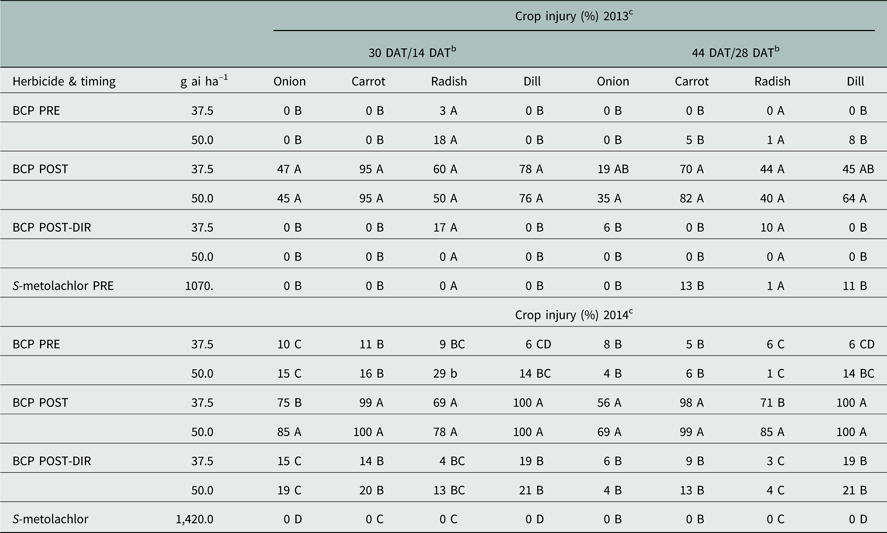
Onion, carrot, radish, and dill response to BCP differed in 2013 and 2014. In 2013 all crops tolerated the herbicide better and recovered sooner than in 2014 (Table 1). Compared to S-metolachlor, PRE applications of BCP did not produce significant injury in 2013 regardless of rate, whereas in 2014, more injury ranging from 10% to 29% injury was observed 30 DAT for all crops except radish and dill at the 37.5 g ha−1 rate. Nevertheless, all crops with the exception of dill had recovered completely by 44 DAT regardless of herbicide rate.
Response of onion, carrot, radish, and dill to BCPFootnote a after PRE, POST, and POST-DIR applications. Experiments were conducted at Willard, OH, in 2013 and 2014. BCP treatments were compared to a local standard herbicide, S-metolachlor.

a Abbreviations: BCP, bicyclopyrone; DAT, days after treatment; POST-DIR, post-directed application.
b 30 DAT/14 DAT, 30 DAT PRE and 14 DAT POST/POST-DIR; 44 DAT/28 DAT, 44 DAT PRE and 28 DAT POST/POST-DIR.
c Means with the same letter within the same crop are not significantly different (α=0.05, Student-Newman-Keuls).
Bicyclopyrone applied POST severely injured onion, carrot, radish, and dill 14 to 16 DAT in 2013 and 2014. POST applications produced obvious and distinct injury characterized by chlorosis, necrosis, stunting, and a reduction in seedling number (data not shown) that varied in severity between crops. Relative tolerance 28 DAT was onion ˃ radish ˃ carrot=dill in 2014 at 28 DAT, and onion ˃ radish ˃ dill ˃ carrot in 2013 (Table 1). Onion recovered slightly from injury between 14 and 28 DAT––more so in 2013 than in 2014. However, injury was still relatively severe and unlikely to be acceptable to growers.
In contrast to severe damage caused by POST BCP, POST-DIR application in 2013 did not induce injury with the exception of radish with 17% at 37.5 g ha−1 14 DAT (Table 1). In 2014, injury of all the crops from both BCP rates applied POST-DIR ranged from 4% to 21% at 16 DAT. We infer that BCP drift from the shielded sprayer caused the injury, because chlorosis was observed on only one side of the spray swath. Injury symptoms dissipated over the following 2 wk and ranged from 3% to 13%, except in the case of dill, in which injury remained high, ranging from 19% to 21% at 37.5 and 50 g ha−1, respectively. Persistent injury of dill was probably due to the inherent higher sensitivity of that crop to the herbicide (Table 1).
Results of the field research showed that vegetable crops had good tolerance to BCP PRE in muck soil. POST application induced severe injury of all crops, but onion showed greater tolerance than carrot, radish, or dill. The results concur somewhat with those of Peachey (Reference Peachey2015), who reported that green onion and knob onion displayed acceptable tolerance to LPOST BCP. In Peachey’s experiment, the herbicide was applied approximately 25 d after seeding, when onion plants were larger than in our work. Larger plants are typically more tolerant of herbicide, and crop growth stage is known to have a significant effect on tolerance of POST BCP applications (Dain Bruns, personal communication). Further research should be conducted to fully understand the effect of growth stage. All crops showed good tolerance to BCP POST-DIR. Trace injury symptoms that were observed were almost certainly due to drift. Because escape of some droplets during POST-DIR applications is common, growers will need to consider the risk of crop injury from such applications. Crops were injured more in 2014 than in 2013. Weeds persisted in the 2013 plots despite considerable efforts to maintain control through cultivation and weeding by hand; by contrast, the 2014 plots were consistently weed-free. Weed growth in 2013 may have been a factor in the lower injury observed as high weed density has been shown to decrease the amount of herbicide absorbed from the soil by crop plants (Winkle et al. Reference Winkle, Leavitt and Burnside1981). Moreover, we observed that some crop plants appeared to be partially shaded by weeds, possibly preventing BCP POST droplet deposition. It has also been shown that weed root rhizosphere communities can contribute to more rapid herbicide degradation than occurs under weed-free conditions (Lappin et al. Reference Lappin, Greaves and Slater1985; Yu et al. Reference Yu, Chen, Luo, Pan, He and Wong2003). Moreover, air temperature and relative humidity were higher in 2014 (22.9 C and 90% on average) during POST/POST-DIR compared to 2013 (15 C and 73%); these additional factors may have contributed to the occurrence of more crop injury.
Sensitivity of Selected Vegetables to BCP Grown in Different Soils
Symptoms of BCP injury started to express about 5 to 7 d after emergence, which was 10 to 12 d after PRE treatment. The main effects of BCP rate and soil type, along with their interaction, affected the response of all crops (P<0.0001). However, only onion responded differently among varieties (P<0.0001), as well as significant interactions of variety by soil (P<0.0001), variety by BCP rate (P=0.0013), and variety by BCP rate by soil (P=0.0013). All varieties of onion, carrot, and leek were free of injury symptoms when grown in muck even when the rate of BCP reached 100 g ha−1 (data not shown). Complete tolerance probably occurred because of BCP binding by the high OM content (47.8%) of the soil.
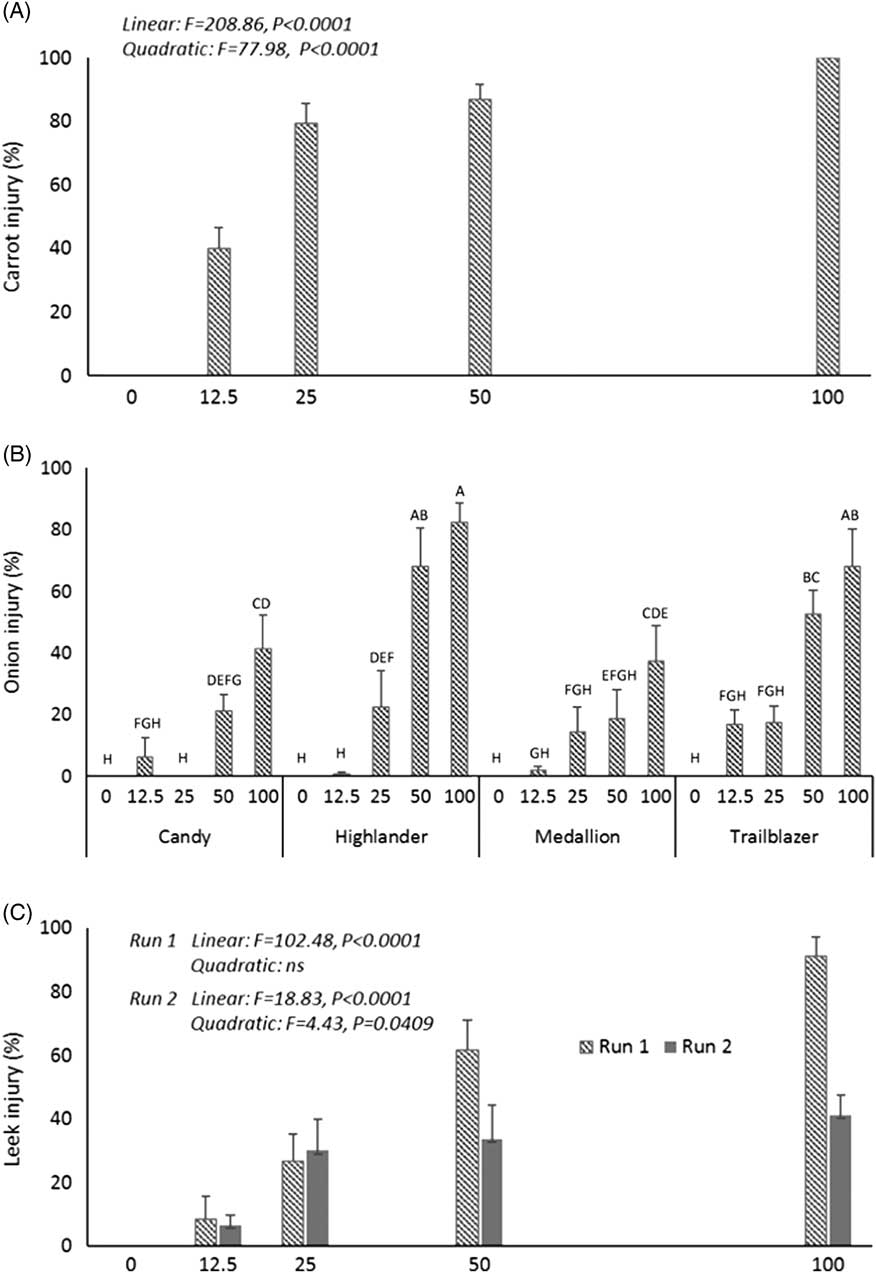
Bicyclopyrone injured all three vegetables when grown in the 1:1 sand and Pro-Mix BX™ mixture (Figure 1). Carrot and leek varieties responded similarly (data not shown), so only the main effect of rate is shown (Figure 1A and C). For onion, there was an effect of variety and rate, as well as an interaction between variety and rate (Figure 1B).
Response of (A) carrot, (B) onion, and (C) leek varieties growing in a sand/Pro-MixTM 1:1 (vol/vol) blend to bicyclopyrone (BCP) PRE at 0, 12.5, 25, 50, and 100 g ai ha–1 24 d after treatment (DAT). Vertical bars represent an average of 32 replications with standard error for carrot, an average of 8 replications with standard error for onion, and an average of 16 replications with standard error for leek. For onion, means with the same letter are not significantly different according to Student-Newman-Keuls (α=0.05).

Carrot was much more sensitive to the herbicide than onion or leek. Bicyclopyrone at 12.5 g ha−1, the lowest rate tested, induced three to four times more injury on carrot than on the other crops (Figure 1A). Injury level increased as the rate increased, with the relationship best described by a linear trend (Figure 1A). Onion varieties ‘Candy’ and ‘Spanish Medallion’ were more tolerant than varieties ‘Highlander’ and ‘Trailblazer’ (Figure 1B). At 50 g ha−1, ‘Highlander’ and ‘Trailblazer’ were injured 70% and 50%, respectively, whereas injury of ‘Candy’ and ‘Spanish Medallion’ was 20% and 15%, levels that were similar to the 12.5 g ha−1 rate. At 100 g ha−1 of the herbicide, injury of ‘Highlander’ and ‘Trailbazer’ was 80% and 65%, whereas injury of ‘Candy’ and ‘Spanish Medallion’ was 40% (Figure 1B). Leek injury levels were similar to onion, though plants were more tolerant to BCP on the second experimental run than the first (Figure 1C). As with carrot, leek injury level increased with rate, and the relationship was best described by a linear trend.
Crops grown in sand+Pro-MixTM blend were more vulnerable to BCP PRE than when grown in muck soil. The correlation between soil OM content and herbicide adsorption is a commonly observed phenomenon (Barriuso et al. Reference Barriuso, Feller, Calvet and Cerri1992) and is known to play an important role in herbicide retention and biological availability in soil (Stevenson Reference Stevenson1972). Bicyclopyrone is relatively mobile in soil with a Koc of 50 at pH 6 (Gordon Vail, personal communication). However, low pH, high clay, and high OM content have been demonstrated to result in higher soil–BCP binding and slower degradation (Dyson et al. Reference Dyson, Beukle, Brown and Lans2002; Dunne Reference Dunne2012). The greater injury observed in sand+Pro-Mix BX™ mixture is most certainly related to a lower active OM content than found in the muck soil (Grover Reference Grover1974; Stevenson Reference Stevenson1972). Dunne (Reference Dunne2012) reported more soybean injury following application of BCP to a low-CEC and OM content Michigan clay loam compared to a South Dakota soil that had a high CEC and OM content. Dunne attributed the phenomenon to less herbicide adsorption in the lighter textured soil. Moreover, the OM present in the commercial potting media Pro-Mix BXTM used in our experiments is sphagnum peat. Sphagnum is a less-decomposed OM compared to the decayed OM of a muck soil (Boelter Reference Boelter1968; Doherty and Warren 1969). Thus, there were fewer adsorption sites available in the sand+Pro-Mix BX™ mixture, resulting in greater availability of BCP to the plants.
Response of Three Weeds to POST and PRE BCP
Response of Hairy Galinsoga, Common Purslane, and Prostrate Pigweed to POST BCP
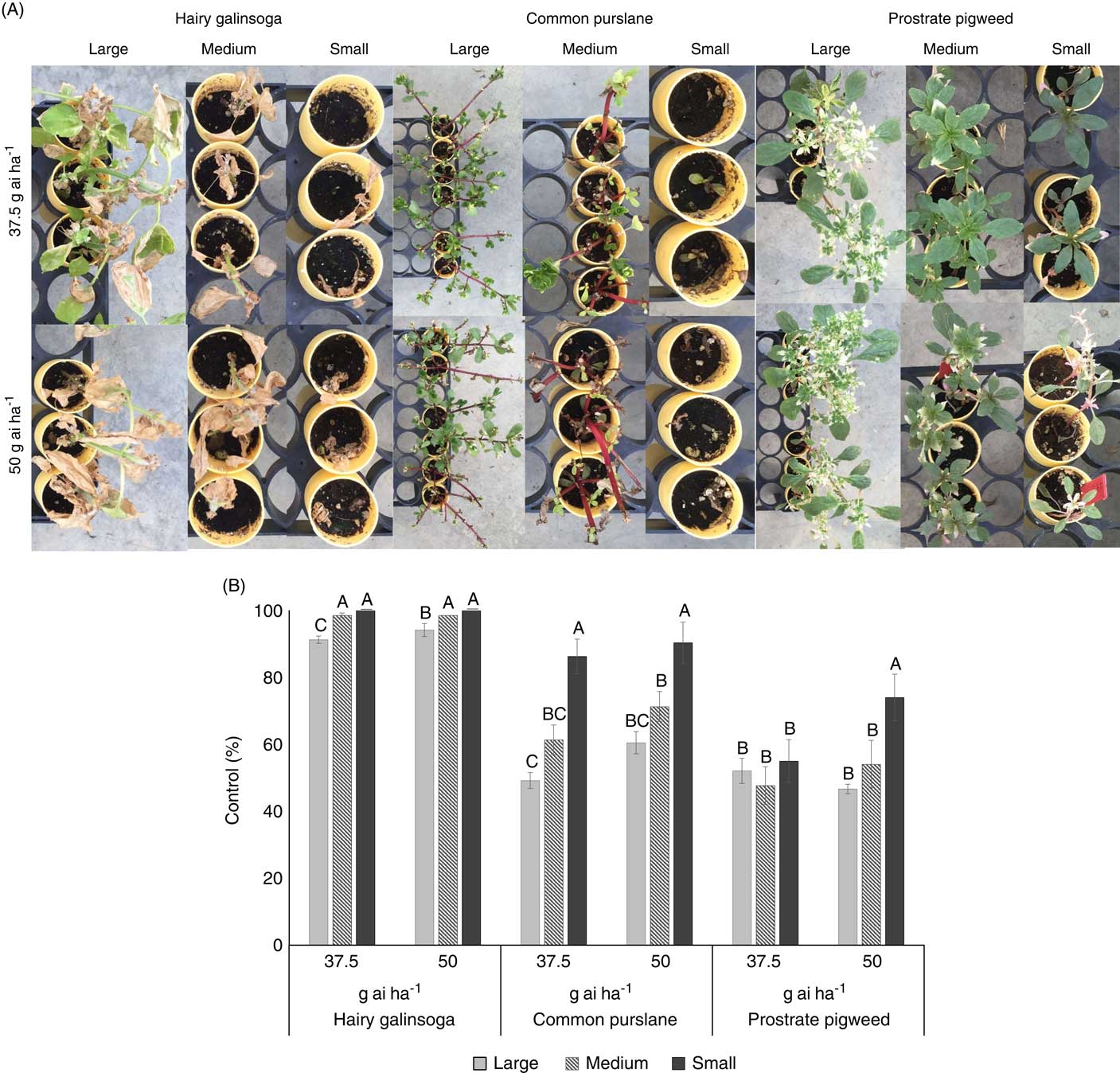
Hairy galinsoga was sensitive (>90% injury) to 50 and 37.5 g ha−1 BCP POST regardless of plant size (Figure 2A, B). Common purslane was controlled when the plants were small, and prostrate pigweed was relatively tolerant (Figure 2A, B). At 28 DAT, small and medium galinsoga plants treated with BCP were dead (Figure 2B). Large plants were severely damaged (90%) (Figure 2B), but some plants retained a persistent green stem. Regrowth was not observed (Figure 2A). Bicyclopyrone severely damaged most small common purslane seedlings, with injury ranging from 85% and 90% 28 DAT at 37.5 and 50 g ha−1, respectively. We observed 60% and 70% damage when medium-size plants were treated with 37.5 and 50 g ha−1 and large plants damaged less, responding with 50% and 60% injury at 37.5 and 50 g ha−1 (Figure 2A, B). Responses across rates were not statistically different (Figure 2B). Prostrate pigweed treated with the herbicide were chlorotic and displayed leaf malformation (Figure 2A). Tissue necrosis was not observed on plants that were medium or large at application. Damage at 28 DAT was similar when BCP was applied at 37.5 g ha−1 and ranged from 45% to 50% regardless of plant size (Figure 2B). When treated with 50 g ha−1 BCP, the damage rating of small prostrate pigweed seedlings averaged 75% at 28 DAT, whereas large- and medium-size plants showed 40% to 50% (Figure 2B), indicating that only the high rate of BCP POST has potential to control this weed. Medium and large common purslane and prostrate pigweed developed flowers and seeds (data not recorded) approximately 60 DAT with BCP at 37.5 and 50 g ha−1. It was readily apparent that damaged purslane plants produced far fewer seed than untreated plants, probably because of stem necrosis, stunting, and leaf abscission and malformation. We did not quantify this effect, and further research is needed.
(A) Response of small, medium, and large hairy galinsoga (4-, 6-, and 8-leaf stage), common purslane (1-, 5-, and 9-cm stem length), and prostrate pigweed (6-, 9-, and 12-leaf stage) to bicyclopyrone (BCP) POST at 37.5 and 50 g ai ha–1 16 d after treatment (DAT). (B) Response of small, medium, and large hairy galinsoga, common purslane, and prostrate pigweed to BCP POST applied at 37.5 and 50 g ai ha–1 28 DAT. Vertical bars represent an average of 12 replications with standard error. Means with the same letter within the same weed species are not significantly different according to Student-Newman-Keuls (α=0.05).

Response of Hairy Galinsoga, Common Purslane, and Prostrate Pigweed to PRE BCP
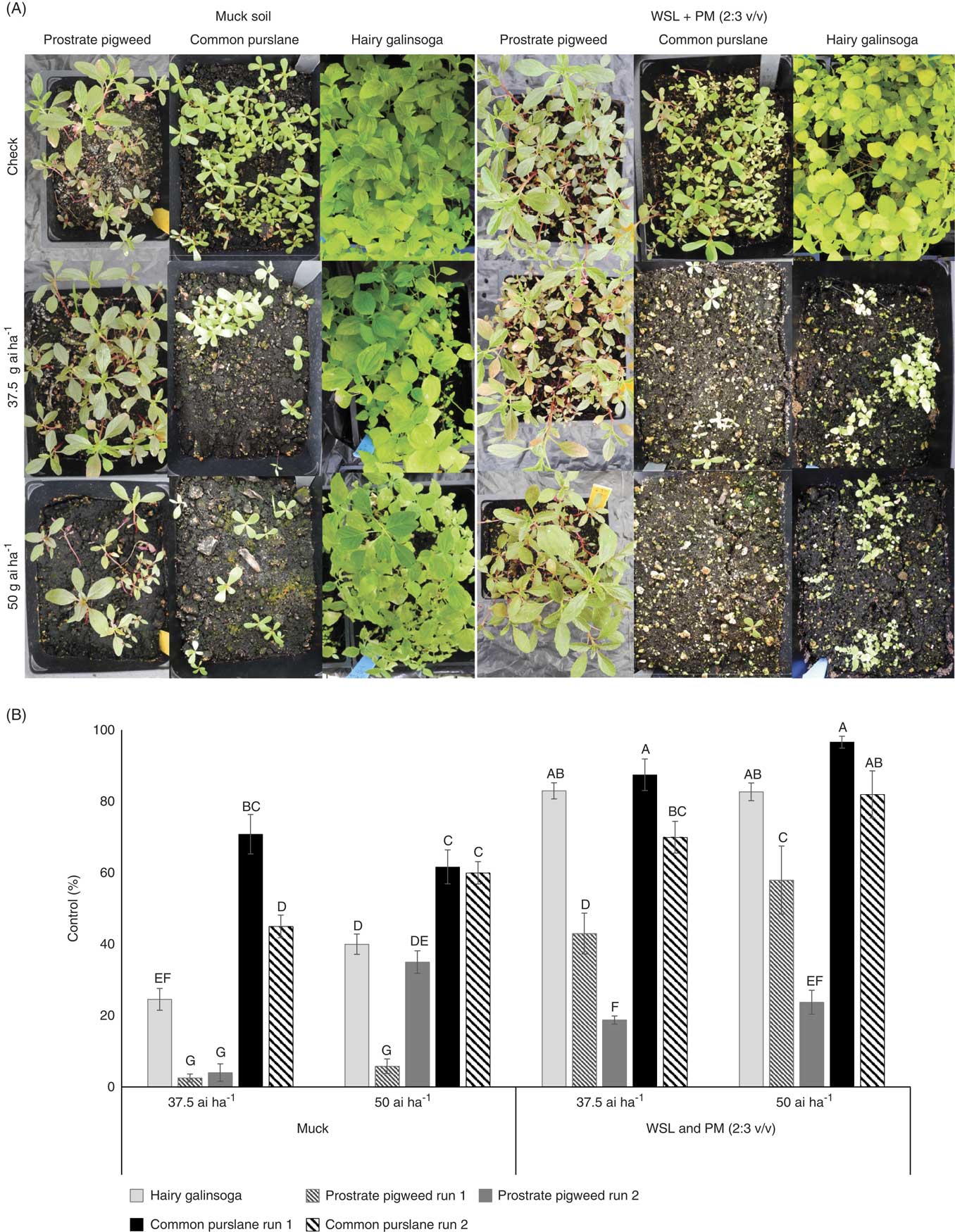
In contrast to the excellent control obtained with BCP POST, control of hairy galinsoga at 30 DAT with a PRE application differed depending upon the soil (Figure 3A, B). Damage to plants in muck soil was 25% and 40% at 37.5 and 50 g ha−1, respectively, but was 80% in WSL+PM (Figure 3B). In muck, common purslane damage was 45% and 70% in runs 1 and 2 at 37.5 g ha−1, and 60% for both runs at 50 g ha−1, whereas in WSL+PM, BCP control was 85%/95% in run 1 and 70%/80% in run 2 with 37.5/50 g ha−1 30 DAT. Reduction in common purslane plant number and size was observed in WSL+PM, which may have been caused by seedling mortality at emergence induced by herbicide. Bicyclopyrone PRE had minimal effect on prostrate pigweed growing in muck, though there was more damage (35%) in the second run of the experiment when treated with 50 g ha−1 of the herbicide compared to the first. Pigweed damage was greater in WSL+PM than in muck but never exceeded 60%. Considering the effects of both PRE and POST treatments, it seems unlikely that BCP can be used to control this important weed (Figures 2 and 3).
(A) Response of hairy galinsoga, common purslane, and prostrate pigweed 30 d after treatment (DAT) to bicyclopyrone (BCP) PRE at 0 (check), 37.5, and 50 g ai ha−1. (B) Response of hairy galinsoga, prostrate pigweed, and common purslane 30 DAT to BCP PRE at 37.5 and 50 g ai ha−1. Bars represent an average of 10 replications for hairy galinsoga, and 5 replications for prostrate pigweed and common purslane, all with standard error. Means with the same letter are not significantly different according to Student-Newman-Keuls (α = 0.05). Experiments were conducted in muck soil and 2:3 Wooster silt loam and Pro-MixTM [WSL and PM (2:3 vol/vol)].

In conclusion, response of all four vegetables to BCP PRE was similar when grown in a muck soil. Phytotoxicity at 30 DAT with 37.5 g ha−1 ranged from 0 in 2013 to about 11% in 2014. Injury with 50 g ha−1 was somewhat higher in 2014, but all crops except dill had largely recovered by 44 DAT. Dill was the only crop injured by the POST-DIR application in 2014, and this was probably related to direct spray contact with dill foliage. POST applications were not well tolerated. Soil type affected the response of onions, carrots, and leaks to BCP PRE in the greenhouse experiment. Crops grown in a soil with low OM were more vulnerable to BCP PRE than when grown in muck soil. Some onion varieties showed great tolerance to BCP PRE even when grown in the low-OM sand+Pro-MixTM blend. This result indicates that variety should be considered if BCP is registered on onion, and further research should be conducted to determine differences in varietal sensitivity of other crops being considered. Bicyclopyrone PRE provided good control of hairy galinsoga and common purslane in the low-OM WSL+PM blend, and delivered 45% to 70% control of common purslane when the weed was grown in muck. However, galinsoga control was only 25% to 40% when growing in muck soil. In contrast, POST applications of the herbicide provided 90% to 100% control of hairy galinsoga and 80% to 90% control of small common purslane. Medium and large common purslane plants survived POST BCP and produced seed following partial recovery from the herbicide. Prostrate pigweed was poorly controlled by PRE and by POST BCP. Future research is needed to optimize weed control while maintaining crop tolerance with this new herbicide.
Acknowledgment
The authors would like to thank Robert Filbrun and the staff of the OARDC Muck Crops Research Station. Funding for this research was provided in part by Syngenta Crop Protection Inc. and by the Ohio Vegetable & Small Fruit Research and Development Program.