1. Introduction
In an increasingly globalized world, many individuals are accustomed to using their non-native language. As a result, people are frequently consuming narrative mass media in a language other than their native tongue. In addition, stories are increasingly being integrated into curricula for teaching a second language (Dutta & Parhi, Reference Dutta and Parhi2014). To our knowledge, however, there is very little research on how processing a story in a second language influences how engaged we are with the plot and its characters. The most relevant research available concerns emotional reactions to words presented in either a person’s first or second language. However, this line of research has often relied on single-word presentations, has produced mixed results, and does not address the issue of narrative transportation directly. In order to better understand whether a story is as transporting when processed in one’s first or second language, we conducted post-hoc Bayesian analyses on three existing datasetsFootnote 1 that each presented a story in a different medium: text, audio, and audiovisual.
1.1. narrative transportation
Consumers of fiction often report feeling completely immersed in the fictional world constructed by the writer, a phenomenon known as narrative transportation. The term narrative transportation is based on the metaphor of a reader being ‘transported’ into the world of the narrative (Gerrig, Reference Gerrig1993). Transportation, in other words, describes how cognitively and emotionally engaged in a story we become, experiencing thoughts and feelings congruent with what’s represented in the story. Narrative transportation occurs through a variety of interacting processes, including strong emotional responses to characters and storylines (Cohen, Reference Cohen2001; Gardner & Knowles, Reference Gardner and Knowles2008), vivid imagery of the plot and story world (van Laer, de Ruyter, Visconti, & Wetzels, Reference van Laer, de Ruyter, Visconti and Wetzels2014), and reduced monitoring and perception of real-world contextual events, such that the reader loses themself in the story (Gerrig, Reference Gerrig1993; Green & Brock, Reference Green and Brock2000). Transportation is not limited to any particular narrative modality and can be experienced by any kind of narrative consumer, including readers, viewers, and listeners. Narrative transportation is most commonly measured via self-report, with scales measuring various aspects of this experience, including cognitive (i.e., focused attention and losing track of time), emotional (i.e., affective reactions), and imagery-based aspects (i.e., vividly imagining the events and characters; Busselle & Bilandzic, Reference Busselle and Bilandzic2009; Green & Brock, Reference Green and Brock2000; Kuijpers, Hakemulder, Tan, & Doicaru, Reference Kuijpers, Hakemulder, Tan and Doicaru2014). The degree to which we become transported into the world of a narrative has been found to be a key predictor of important outcomes, including how persuaded we are by the implicit and explicit themes presented in a story (for a meta-analysis, see van Laer et al., Reference van Laer, de Ruyter, Visconti and Wetzels2014). However, there has been scant research on whether processing a story in our native or second language influences how engaged we become, despite it becoming increasingly common for people to consume stories in their second language.
One exception is an unpublished thesis that recently examined the influence of first- or second-language processing on narrative persuasion. Spring (Reference Spring2017) had 70 Dutch and 70 German participants read a corporate narrative in their native (Dutch or German) or second language (English) and measured various outcomes, including narrative transportation. In this study, language of presentation had no impact on narrative transportation, character identification, narrative understanding, or enjoyment. In addition, language proficiency was also unrelated to these variables. Based on these preliminary data, it may be that stories are equally transporting, regardless of whether they are presented in a person’s native language or a second language. However, the narrative in this case was not the sort that is typically consumed for leisure, but instead focused on a corporate context with a specific persuasive aim. Transportation is typically less likely to occur with persuasive passages because they hold different standards of truth (Bruner, Reference Bruner1986). In contrast, with entertainment narratives, individuals are motivated to accept a fictional world for the purposes of enjoyment. Thus, the lack of difference in transportation observed in this thesis may be due to the type of passage used. As this is the only past study that directly examines narrative transportation in a non-native language, to our knowledge, it is necessary to broaden our scope and consider the available evidence for each component of narrative transportation: emotion, mental imagery, and focused attention.
1.2. second language processing and emotion
Research on the processing of emotional language in either one’s first or second language is typically conducted with sequential bilinguals. Sequential bilinguals acquire their first language at home and a second language from a mixture of peers, family, or school. These studies have frequently found that people report weaker emotional experiences when processing emotional content in their second language, despite equivalent levels of comprehension. This experience has been described as more emotionally distant compared to when processing the same content in their first language (Dewaele, Reference Dewaele2004; for a review see Pavlenko, Reference Pavlenko2012). For example, Anooshian and Hertel (Reference Anooshian and Hertel1994) had Spanish–English bilinguals rate both neutral and emotional words on several dimensions, including emotionality, followed by a free-recall test. Participants recalled more emotional words than neutral words in their native language (i.e., Spanish), a typical finding for emotional memory studies (see Buchanan & Adolphs, Reference Buchanan, Adolphs, Moore and Oaksford2002, for a review). However, for the emotional words processed in their foreign language, no memory advantage emerged. A similar asymmetry in emotionality between first and second language processing has been observed across a wide range of tasks and contexts, including prosody (Min & Schirmer, Reference Min and Schirmer2011), taboo words (Colbeck & Bowers, Reference Colbeck and Bowers2012; Dewaele, Reference Dewaele2004; Harris, Ayçiçeği, & Gleason, Reference Harris, Ayçiçeği and Gleason2003), advertising slogans (Hornikx, van Meurs, & de Boer, Reference Hornikx, van Meurs and de Boer2010; Puntoni, De Langhe, & Van Osselaer, Reference Puntoni, De Langhe and Van Osselaer2009), decision-making (Costa et al., Reference Costa, Foucart, Arnon, Aparici and Apesteguia2014; Hadjichristidis, Geipel, & Savadori, Reference Hadjichristidis, Geipel and Savadori2015; Keysar, Hayakawa, & An, Reference Keysar, Hayakawa and An2012), and moral dilemmas (Cipolletti, McFarlane, & Weissglass, Reference Cipolletti, McFarlane and Weissglass2016; Costa, Foucart, Arnon, Aparici, & Apesteguia, Reference Costa, Foucart, Arnon, Aparici and Apesteguia2014; Hayakawa, Tannenbaum, Costa, Corey, & Keysar, Reference Hayakawa, Tannenbaum, Costa, Corey and Keysar2017). It is important to emphasize that this difference is not an issue of comprehension, with the words and scenarios presented being comprehended equally well in the participants’ first and second language.
In attempting to explain these differences in emotional processing, various theories have been proposed. Caldwell-Harris (Reference Caldwell-Harris2014, Reference Caldwell-Harris2015) proposed that these emotionality differences between first and second language processing exist due to the context within which these languages are learned. A person’s first language is typically learned in the home, whereas a second language is often learned in a more formal setting. Because a bilingual’s first language is more deeply coded and experienced within a wider variety of contexts, emotional words processed in one’s first language evoke richer emotional representations and deeper emotional associations, despite equivalent levels of comprehension. An alternative explanation has been proposed by Kroll and Stewart (Reference Kroll and Stewart1994), in their revised hierarchical model. This model claims that second language representations have a weaker connection to concepts relative to first language representations. When learning a second language, word meanings are often learned by associating them with their first language equivalents. As a result, the connections between first language words and concepts are thought to be stronger than those for second language words, whose conceptual connections are mediated by first language representations.
Despite this wealth of empirical research and burgeoning explanatory theorizing, researchers have not always observed a difference in emotional intensity between first and second language processing (Conrad, Recio, & Jacobs, Reference Conrad, Recio and Jacobs2011; Eilola, Havelka, & Sharma, Reference Eilola, Havelka and Sharma2007; Ferré, García, Fraga, Sánchez-Casas, & Molero, Reference Ferré, García, Fraga, Sánchez-Casas and Molero2010; Sutton, Altarriba, Gianico, & Basnight-Brown, Reference Sutton, Altarriba, Gianico and Basnight-Brown2007). Moreover, the majority of these studies do not examine discourse, often presenting simple single words in isolation (e.g., Colbeck & Bowers, Reference Colbeck and Bowers2012; Dewaele, Reference Dewaele2004; Harris et al., Reference Harris, Ayçiçeği and Gleason2003) or single sentences (e.g., Iacozza, Costa, & Duñabeitia, Reference Iacozza, Costa and Duñabeitia2017). To our knowledge, only one functional magnetic resonance imaging (fMRI) study has investigated the emotional processing of narrative discourse in a person’s first or second language. Hsu, Jacobs, and Conrad (Reference Hsu, Jacobs and Conrad2015) had German–English bilinguals (native German speakers, with high levels of competence in English) read passages from Harry Potter that were either highly emotional or neutral in nature, with the texts presented in either German or English. The authors found greater and more widespread activation in the bilateral amygdala and left pre-central cortex for the ‘happy’ events relative to the neutral events, but only for the participants who read the passages in their first language. Thus, reading in one’s native language appears to result in a stronger emotional response to narrative fiction compared to reading in a second language, which could mean less transportation for individuals processing a story in their second language.
1.3. second language processing and visual imagery
Emotional reactions are just one facet of narrative transportation, with the other aspects being visual imagery and focused attention. Unlike the relative prevalence of past work conducted on emotions, there are few studies on second language processing and visual imagery. Hayakawa and Keysar (Reference Hayakawa and Keysar2018) recently examined this topic in two studies. They argue that using a foreign language may reduce mental imagery due to the reduced access to early sensory memories, which are highly language-dependent (Marian & Neisser, Reference Marian and Neisser2000). In their first study, English–Spanish bilinguals completed the Betts’ Questionnaire Upon Imagery (Sheehan, Reference Sheehan1967) in either their first (English) or second language (Spanish). In this questionnaire, participants are asked to mentally simulate a variety of sensory experiences across seven modalities (e.g., visual, auditory, tactile) and then rate the vividness or clarity of the experience on a 7-point scale. A composite vividness score across all modalities revealed that mental imagery was greater when completed in one’s native language relative to a non-native language. In their second study, an objective measure of mental imagery was used rather than a self-report measure. Chinese–English bilinguals completed a mental imagery task, in which participants are presented with three words and instructed to select the word that does not belong, based on a given attribute. For example, if participants were presented with the words ‘mushroom’, ‘pencil’, and ‘carrot’, and the attribute was ‘shape’, then ‘mushroom’ would be the correct answer. Participants who performed the task in their native language were more accurate than those using their non-native language. In both studies, a comprehension check was used to ensure that participants understood and comprehended the descriptions equally well for both languages. Taken together, these two studies provide preliminary evidence that using a foreign language diminishes sensory experiences associated with mental imagery. Therefore, we would expect individuals processing a story in their non-native language to be less transported relative to those using their native tongue.
1.4. second language processing and focused attention
In addition to emotional reactions and visual imagery, individuals transported into a story tend to experience a reduced monitoring of real-world events due to a focused attention on the narrative presentation. Unfortunately, this phenomenon has not been examined with respect to second language processing in past research. That said, several theorists have proposed that using a second language requires greater cognitive and working memory resources (e.g., Morishima, Reference Morishima2013). It is, however, a bit unclear how this greater cognitive burden would influence focused attention. One possibility is that involving more resources when processing a story in a second language would result in greater focused attention, directed at comprehending the narrative. If processing a story in one’s native language involves less cognitive resources, these might be available to attend to elements outside of the narrative itself. Alternatively, if comprehension of the story in one’s second language is more cognitively taxing compared to a native language, perhaps this means fewer available resources to conjure the vivid imagery required to become fully immersed in the story, resulting in higher distractibility. Furthermore, research on cognitive load has found that increased perceptual load leads to greater focused attention, whereas increased working memory load results in greater distractibility (Lavie, Reference Lavie2010). Processing a story in one’s second language would seem more akin to the latter than the former, resulting in a prediction of less focused attention and less transportation overall. Another factor to consider is how emotional experiences influence attention. Nabi and Green (Reference Nabi and Green2015) have proposed that the emotional flow of a narrative, the shifts from one emotional experience to another as a story progresses, is what establishes and maintains engagement. If that is the case, then the focused attention on a story may well depend on whether those processing a story in their second language do indeed have an impoverished emotional experience relative to those using their native language.
1.5. the current study
In light of the paucity of research on this topic, and the mixed results found among related studies, we re-analyzed three existing datasets to examine whether narrative transportation is affected by use of a non-native language. Each study presented a story in English to individuals who either reported: (1) English as the first language they learned or (2) another language as the first language they learned. Each study also measured how transported participants were into the story. Stories were presented either as a written text (Study 1), an audio clip (Study 2), or a short film (Study 3), allowing us to examine the generalizability of any observed effect across different narrative modalities. Past research on affective responses, visual imagery, and focused attention would seem to predict lower transportation scores for individuals processing the narrative in their second language (e.g., Hayakawa & Keysar, Reference Hayakawa and Keysar2018; Pavlenko, Reference Pavlenko2012; cf. Spring, Reference Spring2017). However, these studies only examined our research question indirectly, have at times produced mixed results, and in the case of imagery and attention are very few in number. Our studies therefore hope to better establish whether individuals who consume a story in their second language report lower levels of narrative transportation compared to those who consume the same story in their first language.
2. Study 1
2.1. materials and methods
2.1.1. Participants
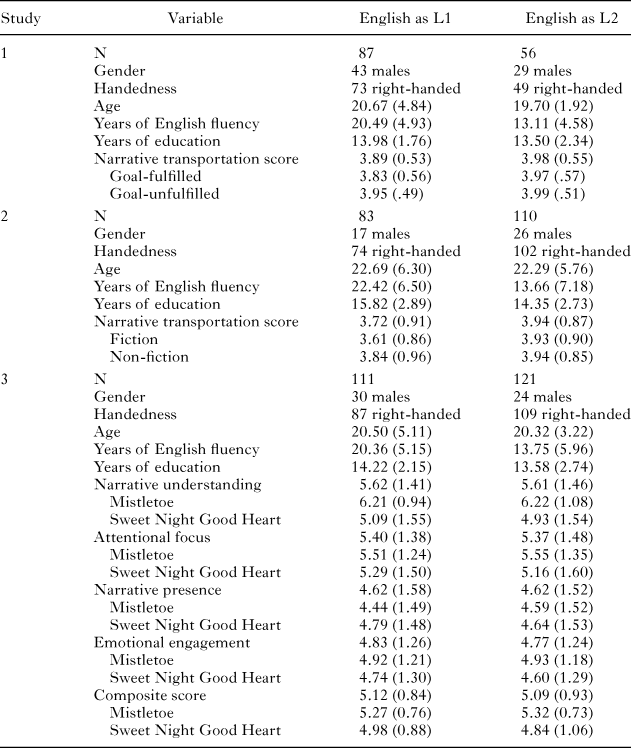
A total of 143 participants between the ages of 16 and 45 (M = 20.29, SD = 3.98) were recruited from an undergraduate research participant pool. As these studies are re-analyses of previously collected data, no power analyses relevant to the hypothesis were performed at the time, but sample size was predetermined prior to any analyses based on what was available. As compensation for their time, participants received course credit. There were 87 participants who listed English as the first language they learned (English as L1), with the remaining 56 participants listing another language aside from English as the first language they learned (English as L2). See Table 1 for demographic information for both groups. Both groups were approximately equivalent in age (t(141) = 0.95, p = .34; d = 0.16, 95% CI [–0.17, 0.49]) and years of formal education (t(141) = –0.97, p = .33, d = –0.16; 95% CI [–0.49, 0.17]). The only difference between groups was self-reported years of English fluency, in the expected direction (t(141) = 9.00, p < .001; d = 1.54, 95% CI [1.16, 1.92]).
Demographic information and descriptive statistics by group in Studies 1, 2, and 3

2.1.2. Stimulus text
Participants were randomly assigned to read one of two possible short stories (both 606 words in total), which were identical except for the final paragraph (all stimuli available at <osf.io/7dkm6>). The story described a student pursuing an academic goal and then either succeeding (version 1) or failing (version 2). For the purposes of this study, we were not interested in any differences between these two versions and so we collapsed across both stories for all analyses. The stories were simply written, with Flesch–Kincaid reading levels of grade 6.6–6.7 and reading ease scores of 73.4–74.3.
2.1.3. Narrative Transportation Scale (Green & Brock, Reference Green and Brock2000)
Engagement with the narrative was evaluated using the Transportation Scale developed by Green and Brock (Reference Green and Brock2000). The scale contains 13 questions pertaining to the participants’ ability to visualize the events of the story (e.g., “While reading the narrative, I could easily picture the events in it taking place”), degree of emotional engagement with the story and characters (e.g., “The narrative affected me emotionally”), and attentional focus on the narrative (e.g., “I was mentally involved in the narrative while reading it”). Responses were made using a 7-point Likert scale ranging from ‘Not at all’ to ‘Very much’.
2.1.4. Recall test
A 5-item multiple choice recall test was administered to determine how closely participants read the narrative provided. It consisted of simple questions about the major elements of the story. All participants, except for one, scored perfectly on the recall test.
2.2. procedure
Participants read one of the two stories and subsequently rated their transportation into the story, in addition to a battery of other measures not relevant to the current aims and so not discussed here.Footnote 2
2.3. results and discussion
2.3.1. Equivalence of text passages
We began by establishing that the two versions of the story had no impact on transportation, so that the conditions could be collapsed for the current study. Transportation did not differ between conditions, with scores for the goal-fulfilled story (n = 78, M = 3.89, SD = 0.57) very similar to the scores for the goal-unfulfilled story (n = 65, M = 3.97, SD = 0.50) (t(141) = –0.84, p = .40; d = –0.14, 95% CI [–0.47, 0.19]).
2.3.2. Influence of English as first or second language on narrative transportation
All descriptive statistics appear in Table 1. Bayesian statistics were performed to examine the likelihood that those with English as a native language experienced a difference in transportation into the story relative to those reading in their foreign language (H1), relative to the possibility of equivalent levels of transportation for the two groups (H0). All analyses were performed using JASP version 0.8.2.0 (JASP Team, 2018). Bayesian model selection offers the possibility to use prior knowledge or expectations, operationalized using a prior distribution, to compare the likelihood of hypotheses based on sample data. A likelihood function is first derived from the sample data, and then Bayes theorem is used to incorporate the prior distribution with this likelihood function to create a posterior probability distribution. This posterior probability distribution is an updated reflection of beliefs about the hypotheses (H0 and H1). The output of the analysis is a Bayes Factor (BF), which provides information about the probability distributions as well as the likelihood of the null (BF01) and alternative hypothesis (BF10; Kass & Raftery, Reference Kass and Raftery1995; Rouder, Speckman, Sun, Morey, & Iverson, Reference Rouder, Speckman, Sun, Morey and Iverson2009). One of the benefits of using Bayesian statistics is that researchers have the ability to evaluate the likelihood of the null hypothesis, unlike traditional null hypothesis statistical testing (NHST), which assumes that the null is true as its foundational premise (Fraley & Marks, Reference Fraley, Marks, Robins, Fraley and Krueger2007; Wagenmakers, Morey, & Lee, Reference Wagenmakers, Morey and Lee2016). That said, we report traditional NHST results in the form of t-values and p-values for an independent-samples comparison for those curious about these results, but caution that they are uninterpretable with respect to indicating any probability considering the null.
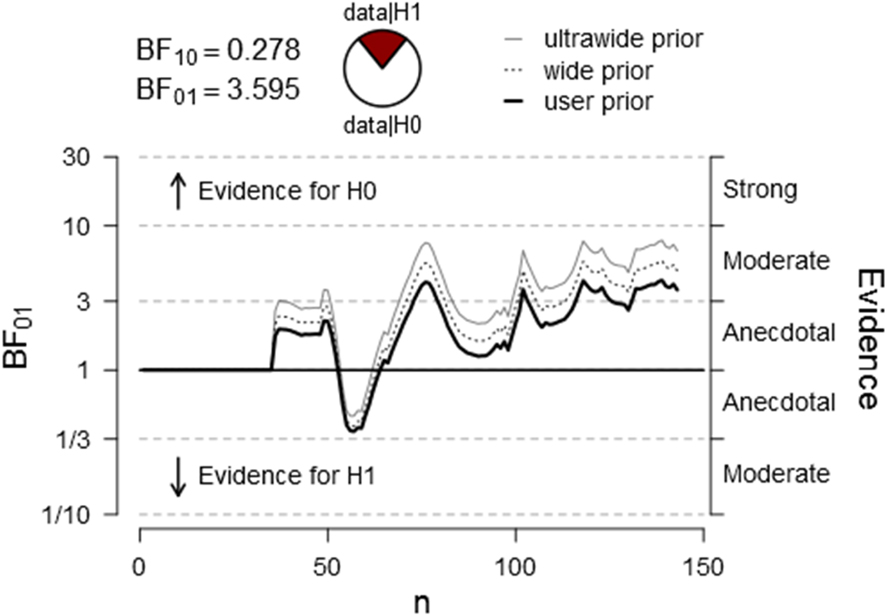
Using a default cauchy prior of 0.707 (corresponding to a ‘medium’ effect), our analyses revealed that participants who read the story in their first language were about equally as engaged as those who read the story in their second language (t(141) = –0.96, p = .34; d = –0.16, 95% CI [–0.50, 0.17]; BF01 = 3.60, BF10 = .28). The Bayes Factor revealed that the data were 3.6 times more consistent with there being no difference in narrative transportation as a function of reading in one’s first or second language, relative to there being some difference. Figure 1 presents a sequential analysis for this Bayesian analysis, illustrating the influence of sample size on BF01, in addition to how choosing a wider prior (indicating greater prior uncertainty) would influence the analysis. In light of the paucity of past work on this topic, readers may prefer a wider prior than the default we have chosen.
Sequential analysis of the Bayesian statistics for the effect of L1/L2 on narrative transportation in reading. BF = Bayes Factor. This figure was created in JASP (JASP team, 2018).

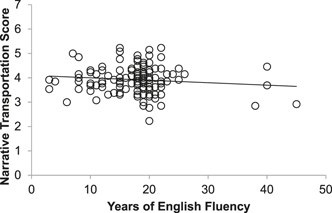
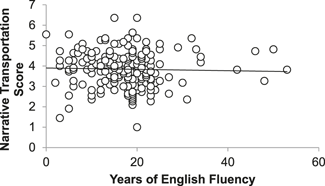
The majority of our participants who listed English as their second language acquired English at a very early age. In order to thoroughly examine whether English proficiency was related to narrative transportation, we calculated a Pearson correlation between years of English fluency and narrative transportation across the entire sample. Years of English fluency was weakly associated with narrative transportation, with greater fluency predicting lower levels of transportation (r(143) = –0.11, p = .18, 95% CI [–0.30, 0.080]) (see the scatterplot in Figure 2). Because years of English fluency is likely correlated with the age of participants, we subsequently controlled for age using partial correlation and again found almost no association between years of English fluency and narrative transportation (r(140) = 0.01, p =.97, 95% CI [–0.16, 0.15]).
Correlation scatterplot for the relationship between narrative transportation and years of English fluency for Study 1.

In these data, processing a written story in one’s native language or second language did not impact how transported readers were into the narrative world. In order to replicate this finding and examine its generalizability to other modalities of narrative presentation, we examined a second existing dataset for participants who listened to the audio of a short story. This is akin to listening to an audiobook or a podcast, another popular form of consuming stories.
3. Study 2
Study 2 examined whether there are differences in narrative transportation for participants who listened to a short story or talk in either their first or second language.
3.1. materials and methods
3.1.1 Participants
A total of 193 participants between the ages of 18 and 60 years (M = 22.46, SD = 5.98) were recruited from an undergraduate participant pool, who received course credit for participating in the study. There were 83 participants who listed English as the first language they learned and 110 participants who listed a language other than English as the first language they learned (Table 1). As expected, the two groups differed on years of English fluency (t(191) = 8.74, p < .001; d = 1.29, 95% CI [0.96, 1.58]). The groups also differed on years of formal education, with those who reported English as their first language having slightly more years of education (t(189) = 3.59, p < .001; d = 0.53, 95% CI [0.23, 0.82]). The two groups were roughly equivalent in age (t(191) = 0.45, p = .65; Cohen’s d = 0.07, 95% CI [–0.22, 0.35]).
3.1.2. Audio stories
Participants listened to 1 of 3 possible short fiction stories or 1 of 3 possible short non-fiction talks. The fiction stories came from the New Yorker fiction podcast and were as follows: You Must Know Everything by Isaac Babel, I Bought a Little City by Donald Barthelme, and The Wood Duck by James Thurber. The non-fiction talks were all taken from the TED talk series and included the following: Why We Make Bad Decisions by Dan Gilbert, Six Ways Mushrooms Can Save the World by Paul Stamets, and New Thinking on Climate Change by Al Gore. As we were not primarily interested in differences between fiction and non-fiction in this study, and to maximize statistical power, we collapsed across genre for all analyses.Footnote 3 These presentations had an average Flesch–Kincaid reading grade level of 6.7 (SD = 1.7) and reading ease score of 72.8 (SD = 10.7), with the fiction stories being simpler and easier to comprehend (M grade = 5.3, SD grade = 1.3; M ease = 81.3, SD ease = 5.8) than the non-fiction presentations (M grade = 8.1, SD grade = 0.5; M ease = 64.3, SD ease = 5.7).
3.1.3. Narrative Transportation Scale (Green & Brock, Reference Green and Brock2000)
This measure was identical to what was used in Study 1, except for the questions pertaining specifically to the contents of the story, which were adapted to match the contents of the audio presented. A total of 11 items were used with responses made on a 7-point Likert scale ranging from ‘Not at all’ to ‘Very Much’.
3.2. procedure
Participants listened to 1 of 3 audio presentations for one of the genres (fiction or non-fiction) and subsequently rated their transportation into what they heard, in addition to a battery of other measures not relevant for the current aims (see footnote 2).
3.3. results and discussion
3.3.1. Equivalence of fiction and non-fiction podcasts
Transportation into the fiction stories (n = 96, M = 3.79, SD = 0.89) did not differ much from that observed for the non-fiction talks (n = 97, M = 3.90, SD = 0.89) (t(191) = –0.91, p = .36; d = –0.13, 95% CI [–0.41, 0.15]). For this reason, we felt comfortable collapsing across the two genres for all subsequent analyses (see footnote 3).
3.3.2. Influence of English as first or second language on narrative transportation
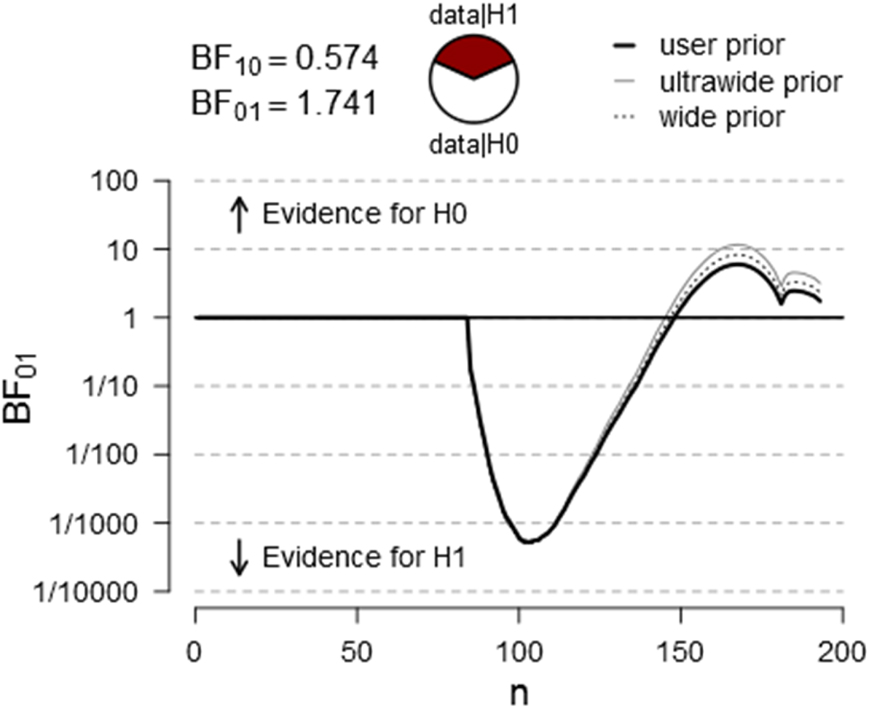
Bayesian statistics and traditional NHST analyses using the same parameters as in Study 1 revealed that participants who listened to the audio in their first language were about equally as engaged as those who listened to the audio in their second language (t(191) = –1.67, p = .097; d = –0.24, 95% [–0.53, 0.044]; BF01 = 1.74, BF10 = .57). If anything, those using their non-native language were slightly more transported (Table 1). The data were 1.74 times more consistent with there being no difference in narrative transportation as a function of whether the audio was processed in a person’s first or second language, relative to there being some difference. See Figure 3 for the sequential analysis and the influence of choosing a wider prior (indicating less a priori certainty).
Sequential analysis of the Bayesian statistics for the effect of L1/L2 on narrative transportation in listening to podcasts. BF = Bayes Factor. This figure was created in JASP (JASP team, 2018).

To further investigate whether those with fewer years of English fluency were more or less transported into the audio, a Pearson correlation was calculated across the entire sample. This correlation revealed almost no association between years of English fluency and narrative transportation (r(193) = –0.03, p = .68, 95% CI [–0.18, 0.10]) (see the scatterplot in Figure 4). In order to control for any influence of age, a partial correlation controlling for age was calculated and it again found no strong association between years of English fluency and narrative transportation (r(190) = –0.09, p = .20, 95% CI [–0.25, 0.05]). If anything, more experience with English predicted lower levels of transportation in these data.
Correlation scatterplot for the relationship between narrative transportation and years of English fluency for Study 2.

The results of this study replicate those for Study 1, with the data more consistent with there being no difference in how transported individuals were into the audio presentation based on whether they were employing their first or second language for comprehension. Correlations and partial correlations were also inconsistent with the idea that those more fluent in English were more transported into the English audio. In order to investigate whether the effect generalizes to multi-media presentations, we turned to another pre-existing dataset that examined how transported individuals were into short films.
4. Study 3
In this final dataset, we examined whether individuals watching a short narrative film in their first language are more transported into the story relative to those watching the film in their second language.
4.1. materials and methods
4.1.1. Participants
A total of 273 participants were recruited from an undergraduate participant pool with all participants receiving course credit as remuneration. Participants ranged in age between 17 and 55 years (M = 20.41, SD = 4.22). Fourteen participants had to be removed because they did not report their first or second language. Furthermore, an additional 26 participants were removed because there was no reported narrative engagement score. Hence, the final sample consisted of 232 participants with 111 participants listing English as the first language they learned, and 121 participants listing a language other than English as their first language (Table 1). The only difference between language groups that emerged was for years of English fluency, with those who listed English as their first language also reporting more years of English fluency (t(229) = 8.99, p < .001; d = 1.18, 95% CI [0.90, 1.46]). Both groups were approximately equivalent in age (t(230) = 0.33, p = .74; d = 0.043, 95% CI [–0.22, 0.30]), and there was a marginal difference between groups in years of formal education (t(229) = 1.94, p = .053; d = 0.26, 95% CI [–0.003, 0.52]).
4.1.2. Film
Participants watched 1 of 2 possible short films. The first, Mistletoe, was 9 minutes and 7 seconds in length and describes the story of a man who comes to realize his romantic feelings for a co-worker (finitefilms, 2011). The second film, Sweet Night Good Heart, was 9 minutes and 16 seconds in length. It portrays a man trying to break up with his girlfriend, but she instead misunderstands his attempt as a proposal for marriage, leading him to eventually realize his true feelings of love for her by the end (Goodman & Zeff, Reference Goodman and Zeff2001). Both are relatively sophisticated, telling nuanced stories intended for adults in a short period of time. Sweet Night Good Heart, in particular, was fast-paced and rather complex, involving several cases of misunderstanding between characters.
4.1.3. Narrative Engagement Scale (Busselle & Bilandzic, Reference Busselle and Bilandzic2009)
Narrative transportation was measured in this study with the Narrative Engagement Scale. It is a 12-item scale that covers four separate dimensions of narrative engagement: (1) Narrative Understanding (e.g., “I had a hard time recognizing the thread of the story”, reverse-coded), Attentional Focus (e.g., “While the program was on, I found myself thinking about other things”, reverse-coded), Narrative Presence (e.g., “At times during the program, the story world was closer to me than the real world”), and Emotional Engagement (e.g., “The story affected me emotionally”). This scale was developed by Busselle and Bilandzic (Reference Busselle and Bilandzic2009) to create a measure of transportation more appropriate for audiovisual narratives such as film or television. Notably, this scale does not measure visual imagery, as audiovisual presentations include a visual element, abrogating the need for visual imagery. The inclusion of these subscales also allows us to examine separately the different aspects of narrative transportation. Responses for this measure are made using a 7-point Likert scale, anchored by ‘Not at All’ and ‘Very Much’.
4.2. procedure
Participants watched 1 of the 2 short films and subsequently rated their transportation into what they watched, in addition to a battery of other measures not germane to the current question (see footnote 2).
4.3. results and discussion
4.3.1. Equivalence of films
We first examined whether participants were equivalently transported into the two films, for the purposes of determining whether we could collapse across them. The composite Narrative Engagement score was higher for Mistletoe (N = 117, M = 5.23, SD = 0.74) than Sweet Night Good Heart (N = 115, M = 4.91, SD = 0.97) (t(230) = 3.46, p < .001, d = 0.46, 95% CI [0.19, 0.72]). The two films did not differ with respect to 3 of the transportation dimensions: Narrative Presence (t(230) = –0.99, p = .32; d = –0.13, 95% CI [–0.39, 0.13]); Emotional Engagement (t(230) = 1.58, p = .12; d = 0.21, 95% CI [–0.051, 0.47]); and Attentional Focus (t(230) = 1.64, p = .10; d = 0.22, 95% CI [–0.044, 0.47]). However, the more straightforward film (Mistletoe; N = 117, M = 6.21, SD = 1.02) was rated higher in terms of Narrative Understanding relative to the more complex film (Sweet Night Good Heart; N = 115, M = 5.00, SD = 1.54) (t(230) = 7.06, p < .001, d = 0.93, 95% CI [0.66, 1.20]). Based on these results, we felt comfortable collapsing across the two films for our analyses.
4.3.2. English as first or second language on narrative transportation
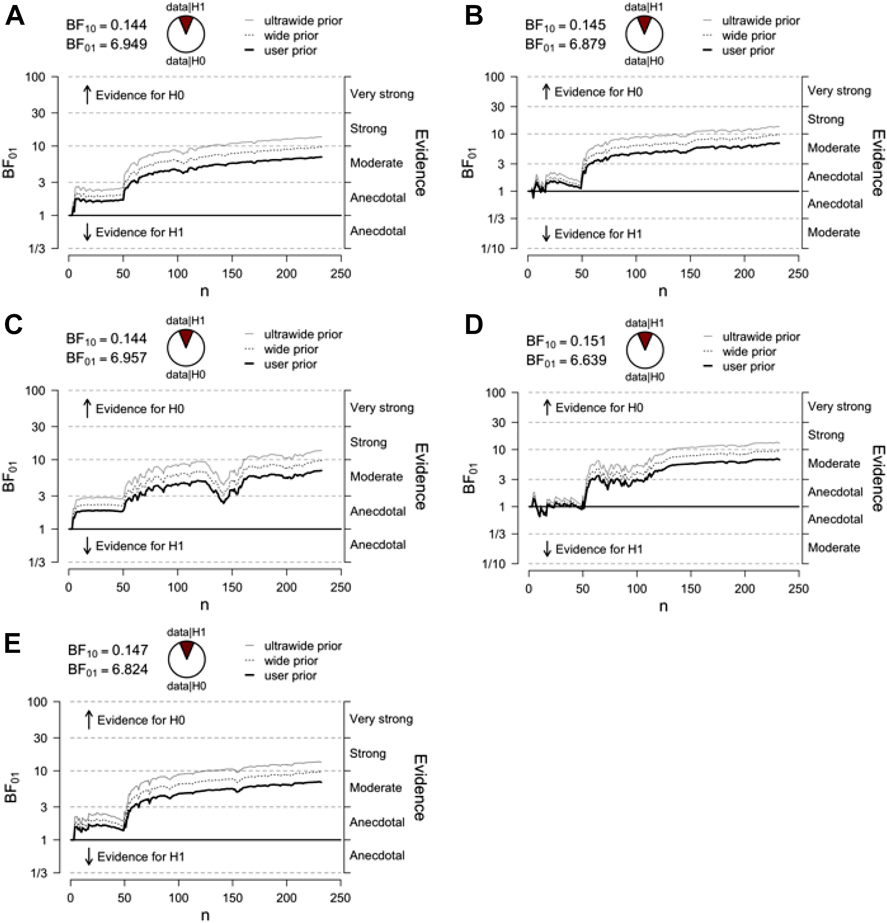
Analyses were performed as per Studies 1 and 2. Participants who watched the film in their first language were about equally as engaged as those who watched the film in their second language, averaging across the four transportation subscales (t(230) = 0.21, p = .84; d = 0.027, 95% CI [–0.23, 0.29], BF01 = 6.82, BF10 = .15). The data were almost 7 times more consistent with there being no difference in transportation between groups, relative to some difference. This lack of difference was also observed across all four aspects of transportation: Narrative Understanding (t(230) = 0.061, p = .95, d = 0.008, 95% CI [–0.25, 0.27], BF01 = 6.95, BF10 = .14); Attentional Focus (t(230) = 0.16, p = .87, d = 0.021, 95% CI [–0.24, 0.28], BF01 = 6.88, BF10 = .15); Narrative Presence (t(230) = 0.035, p = .97, d = 0.005, 95% CI [–0.25, 0.26], BF01 = 6.96, BF10 = .14); and Emotional Engagement (t(230) = 0.32, p = .75, d = 0.042, 95% CI [–0.22, 0.30], BF01 = 6.64, BF10 = .15). For each of the four subscales, the data were at least 6.5 times more consistent with there being no difference between groups, relative to there being some difference. Figure 5 presents the sequential analyses for each subscale, illustrating the influence of sample size and choosing a wider prior.
Sequential analysis of the Bayesian statistics for the effect of L1/L2 on (a) narrative understanding, (b) attentional focus, (c) narrative presence, (d) emotional engagement, and (e) composite score when watching film. BF = Bayes Factor. This figure was created in JASP (JASP team, 2018).

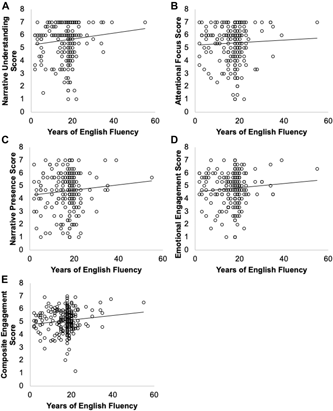
Following the analyses for Studies 1 and 2, Pearson correlations between years of English fluency and narrative transportation were calculated across the entire sample (Figure 6). In these data, there was a correlation between the composite engagement score and years of English fluency that fell just above threshold for statistical significance, with greater fluency predicting higher levels of narrative engagement (r(231) = 0.13, p = .050, 95% CI [–0.00, 0.25]). Examining each of the four aspects of transportation separately revealed only weak associations between years of English fluency and Narrative Understanding (r(231) = 0.11, p = .10, 95% CI [–0.022, 0.23]); Attentional Focus (r(231) = 0.045, p = .50, 95% CI [–0.085, 0.17]); Narrative Presence (r(231) = 0.090, p = .17, 95% CI [–0.044, 0.22]); and Emotional Engagement (r(231) = 0.085, p = .20, 95% CI [–0.044, 0.21]). The strongest relation was between English fluency and Narrative Understanding, with those who had more experience with English reporting higher levels of comprehension. We subsequently controlled for age using partial correlation and found no strong associations between years of English fluency and transportation: Total (r(228) = 0.046, p = .49, 95% CI [0.062, 0.16]); Narrative Understanding (r(228) = 0.066, p = .32, 95% CI [–0.044, 0.19]); Attentional Focus (r(228) = –0.038, p = .57, 95% CI [–0.14, 0.086]); Narrative Presence (r(228) = 0.082, p = .21, 95% CI [–0.043, 0.20]) ; and Emotional Engagement (r(228) = 0.001, p = .98, 95% CI [–0.13, 0.12]).
Correlation scatterplots for the relationship between years of English fluency and (a) narrative understanding, (b) attentional focus, (c) narrative presence, (d) emotional engagement, and (e) composite score in Study 3.

5. General discussion
The present set of studies examined the impact of first or second language processing on narrative transportation across different modalities, including written text, audio, and the audiovisual format of films. Bayesian statistics revealed that, within each dataset, approximately equivalent levels of narrative transportation were achieved regardless of whether the narrative was processed in one’s first or second language. Furthermore, across all our studies, years of English fluency had no strong association with narrative transportation, even after controlling for age, corroborating the group comparisons. Altogether, these set of findings demonstrate that second language processing can be just as successful in engaging the cognitive, attentional, and emotional mechanisms associated with narrative transportation as first language processing.
These data are consistent with the findings from an unpublished thesis by Spring (Reference Spring2017) that used corporate narratives, as well as past studies that found no differences between native and non-native language processing on emotionality (e.g., Eilola et al., Reference Eilola, Havelka and Sharma2007; Ferré et al., Reference Ferré, García, Fraga, Sánchez-Casas and Molero2010; Sutton et al., Reference Sutton, Altarriba, Gianico and Basnight-Brown2007). That said, the results run counter to other studies reporting weaker emotional responses when processing information in a foreign language (e.g., Pavlenko, Reference Pavlenko2012). It is important to keep in mind, however, that many of these studies on emotion did not examine discourse-level text, often relying on single-word paradigms, and that emotional responses are only one facet of narrative transportation. In addition, for past studies demonstrating a difference in emotionality, this difference cannot be attributed to comprehension, since these single-word paradigms all used simple words easily understood in both languages.
Despite the fact that we observed consistent results across our three studies when examining three different modalities of presentation for a narrative, there are many questions left unanswered by these studies and past work. For example, it is possible that self-report measures of narrative transportation may not sufficiently capture the deep emotional engagement under question: alternative, possibly in vivo, methods should be considered in the future. Additionally, although empirical and theoretical work into attenuated emotional responses for second language processing distinguish this effect from the process of comprehension, it is possible that differences in transportation may well emerge among groups with varying levels of English proficiency than those examined here. Our participants who had English as a second language tended to report many years of fluency in the language (Table 1) and were all immersed in an Anglophone environment. Our findings are similar to those by Čavar and Tytus (Reference Čavar and Tytus2018), who did not report a ‘foreign language effect’ in moral decision-making due to high proficiency for the second language and frequent usage of both languages. In order to investigate this further, a richer set of background questions related to language should be incorporated, including questions related to proficiency, usage, and age of acquisition for each language.
Another possibility is that differences between language groups may emerge in response to more complicated or longer narratives. Our stories were all brief in presentation and relatively easy to comprehend. Future studies should incorporate longer and more complex stories, such as a novel or an entire television episode, to better explore this possibility. That said, we observed similar results for our more complex, non-fiction audio presentations as we did for our simple texts (see footnote 3), and the films we presented were also relatively complex.
Last, engaging with narratives in one’s second language might be just as transporting as using one’s first language, but perhaps require more cognitive effort or attentional resources.Footnote 4 In order to investigate this possibility, reading times could be measured, or a dual-task paradigm could be employed. If greater effort is required for those using their second language, this would be consistent with past work demonstrating greater accuracy and recall for native language processing of emotional material (Colbeck & Bowers, Reference Colbeck and Bowers2012; cf. Anooshian & Hertel, Reference Anooshian and Hertel1994; Eilola et al., Reference Eilola, Havelka and Sharma2007; Sutton et al., Reference Sutton, Altarriba, Gianico and Basnight-Brown2007).
In conclusion, the best available evidence demonstrates that using your non-native language to understand a story does not impair narrative transportation. These results may have numerous real-world implications, most obviously with respect to education. The fact that people appear to be as engaged in a narrative presented in their second language relative to their first hints that stories might be a promising tool for language learning (Dutta & Parhi, Reference Dutta and Parhi2014). The deep intrinsic interest we have for stories, which emerges at very early ages (Alexander, Miller, & Hengst, Reference Alexander, Miller and Hengst2001), might well be a powerful motivator when it comes to learning a new language.