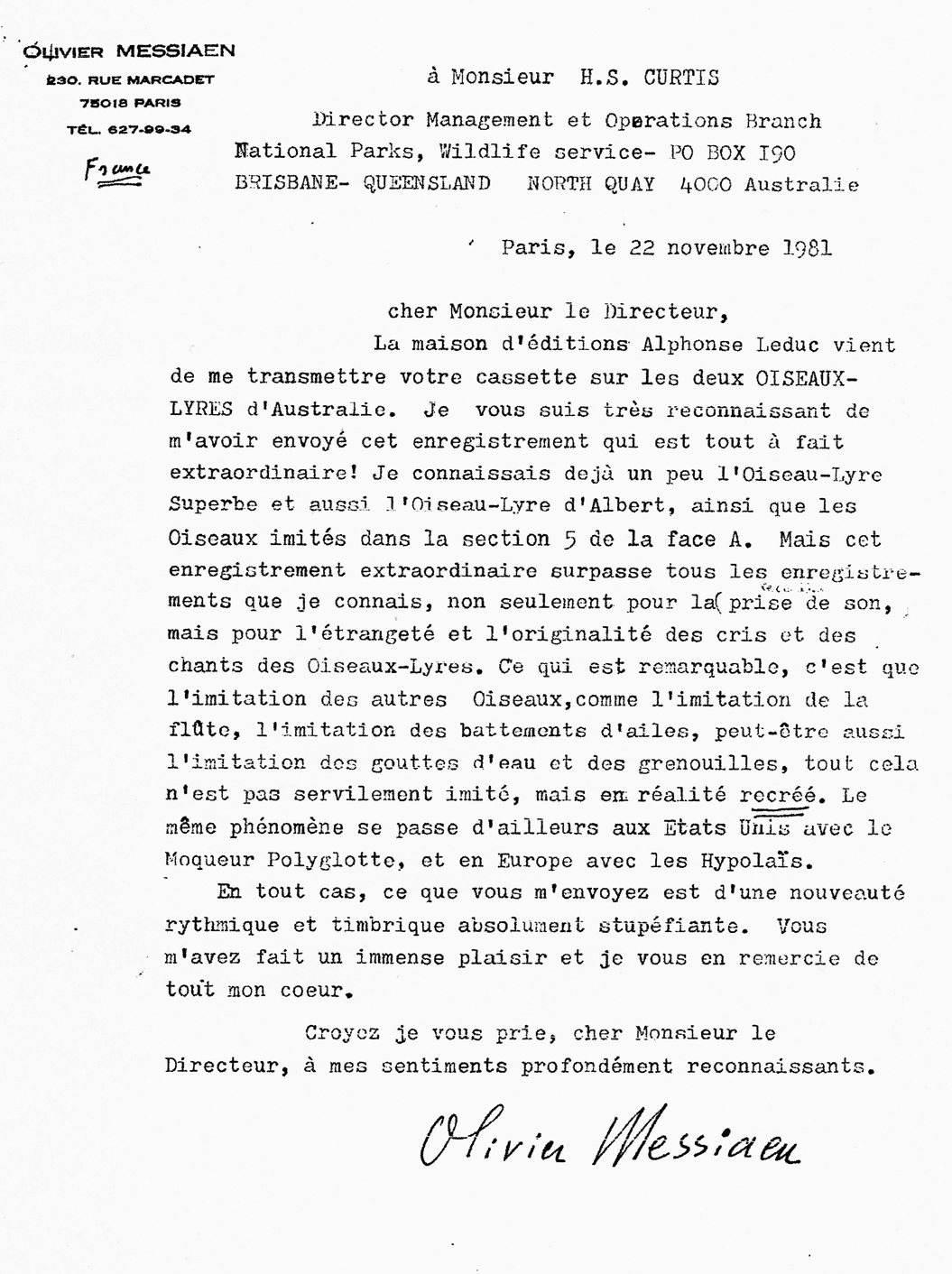
‘I don't suppose you'd be interested in my correspondence with Olivier Messiaen, would you?’ asked Australian ornithologist Sydney Curtis.Footnote 1 In a relationship that up to then had gone unreported, Curtis recounted to me how he had written to the composer in 1981 about lyrebird mimicry. Aware that Messiaen employed birdsong in his compositions, Curtis wanted to enlighten him about an avian corollary: lyrebirds who incorporated human music in their vocalizations.Footnote 2 He sent a cassette (which he titled Lyrebirds for Olivier Messiaen) containing his original recordings of the two species of lyrebirds, the superb (Menura novaehollandiae) and the Albert's (Menura alberti), and a letter of explanation on how the mapping of one musical language onto another was a cross-species practice.Footnote 3 Curtis was rewarded with an enthusiastic and gracious thank-you letter (Figure 1). Then, in 1988 Curtis was one of three ornithologists to take Messiaen birding during his six-week tour of Australia. The following year, Curtis compiled and sent to Messiaen a second personalized cassette, entitled Pour Messiaen, which featured assorted Australian birdsong.Footnote 4
Letter from Messiaen to Curtis dated 22 November 1981. Used with permission.

This recording provides my starting point for analytical scrutiny of eight Messiaen birdsong transcriptions appearing in his Cahiers de notation des chants d'oiseaux. I begin by examining transcriptions that Messiaen made of Curtis' recordings of the pied butcherbird, comparing them to the original tape and to my own transcriptions. The study expands to include pied butcherbird transcriptions made by Messiaen from a 1977 cassette recording of Australian birdsong of limited release (Bird Calls of the Inland) which, like the Curtis recording, appears to be unknown to musicologists, and further transcriptions from a 1987 Jean C. Roché commercial release.Footnote 5 I also examine sketch pages attributed to Messiaen's fieldwork with Curtis. The goal is to establish with new clarity the habits and idiosyncracies of Messiaen's birdsong transcription.
Much ink has been spilled concerning Messiaen's use of birdsong in his compositions. At times he would transfer every nuance of his transcription into a piece, such as the nightingale he notated at St-Germain-en-Laye, which figures in the final phrases of the opening piano cadenza of Réveil des oiseaux (1953).Footnote 6 At other times, the composer intervened to a greater or lesser extent, especially in the later works, where dramatic flair, artistic licence and transformation surface regularly. Oiseaux exotiques (1955–56) is the first composition containing birdsong sourced (in part) from recordings.Footnote 7 Detailed accounts of the extent to which Messiaen's birdsong compositions (as opposed to transcriptions) match their models fill the literature, and they will not be added to here. Rather, I will move through ground that has been unsatisfactorily traversed, interrogating the kinds of transcriptions that Messiaen crafted.
Music transcription entails the subjective and the reductive. Béla Bartók held that ‘[t]he only really true notations are the sound-tracks on the record itself’.Footnote 8 Of course, this ignores technology's varying ability to capture and reproduce sonic properties (magnified by shellac's deficiencies of scratch and click, tape's propensity for wow and flutter, etc.). Listening cannot be classified as an objective act. Furthermore, neither a recording nor a sonogram can be deemed an unassailable fact, and both can be problematized.Footnote 9 In a brief chronological survey, I find that Messiaen's comments concerning accuracy and authenticity ping-pong, sometimes complicated by a lack of clarity on whether the subject is transcription or composition:
1944: ‘[A]s it is ridiculous servilely to copy nature, we are going to give some examples of melodies of the “bird” genre which will be transcription, transformation, and interpretation of the volleys and trills of our little servant of immaterial joy’.Footnote 10
1953: In his preface to Réveil des oiseaux, Messiaen describes his birds as ‘parfaitement authentiques’.Footnote 11
1961: ‘I write down rapidly what I hear; the melody and rhythm. I do not note the timbre. As timbre arises from a more or less large number of harmonics it is necessary for me to seek combinations of unexpected sounds, to re-invent at each moment and for each bird. [Birds] are the real authors of some of my pieces’.Footnote 12
1962: ‘[M]y birdsongs are entirely free’.Footnote 13
1967: ‘I've used bird songs in two different ways: either by trying to outline the most exact musical portrait possible, or by treating the bird song as malleable material. […] Personally, I'm very proud of the exactitude of my work […] I assure you that everything is real; but, obviously, I'm the one who hears, and involuntarily I inject my reproductions of the songs with something of my manner and method of listening’.Footnote 14
1968: ‘And now I'd like to talk about the musical forms in which I use birdsongs. There are two different forms, one deceitful and one truthful. The deceitful one – I insist on the word “deceit” – employs the bird-calls as raw material after the manner of composers of electronic music, who use bird-sounds as a source which they constantly electronically alter so much that they almost forget the starting point of the process – so much for the first method. […] I'll now speak about the second method, which seems to me to be better, I think, also more original. […] [It] consists quite simply of conforming to reality, not only to the bird-calls, but also to everything surrounding them: landscapes, fragrances, colours and, above all, the passing of the hours during the day and night’.Footnote 15
Notwithstanding Messiaen's assertion, in interview with Claude Samuel, that ‘I'm the first to have made truly scientific and, I hope, accurate notations of bird songs’,Footnote 16 the majority of scholars have been wary of claims of authenticity chez Messiaen, insisting that our attention should be on whether the music works in and of its own accord, a view I share. This article assumes that the human musical outcome will always be different from the avian one. Trevor Hold was an early advocate of this position, writing in 1971: ‘The music says what it has to say in its own terms. In a way these trappings are more important to the composer than they are to us, in the same way that serial permutations and manipulations are to other composers’.Footnote 17 David Kraft concludes that ‘however complex the birdsong, Messiaen's intention was to respond creatively rather than to imitate’.Footnote 18 Robert Fallon, who has conducted pioneering work on Messiaen's transcriptions, agrees that they ‘attest to his artistry rather than his mimicry’,Footnote 19 while Rob Schultz directs our attention to ‘Messiaen's self-admitted tendency to unintentionally insert his own compositional voice and artistic sensibilities into his birdsong transcriptions’.Footnote 20 He concludes that we have ‘considerable evidence that Messiaen's birdsong is still unabashedly Messiaen's music, and may in fact be understood as such, in strictly musical terms’.Footnote 21 Messiaen student Alexander Goehr recalls that ‘Messiaen liked to pretend that he was merely transcribing what he heard when he went to the forests …. In reality it hardly mattered musically which particular bird he thought he was transcribing; his inventiveness and supreme musical personality revealed itself in the way he set down his transcriptions’.Footnote 22
It is the ‘setting down’ with which this article concerns itself. Hold bemoaned in 1971 that ‘without having records of the exact birds that Messiaen used’, he ‘obviously cannot give exact examples’ of Messiaen's transcription methods.Footnote 23 More recently, Fallon discovered that Messiaen used sound recordings to notate North American birds in Oiseaux exotiques.Footnote 24 He placed five birdsong models in sonograms in order to compare them to their compositional counterparts, concluding that Messiaen's ‘music conforms to his models about two-thirds of the time’.Footnote 25 The present study also benefits from access to the exact recordings used by Messiaen. It employs sonographic and waveform analysis of both the recorded birdsong models and Messiaen's transcriptions of them from his cahiers. On the basis of this analysis, I will argue that Messiaen does not wait until compositional work on a particular piece to transform the birdsong he notates, but instead actively and with ‘characteristic thoroughness’Footnote 26 adapts birdsong into his personal and distinct musical language at the moment of transcription. I will propose a provisional template for how he filters avian vocalizations – one that confirms and codifies what many have suspected for decades. The template is based on Messiaen's transcriptions of the Australian pied butcherbird (Cracticus nigrogularis) and supported by analysis of the superb and Albert's lyrebirds transcriptions and initial analyses of the other species contained in the 64 pages of Australian birdsong transcription in my possession.Footnote 27
Approach and Methods
If we were to browse any number of books and articles containing birdsong notation from the nineteenth and early twentieth centuries, ‘quaint’ might be the first word that springs to mind. The notations typically consist of a simple phrase formed almost entirely with crotchets and quavers, set in 3/4 or 4/4 time, floating on a page filled with, depending on the author, learned observations, sentimental text, or a mix of the two.Footnote 28 Others were motivated to write books suggesting new birdsong notational systems exploring the potential of mnemonic catchwords and graphic notation (like the use of a musical shorthand with lines and squiggles to indicate pitch height, rhythm, and gesture, or of colours to differentiate timbre).Footnote 29 We cannot dismiss how the visual appearance of Messiaen's extremely detailed avian transcriptions, arriving on the heels of this, influences our estimation of them: they impress. They look, in a word, accurate.
Are considerations of transcription accuracy germane? Fallon believes that they are, not for proving or disproving issues of authenticity, but for understanding the composer's ‘aesthetic of representation’.Footnote 30 Humans are complex and even contradictory creatures; Messiaen was no exception. Christopher Dingle and Nigel Simeone have suggested how, in making our way through the sheer quantity of documentation Messiaen left ‘to help to elucidate his music and its inspiration’, we risk losing some perspective: ‘Scholars of other composers might look with envy upon this abundance of riches, and we are indeed fortunate. However, with a little distance, it is possible to see the limitations of what Messiaen told us’.Footnote 31 In this spirit, when we abandon Messiaen's conflicting statements about notation accuracy and cleave to another set of texts – the avian transcriptions themselves – I believe we can best follow this hunch: that birdsong transcriptions can be read as reflecting the priorities, interests and enculturation of the individual composer. A composer's avian transcription is less an ornithological artefact than a text that mediates between birdsong and the musical score, and as such it will always be conflicted between its descriptive and prescriptive tasks. While we should not expect scientific precision in his transcriptions, or equate ‘success’ to a close match with a bird model, accuracy nonetheless remains a touchstone as we examine Messiaen's notation choices and contemplate what is chosen and what is ignored, and what is lost and what is gained, through the filtering of birdsong by the richness of the personal musical language and imagination that he brings to the task.
I limit the present discussion to the Australian pied butcherbird in the belief that our investigation could profit from a zoömusicologist who regularly transcribes a species also transcribed by Messiaen.Footnote 32 This mid-sized black and white songbird delivers mostly pure, flute-like whistles at a lower tessitura and slower pace than many birds.Footnote 33 Thus, their song fits reasonably into standard music notation,Footnote 34 allowing the transcriber to avoid most of the notational challenges encountered in microtonal, high speed, and/or high pitched birdsong. This songbird delivers four types of vocalizations.Footnote 35Calls tend to be shorter and simpler than songs and are assumed to be innate.Footnote 36Solo songs are usually sung nocturnally and always discontinuously (phrases are a second or two in duration, followed by inter-phrase intervals of silence generally at least twice as long as phrases).Footnote 37 Solo songs may last up to six hours.Footnote 38Group songs range from hocket-like duets, where singers take turns so rapidly that a single melodic line is formed, to large ensembles of eight or even more birds whose vocalizations betray a looser construction.Footnote 39 Finally, pied butcherbirds are mimics with the capacity to eclectically copy techniques and sonic constructs of alien species, as well as environmental sounds like cell-phone ringtones, car alarms, and reversing truck signals, in a non-stop montage that they mix with motifs from their own song phrases.Footnote 40
How close can human transcription come to capturing a bird's song? My transcriptions of the same recordings will allow our analysis to follow what Messiaen might have reasonably achieved in terms of accuracy, and thus serve to highlight when and how he departs from the bird model in his unspoken adaptations.Footnote 41 My transcription follows in the spirit of Bartók, who in 1929 wrote vis-à-vis folk music collection: ‘the musician should not rely on his ear alone, but should use either a phonograph or a gramophone, even in cases of the seemingly simplest melodies’.Footnote 42 Nevertheless, in matters of uncertainty, whether in pitch or rhythm, I defer to the human ear.
Music notation software can only partially capture the visual sense of Messiaen's hand in the cahiers; for example, transcriptions were typically written at speed, as evidenced by occasional headless notes employed for repetitions of the same pitch.Footnote 43 Sometimes, even an experienced eye finds some markings to be ambiguous, and none of the conclusions drawn from this study are based on such uncertain details. When conducting a direct comparison of Messiaen's and my transcriptions, the two are aligned note-by-note whenever possible, with the author's above (or facing) the composer's. In order to facilitate this, despite space and silence appearing relevant in pied butcherbird musical discourse, inter-phrase time intervals are not notated.Footnote 44 In my transcriptions thin double bar lines mark out phrases and indicate a momentary pause in singing.
Messiaen's cahiers
Messiaen's Cahiers de notation des chants d'oiseaux are housed in the Fonds Messiaen of the Département de la musique at the Bibliothèque nationale de France. Some 200 cahiers survive, totalling approximately 10,000 pages.Footnote 45 The marginalia of these transcriptions are frequently annotated with details of location, date, time, habitat, avian behaviour, and plumage. Messiaen credits his attention to ornithological detail and orderliness in part to his tutorials from brandy producer Jacques Delamain, the first of which was in April 1952. A friendship developed with Delamain, who was also an author of popular bird books, and Messiaen would later make him one of three dedicatees of his Réveil des oiseaux.Footnote 46 Messiaen had been transcribing birdsong since his time at the Conservatoire, but a month after his meeting with Delamain, he began notating in his more systematic cahiers. The first cahier entry is the result of four days (14, 15, 18, and 20 May 1952) in the forest of St-Germain-en-Laye, soon followed by a return visit to Gardépée on 12 June 1952 for three more days of tutorial with Delamain.Footnote 47
The cahiers’ marginalia also incorporate comments on timbre, musical mood, tempo, and proposed orchestration, as well as Messiaen's personal reaction to the natural world. Some of the cahiers are the product of deskwork, as Messiaen was known to work occasionally from recordings, although he seldom referred to this.Footnote 48 A portion of Messiaen's birdsong transcriptions from his cahiers (along with his analyses and examples from his compositions) are featured in volumes 5/1 and 5/2 of the Traité de rythme, de couleur, et d'ornithologie (1949–1992).Footnote 49 The first is dedicated to the birdsong of Europe (France in particular), while the second attends to birdsong of the world. In its 1300+ pages, there is no mention that any of the notations are transcribed from a recording.Footnote 50 Fallon estimates that Messiaen began recording birdsongs in the late 1950s.Footnote 51 However, Hill reports that no recordings from Messiaen's personal collection, either commercial ornithological recordings or Messiaen's own field recordings, are housed in the Archives, or if they are, they have yet to be catalogued and made available to scholars.Footnote 52
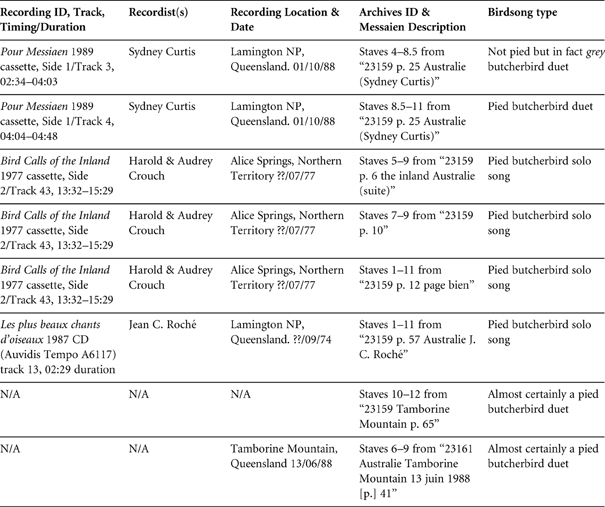
To date, I have examined 64 pages from Messiaen's cahiers #23158, #23159, #23160 and #23161 that contain Australian birdsong transcriptions and text related to their cataloguing. When referring to these, I place a period after the cahier followed by the page number(s), and if there is a further need to identify staves, I employ a second period (for example, #23159.65.8–10 indicates cahier #23159, page 65, staves 8–10). When working in the field, Messiaen dated each notation; with recordings, this is not the case, nor are the cahiers, pages catalogued chronologically.Footnote 53Table 1 details all eight pied butcherbird examples appearing in the cahiers.
Australian pied butcherbird transcriptions by Messiaen.
Transcription of the Curtis recording Pour Messiaen
Pour Messiaen features 19 Australian bird species in all. Messiaen transcribed five pages from it (cahier #23159.25–29). All but three of the 19 birdsongs were transcribed; they were notated in order, and most include the entire excerpt. Eight staves (4–11) from cahier #23159.25 are credited to the pied butcherbird.
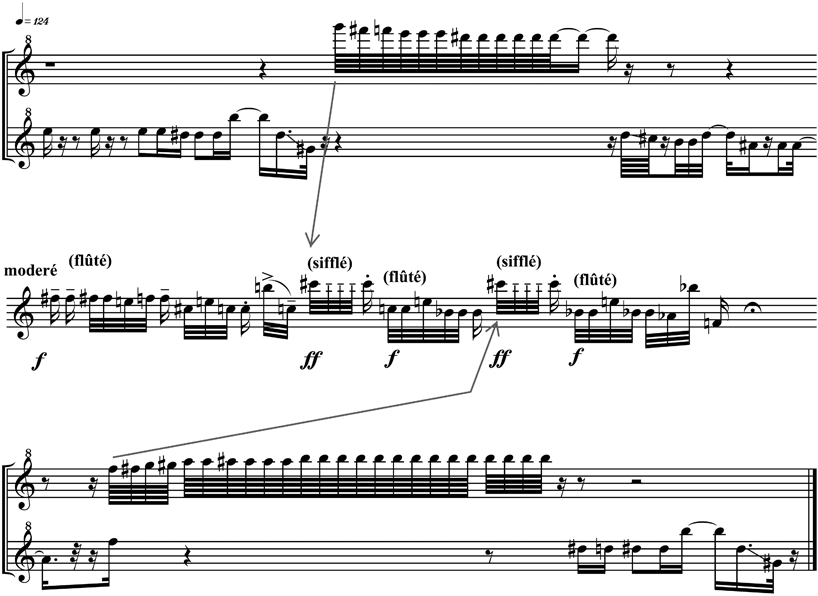
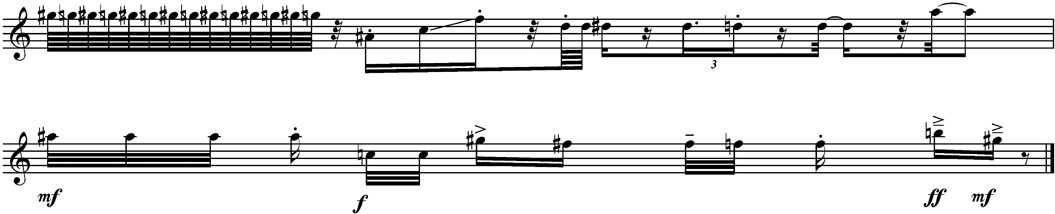
Curtis initially identified Track 3 (transcribed by Messiaen on staves 4–9.5) as pied butcherbirds duetting, but later revised this to grey butcherbirds. I can verify that Track 3 (as well as Tracks 5 and 6) indeed features a grey butcherbird pair; all three tracks were recorded at the same site and contain similar phrases. Messiaen understandably misidentifies his transcription of Track 3 as ‘Pied Butcherbird’. But although the grey butcherbird is not our target species, it presents an illuminating entry point to Messiaen's transcription practice. A notable feature of the grey butcherbird duet is some remarkable glissando rattles. One of the pair delivers a rattle twenty times in this excerpt, both ascending and descending, and the rattle spans from three to six semitones in 11–24 units (top line of the double staves of Example 1; note that my transcription places the duo on separate staves, while Messiaen combines them). Messiaen notates all the whistled rattles with a mere five demisemiquavers on a static c#3 marked sifflé (‘whistle’; arrows mark the contrast in Example 1), scarcely addressing the rattles’ direction, pitch, duration, and even number of approximate iterations. We cannot assume the composer intends only to notate what humans could perform. Several instrumental techniques, like a keyboard glissando or a portamento on the violin with a ricochet bow, would have been at his disposal.
Pour Messiaen, Track 3 at the beginning. The author's transcription is on the top and bottom pair of staves, and Messiaen's (cahier #23159.25.9) is on the middle staff. Arrows match the rattles in each. Extracts from Messiaen's cahiers here and throughout this article are reproduced by kind permission.
The other bird of the pair is notated in the author's transcription with various syncopations and rests. Messiaen relies exclusively on an unbroken chain of semiquavers and demisemiquavers to tell the sonic story. This scarcely seems to be the same person who told Gavoty: ‘Rhythm is a matter of intelligence; the more perfect the human brain becomes, the more one will be able to use complex rhythms’,Footnote 54 nor he who in his book The Technique of My Musical Language goes ‘to great inconvenience in order that his rhythmic innovations should be thoroughly treated before he turns to questions of harmony or melody’,Footnote 55 and who devotes much of the first three volumes of his Traité to rhythm. Since the transcription is not the product of fieldwork, it was not necessary to notate in haste. Instead, the composer is notating only those song elements that interest him and/or that he will require later in the compositional process, and he is notating very much in keeping with the ‘look’ as well as the eventual sound of his scores. In summary, the rhythm and pitch of Messiaen's transcription of this duet only partially match the model, and in terms of capturing the essence – the jizz Footnote 56 – which, to this auditor, would be the vivid ascending and descending glissando rattles, they are not described at all in Messiaen's notation. The fluté contribution from the other bird matches the recorded model more closely, at least by eye – an aural assessment of the transcription when played back matches less well.
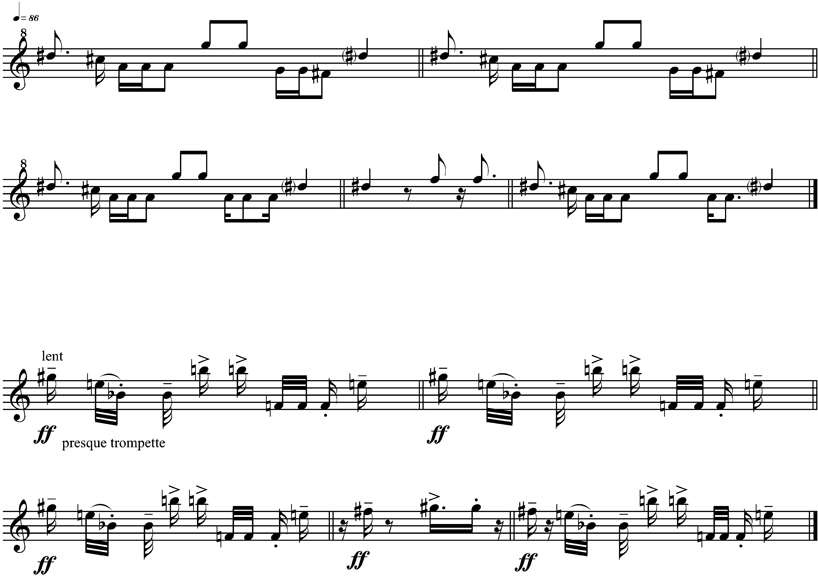
Midway through staff nine of the same cahiers page (#23159.25), Messiaen writes ‘2 autres Pied Butcherbird, presque trompette’, and this is where the actual pied butcherbird vocalization begins. Comparison of this transcription with my own will further expand our understanding of Messiaen's method (Example 2). To notate this hocket-like duet, I have assigned downward stems to one bird and upward stems to the other on the same staff.
Pour Messiaen, Track 4 from beginning to end, with the author's transcription above and Messiaen's (cahier #23159.25.9) below.
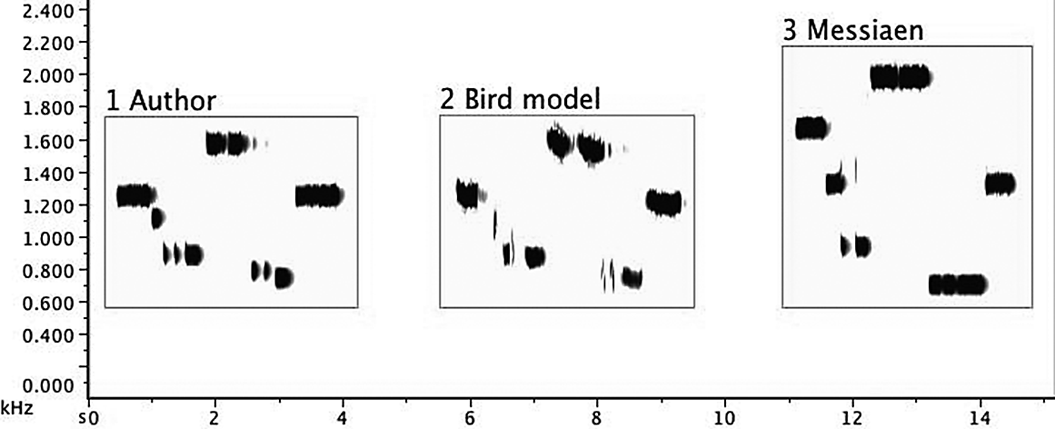
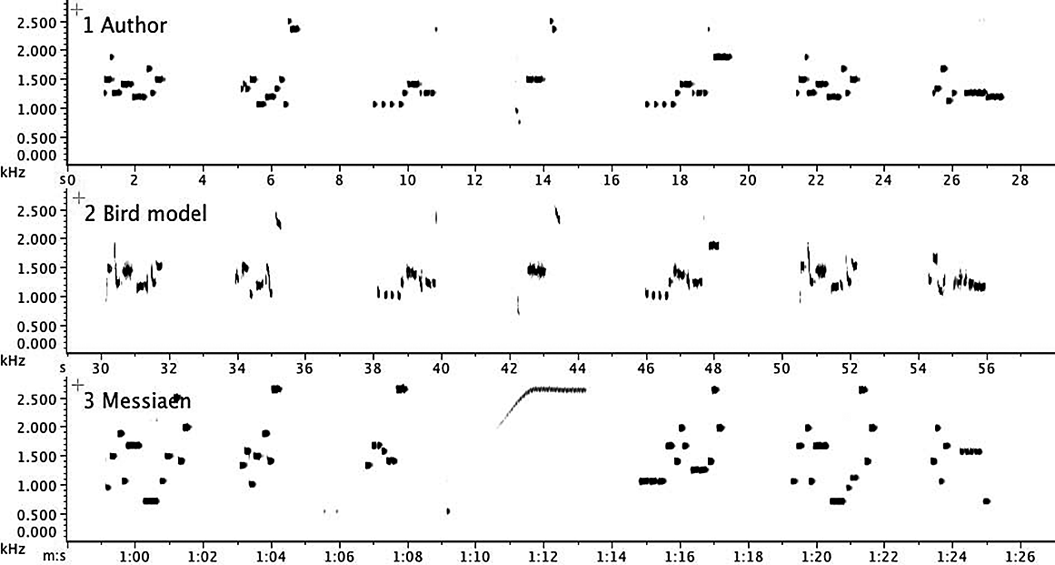
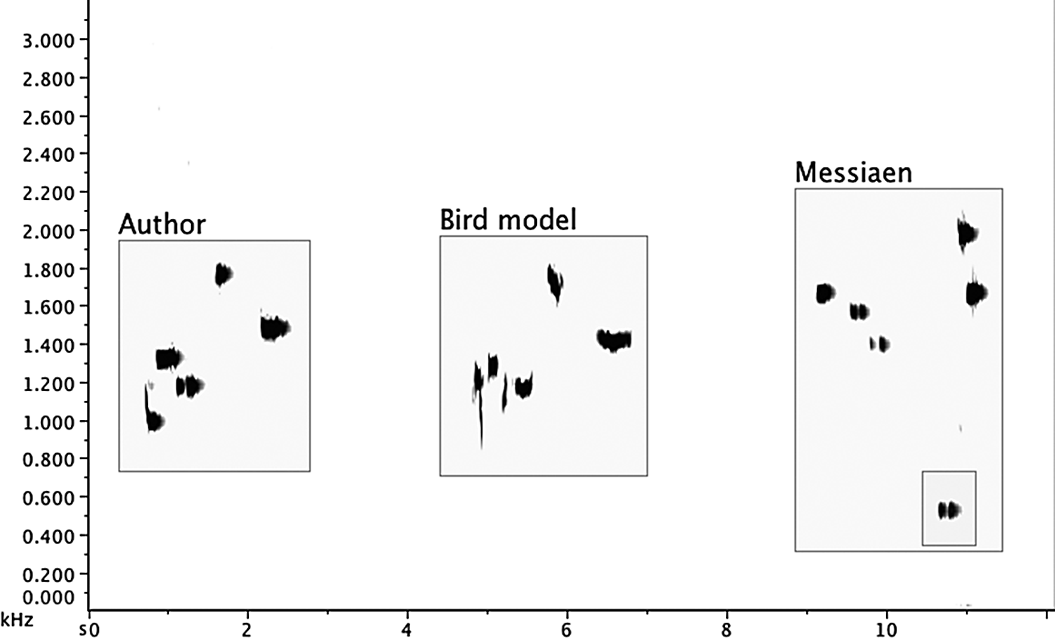
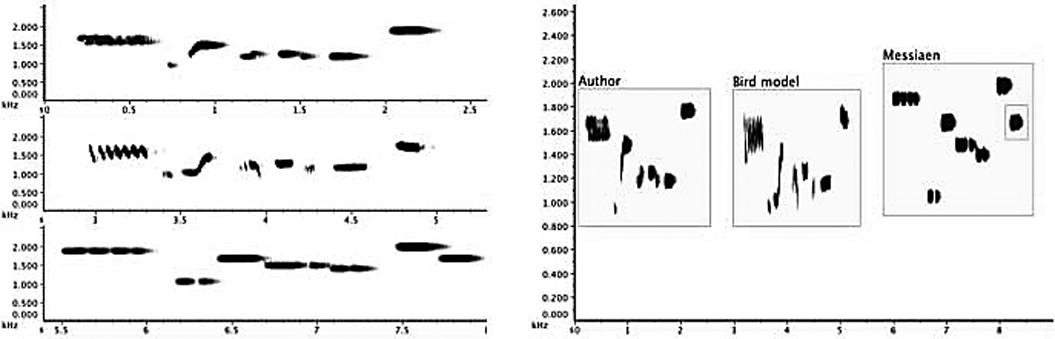
Track 4, phrase 1 as viewed in sonographic analysis (Figure 2) details how Messiaen expands the pitch range in both directions (five semitones beyond my transcription). Messiaen's discussion with Samuel is perhaps relevant here:
Birds are able to sing in extremely high registers that cannot be reproduced on our instruments; so I write one, two, or three octaves lower. And that's not the only adjustment: for the same reasons, I'm obliged to eliminate any tiny intervals that our instruments cannot execute. I replace those intervals, which are of the order of one or two microtones, by semitones, but I respect the proportions of the different intervals, which is to say that if a few microtones correspond to a semitone, a whole tone or a third will correspond to a real semitone; all are enlarged, but the proportions remain identical. As a result, what I restore is nevertheless exact. It's a transposition of what I heard, but on a more human scale’.Footnote 57
Pour Messiaen, Track 4 at the beginning: sonographic analysis of phrase 1 of the author's transcription, the bird model, and Messiaen's transcription (cahier #23159.25.9).
However, since Messiaen leaves no record of by how many semitones he stretches the proportions for this or any other birdsong – indeed, he leaves no documentation at all of when he does this and when not – it becomes impossible to salvage the original material from his notation.
A further peculiarity concerns Messiaen's choice of durational values. It is difficult to reconcile Messiaen's omission of noteheads from repeated notes, which indicate haste, with the laboriousness involved in notating a slow song (marked lent) in semiquavers and demisemiquavers. While the choice of note values seems counter-intuitive, these rhythms are pertinent because they will be the ones called upon by the composer in his score. The visual appearance of the composer's scores undoubtedly here affects his approach to transcription. As Erhard Karkoschka notes, ‘[t]he technical possibilities of a notation system also influence the act of composing – the entire musical way of thinking of all musicians – so that the aural image of a musical work in every epoch is characteristically related to its visual configuration’.Footnote 58
Transcription of the Crouch recording Bird Calls of the Inland
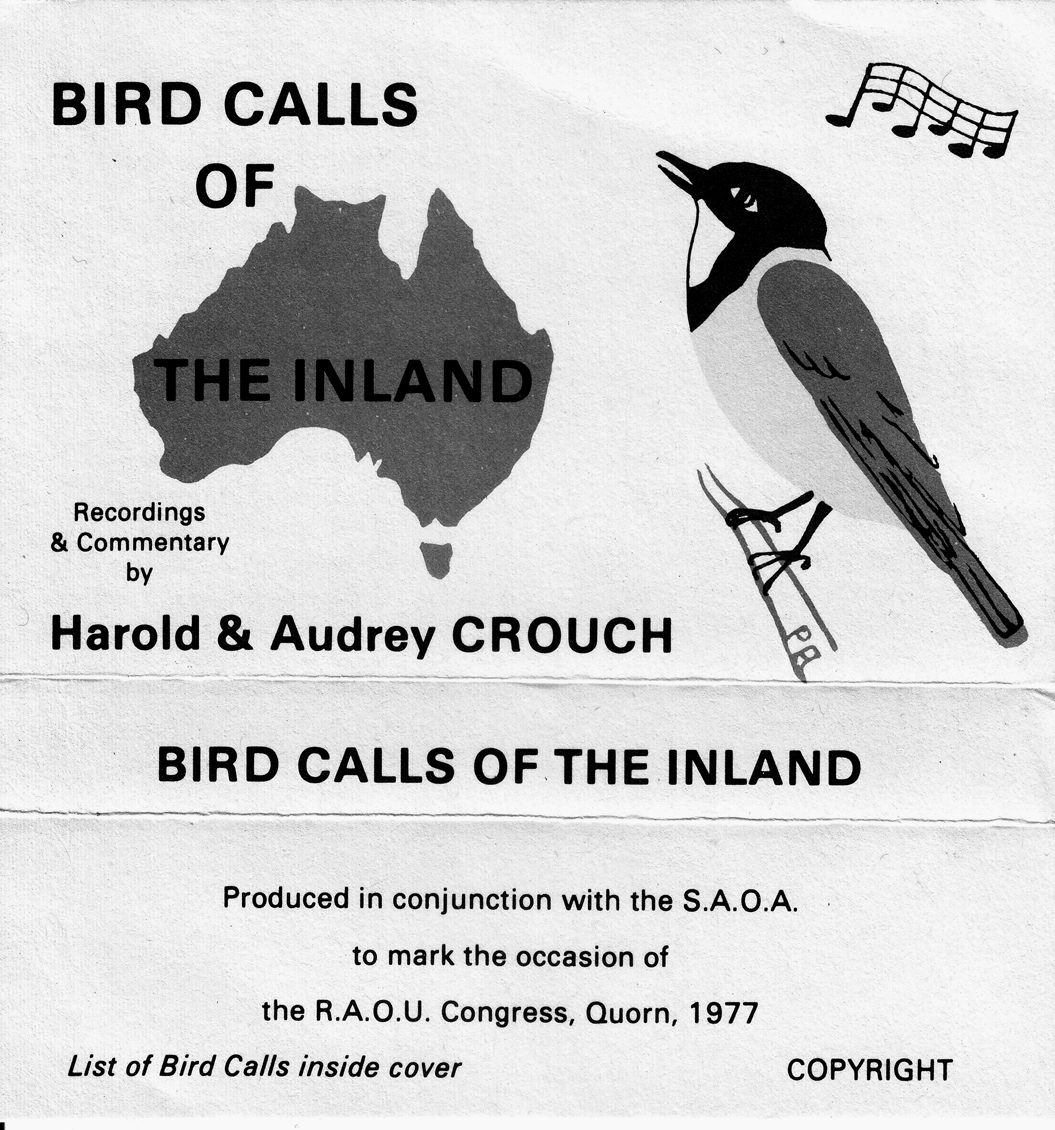
In 1977 the ornithologists Harold and Audrey Crouch produced a cassette recording entitled Bird Calls of the Inland (see Figure 3). Obscure in its day, it is even more so thirty-six years on. Nevertheless, Messiaen had a copy from which he transcribed thirty-three birdsongs. (By the early 1960s, Messiaen was collecting discs of birdsong from all over the world, and students often gave him birdsong recordings as gifts.Footnote 59) Cahiers #23159.3–12 contain notations of all but ten birdsongs from this cassette, and several birds are reworked on a later page. Such is the case with Track 43, the pied butcherbird recording that ends the cassette and which sees three manifestations in this cahier, on pages six, ten, and twelve.Footnote 60
Cassette insert for Bird Calls of the Inland, from which Messiaen transcribed. Reproduced with permission.
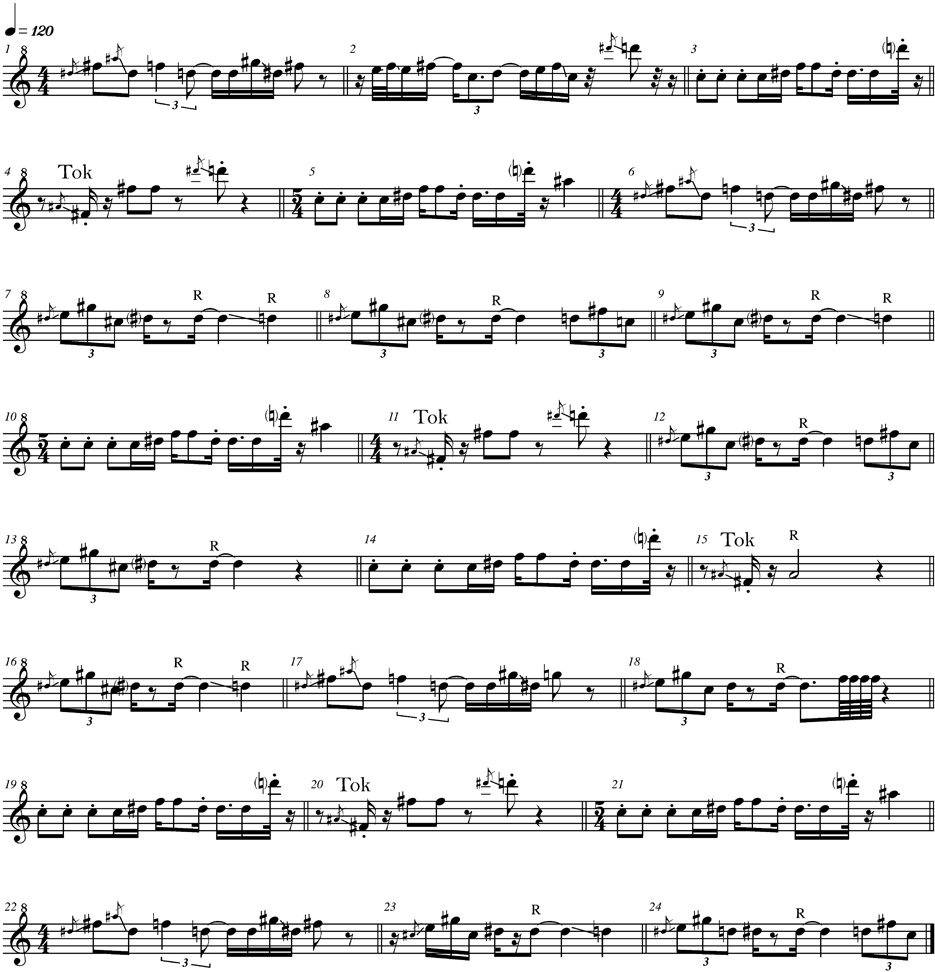
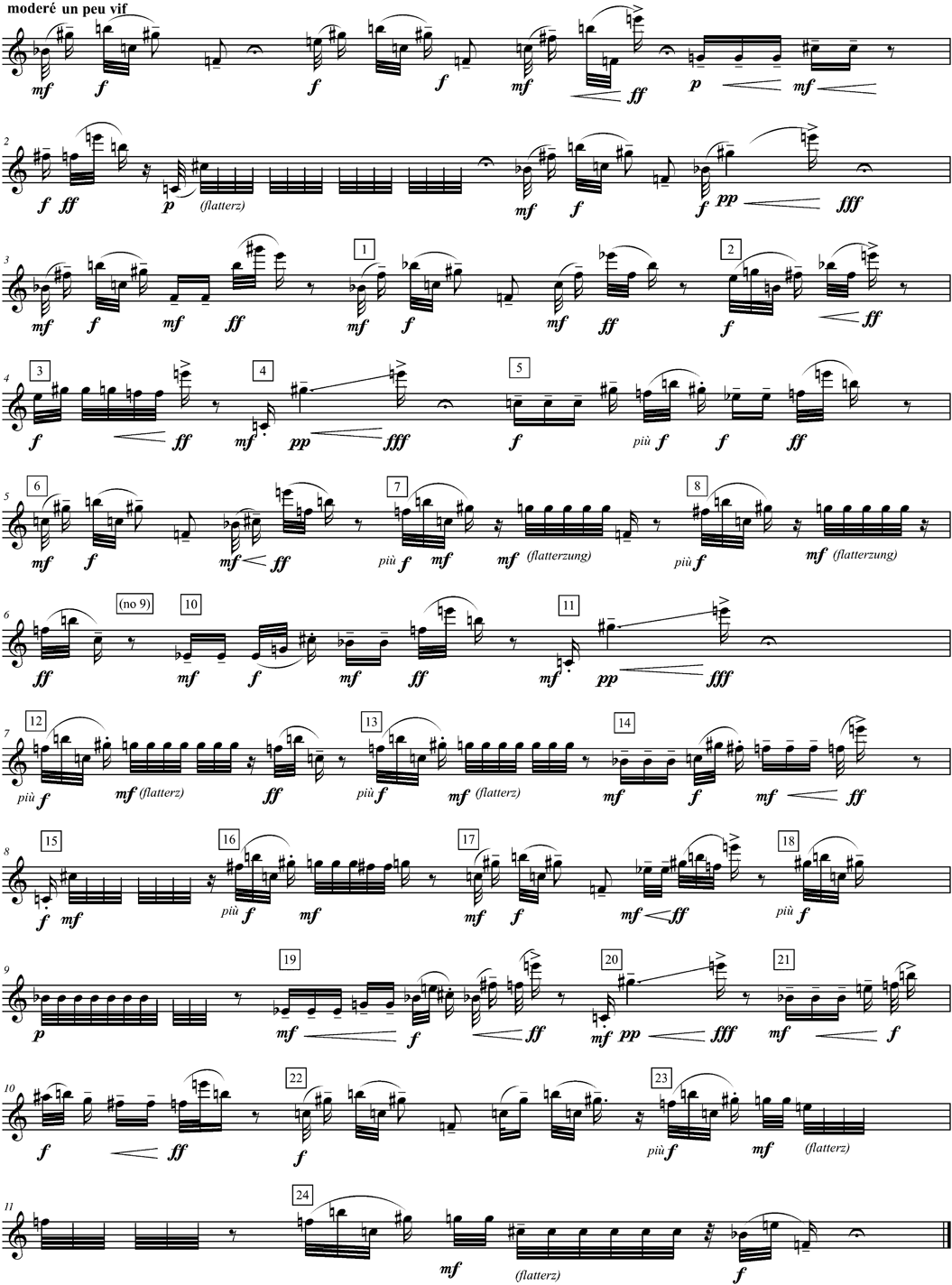
Page twelve (cahier #23159.12) contains Messiaen's sole transcription of the entire track. In fact, there are six more phrases in the transcription than in the recording; these precede the complete transcription and may represent ‘false starts’ on the part of the composer (the phrases are close matches to material that appears later). In Example 3a and 3b, Messiaen's transcription from page twelve is paired with the author's, and if we begin in the middle of the third stave of Messiaen's transcription, the matchup works to the end. In the author's transcription, note that ‘R’ indicates a rattle on that pitch for the duration of the assigned rhythm, and that ‘Tok’ indicates a timbral effect resembling this mnemonic catchword. It is interesting to observe that here Messiaen elects to write out the rattle iterations in a more thorough manner than in his grey butcherbird transcription (see Example 1).
Bird Calls of the Inland, Track 43 from beginning to end, as transcribed by the author.
Bird Calls of the Inland, Track 43 from beginning to end, as transcribed by Messiaen (cahier #23159.12). Square-bracketed numbers have been added to aid comparison with the phrases in the author's transcription.
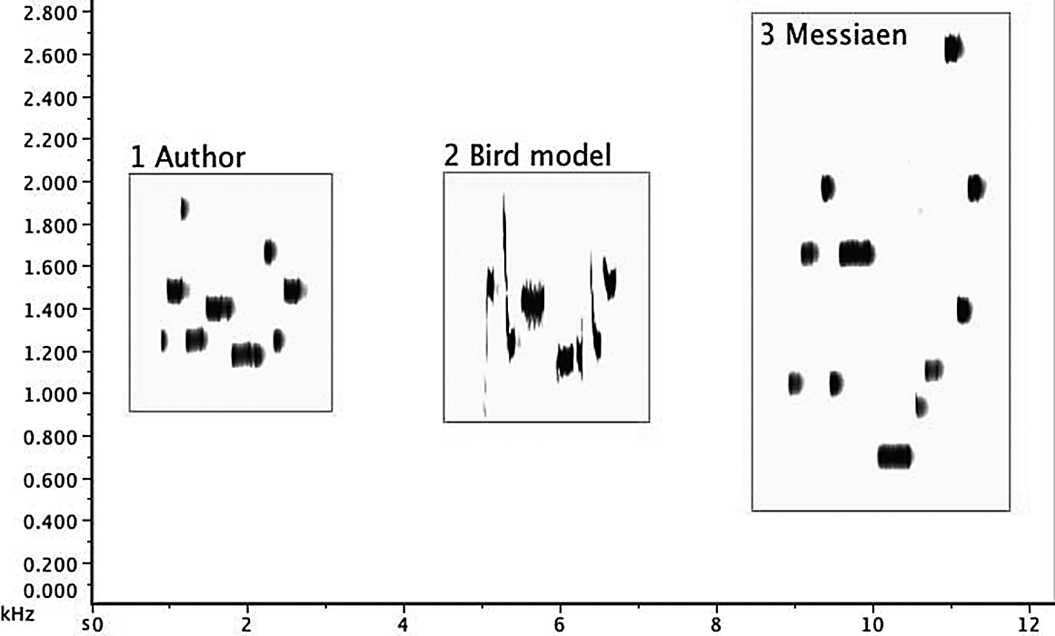
There is much that could be commented upon in the extended transcription, and my discussion is necessarily selective. Sonogram analysis helps to highlight Messiaen's treatment of pitch range. Figure 4 represents phrases 1–7. Again, we see an expanded pitch range (up from my five semitone range to thirteen semitones for Messiaen). A close-up of the first phrase (Figure 5 in a sonogram and Example 4 in notation) makes this even more evident.
Bird Calls of the Inland, Track 43: sonographic analysis (14:08–14:37) of the author's transcription of phrases 1–7, the bird model, and Messiaen's transcription of the same phrases (cahier #23159.12.3–4).
Bird Calls of the Inland, Track 43 at phrase 1 (14:08): sonographic analysis of phrase 1 of the author's transcription, the bird model, and Messiaen's transcription (cahier #23159.12.3).
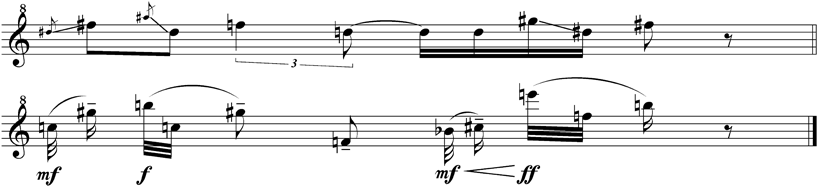
Bird Calls of the Inland, Track 43 at phrase 1 (14:08) with the author's transcription on the top staff and Messiaen's (cahier #23159.12.3) on the bottom.
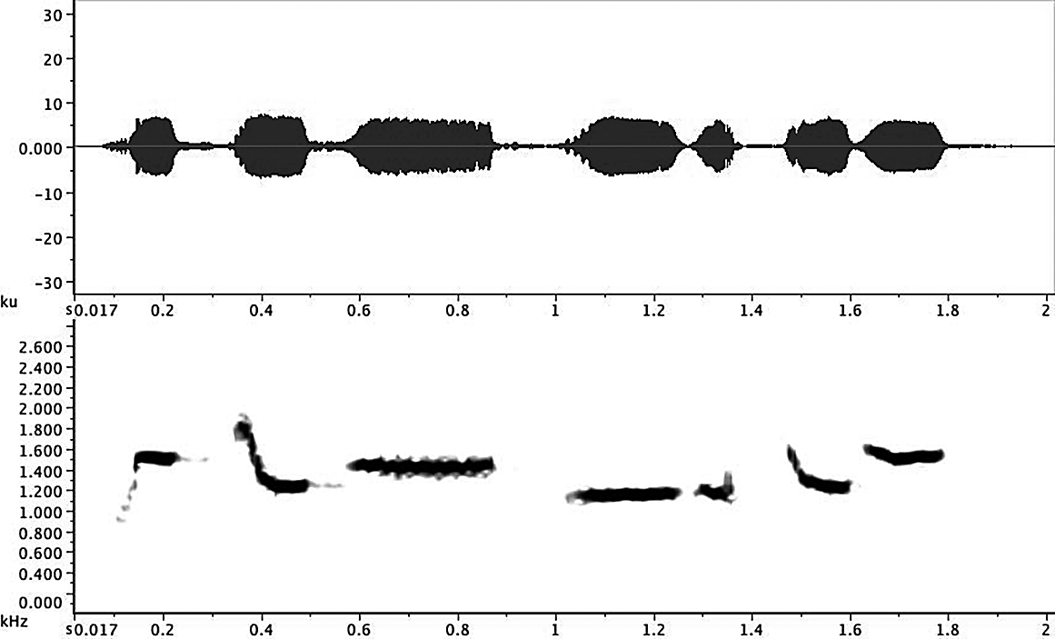
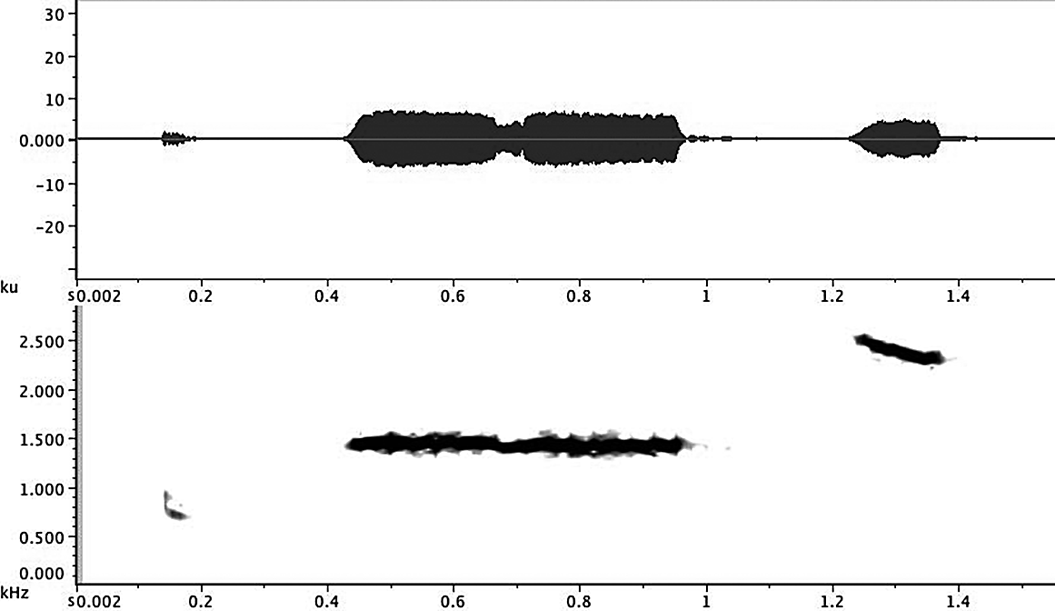
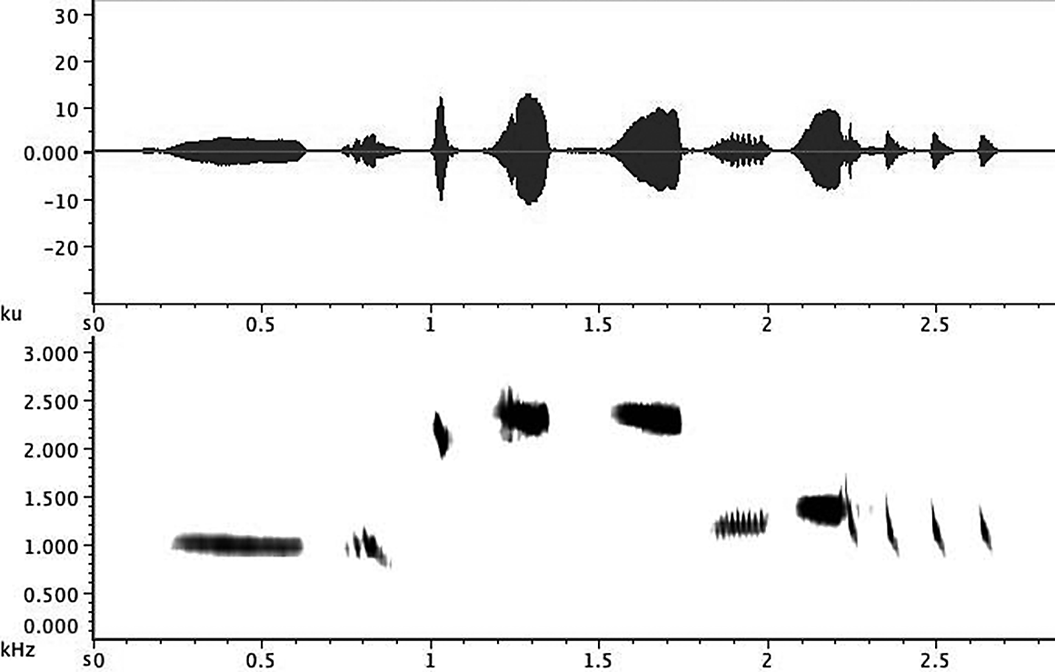
A waveform analysis of the start of the original recording of this track (Figure 6) displays a virtually flat envelope. This does not provide a basis for the dynamic fluctuation notated by Messiaen. The first note is indeed softer than the others, but Messiaen waits until note three to insert forte. The other dynamics are Messiaen's contribution, rather than determined by the birdsong itself. It seems fair to assume that Messiaen is already in composition mode and not seeking complete faithfulness to what the bird-musician is vocalizing. Phrase 4 presents an even more extreme disparity between waveform analysis of the original song and Messiaen's chosen dynamics (mf-pp[cresc]-fff) (Figure 7).
Bird Calls of the Inland, Track 43 at phrase 7 (14:08): waveform analysis of the original recording paired with its sonogram below.
Bird Calls of the Inland, Track 43 at phrase 4 (13:54): waveform analysis of the original recording paired with its sonogram below.
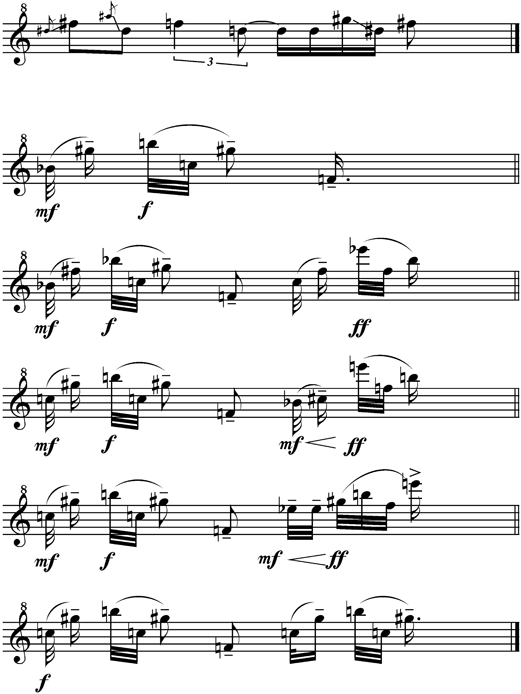
In further scrutiny of the first phrase of the track, the author's transcription of it is placed in the top stave of Example 5. This phrase is sung four times in the recording (in one delivery, the final note is closer to a g2 than an f#2). The subsequent bars are Messiaen's various versions to what the author's ear and sonographic analysis indicate are nearly identical repetitions of the phrase. During his crafting of Réveil des oiseaux, Messiaen was thought to have had ‘an almost superstitious belief that his first impressions were the truest’, although this attachment, at least during the compositional process, diminished in the course of writing Oiseaux exotiques.Footnote 61 Whilst we cannot know which of these phrases he finds the truest, or if fidelity is even his goal, it is clear that he arrives at something different each time. Hill and Simeone describe a similar moment in Oiseaux exotiques:
A moment that encapsulates Messiaen's new and more imaginative way came with the music of the wood thrush. Messiaen's first notation and the two subsequent elaborations could be described, if not as accurate, at least as accurate equivalents. But the final step goes much further: an inspired simplification, with its spacious tempo and timing, and harmonies drenched in pedal. This is certainly not a transcription, or even a creative reconstruction, but the song of the wood thrush as Messiaen wished to imagine it.Footnote 62
Bird Calls of the Inland, Track 43 with the author's transcription of phrase 1 on the top and Messiaen's five differing transcriptions (cahier #23159.12) of it below.
Although Messiaen does not move in this transcription towards simplification, it appears that he is merging the sounds of the pied butcherbird and those of his imagination. Whilst some notes are consistent in all parameters, the pitch, the number of notes, and even the direction of some notes vary considerably. A comparison with the notations of the author, along with sonographic analysis, points to similar discrepancies in other phrases of Messiaen's transcription: extra notes are included, the rhythm matches the model reasonably, the pitch range is stretched (with no sense that intervallic relationships are preserved or are musically salient), and the dynamics match the model only partially.
Transcription of the Roché recording Les plus beaux chants d'oiseaux
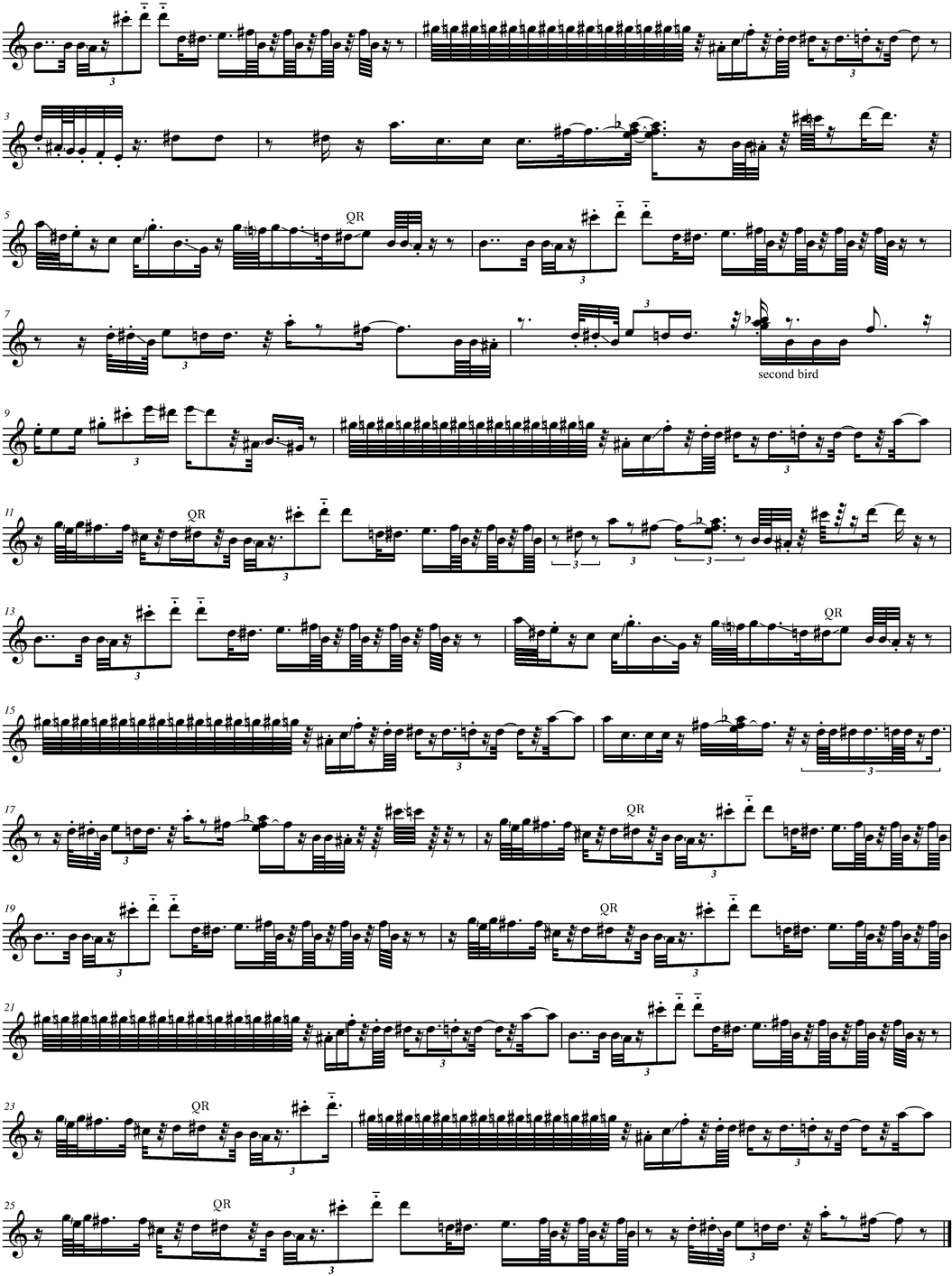
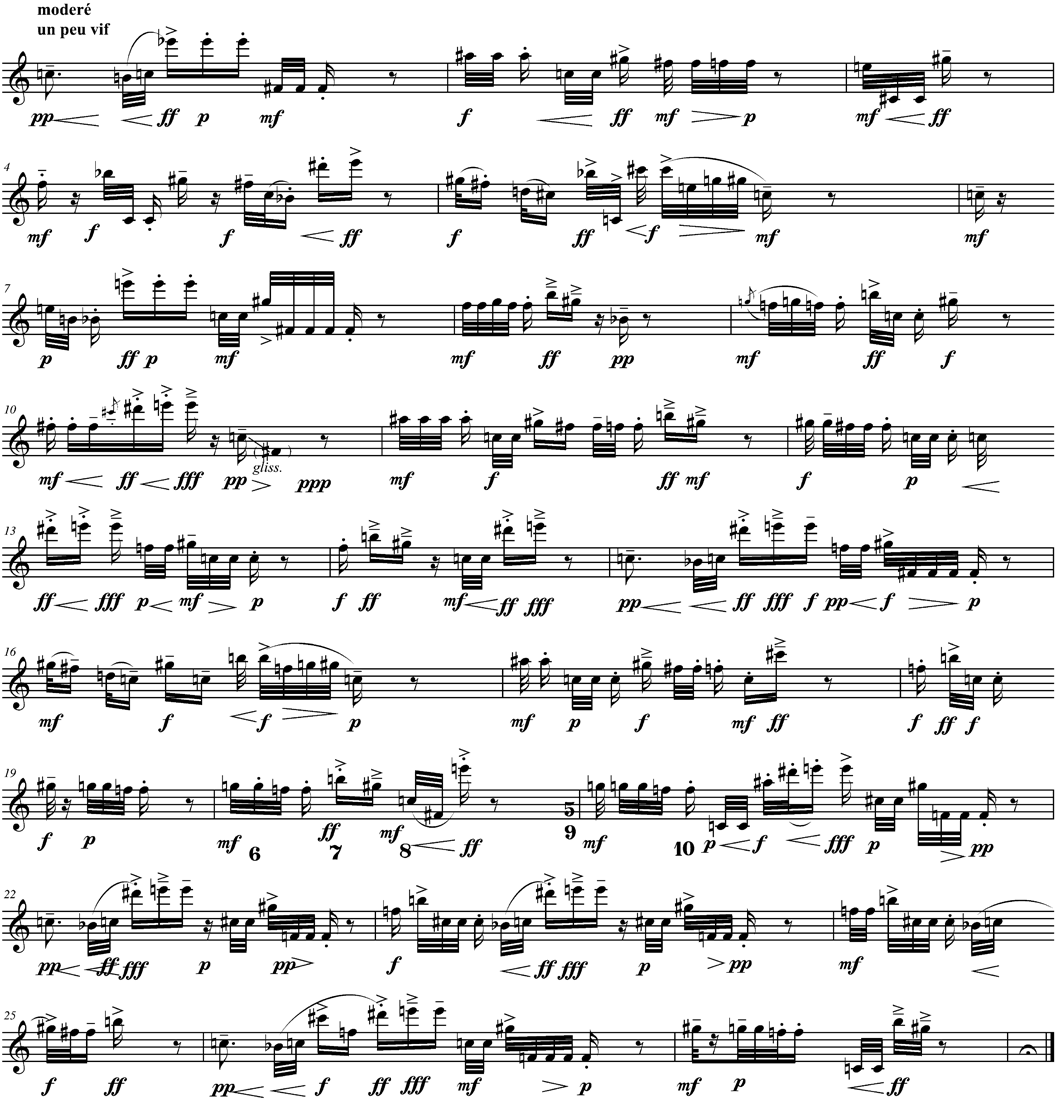
Our final pied butcherbird recording is Track 13 from Jean C. Roché's Les plus beaux chants d'oiseaux. This recording had a further public release in the form of a pied butcherbird stuffed toy from Wild Republic Birds, which credits Roché as the recordist and places the recording at Lamington National Park, in Queensland, in September 1974 (Roché's CD was released in 1987, with presumably an earlier release in cassette format that Messiaen must have had).Footnote 63 A comparison of the author's transcription (Example 6) with Messiaen's (Example 7) reveals considerable differences.
Les plus beaux chants d'oiseaux, Track 13 from beginning to end, as transcribed by the author.
Les plus beaux chants d'oiseaux, Track 13 from beginning to end, as transcribed by Messiaen (cahier #23159.57.1–11).
We will focus on two phrases. Example 8 and Figure 8 detail the phrase at 2:22 (his b. 26 and the author's b. 25), where Messiaen has added two extra notes, his notes six and seven. Otherwise, the rhythm and the pitches are a reasonable match. The extra notes radically stretch the pitch range, and the full transcription sees the author's range of nineteen semitones versus Messiaen's twenty-eight. Messiaen has essentially replaced the bird's pitch relationships with his own.
Les plus beaux chants d'oiseaux, Track 13 at 2:22, with the phrase as transcribed by the author on the top staff and Messiaen (cahier #23159.3) on the bottom.
Les plus beaux chants d'oiseaux, Track 13 at 2:22, with sonographic analysis of the final phrase of the author's transcription, the bird model, and Messiaen's transcription (cahier #23159.57.3). Messiaen's extra two notes are internally boxed.
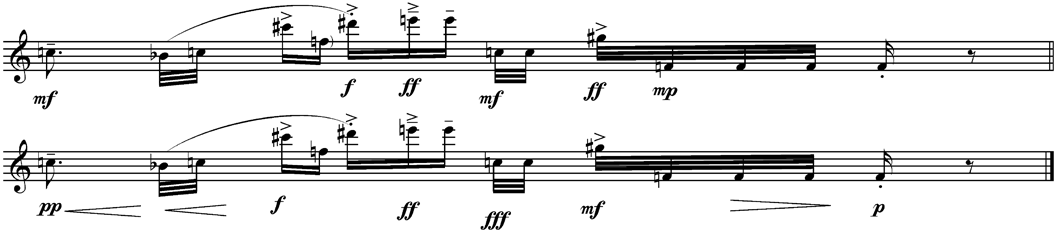
In Figure 9, a waveform of the phrase at 0:33 suggests that this example would be ripe for dynamic markings, and Messiaen has contributed some. However, they correspond to the waveform analysis only to a limited degree. Example 9 offers the author's translation of the waveform analysis into dynamic markings, using Messiaen's pitch and rhythmic transcription, with Messiaen's version below. At best, his dynamic markings match the model only half of the time.
Les plus beaux chants d'oiseaux, Track 13 at 0:33, with waveform analysis of phrase 1 of the recording, paired with its sonogram below.
Les plus beaux chants d'oiseaux, Track 13 at 0:33. Both are the same Messiaen transcription (cahier #23159.57.3), but with the author's suggested dynamics based on waveform analysis on the top staff and Messiaen's on the bottom.
The other phrase from Track 13 under inspection is at 0:48 (Messiaen's b. 11 and the author's b. 10, singled out in Figure 10), which is displayed in two sonogram views (Figure 10a and 10b), and in transcriptions from the author and Messiaen (Example 10). This phrase was chosen because the two transcriptions are the best match from the whole song. Messiaen does not stretch the pitch range, and the only major difference is the extra note he adds at the end. However, listening back to this phrase, and indeed all of this track as well as the Curtis and Crouch recordings, I am struck by how seldom the Messiaen transcriptions when played back correspond to the rhythm of the bird model. The syncopated flavour of this birdsong phrase is captured by Messiaen for Messiaen via note groupings and slur markings, which in part compensate for the lack of further rhythmic detail. As in other examples, the almost exclusive use of chains of semiquavers and demisemiquavers represents a stylized – and, one must assume, deliberate – simplification. These aspects of Messiaen's transcription style do not allow for a retrieval of the source material after the fact, either by Messiaen or anyone else.
Les plus beaux chants d'oiseaux, Track 13 at 0:48, with the author's transcription, the bird model, and Messiaen's transcription (cahier #23159.57.4) from top to bottom (10a) and from left to right (10b). Messiaen's final ‘extra’ note is internally boxed.
Les plus beaux chants d'oiseaux, Track 13 at 0:48, with the author's transcription on the top staff and Messiaen's (cahier #23159.57.4) on the bottom.
Transcriptions from Tamborine Mountain
We return to Curtis, this time to examine the results of his fieldwork trips with Messiaen. The composer wrote of this morning:
Tamborine Mountain, the 13th of June 1988. It was necessary to depart the hotel at 3 a.m. for the one-hour drive in order to install ourselves in the forest at dead of night so as to not disturb the birds. This is a tropical forest. This spot was particularly rich in songs: it is here that I heard, in addition to the Superb Lyrebird, the Albert's Lyrebird. It is less brilliant than the Superb, a little slower, but the song is very beautiful and the timbre remarkable. In three hours, in addition to these two birds I also had the Australian Magpie, the Pied Butcherbird, the Grey Butcherbird, the Black Butcherbird, the Golden Whistler, the Little Shrike-Thrush, the Grey Shrike Thrush, several Whipbirds, the Lewin's Honeyeater, the Rainbow Lorikeet, and the irresistible laugh of the Kookaburra. I saw “Curtis Falls”: the waterfall named after the grandfather of my ornithologist. A stream of clear green water flows down the tropical landscape among giant ferns, eucalypts, and a giant fig tree with a trunk measuring ten metres in diameter at the base … branches, enormous root – it's marvelous!!!Footnote 64
Curtis recalls: ‘I was able to get us into position before the [Albert's] lyrebird started calling from his roost – they start before there's much light at ground level. His wife was operating a little recorder, and I held the torch while Messiaen notated’.Footnote 65 Six pages in the cahiers are devoted to this outing. The first three were done in the field: cahiers #23159.64–66. The second three, cahiers #23161.40–42, are marked ‘second notation’ and are apparently the result of transcription from the recording. Concerning second notations, Messiaen writes:
I make one notation on the spot with all the variations, and my wife makes a tape recording which is less varied than mine, but which captures everything exactly. Then I make a second notation from the tape recorder which is more exact but less artistic. […] So I always have my two notations, one exact and one more artistic, and I mix the two.Footnote 66
Fallon observes that ‘[b]ecause Messiaen's handwriting for his outdoor transcriptions appears to be no more hurried than for the recording, there is no reason to suppose that his transcriptions from the records are any more or less accurate than his live transcriptions’, and this holds true for all paired examples of fieldwork and deskwork that I have inspected.Footnote 67 The Tamborine Mountain re-notation bears the original date and time and sees a repeat transcription of all birds except the brown pigeon, the rainbow lorikeet and the white-throated treecreeper. The birds arrive in approximately the same order, with the most attention being given to the Albert's lyrebird, followed by the pied currawong, pied butcherbird and Australian magpie. A pied butcherbird is notated on #23159.65.11–12 and #23161.41.6–9. Since we have no access to Loriod's recording, I shall limit the analysis to a brief comparison of the two Messiaen transcriptions.
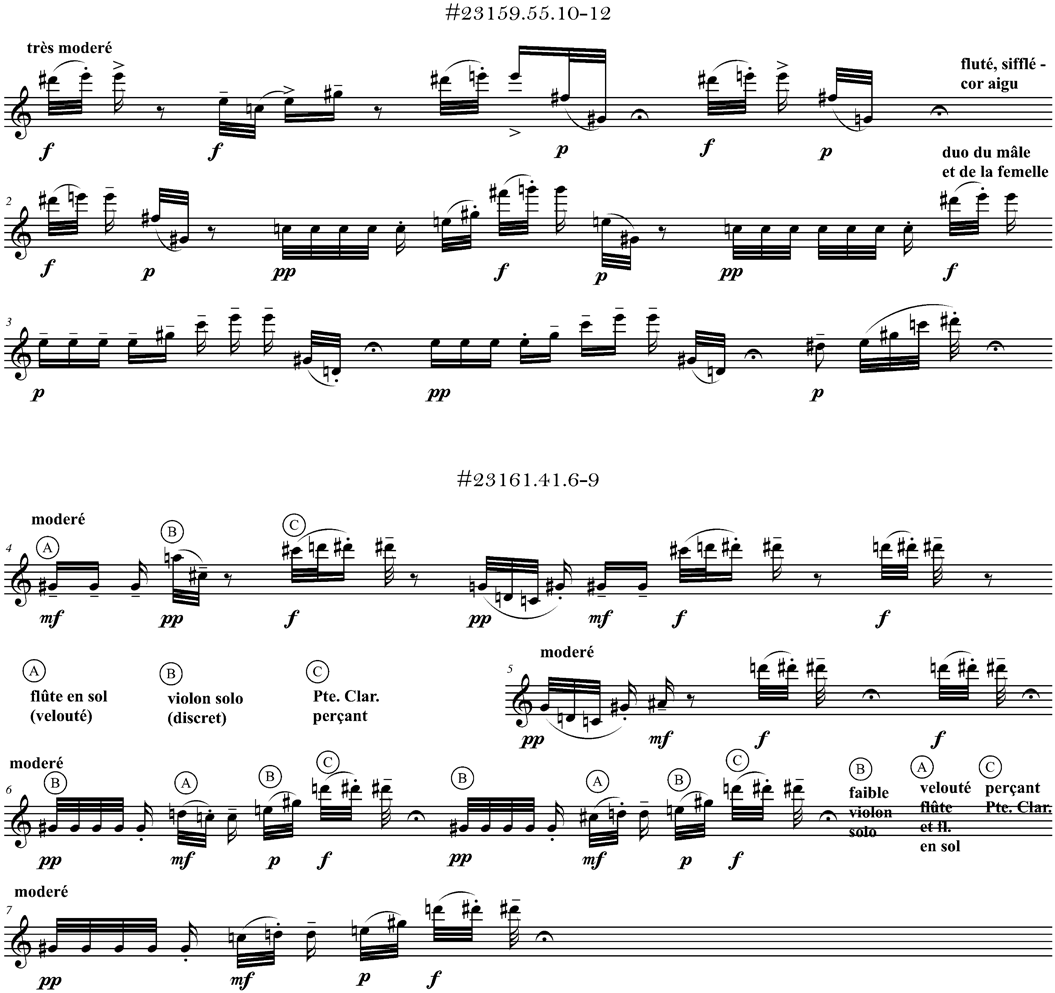
Example 11 reveals, first, a pitch disparity in the initial note of a prominent repeated ascending motif: five or more repetitions of a stable pitch in demisemiquavers begin on c2 (staff 2) and e2 (staff 3) in the first notation, but on g#1 in the second (staves 6 and 7). While this note is thus altered by four and nine semitones respectively, it is safe to assume that the bird delivered the motif on the same pitch each time. However, by the time Messiaen arrives at the highest notes of the phrase, the pitch disparity is all but ironed out. As in other transcriptions by Messiaen, semiquavers and demisemiquavers are the sole note values in both notations (along with quaver rests or fermatas to mark out the phrases). In the second transcription Messiaen is preparing orchestration ideas. For example, the petites clarinets, along with the flute, will indeed be given motif C in a Messiaen composition, as discussed in the next section.
Messiaen's first (cahier #23159.55.10–12) and second notation (cahier #23161.41.6–9) of his Tamborine Mountain fieldwork.
Based on this and the other analyses presented here, I propose a provisional template of Messiaen's personal style of birdsong transcription, which is also informed by a previous study of Messiaen's transcription from Lyrebirds for Olivier Messiaen, and a less formal analysis of all the other Australian birds transcribed from the Curtis and Crouch recordings:
1. Rhythm: Rhythms are often underspecified and rely on beams and slur markings to suggest additional subtleties. Semiquavers and demisemiquavers are by far the most common note values; quavers make a rare appearance, and crochets are even rarer. No triplets or other tuplets are indicated. The marking of the end of a phrase is accomplished by a bar-line, a fermata sign embedded in an empty staff, or a rest (usually a quaver, although intra-phrase rests are most often semiquavers); when none of these is present, a new dynamic marking or the grouping of motifs by a slur can assist in parsing the phrase separations. A Messiaen transcription played back side-by-side with its bird model can seem to have undergone the technological processing of rhythm quantization, since with such a limited rhythmic palette, its rhythm matches the birdsong model only very approximately.
2. Tempo and Metre: No metronomic markings or time signatures are present. Tempo is occasionally indicated by text, such as lent.
3. Pitch: Although never marked as such, the pitch proportions are sometimes stretched. There is no indication that the proportions of the new intervals are applied consistently; instead, stretched intervallic proportions appear to be haphazard. Overall, pitch and pitch contour match the birdsong model moderately well, but there is a large fluctuation: some match well, while others poorly. Any number of events could contribute to ambiguity of pitch in the field or on a recording: when notes are noisy (where energy is distributed at multiple frequencies), microtonal, very short, very soft, very loud, or the victim of a recording fault. Although such notes could be marked in a variety of manners, including parentheses, question marks, half-sharps, and headless noteheads, Messiaen does not attend to these sorts of issues in his transcriptions. However, headless noteheads are sometimes in evidence for a series of repeated notes on the same pitch.
4. Portamento: Approximately 10–20% of portamentos are notated. These are indicated by a line between two noteheads (or occasionally by a slur marking) and are sometimes also marked ‘gliss.’.
5. Dynamics: Even in the field, Messiaen takes the time to meticulously notate dynamic indications. Sometimes, a majority of notes in a phrase are each assigned a marking. These match to waveform analysis of the songs about half of the time.
6. Articulations: Messiaen notates detailed articulations. Since these are subjective assessments (or at least not easily measurable in sonographic and waveform analysis), this study makes no attempt to assess them.
7. Timbre: Messiaen regularly writes text in the marginalia referring to timbral characteristics.
8. Absence/presence: At times, notes or other elements of a song are disregarded, whilst at other times notes or other details not in the birdsong model are included.
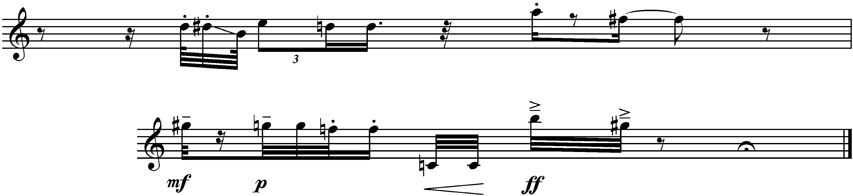
What might it mean to be wrong in a pied butcherbird transcription – wrong to whom? Pied butcherbirds appear to possess absolute pitch, and phrases that endure more than a season are typically delivered on the same pitch in subsequent years, indicating that at least for them a stretched pitch profile is not equivalent.Footnote 68 Solo songs are always delivered discontinuously, with silent space between phrases; the fact that their mimicry can be delivered in continuous bouts of fifteen minutes or more indicates that theses gaps are not the product of physical constraint but of avian choice. While no two mature pied butcherbirds sing exactly the same phrases in their solo songs, and these song phrases transform annually, group song phrases are their unchanging ‘classics’, featuring stable pitch and rhythm on phrases that are held in common in a ‘trading zone’ of up to 150 kilometres in distance.Footnote 69 Music is about relationships – the proportions of components and the subtleties of combinations are in a fragile dance with one another. Stretched intervals that are interchangeable for Messiaen may not be so for others, including avian others. To paraphrase Hold, this is Messiaen's pied butcherbird, not the birds’, and not mine.Footnote 70
The Pied butcherbird in Messiaen's compositions and texts
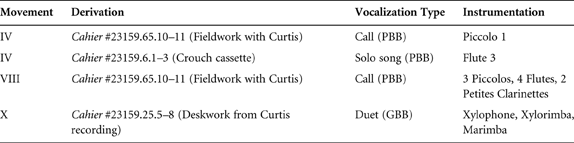
While it is not my principal purpose to trace pied butcherbird vocalizations from transcription to score, nor how these motifs are harmonized, set in particular rhythms, combined to create certain timbres, or otherwise elaborated, I will briefly note the species’ presence or absence in Messiaen's compositions and texts. A number of Australian birds figure in his final completed work, Éclairs sur l'Au-Delà. Footnote 71 The pied butcherbird has the unique distinction of being named in three movements, IV, VIII, and X. However, reproducing the confusion noted earlier around Track 3 in the Pour Messiaen cassette, what is identified by the composer as a ‘pied butcherbird’ soloist in the tenth movement is actually a pair of grey butcherbirds.Footnote 72 This and the pied butcherbird appearances in the other two movements are summarized in Table 2.
Pied (PBB) and grey (GBB) butcherbird vocalizations (mistakenly identified as pied) in Éclairs sur l'Au-Delà.
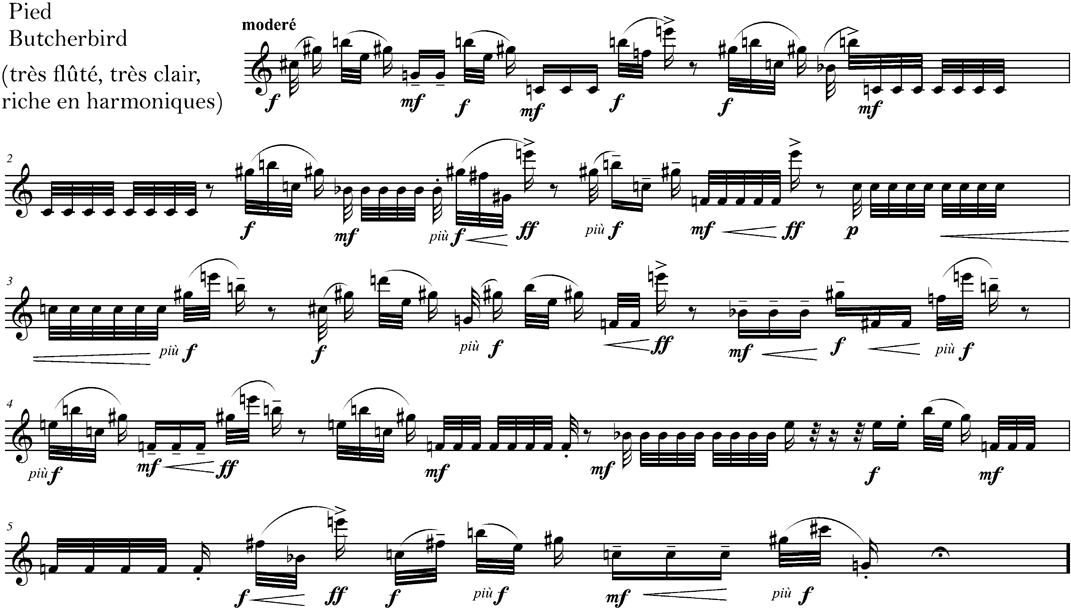
In movement IV, ‘Les élus marqués du Sceau’, Messiaen names the pied butcherbird in the score in Flute 3 at the end of Fig. 2-2, and in the next bar the flute takes up a near verbatim delivery of lines 1–2 of cahier #23159.6, the first transcription in this cahier of track 43 of the Crouch cassette (Example 12). There are only two minor deviations of this material: repetitions of the same pitch do not continue for more than two or three iterations, and two notes from line 1 (bb1 rising to b2) are transposed up an octave. These motifs are almost the entire material assigned to Flute 3 in this movement and see several repetitions. Other motifs are sourced from line 3 of the transcription (notes 7–9 appear at Fig. 3+1, transposed up a tritone) and line four (notes 1–4 find their way to Fig. 5+3). Flute 3 also is assigned the pied butcherbird ‘species call’ (in its last three notes of Fig. 7-1), a motif of three, four, or five high-register notes that may be transposed by the birds when decontextualized and placed in song.Footnote 73 The call is diagnostic for the species, meaning that one can identify the bird by it, whether sighted or not (see Example 12 for another example).Footnote 74 In movement IV, Piccolo 1 is regularly assigned notes that are likely the species call (in the piccolo's final three notes of b. 3, of Fig. 3+1, of Fig. 6, and Fig. 8+4; in its first four notes of Fig. 8-2; and in its two notes of the final bar). We recall that Messiaen notated this recording three times (cahiers pages six, ten, and twelve, the last of which is reproduced in Ex. 3b); if we can trust the catalogue numbering, which is not always the case, he has here relied on his first impression.
Bird Calls of the Inland, Track 43 from beginning to end: Messiaen's transcription from cahier #23159.6, reproduced almost verbatim in movement IV of Éclairs sur l'Au-Delà.
Dingle provides an illuminating and detailed analysis of movement VIII, ‘les étoiles et la Gloire’, setting up the birdsong sections thusly:
[T]he term ‘birdsong’ covers an enormous variety of material. The C sections of ‘les étoiles et la Gloire’ are no exception. Indeed, Messiaen seems determined to give some indication of the full gamut of possibilities thrown up by his feathered protagonists. Broadly speaking, these lengthy ornithological passages start with songs that have clear harmonic associations, and gradually move towards songs and calls that are harmonically ambiguous, aharmonic or even little more than a noise.Footnote 75
In his own analysis of ‘les étoiles et la Gloire’ in the preface to the score, Messiaen divides the movement into ten sections.Footnote 76 He writes that section four includes four birds: in order of entry, the mallee ringneck, the hooded butcherbird, the shama, and the pied butcherbird.Footnote 77 The latter is identified at Fig. 19+2. The motif d#3 – e3 – e3 at 19+3 (circled in Example 13) is an exact match with the species call in the Tamborine Mountain field transcriptions.Footnote 78 This motif is also found in the Roché recording, although transposed down two semitones. I also note the slur in Example 13, indicated with an arrow, joining an anacrusic demisemiquaver to the high d♯3, which suggests the occasional pied butcherbird strategy of a ‘zip’ up to the first note of the call.Footnote 79 Although this could be merely the product of Messiaen's imagination, it is possible he heard this zip on Tamborine Mountain and the subsequent tape, even though he never notated it. The three- (or four-) note motif (notated in semiquavers) matches the birdsong model in full. No other material in these four score pages is an obvious match with any pied butcherbird transcriptions we have examined, but the nineteen-bar section of the score between Figures 19 and 20 includes motifs with complex harmonisations that could have originated in the species models, or at least be their re-worked motifs, particularly the rolling three-note slurred groups found in this section and also in cahiers #23159.6, #23159.10, and #23159.12 (Bird Calls of the Inland) and #23159.25 (Pour Messiaen).
A pied butcherbird motif in Messiaen's score of movement VIII, ‘les étoiles et la Gloire’ from Éclairs sur l'Au-Delà is an exact match with the recorded bird model and in his field transcription (cahier #23159.65.10–11).
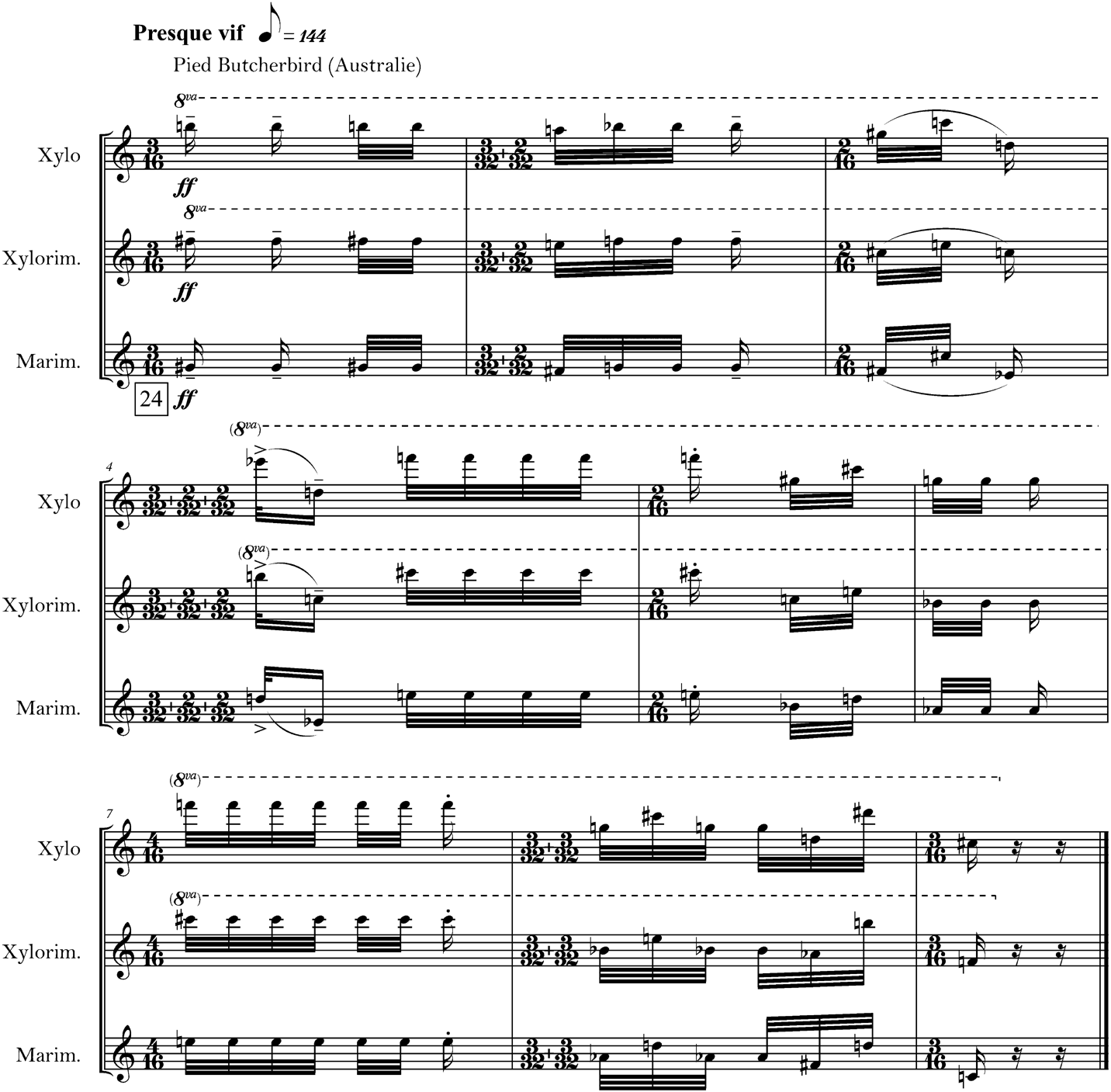
In movement X, ‘le chemin de l'Invisible’, only one species’ song is featured, one that Messiaen describes as flute-like, clear, and rich in harmonics, the grey butcherbird mistaken for the pied.Footnote 80 The first entrance at Fig. 17+3-4 (and again at Fig. 181-3) of a trio of percussionists (xylophone, xylorimba, and marimba) suggests in its rhythm and contour, but not in intervallic fidelity, a motif from cahier #23159.25. Messiaen does not indicate a pied butcherbird entrance until Fig. 24 (Example 14), where the trio, beginning on b3, f♯3, and b1, respectively, gives a faithful transposed rendition of the first seven notes of the grey butcherbird vocalization we examined earlier (bottom staff of Example 1). The three slurred notes that follow in the score (Fig. 24+2) find a close counterpart neither in Messiaen's nor the author's transcriptions, although they do hint at the melodic contour of several slurred three-note groupings in cahier #23159.25.5–8. The next seven notes in the score (Fig. 24+3 and the first note of Fig. 24+4) return with fidelity to the original grey butcherbird transcription. The last five of these notes are repetitions of a single pitch, which, as the reader will recall, the bird delivered as ascending and descending rattles. We can only speculate as to whether or not Messiaen re-listened to the original recording, but it seems that his original transcription satisfied him as it was first set down. Earlier in the movement (Fig. 15–15+3), he assigns ascending and descending portamentos and scale fragments to the strings, but no other grey butcherbird material is given to them; it is unclear whether this is a nod to the grey butcherbird recording, though it demonstrates that he was amenable to occasionally assigning the technique to instruments.
Grey (but attributed to the pied) butcherbird notes assigned to a percussion trio at Fig. 24 of movement X, ‘le chemin de l'Invisible’ from Éclairs sur l'Au-Delà.
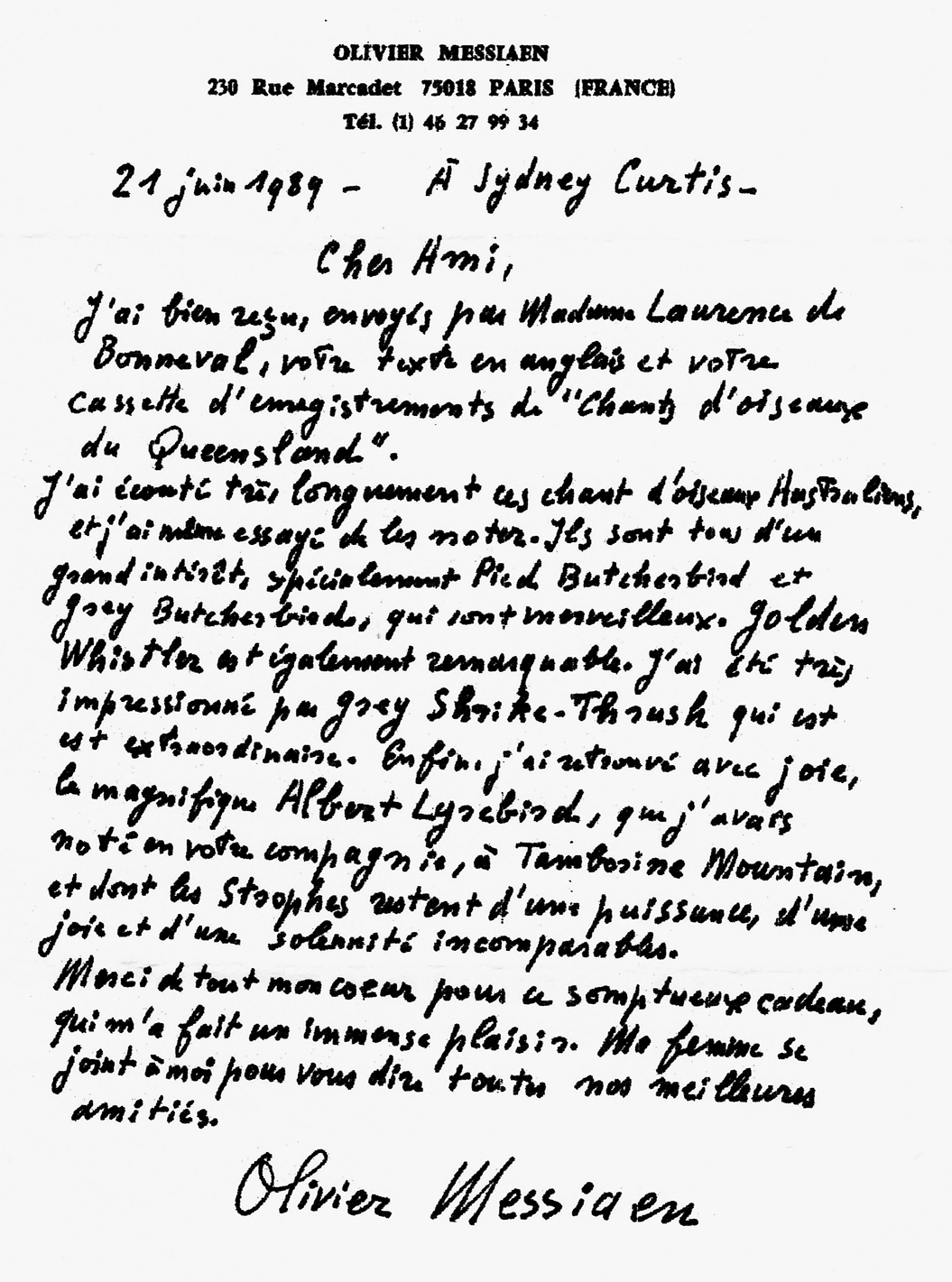
The pied butcherbird appears in several of Messiaen's texts. First, amongst his correspondence with Curtis is a 1989 letter (Figure 11), in which Messiaen singles out the pied butcherbird, grey butcherbird, golden whistler, grey shrike-thrush and Albert's lyrebird as being his particular favourites from the cassette Pour Messiaen.
Letter from Messiaen to Curtis dated 21 June 1989. Used with permission.
The pied butcherbird is absent from the Traité. Six Australian birds from the cahiers are included (the superb lyrebird, grey butcherbird, willie wagtail, laughing kookaburra, Australian magpie and fantailed cuckoo). Amongst my 64 cahiers pages of Australian birdsong examples, only the Australian magpie matches with the example in the Traité. Messiaen writes that he returned from his Australian trip with over 100 pages of notation,Footnote 81 so the Archives might house more pages devoted to Australian birdsong than have been found to date. Of the fourteen instances of magpie transcription, the match is with cahier #23161.41.11–12 from Tamborine Mountain, which Messiaen does indeed attribute to this site in the Traité, giving the date June 1988.Footnote 82 This transcription is the re-worked version, presumably undertaken in Paris from a fieldwork tape. Intriguingly, there is also an example of a magpie in the ninth movement of D es canyons aux étoiles… (1974): Le moqueur polyglotte.Footnote 83 Messiaen began work on this 1971 commission from Alice Tully in 1972.Footnote 84 This would indicate that he had access to an Australian birdsong recording well before the Curtis and Crouch cassettes. The lyrebird entry in the Traité is credited by the composer as a superb lyrebird (Menura novaehollandiae) from Sherbrooke Forest,Footnote 85 which is east of Melbourne in the state of Victoria (I have 21 cahiers pages with superb lyrebird transcriptions, but none is a match), and the grey butcherbird entry (a species which he notated three times from the Crouch recording, once on Tamborine Mountain, and another unattributed time in the cahiers – but none is a match) is also placed in the forests of Victoria.Footnote 86
Finally, the Messiaen Archives houses a 1988 letter from Australian Ivan Kinny, who (according to Hill and Simeone) ‘sent Messiaen his own notations of birdsong, and commended the musical possibilities of the Australian Butcher Bird: “The bird is carnivorous and gets its name because of its practice of making a larder, impaling its prey on a thorn or wedging it in the fork of a tree to eat later. There is a grey variety (cracticus torquatus) and a black–and–white species (cracticus nigrolatus) [sic], which are among the finest bird singers. Their calls are very tuneful and diatonic and the sound is bright and pure, like a flute”’.Footnote 87
Conclusion
Birdsong transcription and fieldwork are easily romanticized and probably always will be. A case in point is Louvier, who begins his introduction to vol. 5/2 of the Traité: ‘For probably the first time in the history of music, a great artist agrees to thoroughly study ornithology, to go into the field in the company of scientists and expand research surveys with extraordinary tenacity, and to collect at all hours, in all seasons, in all weather’.Footnote 88 In a similar vein, Griffiths asserts that ‘there can be no doubt that he is far more conscientious an ornithologist than any earlier musician, and far more musical an observer than any other ornithologist’.Footnote 89 Reverence for Messiaen as a person and as a master-composer has the potential to cloud an accurate assessment of his birdsong transcriptions. Without taking anything away from his accomplishments, it is clear from our sample of Messiaen's pied butcherbird transcriptions post-1974 that they match their models only to a very limited degree. For all of the meticulousness, time, and effort that went into the cahiers and Traité, the end result is (despite what Louvier suggests) of negligible use to scientists or naturalists. Messiaen's birdsong transcriptions serve predominantly as an aide-memoire and a preliminary sketch for composition. Granted, this modest study essentially limits itself to one species, but an earlier study of Messiaen's lyrebird transcription and an initial assessment of 64 pages of Australian birdsong transcription identify similar outcomes and stylistic conventions in matters of rhythm, metre, pitch, portamento, dynamics, and matters of absence/presence.Footnote 90 Whether this provisional template holds true when other birds are surveyed employing a comparable methodology remains to be seen.
Goehr asks provocatively: ‘Why do birds sound like birds, but Messiaen's birds sound like Messiaen?’Footnote 91 Messiaen's transcriptions suggest that he dealt with the tasks of collecting and composing as interwoven and interdependent components. What Messiaen heard, saw, thought and felt, was filtered by and through his personal musical vocabulary, which he had so robustly and systematically begun to define as early as 1942, when he wrote The Technique of My Musical Language. The above results confirm with new precision what has long been suspected: that Messiaen does not wait until the moment of composition to transform the birdsong he notates. The practice of composition and the richness of his musical language are ever with him, and he actively and methodically establishes his creative presence at the moment of transcription.