Introduction
The COVID-19 pandemic caused a dramatic change in the Finnish festival summer of 2020: all events with more than 500 participants were banned from March to the end of July. Even after that, there were several restrictions related to public events. In the preceding and financially successful festival year of 2019, over 300 music festivals offering other than classical music were arranged, but in 2020, 85% of them were cancelled (LiveFIN 2020). Those few that were arranged were much smaller owing to the restrictions. For instance, a three-day Vauhtiajot Race & Rock Festival that attracted 60,000 visits in 2019 was able to proceed with a maximum of 5,000 daily attendees, resulting in a total of 14,000 visits.
Since the beginning of restrictions in March 2020, the music and event industry has planned and tested different forms of live events and festivals during the pandemic. Even though the restrictions on the number of attendees cut the profit margin and increased the risk of financial losses, organisers wanted to test how these new types of events would work. Music events have been organised where each participant had their own seat, only people belonging to the same party were allowed around the same table, it was forbidden to push to the front row and the total number of people was severely restricted to keep safety distances among participants (Helsinki 2020). The use of face masks was purely a recommendation from autumn 2020 onwards until the first festival made it compulsory in August 2021; also, this festival warned that attendees not following the rule would have to leave the festival area (Huttunen Reference Huttunen2021).
According to the survey directed at the participants of the Suvilahti Summer event series in Helsinki in 2020, people were very satisfied with the health security and advance information about COVID-19 related rules and arrangements (Helsinki 2020). Some festivals were also arranged during the summer of 2020 complying with the reduced number of participants, and the regulations concerning safe distances and hygiene (Kostiainen Reference Kostiainen2020). Despite these regulations, there were instances where attendees gathered in the front row, just like before, and this caused lots of discussion owing to breaching safety distance rules (Salomäenpää Reference Salomäenpää2020).
A strong desire for social music events has been evidenced during the COVID-19 restrictions in the form of privately organised parties, including ‘huge’ (in terms of the COVID-19 era) raves with hundreds of participants (Koskela Reference Koskela2020). These private gatherings have been one of the concerns for infection control and tracking (Rajamäki Reference Rajamäki2020), and the event industry has constantly reminded authorities that events organised by professionals are safer than these private parties (Yle 2020).
Music Finland, the association promoting the development and export of Finnish music, estimated in November 2020 that the total loss of revenue owing to the COVID-19 restrictions in the Finnish music industry was around 75% (Music Finland 2020). After making this estimate, different restrictions on the number of participants in live music events have been in force and, owing to the various waves of COVID-19, there have been further periods of event bans.
Pre-purchased tickets for cancelled festivals were refunded while some fans kept their tickets for the rescheduled event. The disappointment was huge as many festival organisers cancelled their events for the summer of 2021 as well. How has the prolonged absence of live music events and the cancellation of the festival summer of 2020 influenced attitudes towards festivals? During the downward curve of corona infections, live music events and even music festivals were arranged but with various restrictions on the number of attendees and their behaviour. What did the audience members think of these restrictions at those festivals?
There is a growing body of studies that explores different types of well-being effects of festivals. Hedonic well-being (enjoyment and pleasure) is the most recognised outcome (Griffin et al. Reference Griffin, Bengry-Howell, Riley, Morey and Szmigin2018; Packer and Ballantyne Reference Packer and Ballantyne2011) of music festival attendance. Social dimensions of festivals have been identified as social well-being (Jepson et al. Reference Jepson, Stadler and Spencer2019; Kinnunen et al. Reference Kinnunen, Homi and Honkanen2020; Packer and Ballantyne Reference Packer and Ballantyne2011) and lately, eudaimonic well-being (personal expressiveness and developing one's potential) has increasingly been pointed out (Neuhofer et al. Reference Neuhofer, Celuch and To2020; Packer and Ballantyne Reference Packer and Ballantyne2011). As festivals were cancelled or people were afraid of participating in mass gatherings during the COVID-19 pandemic, the well-being effects of festival participation were missed. How can these missed hedonic, eudaimonic or social well-being impacts be described?
The research on well-being effects of festival attendance is still emerging (Packer and Ballantyne Reference Packer and Ballantyne2011) and the present study contributes to this area. However, a more important aspect was the timing of this study in the middle of the COVID-19 pandemic when mass gatherings were prohibited. This means that festival-goers were not experiencing the well-being impacts of festival attendance, but rather missing them. They knew what festival attendance brought to them – even more clearly at a time when festivals were banned – and were able to identify impacts of distress. Scrutinising well-being effects from this ‘negative’ side during the crisis might shed light on the most relevant factors behind the well-being related to music festival attendance. It is also essential to study why some people did not experience distress owing to the absence of festivals, even though they indicated that they will continue their festival attendance, but only after the pandemic.
The biennial Finnish Festival Barometer, a web survey for music festival audiences, was conducted from October to November 2020. There was an opportunity to include COVID-19-related questions in the questionnaire, making it possible to gather research data at a time when all the large festivals had been cancelled. The strong desire for festivals was reflected in the number of responses, since the survey got nearly 13,000 replies, more than ever before.
The current situation is unique in modern festival history. Never before have festivals been cancelled all around the world owing to a health hazard. We aimed to study how Finnish music festival-goers perceived the situation caused by the COVID-19 pandemic. It is of utmost importance to collect data on this exceptional situation, particularly regarding the well-being effects of festivals – or rather, the effects of distress that the absence of festivals might have created. At the same time, it is possible to find out what kinds of attitude changes there might be regarding festival attendance.
The results of this study add knowledge to the impacts of music festivals, contributing to event and festival studies. The research sheds light on the deeper understanding of hedonic, eudaimonic and social well-being facilitated by music festival attendance. So far, well-being dimensions of festivals have been studied through participation (that is, live presence) in festivals. Our viewpoint is different because we study this subject through the absence of festivals.
For festival organisers, the study presents what kinds of challenges in festival communality are to be mitigated when arranging festivals during the COVID-19 restrictions and afterwards. Valuable information is also offered on the audience's perceptions of the new normal at festivals, demonstrating what kinds of changes festival-goers might expect after the pandemic. However, most importantly, a study on missed well-being effects demonstrates to political decision-makers the broader impacts of closing and restricting the organisation of music festivals. Owing to COVID-19 restrictions, political decisions were made to compensate part of the losses to festival organisers. The results of the present study indicate that owing to the cancellation of festivals, there are potentially more significant losses in the mental health of festival-goers.
Literature
In this section, we will discuss first the concept of well-being, and then the hedonic, eudaimonic and social types of well-being that form the focus of the present study. Then we will continue on to music festival studies that can be linked to the defined dimensions of well-being. Finally, we will summarise the impacts of the COVID-19 pandemic on music festivals and the live music sector in general.
Concept of well-being
‘Well-being’ has been taken to mean happiness, life satisfaction, quality of life or sustainability (Dalingwater et al. Reference Dalingwater, Constantine and Champroux2019), and it has been defined as ‘the absence of negative conditions and feelings’ (Keyes Reference Keyes1998, p. 121). Furthermore, numerous studies describe different dimensions of well-being, like psychological, subjective, hedonic, eudaimonic or social well-being (Diener and Ryan Reference Diener and Ryan2009; Keyes Reference Keyes2005; Ryff Reference Ryff1989; Waterman Reference Waterman1993). Dodge et al. (Reference Dodge, Daly, Huyton and Sanders2012, p. 229) are critical of the fact that ‘previous research has been driven by dimensions and descriptions rather than definitions’. They propose a new definition of well-being as ‘the balance point between an individual's resource pool and the challenges faced’ (Dodge et al. Reference Dodge, Daly, Huyton and Sanders2012, p. 230), meaning that psychological, social and physical challenges are weighed against personal resources. If challenges overweigh the available resources, well-being is negative. This definition is rather close to a layman's understanding of well-being and describes intuitively how well-being is an ever-changing, individually perceived state that depends on the situation. When discussing well-being on a general level, we will refer to this definition.
We will also study well-being dimensions that can be found in music festivals and how festival attendance might improve the mental resources needed to face everyday challenges. Keyes (Reference Keyes2005) defined that hedonic, eudaimonic and social well-being are the dimensions that represent ‘flourishing’ mental health. We scrutinised these three dimensions because they represent impacts that have previously been identified as benefits of festival attendance (see the section below). The history of hedonic, eudaimonic and social well-being is very long, starting from the works of Greek philosophers, and there are several articles (for example, Dalingwater et al. Reference Dalingwater, Constantine and Champroux2019; Diener and Ryan Reference Diener and Ryan2009) that summarise the development of the concept of well-being in different disciplines. Here, we will just briefly describe each of the three well-being dimensions under scrutiny.
Hedonic well-being refers to enjoyment and pleasure. Waterman (Reference Waterman1993) included positive feelings (like relaxation, excitement, contentment) as well as losing track of time, and forgetting personal problems inside the concept of hedonic well-being. Keyes (Reference Keyes2005, p. 540) proposed that, among other things, mental health consists of ‘symptoms of hedonia, or emotional vitality and positive feelings toward one's life’. Hedonic well-being looks for ‘instant gratification’ (David et al. Reference David, Boniwell, Conley Ayers, David, Boniwell and Conley Ayers2012, p. 4) and hence, seems to produce a short-term effect (see also Huta and Ryan Reference Huta and Ryan2010, p. 757).
Waterman (Reference Waterman1993) described eudaimonic well-being as personal expressiveness and an opportunity to develop one's best potential, associated with effort, challenge, feelings of competence and a high level of concentration. Ryff (Reference Ryff1989) summarised eudaimonia-based dimensions of ‘psychological well-being’ as self-acceptance, positive relations with others, autonomy, environmental mastery, purpose in life and personal growth. Ryff and Singer (Reference Ryff and Singer2008) argued further that eudaimonic well-being contributed, not only to mental health but also to physical health. Huta and Ryan (Reference Huta and Ryan2010, p. 758) concluded that eudaimonia produced well-being benefits for a long period of time. Eudaimonic well-being includes features of flow, defined by Csikszentmihalyi (Reference Csikszentmihalyi2002, p. 4) as ‘the state in which people are so involved in an activity that nothing else seems to matter’. In the flow experience, it is important that skills and challenges are in balance.
Gallagher et al. (Reference Gallagher, Lopez and Preacher2009, p. 1027) emphasised the importance of social well-being because of its interpersonal focus since hedonic and eudaimonic are more intrapersonal, and Keyes (Reference Keyes1998) pointed out that well-being includes social dimensions. Social well-being was structured by Keyes (Reference Keyes1998) as consisting of social integration, social contribution, social coherence, social actualisation and social acceptance. In this model, social integration means a sense of belonging with society and community; social contribution refers to one's social value; social coherence means understanding how the social world works; social actualisation embraces the development of society through the realisation of social potential; and lastly, social acceptance is highlighted as trusting others and feeling comfortable with them (Keyes Reference Keyes1998). When measuring hedonic, eudaimonic and social well-being, Gallagher et al. (Reference Gallagher, Lopez and Preacher2009) would even move Ryff's (Reference Ryff1989, p. 1071) ‘positive relations with others’ from the eudaimonic to the social dimension.
Hedonic, eudaimonic and social well-being in music festival attendance
At a time when festivals are not available for getting a break from everyday life, it is important to study the impacts on the well-being of people who intended to participate but were not able to do so. To understand the COVID-19-implicated situation and its consequences, we will review the well-being effects that have been identified in music festival participation. Festival attendance produces a state of well-being but, more importantly, we aim to scrutinise different ways in which participation in music festivals might help recharge the batteries and increase personal resources that are essential for future well-being (Dodge et al. Reference Dodge, Daly, Huyton and Sanders2012). From this point of view, festival attendance increases well-being not only during but also after a festival.
Our research is positioned in the field of event and festival studies combined with features of positive psychology around well-being. The general well-being effect of music festival attendance is noted in several festival studies (Kinnunen and Haahti Reference Kinnunen and Haahti2015; Webster and McKay Reference Webster and McKay2016), but detailed investigations of its dimensions and how it is produced are somewhat scarcer (Kitchen and Filep Reference Kitchen, Filep, Armbrecht, Lundberg and Andersson2019). However, the tendency to handle different well-being dimensions has moved from traditional festival motivational studies towards more specific well-being studies (for instance, Saragih and Amelia Reference Saragih and Amelia2020).
Reasons for this shift can undoubtedly be found in the progress of event and festival studies, but also in changes in society. For instance, Diener and Ryan argue that one of the reasons for putting more emphasis on well-being issues in the ‘post-materialistic’ era is that most people ‘today have the luxury of seeking a fulfilling life rather than mere economic sustenance’ (Diener and Ryan Reference Diener and Ryan2009, p. 401). Another, closely related reason is the development of individualisation resulting from the long, global history of neoliberalism, during which focus has shifted from general social welfare towards individual well-being (Dalingwater et al. Reference Dalingwater, Constantine and Champroux2019, p. 5). Nevertheless, it should be noted that hedonism has been part of music festival attendance longer than the neoliberalist discourse. The rise of individualism has made hedonism more acceptable also in work-oriented societies. However, the research and understanding of the influence of music festival attendance on eudaimonic and social well-being are more recent and developed, at least partly, owing to the increased focus on individual well-being.
Two core characteristics of festivals often mentioned are liminality and communitas. Liminality of festivals means that, when entering the festival space, attendees leave the mundane world behind. At festivals, it is acceptable to behave differently than in everyday life. For instance, drinking, singing and dancing in a relaxed atmosphere are typical music festival practices (Anderton Reference Anderton2006, pp. 334–42). Inside the liminal space, music festival attendees tend to feel a sense of community and form communitas (Turner Reference Turner2008), a temporary like-minded community, even though festivals also include feelings of exclusion (Wilks Reference Wilks2011), just like the outside world. Both liminality and communitas have proven to be important for facilitating well-being effects of music festivals.
Packer and Ballantyne (Reference Packer and Ballantyne2011) concluded that festivals provide time and space out of the ordinary – that is, liminality – for identity building (self-discovery and personal growth), facilitating social connections and joint celebration. Hence, they described features of eudaimonic, social and hedonic well-being. Furthermore, participants ‘reported feeling more positive about themselves, others and life in general as a result of attending a music festival’ (Packer and Ballantyne Reference Packer and Ballantyne2011, p. 178), which demonstrated that the balance between challenges and personal resources was positive, resulting in a state of well-being (Dodge et al. Reference Dodge, Daly, Huyton and Sanders2012).
Neuhofer et al. (Reference Neuhofer, Celuch and To2020) emphasised the importance of the liminal festival environment and communitas in the establishment of both immersion (or flow state) and the emotional, positive ambience of music festivals. They used the PERMA (positive emotions, engagement, relationships, meaning, accomplishments) model of positive psychology (Seligman Reference Seligman2012) in their study of EDM festival attendees’ well-being (see also Lamont Reference Lamont2011). In this model, positive emotions include enjoyment and excitement; engagement refers to the flow or immersion often occurring in live music attendance, especially in the liminal space and time of festivals; relationships mean positive relations with others; meaning refers to using one's potential towards personally significant ends; and accomplishments consist of achievements, mental growth and self-discovery. Thus, the PERMA model includes hedonic and eudaimonic perspectives of well-being even though ‘relationships’ could be considered as part of social well-being (see Gallagher et al. Reference Gallagher, Lopez and Preacher2009).
Festivals are social platforms and facilitators that produce social well-being in various ways. Live music experiences contain special characteristics, as the collective ‘we-mode’ of live music is developed through the common interest, shared emotions, physical proximity and bodily expressions of the crowd (Cochrane Reference Cochrane2009). Rihova et al. (Reference Rihova, Moital, Buhalis and Gouthro2019; see also Rihova et al. Reference Rihova, Buhalis, Moital, Gouthro, Moufakkir and Pernecky2015) emphasise the meaning of co-creation practices at festivals. Singing, dancing and other social interactions with strangers, as well as spreading a positive attitude by one's behaviour, produce social value in festival attendance. Rihova et al. (Reference Rihova, Moital, Buhalis and Gouthro2019) distinguish four dimensions that nurture different types of socialities in festivals: bonding with friends and family (see also Jepson et al. Reference Jepson, Stadler and Spencer2019; Quinn and Wilks Reference Quinn, Wilks, Richards, de Brito and Wilks2013); a long-term sense of belonging among members of the same tribe (Maffesoli Reference Maffesoli1997; see also Goulding et al. Reference Goulding, Shankar and Canniford2013); social interactions with strangers; and a sense of community within the temporary festival communitas.
As we can see from this short review, some studies describe hedonic, eudaimonic and social well-being dimensions of music festival attendance, even though the focus of a specific study might not be on well-being per se. Furthermore, all of these studies are performed by evaluating dimensions of well-being through music festival attendance. The COVID-19 pandemic introduced a novel context: the absence or heavily modified arrangements of music festivals. When people who used to attend music festivals evaluate the COVID-19 specific context of festivals, it might reveal new insights, or at least demonstrate which aspects of music festival attendance are most important for well-being from their point of view. These aspects are covered in this study, where we use responses from the Finnish Festival Barometer that was conducted just after the cancelled festival summer of 2020. The survey and its respondents are described in detail in the Methodology section.
Impact of COVID-19 on the live music sector
Starting from March 2020, governments all over the world had to consider how to fight the virus. Aiming to reduce the spread of infection, national governments and local authorities put in force regulations concerning safe distances and hygiene, as well as strict restrictions on the number of participants in mass gatherings (McCloskey et al. Reference McCloskey, Zumla, Ippolito, Blumberg, Arbon, Cicero, Endericks, Lim and Borodina2020). The term ‘lockdown’ became part of everyday vocabulary, meaning severe restrictions on people's movements and face-to-face interaction. It defined how many people could be in the same space at the same time. Worldwide, the live music sector came to a halt and the impact was enormous (IASPM 2021; Stassen Reference Stassen2020). Even though there were occasional relaxations owing to a reduced number of infections, hardly any country allowed live music events in the ‘old way’ for over a year.
The consequences were disastrous for people who were working in the live music sector. Musicians, light and sound engineers, event organisers, promoters, agents, road crews and other people working for live music events were suddenly unable to practise their profession. Given that many of them were entrepreneurs or self-employed or had short-term employment, they lacked the safety net that might protect traditional employees. Karmy (2021) has reported on how the pandemic revealed the vulnerability of the freelancers and self-employed within the live music industry as well as the project-based, seasonal nature of the work, not only in Hungary but worldwide. It took time before governments put in place any kind of financial support – if any (UK, Banks and O'Connor Reference Banks and O'Connor2021; Germany, Dümcke Reference Dümcke2021; China, Gu et al. Reference Gu, Domer and O'Connor2021). Unfortunately, there always seemed to be music event workers who did not qualify for aid. The long duration of the restrictions forced many music sector workers to find other ways to support their families. Some 22% of Finnish (Tiikkaja Reference Tiikkaja2021) and up to 34% of Swedish (Riks 2020) musicians considered changing their profession during the pandemic. Given that Scandinavian countries are welfare states that aim to take care of their citizens, the figures are alarming.
Live music venues and music event organisations faced a situation where they had fixed costs, but no income, owing to Covid-related restrictions. The situation was particularly grave for live music venues that did not have any alternative sources of income if their restaurants and bars were forced to shut their doors as well. As the autumn of 2020 was also very restricted in terms of live music, Finnish live music venues were in deep trouble, since 50% of their annual income generally comes in the period from September to December (LiveFIN 2020). Some of the losses were compensated by government or municipal support (Davies Reference Davies2020; LiveDMA 2020; Schildt Reference Schildt2020), but not all of the venues were lucky enough to get aid. Crowdfunding helped some of them, particularly at the beginning of the pandemic when sympathy was directed at those who had suffered most, but as the pandemic persisted, broader concerns about coping with life during the pandemic took precedence and donations dried up. The situation was extremely difficult throughout the world, and venues started to close their doors permanently (Gu et al. Reference Gu, Domer and O'Connor2021; Whitby Reference Whitby2020). At the time of writing this article, the restrictions have lasted for more than a year and live music industries in different countries are putting pressure on their governments for strategies to restart live music events after the pandemic (IQ 2021; UK Music 2021).
Music festivals faced problems like venues even though many festival-goers retained their pre-purchased tickets for the rescheduled events. In spring 2021, some festival-goers had tickets that they had bought for a 2020 festival which was first postponed to 2021 and then further to the summer of 2022. The main remedy for cutting costs for both venues and festivals was to lay off employees temporarily or even terminate their employment. Furthermore, salary reductions were implemented, for instance in Live Nation (Tschmuck Reference Tschmuck2020).
Political decision-makers, media and researchers have acknowledged the economic impacts of the COVID-19 pandemic on the live music sector, as well as the risks of bankruptcies that exist owing to the prolonged ban on gigs and festivals. However, because of cancelling festivals or organising them in a new, restricted way full of rules and regulations, the impact on festival-goers has remained concealed. It has been identified that people miss festivals (Coletto Reference Coletto2020; Stefano Reference Stefano2020), but research on more detailed reasons for this longing has not been done. We aim to shed light on the issue.
Methodology
COVID-19 pre-study
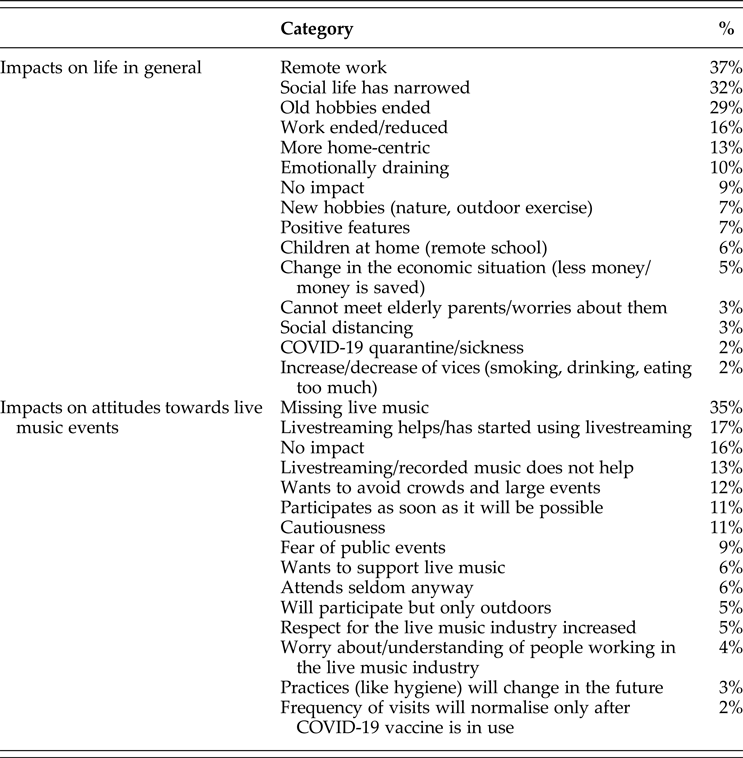
The COVID-19 questions were developed using a pre-survey conducted at the beginning of June 2020 (during the restrictions). Besides demographics, the pre-questionnaire included only two questions: ‘How has the COVID-19 pandemic influenced you and your life?’, and ‘How has the COVID-19 pandemic influenced your attitude towards live music events?’ The survey was distributed on Facebook by the authors and their network, resulting in 174 responses. The open-ended questions were classified into the categories described in Table 1.
Categories of COVID-19 impacts in the pre-survey (n = 174).

The categories were discussed by the authors and the CEO of LiveFIN (the network and interest group of Finnish music events), who has long experience in live music event management, and the following statements were elaborated for the final questionnaire:
What is your opinion of the following statements regarding the impacts of the COVID-19 pandemic? (1 = Totally disagree … 7 = Totally agree):
• In the future, I will follow livestreaming (web gigs) more than before.
• I will participate in large events only after the COVID-19 vaccine is in use.
• I want to support events and musicians more than before.
• In the future, I will buy my festival tickets later than before.
• The break in live gigs has affected negatively my well-being.
• The fear of COVID-19 infection reduces my festival attendance even if there were no restrictions.
• It should be obligatory to wear masks at festivals.
Well-being was deliberately addressed on a general level (‘The break in live gigs has affected negatively my well-being’) to find out the state of well-being (Dodge et al. Reference Dodge, Daly, Huyton and Sanders2012) during the restrictions on live music events. More detailed dimensions of well-being were studied using statements concerning the meaning of music and festival attributes (see Tables 5 and 6).
Three further questions were added concerning the COVID-19 pandemic and festivals. First, within an existing question battery asking for factors that might increase the frequency of festival attendance (‘I would attend festivals more often if …’), a Likert statement was added: ‘… there were better opportunities to wash hands and maintain good hygiene at the festival area’. Second, within a series of festival experience elements (‘For me, a successful festival experience includes …’), a new choice ‘… sufficient safety distances’, was added. Third, an open-ended question was added (‘How has COVID-19 influenced your attitude towards festivals?’) to capture nuances of opinions.
Research data
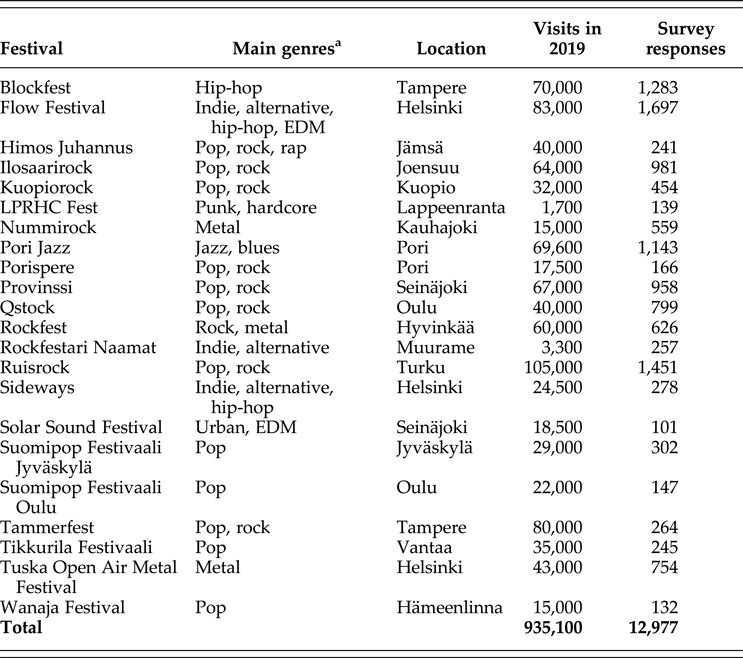
The Finnish Festival Barometer is a biennial web survey directed at music festival audiences. In 2020, the survey was distributed from October to November by 22 member festivals of LiveFIN. In 2019, these festivals attracted nearly 1 million visits, and in 2020, owing to COVID-19, none of them took place.
In 2019 in Finland, altogether 312 music festivals were organised that offered other than classical music; that is, their programme consisted of pop, rock, jazz and so forth, and they attracted 3.5 million visits (LiveFIN 2020), which is a remarkable number in a country of 5.5 million inhabitants. Thus, festivals participating in the Finnish Festival Barometer represented 7% of all the popular music festivals and 27% of the corresponding festival attendances. Table 2 describes the participating festivals. The questionnaire was distributed on social media (Facebook and Instagram) and 12,977 valid responses were received.
Participating festivals (n = 22).

a The genres were defined by the authors.
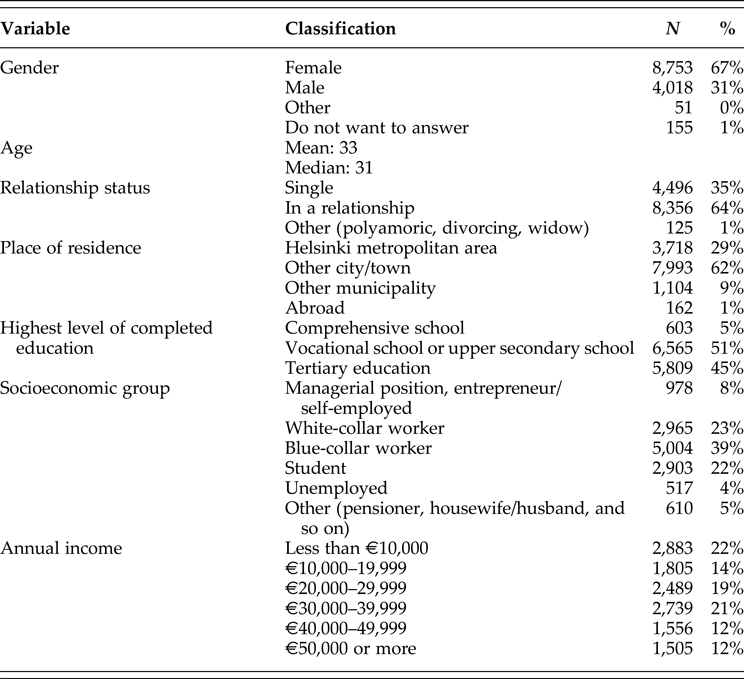
Table 3 describes the socio-demographics of the respondents. Some 31% of them were male, 67% female and 1% were other or did not want to state their gender. Respondents’ mean age was 33 years and median 31. Most of them were in a relationship (64%), 35% were single and 1% other (polyamoric, widow, separating and so on). Some 29% lived in the Helsinki metropolitan area, 62% in other cities or towns, 9% in the countryside and 1% abroad. Most of the respondents had completed secondary (51%) or tertiary (45%) education. The biggest socioeconomic groups were blue-collar (39%) and white-collar (23%) workers, as well as students (22%). More than half of the respondents earned less than €30,000 per year.
Respondents’ socio-demographics (n = 12,799).

The questionnaire contained various questions about respondents’ perceptions of the quality of Finnish music festivals, important experience elements in festival attendance, factors facilitating festival participation, musical taste, the meaning of music, future intentions of music festival attendance and the COVID-19 questions described earlier.
Data analysis methods
The nine COVID-19-related questions were used to create festival-goer segments to analyse their differences. K-means clustering was conducted using SPSS version 26. ‘The basic idea of cluster analysis is to divide a number of cases (usually respondents) into subgroups according to a pre-specified criterion (for example, minimal variance within each resulting cluster) which is assumed to reflect the similarity of individuals within the subgroups and the dissimilarity between them’ (Dolnicar Reference Dolnicar2002, p. 4). Typically, segmentation is done to find suitable customer grouping for marketing purposes. However, we aimed to find festival-goer groups that differ in their attitudes towards COVID-19 and music festivals, aiming to find well-being effects that motivate different attendee groups.
The segmentation variables were standardised to eliminate ‘want-it-all’ and ‘passive’ segments based on response style (Fischer and Milfont Reference Fischer and Milfont2010; Pesonen and Honkanen Reference Pesonen and Honkanen2014). ‘Want-it-all’ respondents use the highest values of the scale and ‘passive’ respondents the low end of the scale. The need for standardisation of variables used in music festival segmentation was suggested by Kinnunen et al. (Reference Kinnunen, Luonila and Honkanen2019), who found response style biased segments from earlier studies. The resulting segments were evaluated using ANOVA, χ 2-test, Kruskal–Wallis H-test and Dunn's test with Bonferroni correction. These tests will be explained later.
A total of 7,132 answers to the open-ended question ‘How has COVID-19 influenced your attitude towards festivals?’ were analysed using content analysis (Krippendorff Reference Krippendorff2004). The categories were transferred to SPSS to create a richer description and to compare the perceptions of the members of different segments.
Resulting segments
We experimented with cluster analysis using two to five clusters, since a predefined number of clusters is needed in K-means clustering. The three clusters model was chosen because the solution was clearly distinguishable, and the respondents were divided more evenly than in other cluster alternatives. The ANOVA test was used to determing the significance of each variable for the cluster solution and it confirmed that all nine items included in the cluster analysis made a significantFootnote 1 (p = 0.000) contribution to the clustering process. In addition, a discriminant analysis was conducted to confirm the results obtained in the cluster analysis. It tested the accuracy of classifying the respondents (>90% being acceptable) into the three groups obtained by K-means clustering. The discriminant analysis confirmed the existence of three distinct groups. Two discriminant functions were generated with eigenvaluesFootnote 2 2.204 and 0.880 explaining 71.5 and 28.5% of the variance, respectively. As many as 98.0% of the original grouped cases were correctly classified.
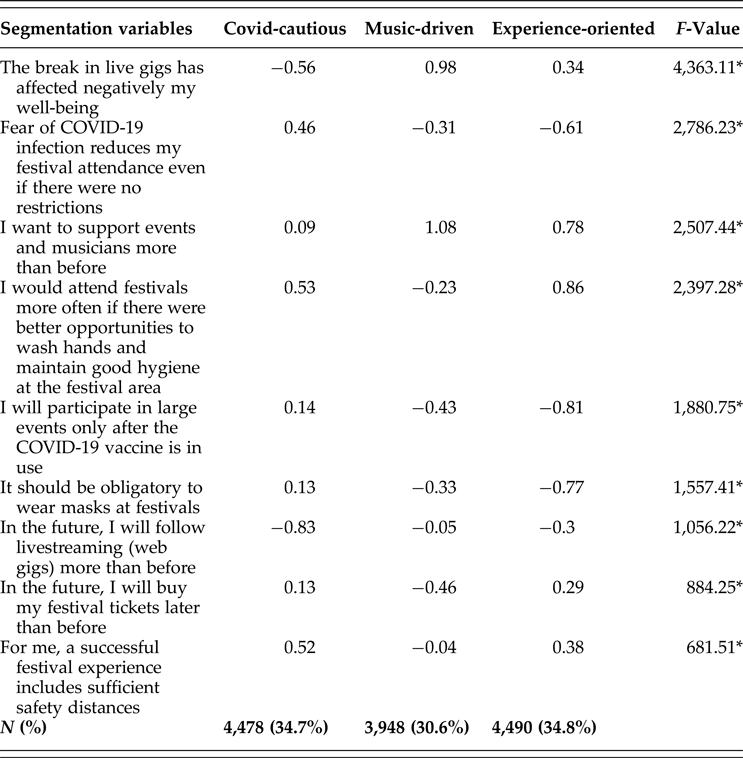
F-values (Table 4) define the importance of each variable in the clustering process. Three items with the highest F-value were ‘The break in live gigs has affected negatively my well-being’, ‘The fear of COVID-19 infection reduces my festival attendance even if there were no restrictions’ and ‘I want to support events and musicians more than before’.
Final cluster centres with standardised variables and F-values.

* p = 0.000.
The resulting segments were named Covid-cautious (34.7%), Music-driven (30.6%) and Experience-oriented (34.8%). The Covid-cautious respondents have changed their behaviour regarding mass gatherings because of the pandemic: they will participate in large events only after vaccination, they would not participate in festivals during pandemic even if there were no restrictions, they want safe distances and people to wear masks. At the same time, they were least affected by the break in live music gigs, and they were not interested in livestreaming nor supporting those affected by the ban on live music events. The Music-driven respondents were clearly suffering most because they were missing opportunities to experience live music. They wanted to support events and musicians more than ever, the break in live music events had affected negatively their well-being, they will follow livestreaming more than before and they will not delay buying festival tickets. Additionally, they were not that interested in safe distances nor improved hygiene conditions. The Experience-oriented respondents, on the other hand, were people who did not intend to wait for vaccination to participate in festivals even though they would buy their tickets later than before owing to the fear of cancellations. They did not want to wear masks, but they wanted better hygiene conditions in festivals. They were the ones who most probably participated in those few festivals that were arranged during the summer of 2020.
In all of the segments, there were more women than men owing to their bigger share among respondents. However, there was a statistically significant difference in gender proportion between the segments (χ 2 = 181.04; p = 0.000).Footnote 3 A total of 38.4% of men belonged to the Music-driven segment but only 31.9% to the Covid-cautious and 29.7% to the Experience-oriented segments. Women were most often in the Experience-oriented (37.2%) and Covid-cautious (35.8%) segments but less often in the Music-driven segment (26.9%). Those who did not want to indicate their gender (‘Do not want to answer’) belonged most often to the Covid-cautious segment (42.2%). The difference between the mean age in segments was statistically significant (H = 193.62; p = 0.000).Footnote 4 The Covid-cautious respondents were the oldest (mean 35.5, median 33.0) whereas the age difference between the Music-driven (mean 32.5, median 30.0) and Experience-oriented respondents (mean 32.4, median 30.0) was minimal. The Covid-cautious were more highly educated than the Experience-oriented (χ 2 = 226.58; p = 0.000). For example, 28.5% of the Covid-cautious had at least a bachelor-level diploma from a university, vs. only 17.4% of the Experience-oriented.
Well-being effects by segments
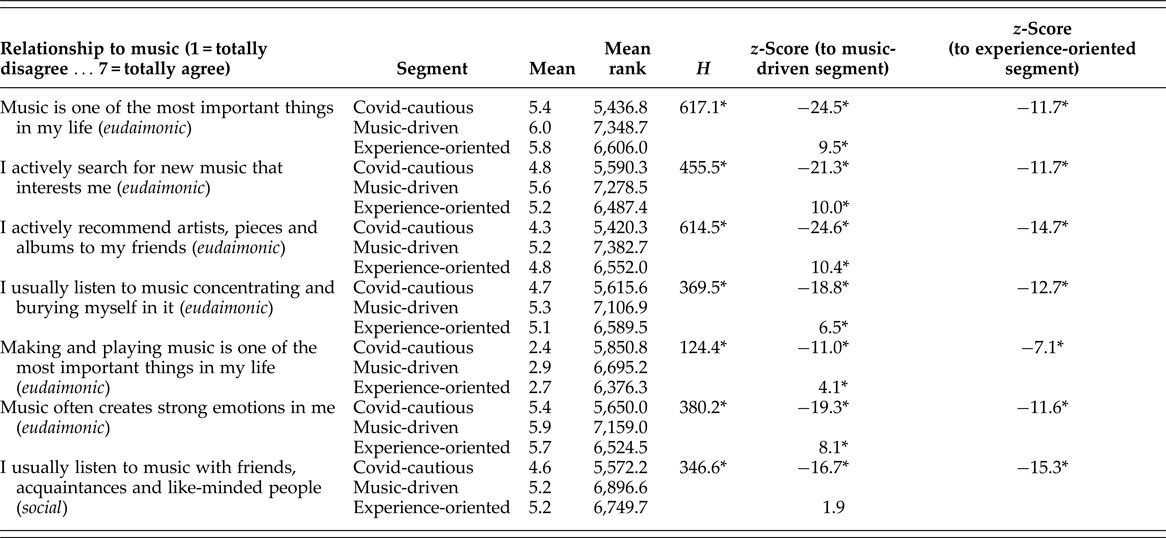
To understand the segments better, they were compared in terms of hedonic, eudaimonic and social well-being dimensions. Table 5 (relationship with music) concentrates on eudaimonic and social well-being, including aspects of personal growth, development of one's potentials and flow (Csikszentmihalyi Reference Csikszentmihalyi2002; Waterman Reference Waterman1993), as well as social dimensions. The Kruskal–Wallis H-tests showed that all of the variables measuring relationship to music had statistically significant differences between the segments (p = 0.000). Dunn's test with Bonferroni correctionFootnote 5 showed that the Music-driven segment had higher mean ranks compared with other segments in all of the other variables (p = 0.000), except ‘I usually listen to music with friends, acquaintances and like-minded people’, where the difference from the Experience-oriented was not statistically significant (H = 1.9; p = 0.193). The Covid-cautious had the lowest mean ranks compared with the Music-driven and Experience-oriented in all of the tested variables (p = 0.000).
Relationship with music contributing to eudaimonic and social well-being: mean, mean rank, Kruskal–Wallis H-test and Dunn's test with Bonferroni correction.

* p = 0.000.
In summary, the Covid-cautious segment was least impacted by the meaning of music, whereas the Music-driven used music for their identity building, both on a personal (music being an important part of life) and social level (recommending music to others, being an opinion leader; Duffy Reference Duffy2000; Lamont Reference Lamont2011). They also got immersed in music (flow) and intentionally increased their knowledge of music (Lamont Reference Lamont2011; Waterman Reference Waterman1993). In their case, ‘meaningful music listening is characterised by more than simple pleasure’ (Lamont Reference Lamont2011, p. 242). All of this implies that, for the Music-driven segment, eudaimonic well-being was an obvious outcome of music festivals. On the other hand, listening to music with friends and like-minded people, fulfilled especially in music festival attendance, was part of social well-being for both the Experience-oriented and Music-driven segments.
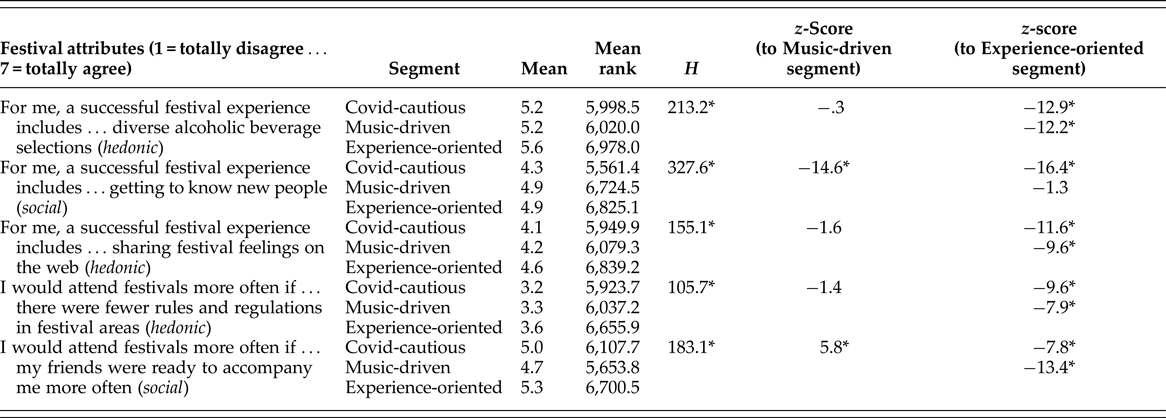
Table 6 describes festival attributes related to hedonic and social well-being. In this regard, hedonism is present in the form of fun and celebration (Waterman Reference Waterman1993), and social well-being through bonding and bridging (Quinn and Wilks Reference Quinn, Wilks, Richards, de Brito and Wilks2013). The Kruskal–Wallis H-test revealed statistically significant (p = 0.000) differences between segments in the festival attributes related to hedonic and social well-being. Dunn's test with Bonferroni correction showed that the Covid-cautious respondents considered all of the festival attributes less important than the Experience-oriented (p = 0.000), and ‘getting to know new people’ less important than the Music-driven (z = −14.6; p = 0.000). However, they were ready to attend festivals more often if friends would accompany them (z = −5.8; p = 0.000) compared with the Music-driven. The Experience-oriented appreciated more all of the festival attributes than the Music-driven (p = 0.000) except ‘getting to know new people’ (z = −1.3; p = 0.615).
Festival attributes contributing to hedonic and social well-being for different segments: mean, mean rank, Kruskal–Wallis H-test and Dunn's test with Bonferroni correction.

* p = 0.000.
To summarise, the Experience-oriented respondents yearned for hedonic and social well-being through festival attendance more than others. In the hedonic dimension, they wanted to celebrate by consuming alcohol and sharing their feelings on the web, and they wished that there were fewer rules and regulations restricting their enjoyment. On the social level, the presence of friends was more important for them than for other segments. The Music-driven showed more autonomy even though they were interested in getting to know new people.
Qualitative viewpoint on segments
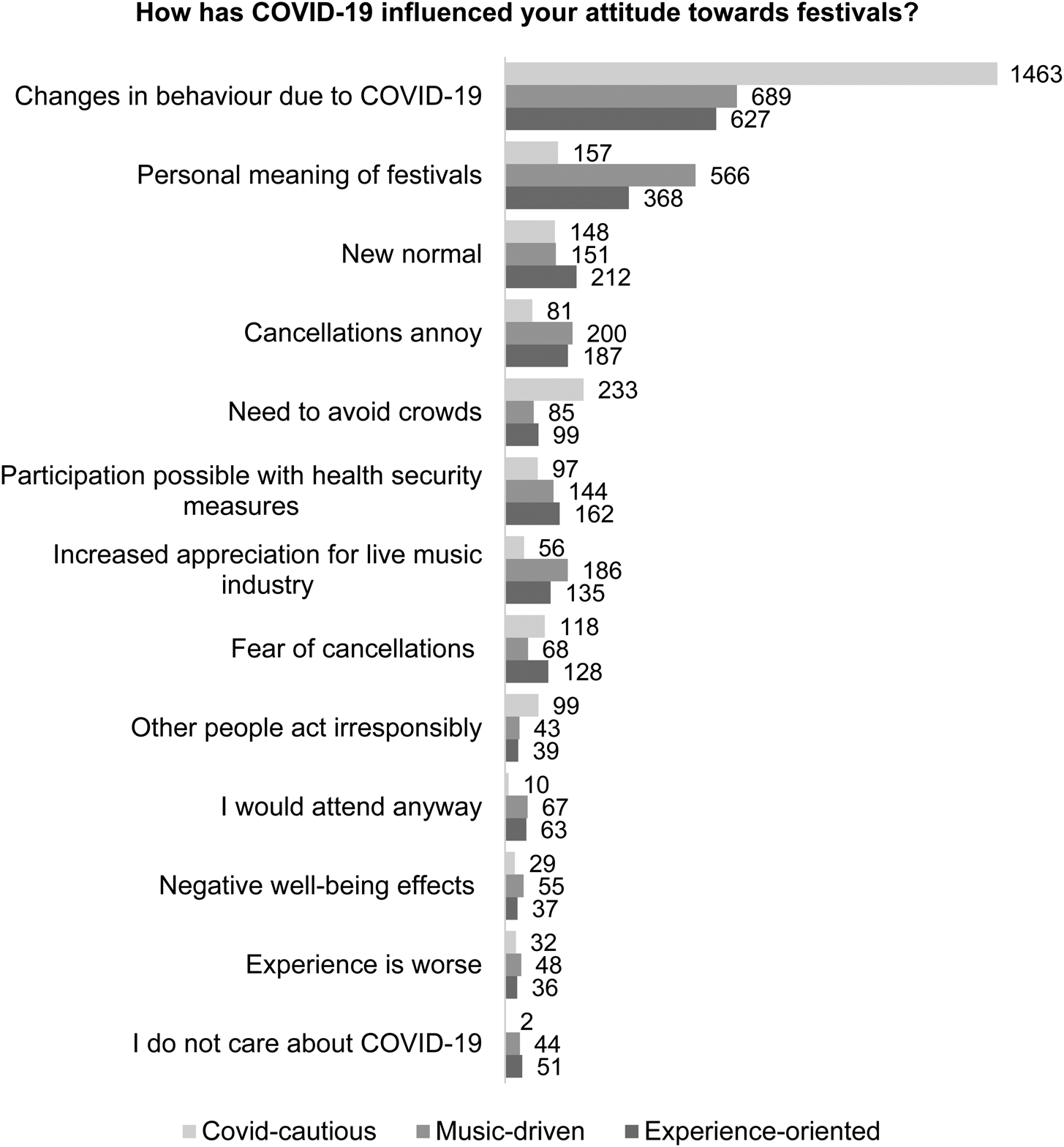
Scrutinising segments with the help of the open-ended question concerning perceptions of festivals in the COVID-19 era helps to obtain a more holistic picture. The content analysis produced 13 categories (Figure 1 in total and Figure 2 by segments) of which those that introduced deeper knowledge for the segments are discussed next.
Categories of the open-ended question.

Categories of open-ended questions by segments.

Covid-cautious segment
The open-ended question revealed various grades of cautiousness (category ‘Changes in behaviour owing to COVID-19’) within the Covid-cautious segment. Some of the respondents were genuinely afraid of getting the infection or spreading the disease to vulnerable others, as the following quotes illustrate:
I belong to the risk group and there are people in the circle of my friends that have had really serious post viral fatigue. One acquaintance died [of the virus]. I work in the field of public health. For these reasons, I try to avoid all the possible risk situations, and for me, any festival experience is not worth the risk. (Covid-cautious, male, 41)
I cannot even think of participating in festivals, since I work with patients in a hospital. I will wait for the vaccination. (Covid-cautious, female, 28)
On the other hand, the segment included people who felt more uncomfortable with the idea of attending festivals during the pandemic (‘I don't attend festivals even though I would like to because I'm afraid that other people would condemn me [if I attended a festival during the pandemic]’, Covid-cautious, female, 27). One of the characteristics was also that the Covid-cautious wanted to follow the instructions and recommendations given by authorities. Naturally, there were lots of people in other segments as well who obeyed the recommendations, but in the Covid-cautious segment they dominated.
The Covid-cautious respondents were not disappointed that festivals were cancelled since they agreed that mass gatherings should not be arranged during the pandemic. They wanted to avoid places where there were lots of people and they thought that there were too many drunk people at festivals who acted irresponsibly (category ‘Other people act irresponsibly’).
If those idiots, who do not understand anything about safe distances or the importance of wearing masks, are let into festivals, I will stay far away. Corona is mainly spreading through morons. Smart event organisers understand that there must be rules and regulations precisely for these morons. (Covid-cautious, male, 53)
The Covid-cautious respondents – like people in other segments as well – realised that new measures influenced the festival experience (category ‘Experience is worse’), as a 31-year-old female in the Covid-cautious segment described: ‘People intruding into my air space really piss me off. I'm not very good at keeping the safe distance either. Festivals are not the same thing because of corona.’ Even though they were careful now, many of the Covid-cautious assured us that they will return to festivals after the pandemic is over. Meanwhile, they did not buy tickets (category ‘Fear of cancellations’):
I'm afraid of buying tickets or attending. Everything will be cancelled anyway or you will get a lethal disease in them and you will die. (Covid-cautious, female, 43)
All in all, the Covid-cautious respondents did not seem to have bigger negative well-being effects because of the absence of festivals. For them, it was more important to tackle the pandemic (see also Khan et al. Reference Khan, Mamun, Griffiths and Ullah2020).
Music-driven segment
Members of the Music-driven segment identified more negative well-being effects (category ‘Negative well-being effects’; see also Table 4) than others, which was obvious owing to the great importance of music in their life (see Gabrielsson Reference Gabrielsson2011; Laiho Reference Laiho2004). They missed festivals and live music (category ‘Personal meaning of festivals’) since the meaning of music was of utmost importance for their eudaimonic well-being (see also Table 5). Without the opportunity to experience live music as often as they normally would, they missed the long-lasting eudaimonic effect (Huta and Ryan Reference Huta and Ryan2010) on their personal resources. In addition, there was a severe threat that challenges could overweigh their resources causing negative well-being and even mental health problems.
I miss them and for instance, their meaning for my well-being is highlighted in their absence. Without festivals, I have been sadder than normally. (Music-driven, female, 21)
The Music-driven respondents felt simultaneously pity and appreciation for the event and music business (category ‘Increased appreciation of live music industry’). They wanted to give support to keep the business alive (see also Gloor Reference Gloor2020).
Of course, I'm very sorry for festivals, restaurants and the whole event industry since the pandemic so strongly influences them. When the bugger eases up, I promise to attend festivals more than ever and will forcibly drag my friends along. (Music-driven, male, 60)
Some would participate in festivals with special precautions (category ‘Participation possible with health security measures’), or they had already attended the few festivals that were arranged during the summer (category ‘I would attend anyway’). For some of them, the experience of participating in festivals during COVID-19 was alright or even a positive surprise, since health security measures were in order and did not greatly affect the music experience, while others thought that the experience had worsened (category ‘Experience is worse’):
We went to a festival during the summer and now I feel that it didn't make sense. Even though I tried to keep the safe distances, some people just didn't care even though organisers tried to control it. It's more difficult to enjoy the gig when you all the time have to unconsciously worry about safe distances and hand hygiene. (Music-driven, other, 24)
Among the Music-driven, some did not care about the COVID-19 situation (category ‘I do not care about COVID-19’) even though the total number was quite low. A 35-year-old male in the Music-driven segment illustrated a neoliberal opinion that was common among the sceptics:
There will always be epidemics like this and you cannot close the whole society because of them. Mortality comes with the territory and with so low percentages you just cannot close down or restrict everything. Everyone is responsible for their own health.
Experience-oriented segment
The Experience-oriented respondents were ready to attend festivals, with or without precautions (categories ‘Participation possible with health security measures’ and ‘I would attend anyway’) since festivals were important for them. Some of them did not care about the pandemic (category ‘I do not care about COVID-19’) but they were a minority. Some of those who attended festivals during the summer were aware of the changed attitude towards attendance during the pandemic.
I attended two festivals in August 2020 and acted in a totally different way than before. You were a little bit worried about your environment all the time. You didn't share content to social media the same way as before since you were worried about what others would think of you because you had decided to participate in a festival. However, I haven't started to be afraid of festivals or public events due to corona. (Experience-oriented, female, 27)
The Experience-oriented longed for festival participation (category ‘Personal meaning of festivals’) and experienced negative well-being effects (category ‘Negative well-being effects’):
I miss so much festivals and other gigs as well, and the life just isn't as good without live music. My depression has worsened considerably since the small everyday points of reference – that is, gigs – have all been cancelled. It has been and will continue to be like this for a long time. I feel really powerless. (Experience-oriented, female, 25)
The uncertainty of the situation led to a postponement of ticket purchases (category ‘Fear for cancellations’) and frustration (category ‘Cancellation annoy’), like for a 34-year-old male in the Experience-oriented segment: ‘Everything will be cancelled anyway, it's not worthwhile to get excited about any event.’ Some of the festival fans blamed others for the situation (category ‘Other people act irresponsibly’):
Festivals are in the same bunch with all the other events and experiences: there's no life and we are just at home. You cannot get anywhere and it's all because of [drunks’] stupidity. At the moment, a festival is a utopia but it might become a dystopia. (Experience-oriented, female, 55)
Some of the health security measures were seen as necessary also in the future (category ‘New normal’). The Experience-oriented wanted better hygiene conditions: ‘The appreciation for hygiene and tidiness inside the festival area has grown. I also believe that safe distances will be seen at festivals [after the pandemic]’ (Experience-oriented, female, 21).
Discussion
Hedonic well-being
The liminal space of music festivals offers a break from everyday challenges. Music experience combined with like-minded communitas and quality time with close friends and family members forms a perfect setting for hedonic enjoyment. The current neoliberal atmosphere that emphasises individualism approves of hedonism as part of personal indulgence. Additionally, occasional time out of the ordinary is an important way of relaxing and relieving stress that helps in coping with studies and work. Hedonic pleasures increase personal resources that help in facing everyday challenges (Dodge et al. Reference Dodge, Daly, Huyton and Sanders2012).
Positive emotions of a festival experience can be relived through reminiscence (Wood and Kinnunen Reference Wood and Kinnunen2020). Collective reminiscing strengthens the memory and makes festival emotions vivid again, sometimes even making them more positive than they originally were. This way positive emotions are re-experienced, producing repeated well-being effects even though the direct impact of hedonism is only short-term (Huta and Ryan Reference Huta and Ryan2010).
Eudaimonic well-being
Eudaimonia provides a long-term well-being impact by filling up the internal resource pool (Huta and Ryan Reference Huta and Ryan2010). If music is of high personal importance – sometimes even a purpose in life – participating in music festivals is a natural means of self-discovery. A deep concentration on music performances combined with a communal atmosphere helps in achieving a flow state where everything else does not matter (Csikszentmihalyi Reference Csikszentmihalyi2002). Interestingly, music enthusiasts seem to possess a sense of autonomy (that forms a part of eudaimonic well-being; Ryff Reference Ryff1989) since they are not so dependent on friends’ company as those who look for hedonic enjoyment. The lack of eudaimonic dimensions in one's life might even endanger mental health (Ryff and Singer Reference Ryff and Singer2008), as could be seen in a couple of the earlier quotations (‘Without festivals, I have been sadder than normally’ and ‘My depression has worsened considerably’).
Social well-being
The findings indicate challenges for event organisers, particularly in terms of communality, which is an important part of social well-being at music festivals. First, some people do not care about COVID-19 restrictions, and others are afraid of the infection (see also Khan et al. Reference Khan, Mamun, Griffiths and Ullah2020). The following examples illustrate the huge difference that there might be even though the number of people who did not care about or did not follow COVID-19 restrictions was minimal (1% of all the answers to the question):
People's selfishness usually escalates at festivals due to drunkenness. I'm not interested in listening to the omnipotence of corona-fearless. (Covid-cautious, female, 48 years)
It annoys me that everything's put on ice due to an influenza. I'm not going to wear a mask unless there's a threat of a fine or prison. (Experience-oriented, gender not known, 48 years)
This leads to the situation where there are two groups of people on opposing sides, instead of a like-minded communitas which is essential for festivals and one of their major pull factors (Anderton Reference Anderton2006).
Second, the reduced capacity and safe distances reduce feelings of shared and ‘extended emotions’ (Krueger and Szanto Reference Krueger and Szanto2016) that are typical for live music event attendance with physical proximity (Cochrane Reference Cochrane2009; Gloor Reference Gloor2020) and enhance feelings of communality. For example, a 34-year-old Music-driven segment female describes: ‘In my opinion, safe distances, obligation to use masks or following gigs sitting do not belong to the festival spirit’.
Third, co-creation of collective experiences (Rihova et al. Reference Rihova, Moital, Buhalis and Gouthro2019) is difficult or even impossible if participants are physically apart from each other or wear masks. Typical co-creation practices like singing and dancing are communal activities that require physical closeness. Additionally, by showing positive feelings (like smiling at strangers) attendees co-create a relaxed and positive communal atmosphere. If these aspects are missing, it leads to reduced social well-being in festival attendance.
Festivals in the COVID-19 era
Finland has been one of the most successful countries in the fight against COVID-19, at least at the beginning of the pandemic. One of the reasons is that the country is sparsely populated outside the cities. However, an important aspect is also Finns’ obedience and trust in government and public health authorities. Even though a 38-year-old Music-driven segment female puts it in the extreme, her statement reflects the fact that most Finns would not participate in festivals before authorities gave the definitive green light:
Well, you don't go to festivals since there are none. But even though there were, I really wouldn't go before [the Prime Minister] Sanna Marin gives her permission. But when she gives it, I will definitely go! With a mask or without it, whatever Sanna says. (Music-driven, female, 38)
Several international COVID-19 surveys demonstrate that people miss live music but, at the same time, are afraid of participating in them (Coletto Reference Coletto2020; Stefano Reference Stefano2020). In the US, according to an April 2020 survey, people were not willing to participate in live music events before getting vaccinated (Stefano Reference Stefano2020). In July 2020, a Music Canada survey revealed that people were going to avoid public events for 6 months or more after the restrictions ended (Coletto Reference Coletto2020). In the UK, the probable time before participation was 3 months after the ending of lockdown (Ticketing Business News 2020). These findings are in line with the Covid-cautious segment in our study. Additionally, the Live Nation and TicketMaster (2020) global survey in May 2020 pointed out that people wanted increased cleanliness and better facilities for washing hands in music venues, which reflects the thoughts of the Experience-oriented respondents of the present study.
During the pandemic, there have been live music events that have fulfilled the given rules for health security (Surplice Reference Surplice2020). Restricting the ability of the audience to move around, using divided attendee zones with dedicated entrances and reserving a designated area with seats for each group helped in keeping safe distances but, simultaneously, considerably reduced the dimensions nurturing social well-being. Recommendations or obligations to wear masks, wash hands and use hand sanitiser were part of the measures to avoid the spread of the virus. However, event organisers wanted to test ‘Corona-proof’ events, trying to find ways to organise live events that resemble the ‘old way’ as much as possible, thus minimising the negative impacts on the experience caused particularly by the requirement for safe distances. For instance, a protocol of having each attendee undergo a rapid Covid test, dividing people into separate zones and using more efficient air conditioning and more secure FFP2 masks was tested in Barcelona, allowing participants to dance and celebrate without the need to impose minimum safe distances (APM 2021). In the Netherlands, dividing audiences into separate ‘bubbles’ with different rules on social contacts for each bubble was trialled to discover possible ways to organise Corona-proof events (Deloughry Reference Deloughry2021).
Digital developments were sped up during the pandemic. Because of COVID-19, there was an increase in livestreaming gigs and the use of virtual/augmented/extended reality (Gloor Reference Gloor2020). Vandenberg et al. (Reference Vandenberg, Berghman and Schaap2020, p. 4) reported that the ‘“liveness” of livestreamed concerts is defined in terms of time, rather than space’, meaning that following a gig simultaneously with its actual performance might produce more easily the same feelings as a traditional gig. Even though livestreamed concerts induced more online commenting than recorded music, it did not bring out the emotions and collectivity that were present in ‘real’ live music events (Vandenberg et al. Reference Vandenberg, Berghman and Schaap2020; see also Coletto Reference Coletto2020; Live Nation and Ticketmaster 2020). The present study was in line with this finding since only a small portion of respondents was interested in taking part in livestreamed concerts in the future. However, an increasing number of festivals will probably include livestreamed performances in their repertoire, and livestreaming will become more popular as its social possibilities are developed further.
The possibilities of augmented or extended reality in tourism have been studied for some time and the COVID-19 pandemic made the concept of virtual tourism even more interesting (Kwok and Koh Reference Kwok and Koh2020; Mohanty et al. Reference Mohanty, Hassan and Ekis2020). Virtual reality, familiar from the context of video-gaming, was tested in Finland on May Day Eve 2020 when the popular hip-hop duo JVG performed in the virtual Senate Square of Helsinki (Baxter Reference Baxter2020). A total of 150,000 avatars were ‘present’ and over half a million people watched the gig on TV or computer. The use of avatars allowed further possibilities for socialising during virtual gigs and, in time, might develop into new co-creation initiatives and shared emotions on web platforms.
Contribution
The theoretical contribution of this study is in scrutinising the hedonic, eudaimonic and social well-being dimensions of festival attendance at a time when festivals were banned. So far, well-being effects have been studied from actual festival attendance. In this case, the situation was the opposite: it was not possible to attend festivals, and this caused a state of negative well-being. Thus, survey participants could indicate the factors they missed most, revealing the most important well-being dimensions for their festival attendance. Another important aspect is our responsibility as researchers to study, analyse and document this exceptional COVID-19 era and its influence on music festival-goers.
From the praxis point of view, the difference between the Covid-cautious and Experience-oriented segments revealed, in particular, the challenges faced by event organisers in rebuilding communality in post-COVID festivals. Additionally, the expectations for better hygiene conditions and fewer crowds will have long-term effects after the pandemic – not only in Finland, but internationally (Live Nation and TicketMaster 2020). Consequently, the trend towards smaller festivals might become more evident because of the pandemic. It will also be interesting to see how festivals will be reorganised after the crisis. In the summer of 2021, there were fewer international performers than normal owing to travel restrictions and quarantine regulations. The strong desire for live music festivals seemed to outweigh the importance of an international line-up as many festivals were sold out (although with restricted capacity). It remains to be seen how long this tendency lasts for. Another noteworthy aspect is the consumption of alcohol. The open-ended answers demonstrated that many people thought that during the pandemic, drunk people constituted a health hazard and there were suggestions that the use of alcohol at festivals should be restricted, at least during the pandemic. So far, no festival has followed this initiative since the sale of alcohol is such an important source of income.
Limitations and future research
The limitations of the study are in the dominance of quantitative data, even though one open-ended question revealed a somewhat wider perspective. Deeper qualitative material is needed on the consequences of the COVID-19 pandemic (see also Frenneaux and Bennett Reference Frenneaux and Bennett2021). Digital developments that were sped up by the restrictions should be investigated further; for example, how do festival-goers perceive livestreaming and virtual reality in the music festival context? This might give some indications for the future of festivals and the viability of online and hybrid events (see also Duffy and Mair Reference Duffy and Mair2021).
The long-term effects of the absence of live music events might have consequences on both the supply and demand sides. Small festivals with fewer than 5,000 visits comprise 61% of the Finnish popular music festivals (LiveFIN 2020). During the pandemic, they got even more attention than before. How the well-being effects of small festivals differ from those experienced in the large ones should be investigated in detail.
Furthermore, how do the restrictions influence the music festival experience? The present study confirmed that restrictions worsened the experience and reduced well-being effects. What did people actually miss and what were the consequences? More importantly, did the restrictions create anything new (besides better hygiene) that might, in the long run, influence the festival experience positively?
Lastly, owing to the cancellation of most festivals for two consecutive years, a whole age group of young people missed the opportunity to participate in their first music festival. For generations, the first music festival experience has been a common rite of passage for adulthood, generating a new group of regular festival attendees. Will the missed opportunity have a lasting impact on the attitudes of this age group towards music festivals?
It must be noted that the Finnish context cannot necessarily be generalised to other countries. Many of the issues, particularly the attitudes towards the restrictions, are culture-sensitive. For instance, Finns tend to obey regulations and the overall societal consensus has long been that the common interest takes priority over the individual. The pandemic demonstrated that this might not be the case with the younger generations, which, together with the continued neoliberal developments, might have caused conflict between the Covid-cautious and others. It is also stressed that the mean age of our respondents was over 30. If the sample would have been, for example, 10 years younger, the results might have been different.
Conclusion
In normal circumstances, a festival atmosphere is relaxed and communal. However, during the Covid restrictions, the attitude towards the pandemic has caused conflicts that have had a negative impact on festival communality, atmosphere and experience. The pandemic has generated a situation where there is a clear divergence of opinions regarding suitable behaviour at festivals. People disagree on the scope of measures that should be taken in the current situation, and these opinions might last for some time even after the pandemic.
Clustering the COVID-19-related questions in the Finnish Festival Barometer 2020 led to three segments: Covid-cautious, Music-driven and Experience-oriented. Evaluating the meaning of music and different festival attributes – at a time when nearly all the festivals were banned – revealed different well-being dimensions of festival attendance in these segments.
Music festival attendance produces a temporary, individually perceived state of positive well-being: a situation where personal resources overcome challenges. Moreover, music festival attendance also complements and fills up personal resources for future challenges through hedonic, eudaimonic and social dimensions of attendance.
The Covid-cautious respondents were the oldest and most educated. They believed that public events should be avoided during the pandemic, and they did not experience negative well-being effects owing to the ban on festivals. They concentrated on coping with the pandemic; some of them even considered ceasing festival attendance for good.
The Music-driven respondents were clearly motivated to participate in music festivals and other live music events for predominantly eudaimonic reasons, even though social well-being was also a pertinent factor. Being involved with music meant personal growth for them: music was meaningful for their life and personal identity, and they wanted to increase their knowledge and immerse themselves in the music experience. When festivals were not available, these respondents suffered from negative well-being effects.
The Experience-oriented respondents wanted to get back to festivals, with or without masks and safe distances. However, they were also the keenest to see better hygiene in festivals in the future as well as during the pandemic. For them, festivals offered hedonic and social well-being, and without festivals, they identified negative well-being effects.
The study presented three distinct festival-goers’ perspectives on music festivals in the middle of the COVID-19 crisis. Traditional large festivals were cancelled, but smaller festivals complying with the COVID-19 restrictions were arranged. However, the restrictions had a negative impact on social well-being, since they prevented most of the co-creational practices that are important for the music festival experience. It can be argued that the restrictions even prevented, to some degree, the creation of liminality that is so essential for festivals. In a way, the festival area was no longer that different from the outside world, and it was not as easy to forget the everyday worries as before. Additionally, the opinions revealed that there will be some permanent changes at music festivals, for example, better hygiene facilities. It will also be worthwhile to follow developments in online and hybrid productions of music festivals in the post-COVID time.
More profound changes in music festival audience behaviour and preferences might have developed during or been accelerated by Covid restrictions. According to the media, many young adults ignored the restrictions on social distancing, participated in festivals without wearing a mask and organised private parties. During the summer of 2021, it seemed that festivals that were earlier occupied by 30- or-40-somethings were now dominated by younger attendees. Neoliberal individualism, exemplified by partying for the sake of personal enjoyment, has been stronger with the younger generation, which might indicate that the traditional welfare society style of emphasising the common interest is giving way to market forces and individualism, even in Finland.
When analysing the popular music festival market in Finland, large festivals are already considered investments. International private equity and live music entertainment companies entered the Finnish music festival scene in the 2010s. However, compared with the UK, the position of Live Nation is not that big since it owns, so far, the majority share of only one festival in Finland. The biggest single company in the Finnish music festival market is Nelonen Media Live, a media organisation that owns 29% of the largest festivals that have over 30,000 visits (Kinnunen et al. Reference Kinnunen, Koivisto and Honkanenforthcoming). Before the pandemic, market forces and the commercialisation of music festivals were changing the Finnish context towards the dominance of large, enterprise-owned festivals that attracted tens of thousands of participants.
COVID-19 somewhat complicated this ongoing development. Large festivals were banned, which meant that for two consecutive summers, smaller actors took the festival market. The only exception was Nelonen Media Live that organised most of its festivals in the summer of 2021 (while none in 2020). This happened at a time when nearly all of the other large festivals announced cancellations, since they thought that it was not economically viable to arrange a large festival during the restrictions.
Owing to the limited supply, it is likely that many people attended their first small festival in the second Covid summer. This attendance might have changed their attitude more positively towards smaller organisers since small festivals offer social and eudaimonic well-being through tighter communality, better opportunities to get to know new people and line-ups that introduce newcomers and marginal music instead of well-known pop stars. All in all, they tend to offer more opportunities for learning through their eclectic or genre-specific programmes. Small festivals seem suitable choices for the Music-driven festival participants, but will they eventually gain popularity also among the Experience-oriented? Most importantly, did COVID-19 change the direction of the Finnish festival scene from large, commercial festivals to a slight preference for non-profit events? Did it slow down the investment-oriented development of the last decade since festivals turned out to be such high-risk investments?
Funding
The Finnish Music Foundation supported the execution of the survey.
Acknowledgement
The authors wish to thank Harri Homi, Antti-Ville Kärjä and Jenna Lahtinen for their valuable feedback on the article.