Implications
The search for high-quality ingredients at low prices is one of the main strategies in broiler chicken diets. Particularly, acid oils (A) and glycerol (G) seem to be an interesting subject for the study, as they are quite cheap, contain substantial energetic value, and sometimes constitute a residual product to be recycled in order to avoid environmental contamination. The present study evaluates two strategies to improve the nutritive value of these acid oils: (1) by chemical esterification of their free fatty acids (FFA) with G, and (2) by adding increasing amounts of free G to A.
Introduction
The fats commonly used in monogastric animal diets are mainly constituted by triacylglycerols (TAG), that is, a G molecule attached to three fatty acids (FA) with a glycerol-to-fatty acid ratio (G : FA), equivalent to 0.33 mol/mol. However, nowadays there are other available fat sources that have a relevant scientific, economic and environmental interest. They have the same FA composition as their corresponding native oils (N), but a different molecular structure and a different G : FA ratio, which may modify their nutritional value.
On the one hand, we find A, obtained from the refining process of crude N. In these fatty by-products, a high proportion of FA is characterized for not being esterified or linked to any organic structure such as G (50% to 90% FFA) (Vila and Esteve-Garcia, Reference Vila and Esteve-Garcia1996). From an economic point of view, these fat sources are a very interesting alternative, but it is well-known that they have a lower nutritional value than does N, due to the lack of enough monoacylglycerols (MAG), necessary to promote the absorption of FFA (Raber et al., Reference Raber, Ribeiro, Kessler and Arnaiz2009; Ravindran et al., Reference Ravindran, Tancharoenrat, Zaefarian and Ravindran2016). A high content of FFA hinders the process of absorption and re-synthesis of lipids, especially when they are saturated and are administered to young animals (Wiseman and Salvador, Reference Wiseman and Salvador1991; Leeson and Summers, Reference Leeson and Summers2001).
On the other hand, we find re-esterified oils (E), obtained from the chemical esterification of the FFA present in A with G, another by-product of the biodiesel industry. These re-esterified oils present a higher content of MAG and diacylglycerols (DAG) than do their corresponding N (Vilarrasa et al., Reference Vilarrasa, Guardiola, Codony, Esteve-Garcia and Barroeta2014), which can favor the processes of fat digestion and absorption due to their emulsifying capacity (Garrett and Young, Reference Garrett and Young1975). Nevertheless, due to the specificity of pancreatic lipase, 1,3-DAG and 1(3)-MAG present in E can be completely hydrolyzed to G and FFA at the intestinal level (Mattson and Beck, Reference Mattson and Beck1956). It is for this reason that one of our hypotheses is that the inclusion of G to A could have the same effect and reach a similar nutritive value than do their corresponding E. On the other hand, it is also possible that the modification of the usual G : FA ratio (0.33) of N also contributes to modify the level of FA absorption.
Therefore, the aim of the present study is to assess how the fat molecular structure and the G : FA ratio of palm oils affect the FA apparent absorption in broiler chickens.
Material and methods
Experimental fats
Experimental fats were supplied by SILO S.P.A. (Florence, Italy) and NOREL S.A. (Valls, Spain). E was produced using, as raw materials, A (a by-product obtained from the physical refining process of crude palm oil, with a high FFA content; >85%) and G (a by-product obtained from the methylation process applied for biodiesel production), which were processed in a reactor for 4 to 6 h, under great vacuum conditions (1 to 3 mmHg), at temperatures between 190°C and 250°C, and without chemical catalysts.
The acylglycerol and FFA composition of experimental fats was analyzed according to ISO 18395:2005, in which TAG, DAG, MAG and FFA are separated according to their molecular size. Moreover, given the potential importance of different positional isomers of MAG and DAG molecules in the digestion and absorption processes, the experimental fats were also analyzed by high-resolution 1H nuclear magnetic resonance spectroscopy. More details about these methods are described in Vilarrasa et al. (Reference Vilarrasa, Guardiola, Codony, Esteve-Garcia and Barroeta2014).
The total FA composition of experimental fats was determined by gas chromatography, according to the methylation method described by Guardiola et al. (Reference Guardiola, Codony, Rafecas, Boatella and López1994). The average molecular weight was calculated according to the total FA composition of the fat and the G : FA ratio for each molecular species. These calculations were also used to obtain an estimation of the global G : FA ratio of our experimental fats.
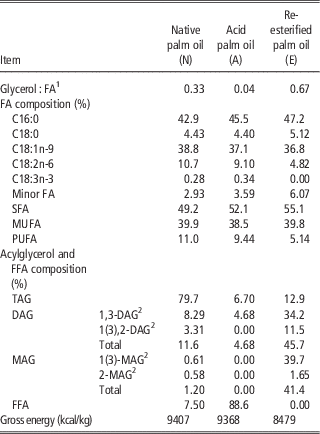
Finally, combustion energies of the experimental fats were measured by an adiabatic bomb calorimeter (IKA-Kalorimeter system C4000; Staufen, Germany). The chemical analyses of the experimental fats are presented in Table 1.
Chemical analyses of the experimental fats

DAG=diacylglycerols; FA=fatty acids; FFA=free fatty acids; MAG=monoacylglycerols; MUFA=monounsaturated fatty acids; PUFA=polyunsaturated fatty acids; SFA=saturated fatty acids; TAG: triacylglycerols.
1 Estimated calculation based on the acylglycerol and FFA composition values.
2 The proportions of 1,3-DAG v. 1(3),2-DAG and 1(3)-MAG v. 2-MAG were determined by high-resolution 1H nuclear magnetic resonance spectroscopy. Then, these mol percentages were applied to the total DAG and MAG content analyzed by HPLC.
Animals and diets
The study was performed at the animal experimental facilities of the Servei de Granges i Camps Experimentals (Universitat Autònoma de Barcelona; Bellaterra, Barcelona, Spain). The experimental procedure received prior approval from the Animal Protocol Review Committee of the same institution. All animal housing and husbandry conformed to the European Union Guidelines (2010/63/EU).
A total of 192 one-day-old female broiler chickens of the Ross 308 strain were obtained from a commercial hatchery (Pondex SAU; Juneda, Lleida, Spain), where birds with extreme weights were discarded. On arrival, chicks were wing-banded, weighed (initial BW, 45.5 g) and randomly assigned to one of the eight dietary treatments, with four chicks per cage and six cages per treatment.
Birds were housed in wire-floor cages with excreta collection trays (0.5×0.6 m) located in environmentally controlled rooms. Room temperature was maintained at 33±2°C during the first 3 days of life and then was gradually reduced according to age until reaching 24±2°C at day 21. For the 1st week of life, chicks received 23 h light per day and then a continuous light program of 18 h light per day until the end of the experiment. Throughout the study, feed and water were supplied ad libitum.
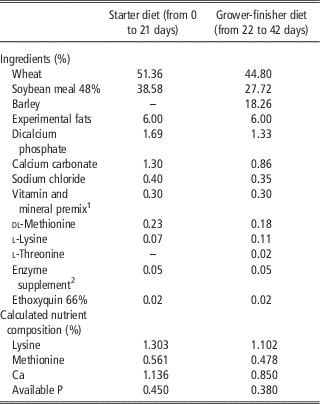
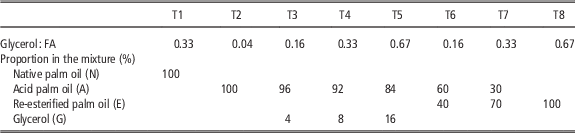
Birds received a starter feed (in mash form) until day 21, and a grower-finisher feed (in pellet form) up to 42 days. The wheat- and soybean-meal-based diets were formulated to meet or exceed FEDNA (2008) requirements and to minimize basal fat levels. The composition of the experimental diets is presented in Table 2. The dietary treatments were the result of including 6% (as-fed basis) of one of the fat blends detailed in Table 3 to the basal diet, obtaining a total of eight diets with different molecular structures and G : FA ratios.
Ingredients and calculated nutrient composition of the experimental diets (as-fed basis)

1 Provides per kg of feed: vitamin A (from retinol) 13 500 IU; vitamin D3 (from cholecalciferol) 4800 IU; vitamin E (from alfa to tocopherol) 49.5 IU; vitamin B1 3 mg; vitamin B2 9 mg; vitamin B6 4.5 mg; vitamin B12 16.5 µg; vitamin K3 3 mg; calcium pantothenate 16.5 mg; nicotinic acid 51 mg; folic acid 1.8 mg; biotin 30 µg; Fe (from FeSO4·7H2O) 54 mg; I (from Ca(I2O3)2) 1.2 mg; Co (from 2CoCO3·3Co(OH)2·H2O) 0.6 mg; Cu (from CuSO4·5H2O) 12 mg; Mn (from MnO) 90 mg; Zn (from ZnO) 66 mg; Se (from Na2SeO3) 0.18 mg; Mo ((NH4)6Mo7O24) 1.2 mg.
2 Provides per kg of feed: β-glucanase 350 IU; xylanase 1125 IU.
Oil blends used in the experimental diets

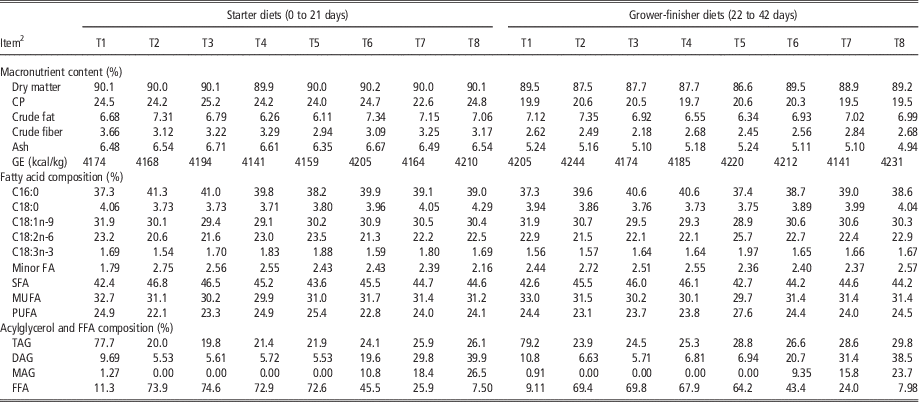
Analytical determinations of feeds were performed according to the methods of AOAC International (2005): dry matter (Method 934.01), ash (Method 942.05), CP (Method 968.06), crude fat (Method 2003.05), and crude fiber (Method 962.09). Gross energy was determined as described previously for fats, and the FA content was analyzed following the method of Sukhija and Palmquist (Reference Sukhija and Palmquist1988). The macronutrient and the FA composition of the experimental diets are presented in Table 4.
Analyzed macronutrient content, fatty acid composition and acylglicerol and free fatty acid composition of the experimental dietsFootnote 1

DAG=diacylglycerols; FFA=free fatty acids; GE=gross energy; MAG=monoacylglycerols; MUFA=monounsaturated fatty acids; PUFA=polyunsaturated fatty acids; SFA=saturated fatty acids; TAG=triacylglycerols.
1 T1=100% native palm oil (N) positive control (G : FA=0.33 mol/mol, 80% triacylglycerols); T2=100% acid palm oil (A) negative control ( G : FA=0.04 mol/mol, 89% FFA); T3=4% G+96% A (G : FA=0.16 mol/mol); T4=8% G+92% A (G : FA=0.33 mol/mol); T5=16% G+84% A (G : FA=0.67 mol/mol); T6=40% E+60% A (G : FA=0.16 mol/mol); T7=70% E+30% A (G : FA=0.33 mol/mol) and T8=100% re-esterified palm oil (E) (G : FA=0.67 mol/mol; 45% diacylglycerols and 41% monoacylglycerols).
2 All samples were analyzed at least in duplicate.
Controls and sampling
Feed consumption and weight gain were measured weekly to calculate average daily feed intake, average daily gain and feed conversion ratio throughout the experiment. From days 7 to 10 and 37 to 39, a digestibility balance was carried out using the total-excreta-collection method, according to the European reference method (Bourdillon et al., Reference Bourdillon, Carré, Conan, Francesch, Fuentes, Huyghebaert, Janssen, Leclercq, Lessire, McNab, Rigonii and Wiseman1990). The last day of the balance, feed consumption was measured and total excreta was collected, weighed and homogenized, and a representative sample was frozen at −20°C. Contaminants such as feed, feathers, down, and scales were removed. Then, the excreta samples were freeze-dried, ground, and kept at 5°C until further analysis.
Excreta samples were analyzed by the same methods as those described for feeds, to determine the apparent absorption of FA, and to calculate the apparent metabolizable energy of the diets. The apparent absorption coefficients of the nutrients were calculated as the difference between the amount ingested and the amount excreted, expressed as the percentage of the amount ingested.
In the case of apparent metabolizable energy, the apparent absorption coefficient of gross energy was multiplied by its corresponding gross energy of feed.
Statistical analysis
Normality of the data and homogeneity of the variance were verified. All data were subjected to one-way ANOVA, with diet as the main factor, using the GLM procedure of SAS (Version 9.2; SAS Institute Inc., Cary, NC, USA). Differences between treatment means were tested using Tukey’s correction for multiple comparisons. The REG procedure of the same statistical package was used for the simple linear-regression analysis. The cage served as the experimental unit, so there were six experimental units per treatment. Results in tables are reported as least square means, and differences were considered significant at P<0.05.
Results and discussion
Characterization of experimental fats and diets
A detailed characterization of the experimental fats was performed (Table 1). Fatty acid composition was quite similar among experimental fats. Palmitic acid was the most important FA (45.2±2.18%), followed by oleic acid (37.6±1.08%). In general, the percentage of saturated fatty acids (SFA), monounsaturated fatty acids (MUFA), and polyunsaturated fatty acids (PUFA) were very similar in all experimental fats. However, there were many differences in the acylglycerol and FFA composition. N showed a higher TAG content (79.7%), as compared with A (6.7%) and E (12.9%). On the other hand, E was rich in MAG (41.4%) and DAG (45.7%), while A was rich in FFA (88.6%). The different acylglycerol composition observed in experimental fats was closely related to its G : FA ratio and, in turn, to its subsequent gross energy content. Given that the average heat of combustion of palm FA (9455 kcal/kg) is more than twice that of G (4346 kcal/kg), an increase in the G : FA ratio has a negative impact on the gross energy content. Thus, the gross energy content of E (8479 kcal/kg) was lower than that of N (9407 kcal/kg) and A (9368 kcal/kg). This indicates that the re-esterification of A with G substantially modified the acylglycerol composition of the original fat, but the FA composition remained virtually unchanged.
The chemical analysis of the experimental diets is presented in Table 4. The macronutrient composition, as expected, was very similar among diets. The different acylglycerol composition observed in experimental fats was closely related to the acylglycerol composition observed in the experimental diets. Thus, T1 was rich in TAG (77.7% and 79.2% for starter and grower-finisher diets, respectively), while T2 was rich in FFA (73.9% and 69.4% for starter and grower-finisher diets, respectively). In T3, T4 and T5, the increasing G supplementation was directly related to an increase in the G : FA ratio, but without substantially decreasing the FFA percentage (74.6%, 72.9% and 72.6% in starter diets, 69.8%, 67.9% and 64.2% in grower-finisher diets, respectively). In contrast, in T6, T7 and T8, the increasing incorporation of E resulted in an important reduction of the FFA content (45.5%, 25.9% and 7.50% in starter diets, and 43.4%, 24.0% and 7.98% in grower-finisher diets, respectively) and, consequently, an increase in the DAG and MAG proportions, while achieving the same increase in the G : FA ratio. All diets showed a very similar fatty-acid profile.
Growth performance
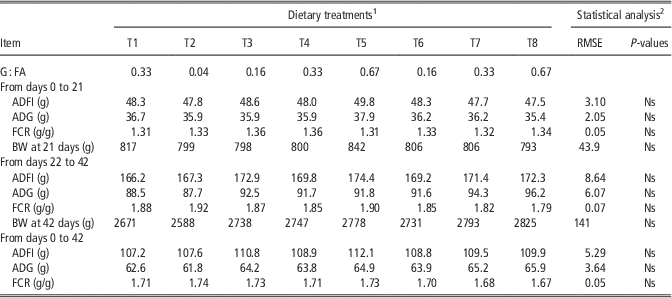
The effect of dietary fat source on growth-performance traits is reported in Table 5.
Growth performance of broiler chickens according to different dietary fat sources

ADFI=average daily feed intake; ADG=average daily gain; BW= body weight; FCR=feed conversion ratio.
1 T1=100% native palm oil (N) positive control (G : FA=0.33 mol/mol, 80% triacylglycerols); T2=100% acid palm oil (A) negative control ( G : FA=0.04 mol/mol, 89% FFA); T3=4% G+96% A (G : FA=0.16 mol/mol); T4=8% G+92% A (G : FA=0.33 mol/mol); T5=16% G+84% A (G : FA=0.67 mol/mol); T6=40% E+60% A (G : FA=0.16 mol/mol); T7=70% E+30% A (G : FA=0.33 mol/mol) and T8=100% re-esterified palm oil (E) (G : FA=0.67 mol/mol; 45% diacylglycerols and 41% monoacylglycerols).
2 RMSE=root mean square error of six observations per treatment (the experimental unit is the cage).
The addition of increasing proportions of G to A (T3<T4<T5) did not improve broiler-chicken performance, as compared with the diet containing only A (T2).
In literature, few studies are found using G as a facilitator of FA absorption (Sklan, Reference Sklan1979; El-Wafa et al., Reference El-Wafa, Toson, Hassan and El-Wakil2013). Most research in broiler chickens has studied the effect of G as an energy source, in inclusion levels up to 10%. In this case, studies examining the effects of supplementing diets with crude G have shown some positive, or no adverse effects on animal performance (Cerrate et al., Reference Cerrate, Yan, Wang, Coto, Sacakli and Waldroup2006; Abd-Elsamee et al., Reference Abd-Elsamee, Abdo, EL-Manylawi and Salim2010; Min et al., Reference Min, Yan, Liu, Coto and Waldroup2010).
On the other hand, no significant differences were shown in productive parameters as the dietary proportions of MAG and DAG increased. The absence of differences found between the N and E groups is in agreement with the findings observed by Smink et al. (Reference Smink, Gerrits, Hovenier, Geelen, Lobee, Verstegen and Beynen2008), Lin and Chiang (Reference Lin and Chiang2010), Mandalawi et al. (Reference Mandalawi, Mallo, Menoyo, Lázaro and Mateos2017) and Vilarrasa et al. (Reference Vilarrasa, Guardiola, Codony, Esteve-Garcia and Barroeta2014), who also fed broiler chickens with N and E and suggested that these re-esterified oils can be used as alternative fat sources in broiler-chicken diets.
Digestibility balances
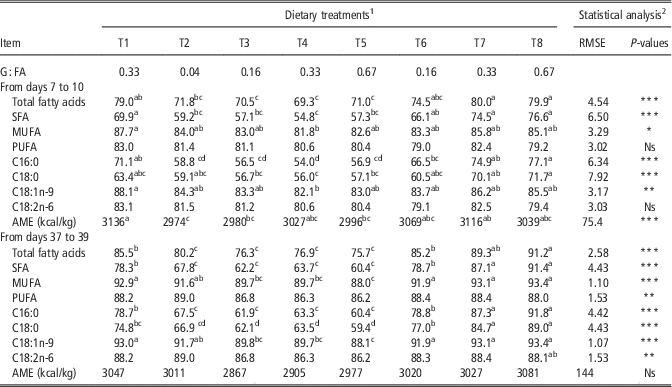
The effects of the molecular structure and the G : FA ratio of fat sources on the apparent metabolizable energy of the diets and the apparent absorption of individual FA in both starter (from 7 to 10 days) and grower-finisher (from 37 to 39 days) periods are presented in Table 6.
Apparent metabolizable energy of the diets (kcal/kg) and individual fatty acid apparent absorption coefficients (%) in broiler chickens fed different dietary fat sources

AME=apparent metabolizable energy; MUFA=monounsaturated fatty acids; PUFA=polyunsaturated fatty acids; SFA=saturated fatty acids.
1 T1=100% native palm oil (N) positive control (G : FA=0.33 mol/mol, 80% triacylglycerols); T2=100% acid palm oil (A) negative control ( G : FA=0.04 mol/mol, 89% FFA); T3=4% G+96% A (G : FA=0.16 mol/mol); T4=8% G+92% A (G : FA=0.33 mol/mol); T5=16% G+84% A (G : FA=0.67 mol/mol); T6=40% E+60% A (G : FA=0.16 mol/mol); T7=70% E+30% A (G : FA=0.33 mol/mol) and T8=100% re-esterified palm oil (E) (G : FA=0.67 mol/mol; 45% diacylglycerols and 41% monoacylglycerols).
2 RMSE=root mean square error of six observations per treatment (the experimental unit was the cage).
a,bValues within a row with different superscripts differ significantly at P<0.05. *P<0.05; **P<0.01; ***P<0.001
It was observed that the digestibility values were generally lower in the first period (7 to 10 days) than in the second one (36 to 39 days). It is well-known that younger broiler chickens are less efficient in digesting fats than are older broiler chickens, especially when fed saturated fat sources rich in FFA, due to the reduced secretion of bile salts and low levels of pancreatic lipase (Leeson and Summers, Reference Leeson and Summers2001).
Moreover, it was noted that in all treatments the apparent absorption of unsaturated FA was higher than was that of SFA.
Furthermore, this study has proved how the fat molecular structure also influences fat absorption. In the first period, keeping the G : FA ratio constant (0.33 mol/mol), treatments T1, with a high TAG content, and T7, with a high MAG and DAG content, achieved higher SFA apparent absorption values than did treatment T4, with a high FFA content (T1=69.9%, T7=74.5%, T4=54.8%; P<0.001). The low FA apparent absorption observed in broiler chickens fed high FFA levels is directly linked to the lack of TAG, DAG and MAG, as it has been observed that these molecules activate bile secretion and, subsequently, the formation of mixed micelles (Garrett and Young, Reference Garrett and Young1975). Triglycerides are hydrolyzed to FFA and 2-MAG by the action of pancreatic lipase (Mattson and Beck, Reference Mattson and Beck1956). The resulting 2-MAG favors the solubilization and, therefore, the absorption of FFA due to the formation of mixed micelles with bile salts (Hofmann, Reference Hofmann1963). When FFA is supplied as the only source of lipids, there is not enough MAG and, therefore, the absorption process becomes impaired (Blanch et al., Reference Blanch, Barroeta, Baucells and Puchal1995). This effect has been demonstrated in chicks with ligated pancreatic ducts, to whom palmitic acid with or without MAG was offered (Garrett and Young, Reference Garrett and Young1975). These authors showed how MAG are more readily absorbed than are TAG in the gastrointestinal tract of broiler chickens, confirming that MAG are necessary for the absorption of FFA, as they facilitate the formation of mixed micelles.
Corroborating these results, Wiseman and Salvador (Reference Wiseman and Salvador1991) and Vila and Esteve-Garcia (Reference Vila and Esteve-Garcia1996) also found a reduction in fat digestibility as dietary FFA levels increased. One possible explanation for the decreased fat digestibility when FFA is added into the diet could be due to the strong tendency that carboxylic groups of FFA show in forming insoluble soaps with divalent cations, such as calcium and magnesium, at the alkaline pH of the small intestine (Renaud et al., Reference Renaud, Ruf and Petithory1995; Lien et al., Reference Lien, Boyle, Yuhas, Tomarelli and Quinlan1997). The effect of the fat molecular structure was even more evident in the second digestibility balance. Thus, keeping the G : FA ratio constant (0.33 mol/mol), treatment T7, with a high MAG and DAG content, reached higher digestibility values of SFA than did treatment T1, with a high TAG content, and this, in its turn, than did treatment T4, with a high FFA content (T7=87.1%, T1=78.3%, T4=63.7%; P<0.001).
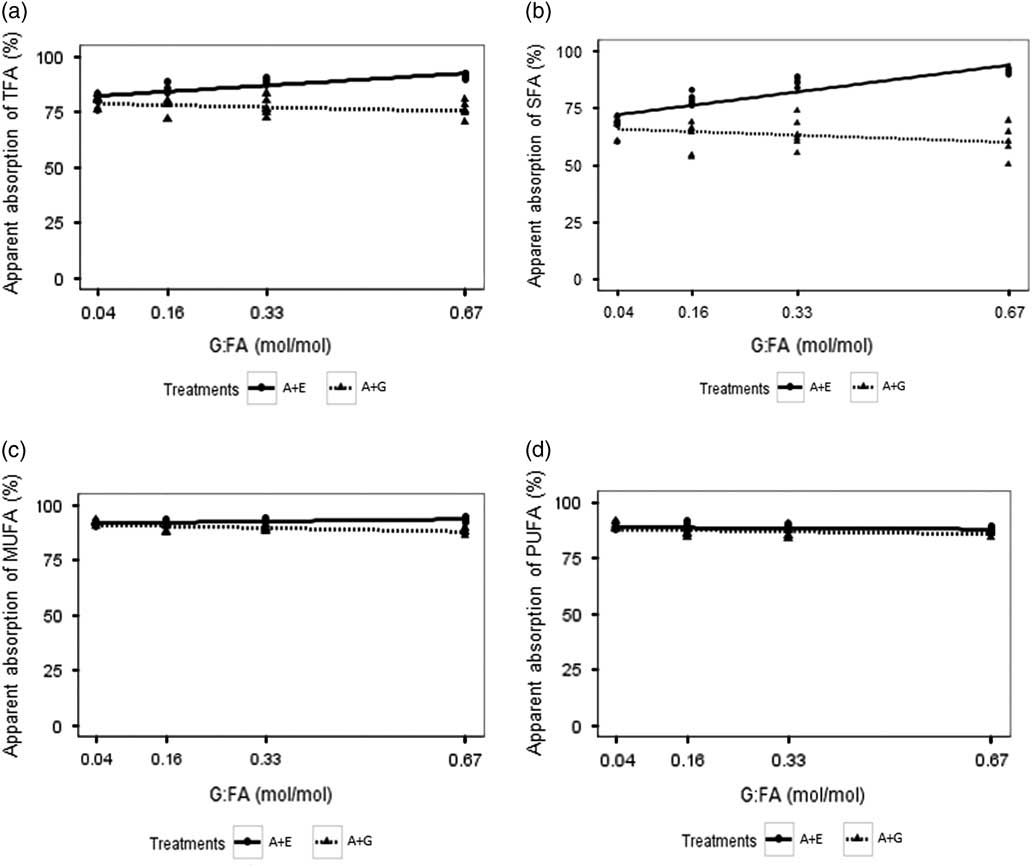
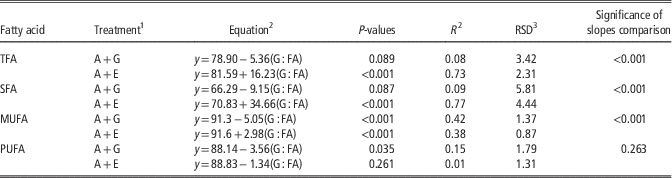
Related to this, Vilarrasa et al. (Reference Vilarrasa, Tres, Bayés-García, Parella, Esteve-Garcia and Barroeta2015) observed similar results among palm N, palm E, and palm A, although no differences were observed among the same soybean-oil treatments. These results are in line with those observed by Mandalawi et al. (Reference Mandalawi, Mallo, Menoyo, Lázaro and Mateos2017), who also found no differences among different soybean oil sources. This different behavior among fat sources, according to their degree of saturation, may be related to their potential for improvement. Thus, there is more potential for improvement in palm A than in soybean A. On the other hand, taking into account the G : FA ratio, it was observed how the behavior of the oils was not the same if G was found in its free state or if it was esterified, forming part of the acylglycerol molecules (Figure 1 and Table 7).
Apparent absorption of (a) total fatty acids (TFA), (b) saturated fatty acids (SFA), (c) monounsaturated fatty acids (MUFA), and (d) polyunsaturated fatty acids (PUFA), according to glycerol-to-fatty acid ratio (G : FA) in broiler chickens (37 to 39 days) fed different dietary fat blends: acid palm oil with re-esterified palm oil (A+E) or acid palm oil with glycerol (A+G).

Regression equations of fatty-acid apparent absorption according to glycerol-to-fatty acid ratio in broiler chickens (37 to 39 days) fed different dietary fat sources

G : FA=glycerol-to-fatty acid ratio; MUFA=monounsaturated fatty acids; PUFA=polyunsaturated fatty acids; SFA=saturated fatty acids; TFA=total fatty acids.
1 A+G=G : FA gradient achieved by adding glycerol (G) to acid palm oil (A), which corresponds to treatments T2 (0.04)<T3 (0.16)<T4 (0.33)<T5 (0.67); A+E=G : FA gradient achieved by adding re-esterified palm oil (E) to acid palm oil (A), which corresponds to treatments T2 (0.04)<T6 (0.16)<T7 (0.33)<T8 (0.67).
2 Corresponding graphics in Figure 1.
3 RSD=relative standard deviation.
Thus, it could be seen how adding increasing proportions of G to A (T2<T3<T4<T5), mainly in the second digestibility balance, did not favor the absorption of total FA (P>0.05), but rather even impaired the absorption of MUFA (Figure 1c) and PUFA (Figure 1d).
The G absorption rate is very high in broiler chickens and can reach up to 97%, due to its small molecular weight and hydrophilic character, being absorbed passively without forming micelles (Min et al., Reference Min, Yan, Liu, Coto and Waldroup2010), thus not contributing to the absorption of FFA.
In this sense, Mattson and Volpenhein (Reference Mattson and Volpenhein1964) observed how free G was almost not incorporated in acylglycerol molecules (5%) because of its insolubility with dietary fat.
In contrast, Sklan (Reference Sklan1979) observed how chicks that had been offered FFA with G had a greater absorption of fat, as compared with those offered only FFA, as the addition of G favored the synthesis of MAG.
However, the addition of increasing amounts of MAG and DAG to A (T2<T6<T7 <T8) actually favored the absorption of total FA (Figure 1a), mainly owing to the increased absorption of SFA (Figure 1b).
Thus, E rich in MAG and DAG exercised an emulsifier effect, favoring the absorption of FFA, despite the fact that 96% of MAG and 75% of DAG corresponded to their positional isomers 1(3)-MAG and 1,3-DAG, respectively. In this sense, Mattson and Volpenhein (Reference Mattson and Volpenhein1964) also proved that 1(3)-MAG and 1,3-DAG were not completely hydrolyzed to G and FFA. Due to its rapid absorption, 1(3)-MAG escapes from the hydrolytic action exerted by pancreatic lipase.
The regression equations obtained to estimate the digestibility of SFA due to the percentage of E incorporated in the fat mixture (T2=0%, T6=38.5%, T7=69.5%, and T8=100%), at a 6% inclusion level in feed, were in the starter digestibility balance: SFA=59.5+0.184(E), R 2=0.56, P=0.001) and in the grower-finisher digestibility balance: SFA=67.64+0.339(E)−0.001(E2), R 2=0.94, P=0.043). As can be seen, the equations show a positive association between the inclusion of E (MAG/DAG) in combination with A (FFA) and the digestibility of SFA. Therefore, the percentage of E mixed with A required to achieve the same digestible coefficient as in the control diet (N; T1) was 57% in the starter period (from 7 to 10 days) and only 35% in the grower-finisher period (from 37 to 39 days). Hence, we can conclude that E facilitates the absorption of FFA (A).
Taken together, although no differences were observed in growth performance results, it is concluded that the greater the G : FA ratio of palm oil, the greater the absorption of total FA, as long as G is esterified as part of acylglycerol molecules (G in its free state does not improve the absorption of total FA).Thus, the re-esterification process for obtaining E makes sense in order to give added value to A, achieving even greater digestibility values than does its corresponding N.
Acknowledgments
This work was carried out thanks to the financial support provided by the Ministerio de Economia y Competitividad of the Spanish Government (Project AGL2010-22008-C02), a pre-doctoral research grant from the Generalitat de Catalunya (Ref. 2012FI_B 00406) and by CAPES through a PDSE scholarship (18357-12-1) granted to Aline Piccini Roll. The authors are also grateful to SILO S.P.A. and NOREL S.A. for providing the experimental fats. The English of this manuscript has been proofread by Mr. Chuck Simmons, a native, English-speaking Instructor of English of this University.
Declaration of interest
The authors have no conflict of interest to declare.
Ethics statement
None.
Software and data repository resources
None.