Introduction
Delirium is a common neuropsychiatric syndrome that is highly heterogeneous in etiology, treatment needs and course (Trzepacz et al., Reference Trzepacz, Mittal, Torres, Kanary, Norton and Jimerson2001). It is an umbrella term that encapsulates a number of clinical presentations, all of which share features of generalized disruption of brain function. These different patterns have been characterized as clinical subtypes – with most attention to date having focused upon the designation of subtypes according to motor activity profile. Lipowski (Reference Lipowski1983) suggested “hyperactive” and “hypoactive” as labels for delirium subtypes, characterized by increased and decreased motor activity respectively, before adding a third “mixed” category in recognition that many patients experience elements of both within short time frames. A variety of different approaches to defining motor subtypes have emerged that include a wide range of motor and non-motor features (Lipowski, Reference Lipowski1989; Liptzin and Levkoff, Reference Liptzin and Levkoff1992; O'Keeffe and Lavan, Reference O'Keeffe and Lavan1999) though these have not been validated using non-delirious controls or independent measurements of motor behavior. These methods differ considerably in subtype attribution when applied to the same patients with concordance between four subtyping methods of only 34% in one study. (Meagher et al., Reference Meagher2008b) Clarifying the relevance of different motor presentations in delirium to pathophysiological mechanisms, treatment needs and outcomes requires a more focused, readily applicable, reliable, and validated methodology. (Platt et al., Reference Platt, Breitbart, Smith, Marotta, Weisman and Jacobsen1994; Meagher, Reference Meagher2009)
The study of clinical subtyping in delirium has thus been hindered by the absence of well-designed and validated tools that allow for the efficient and reliable attribution of clinical subtypes. The DMSS was developed using elements of previous methods selected according to their relative specificity for delirium and correlation with independently measured motor activity changes in delirium – both observed and bioelectronically measured. (Meagher et al., Reference Meagher2008b; Godfrey et al., Reference Godfrey, Leonard, Donnelly, Conroy, Olaighin and Meagher2010) Subsequent work has further validated the scale in a general hospital consultation-liaison psychiatry referral population. (Grover et al., Reference Grover2013) It has also been translated and validated in the Dutch language. (Slor et al., Reference Slor2014) In addition, the DMSS has been applied to the longitudinal study of motor subtype profile in delirium. (Meagher et al., Reference Meagher, Leonard, Donnelly, Conroy, Adamis and Trzepacz2011; Reference Meagher, Leonard, Donnelly, Conroy, Adamis and Trzepacz2012; Fitzgerald et al., Reference Fitzgerald2015) No other rating scale for motor subtypes of delirium has been developed and validated with such rigor.
More recently, the scale has been reduced to an abbreviated 4-item version. (Meagher et al., Reference Meagher2014) Initial studies indicate that this abbreviated version has high concordance with the longer version, but with the advantage of requiring only 1–2 minutes to complete. It is hoped that the availability of this more rapid method of assessment can promote more consistent documentation of clinical subtype within the time-pressurized clinical environments that characterize modern healthcare. Moreover, a brief reliable means of documenting clinical subtype that could be readily incorporated into assessments alongside other tools would promote better account of clinical subtypes in research studies where such issues are not necessarily the primary focus.
However, the abbreviated DMSS scale has not yet been validated in hip fracture patients. Therefore, the aims of this study are to evaluate the concurrent validity (agreement) and reliability (internal consistency) of DMSS-4 in a cohort of delirious hospitalized hip fracture patients. More specifically the aims were:
-
1. To explore the concordance with respect to motor subtype attribution between the original DMSS scale and the abbreviated DMSS-4 scale in a new cohort of elderly patients experiencing delirium post hip-surgery.
-
2. To investigate concordance between subtypes defined by the DMSS-4 and the Liptzin and Levkoff developed DSI (Liptzin and Levkoff, Reference Liptzin and Levkoff1992). For this analysis both scales were rated using pooled longitudinal data in order to assess correlation over longitudinal assessment.
-
3. To calculate the internal consistency of the DMSS-4.
Methods
Design
This is a post-hoc analysis of motor data that were collected as part of a multi-center double-blind randomized controlled trial studying the effect of melatonin suppletion on the incidence of delirium in the Netherlands between November 2008 and May 2012, the MAPLE study. Full details of the study are described elsewhere. (de Jonghe et al., Reference de Jonghe2014)
Participants and setting
The study population comprised Dutch patients of 65 years and above who were admitted acutely for surgical treatment of hip fracture. The three trial locations were the surgical, orthopedic, and trauma surgery wards of the Academic Medical Center in Amsterdam (a 1,000-bed university teaching hospital), and Tergooi hospital (a regional teaching hospital comprising 633 beds at two locations: Hilversum and Blaricum). Exclusion criteria included post-operative intensive care unit (ICU) or coronary care unit (CCU) admission, and prior use of melatonin at home.
Procedures
All patients of 65 years and older with an acute hip fracture were approached within 24 hours of admission by the research team, which comprised geriatricians and trained research nurses with experience in geriatrics. Patients were screened for eligibility and asked to participate. At baseline, demographic data, medical history, medication use, and surgery-related characteristics were recorded. DSM-IV criteria were used for the diagnosis of delirium. (American Psychiatric Association, 1994) Subsequently, over seven days or until discharge in case of persistent delirium, daily assessments for the presence of delirium were performed six days a week, in which all information about the patient, including from medical and nursing records over the previous 24 hours was included. For patients who were not delirious on day eight, all daily research assessments were terminated.
For the purpose of the present study a subsample of 113 consecutive participants with delirium according to DSM-IV criteria and data on motor subtypes has been used.
Motor subtyping methods
-
1. The (original) DMSS (Meagher et al., Reference Meagher2008a) comprises 11 (4 hyperactive and 7 hypoactive) symptoms selected according to their reflection of motor phenomenology, relative specificity for delirium relative to controls, and demonstrated correlation with independent and objective measures of motor behavior. (Meagher et al., Reference Meagher2008b; Godfrey et al., Reference Godfrey, Leonard, Donnelly, Conroy, Olaighin and Meagher2010; Grover et al., Reference Grover2013) The DMSS can be rated by any healthcare professional familiar with the clinical presentation of delirium. Each item is rated dichotomously as present or absent through observation and discussion with nursing responsible for the patient and considering the 24 hours of each day. Scoring requires at least two symptoms to be present from either the hyperactive or hypoactive list to meet subtype criteria. Patients meeting both hyperactive and hypoactive criteria are deemed mixed subtype, while patients meeting neither criteria are labeled “no subtype”.
-
2. DMSS-4: The DMSS-4 is an abbreviated version of the DMSS which includes two hyperactive (Increased amount of activity and loss of control of activity) and two hypoactive (decreased speed of actions and decreased speech) features. Presence of either of the two suggested features qualifies for hyperactive and hypoactive respectively, while patients meeting both hyperactive and hypoactive criteria are deemed mixed subtype, while patients meeting neither criteria are labeled “no subtype”. For the DMSS-4 data on motor subtypes items obtained for the DMSS were used. Concordance analysis with the DMSS showed a κ of 0.63 in the original development study and a κ of 0.75 in general medicine inpatients. (Meagher et al., Reference Meagher2014; Fitzgerald et al., Reference Fitzgerald2015)
-
3. The DMSS-4 ratings over the course of the admission for each patient (i.e. up to a maximum of seven assessments) were used in the same way as the Liptzin and Levkoff DSI method in order to make both scales comparable and to use all available information on motor symptoms obtained during admission. All delirium symptoms expressed during admission were added and one overall subtype was determined for each patient, thus providing a measure of longitudinal expression of motor profile. Patients with hyperactive and hypoactive symptoms were allocated to an overall mixed subtype.
-
4. The DSI is an instrument that assesses the seven symptom domains delineated by the DSM-III criteria for delirium in a systematic manner according to operationalised methods. It was developed by Albert et al. (Reference Albert1992) and was designed to be administered (on a daily basis) to hospitalised older people by both clinicians and non-clinicians. Specific symptoms on the DSI can be defined as hyperactive or hypoactive. Hyperactive features include hypervigilance, restlessness, fast or loud speech, irritability, combativeness, impatience, swearing, singing, laughing, uncooperativeness, euphoria, anger, wandering, easy startling, fast motor responses, distractibility, tangentiality, nightmares, and persistent thoughts. Hypoactive symptoms include unawareness, decreased alertness, parse or slow speech, lethargy, slowed movements, staring, and apathy. Liptzin and Levkoff (Reference Liptzin and Levkoff1992) first applied this approach to identifying psychomotor subtypes of delirium using a definition whereby delirious patients who had three or more different symptoms of hyperactivity were rated as hyperactive, those who had four or more different symptoms of hypoactivity were rated as hypoactive, those who were rated as positive on both scores were considered as mixed type and those who were rated as negative on both scores were considered as none. The DSI ratings of clinical subtype were based upon the Liptzin and Levkoff approach (Liptzin and Levkoff, Reference Liptzin and Levkoff1992) and related to pooled data regarding motor profile over the seven daily assessments during the admission—thus providing a measure of the longitudinal expression of motor activity disturbances in delirium. The DSI was obtained separately from the DMSS items.
Assessment of previous cognitive status
Medical case notes were reviewed for documentation of prior cognitive impairment (mild cognitive impairment or dementia). If this was not evident, pre-morbid cognition was determined using the Informant Questionnaire on Cognitive Decline in the Elderly (IQCODE) – a validated screening tool for detecting cognitive impairment. (Jorm, Reference Jorm2004) We defined “cognitive impaired” as: an IQCODE score of ≥3.4 or diagnosed dementia in medical history.
Ethics
The study was conducted in compliance with the Helsinki Declaration and Good Clinical Practice guidelines. The study was approved by the Medical Ethics Committee (MEC) of the Academic Medical Center with local approval of the other participating centers. Written informed consent was obtained from all patients or a legal representative in patients with cognitive impairment. The study was registered with the Dutch Clinical Trial Registry (NTR1576).
Statistical analysis
Statistical analyses were conducted using the Statistical Package for the Social Sciences version 22 and the R psych package. Agreement between the DMSS-4 and DMSS-11, and respectively DMSS-4 and DSI, was tested by using Cohen's κ coefficient. The agreement between DMSS-11 and DMSS-4 was evaluated using data from the first assessment as they include the maximum number of participants. Agreement between DSI and DMSS-4 was evaluated from the overall pooled data during hospitalization as the DSI is based upon such longitudinal assessment. Correspondence analysis was used to graphically represent the relationships between motor categories defined by the DMSS-4 and DMSS-11 respectively DMSS-4 and DSI. Finally, to estimate the internal consistency reliability of the DMSS-4 scale, Cronbach's α was calculated and the total McDonald's omega ⱷ
t
according to equation: ⱷ
t
=1-
 $\ \frac{{\mathop \sum \nolimits^{} ( {1 - h_j^2} )}}{{Vx}}$
where h
2
j
is the communality of item j, based upon general as well as group factors, and Vx the total variance. (Revelle and Zinbarg, Reference Revelle and Zinbarg2009)
Results
Descriptive statistics
The total studied sample consisted of 113 participants with DSM-IV delirium. The mean age was 87.0 years old (SD 6.5 years) and age range 65 to 102 years. Thirty-six were males (31.9%) and 25 (22.1%) had no previous history of cognitive impairment.
Motor subtypes defined according to DMSS-11 and DMSS-4
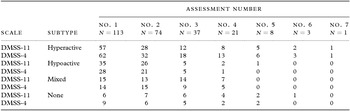
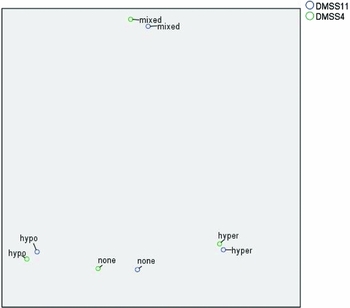
Table 1 shows the actual numbers and percentages of the participants in each motor category across each assessment as they identify with the DMSS and the same categories as identified with the abbreviated scale (DMSS-4). Using data from the first assessment (n = 113) the agreement between the two scales was good (κ = 0.82; ASE = 0.05; λ2 = 198; df = 9; p < 0.001) (see Table 2). Also, the concordance was high across the different motor subtypes as shown in the correspondence graph (Figure 1). The concordance for subtype attribution was considerably lower for no subtype than for the other groups.
DMSS-11 and DMSS-4 determined subtype categories each assessment during hospitalization

Concordance between DMSS-11 and DMSS-4 at first assessment

(n = 113, κ 0.82, λ2 = 198, ASE 0.05, df = 9, p < 0.001).
Correspondence figure of the subtype attribution by DMSS-4 and DMSS-11 methods at first assessment.

Overall subtype attribution and agreement between DSI and DMSS-4
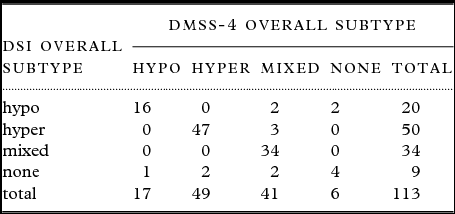
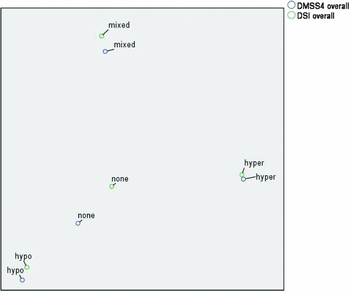
Because the DSI was rated according to psychomotor profile during the overall hospitalization, we used a similar methodology to rate the overall DMSS-4 subtype categories by summating data from all available assessments for each patient. The frequencies of subtypes for the DSI and longitudinal DMSS-4 respectively were hyperactive subtype 50 (44%)/49(43%), hypoactive subtype 20 (18%)/17(15%), mixed subtype 34 (30%)/41(36%), and no subtype 9 (8%)/6(5%). The agreement between the two scales was high (see Table 3) (n = 113; κ = 0.84; λ2 = 209; df = 9; ASE = 0.04; p < 0.001). In addition, the relationship across all subtype categories was high as depicted in Figure 2 which shows the correspondence analysis between the scales. The discordance between the scales was principally accounted for by differences in the frequency of no subtype and mixed subtype, with the former more common with the DSI method and the latter more common with the DMSS-4 method.
Subtype attribution for the DSI and DMSS-4

Based upon longitudinal data from all assessments. (n = 113, κ 0.84, λ2 = 209, ASE 0.04, df = 9 p < 0.001).
Correspondence figure of the overall subtype attribution by DMSS-4 and DSI methods.

Reliability analysis (internal consistency of DMSS-4)
We investigated the internal consistency of the DMSS-4 using Cronbach's α and McDonald's total omega (ⱷ t ). The reliability (Cronbach's α) of the scale at first assessment was 0.68 and McDonald's total omega 0.90 – both indicative of good reliability. The lower rating for Cronbach's α reflects the small number of items included in this abbreviated scale.
Discussion
This study explores the use of the DMSS-4 in the assessment of motor subtypes in elderly patients developing delirium after hip-surgery. We focused upon it's concordance with the more detailed original 11 item DMSS, as well as the level of agreement with the approach to motor subtyping described by Liptzin and Levkoff (Liptzin and Levkoff, Reference Liptzin and Levkoff1992) utilizing longitudinal data captured on the DSI. Our analyses indicate high agreement between the DMSS-4 and both the DMSS-11 and the DSI. The agreement is slightly higher with the DSI than the DMSS-11, although the latter is based upon a cross-sectional assessment, while the former is based upon longitudinal assessment and includes considerably more information gathered over a full week of assessments. These findings suggest that the DMSS-4 can provide an efficient and reliable means of subtype attribution where rapid assessment is needed and seems an acceptable substitute for more detailed and time-consuming approaches. Delirium in this elderly hip fracture surgical population was predominantly hyperactive (by all three subtyping instruments) which is in keeping with other studies whereby post-operative and elderly medical populations with delirium tend to have greater expression of hyperactive features compared to those in ICU and palliative care settings where delirium is predominantly hypoactive in presentation, although all of these populations include the range of motor presentations. (de Rooij et al., Reference de Rooij, Schuurmans, van der Mast and Levi2005; Meagher, Reference Meagher2009; Leonard et al., Reference Leonard, Donnelly, Conroy, Trzepacz and Meagher2011)
The concordance (as per K value) for DMSS-11 with the DMSS-4 was higher in this population (k = 0.82) than in the previous development study of the DMSS (k = 0.63) which included patients from a variety of general medical, CL Psychiatry referral and palliative care settings. This may reflect the greater homogeneity of the current population, as patients were all admitted to the hospital for surgical repair of a hip fracture and received similar agents for sedation, anesthesia, neuromuscular blockade and pain relief — and thus may all have a similar etiology of delirium. The smaller percentage of patients with no subtype in our study could also play a role since the concordance for subtype attribution was considerably lower for no subtype. Fitzgerald et al. found an overall K value of 0.75 in elderly medical inpatients, which is in line with our findings. (Fitzgerald et al., Reference Fitzgerald2015)
The principal difference in subtype attribution between the scales was for the attribution of mixed and no subtype between the DSI and the DMSS-4 such that the DSI was less inclusive of subtypes with less mixed cases and more no subtype cases. Previous work comparing subtype attribution for four methods (Meagher et al., Reference Meagher2008b) found that the DSI was the least inclusive, which is unsurprising given that it has a high symptom requirement (three hyperactive features and/or four hypoactive features). Given that studies indicate that motor activity disturbances are almost invariably present in delirium, higher coverage of actual subtypes is desirable and this work suggests that both the DMSS-11 and DMSS-4 have advantages in this regard. Notably, no subtype was relatively uncommon in this delirious population, with frequencies typically 4–15% with cross-sectional assessment and rated as 5–7% by the two longitudinal methods. The lower rates of no subtype with the DMSS-4 highlight its coverage of motor activity changes in delirium.
Previous work has highlighted that identifiable alterations in motor activity profile are evident in the vast majority of patients with full syndromal delirium (Meagher et al., Reference Meagher2008b; Jabbar et al., Reference Jabbar2011; Grover et al., Reference Grover2013) thus emphasizing their potential role not only in subtype attribution, but also in delirium detection in general. The emphasis of hypoactive behaviors as a separate symptom of delirium is a key element that underpins the sensitivity of instruments such as the Revised Delirium Rating Scale (DRS-R98) (Trzepacz et al., Reference Trzepacz, Mittal, Torres, Kanary, Norton and Jimerson2001) for delirium diagnosis and/or severity rating (Marcantonio et al., Reference Marcantonio, Ta, Duthie and Resnick2002; de Rooij et al., Reference de Rooij2006; Radtke et al., Reference Radtke2010) and Delirium Observation Screening Scale (DOSS) for delirium screening. (Schuurmans et al., Reference Schuurmans, Shortridge-Baggett and Duursma2003) Also, differences in prognosis and outcome have been described when comparing patients with hyperactive and hypoactive delirium. (Robinson et al., Reference Robinson, Raeburn, Tran, Brenner and Moss2011) As delirium subtyping is not commonly done in daily practice, a rapid and reliable method that can be easily implemented alongside other tools would attribute to more consistent documentation of clinical subtype. Especially in daily clinical practice and in research studies where subtyping is not the primary aim, the DMSS-4 would be useful. However, other measurement scales like the DRS-R98 will be required in addition to the DMSS-4 to diagnose delirium and to measure severity.
Limitations
This study relates to a secondary analysis of data collected as part of a randomized controlled trial of melatonin treatment to prevent delirium. Although the study did not indicate significant differences between the treatment groups, the analyses described herein are not in respect of a priori hypotheses. Moreover, although use of melatonin did not impact upon delirium status, it may have influenced phenomenological profile in some patients. However, although melatonin has well recognized effects upon sleep (Laudon and Frydman-Marom, Reference Laudon and Frydman-Marom2014) impact upon motor activity is minimal and as such it is less likely to have influenced motor subtype ratings with the DMSS versions.
Secondly, this work involves an elderly post-hip operation population but the heterogeneity in the patterns of clinical presentation of delirium across treatment settings and populations is such that these findings may not directly generalize to delirium subtyping in other settings. In particular, the rate of comorbid dementia is high and a higher rate of hypoactive delirium has been noted in patients with comorbid dementia. (Meagher, Reference Meagher2009) However, the DMSS-4 has been developed using data from a variety of clinical populations and as such has an inherent sensitivity to these variations in clinical profile for delirium.
For the DMSS-4 data on motor subtypes items obtained for the DMSS were used. Although the scales have not been measured independently in this study, we took all symptoms present over 24 hours into account. Fitzgerald et al., (Reference Fitzgerald2015) recently demonstrated that the inter-rater reliability for the DMSS-4 was high and for the DMSS moderate. Therefore, we believe the influence of not measuring the scales independently was low in this study.
This work does not include the use of a “hard” (e.g. bioelectronic) measure of motor activity which could add to the concurrent validity of these scales in respect of their relationship to activity levels documented by objective measures. Of note, the use of κ to explore agreement between the scales does not make any assumptions as to which scale might be better. Future work can include bioelectronics measurements.
Conclusions
The DMSS-4 provides a rapid means of identifying motor-defined clinical subtypes of delirium, and appears to be a reliable alternative to more detailed scales such as the DMSS-11 and DSI methods of subtype attribution. This short scale has high correlation with more detailed measures while also allowing for good coverage of the motor presentations of delirium. The DMSS-4 can be readily applied to further studies of causation, treatment and outcome in delirium.
Conflicts of interest:
None.
Description of authors' roles
S. de Rooij and D. Meagher designed the study, A de Jonghe collected the data, D. Adamis and R. Scholtens analysed and interpreted the data under supervision of B. van Munster, D. Meagher and S. de Rooij. D. Meagher and R. Scholtens drafted the manuscript. All authors critically revised the manuscript and have approved the final version.