Implications
The goats used in the present study (a mix of 75% temperate breed with 25% local adapted breed) have shown remarkable capacity to endure significant water restriction for a long time. Water restriction endurance was associated with minimal disruption of plasma electrolyte and metabolite composition, thermoregulation and general well-being. The water-saving responses were activated in response to mild loss of body fluids and increase in plasma sodium concentration and ADH concentration. The results of this study help us understand the adaptation of goats to water restrictions and might be helpful for management purposes under conditions of water limitation, or as a technique to manipulate feed intake.
Introduction
The mass of body water accounts to 60% to 70% of BW and constitutes 99% of the molecules in the mammalian body (Chew, Reference Chew1965). Maintaining homeostasis of body fluids is, therefore, an essential function in terrestrial mammals. For maintaining homeostasis of the body fluids, water – which is constantly lost through evaporation, urination and fecal excretion – should be replaced. In addition, at any time point, there is a need to maintain an essential minimal mass of water pool in order to preserve essential functions such as cardiovascular flow, appropriate ion balance and composition, as well as thermoregulation (Schmidt-Nielsen, Reference Schmidt-Nielsen1983; Silanikove, Reference Silanikove1994). Under thermoneutral conditions, food and water intake are highly related to each other in goats and other mammals (Silanikove, Reference Silanikove1989). Feed restriction or reduced energy intake is associated with proportional reductions in water intake without loss of body fluids and changes in blood plasma composition (Silanikove, Reference Silanikove1989 and Reference Silanikove1994). In contrast, water deprivation induces a decrease in body fluid content and an increase in its osmolality. Heat stress increases the loss of body fluids due to sweating and panting in order to maintain thermoregulation. In order to maintain thermoregulation during periods of heat stress, animals may sweat and pant, both of which may lead to loss of body water. The main general homeostatic responses to dehydration in mammals include reductions in fecal and renal water losses, reductions in metabolism, and thus in evaporation, and protection of plasma volume (Schmidt-Nielsen, Reference Schmidt-Nielsen1983; Silanikove, Reference Silanikove1994).
From the above discussion, it appears that there are two types of drinking and water-regulatory mechanisms: the first is the food intake-dependent drinking, in which homeostasis of body fluids is achieved without perturbation of the body fluid volume and without significant changes in the osmolality of body fluids and ion composition, and the second one is drinking in response to dehydration, which is also influenced by the physiological changes induced by water deprivation.
Water restriction has been extensively studied in ruminants over the past five decades in order to evaluate and understand the physiological basis underlying their capacity to endure water shortage, as well as the effects of water restriction on feed intake and utilization (see Ahmed and El Kheir, Reference Ahmed and El Kheir2004; Abioja et al., Reference Abioja, Osinowo, Adebambo, Bello and Abiona2010; Rahardja et al., Reference Rahardja, Toleng and Lestari2011 for recent studies on goats and Silanikove, Reference Silanikove1992 for a review of older publications on ruminants). It is possible to maintain ruminants for longer periods (e.g., for entire season) on restricted water intake (Khan et al., Reference Khan, Ghosh and Sasidharan1978; Silanikove, Reference Silanikove1992). Therefore, it is obvious that ruminants in general and goats in particular have the capacity to balance their water economy at a lower level than their normal water intake. Consequently, unlike in animals experiencing dehydration, the plasma tonicity and electrolyte concentrations may be in steady state throughout the water-restriction period for a longer duration (Khan et al., Reference Khan, Ghosh and Sasidharan1978; Silanikove, Reference Silanikove1992). However, despite the above-mentioned extensive research, the existing information does not allow us to tell between two options that enable goats to maintain water balance under water restriction: (i) reduced feed intake is linked to reduced energy metabolism, and hence reduced water losses (Silanikove, Reference Silanikove1989). With this option, the goats maintain homeostasis without losing body water and without changes in plasma electrolyte composition in comparison with initial conditions, and (ii) water restriction induces losses in body water content in comparison with pre-restricted levels and activates physiological responses to preserve water losses. In this case, the achievement of homeostasis of water fluids is associated with some loss of body water and increase in plasma electrolyte composition in comparison with pre-restricted conditions.
The aim of this experiment was to examine the effect of water restriction on feed intake, body fluid homeostasis, thermoregulatory responses and feeding behavior in order to understand what type of physiological responses were evoked by water deprivation.
Material and methods
The experimental procedures were approved by the ethics committee of the Faculty of Agriculture of Cukurova University. The study was carried out on 20 cross-bred 3-year-old female goats (75% German Fawn and 25% Hair Goat) in the Dairy Goat Research Farm at the Faculty of Agriculture of Cukurova University from the beginning of July to the end of August (30 days). The farm is located in the Eastern Mediterranean region of Turkey (40 m in altitude; 36 59' N, 35 18'E), in which subtropical weather conditions prevail. The annual precipitation in the area is 450 mm. The actual average temperatures and relative humidity of the pens where the goats were maintained were recorded daily with a thermometer and a barometer in a nearby climatic station that belongs to the University. The average daily temperature during the experiment was 34.2°C, whereas the highest and lowest temperatures were 42°C and 23.1°C, respectively. The average relative humidity was 68.2% and wind speed was 1.2 km/h during the entire experimental period. Weekly average thermal heat indexes (THI, see Silanikove, Reference Silanikove1992 for definition) during the experiment were 78.3 (week 1), 79.1 (week 2), 80.1 (weak 3), 79.8 (weak 4), 81.3 (weak 5) and on average 79.7. The climatic data were recorded all day long during the experiment.
The goats were housed individually in pens, which provided a space of 1.5×15 m for each goat and were located within semi-open barns (the south side of the barn was opened). The floor surface was concrete, and due to summer season there was no bedding. The goats were fed diets containing 60% concentrate and 40% alfalfa hay ad libitum twice daily at 0800 to 0900 h and at 1400 to 1500 h; fresh water was available at all times.
The concentrated feed composition was as follows: dry matter (DM) (88%), CP (13%), crude cellulose (14%, maximal content), crude ash (9%, maximal content), calcium (between 0.6% and 1.2%), sodium (between 0.3% and 0.6%) and phosphorus (0.4%). The alfalfa hay composition (according to conventional feed analysis in the university nutritional laboratory) was as follows: DM (88.5%), CP (13%), crude ash (6.4%), ADF (45.4%), NDF (52.9%) and crude fat (0.91%); 10 days were given for the adaptation to diets and the experimental unit.
In early May, the animals were divided into four groups, with five goats per group. Each group of five goats was kept together. The animals were selected based on their age, lactation number, number of kids and their live weight. Treatment 1: restricting water intake to 2 l/day; treatment 2: restricting water intake to 3 l/day; treatment 3: restricting water intake to 4 l/day; and treatment 4: water intake ad libitum. Climate data, weight changes and feed consumptions were recorded daily. Rectal temperature (RT), respiration (RR) and pulse rates (PR) and skin temperatures of the shaved head and udder surfaces were recorded in the morning (0800 to 0900 h), midday (1200 to 1300 h) and afternoon (1800 to 1900 h) twice a week during the 4 weeks of measurements. RT was measured using a digital thermometer, and RR and PR were recorded using a stethoscope during 1 min while they were stabilized inside the pen. Skin temperatures were measured via an infrared thermometer (Testo BP-960; Shenzhen Pacom Medical Instruments, Shenzhen, China) at a distance of 10 cm from the head and udder skins. Blood samples (10 ml) were collected from the jugular vein into heparinized sterile tubes once a week in the morning before feeding and drinking water, and the separated plasma samples were stored at −20°C until analysis. The blood was centrifuged for 5 min at 3000×g. The behavior of the goats was recorded using a camera system, which operated 24 h. The camera system was fixed in every barn, and the camera recordings were automatically assessed using a computer all day long during the experiment. Rumination, walking, standing and lying periods were calculated following the method of Darcan et al. (Reference Darcan, Cedden and Çankaya2008).
The animals were weighed individually every week in the morning (0800 to 0900 h) using automatic scales.
All analytical measurements of metabolites were carried out in duplicates and those of ADH in triplicates. Plasma cholesterol concentrations were analyzed using the EnzyChromTM kit (ECCH-100; Bioassay Systems, Hayward, CA, USA). Colorimetric procedures were used to measure the concentrations of glucose (Schönhusen et al., Reference Schönhusen, Junghans, Flöter, Steinhoff-Wagner, Görs, Schneider, Cmetges and Hammon2013), urea (Meza-Herrera et al., Reference Meza-Herrera, Calderón-Leyva, Soto-Sanchez, Serradilla, García-Martinez, Mellado and Veliz-Deras2014) and creatinine (Silanikove, Reference Silanikove1984). Plasma Na and K concentrations were analyzed by flame photometry (Silanikove, Reference Silanikove1984). Plasma ADH concentrations were analyzed using a commercial kit (SKU: E06A1779; Life Sciences Advance Technologies Inc., St. Petersburg, FL, USA) according to the manufacturer’s instructions.
The statistical analyses were carried out on data pooled on a weekly basis (weeks 1, 2, 3 and 4). The UNIVARIATE procedure of SAS (1999) statistical package program was used to check the normality of data. The result of this analysis showed that the data for all the measured characteristics were normally distributed. Subsequently, ANOVA procedures for repeated measures SAS (1999) were used to test the effects of water restriction on feed intake, live weight, thermoregulatory responses and concentrations of blood plasma metabolites. In the case of thermoregulatory responses, the effect of time of sampling was included. The behavioral parameters (total rumination, walking, standing and lying periods pooled on a weekly basis) were evaluated by repeated measures ANOVA. In cases of an overall difference, the Bonferroni correction for multiple comparisons was used for the behavioral parameters. When a statistical significance was detected (P<0.05) for a particular measure, paired comparisons between means were carried out using Tukey’s test to rank between the treatments.
Results
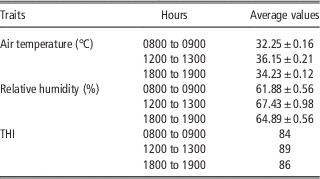
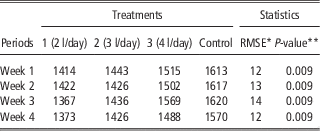
Average morning, noon and evening air temperatures, relative humidity and THI in the experimental pens throughout the experimental period are described in Table 1. The average daily temperature during the experiment was 34.2°C, whereas the highest and lowest temperatures were 42°C and 23.1°C, respectively. The average relative humidity was 68.2% and wind speed was 1.2 km/h. Weekly average THIs during the experiment were 78.3 (week 1), 79.1 (week 2), 80.1 (weak 3), 79.8 (weak 4), 81.3 (weak 5) and on average 79.7. Water intake by goats in the control group was 7.40 l/day. Water intake of 4 l/day (treatment 3), 3 l/day (treatment 2) and 2 l/day (treatment 1) imposed restrictions of 56% (treatment 3), 73% (treatment 2) and 87% (treatment 1), respectively, relative to the free water intake (FWI) in the control group (Table 2). The restrictions in FWI were associated with reduction in the average free feed intake (FFI) during the 4 weeks of measurements, which were proportional to the level of FWI restriction: 5% in treatment 1, 11% in treatment 2, 13% in treatment 3 (Table 2). Feed intake for each treatment during the experiment was quite stable, although, in treatment 1, it was lower in week 4 than in week 1 (Table 2). The FFW/FFI ratio in control goats was 4.61. Water restriction induced reductions in the ratio between water intake and feed intake, which were proportional to the level of water restriction: to 2.63 in treatment 3 (a reduction of 43%), 2.10 in treatment 2 (a reduction of 54%) and 1.44 in treatment 1 (a reduction of 69%) (Table 2).
Average morning, noon and evening air temperature, relative humidity and THI throughout the experimental period

THI=thermal heat index.
Effect of water restriction on free feed intake by the experimental goats (g/day)

* RMSE=root mean square error, n=5.
** P-value refers to differences between treatments. Differences between weeks were significant (P<0.045 and P<0.038, respectively) only for treatment 1 for the differences between weeks 1 and 3 and between weeks 1 and 4.
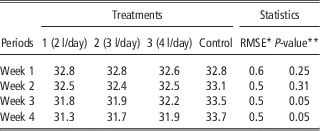
Live weight of the control goats increased during the experimental period by 0.9 kg on average. On the other hand, live weights were reduced during the experimental period in the water-restriction treatments, and the reductions were proportional to the level of water restriction: −0.69 kg (treatment 3), −1.06 (treatment 2) and −1.55 (treatment 1) (Table 3). Weight loss between weeks 3 and 4 was the highest in treatments 2 and 1.
Effect of water restriction on live weight of the experimental goats (kg)

* RMSE=root mean square error, n=5.
** P-value refers to differences between treatments. Differences between weeks were significant (P<0.047 and P<0.048, respectively) only for treatments 1 and 2 for the differences between weeks 1 and 4.
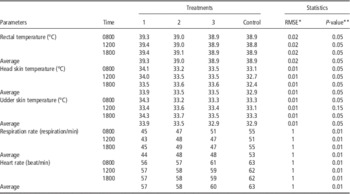
The effects of water restriction on RT were notable only in treatment 1: an increase of 0.51°C in comparison with controls (Table 4). Similarly, the effects of water restriction on udder skin temperature were notable only in treatment 1: an increase of 0.78°C in comparison with controls (Table 4). Head skin temperature was higher in the goats in the water-restriction treatments in comparison with the controls and the response was proportional to the levels of water restriction: 0.40°C (treatment 1), 0.57°C (treatment 2) and 0.97°C (treatment 1) (Table 4). Water restrictions induced modest increases in the RR, which were proportional to the level of water restriction: 12.7% (treatment 3), 13.3% (treatment 2) and 19.7% (treatment 1). Water restrictions induced reductions in heart rate, which were proportional to the level of water restriction: 4.7% (treatment 3), 8.3% (treatment 2) and 9.3% (treatment 1). Time of measurement did not affect the rectal, udder skin and head temperatures as well as the RR and heart rate in all the treatment groups (Table 4).
Effect of water restriction on thermoregulatory responses of the experimental goats

Week effect was not significant, and therefore the results were pooled. Time of measurement effect was not significant. For rectal, head and udder skin temperatures, the results were significant only between treatment 1 and control. For respiration rate and heart rate, the results of the three water-restricted groups were significantly different from the control.
* RMSE=root mean square error, n=5.
** P-value refers to differences between treatments.
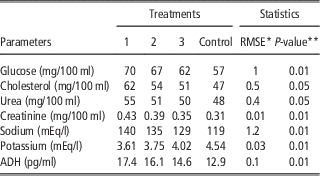
Water restrictions were associated with increases in blood plasma concentrations of glucose, cholesterol, creatinine, sodium and antidiuretic hormone (ADH or vasopressin), which were related to the level of water restriction (Table 5). In the case of urea, the increase in blood plasma concentration upon water restriction was significant only in treatments 2 and 1. Water restriction was associated with a decrease in the concentrations in blood plasma of potassium, which was related to the level of water restriction (Table 5).
Effect of water restriction on the concentrations of blood plasma metabolites of experimental goats

ADH=antidiuretic hormone.
Week effect was not significant, and therefore the results were pooled. For all the parameters, the differences between water restriction treatment and control were significant.
* RMSE=root mean square error, n=5.
** P-value refers to differences between treatments.
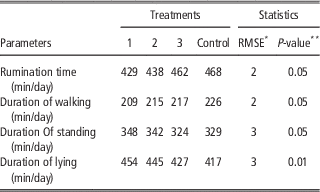
Water restrictions affected all the behavioral aspects described in Table 6. The behavioral changes were most notable and always significant in goats of treatment 1. In most cases, the responses were also significant in goats of treatment 2. Water restrictions affected the feeding behavior as follows: decrease in rumination time, decrease in the duration of walking, increase in the duration of standing and increase in the duration of lying.
Effect of water intake restriction on the behavioral aspects of experimental goats

Week effect was not significant, and therefore the results were pooled. For rumination time and duration and walking, the differences were only significant between treatment 1 and control. For duration of standing and duration of lying, all the water-restriction treatments differed significantly from the controls.
* RMSE=root mean square error, n=5.
** P-value refers to differences between treatments
Discussion
The experimental conditions that prevailed during the experiment indicate that the goats were subjected to moderate heat stress (Silanikove and Koluman, Reference Silanikove and Koluman2015). This study shows that cross-bred goats are able to cope with a substantial reduction in FWI (up to 90%) for a long period (>1 month) under heat stress, without significant adverse effects on energy balance and thermoregulation capacity, and it also identifies some of the mechanisms involved.
When water supply is unlimited, there is a close inter-relationship between the amount of food consumed and the amount of water consumed in ruminants as well as in other mammals (Chew, Reference Chew1965; Silanikove, Reference Silanikove1989). This relationship derives from the close inter-relationship between energy and water fluxes in mammals (Silanikove, Reference Silanikove1989). Imposing reduction of feed intake of roughage diets to about 45% of the ad libitum intake was reflected by a similar reduction in water intake in desert and non-desert goats (Silanikove, Reference Silanikove1989). In contrast, in the present experiment, the reduction in FFI upon restricting FWI was proportionally much lower than the level of water restriction imposed. Similar moderate reduction in feed intake in proportion to considerable imposition of water restriction (33% and 67%) was found in breeds of tropical (Abioja et al., Reference Abioja, Osinowo, Adebambo, Bello and Abiona2010) and desert goats (Alamer, Reference Alamer2009). In cows, with 50% drinking water restriction, the reduction in feed intake was 20% lower than that during when water was available ad libitum (Burgos et al., Reference Burgos, Senn, Sutter, Kreuzer and Langhans2001). Thus, although in cows the reduction in feed intake upon water restriction was also lower than the level imposed by feed restriction, the relative reduction in feed intake was greater than that found in goats. It can be concluded that the present results are consistent with the notion that (i) goats are better adapted to desert conditions than cows by being less sensitive to water deprivation and water restriction (Silanikove, Reference Silanikove1992, Reference Silanikove2000a and 2000Reference Silanikoveb) and that (ii) the physiological basis for the inter-relationships between food and water intake in response to food restriction are different from those controlling the response to water restriction, particularly under heat stress.
Collectively, the present results suggest that the imposed levels of water restriction induced dehydration of body fluids in comparison with control goats and that the physiological responses were targeted on conservation of body fluids. There should be no problem for goats to maintain BW and energy balance on 30% to 40% reduction in feed intake, and desert goats can maintain BW even with 50% to 60% reduction in feed intake (Silanikove, Reference Silanikove1986 and Reference Silanikove1987). Thus, the loss of BW found in the present experiment cannot be explained by the modest reduction in feed intake, particularly if taking into consideration that the digestibility of the diet was most likely increased under the present conditions (Silanikove, Reference Silanikove1985 and Reference Silanikove1992). The concentration of ADH increased under deficit in body fluids in order to preserve body water: reduction in plasma volume was associated with an increase in sodium concentrations, the major ion in extracellular fluids, and with a parallel increase in ADH concentrations (Andersson, Reference Andersson1977; Maltz et al., Reference Maltz, Olson, Glick, Fyhroquist, Silanikove, Choshniak and Shkolnik1984). Thus, lack of evidence for appreciable energy deficit and the evidence for reduced plasma volume in proportion to the level of imposed water restriction are the most probable explanations for the proportional increase in glucose, cholesterol, creatinine and urea concentrations under water restriction. Similar increase in blood plasma metabolites upon water restriction of 20% and 40% was found by Casamassima et al. (Reference Casamassima, Pizzo, Palazzo, D’Alessandro and Martemucci2008) in lactating sheep.
Exposure of goats and sheep to heat stress was found to be associated with a regulatory increase in body fluid volume and plasma volume (Silanikove, Reference Silanikove1988 and Reference Silanikove1992; Rahardja et al., Reference Rahardja, Toleng and Lestari2011). Thus, a putative regulatory increase in body water and plasma volume before initiation of water restriction when water was freely available may explain why the dehydration imposed by water restriction did not bring it to a level that affected substantially feed intake and thermoregulatory responses. The imposed dehydration did not bring the goats to the dehydration level, which would put at risk their cardiovascular and thermoregulatory functions.
Although all the animals were subjected to similar heat stress, the thermoregulatory symptoms in those subjected to water restriction were more pronounced as reflected by the increase in the temperature of the most exposed area – the head skin. Nevertheless, the increase in deep (rectal) temperature and udder skin temperature were quite modest in comparison with the responses of animals that were exposed to severe heat stress (Silanikove, Reference Silanikove2000a), indicating that the heat stress under the present conditions did not induce significant challenge on the thermoregulation capacity of the goats. For comparison, under dehydration, the mean daily maxima of deep temperature was 0.5°C to 0.9°C higher in dehydrated goats than in hydrated ones, which was a result of a reduction in evaporative heat loss (Baker, Reference Baker1989; Jessen et al., Reference Jessen, Dmi’el, Choshniak, Ezra and Kuhnen1998). Thus, only in treatment 1, in which the restriction level was 90% of control, the prevailing heat stress induced an increase in deep body temperature that resembled a modest response under combined effects of heat stress and dehydration. Consistently, the increase in RR, which is the main avenue to dissipate heat in goats (Silanikove, Reference Silanikove2000a), was modest.
The relatively high water-to-food intake ratio in the control goats reflected most likely the high rate of water used for maintaining thermoregulation by evaporation (Silanikove, Reference Silanikove1988). Imposition of water restriction enforced the animals to use different strategies, which applied much more economic use of water for maintaining the water balance and thermoregulation, and this switch was reflected by marked reduction in the water-to-feed intake ratio. A Similar sharp reduction in the ratio between water and feed intake in response to water restriction was also found by Ahmed and El Kheir (Reference Ahmed and El Kheir2004) in the Sudanese desert goats and Abioja et al. (Reference Abioja, Osinowo, Adebambo, Bello and Abiona2010) in the West African tropical goats.
As noted above, the most notable physiological and behavioral responses in the water-restricted animals were those associated with preventing water loss. The increase in body temperature allows goats to save on water losses, and under harsher conditions the level of thermolability may be much higher than during euhydration (Baker, Reference Baker1989). Water flux is the product of pool size and the exchange rate of the pool. Thus, the reduction in body water pool content contributes to reduce water losses. The main component of water losses from the body is evaporation (cutaneous and respiratory), which is directly linked to the metabolic rate of the organism (Silanikove, Reference Silanikove1989). Heart rate in mammals is proportional to heat production (Brosh, Reference Brosh2007). Thus, the reduction in heart rate in the water-restricted goats suggests that they reduced their metabolism in order to conserve water and to compensate for the reduction in feed intake. The RR, even in treatment 1, was much lower than those induced under combination of dehydration and heat stress (Baker, Reference Baker1989; Jessen et al., Reference Jessen, Dmi’el, Choshniak, Ezra and Kuhnen1998), indicating that the goats in the present experiment were still far from situations that necessitate induction of heavy panting to maintain thermoregulation (Silanikove, Reference Silanikove2000a).
The reduction in walking and the increase in lying activity are two factors that explain the more economical energy metabolism. The increase in standing activity may reflect a thermoregulatory behavioral response: in the standing position, the goats may direct themselves to position with respect to the sun, so that lower proportion of their body surface will be exposed to direct radiation (Silanikove, Reference Silanikove2000a). The reduction in meal size under water restriction explains the reduction in feed intake and is consistent with the results of Burgos et al. (Reference Burgos, Senn, Sutter, Kreuzer and Langhans2001) in cows. The reduction in meal size may also explain the lower rumination in the water-restricted goats.
Conclusion
The goats used in the present experiment (a mix of 75% temperate breed with 25% local adapted breed) have shown remarkable capacity to endure significant water restriction for long time (>30 days), with minimal disruption of plasma electrolyte and metabolite composition, thermoregulation and general well-being. An ability to maintain good homeostasis of body fluids, energy and thermoregulation was achieved, presumably by being pre-adapted to potential water shortage under heat stress (higher level of body fluids) and by activating a range of physiological and behavioral water-saving mechanisms. However, this study has shown that the water-saving responses were activated in response to mild loss of body fluids and an increase in plasma sodium and ADH concentrations.
Acknowledgment
This study was supported by Scientific Research Fund of Cukurova University.