Introduction
The increased international weight of countries such as China, India, Brazil, and South Africa has attracted scholarly attention to these countries of the ‘South’ and to their assumed roles not only as ‘emerging powers’ in the economic field but also as ‘system challengers’ or new norm builders in contexts like the World Trade Organization negotiations.Footnote 1 At the same time, the end of the Cold War great power ‘overlay’ and the salient relevance of regions as units of analysisFootnote 2 induced several scholars to deal with the role of these emerging powers as dominant states in their respective regions. The (new) regional powers are assumed to strongly influence the interactions taking place at the regional level, thereby contributing in a significant way to shaping the regional order, or, in other terms, the degree of cooperation or conflict or the level of institutionalisation in their regions.Footnote 3 As outlined in the introductory chapter to this special section, despite the increasing scholarly interest in these ‘regional powers’, however, few attempts have been made to go beyond single empirical case studies and theorise about these states, identify their essential traits, define them, or make sense of the way they are involved in the shaping of the regional order in their respective regions. This article aims to contribute to this debate by developing a broader conceptualisation of regional powers through the identification of ideal-typical strategies these states might pursue in their relations with regional neighbour countries.Footnote 4 To this end, I first briefly deal with existing conceptualisations of regional powers and show the gap in the literature which needs to be filled. In fact, while structuralist approaches neglect the problem of regional powers’ strategies, more actor-centred theorisations on regional powers tend to focus on one particular strategy or behaviour, thereby leading to a flawed and only partial conceptualisation of regional powers. Starting from notions used in the literature analysed, I stress the need to study regional powers’ strategies as being placed on a continuum reaching from a unilateral, highly aggressive and coercive strategy, which I call ‘imperial’, to an extremely cooperative one, aimed at reaching common goals, which I call ‘leading’. In the middle of this continuum, I argue, there are different kinds of ‘hegemonic’ strategies. Since the terms ‘empire’, ‘hegemony’, and ‘leadership’ are subject to extreme conceptual confusion in IR literature, the central part of the article is devoted to a theory-led conceptual distinction and clarification of these three notions. On this basis, I develop an ideal-typical taxonomy of possible strategies pursued by regional powers. In the concluding section, I outline a broader and more diversified conceptualisation of regional powers and suggest a simple operationalisation of the notions of empire, hegemony, and leadership for the empirical analysis of regional powers’ strategies.
1. Theoretical approaches to regional powers
While the term ‘regional (great) powers’ is widely used and relatively uncontested, the salient features and the constitutive character of these countries is still debated.Footnote 5 Among the few aspects concerning regional powers which seem to be uncontested in the literature are the following assumptions: a) that these states belong to the region considered; b) that they display a superiority in terms of power capabilities, that is, that they possess the largest power share in the region and, c) that they exercise some kind of influence on the region.Footnote 6
One of the most influential recent studies on regions, Buzan and Wæver's Regions and Powers, does not explicitly deal with the strategies pursued by regional powers.Footnote 7 The authors’ research interest lies, in fact, in structural considerations: the structure of the region, or in their terminology, of the Regional Security Complex (RSC),Footnote 8 depends on the power relations between the involved states and the ‘patterns of amity and enmity’ originating from geographical proximity.Footnote 9 In this context, regional powers are merely conceptualised in terms of the possession of power capabilities, as countries determining the polarity of the RSC on the basis of the regional distribution of power.Footnote 10
Lemke, in a similar fashion, follows a structuralist approach, but regional powers, or in his words, the dominant states of a ‘local hierarchy’, are of central importance for his theorising.Footnote 11 In his extension of power transition theory to the regional level, Lemke conceives of regions as hierarchical subsystems functioning like the international system, within which war and peace depend on the relative distribution of power and on the status quo evaluations of the countries involved. In this framework, regional powers are conceptualised as ‘local dominant state[s] supervising local relations, by establishing and striving to preserve a local status quo’.Footnote 12 However, by choosing a structuralist approach, Lemke explicitly excludes a further investigation of regional powers’ strategies from his study, even though he admits the potential usefulness of incorporating strategic considerations into his theory.Footnote 13
If we want to make sense of the strategies adopted by regional powers in their relations with neighbouring states and, consequently, of the influence they exert on shaping the regional order, a more actor-centred approach is required. One of the most comprehensive approaches dealing with regional powers’ behaviour and strategies – and thereby following such an actor-based perspective – has been developed by Nolte,Footnote 14 who conceptualises regional powers as ‘regional leading powers’ (Regionale Führungsmächte). Apart from the criteria of being part of the region, possessing superior power capabilities, and effectively exercising their influence in the region, according to Nolte, regional leading powers not only claim a ‘leading’ role in the region, but are also able to induce other states and actors inside and outside the region to accept their leadership. Moreover, regional powers are considered to act as advocates of regional interests in interregional and global fora and to exercise a ‘cooperative hegemony’ in the regional context.Footnote 15 In a more recent study, Flemes and Nolte highlight that ‘[r]egional powers usually combine leadership and power over resources’ and ‘have to bear a special responsibility for regional security and for the maintenance of regional order’.Footnote 16
Similarly, approaches deriving from the empirical study of single regional powers focus almost exclusively on the assumed benevolent and integrative character of the strategies pursued by these states – or posit that the adoption of such strategies constitutes a prerequisite for defining a state as a regional power. Thereby, however, ‘harder’ forms of the exercise of power are explicitly excluded from conceptualisations of regional powers. For example, in her study about South Africa, Schoeman argues that the essential features of regional powers are the assumption of a stabilising and leading role in the region and the acceptance of this role by neighbouring states.Footnote 17 These issues are related to ‘taking responsibility for those in need of assistance’ and being ‘an example to other countries in a number of ways’.Footnote 18 In a similar way, but with reference to Brazil, Schirm assumes that regional powers aspire to – and ultimately succeed in – influencing the region in the sense of rule-making since they dispose of power over material and organisational resources and carry out ‘leading’ activities which are accepted by neighbouring countries. Regional powers are therefore considered as role models and leaders in their region.Footnote 19 Similarly, Gratius observes the rise of Brazil to the status of a ‘cooperative regional leading power’ which, by exclusively using soft power, renounces to a ‘hegemonic’ role in South America.Footnote 20 Burges in a similar way resorts to the notion of ‘consensual hegemony’ to understand Brazil's foreign policy in the post-Cold War years, arguing that this notion implies an exercise of influence through the dissemination of ideas or through the creation of disincentives for other states to deviate from the course proposed by the regional power.Footnote 21 This particular form of hegemony implies that the regional power leads a system of states in a desired direction with the aim of reaching a ‘shared goal’ and not of enforcing or imposing a particular order corresponding to its interests.Footnote 22
All the approaches outlined above imply a conceptualisation of regional powers which seems to be seriously flawed: regional powers are conceived of as states pursuing exclusively benevolent, leading, integrating strategies. But even a superficial look at the regional foreign policies pursued by states such as India or China, which are often categorised as regional powers (in addition to – and not in conflict with – their frequent classification as great or emerging powers),Footnote 23 reveals that the notion of regional ‘leading’ powers hardly corresponds to empirical reality, or that the cases to which it is applicable are too rare to constitute a solid base for more general theorising about regional powers. Recently, authors like Schirm and Flemes/Wojczewski started acknowledging the difficulties regional powers face in their efforts to ‘lead’ the region, highlighting the ‘contested’ nature of leadership and the need for the support of regional followers.Footnote 24 However, these studies also consider leadership to be the most typical form of strategy adopted by regional powers. My argument, on the contrary, is that we should conceive a much broader range of strategies regional powers can pursue in their relations with neighbouring countries. Some authors have already been working in this direction. Pedersen, for example, assumes that regional great powers might follow different strategies – unilateral hegemony, cooperative hegemony, empire, and concert – but in the end he limits his attention to cooperative hegemony, which is considered the most plausible strategy for a regional power to promote regional institutionalisation.Footnote 25 Similarly, Prys has developed a classification of types of regional power with a strong focus on the concept of regional hegemony,Footnote 26 while Frazier and Stewart-Ingersoll deal with different regional power roles and orientations.Footnote 27 Hurrell also recognises that cases like the Russian intervention in Chechnya show us very clearly to what extent great power politics and coercive approaches still matter,Footnote 28 and discusses the possible existence of different strategies pursued by regional powers:
What of regions centred on powerful states? Such a situation may arise because the regional state is so overwhelmingly dominant that it can enforce its will, or because it succeeds in creating consensual hegemony within a region – maybe by providing economic benefits, or by underpinning regional security, or by claiming to embody a particular view of the world or set of values. Or it might arise when its regional position is actively supported by those outside the region.Footnote 29
However, as can be seen from the consideration of the approaches outlined above, few serious attempts have been made so far to develop a broader and more elaborate notion of regional powers that encompasses the different strategies these states may pursue. Therein lies the gap in the conceptualisation of regional powers: the approaches outlined above mostly address single forms of behaviour or single strategies of regional powers. What is missing is a single, generalisable conceptualisation of regional powers able to grasp the commonalities of these countries and, at the same time, to account for the different foreign policy strategies these states can pursue in dealing with their neighbours in the region.
If we start from a very basic notion of regional powers centred on the three elements cited above (belonging to a region, superiority in power capabilities, and exercise of some form of influence on regional neighbours), I argue that we can further specify this conceptualisation by outlining the possible ideal-typical foreign policy strategies these countries pursue. The best solution is to imagine regional powers’ strategies as being located on a continuum, since this approach will allow us to deal, in empirical analyses, with grey zones between different strategies, as well as with borderline cases.Footnote 30 To this end, I start from two notions repeatedly used in studies about regional powers – leadership and hegemony – and further add the notion of empire as the opposite of leadership. As outlined above, a unilateralist strategy based on the exercise of military power will be referred to as ‘imperial’, while at the other end of the spectrum, a cooperative one, targeted at reaching common goals, will be conceived of as ‘leading’. Between these two ends we find a ‘hegemonic’ strategy that needs to be further specified in terms of its essential features.Footnote 31 The notions of ‘empire’, ‘hegemony’, and ‘leadership’ are particularly useful if we consider regional powers’ strategies as being located on a continuum, since they are, as I will show later on, broadly comparable according to a series of criteria, which thus allows for viable operationalisation. Moreover, empire, hegemony, and leadership are multifaceted concepts which reflect the complexity of regional powers’ strategic considerations and the implications the strategies adopted have for regional relations.
However, the terms ‘empire’, ‘hegemony’, and ‘leadership’ are highly contested in IR literature and are often used in a confusing, inconsistent manner. Empire and hegemony or hegemony and leadership are frequently employed as synonyms, which makes an unequivocal identification of their meaning particularly problematic. The following sections of this article are, therefore, devoted to a theory-based distinction and clarification of these three concepts. Such a clarifying attempt goes well beyond mere terminological debates since it represents the basis for the development of a heuristic instrument for the analysis of regional powers’ strategies in empirical research. Only through a broader and deeper understanding of the whole range of strategies regional powers can adopt in dealing with neighbouring countries – well beyond the exclusively cooperative or broadly hegemonic approaches outlined above – will the development of a single, generalisable conceptualisation of regional powers be possible.
2. Contested concepts: empire, hegemony, and leadership
In the discipline of IR, the notions of ‘empire’, ‘hegemony’, and ‘leadership’ have taken centre stage in some important debates in the past decades. Since the 1970s, but especially since the end of the Cold War and the emergence of the US as the ‘only superpower’, increasing attention has been paid by IR theorists to the strategies pursued by the US as the most powerful actor in the international system. Washington's course of action is seen by some authors as coercive hegemony and by others as benevolent leadership.Footnote 32 Meanwhile, a whole debate has emerged in the past years about the US as an imperial power or a privileged actor in a new global imperial order determined by globalisation.Footnote 33
This ‘global level of analysis’ literature can be applied to the regional level bearing in mind that the choice of the most appropriate strategy for a regional power will depend on a wide range of factors related to the different levels of analysis involved – among others, the influence of ‘external’ great powers not belonging to the region, the actions and reactions of regional neighbours, and domestic pressures.
2.1 Empire
A state which is clearly dominant in terms of material power resources has the option of creating security for itself in an environment perceived as anarchical (according to the realist perspective) through the unilateral pursuit of its own national interest, sustained by coercion and, if necessary, the use of military power. In this study, I will call this kind of state strategy ‘imperial’.
Some authors – and here the terminological confusion becomes evident – have defined states acting in this way as hegemons: ‘[…] hegemony is necessarily coercive and based on the exercise of power; the hegemon must effectively change the policies of other states to satisfy its own goals’.Footnote 34 This use of the term hegemony, however, contrasts sharply with the widespread conception of hegemony as benevolent leadership or the provision of public goods.
Besides these terminological problems, the lack of any kind of juridical or political science-based specification has given the meaning of the term ‘empire’ a diffuse character, leading to different normative interpretations and abuses in its usage.Footnote 35 In the current debate about the ‘empire USA’ the term has become a synonym for the US-dominated world order. This order is propagated by its advocates as clearly power-based, militarily sustained, but ‘benevolent’ unilateralism;Footnote 36 it is identified by its opponents as a greedy system of subordination based on militarism and global dominance.Footnote 37 If we leave aside the concrete reference to US policy, what emerges from this debate is, on the one hand, the controversial nature of the term empireFootnote 38 and, on the other hand, the fact that both advocates and opponents of the ‘empire USA’ associate this term with unilateralism and the use of military power.
In the contemporary nation-state based international system, the notion of empire is freed from the association with territorial annexations, which is replaced with the idea of ‘informal empire’. Empires can therefore be defined as ‘[…] relationships of political control imposed by some political societies over the effective sovereignty of other political societies’Footnote 39 or, more precisely, as ‘structures of transnational political authority that combine an egalitarian principle of de jure sovereignty with a hierarchical principle of de facto control’.Footnote 40
If empires or imperial relations imply a ‘substantial’ limitation to the sovereignty of subject states,Footnote 41 the degree to which sovereignty is limited – in a world where it already constitutes no more than a ‘cognitive script characterized by organized hypocrisy’Footnote 42 – cannot be definitively fixed in order to distinguish imperial behaviour from other forms of hierarchical interaction, such as hegemony.Footnote 43 Nor can the degree of predominance in capabilities be used as an index allowing an unequivocal demarcation between states or, more specifically, between regional powers which will act as empires or as hegemons.Footnote 44 The discriminating element is instead represented by the means employed in the exercise of power,Footnote 45 namely, in the case of empire, coercion and imposition. Coercion implies ‘[…] making credible threats to which the target might or might not acquiesce, or engaging in unilateral moves which undermine the bargaining position of the weaker state’. Imposition means that ‘[…] the target is so weak that it has no option but to comply with the preferences of the stronger’.Footnote 46 Since these two concepts, however, are also somehow elusive, the final distinctive feature of imperial behaviour is represented by military intervention or its threat:
The depth and objects of centralized control vary. Within a given issue-area control can range from proscribing a particular policy while still permitting significant local autonomy, to prescribing one, in effect vetoing all others […]. It is difficult to define how much centralization is required for informal empire, but this is less important than the expectation of intervention when rules are violated.Footnote 47
Regional powers adopting an imperial strategy are forced to resort to the threat of military intervention if subordinate states do not comply with their will, since otherwise they risk losing their dominant position.Footnote 48 As outlined by Knorr in his remarkable contribution on different forms of power, this threat may be ‘substantive’, which means specific and precise (for example, an ultimatum), or ‘inferential’, that is, more vague and implicit: ‘For example, to put some pressure on B, who presumably knows what A wants, A may make vague domestic statements about increasing military expenditure’.Footnote 49
Analysing an assumed change of US policy from that of hegemony to that of empire, Rapkin adds two further elements typical of imperial strategy: a preference for unilateral problem solving and actions, and a sense of exemptionalism implying the imposition of one's own rules on others and, at the same time, the rejection of rules contrasting with one's interests (an oft-cited example is the US response to the Kyoto Protocol).Footnote 50 As a consequence, we can affirm that imperial rule is always illegitimate, if we conceive of legitimacy according to Habermas:Footnote 51 in a hierarchical interstate relationship the dominant position of the stronger state is legitimated if the weaker states share its values and goals, that is, if a ‘consensual normative order that binds ruler and ruled’Footnote 52 is established. This decisive distinguishing factor of empire – the threat or use of military power – implies, on the one hand, that imperial strategy is mostly associated with a highly aggressive, intimidating policy style and rhetoric;Footnote 53 on the other hand, its illegitimate character and the lack of consensus in imperial domination implies that empire is always accompanied by a great dissatisfaction in subordinate states, which can lead to different forms of resistanceFootnote 54 or simply to inescapable subjugation if subordinate states are too weak to resist.
2.2 Hegemony
While the identification of the essential features of empire is relatively simple, since a sort of basic consensus seems to exist in the corresponding IR literature, the meaning of ‘hegemony’ is much more difficult to grasp. This can be traced back to several reasons: firstly, hegemony is often used as a synonym for both leadership and empire;Footnote 55 secondly, it is employed by authors belonging to extremely different schools of thought with sometimes radically diverging research interests; thirdly, like ‘empire’, also ‘hegemony’ has become a normatively loaded term, especially in the context of the US debate and the alleged transition of the US from a cooperative and benevolent hegemony to an egoistic and greedy empire.Footnote 56 Because of this greater complexity, the discussion of hegemony will require more attention and ‘space’ in this study than that of empire, and will lead to a further classification of and formation of subtypes of hegemonic strategies.
Hegemony, I argue in this study, is a form of power exercised through strategies which are more subtle than those employed by states behaving as imperial powers. The means through which power is exercised – and here the distinction between hegemony and empire will become evident – can vary from the exertion of pressure to the provision of material incentives, up to the discursive propagation of the hegemon's norms and values. The end of hegemonic behaviour – and this, as we shall see, is the point that marks the difference between hegemony and leadership – is always primarily the realisation of the hegemon's own goals.
One of the most significant contributions on the issue of hegemony comes from Antonio Gramsci, who analysed this concept with reference to the realm of social relations in his Prison Notebooks.Footnote 57 A social class, he argues, acts hegemonically if it tries to establish a new order by formulating a universal ideology which brings the interests of subordinate classes in line with its own interests – or presents and affirms its own interests as general interests for the whole society. Hegemony implies the ability of the hegemon to let subordinates believe that power rests upon the consensus of the majority.Footnote 58 In this process, ideational and material power resources are always operating together and influencing each other. According to Gramsci, hegemony is and remains a form of dominance, even though it abstains from the use of force. To represent power, Gramsci takes over Machiavelli's metaphor of the centaur: like the centaur, which is half human and half animal, power is always two-fold, encompassing the use of force and coercion on the one hand, and consensus and hegemony on the other.Footnote 59 ‘To the extent that the consensual aspect of power is in the forefront, hegemony prevails. Coercion is always latent but is only applied in marginal, deviant cases. Hegemony is enough to ensure the conformity of behaviour in most people most of the time.’Footnote 60
Another ‘classical’ approach, which is even more neglected than the Gramscian one by IR theory, is Heinrich Triepel's.Footnote 61 Triepel considers hegemony as a form of power situated at an intermediate level on a continuum reaching from mere influence to domination.Footnote 62 As opposed to domination, hegemony is a tamed form of power, characterised by a high degree of self-restraint on the part of the hegemon.Footnote 63 Triepel considers hegemony to be a particular kind of leadership, but he underlines that in International Relations followership to a hegemon will not be based on ‘joyful devotion’ as in the field of social relations, but rather on the cost-benefit calculations of the weaker states, as well as on their recognition of their own weakness.Footnote 64
The contributions by Gramsci and Triepel embody the salient aspects later discussed in different strands of the IR debate on hegemony. These essentially revolve around two interrelated points: around the very ‘nature’ of hegemony, which is supposed to be either benevolent or coercive, and around the means employed to exercise hegemony, which are considered to be either material (sanctions, rewards, incentives) or ideational (persuasion to accept norms and values).
2.2.1 Benevolent vs. coercive hegemonyFootnote 65
The origins of this debate lie in the theory of hegemonic stability, originally formulated by Charles Kindleberger in the context of a perceived decline in US influence on world affairs.Footnote 66 Kindleberger argues that only a clearly preponderant state in terms of material capabilities can stabilise the world economy. Moving from an initially self-interested imperative, the creation of a stable environment for its own development, the hegemon invests its resources to stabilise the system. These stabilisation efforts correspond to the provision of public goods to the other states, which will act as free-riders and take advantage of the stability created by the hegemon without sharing the costs.Footnote 67 This kind of behaviour, which leads to advantages for all the states in the system, is considered to be ‘benevolent’ by one strand in the theory of hegemonic stability. The supposedly benevolent nature of hegemony and its interpretation as not only a desirable but also an ideal condition in the international system – the only one able to provide stability – have contributed to the conceptual confusion between hegemony and leadership.
The introduction of a ‘negative’ connotation of hegemony is due to Gilpin, who transposes the theory from the analysis of international economy to the broader study of IR.Footnote 68 Gilpin's neo-realist approach, founded on an assumed marginal utility maximisation by international actors, frees hegemony from its benevolent stance and associates it more closely with the pursuit of national interests. The hegemonic state provides public goods, in this case stability and peace, but it imposes a sort of ‘tax’ on subordinate states, obliging them to contribute to the costs of provision. Since the other states are too weak to exercise effective opposition, they will be forced to comply. However, possible benefits deriving from the public goods provided could induce subordinate states to accept hegemony and legitimise it. Herein lies the reason for the ‘egoistic’ provision of public goods by the hegemon: a cost/benefit calculation tells it that the realisation of its interests through the establishment of an order acceptable for the other states is ‘cheaper’ than resorting to the use of force.Footnote 69
Gilpin's contribution marked the beginning of a debate in which a clearer discrimination of the concepts of ‘hegemony’ and ‘leadership’ was attempted, and the ambiguous nature of hegemony already taken into consideration by Gramsci was highlighted.Footnote 70 Snidal comes to the conclusion that hegemony can be ‘benevolent, coercive but still beneficial, or simply exploitative’.Footnote 71 Lake, on the other hand, tries for a broader distinction between ‘leadership theory’ and ‘hegemony theory’, which he believes are separate components in the theory of hegemonic stability, both including, however, elements of coercion. Hegemony theory, he argues, concerns the hegemon's efforts to create economic openness by manipulating the trade policies of other states, which could prefer a closed system.Footnote 72 ‘Thus, hegemony is necessarily coercive and based on the exercise of power; the hegemon must effectively change the policies of other states to satisfy its own goals.’Footnote 73
Somewhere between these benevolent and coercive interpretations of hegemony lies a more explicitly self-interested account of hegemony provided by power transition theory. This approach is based on the idea of a hierarchical international system where hierarchy depends on the distribution of material resources and dominant states are supposed to be satisfied and interested in maintaining status quo. The dominant state is thought to realise its main interest, the maintenance of stability, by coopting (potential) smaller allies through the provision of incentives, that is, of private goods.Footnote 74
This debate demonstrates how the term hegemony has been adapted (and deformed) to describe a whole range of strategies and behaviours, some of which would be better defined as leading or imperial. Interestingly, all approaches highlight the fact that the hegemon primarily follows its own interests. Also, in the case of the provision of public goods, even if subordinate states gain more than the hegemon, its primary aim is the establishment of a stable environment for itself. The benefits deriving to subordinate states from this provision are essentially a sort of by-product.
This insight corresponds to the assumptions made by neo-Gramscian authors such as Cox, who argues that hegemony constitutes a subtle form of domination:
In the hegemonic consensus, the dominant groups make some concessions to satisfy the subordinate groups, but not such as to endanger their dominance. The language of consensus is a language of common interest expressed in universalist terms, though the structure of power underlying it is skewed in favor of the dominant groups.Footnote 75
2.2.2 Material vs. ideational power resources
While the debate about the benevolent vs. coercive character of hegemony essentially takes place within rationalist approaches to IR, the other great debate around the concept of hegemony, concerning the kind of power resources required for and employed in the exercise of hegemony, sees an antagonism between rationalist and constructivist approaches. For rationalist authors, the central problem concerns the conversion of military and economic power resources into political power since a hegemonic state is supposed to be predominant in terms of material power resources.
Realists assume that hegemonic states provide material incentives to their weaker counterparts in order to establish a stable international order. Both hegemonic stability theory, with its emphasis on the provision of public goods in the international economy, and power transition theory, which concentrates on the provision of private goods to allies of the dominant power, focus on the role of material incentives. Other realists, however, recognise the importance of moral and normative factors in the successful establishment of hegemony.Footnote 76 Thus, Gilpin recognises that the distribution of power, which represents the ‘principal form of control’,Footnote 77 is not the only factor necessary for the maintenance of international order: prestige (‘the probability that a command with a given specific content will be obeyed’, even without the direct exercise of power)Footnote 78 also counts, as well as a set of rules imposed by the hegemon in order to advance its interests.Footnote 79
At the other extreme, in opposition to realist theories, post-structuralist accounts privilege the role of norms and ideas in the establishment of international hegemony, which is characterised as discursive hegemony.Footnote 80 The insight deriving from this debate is that, apart from the ‘hardest’ realist accounts, most other approaches to hegemony assume that material power factors and ideational aspects such as norms, rules, value orientations, or, more generally, an influence on the ‘way to see the world’ interact in the exercise of hegemony. ‘These two ways of exercising hegemonic power are mutually reinforcing and frequently difficult to disentangle’.Footnote 81 In this case we can again refer back to Gramsci and the neo-Gramscians, who underline the interplay between material and ideational power resources ‘to found and protect a world order […] universal in conception, i.e. not an order in which one state directly exploits others but an order which most other states […] find compatible with their interests’.Footnote 82 While the employment of material power resources implies altering the incentives, that is, the costs and benefits for other states of following different courses of action,Footnote 83 the employment of ideational power resources is considered necessary in order to gain acceptance of the hegemonic state's pre-eminent position, and thereby establish some degree of consensus.Footnote 84
This brief analysis of the main debates about hegemony highlights two essential features of this concept:
a) Hegemony is essentially self-interested and aims primarily at the realisation of the hegemon's goals, which, however, are presented to subordinate states as collective goals.
b) Hegemons operate by employing a combination of material incentives and ‘ideational’ power instruments (the changing or reshaping of norms and values in the subordinate states) in order to gain consensus in the subordinate states.
For this reason, ‘[…] hegemony rests on a delicate balance between coercion and consensus, between the exercise of the direct and indirect power of the hegemonic state and the provision of a degree of respect for the interests of the weaker states’.Footnote 85 What makes the concept of hegemony so difficult to define and analyse is the wide range of policy options and strategies that a state defined as ‘hegemonic’ can pursue. The literature tells us that ‘some degree of consensus’ is required and that a whole range of power resources, reaching from the imposition of sanctions to the ‘normative persuasion’Footnote 86 of subordinate states, can be utilised. From the awareness of a variation in the exercise of hegemonic power derives a widespread assumption that hegemony can assume different, more or less unilateral vs. cooperative or coercive vs. benevolent, forms, and that the different character of these types of hegemonic strategies depends on the kind of power resources employed.Footnote 87
In order to make the concept of hegemony suitable for empirical analysis, I argue that a further specification and differentiation of forms of hegemony is necessary, one which goes beyond the outlined benevolent/coercive and material/ideational divides and combines these analytical categories into new sub-types. Otherwise the fuzzy concept of hegemony can hardly be employed to study state strategies in IR. Only a few attempts to go beyond mere assumptions of the existence of different kinds of hegemony, if not to build a taxonomy of forms of hegemonic strategy or behaviour, have been made so far in IR theory.Footnote 88 An initial approach could be the broad division of hegemony into three subtypes, which I will label as ‘hard’, ‘intermediate’ and ‘soft’ hegemony, according to the power instruments employed. A further guiding framework for this differentiation will be Ikenberry and Kupchan's work on the legitimation of hegemony,Footnote 89 since the more or less effective ‘manufacturing of consent’Footnote 90 and the consequent degree of legitimation depend on the hegemonic strategies used.
2.2.3 Forms of hegemonic strategy
If we exclude the use of military power or the threat of intervention, which is typical for imperial power, the first form of hegemonic strategy, ‘hard’ hegemony, can be conceived of as a system of domination based on coercion but exercised, as Gramsci suggests, in a more subtle way. This means that the hegemonic state primarily aims to realise its own goals and satisfy its own interests, but seeks to hide this aspiration by emphasising, to some extent, a community of interests with subordinate states. This kind of hegemonic strategy is based on a discrepancy between the stated, rhetorical commitment to common goals by the hegemon and the intention to act unilaterally and establish a sort of dominance over subordinate states. Secondary states are forced to change their practices through sanctions, threats, political pressure, and, to a lesser extent, inducements. This has been suggested by Ikenberry and Kupchan in their ‘coercion’ modelFootnote 91 and by Pedersen in his ‘unilateral hegemony’ model,Footnote 92 as well as by most realist accounts. Another element, which most authors do not explicitly mention, but which fits to this kind of hegemonic strategy, is the exercise of political pressure or the imposition of diplomatic and political sanctions (from protest notes and postponement or cancellation of state visits to the suspension of diplomatic relations) on subordinate states to induce them to fit into the hegemon's hierarchical conception of order. A particular form of pressure is represented by ‘threats of exclusion’,Footnote 93 for instance, in established international (or, in this case, regional) institutions. It takes place particularly through the formation of (or the threat of forming) ‘sub-systemic schemes’, from which subordinate states risk being excluded if they do not comply with the hegemon's wishes: ‘Members facing this kind of threat face the cost of not being able to influence future decisions in a subordinate group provided that the threat is credible.’Footnote 94
To a great extent, the sanctions imposed by hard hegemons are of an economic nature, for example, the denial of access to the hegemon's market;Footnote 95 the revocation of trade agreements; or the reduction, intermission, or cancellation of foreign aid. Financial sanctions and restrictions on travel are also possible instruments in the exercise of hard hegemony, as well as military measures, as long as they do not involve a threat of intervention, such as a weapons embargo or an interruption of military assistance or cooperation.
If the dominant state follows a hard hegemonic strategy, the compliant behaviour of subordinates derives mainly from the fact that ‘secondary states make rational calculations about the expected costs of noncompliance’.Footnote 96 This implies that there is no real change in their normative orientation. Therefore, instead of real legitimation based on the adoption of the norms and values promoted by the hegemon, in hard hegemony we find something which could be called ‘pseudo-legitimation’: subordinate states change their behaviour, but without internalising the values promoted by the hegemon.
‘Intermediate hegemony’ is centred around the provision of material benefits and rewards to subordinate states (as suggested by hegemonic stability theory) in order to make them acquiescent. Moreover, norms and values are shared to a certain degree between hegemon and subordinate states. In this case the hegemon also pursues its narrow national interest and its own goals, and it also emphasises the existence of common interests and objectives, shared with subordinates. However, in intermediate hegemony the discrepancy between rhetorical commitment and actual behaviour is less blatant than in hard hegemony, since the hegemon renounces the use of threats and sanctions. The side-payments provided by the hegemonic state are mainly of an economic nature: trade facilitation and economic assistance (loans, development aid – with a particularly strong hegemonic influence in the case of tied aid or conditionalities). However, as Pedersen underlines, side-payments can also take the form of institutional power sharing.Footnote 97 Military support can also play a role as reward or incentive for compliant behaviour.Footnote 98 This form of hegemonic strategy is based on what Knorr in his distinction of forms of power defines as ‘reward power’: ‘It is influence based on A's promise of some sort of goal gratification to B on condition that B will supply something of value to A.’ One of the means employed in intermediate hegemony strategies is therefore bribery, which corresponds to a ‘prepaid reward’.Footnote 99
In intermediate hegemony also, the compliance of subordinate states derives from rational cost-benefit calculations. The existence, to a certain degree, of common values and the absence of threat make the intermediate hegemonic strategy more acceptable for subordinate states than the ‘hard’ one. As pinpointed by Knorr: ‘Promises are commonly taken as less unfriendly than threats as a way of manipulating relationships. B feels less put upon and is less likely to defy the influence attempt. He receives something of value even if he also loses something of value’.Footnote 100 For this reason we can speak of a ‘partial legitimation’ of intermediate hegemony.
‘Soft hegemony’ denotes a strategy which strongly resembles leadership. However, in contrast to leadership, the ends and interests of the hegemon are still at the forefront.Footnote 101 This kind of hegemonic strategy is based on the hegemon's efforts to modify and reshape the norms and values of subordinate states, as illustrated by Ikenberry and Kupchan in their ‘normative persuasion’ model:
[…] the hegemon is able to alter the normative orientation and practices of secondary elites without sanctions, inducements, or manipulation. Rather, the hegemon engages in a process of socialization and ideological persuasion in which legitimacy emerges through the osmosis of norms and values from dominant to secondary elites […].Footnote 102
The complex socialisation process also leads to a redefinition of the subordinate state's national interests in terms of the hegemon's normative order and to a transformation in its policies corresponding to the hegemon's values and principles.Footnote 103 As possible instruments to efficiently realise normative persuasion through ideological persuasion and transnational learning, Ikenberry and Kupchan mention various kinds of contact with elites in secondary states, for example, through diplomatic channels, cultural exchange, and foreign students.Footnote 104 In soft hegemony the compliance of subordinate states does not derive from utilitarian calculations but is rather a result of the convergence of norms and values. For this reason, soft hegemony is the only form of hegemonic strategy which can obtain a full legitimation by subordinate states.Footnote 105
The three forms of hegemony outlined above can be conceived of as different specifications of the same concept. A transition from one form of hegemonic strategy to the other is possible, if not probable. In fact, as Ikenberry and Kupchan have underlined, the projection of norms and values (soft hegemonic strategy) can follow a coercive moment (hard hegemonic strategy) or the provision of material incentives (intermediate hegemonic strategy or, in their terminology, ‘external’ or ‘positive’ inducement).Footnote 106 The authors argue that policy coercion and different forms of pressure represent a sort of ‘first stage’ in the process of establishment and legitimation of international hegemony: the hegemon first forces subordinate states to change their policies, and later, gradually, the elites in subordinate states adopt the hegemon's norms and values. This is what the authors call ‘acts before beliefs’.Footnote 107 The final objective of a hegemonic state is the establishment of an accepted, uncontested and legitimated international order fixing hierarchical asymmetries, since such an order is much ‘cheaper’ to manage because no use of force or side-payments is necessary. But the attainment of such an uncontested order may require, first, the employment of ‘harder’ strategies. The final attainment of the hegemon's goal, the successful diffusion of its norms and values, however, is only of secondary importance here. The object of this study is the strategy used by the hegemonic state to reach this final goal. Probably in most cases the complete acquiescence of subordinate states is never achieved. In any case, socialisation processes are very lengthy and difficult to observe, in part because they are still under way. If we just focus on the strategy of the dominant power, however, the first step is to find out if the power aims to establish an international (or, in this case, regional) order, allowing it to realise its goals without the need to resort to the use of force (hegemony). The second stage would then consist of the identification of the means preferred to establish this order, that is, the detection of the hegemon's choice of a ‘hard’, ‘intermediate’ or ‘soft’ hegemonic strategy.Footnote 108
2.3 Leadership
Like empire and, to a greater extent, hegemony, leadership is a controversial concept in IR theory. What is especially confusing is the sometimes undifferentiated usage of hegemony and leadership, which mainly derives from the theory of hegemonic stability and its assumption that only a ‘hegemonic’ state with disposal over predominant resources can assume a leadership position by providing public goods.Footnote 109
In this study I argue that there is a fundamental difference between hegemony and leadership, which lies in the goals pursued by the dominant state: while the hegemon aims to realise its own self-interested goals by presenting them as common with those of subordinate states, the leader guides – ‘leads’ – a group of states in order to realise or facilitate the realisation of their common objectives.
Some helpful tools for better grasping the meaning of leadership are theories from social psychology and political science, the fields in which the study of leadership began.Footnote 110 While early studies were devoted to the identification of the character traits and attributes of great public figures, starting in the 1960s various theories aiming to provide managers with useful instruments to improve their leadership style began to deal with the relationship between leader and followers.Footnote 111 For instance, the ‘situational approach’ studied the ways in which leaders have to adapt their leadership style to different situations in order to recognise the needs of their subordinates and to cooperate with them. On the basis of Burns’ work,Footnote 112 the ability of leaders to influence their followers became a central object of study in the 1980s, thereby implying that leadership excludes the exercise of power and coercion since great significance is attributed to the followers’ needs.Footnote 113 Leadership was therefore conceived of as ‘transformational’: leaders are able to alter the motives and preferences of followers, but they are in turn influenced. Therefore, leader and followers ‘share a common cause’.Footnote 114 Northouse has summarised the salient aspects of this whole range of social psychological leadership theories as follows: ‘[…] (a) leadership is a process, (b) leadership involves influence, (c) leadership occurs within a group context, and (d) leadership involves goal attainment’. From these points, the following definition is derived: ‘Leadership is a process whereby an individual influences a group of individuals to achieve a common goal’.Footnote 115
The aim of this brief digression is to underline how various theories outside the discipline of IR have conceptualised leadership as an interaction between leader and followers on the basis of common goals. This conception is radically different from the materialistic assumptions made by the theory of hegemonic stability, which identifies leadership with the provision of public goods, and from ‘transactional’ accounts highlighting the role of mutual gains and benefits in the exercise of leadership. For instance, according to Knorr, the essential features of leadership in IR are represented by the absence of coercion and the reciprocal flow of benefits: ‘[…] one actor gives something of value to another without condition, without any stipulated payment, now or later’.Footnote 116 Fitting examples are the case of the creation of a custom union, ‘from the establishment of which all participants would gain – not one from the other, but all from sharing newly created values, in this case, of an economic nature’.Footnote 117 Or the case in which ‘A acts as a successful mediary in bringing conflict between B and C to a conclusion that is acceptable to both, and preferable to continued conflict’.Footnote 118 According to this perspective, as Young put it in his article on institutional bargaining, ‘Leadership […] refers to the actions of individuals who endeavor to solve or circumvent the collective action problems that plague the efforts of parties seeking to reap joint gains in a process of institutional bargaining’.Footnote 119
The transactional approach, focused on an exchange of benefits, might be of importance for leadership, but we should go a step further and conceive of leadership as being characterised by the pursuit of common objectives and, therefore, by a commonality of interests between leader and followers.Footnote 120 This trait of leadership, developed by social psychological theories, has been taken over by some authors in the field of IR. However, the equation of leadership with hegemony has prevented many authors from taking into consideration the perspective of the followers and, as a consequence, the idea of a commonality of goals between leader and followers.Footnote 121 In fact, as Cooper, Higgott, and Nossal have demonstrated, the interests and motivations of followers are of central importance in conceptualising leadership – and ignoring the dynamics of followership can be misleading. Thus, the USA did not exercise ‘real’ leadership in the second Gulf War, even though their allies seemed to ‘follow’, because there was a lack of common interests and goals.Footnote 122 ‘For in order to give leadership concrete meaning, a leader must have followers, those willing to buy into a broad vision of collective goals articulated by a leader in whom both legitimacy and trust are placed’.Footnote 123
As Wiener underlines, international leadership should be studied from a behavioural perspective, independently of the possession of material power resources by the leader.Footnote 124 More generally, we can affirm that leadership does not imply in a strict sense the exercise of power by the leader since the followers’ participation is voluntary and in their own interest. The provision of incentives or side-payments is not relevant for understanding leadership. On the contrary, leadership implies ‘[…] leaders inducing followers to act for certain goals that represent the values and motivations – the wants and the needs, the aspirations and the expectations – of both leader and followers’.Footnote 125
How, then, does international leadership take place? On the basis of the relevant literature, I argue that two kinds of leadership exist, depending on who initiates the leadership relationship. In this case also, Ikenberry and Kupchan's models of ‘hegemonic’ order are helpful. On the one hand, in the ‘normative persuasion’ model presented above, the ‘hegemon’ (in this case, the leader) ‘[…] engages in a process of socialization and ideological persuasion in which legitimacy emerges through the osmosis of norms and values from dominant to secondary elites’.Footnote 126 On the other hand, the authors develop two legitimation models based on the voluntary participation of followers: the first, named ‘endogenous learning’, is based on the development of identical norms and values in different states due to coincidence or to a common reaction to structural conditions.Footnote 127 The second, the ‘emulation’ model, is focused on the adoption by the followers of the dominant state's norms and policies in an effort to imitate its success, but without attempts by the leader to influence their normative orientations or policies.
2.3.1 Leader-initiated leadership
The first possible way of establishing international leadership originates from the initiative of the leader. In this case the leader's strategy is based on its engagement in a socialisation process with the aim of creating shared norms and values and generating ‘true’ followership.
The leader may have to consult, to explain, to persuade, even on occasion to cajole. But because followership involves followers intertwining their own interests with those of a leader in whom they place confidence and trust, these followers are likely not simply to defer and acquiesce to the leader, but to willingly follow that leader.Footnote 128
This model corresponds to the ‘normative persuasion’ process outlined by Ikenberry and Kupchan. The difference between this leader-initiated leadership and hegemonic normative persuasion lies, as specified above, in the goals pursued: in soft hegemony, the hegemon promotes its own norms and values for the realisation of its own interests and objectives, while in leadership the goals striven for are collective. It is also possible that the socialisation process initiated by the leader makes followers aware of their group interests or of an existing commonality of interest with the leading state. In this context, I hypothesise that soft hegemony and leadership can represent different strategies in an ongoing process: the hegemon initiates a socialisation process with the aim of realising its own objectives, but in a second stage the adoption of its norms and values by subordinate states leads to a commonality of ends and interests, thereby transforming subordinates into followers. It is at this point that the dynamic and interactive character of strategy emerges, which is based on the assumption that ‘[…] states may learn and in the process incorporate causal ideas and principled beliefs in revised state strategies’.Footnote 129
2.3.2 Follower-initiated leadership
Although the second kind of leadership relationship does not correspond to a strategy a regional power could adopt, I consider it useful to deal with it briefly in order to clarify the difference between a regional leadership strategy pursued by the regional power and a leadership relationship emerging from the initiative of the smaller states in the region which are in need of a leader in order to achieve their common goals. This particular impulse for leadership derives as a logical consequence from the adoption of a ‘bottom-up’ perspective, which not only concentrates on the leader but places the followers in the centre of the analysis. A group of states can be too heterogeneous or simply too weak to reach a collective goal – and therefore in need of a leader to become capable of acting. This might happen, following Tucker's reflections on political leadership, in two different situations: in crisis situations or, more specifically, if the group is threatened from outside, and in the ‘everyday business’ of IR.Footnote 130
In the first case, the leader will help the group achieve the common goal of defending itself or of reacting to the crisis situation by assuming a ‘directive’ function. The followers will ask the leading state for help or, at least, for support in terms of coordination: ‘A leader is one who gives direction to a collective's activities’.Footnote 131
In the second case, the leader is induced by followers to adopt a ‘managerial’ function, helping them ‘organizing action’Footnote 132 in order to reach their objectives. This implies that common norms and values and especially shared ends already exist among the group of states constituted by leader and followers – the aspect outlined in Ikenberry and Kupchan's ‘endogenous learning’ model described above. The leader therefore does not have to launch a socialisation process, but just has to bundle the interests of the group and ‘lead’ its followers towards their realisation.
Regardless of the initiator of leadership, in any case we can affirm (and this is one of the few points on which most leadership theories agree)Footnote 133 that international leadership is always legitimated. This is due to the commonality of goals and to the convergence of norms and values between leader and followers: ‘[…] followers see the leader as legitimately placed to make decisions on their behalf’.Footnote 134 By hypothesising the existence of truly ‘benevolent’ leadership strategies, I do not intend to assume that states act completely ‘altruistically’ or against their own interests. This is simply not imaginable. Nor do I claim that the kind of leadership strategy and relationship outlined above is common in the empirical reality of IR. However, the pursuit of common goals is not that unusual, at least in certain policy areas; I thus consider the inclusion of leadership in this discussion about the ideal-typical strategies of regional powers to be adequate and helpful.
3. Overview and research design implications
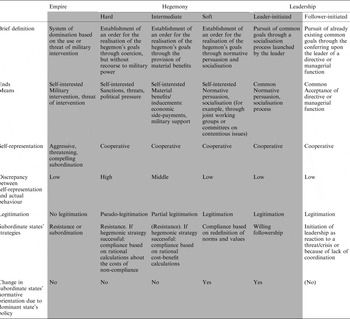
Following this theory-led conceptual clarification of ideal-typical strategies pursued by regional powers, the main findings are recapitulated in Table 1 according to several dimensions identified as relevant. Since follower-initiated leadership originates from the initiative of the regional power's smaller neighbouring states, it is not considered to be a strategy pursued by the regional power. The fields marked in grey in Table 1 therefore represent the possible strategies regional powers can adopt.
Main features of empire, hegemony and leadership

Source: Author's compilation.
The notions of empire, hegemony, and leadership appear particularly useful for characterising a continuum of strategies employed by regionally powerful states. In fact, the multi-dimensional nature of these concepts not only allows for a classification of observed behaviours but also takes into account a much broader range of dimensions related to the interaction of the regional power with its neighbours in the region, such as the strategies of these subordinate states, the degree to which they confer legitimacy to the regional power, and possible alterations in their normative orientation.
When it comes to operationalising these concepts for empirical research, however, a reduction in the number of dimensions considered seems to be appropriate. On the basis of the theory-led discussion developed above, I argue that two elements are central to distinguishing imperial, hard/intermediate/soft hegemonic, and leading strategies. These two essential discriminating factors are: a) the commonality or divergence in the goals pursued by the regional power and neighbouring countries and, b) the means employed by the regional power in its relations with these countries. In fact, on the one hand, a commonality of goals represents the distinctive feature of leadership and of a leading strategy. On the other hand, it is through an analysis of the means employed by the regional power that we can distinguish an imperial strategy, based on the use of military power or on the threat of military intervention through an ultimatum, from a hegemonic strategy. Moreover, taking into consideration the means employed allows us to differentiate between hard, intermediate, and soft hegemony, since hard hegemony is essentially based on coercive measures, intermediate hegemony on different kinds of incentives and side-payments, and soft hegemony on normative persuasion and an effort at initiating a socialisation process in subordinate states. A deeper analysis of soft hegemony and leadership would imply considering the discursive processes taking place in the relations between the regional power and subordinate states. In addition to the two essential elements, means and ends, further dimensions such as the reactions or, more generally, the behaviour of subordinate states in the region can be analysed. From a deeper understanding of the interaction between regional power and subordinate states one can gain interesting insights into the dynamics of how regional power's strategies evolve and flexibly adapt to the conditions of the regional environment. In a second stage, further dimensions such as the kind of self-representation undertaken by the regional power or the degree of legitimation it enjoys among its regional neighbours can be taken into consideration in order to confirm the results obtained.
Conclusion
The conceptual clarification of the notions of empire, hegemony, and leadership has allowed us to identify several dimensions according to which these possible strategies of regional powers are comparable. It is this comparability of the single dimensions of imperial, hegemonic, and leading strategies which allows us to consider them as being arrayed along a continuum. And it is precisely by realising that regional powers can pursue a whole range of strategies along this continuum that we can contribute to the development of a more convincing theorisation of regional powers. Beginning with the idea that a regional power is a state which belongs to a region, disposes of superior power capabilities, and exercises an influence on regional neighbours, we can analyse the strategies this state pursues in dealing with these neighbours without running the risk of biasing our research by assuming that, if we are dealing with a regional power, the strategies adopted must necessarily be ‘leading’ or ‘cooperatively hegemonic’, as is suggested in a large part of the literature presented at the beginning of this article. The clarification, combination, and integration of existing approaches leads, therefore, to a broadening of the notion of regional powers which goes beyond current conceptualisations of ‘regional leading powers’ or ‘regional hegemons’ by admitting that regional powers can also pursue coercive, compelling, aggressive, or threatening foreign policy strategies in dealing with neighbour countries.
Some concluding remarks have to be made at this point. The distinctions between the features of empire, hegemony, and leadership are, as outlined above, ideal-typical. This implies that probably only rarely will a state follow a ‘pure’ imperial, hard/intermediate/soft hegemonic, or leading strategy. This is especially important for the three different forms of hegemony, since hegemonic regional powers will probably adopt a combination of material and ideational inducements to spread the norms, values, and conceptions of order most suitable to their interests. The ideal-typical categories developed in this article should therefore act as a guideline for analysis, but what most probably will be identified in empirical research are situations in which a particular form of strategic orientation prevails. Moreover, since strategy is dynamic and subject to learning processes,Footnote 135 I assume that regional powers can modify their strategies in the course of time, passing, for instance, from a hard to an intermediate hegemonic strategy or from a soft hegemonic strategy to a leading strategy in response to changed reactions by subordinate states, to domestic factors redefining state priorities, or to pressures deriving from the external environment, for example, from global powers.
Moreover, interesting results from empirical studies could be gained by applying the conceptual framework developed above to the study of the strategies a regional power pursues in different issue areas. Most probably, one would find that a regional power pursues a simultaneous policy mix of different strategies according to the policy area analysed. In this context, one could assume that much harder strategies are adopted in the field of security than in economic relations. In a similar way, the adoption of diversified strategies towards different neighbouring countries seems to be a plausible hypothesis.
The conceptual framework developed in this article is therefore useful in three regards. First, it allows for a more diversified conceptualisation of regional powers. A regional power is therefore considered to be a regionally predominant state exercising an influence on the region to which it belongs by pursuing, in relation to its neighbours, strategies which can be imperial, hegemonic, or leading.
Second, the conceptual clarification of empire, hegemony, and leadership allows for a better distinction of the strategies pursued by the regional power when it comes to analysing them empirically. Third, and related to the previous point, by permitting a clear classification of regional powers’ strategies, this conceptual framework also serves as a basis and a point of departure for future research. In fact, one could consider the strategies identified as the dependent variable and ask what factors lead a regional power to adopt them, thereby studying the interplay of domestic factors and extra-regional pressures – that is, the complex interplay of levels of analysis – on the regional power's decision making process. On the other hand – and this aspect seems even more intriguing – one could ask what consequences the adoption of a particular kind of strategy has for the degree of stability or instability, cooperation or conflict, or the integration of the region – that is, in which ways the strategies adopted by the regional power and the ways neighbouring states interact with it contribute to shaping the regional order.