While the Research Domain Criteria (RDoC) now openly acknowledges that the environment and development are “equally important elements of the RDoC framework” (Garvey, Avenevoli, & Anderson, Reference Garvey, Avenevoli and Anderson2016), there is little specificity regarding how and when to systematically examine the impact of these dimensions on particular domains of function. Although this allows investigators the freedom to define which environmental influences and developmental periods may be most relevant for their research (Cuthbert, Reference Cuthbert2014), it jeopardizes rigor and reproducibility, and risks recapitulating field-wide norms that are driven by tradition or researcher preference. Moreover, the RDoC does not explicitly delineate development as a dynamic process, a central tenet of developmental psychopathology that necessitates repeated assessments over time (Cicchetti & Rogosch, Reference Cicchetti and Rogosch1999). In line with recent commentaries calling for an expansion of the RDoC framework, we highlight the need to incorporate explicit consideration of both environmental and developmental influences on within-individual change. The primary aim of this paper is to demonstrate the ways in which the RDoC can be expanded to reflect the ongoing impact of environmental and developmental dimensions on emotion regulation (ER). Specifically, we propose including an explicit emphasis on (a) examining within-individual change in this developmental process over time and (b) evaluating the extent to which selective and measurable environmental influences drive that change during key developmental periods. We focus specifically on the impact of maternal ER on the development of child ER during the preschool period, a key developmental window known for rapid emotional development (Carlson & Wang, Reference Carlson and Wang2007; Denham et al., Reference Denham, Blair, DeMulder, Levitas, Sawyer, Auerbach-Major and Queenan2003).
We first provide a brief overview of the RDoC and recent critiques calling for the necessary incorporation of environmental and developmental dimensions. We then summarize literature pointing to the importance of examining ER as a within-individual process that changes over time as a function of environmental and developmental influences. Next, we provide data from our own work as a proof of concept to highlight how repeated assessments within an experimental intervention design affords the unique opportunity to test mechanisms of within-individual change in developmental processes. Specifically, we examine the impact of change in maternal ER on within-individual change in child ER during the preschool period and assess how these within-individual changes are linked to internalizing and externalizing problems. Findings are discussed within the context of expanding and clarifying the existing RDoC framework to explicitly incorporate environmental and developmental dimensions. We also consider how this approach can be translated to other key periods of development and extended to other relevant developmental processes.
Widening the RDoC lens to include multiple dimensions
For the last decade, the RDoC has provided an alternative framework for research on mental disorders. The goal of the RDoC is to characterize the pathophysiology of psychopathology, with a specific emphasis on genomics and neuroscience, to identify fundamental circuit-behavior relationships that exist transdiagnostically (Insel et al., Reference Insel, Cuthbert, Garvey, Heinssen, Pine and Quinn2010). The RDoC aims to create a unified structure to investigate individual differences across multiple domains of functioning and multiple levels of analysis. The overarching goal of this work is to advance our understanding of behavior across the full range of functioning, and ultimately identify and refine targets for intervention (Cuthbert & Insel, Reference Cuthbert and Insel2013). While the RDoC has undoubtedly contributed to advancements in our understanding of psychopathology (Carcone & Ruocco, Reference Carcone and Ruocco2017), recent research has highlighted ways in which its utility and applicability may be enhanced, ultimately increasing traction in pursuit of its intended goals.
Two of the most common critiques have focused on the importance of incorporating dimensions of the environment and development into the RDoC framework. This call for a widening of the RDoC lens stems from decades of research highlighting the ways in which environmental and developmental influences inextricably shape domains of functioning across all levels of analysis (Franklin, Jamieson, Glenn, & Nock, Reference Franklin, Jamieson, Glenn and Nock2015; Garber & Bradshaw, Reference Garber and Bradshaw2020). Accordingly, researchers have proposed variations of a four-dimensional model, including one that retains the original two dimensions and adds two new dimensions that capture critical environmental and developmental influences (Mittal & Wakschlag, Reference Mittal and Wakschlag2017; Woody & Gibb, Reference Woody and Gibb2015). Along these lines, Garber and Bradshaw (Reference Garber and Bradshaw2020) suggest that the inclusion of environmental and developmental dimensions is not only “compatible and complementary” to the current RDoC perspective, but necessary to “inform future research and interventions…with children and adolescents, [and] with adults across the lifespan” (p. 342). These sentiments have been echoed in recent empirical work (e.g., Ip, Jester, Sameroff, & Olson, Reference Ip, Jester, Sameroff and Olson2019) and conceptual papers focused on a wide range of psychopathology (e.g., Beauchaine & Hinshaw, Reference Beauchaine and Hinshaw2020; Glenn, Cha, Kleiman, & Nock, Reference Glenn, Cha, Kleiman and Nock2017), as well as in other special issues of journals including the Journal of Clinical Child & Adolescent Psychology (Garber & Bradshaw, Reference Garber and Bradshaw2020) and Development & Psychopathology (Beauchaine & Cicchetti, Reference Beauchaine and Cicchetti2016). Taken together, this highlights a growing emphasis on better characterizing change that occurs within-individuals across development and quantifying the extent to which that change is influenced by environmental factors.
Investigating ER as a within-individual process
Emotion regulation (ER) is a dynamic process by which individuals modify the intensity and/or duration of their emotional experience in response to situational circumstances (Cicchetti, Ackerman, & Izard, Reference Cicchetti, Ackerman and Izard1995; Gross, Reference Gross1998; Thompson, Reference Thompson1994). Effective regulation of emotion aids in organizing adaptive responses to shifting environmental demands (Thompson, Reference Thompson1994) and reflects concomitant changes in cognitive, emotional, and social domains (Fox, Reference Fox1994; Saarni, Campos, Camras, & Witherington, Reference Saarni, Campos, Camras and Witherington2006). Although competing conceptualizations of ER exist, researchers generally agree that it is a multifaceted process that is continually modified across development (Aldao, Reference Aldao2013; Cole, Martin, & Dennis, Reference Cole, Martin and Dennis2004; Crowell, Vlisides-Henry, & Kaliush, Reference Crowell, Vlisides-Henry, Kaliush, Beauchaine and Crowell2020; Morris, Criss, Silk, & Houltberg, Reference Morris, Criss, Silk and Houltberg2017; Walden & Smith, Reference Walden and Smith1997).
Regardless of the conceptual model, understanding developmental changes in ER represents a central tenet ubiquitous to all ER theory. However, there is a dearth of research describing how this process develops within-individuals over time and, at present, the RDoC offers little guidance on how to achieve this aim. To date, our understanding of the maturation of ER rests almost entirely on evidence obtained from between-person differences utilizing either age-based cohort studies (e.g., comparing delay of gratification in a cohort of 3-year-olds and a cohort of 4-year-olds; Hongwanishkul, Happaney, Lee, & Zelazo, Reference Hongwanishkul, Happaney, Lee and Zelazo2005) or prospective longitudinal studies that focus on between-person changes in rank-order stability (for exceptions see Blandon, Calkins, Keane, & O'Brien, Reference Blandon, Calkins, Keane and O'Brien2008; Bocknek, Brophy-Herb, & Banerjee, Reference Bocknek, Brophy-Herb and Banerjee2009; Lengua et al., Reference Lengua, Moran, Zalewski, Ruberry, Kiff and Thompson2015; Moilanen, Shaw, Dishion, Gardner, & Wilson, Reference Moilanen, Shaw, Dishion, Gardner and Wilson2010). While this research has been critical in identifying key development periods of rapid ER growth, continuing to pursue designs that focus on between-person differences is unlikely to lead to any new or substantial discoveries (Cole & Jacobs, Reference Cole and Jacobs2018). Advances in our methodological and analytic approach are needed to more accurately reflect and capture theoretical conceptualizations of ER as a within-individual process that develops over time (Cicchetti & Rogosch, Reference Cicchetti and Rogosch1999; Kim-Spoon & Grimm, Reference Kim-Spoon, Grimm and Cicchetti2016; Wood, Reference Wood2011).
Here, we aim to illustrate the potential utility of using repeated assessments to model within-individual change in ER using the RDoC framework. Given that ER is not currently defined by a specific RDoC domain (see Fernandez, Jazaieri, & Gross, Reference Fernandez, Jazaieri and Gross2016; Sun, Vinograd, Miller, & Craske, Reference Sun, Vinograd, Miller, Craske, Essau, LeBlanc and Ollendick2017 for discussions), we build on previous work that utilized the RDoC to assess functioning across related cognitive, emotional, and social domains (Ip et al., Reference Ip, Jester, Sameroff and Olson2019). In line with Ip et al. (Reference Ip, Jester, Sameroff and Olson2019), we focus on within-individual change in four validated constructs across four RDoC domains during the preschool period: executive control (cognitive system), delay of gratification (positive valence system), regulation of frustration (negative valence system), and emotion knowledge (social processes system). These constructs are typically conceptualized under the larger umbrella of “self-regulation”, each of which are heavily implicated in ER development (Posner & Rothbart, Reference Posner and Rothbart2000).
Executive control, also termed effortful control, is defined as the ability to regulate attentional and behavioral impulses (Rothbart, Michael, & Kieras, Reference Rothbart, Michael, Kieras, McCartney and Phillips2006). Executive control can be conceptualized in terms of “hot” and “cool” effortful control, with the latter referring to attentional and inhibitory control in response to neutral, nonrewarding stimuli (e.g., Stroop-like tasks) (Kim, Nordling, Yoon, Boldt, & Kochanska, Reference Kim, Nordling, Yoon, Boldt and Kochanska2013; Sturge-Apple, Davies, Cicchetti, Hentges, & Coe, Reference Sturge-Apple, Davies, Cicchetti, Hentges and Coe2017). “Hot” executive control, referred to here as delay of gratification, denotes inhibition in the face of heightened emotion elicited by a rewarding stimulus (e.g., a toy; Kochanska, Murray, Jacques, Koenig, & Vandegeest, Reference Kochanska, Murray, Jacques, Koenig and Vandegeest1996). Regulation of frustration is another key domain of ER, and it refers to the ability to modify the intensity and/or valence of emotional responses during stressful situations in order to achieve a desired goal (Cole et al., Reference Cole, Martin and Dennis2004). Finally, emotion knowledge refers to one's understanding of emotion as well as the ability to perceive and understand others’ emotional states and reactions (Izard et al., Reference Izard, Woodburn, Finlon, Krauthamer-Ewing, Grossman and Seidenfeld2011). While many studies have examined these constructs in isolation (e.g., Bendezú et al., Reference Bendezú, Cole, Tan, Armstrong, Reitz and Wolf2018; Carlson & Wang, Reference Carlson and Wang2007; Moilanen et al., Reference Moilanen, Shaw, Dishion, Gardner and Wilson2010; Supplee, Skuban, Trentacosta, Shaw, & Stoltz, Reference Supplee, Skuban, Trentacosta, Shaw and Stoltz2011), it has become increasingly clear that the simultaneous consideration of constructs across multiple domains may yield important information about the development of ER (see Campos, Frankel, & Camras, Reference Campos, Frankel and Camras2004; Ip et al., Reference Ip, Jester, Sameroff and Olson2019; Saarni et al., Reference Saarni, Campos, Camras and Witherington2006; Zelazo & Cunningham, Reference Zelazo, Cunningham and Gross2007). Moreover, enhancing our understanding of within-individual change in these domains can sharpen the precision with which we can evaluate the impact of known environmental influences on developmental trajectories of ER.
Environmental influences on ER: The role of maternal ER
Decades of research and theory highlight the influential role of the environment, particularly parental influences, in shaping individual differences in the development of ER (Calkins & Hill, Reference Calkins, Hill and Gross2007; Hajal & Paley, Reference Hajal and Paley2020; Morris et al., Reference Morris, Criss, Silk and Houltberg2017). A parent's response to their child's emotion provides immediate feedback about the acceptability of emotions, shaping the way in which emotions are understood, experienced, expressed and regulated in the future (Eisenberg, Cumberland, & Spinrad, Reference Eisenberg, Cumberland and Spinrad1998; Morris, Silk, Steinberg, Myers, & Robinson, Reference Morris, Silk, Steinberg, Myers and Robinson2007). Mounting research suggests that parents with ER difficulties may find it especially challenging to respond in a supportive manner to their child's expression of emotion (e.g., Buckholdt, Parra, & Jobe-Shields, Reference Buckholdt, Parra and Jobe-Shields2014). For example, parents with ER difficulties may feel overwhelmed by their own internal emotional experience when attempting to navigate challenging emotional interactions with their child, making it more difficult to attend and respond effectively (Rutherford, Wallace, Laurent, & Mayes, Reference Rutherford, Wallace, Laurent and Mayes2015). Along these lines, research suggests that parents with ER difficulties are much more likely to ignore, dismiss, magnify, or punish their child's emotional experience, even if unintentionally (Morelen, Shaffer, & Suveg, Reference Morelen, Shaffer and Suveg2016). This combined with parental modeling of poor ER strategies places children at increased risk for ER difficulties (Li, Li, Wu, & Wang, Reference Li, Li, Wu and Wang2019; Morris et al., Reference Morris, Silk, Steinberg, Myers and Robinson2007, Reference Morris, Criss, Silk and Houltberg2017), and in turn, increased risk for internalizing and externalizing psychopathology (Crespo, Trentacosta, Aikins, & Wargo-Aikins, Reference Crespo, Trentacosta, Aikins and Wargo-Aikins2017; Ip et al., Reference Ip, Jester, Sameroff and Olson2019; Kaufman et al., Reference Kaufman, Puzia, Mead, Crowell, McEachern and Beauchaine2017; Röll, Koglin, & Petermann, Reference Röll, Koglin and Petermann2012).
Taken together, these findings underscore the importance of more precisely characterizing the impact of known environmental influences, like maternal ER, on within-individual change in child ER. While previous work in this area has enhanced our understanding of links between environmental influences and ER development (Bariola, Gullone, & Hughes, Reference Bariola, Gullone and Hughes2011), traditional study designs are naturalistic and often focus on between-person differences over time, hindering our ability to precisely pinpoint environmental influences as causal predictors of within-individual change in ER (Rutter, Pickles, Murray, & Eaves, Reference Rutter, Pickles, Murray and Eaves2001). At present, the RDoC provides little guidance regarding how to incorporate environmental influences into study designs, impeding collective efforts to capture important explanatory variance in ER as a developmental process. The implementation of prospective, experimental designs would afford opportunities to empirically test environmental influences as causal mechanisms of change in ER and enhance progress toward the identification of potentially malleable intervention targets. For example, employing experimental interventions that target maternal ER would allow us to more precisely quantify the causal impact of this environmental influence on the within-individual change in child ER. Given that intervention studies suggest that parental factors like maternal ER may moderate the effectiveness of traditional parenting interventions (e.g., Shelleby & Shaw, Reference Shelleby and Shaw2014) and that targeting maternal ER can improve child outcomes (Havighurst et al., Reference Havighurst, Wilson, Harley, Kehoe, Efron and Prior2013; Kehoe, Havighurst, & Harley, Reference Kehoe, Havighurst and Harley2020), there is strong impetus for utilizing experimental manipulation of known environmental influences to examine effects on potential changes in ER over time.
Developmental influences on ER: Preschool as a key period
Prominent theory and empirical research point to key developmental periods across childhood and adolescence during which ER development accelerates (Carlson & Wang, Reference Carlson and Wang2007; Denham et al., Reference Denham, Blair, DeMulder, Levitas, Sawyer, Auerbach-Major and Queenan2003), highlighting when we might aim to examine change in this developmental process. Incorporating more explicit guidance in the RDoC about the timing and tempo with which these processes unfold across time offers a roadmap for optimal intervals of assessment (e.g., frequency and duration of assessment) organized by developmental period. For example, the preschool period is characterized by marked neurobiological changes that underlie notable shifts in cognitive, social, and emotional domains of functioning (Brown & Jernigan, Reference Brown and Jernigan2012; Garon, Bryson, & Smith, Reference Garon, Bryson and Smith2008), making it a prime target for frequent assessments of within-individual change in ER. Moreover, the sensitivity of this developmental period makes it particularly vulnerable to environmental influences. Indeed, parental influences on ER development appear to be especially salient during the preschool period (Cole, Lougheed, & Ram, Reference Cole, Lougheed, Ram, Cole and Hollenstein2018), highlighting the potential significance of clarifying causal mechanisms during this time. Given that prospective work has linked ER problems during the preschool period to the subsequent emergence of internalizing and externalizing problems (e.g., Ip et al., Reference Ip, Jester, Sameroff and Olson2019; Röll et al., Reference Röll, Koglin and Petermann2012), focusing our efforts on the development of ER during this developmental period may yield important implications for etiological and intervention models of psychopathology (Beauchaine & Cicchetti, Reference Beauchaine and Cicchetti2019).
Current study
Here, we leverage data from the STEADY Study, an ongoing, multisite, randomized control trial (RCT), which utilizes dialectical behavior therapy (DBT), a robust and effective method for improving ER (Linehan, Reference Linehan1993; Neacsiu, Bohus, & Linehan, Reference Neacsiu, Bohus, Linehan and Gross2014). This prospective study design includes repeated assessments of child ER domains over 12 months, allowing for an examination of within-individual change during the preschool period (3–4 years), as well as the opportunity to test (a) how within-individual change is impacted by change in maternal ER and (b) whether within-individual change is related to internalizing and externalizing problems. We focus on a sample of 77 mother–child dyads recruited from a single site between October of 2017 and January of 2020. This includes 39 mothers with ER difficulties (i.e., mothers with borderline personality disorder; BPD) and 38 nondisordered, control mothers (healthy controls; HC). Half of mothers with BPD were randomly assigned to one year of standard DBT skills training, and the other half to “waitlist control” (WLC), which allows us to assess the impact of change in maternal ER on changes in child ER.
We first examine within-individual change in four domains of child ER (i.e., executive control, delay of gratification, regulation of frustration, and emotion knowledge), assessed repeatedly across 12 months (i.e., baseline, 4 months, 8 months, 12 months). To do so, we utilize a free curve slope intercept (FCSI) latent growth curve model, which makes the fewest assumptions about the form or rate of growth (Wood, Reference Wood2011; Wood & Jackson, Reference Wood and Jackson2013). While this approach to modeling within-individual variability is only one of many, the FCSI model allows us to distinguish between the relative amounts of between-person differences (intercept) and within-individual change (slope) for each of the four ER domains. Next, we examined the impact of change in maternal ER on between-person differences (intercept) and within-individual change (slope) for each of the four ER domains. Finally, we assessed whether the effect of change in maternal ER on change in child ER domains impacts teacher-reported internalizing and externalizing problems. We expect that there will be significant between-person differences and within-individual change in each ER domain across the 12-month period. We also hypothesize that improvements in maternal ER will predict within-individual change in each of the child ER domains. Finally, we predict that within-individual change in ER domains will be associated with internalizing and externalizing problems at 12-month follow-up.
Method
Sample
Participants were 77 mothers (M age = 33.17 years, SD = 4.83; 35% racial/ethnic minority) and their children (M age = 42.48 months; SD = 3.78; 56% female; 47% racial/ethnic minority) enrolled in an ongoing RCT. Two groups of mother–child dyads were recruited using a university-based Research Recruitment Program which employed a targeted multimedia and digital messaging program for mothers of children between 36 and 47 months old (i.e., one advertisement targeting BPD and another targeting HC). Mothers with BPD were also recruited from ambulatory psychiatric treatment clinics in the same geographic region.
Inclusion and exclusion criteria
Initial phone screening was conducted to ensure that all mothers were biological mothers with at least 50% physical custody of the target child since birth. During this call, all mothers also completed the 10-item McLean Screening Instrument for Borderline Personality Disorder (MSI-BPD; Zanarini et al., Reference Zanarini, Vujanovic, Parachini, Boulanger, Frankenburg and Hennen2003): scores ≥7 were required for the BPD groups and scores <2 were required for the HC group. In addition, mothers in the BPD group were asked about current treatment engagement and any mothers currently participating in DBT services were deemed ineligible.
Eligibility was further determined during an in-person clinical intake, which included semi-structured diagnostic interviews for mothers. Trained research personnel administered the Structured Clinical Interview for the fifth edition of Diagnostic and Statistical Manual of Mental Disorders (DSM-5) (SCID-5; First, Williams, Karg, & Spitzer, Reference First, Williams, Karg and Spitzer2016) and the Structured Interview for DSM-IV Personality (SIDP-IV; Pfohl, Blum, & Zimmerman, Reference Pfohl, Blum and Zimmerman1995) to determine eligibility. Approximately, 20% of intake interviews were double-coded from digital recordings and showed strong inter-rater reliability (Krippendorff's α = .91). Mothers in the BPD group met at least three diagnostic criteria for BPD, with one of these three symptoms being affective instability or uncontrolled anger (symptom range = 3–9; mean = 5.13; SD = 1.82). HC mothers reported no history of psychiatric illness (e.g., depression, anxiety) currently or since their child's conception, and showed no evidence of clinically significant ER difficulties as determined by scoring 0 on the affective instability and uncontrolled anger criteria on the SID-P. In addition, any mothers in a current psychotic or manic episode were deemed ineligible.
All mothers and children also completed the Peabody Picture Vocabulary Test Fourth Edition (PPVT-IV; Dunn & Dunn, Reference Dunn and Dunn2007) and the Expressive Vocabulary Test Second Edition (EVT-2; Williams, Reference Williams1997) to provide an estimate of IQ. All eligible participants demonstrated standard scores ≥70. All mothers also completed the Ages and Stages Questionnaire (ASQ; Squires, Bricker, & Twombly, Reference Squires, Bricker and Twombly2009), a brief developmental screening instrument designed to detect developmental delays across five domains of development (i.e., communication, gross motor, fine motor, problem-solving, and personal-social skills); only children without developmental delays were eligible.
Procedure
Those who were eligible were enrolled to complete four laboratory assessments (baseline, 4-month, 8-month, and 12-month follow-ups). This assessment schedule paralleled the 12-month DBT treatment schedule (described below). Assessments were conducted by research assistants blinded to mother's group status and included questionnaires to assess maternal ER and behavioral tasks that assessed each of the four child ER domains (described below). Mothers also provided contact information for their child's preschool teacher or daycare provider. Following the baseline and 12-month laboratory assessment, teachers or daycare providers were contacted and asked to complete an online questionnaire assessing internalizing and externalizing problems observed in the preschool/daycare setting. All mother–child dyads completed the in-person baseline assessment, 81.8% completed the 4-month assessment, 71.4% completed the 8-month assessment, and 45.9% completed the 12-month assessment.Footnote 1
Randomization and treatment
Mothers in the BPD group were randomized to receive DBT skills (n = 14) or WLC (n = 25).Footnote 2 DBT skills training followed the treatment protocol described by Linehan et al. (Reference Linehan, Korslund, Harned, Gallop, Lungu, Neacsiu and Murray-Gregory2015). This included participation in a weekly standard 2-hour skills group for 12 months, which consisted of teaching skills across four modules: mindfulness, ER, interpersonal effectiveness, and distress tolerance (Linehan, Reference Linehan2014). DBT mothers were assigned a study therapist who met with them at least monthly for 30 minutes and were available to meet weekly if needed. Study therapists were also available for coaching calls. In addition, all study therapists attended weekly consultation team meetings for 1 hour. Study therapists were master and doctoral level clinicians, all of whom had significant training in DBT. The DBT Adherence Scale (Harned, Korslund, Schmidt, & Gallop, Reference Harned, Korslund, Schmidt and Gallop2021) was used to code randomly selected DBT skills group sessions for adherence and all scored sessions were deemed adherent. Participants randomized to the DBT condition completed, on average, 30 weekly sessions over the course of a year (63% of the 48-week treatment protocol), consistent with treatment compliance in seminal RCTs demonstrating the efficacy of DBT (Linehan et al., Reference Linehan, Comtois, Murray, Brown, Gallop, Heard and Lindenboim2006; Lynch, Trost, Salsman, & Linehan, Reference Lynch, Trost, Salsman and Linehan2007). The current study implemented an intent-to-treat design, and all participants were retained in analyses.
Measures
Maternal emotion regulation difficulties
Maternal ER difficulties were measured using the Difficulties with Emotion Regulation Scale (DERS; Gratz & Roemer, Reference Gratz and Roemer2004). The DERS is a 36-item self-report measure of perceived ER abilities. Mothers indicated how often the items apply to them on a 5-point Likert-type scale ranging from 1 (almost never) to 5 (almost always). The DERS measures six subscales of ER, including lack of emotional awareness, lack of emotional clarity, impulse-control difficulties, difficulties engaging in goal-directed behaviors, nonacceptance of emotional responses, and limited access to ER strategies. All items were summed to create a total score, with higher scores representing greater ER difficulties.
Child emotion regulation domains
Executive control was measured using the Dimensional Change Card Sort (DCCS; Diamond, Carlson, & Beck, Reference Diamond, Carlson and Beck2005; Frye, Zelazo, & Palfai, Reference Frye, Zelazo and Palfai1995; Hongwanishkul et al., Reference Hongwanishkul, Happaney, Lee and Zelazo2005). In this task, children were first shown two boxes with target cards attached to the front of the box (i.e., blue card with a black star silhouette, red card with a black truck silhouette) and an open slot on the top of each box. Children were then handed sorting cards (i.e., blue cards with a black truck silhouette, red cards with a black star silhouette), and instructed to sort the cards according to shape (six trials) and then according to color (six trials). Before each shape and color trial, the experimenter stated the sorting rule and presented the child with a card. Once the child demonstrated color and shape knowledge, they advanced to the next level, where the target cards integrated the two sorting properties. Specifically, the target cards had either a red truck or blue star on white backgrounds, and sorting cards were red stars and blue trucks (12 trials). Finally, children were presented with target cards with and without a border. Children were instructed to sort by color if the card had a border and by shape if the card did not have a border (12 trials). Each trial was scored incorrect (0) or correct (1) and summed to create a total score ranging from 0 to 36, with higher scores representing better executive control.
Delay of gratification was measured using the Gift Delay task (Kochanska et al., Reference Kochanska, Murray, Jacques, Koenig and Vandegeest1996). In this task, the child was told that they will receive a present from the experimenter. They were instructed to sit on a chair facing in the opposite direction and specifically told not to peek while the experimenter wrapped their gift. The experimenter then noisily wrapped the present for 60 seconds while the child waited. The current study focused on latency to the child's first peek (i.e., child's head, shoulder, or body turning to peek at the gift) as an indicator of delay ability (range 0–60 seconds), with higher scores indicating better delay of gratification.
Regulation of frustration was measured using two well-validated frustration tasks: Transparent Locked Box (LAB-TAB; Goldsmith & Rothbart, Reference Goldsmith and Rothbart1996) and Knotted Sack (Chaplin, Klein, Cole, & Turpyn, Reference Chaplin, Klein, Cole and Turpyn2017). These tasks were alternated across the four assessments to mitigate practice effects associated with tasks including an element of deception (Monks, Smith, & Swettenham, Reference Monks, Smith and Swettenham2005). In each task, the child was allowed to pick one of three toys. The experimenter then placed the chosen toy inside the locked box or knotted sack and told the child that once they opened the locked box/knotted sack, they could keep the toy. The experimenter explained that they “had some work to do”, turned their chair away from the child, and pretended to do work while the child attempted to open the box or sack. The child was left alone for 2 minutes to open the locked box with the incorrect set of keys or to open the tightly knotted sack. The tasks were coded from digital files using an adapted coding system (Dennis, Reference Dennis2004). The current study included a measure of on-task or problem-solving behavior scored in 4, 30-second epochs. On-task behavior could include any of the following: (a) child using strategies to solve the problem; (b) child working toward opening the box or sack; or (c) child seeking information from the experimenter about how to open the box or sack. Each epoch received a score of 0 (none or minimal on task behavior), 1 (on task behavior f or about half of the epoch), or 2 (on task behavior for nearly all or all of the epoch) and 20% of participants were double-coded to assess reliability (average epoch intraclass correlation [ICC] = .78). Scores for each epoch were then summed to create a total score ranging from 0 to 8, with higher scores indicating more on-task behavior and greater regulation of frustration.
Emotion knowledge was measured using an adapted version of the Affective Perspective Taking task (Denham, Reference Denham1986; Pears & Moses, Reference Pears and Moses2003; Zalewski, Musser, Binion, Lewis, & O'Brien, Reference Zalewski, Musser, Binion, Lewis and O'Brien2020). Prior to task initiation, children were shown four emotional faces (happy, sad, mad/angry, scared/afraid) and were instructed to identify all emotions both expressively, then receptively (by pointing). Next, an experimenter taught the child all four basic emotion faces to ensure the child's understanding. The experimenter then presented eight stereotypical situation vignettes using twp puppets: a main character (“Nancy/Johnny”) who always matched the sex of the child, and a sibling who was always the opposite sex. The puppets acted out eight scenes portraying various events that might elicit happiness, fear, sadness, or anger (e.g., getting an ice cream cone, being in a dark room). At the end of each vignette, the child was asked to choose a face that described how the puppet was feeling (happy, sad, mad/angry, scared/afraid). The child received two points if they matched the puppet's expressed emotion to the correct face and one point if they chose the wrong face but correctly identified the emotion valence. Scores for each vignette were then summed to create a total score ranging from 0 to 18, with higher scores reflecting more emotion knowledge.
Child internalizing and externalizing problems
To assess internalizing and externalizing problems, preschool teachers or daycare providers completed the Caregiver-Teacher Report Form (C-TRF; Achenbach & Rescorla, Reference Achenbach and Rescorla2000) via the Qualtrics survey system (Qualtrics, Provo, UT). The C-TRF contains 100 items assessing internalizing problems and externalizing problems for children who are between 1.5 and 5 years old. All items are rated on a 3-point Likert scale, ranging from 0 (not true), to 2 (very true or often true), and are then summed to create an internalizing problems and externalizing problems score. Teacher data were available for 83% of the sample (n = 64) at baseline and 60% (n = 46) of the sample at the 12-month assessment. At baseline, missing data included seven children who were not yet enrolled in preschool or daycare, two children whose parent did not give consent to contact their teacher, one child whose teacher declined participation, and three children for whom data were determined to be invalid (e.g., teachers completed the questionnaire in less than 5 minutes). At the 12-month assessment, missing data included three children who were still not enrolled in preschool or daycare, 23 children for whom data were missing due to preschool/school closures during the global pandemic, two children who stopped attending preschool or daycare (unrelated to the global pandemic), and three children who were lost to follow-up.
Covariates
Demographic variables
Child age, racial/ethnic minority status (0 = white; 1 = minority status), and sex (0 = male; 1 = female) were obtained via maternal report at the first assessment.
Receipt of public assistance
Mothers reported on their annual income and whether or not they received any financial assistance (e.g., WIC, food stamps, welfare, etc.; 0 = no public assistance; 1 = received public assistance).
Estimated IQ
Verbal IQ was estimated using age-based standard scores on the Peabody Picture Vocabulary Test Fourth Edition (PPVT-IV; Dunn & Dunn, Reference Dunn and Dunn2007).
Data analytic plan
We conducted preliminary analyses to examine descriptive statistics by maternal group status and bivariate correlations between all study variables using IBM SPSS Statistics (Version 26.0). In addition, we examined the extent to which our RCT produced change in maternal ER difficulties using multigroup latent growth curve analysis (Jung & Wickrama, Reference Jung and Wickrama2008) in MPlus version 8 (Muthén & Muthén, Reference Muthén and Muthén2017). Full information maximum likelihood (FIML) was utilized to handle missing data. In this model, negative slopes indicate improvements in ER difficulties while positive slopes indicate worsening ER difficulties. Slopes were compared using Satorra–Bentler scaled chi-square test statistic to compare fit for a model in which slope parameters were specified to vary to a model where slope parameters were constrained to be equal. This comparison was made for all possible group combinations (i.e., DBT vs. HC; WLC vs. HC; DBT vs. WLC).
All primary analyses were conducted in MPlus version 8 (Muthén & Muthén, Reference Muthén and Muthén2017) using full information maximum likelihood with robust standard errors (MLR) to handle missing data. Model fit was evaluated using standard criteria for chi-square, comparative fit index (CFI; Bentler, Reference Bentler1990), and the root mean square error of approximation (RMSEA, Browne & Cudeck, Reference Browne, Bollen and Long1993). To examine within-individual change in child ER domains, we utilized a FCSI latent growth model (Wood, Reference Wood2011). This model was chosen because it makes the fewest assumptions about the form or rate of growth (Wood, Reference Wood2011; Wood & Jackson, Reference Wood and Jackson2013). In addition, this model sets the intercept and the slope to be orthogonal (the covariance between the intercept and slope variables is set to zero), allowing us to evaluate the relative amounts of between-person (intercept) and within-individual (slope) variability for each of the four ER domains. We report (a) intercept variance as the indicator of between-person differences in ER across 12 months in preschool; (b) squared slope loadings as an indicator of within-individual variability at each assessment; and (c) a comparison of intercept variance to squared slope loadings as an indicator of relative differences in between-person differences versus within-individual change.
Next, we examined how change in maternal ER difficulties impacted differences in the starting point of preschooler ER growth trajectories (intercept: between-person differences) and their pattern of development over 12 months (slope: within-individual change) above and beyond demographic covariates. To do so, we regressed the latent intercept and slope of each child ER domain on the slope of maternal ER difficulties while controlling for demographic covariates. Finally, to evaluate the extent to which each child ER domain was associated with internalizing and externalizing problems at 12-month follow-up, we regressed internalizing and externalizing problems (separately) on the latent intercept and slope of each child ER domains while controlling for internalizing or externalizing problems assessed at baseline, slope of maternal ER difficulties, and demographic covariates. Indirect effects were also assessed using the MODEL INDIRECT command in MPlus.
Results
Descriptive statistics
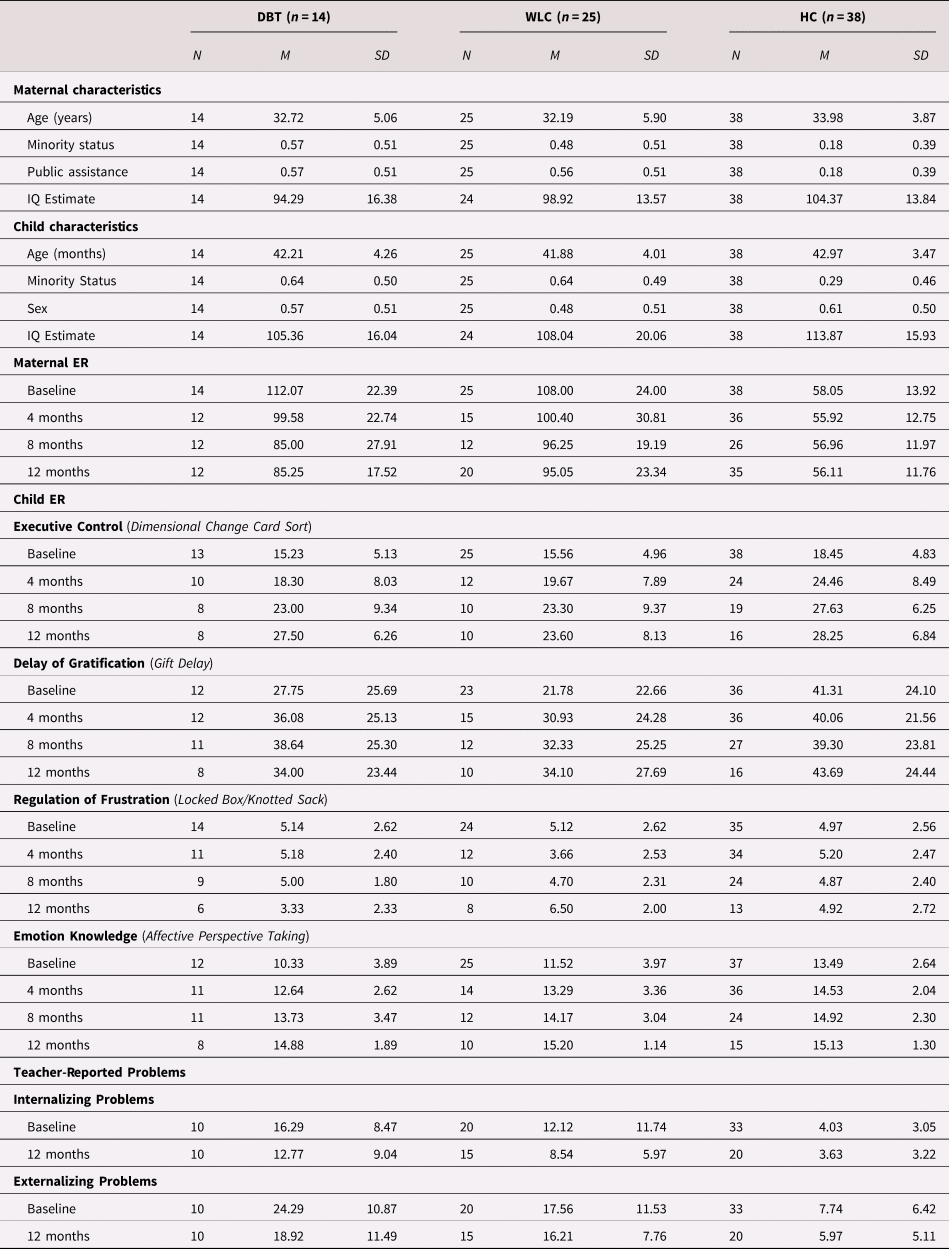
Table 1 provides descriptive statistics for all study variables by maternal group status and Table 2 shows bivariate correlations from primary study variables across all assessments.
Descriptive statistics for all study variables by maternal group status

Note: DBT = dialectical behavior therapy; WLC = waitlist control; HC = healthy control; ER = emotion regulation.
Correlations between main study variables across all timepoints

*p < .05; **p < .01
Treatment effects on maternal ER difficulties
Supplementary Figure S1 shows group trajectories from the multigroup LCGM assessing maternal ER difficulties across the study protocol (χ 2 (21) = 24.25, p = .28, CFI = .97, TLI = .97 RMSEA = .08). Mothers in the DBT (intercept: b = 110.80, p < .01) and WLC (intercept: b = 107.48, p < .01) groups demonstrated equivalent levels of ER difficulties at baseline (DBT vs. WLC: Δχ2 = 0.23, p > .05), and mothers in both groups demonstrated significantly more ER difficulties at baseline relative to mothers in the HC group (intercept: b = 56.77, p < .01; DBT vs. HC: Δχ2 = 30.86, p < .05; WLC vs. HC: Δχ2 = 47.40 p < .05). In addition, mothers in the DBT (slope: b = −9.22, p < .01) and WLC (slope: b = −4.58, p < .01) groups demonstrated greater improvements in ER difficulties across 12 months relative to mothers in the HC group, who showed no significant change in ER difficulties (slope: b = −0.12, p = .82; DBT vs. HC: Δχ2 = 10.28, p < .05; WLC vs. HC: Δχ2 = 8.69, p < .05). Mothers in the DBT group showed significantly steeper improvements in ER difficulties when compared to mothers in the WLC group (DBT vs. WLC: Δχ2 = 4.07, p < .05).
Between-person differences and within-individual change in child ER domains
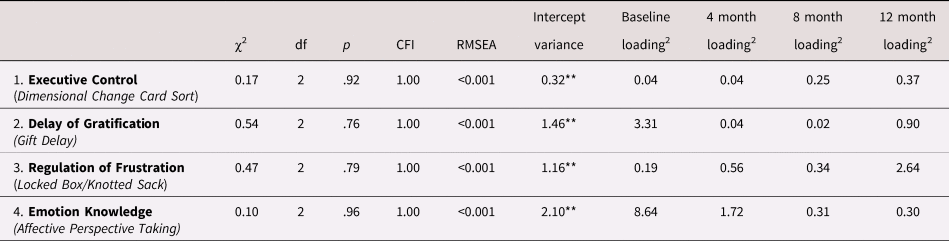
Table 3 presents model fit statistics for FCSI latent growth models for child ER by domain, all of which demonstrated good model fit. Unstandardized parameter estimates for the intercept variance and squared slope loadings across assessments are also presented by child ER domain.
Fit and model statistics for free curve slope intercept (FCSI) growth models for child emotion regulation by domain
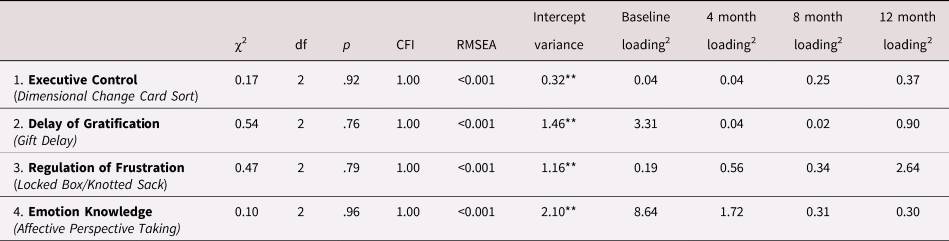
Note. Each row represents a separate model. Unstandardized parameter estimates for the intercept variance represent an estimate of relative between-person differences and squared slope loadings represent an estimate of relative within-individual variability at each timepoint across child ER domains.
CFI = comparative fit index; RMSEA = root mean square error of approximation
** p < .01 indicates significant between-person variance.
Executive control
The intercept variance indicates significant between-person differences in levels of executive control across the 12-month preschool period. An examination of squared slope loadings at each assessment shows increases in the relative amount of within-individual variability in executive control (i.e., 0.04 at baseline and 0.37 at 12 months). Comparing the intercept variance and the squared slope loadings at each assessment point reflects a shift from more between-person than within-individual variability to similar levels of between-person and within-individual variability in executive control over 12 months.
Delay of gratification
The intercept variance indicates significant between-person differences in levels of delay of gratification across the 12-month preschool period. An examination of slope loadings at each assessment shows the highest levels of within-individual variability at the first and last assessment (i.e., 3.31 at baseline and 0.90 at 12 months). A comparison of the intercept variance and the squared slope loadings at each assessment point shows more within-individual than between-person variability at the baseline assessment, and more between-person variability in delay of gratification at all subsequent assessments.
Regulation of frustration
The intercept variance indicates significant between-person differences in levels of frustration regulation across the 12-month preschool period. An examination of squared slope loadings at each assessment shows considerable increases in the relative amount of within-individual variability in the regulation of frustration (i.e., 0.19 at baseline to 2.64 at 12 months). Comparing the intercept variance and the squared slope loadings at each assessment point suggests that there was more between-person than within-individual variability in regulation of frustration across 12 months.
Emotion knowledge
The intercept variance indicates significant between-person differences in levels of emotion knowledge across the 12-month preschool period. An examination of squared slope loadings at each assessment suggests considerable decreases in the relative amount of within-individual variability in emotion knowledge (i.e., 8.64 at baseline and 0.30 at 12 months). Comparing the intercept variance and the squared slope loadings at each assessment point reflects a shift from more within-individual than between-person variability in emotion knowledge to more between-person variability at all subsequent assessments.
Effects of maternal ER difficulties on child ER domains
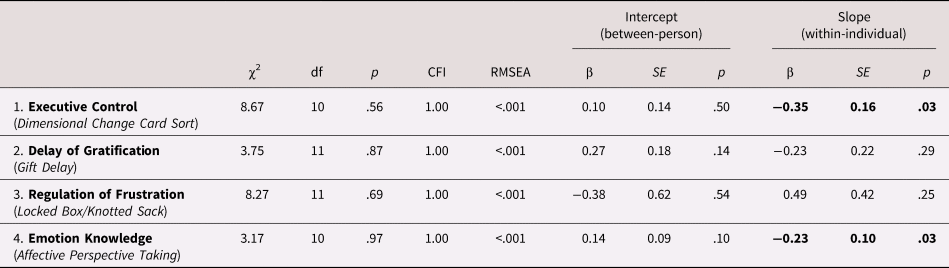
Table 4 presents the associations between change in maternal ER difficulties and change in each child ER domain, controlling for child sex, child age-based estimated IQ, and family receipt of public assistance. All models demonstrated good fit. Standardized parameter estimates and standard errors for associations between change in maternal ER difficulties and between-person differences (intercept) and within-individual change (slope) in child ER domains are also presented.
Models testing associations between maternal change in emotion regulation and between-person differences and within-individual change in child emotion regulation by domain
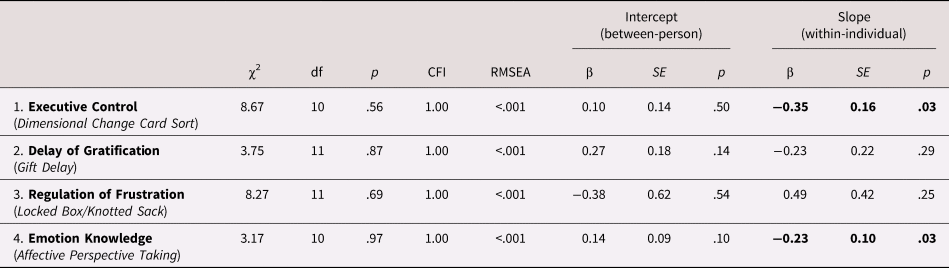
Note. Each row represents a separate model. Coefficients are standardized parameter estimates (β) of the association between maternal change in emotion regulation (ER; slope) and between-person differences (intercept) and within-individual change (slope) in child ER domains. All models control for the child sex, effects of child age-based estimated IQ, and family receipt of public assistance.
Executive control
Change in maternal ER difficulties was unrelated to between-person differences in child executive control. There was a significant association between change in maternal ER difficulties and within-individual change in child executive control such that improvements in maternal ER difficulties predicted increases in child executive control.
Delay of gratification
There were no significant associations between change in maternal ER difficulties and between-person differences or within-individual change in child delay of gratification.
Regulation of frustration
There were no significant associations between change in maternal ER difficulties and between-person differences or within-individual change in child regulation of frustration.
Emotion knowledge
Change in maternal ER difficulties was unrelated to between-person differences in child emotion knowledge. There was a significant association between change in maternal ER difficulties and within-individual change in child emotion knowledge whereby improvements in maternal ER difficulties predicted increases in child emotion knowledge.
Effects of child ER domains on internalizing and externalizing problems
Supplementary Table S1 presents the associations between between-person differences and within-individual change in child ER domains and teacher-reported internalizing and externalizing problems, controlling for teacher-reported problems at baseline, child sex, child age-based estimated IQ, and family receipt of public assistance. All models demonstrated acceptable fit. Standardized parameter estimates and standard errors for the effects of between-person differences (intercept) and within-individual change (slope) in each child ER domain on teacher-reported internalizing and externalizing problems are also presented.
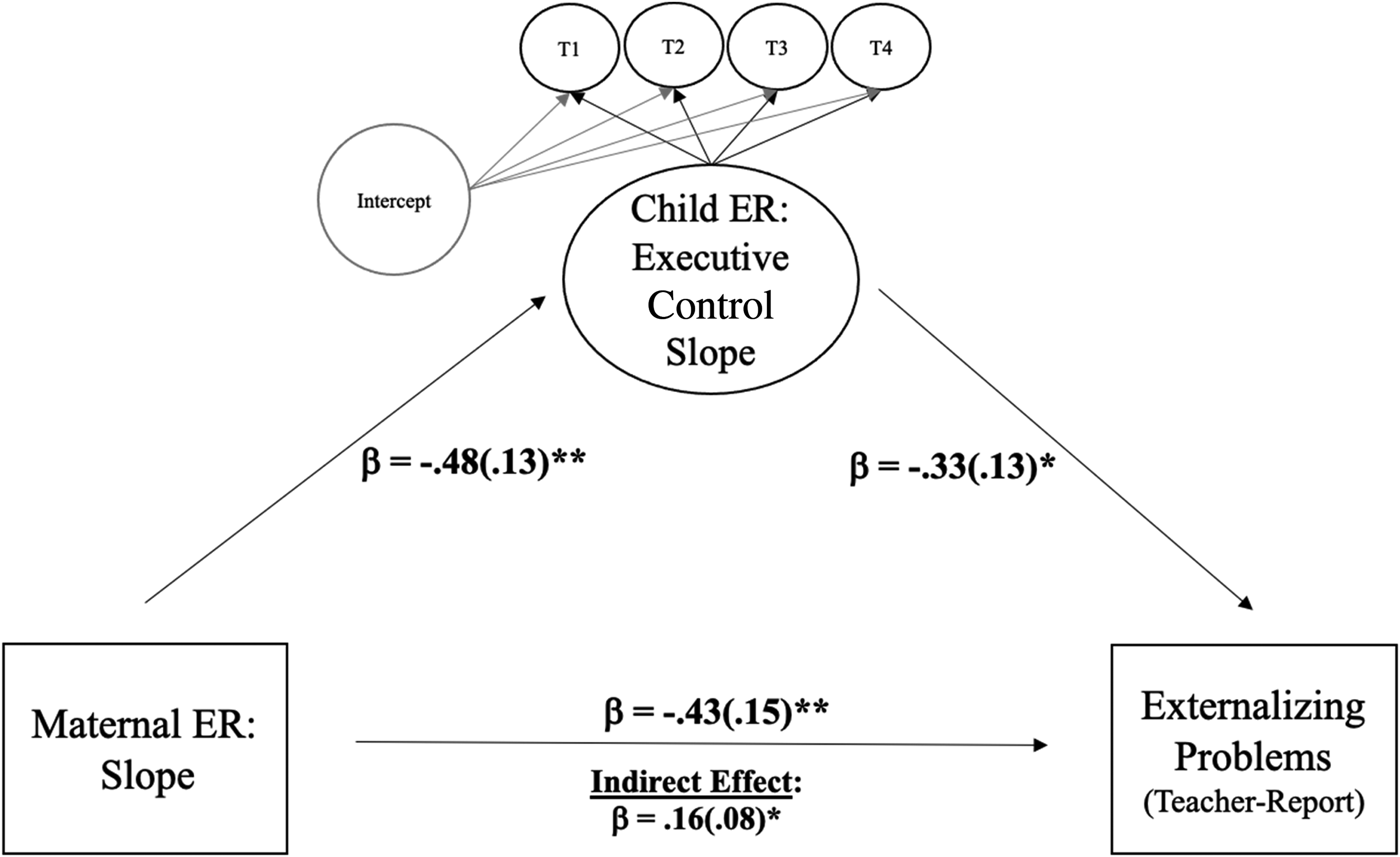
Supplementary Table S1 displays a significant effect of within-individual change in child executive control on teacher-reported externalizing problems. In addition, there was a significant indirect effect whereby improvements in maternal ER difficulties predicted within-individual increases in child executive control and increases in child executive control predicted fewer teacher-reported externalizing problems at 12-month follow-up (Figure 1). There were no other significant effects on teacher-reported internalizing or externalizing symptoms.
Model testing the indirect association between change in maternal emotion regulation and teacher-reported externalizing problems via within-individual change in child executive control. Note. Overall model fit was good (χ2 (21) = 17.27, p > .05; root mean square error of approximation (RMSEA) = < .001; comparative fit index (CFI) = 1.00). Standardized (β) coefficients are shown for significant paths. Nonsignificant paths (i.e., with the intercept (between-person differences)) are not shown. Model controls for the effects of child sex, child age-based estimated IQ, family receipt of public assistance, and teacher-reported externalizing problems at baseline. *p < .05. **p < .01.

Discussion
This study embarks on the ambitious task of applying a multidimensional RDoC framework to the development of ER. While widening the RDoC lens to include an emphasis on environmental and developmental influences, we also sought to sharpen the focus by illustrating how and when this can be accomplished using RDoC domains in this proof-of-concept design. The current study utilized repeated assessments across 12 months during preschool to demonstrate significant between-person differences and within-individual change across several child ER domains. In addition, the current study leveraged an RCT targeting maternal ER difficulties to test the causal impact of this known environmental influence on within-individual change in preschoolers’ ER. Preliminary results suggest that treatment-driven improvements in maternal ER difficulties correspond with steeper growth in preschoolers’ executive control and emotion knowledge. Moreover, growth in child executive control predicted fewer teacher-reported externalizing problems at 12-month follow-up, even after accounting for baseline levels of externalizing problems. Here, we discuss these findings as a proof of concept to highlight how repeated assessments within an experimental intervention design afford the unique opportunity to test environmental mechanisms of change in developmental processes. In line with the goals of this special issue, we emphasize the importance of integrating environmental and developmental dimensions into the existing RDoC framework and offer specific recommendations about how to do so.
Charting within-individual change in developmental processes
The use of longitudinal growth models, here the FCSI model, capitalized on our repeated assessment design and allowed us to parse meaningful between-person differences and within-individual change in four RDoC constructs associated with ER domains: executive control, delay of gratification, regulation of frustration, and emotion knowledge. Importantly, our results showed different patterns of within-individual variability whereby some constructs showed relatively higher levels of within-individual variability at baseline (i.e., 3 years of age; delay of gratification, emotion knowledge) while other constructs showed increases in within-individual variability over time (i.e., 4 years of age; executive control, regulation of frustration). These findings echo previous work demonstrating that functioning within these domains may develop along different timescales (Howse, Calkins, Anastopoulos, Keane, & Shelton, Reference Howse, Calkins, Anastopoulos, Keane and Shelton2003; Lengua et al., Reference Lengua, Moran, Zalewski, Ruberry, Kiff and Thompson2015) and underscore the importance of charting multiple components of ER simultaneously. In addition, results point to potential “turning points” or accelerated rates of growth that may vary by construct or domain of interest. This is consistent with the broader developmental psychopathology perspective that emphasizes the potential for nonlinear growth, and discontinuity of change (Cicchetti & Rogosch, Reference Cicchetti and Rogosch1999; Rutter, Reference Rutter1996; Wood & Jackson, Reference Wood and Jackson2013). Taken together, this work highlights the utility of using latent growth modeling to capture meaningful within-individual change that is overlooked when using more traditional between-person models (Cole & Jacobs, Reference Cole and Jacobs2018; Kim-Spoon & Grimm, Reference Kim-Spoon, Grimm and Cicchetti2016; Wood, Reference Wood2011).
Our emphasis on modeling within-individual change is certainly not new (e.g., Baltes & Nesselroade, Reference Baltes, Nesselroade, Nesselroade and Baltes1979), and neither is the call to harmonize developmental theory with methodological and analytic approaches (e.g., Cicchetti & Rogosch, Reference Cicchetti and Rogosch1999). However, the field has yet to routinely utilize within-individual approaches in practice, despite its consistency with theoretical conceptualizations of development and clear etiological implications. Expanding the RDoC to explicitly define development as a within-individual process would significantly advance research in this area by creating a unified framework and addressing perennial methodological issues that have limited rigor and reproducibility. Specifically, providing a structure that specifies the timing and frequency of assessments needed to capture within-individual change in developmental processes is needed (Fargas-Malet, McSherry, Larkin, & Robinson, Reference Fargas-Malet, McSherry, Larkin and Robinson2010; Hopwood, Bleidorn, & Wright, Reference Hopwood, Bleidorn and Wright2021). The utility of this unified structure necessitates validating repeated assessments of developmentally and culturally sensitive domain-specific constructs to ensure our measurements capture the same underlying developmental phenomena over time. Reliable assessments of within-individual change would enhance our etiological understanding and allow for a more accurate characterization of causal effects, enriching our evaluation of known environmental influences on the development of ER.
Testing environmental influences as causal mechanisms of change
By utilizing a prospective, experimental design, the current study was able to empirically test the influence of change in maternal ER difficulties on within-individual change in child ER. To our knowledge, this proof-of-concept study was the first to utilize an RCT designed to link treatment-driven improvements in maternal ER difficulties with within-individual growth in child ER. Specifically, improvements in maternal ER difficulties predicted increasing trajectories of both child executive control and child emotion knowledge across 12 months during the preschool period. These findings are in line with core developmental psychopathology principles which conceptualize context as intricately intertwined with development (Sroufe & Rutter, Reference Sroufe and Rutter1984), and suggest that fully understanding (and quantifying) developmental change requires systematic manipulation of environmental influences (Garber & Bradshaw, Reference Garber and Bradshaw2020). Further, results demonstrate that maternal-driven growth in child executive control indirectly diminished externalizing problems across the same 12-month period. These findings shift our focus on maternal ER difficulties as a risk factor, to maternal ER difficulties as a malleable target for early intervention that promotes resilience in at-risk children, in line other emerging work in this area (Havighurst et al., Reference Havighurst, Wilson, Harley, Kehoe, Efron and Prior2013; Kehoe et al., Reference Kehoe, Havighurst and Harley2020).
Of note, the influence of change in maternal ER difficulties on child ER was restricted to the RDoC defined cognitive (executive control) and social (emotion knowledge) systems. This is in line with research documenting the impact of parental influences on children's attention deployment and set shifting (Fay-Stammbach, Hawes, & Meredith, Reference Fay-Stammbach, Hawes and Meredith2014) as well as on children's enhanced knowledge and awareness of emotions (Thompson et al., Reference Thompson, Zalewski, Kiff, Moran, Cortes and Lengua2020). However, we failed to detect a link between change maternal ER difficulties and positive (delay of gratification) or negative (frustration tolerance) valence systems. This could be related to the small sample size and reduced power to detect effects. It is also possible that our measurement of these child ER constructs was affected by repeated administration, highlighting the need for future research focused on examining within-individual construct validity over time. In addition, it is helpful to consider these findings within the context of the broader literature on the development of ER in children. Specifically, delay of gratification and regulation of frustration reflect more temperamental (impulsivity, negative reactivity) or phylogenetically older developmental processes (Howse et al., Reference Howse, Calkins, Anastopoulos, Keane and Shelton2003; Lengua et al., Reference Lengua, Moran, Zalewski, Ruberry, Kiff and Thompson2015; Thomas, Letourneau, Campbell, Tomfohr-Madsen, & Giesbrecht, Reference Thomas, Letourneau, Campbell, Tomfohr-Madsen and Giesbrecht2017). While these processes have shown malleability over time (Kiff, Lengua, & Zalewski, Reference Kiff, Lengua and Zalewski2011; Slagt, Dubas, Deković, & van Aken, Reference Slagt, Dubas, Deković and van Aken2016), more significant or sustained environmental changes may be required to observe within-individual change. Conversely, there may be cascading effects whereby maternal driven changes in child executive control may exert downstream effects on delay of gratification and regulation of frustration (Zelazo & Carlson, Reference Zelazo and Carlson2012), necessitating continued observations to capture this developmental sequencing. Finally, because our study focused on a global index of maternal ER difficulties and failed to consider mechanisms of change across parallel ER domains, our understanding of exactly how this intervention induced change in maternal ER difficulties is limited and, in turn, limits our understanding of the intergenerational transmission of ER.
Nonetheless, the current study highlights the ability of experimental intervention designs to more precisely quantify the causal impact of environmental influences on developmental processes across time. This work expands on traditional developmental studies that routinely describe and measure environmental factors but are rarely able to manipulate these influences. Importantly, this shift in design and focus directly aligns with the RDoC's overarching goals, and enables us to translate mechanistic findings into specific prevention and intervention targets aimed at reducing risk for psychopathology (Cuthbert, Reference Cuthbert2014). However, the lack of prescriptive guidance within the RDoC framework prevents collective progress in this area and jeopardizes our ability to capture important explanatory variance in developmental processes of interest. Acknowledging the “environment” as an important dimension is necessary but not sufficient, and guidance for measuring core features of the environment is needed. This includes articulating domains of particular interest (e.g., family factors) and defining relevant constructs (e.g., parental psychopathology, parental influences) as well as including parallel levels of analysis with which these domains can be assessed (e.g., self-report, obervational), all of which would bolster the current RDoC framework. Further, to prevent a recapitalization of the “snap-shot” problem, these environmental influences should be assessed repeatedly, alongside repeated assessments of the developmental domain of interest. These extensions to the RDoC framework would result in greater precision and specificity about the impact of the environment on developmental processes, aiding in the identification of prevention and intervention targets.
Considering developmental influences
The current study focused on the preschool period, a developmental window known for rapid growth in ER development (Carlson & Wang, Reference Carlson and Wang2007; Denham et al., Reference Denham, Blair, DeMulder, Levitas, Sawyer, Auerbach-Major and Queenan2003). Perhaps unsurprisingly, our frequent, repeated assessments showed meaningful within-individual change across all child ER domains. The sensitivity of this developmental period was further underscored by heightened vulnerability to environmental influence (Cole et al., Reference Cole, Lougheed, Ram, Cole and Hollenstein2018), demonstrated here by the impact of maternal ER, and the link between changes in child ER and reduced risk for externalizing problems. Examining ER development within this key developmental period undoubtedly contributed to our ability to detect these associations and highlights the importance of explicit inclusion of a developmental dimension into the RDoC framework. While the ideal developmental window may vary – in both timing and tempo – depending on the developmental process of interest, incorporating a developmental dimension into the RDoC that explicitly defines when assessment and/or intervention are of utmost relevance would enhance our understanding of behavior and refine treatment targets.
Though we focused here on the preschool period, research clearly demonstrates that ER continues to develop across childhood and adolescence (Garber & Dodge, Reference Garber and Dodge1991; Zeman, Cassano, Perry-Parrish, & Stegall, Reference Zeman, Cassano, Perry-Parrish and Stegall2006). Moreover, growing research supports the notion that environmental influences (e.g., parenting) continue to exert a critical influence on ER into adolescence (Klimes-Dougan et al., Reference Klimes-Dougan, Brand, Zahn-Waxler, Usher, Hastings, Kendziora and Garside2007; Laursen & Collins, Reference Laursen, Collins, Lerner and Steinberg2009; Morris et al., Reference Morris, Criss, Silk and Houltberg2017). For example, the transition to adolescence is another developmental period hallmarked by substantial neurobiological changes in systems underlying ER (Guyer, Silk, & Nelson, Reference Guyer, Silk and Nelson2016; Steinberg & Morris, Reference Steinberg and Morris2001), and this developmental period corresponds to the onset of various psychiatric disorders (Spear, Reference Spear2009). Research suggests that the amplification of emotion during this period may necessitate prolonged emotional scaffolding (Guyer et al., Reference Guyer, Silk and Nelson2016; Morris et al., Reference Morris, Criss, Silk and Houltberg2017; Steinberg & Silk, Reference Steinberg, Silk and Bornstein2002) and emerging work demonstrates that parental influences may exacerbate or mitigate ER difficulties (Byrd, Vine, Frigoletto, Vanwoerden, & Stepp, Reference Byrd, Vine, Frigoletto, Vanwoerden and Stepp2021) and emerging psychopathology (Vanwoerden et al., Reference Vanwoerden, Byrd, Vine, Beeney, Scott and Stepp2021). This further underscores the importance of incorporating what is known about developmental processes of interest into a well-defined RDoC dimension. Explicitly defining optimal windows of assessment would enable researchers to maximize their ability to detect and understand the impact of environmental influences on within-individual change.
Summary and future directions
In the past decade, the RDoC has increasingly taken hold as an alternative framework for the study of mental disorders (Cuthbert, Reference Cuthbert2014; Insel et al., Reference Insel, Cuthbert, Garvey, Heinssen, Pine and Quinn2010). Although environment and development are acknowledged as critical elements of the RDoC framework, the consideration of their influences are largely implicit. Scant guidance on how to incorporate these dimensions has created uncertainty for developmental psychopathologists who want to incorporate these two central tenets − environment and development − within the RDoC framework (Garber & Bradshaw, Reference Garber and Bradshaw2020). Here, in this proof-of-concept study, we demonstrate potential for the RDoC to significantly advance our understanding of environmental and developmental influences on within-individual change in developmental processes. Specifically, through experimental manipulation of the environment (maternal ER) we showed a causal effect on within-individual change in child ER during a key developmental window (preschool), enhancing our etiological understanding of this fundamental developmental process. Further, we found that these within-individual changes reduced externalizing problems during this same developmental window, pointing to maternal ER as an important prevention and intervention target. Thus, while the current study was notably limited by small sample size and the use of single constructs within domains of interest, our approach yielded results consistent with the overarching goals of the RDoC framework: advancing our understanding of behavior and identifying and refining targets for intervention. Here, we illustrate the ways in which environmental and developmental dimensions can be explicitly incorporated into the RDoC framework, paralleling conceptualizations of current dimensions. Future work incorporating these dimensions will hasten our progress toward better characterizing within-individual change in behavior and the extent to which that change is influenced by environmental factors across development.
Supplementary Material
The supplementary material for this article can be found at https://doi.org/10.1017/S0954579421000948.
Acknowledgements
We are grateful to all the families who took part in this study, and to the STEADY Study team, which includes interviewers and their supervisors, study therapists, research assistants, data managers, student workers, and volunteers.
Funding Statement
Funding for this study was supported by grants awarded to Drs. Maureen Zalewski and Stephanie Stepp from the National Institute on Mental Health (R01 MH111758). Additional funding from the National Institute of Health also supported this work (K01 MH119216).
Conflicts of Interest
None.