The tragic nature of the human stampede that took place in Phnom Penh, Cambodia on November 22, 2010 claimed the lives of 347 people and injured another 395 according to official reports. Yet, an accurate death toll may never be known as cited estimates of fatalities, compiled from surrounding provinces, were not well documented. 2 During the latter part of a traditional three-day festival, the Bon Om Touk stampede occurred amidst a crowd of more than a million people that had gathered to celebrate the end of the annual rainy season.
The event took place on Koh Pich, or Diamond Island, where many perished on a narrow swaying suspension bridge when panic led to crushing deaths from asphyxiation and internal injuries. With rumors of a failing bridge and individuals passing out and trampled, authorities rushed to regain control, with military-employed water cannons directed at crowds attempting to flee the bridge. The effectiveness of water cannons as a relatively non-lethal method of controlling crowd behavior remains controversial, and likely contributed to further confusion. More deaths resulted from electrocution by electric cables that victims grabbed to pull themselves out of the river, or drowning in the muddy river below. Not unlike other human stampedes, what incited the panic remains unclear.
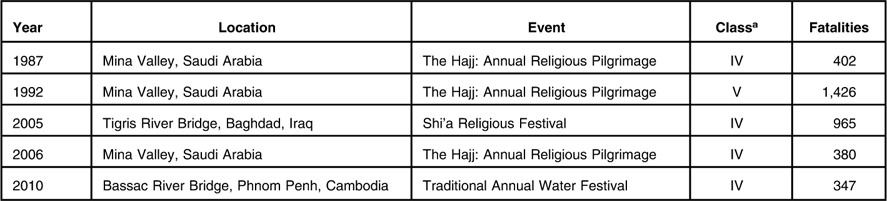
Described as the greatest tragedy that Cambodia has experienced since the collapse of the Khmer Rouge, the Bon Om Touk catastrophe ranks among the deadliest human stampede disasters during the past 30 years, a Class IV event exceeding 100 fatalities according to a recently proposed scale (Table 1).Reference Ngai, Burkle and Hsu 1 Witnesses’ reports described bodies piled five or six deep with the numbers of deceased exceeding the government's capacity to deal with them. 2 It is the fourth major crowd disaster to have taken place in 2010, including a stampede at the Ram Janki Temple in Kunda, India that killed at least 63 and injured hundreds, and the Love Parade disaster in Duisberg, Germany that resulted in 21 deaths and over 500 injuries.Reference Burkle and Hsu 3 The most unfortunate aspect of such a crowd disaster is that the warning signs of a potentially lethal mass gathering, as in previous events, were largely unheeded.
Deadliest Human Stampedes (1980-2010) 2

aClass I injuries, no deaths, Class II 1-10 deaths, Class III 11-100 deaths, Class IV 101-1,000 deaths, Class V >1,000 deaths
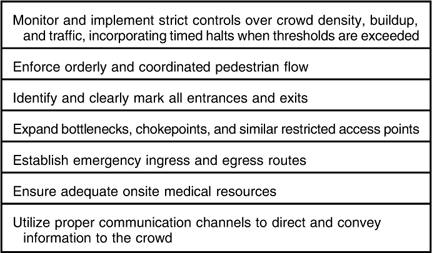
The Bon Om Touk stampede shares many common features with other catastrophic crowd conditions, most of which can be addressed by mitigation measures (Table 2). Poor planning by organizers included closing one of two bridges earlier in the day, an action that directly resulted in markedly increased foot traffic across the remaining bridge. While each bridge originally was intended to accommodate unidirectional traffic to and from the city, absence of clear messaging and enforcement of traffic directions led to intensified physical interactions and turbulent movement among an increasingly dense population. In turn, a critical bottleneck obstructed the pedestrian flow, and safety levels were rapidly exceeded, with more than 7,000 people on the bridge at the time the panic occurred. Elements were in place for a perfect storm of a catastrophe.
Mitigation of Human Stampede Risks

Similarly, in its aftermath, lack of advance planning meant inadequate ingress and egress routes for emergency personnel to reach victims, and in significant delays. Casualties sustaining life-threatening injuries, survivable under normal conditions, had no chance to access emergent care. The state of health care for a representative underdeveloped region coupled with lack of any well-developed disaster preparedness measures certainly contributed to further fatalities. The Bon Om Touk Water Festival may be considered, in the evolving taxonomy, as a non-sports, religious, music, or political (non-SRMP) event that is associated with a relative fatality rate more than 40 times that of sporting events, perhaps in large part due to this less structured nature of planning.Reference Hsieh, Ngai and Burkle 4
From the perspective of global health, the event shares many characteristics with preceding major crowd disasters. The Bon Om Touk disaster took place in a developing country in South East Asia, the most frequent site of such human stampedes worldwide, with a fatality rate 7.75 times higher when compared with crowd disasters occurring in developed countries.Reference Hsieh, Ngai and Burkle 4 Victims consist largely of women, a well-recognized observation that these stampedes disproportionately impact those who are less able to defend themselves from the weight of a crush or unable to escape the rush of a crowd surge. Absence of adequate, commensurate, local onsite medical resources for an event of this size along with insufficient local health care resources serve as a stark reminder of how poor local conditions further magnify the devastating impact of human stampedes in developing nations.
Curiously—and unlike the progress made in scientific investigation and epidemiological scrutiny necessary for preparedness and prevention in other types of disasters—human stampedes have eluded such mitigations, especially evident in religious events in developing countries where, too often, tragic outcomes may be interpreted as the “will of God” or nature. Despite this, the efforts of some individual countries to mitigate occurrence of crowd disasters have enjoyed success to date. For example, the extensive construction of the Jamarat Bridge project, a multilevel structure to accommodate millions of pilgrims during the Hajj in Saudi Arabia, has improved control of pedestrian traffic, with clear identification of entrances and exits, widening of bottlenecks, implementation of selective cushioning, and monitoring of crowd densities, among other measures. Saudi Arabia, which has been the location of numerous deadly Class IV and V stampedes, has not experienced another major crowd disaster since 2006.Reference Ngai, Burkle and Hsu 1 The first conference on mass-gathering medicine to share important lessons learned was held in Saudi Arabia in 2010.
Although these are encouraging steps, more can be done, including the development of potential new strategies for improved mass-gathering planning through research. Conflicting reports of casualties during human stampedes illustrate the pressing need for systematic and thorough independent epidemiological investigation and analysis. Stampedes remain a recurrent and increasingly frequent type of man-made disaster that is not fully understood. What is known to date about the epidemiology of human stampedes comes primarily from inconsistent news feed reports. While there are clear steps that can be undertaken to reduce the likelihood of such tragedies occurring, it is essential for the global community to officially monitor these events as it does other major disasters before collective understanding and prevention can occur.