Introduction
Substance use disorders (SUD) are highly prevalent in first-episode psychosis (FEP) patients (Wade et al. Reference Wade, Harrigan, Edwards, Burgess, Whelan and McGorry2005; Addington & Addington, Reference Addington and Addington2007; Archie et al. Reference Archie, Rush, Akhtar-Danesh, Norman, Malla, Roy and Zipursky2007; Barnett et al. Reference Barnett, Werners, Secher, Hill, Brazil, Masson, Pernet, Kirkbride, Murray, Bullmore and Jones2007; Mazzoncini et al. Reference Mazzoncini, Donoghue, Hart, Morgan, Doody, Dazzan, Jones, Morgan, Murray and Fearon2010; Ouellet-Plamondon & Abdel-Baki, Reference Ouellet-Plamondon and Abdel-Baki2011), with rates of 30–70%, particularly for cannabis (Larsen et al. Reference Larsen, Melle, Auestad, Friis, Haahr, Johannessen, Opjordsmoen, Rund, Simonsen, Vaglum and McGlashan2006; Archie et al. Reference Archie, Rush, Akhtar-Danesh, Norman, Malla, Roy and Zipursky2007; Abdel-Baki et al. Reference Abdel-Baki, Ouellet-Plamondon, Salvat, Grar and Potvin2017), and arguably impair psychiatric and functional outcomes (Linszen et al. Reference Linszen, Dingemans and Lenior1994; Lambert et al. Reference Lambert, Conus, Lubman, Wade, Yuen, Moritz, Naber, McGorry and Schimmelmann2005; Wade et al. Reference Wade, Harrigan, Edwards, Burgess, Whelan and McGorry2006; Turkington et al. Reference Turkington, Mulholland, Rushe, Anderson, McCaul, Barrett, Barr and Cooper2009). Supporting this widely-held assumption, numerous cross-sectional studies have shown that misuse of psychoactive substances (PAS) is associated with increased hospitalizations (Haywood et al. Reference Haywood, Kravitz, Grossman, Cavanaugh, Davis and Lewis1995), poor treatment compliance (Owen et al. Reference Owen, Fischer, Booth and Cuffel1996), high relapse rates (Lambert et al. Reference Lambert, Conus, Lubman, Wade, Yuen, Moritz, Naber, McGorry and Schimmelmann2005; Malla et al. Reference Malla, Norman, Bechard-Evans, Schmitz, Manchanda and Cassidy2008) and elevated costs of mental healthcare services (Bartels et al. Reference Bartels, Teague, Drake, Clark, Bush and Noordsy1993) to psychosis patients. For instance, post hoc analyses of baseline data from seminal Clinical Antipsychotic Trials of Intervention Effectiveness produced evidence that SUD are associated, in schizophrenia (n = 1460), with increased positive symptoms, elevated rates of major depression and homelessness (Swartz et al. Reference Swartz, Wagner, Swanson, Stroup, McEvoy, Canive, Miller, Reimherr, McGee, Khan, Van Dorn, Rosenheck and Lieberman2006). Rather surprisingly, however, longitudinal studies have not produced unequivocal evidence of worse psychiatric and functional outcomes in schizophrenia patients abusing PAS (Zammit et al. Reference Zammit, Moore, Lingford-Hughes, Barnes, Jones, Burke and Lewis2008; Archie & Gyomorey, Reference Archie and Gyomorey2009). These inconsistent findings are noteworthy, since longitudinal studies are better suited to establish causal relationships than cross-sectional studies.
The reasons for such discrepancies are complex and may depend on failure to take into account that some patients maintain their consumption during follow-up, while others change their habits. Paying attention to this methodological issue, Turkington et al. (Reference Turkington, Mulholland, Rushe, Anderson, McCaul, Barrett, Barr and Cooper2009) performed a 1-year longitudinal study in 272 FEP patients and determined that persistent substance misuse was associated, with increased positive and depressive symptoms, more frequent psychotic relapses and worse functional outcomes, while substance misuse cessation was linked with significantly decreased positive symptoms, which reached similar severity at end-point as in never-using FEP patients. A 14-month follow-up study of first-episode schizophrenia patients by Harrison et al. (Reference Harrison, Joyce, Mutsatsa, Hutton, Huddy, Kapasi and Barnes2008) produced corresponding results. Our group recently showed that substance abuse persistence (but not substance abuse cessation) was associated with worse outcomes in FEP patients in terms of positive and negative symptoms, quality of life (QoL), and social functioning (Abdel-Baki et al. Reference Abdel-Baki, Ouellet-Plamondon, Salvat, Grar and Potvin2017).
Also crucial is the impact of different PAS classes abused by psychosis patients, which may not produce similar severity of psychiatric and functional impairments. Cannabis is one of the most frequently-used PAS in FEP, with prevalence rates up to 45% (Larsen et al. Reference Larsen, Melle, Auestad, Friis, Haahr, Johannessen, Opjordsmoen, Rund, Simonsen, Vaglum and McGlashan2006; Archie et al. Reference Archie, Rush, Akhtar-Danesh, Norman, Malla, Roy and Zipursky2007; Koskinen et al. Reference Koskinen, Löhönen, Koponen, Isohanni and Miettunen2010; Abdel-Baki et al. Reference Abdel-Baki, Ouellet-Plamondon, Salvat, Grar and Potvin2017). Continued cannabis smoking in schizophrenia is consistently associated with higher relapse rates, longer hospitalizations and severe positive symptoms (Schoeler et al. Reference Schoeler, Monk, Sami, Klamerus, Foglia, Brown, Camuri, Altamura, Murray and Bhattacharyya2016). However, most studies in Schoeler et al. (Reference Schoeler, Monk, Sami, Klamerus, Foglia, Brown, Camuri, Altamura, Murray and Bhattacharyya2016) meta-analysis did not control for confounders, such as baseline illness severity and the abuse of other PAS, making it unclear if the observed associations are specifically due to cannabis-smoking. Indeed, poly-substance misuse is frequent among cannabis misusers (Linszen et al. Reference Linszen, Dingemans and Lenior1994; Grech et al. Reference Grech, Van Os, Jones, Lewis and Murray2005; Rebgetz et al. Reference Rebgetz, Conus, Hides, Kavanagh, Cotton, Schimmelmann, McGorry and Lambert2014).
Alcohol is another PAS with elevated prevalence in psychosis patients (Koskinen et al. Reference Koskinen, Löhönen, Koponen, Isohanni and Miettunen2009; Abdel-Baki et al. Reference Abdel-Baki, Ouellet-Plamondon, Salvat, Grar and Potvin2017). In large-scale, cross-sectional studies, alcohol misuse in psychosis individuals has been repeatedly linked with increased depressive symptoms and suicidal ideas/attempts (Barak et al. Reference Barak, Baruch, Achiron and Aizenberg2008; McLean et al. Reference McLean, Gladman and Mowry2012). Psycho-stimulants (amphetamines and cocaine) are powerful PAS with serious psychiatric and functional consequences well-established in non-psychosis abusers (Sara et al. Reference Sara, Large, Matheson, Burgess, Malhi, Whiteford and Hall2015). Despite cross-sectional evidence that cocaine misuse transiently worsens positive and depressive symptoms as well as social functioning in schizophrenia (Sevy et al. Reference Sevy, Kay, Opler and van Praag1990; Serper et al. Reference Serper, Chou, Allen, Czobor and Cancro1999), longitudinal studies have paid little attention to the specific effects of psycho-stimulants in psychosis patients, probably because of the lower prevalence of psychostimulant misuse in schizophrenia (Sara et al. Reference Sara, Large, Matheson, Burgess, Malhi, Whiteford and Hall2015). In Montreal (Canada), however, where the present investigation was undertaken, there has been a recent spike in amphetamine use and abuse rates in psychosis patients (Zhornitsky et al. Reference Zhornitsky, Stip, Pampoulova, Rizkallah, Lipp, Bentaleb, Chiasson and Potvin2010; Abdel-Baki et al. Reference Abdel-Baki, Ouellet-Plamondon, Salvat, Grar and Potvin2017), rendering it possible to examine the psychiatric and functional effects of various PAS classes, including psychostimulants, in FEP patients.
The current 2-year longitudinal study sought to assess the specific clinical and functional impact of various PAS classes (and their combination) on FEP patients as well as on service utilization, while paying attention to the persistence of substance use habits during follow-up.
Methods
Setting and samples
A prospective, longitudinal, cohort study was conducted in two early intervention services (EIS) of the Université de Montréal's Network of Early Psychosis Intervention Programs (Nicole et al. Reference Nicole, Abdel-Baki, Lesage, Granger, Stip and Lalonde2007) in defined urban catchment areas of Montreal, Quebec, Canada. Both EIS offer help to all FEP patients from their catchment areas. The programs provide specialized treatment based on early psychosis intervention guidelines (Early Psychosis Guidelines Writing Group and EPPIC National Support Program, 2016). EIS value motivational, psycho-education and harm reduction approaches, delivering individual and group interventions to address SUD and psychosis. A few clients in the cohort have also participated in interventions in parallel institutions specializing in addiction treatment according to need.
FEP patients admitted to the two EIS programs between the fall of 2005 and March 2010 (DSM-IV-TR criteria, American Psychiatric Association, 2000) were invited to participate in the present study. The two EIS were Programme premier episode psychotique of the IUSMM, covering a population of 340 000 inhabitants in the eastern part of Montreal, and Clinique jeunes adultes psychotiques of the CHUM, located in the city centre (catchment area of 225 000 inhabitants). The inclusion criteria of these EIS programs were: age between 18 and 30 years, primary diagnosis of psychosis, untreated or maximum 1 year prior treatment of this condition. The exclusion criteria were mental retardation and incapacity to minimally understand French or English. The study received institutional ethics and scientific committee approval, with written informed consent obtained from all study subjects.
Clinical assessments
Socio-demographic, symptom and functioning data were recorded at admission and annually for 2 years. A research assistant trained in the administration of psychiatric scales (see below) interviewed the study participants and undertook file reviews. Data were collected on socio-demographics (age, gender, education level, marital, immigration and occupational status, income sources, living arrangements, homelessness history, legal problems), symptomatology (Positive and Negative Symptoms Scale) (PANSS) (Kay et al. Reference Kay, Flszbein and Opfer1987), Calgary Depression Scale for Schizophrenia (CDSS) (Addington et al. Reference Addington, Addington and Schissel1990), Drug Use Scale (DUS) and Alcohol Use Scale (AUS) (Drake et al. Reference Drake, Mueser, McHugo, Sedered and Dickey1996), and substance abuse type. The PANSS, CDSS, DUS and AUS were administered at baseline, and after 1 and 2 years of follow-up. Medication type and compliance were noted after 3 months into the program and annually. Service utilization measures for the 2-year period were recorded in 176 individuals who completed the 2-year follow-up (emergency visits, number and length of hospitalizations).
The QoL scale (Heinrichs et al. Reference Heinrichs, Hanlon and Carpenter1984) was administered. Living arrangements were rated according to the following scale adapted from (Ciompi, Reference Ciompi1980): ‘Independents’ regrouped all subjects living alone on their own, with a partner and/or children; ‘With parents’ regrouped all subjects living with any family members; and ‘Others’ regrouped subjects living in supported housing (supervised apartment, group home, foster home, in hospital) or homeless. For occupational status, the cohort was divided into two categories: ‘Full- or part-time work/study,’ including competitive work, work rehabilitation programs, sheltered work, and ‘no productive activity,’ including patients with no professional or student activity.
DSM-IV-TR diagnoses of psychotic disorder and SUD and the presence of Cluster B personality traits or disorder were established by the best-estimate consensus method (Roy et al. Reference Roy, Lanctôt, Mérette, Cliche, Fournier, Boutin, Rodrigue, Charron, Turgeon, Hamel, Montgrain, Nicole, Pirès, Wallot, Ponton, Garneau, Dion, Lavallée, Potvin, Szatmari and Maziade1997) with all available data considered by at least two raters (one senior psychiatry resident and/or one or two psychiatrists). Based on recommendations in the field (Velligan et al. Reference Velligan, Weiden, Sajatovic, Scott, Carpenter, Ross and Docherty2009; Haddad et al. Reference Haddad, Brain and Scott2014), medication compliance was assessed from multiple information sources: patients, file reviews (including information from the family, laboratory measures, subjects’ case managers and psychiatrist reports). Based on these five information sources, FEP individuals were classified as compliant (⩾80%) or partially compliant/non-compliant. The latter two categories were merged since very few patients were totally non-compliant at all times. Social functioning scales – Social and Occupational Functioning Assessment Scale (SOFAS) (Goldman et al. Reference Goldman, Skodol and Lave1992), Global Assessment of Functioning (GAF) (Hall, Reference Hall1995) and Clinical Global Impression (Guy, Reference Guy1976) – were completed by the research psychiatrists with SUD evaluation, including the DUS and AUS. Functioning scales were administered at baseline and after 1 and 2 years of follow-up.
SUD assessment
SUD diagnosis were determined according to DSM-IV-TR criteria for each substance use. The DUS and AUS were also completed to stratify use (Drake et al. Reference Drake, Mueser, McHugo, Sedered and Dickey1996).
Study groups
Participants were clustered into subgroups as a function of their SUD status: ‘no-SUD’, ‘Alcohol use disorder’ (AUD), which included those who had AUD only and not another SUD, ‘Cannabis use disorder’ (CUD), which included those with CUD only, ‘Psychostimulant use disorder’, which included cocaine and amphetamine use disorder and ‘Poly-substance use disorder’ (poly-SUD), which included those with at least two SUD [alcohol and drug(s) or at least two different drugs]. The Psychostimulant use disorder group comprised those with psychostimulant use disorder only as well as those with psychostimulant use disorder and other concurrent SUD, as most psychostimulant misusers have poly-SUD. Subjects with former SUD, not meeting criteria for SUD in the last year, were included in the no-SUD group as a recent study from our team showed that former users reached a level of symptoms and functioning similar to those with no-SUD (Abdel-Baki et al. Reference Abdel-Baki, Ouellet-Plamondon, Salvat, Grar and Potvin2017).
Data analyses
Data were analysed by SPSS software, version 20, with t tests for continuous variables and Pearson's chi-square test for discrete variables, to compare symptoms, social functioning and service utilization after 1 and 2 years of follow-up in the different FEP SUD groups.
Results
284 patients were eligible for enrolment in the study. 57 refused and 227 accepted to participate. No differences in SUD status were detected at admission between patients lost to follow-up (LTF) at 24 months (N = 32, 14%) and those still followed. Compared with the followed sample, the LTF group was more likely to be composed of immigrants (1st and 2nd generations) (42% v. 69%, p = 0.008), working or studying at baseline (40% v. 63%, p = 0.017), less medication-compliant early in treatment (at 3 months) (no or partial compliance 12% v. 29%, p = 0.048) and less likely to have a diagnosis of Schizophrenia Spectrum Disorder (v. affective psychoses) at admission (67% v. 44%, p = 0.037).
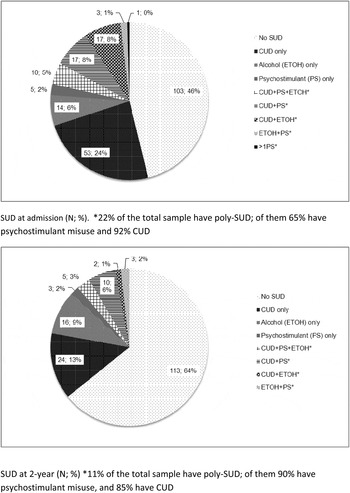
At admission and 2 years follow-up, respectively, 103 (46%) and 113 (64%) individuals had no-SUD, 14 (6%) and 16 (9%) had AUD only, 53 (24%) and 24 (14%) had CUD only, 5 (2%) and 3 (2%) had psychostimulant use disorder only, and 48 (22%) and 20 (11%) had poly-SUD. Thirty-one patients (65%) of the poly-SUD group at baseline were misusing psychostimulants and 44 (92%) were misusing cannabis (Fig. 1). In the persistent poly-SUD group at 2 years, 18 patients (90%) were misusing psychostimulants, and 17 (85%), cannabis. Overall, there was a 32% reduction of total SUD from admission (54%) to 2 years follow-up (37%). Some poly-SUD patients quit 1 or more substances between baseline and 2 years follow-up, changing from poly-SUD at baseline to the ‘no-SUD’ group or to a single addiction. The rate of substance misuse decreased in the case of all specific substances, except alcohol. Among the 16 patients of the AUD only group at 2 years, 10 had AUD only at baseline and persisted at 2 years, two had poly-SUD at baseline and switched to AUD only at 2 years. Finally, two had CUD only at baseline and changed to AUD only at 2 years, while two switched from no-SUD at baseline to AUD only.
Prevalence of specific SUD and poly-SUD at admission (top) and at 2 years (bottom). CUD, cannabis use disorder; ETOH, alcohol, PS, psychostimulants (cocaine, amphetamine); SUD, substance use disorder.

There was no statistical difference between the SUD groups (no-SUD, AUD, CUD, psychostimulant use disorder and poly-SUD) for age (mean 23.0 years), gender (80.2% male), marital status (86.8% single) and immigration status (46.2% first- or second-generation immigrants). Groups differed in education level (no-SUD: 11.5 years, alcohol: 10.5 years, CUD: 10.5 years, psychostimulants: 9.9 years, poly-SUD: 9.7 years; p < 0.05). At baseline, there were no differences between patients with and without SUD in terms of psychiatric symptoms. In regard to functioning and medication-related measures at baseline, no differences were detected between the AUD group and the no-SUD group. However, compared to the no-SUD group, differences were observed at baseline on some functional outcomes (such as lower GAF for CUD, lower QoL and occupational status for the psychostimulant use disorder and poly-SUD groups: online Supplementary Table S1).
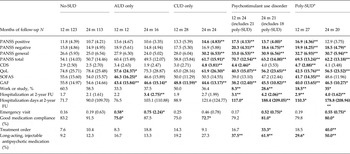
Table 1 reports outcomes in each SUD group at 1- and 2-year follow-up. Relative to the no-SUD group, patients with persistent CUD had increased positive and depressive symptoms, lower QoL, functioning (GAF) and compliance with medication at 2-year follow-up. Outcomes seemed to deteriorate on all measures from years 1 to 2. Compared with the no-SUD group, psychostimulant use disorder had worse outcomes on nearly all measures (psychiatric symptoms, QoL, functioning, service utilization and medication compliance) at 1- and 2-year follow-up. The poly-SUD group showed similar outcomes as the psychostimulant use disorder group, since they overlapped (see Table 1). Lastly, at 1-year follow-up, AUD was linked with lower QoL, social functioning (SOFAS and GAF) scores, lower medication compliance, and increased service utilization at 1- and 2-year follow-up, in comparison with the no-SUD group. However, AUD had no significant impact on symptoms.
Impact of specific SUD on symptomatic outcome, functional outcome, services utilization, route of antipsychotic administration and medication compliance, at 12 and 24 months of follow-up

Notes. PANSS, Positive and Negative Symptoms Scale; CDS, Calgary Depression Scale; QoL, quality of life; SOFAS, Social and Occupational Functioning Scale; GAF, global assessment of functioning; FU, follow-up; med, medication.
a The poly-SUD group and the psychostimulant use disorder group overlap (21 patients at 12 months and 18 patients at 24 months are included in both groups). Indeed, for example, at 2 years, only three individuals from the psychostimulant use disorder group did not have other concomitant SUD, and 18/20 of the poly-SUD group had psychostimulant use disorder.
Data are means (s.d.) unless stated otherwise.
*Significant differences between the substance misusing and no-SUD groups, p < 0.05; **Significant differences between the substance misusing and no-SUD groups, p < 0.01.
Discussion
The impact of SUD on psychosis outcomes was often studied in heterogeneous populations (e.g. early v. chronic psychosis) (Large et al. Reference Large, Mullin, Gupta, Harris and Nielssen2014), without taking into account its course (cessation v. continued use) (Turkington et al. Reference Turkington, Mulholland, Rushe, Anderson, McCaul, Barrett, Barr and Cooper2009), and differentiating substance classes or considering poly-SUD (Sevy et al. Reference Sevy, Kay, Opler and van Praag1990). The present study considered these methodological issues.
Prevalence of substance use
As reported in other studies (Larsen et al. Reference Larsen, Melle, Auestad, Friis, Haahr, Johannessen, Opjordsmoen, Rund, Simonsen, Vaglum and McGlashan2006; Addington & Addington, Reference Addington and Addington2007; Archie et al. Reference Archie, Rush, Akhtar-Danesh, Norman, Malla, Roy and Zipursky2007; Mazzoncini et al. Reference Mazzoncini, Donoghue, Hart, Morgan, Doody, Dazzan, Jones, Morgan, Murray and Fearon2010), all SUD types are more prevalent in FEP patients than in the general population, and cannabis is the most common drug misused. In our cohort, however, half of the individuals with CUD presented poly-SUD. This phenomenon has also been documented previously (Linszen et al. Reference Linszen, Dingemans and Lenior1994; Grech et al. Reference Grech, Van Os, Jones, Lewis and Murray2005; Rebgetz et al. Reference Rebgetz, Conus, Hides, Kavanagh, Cotton, Schimmelmann, McGorry and Lambert2014). Psychostimulants (amphetamines and cocaine) were the most common, concurrently-misused substances in the cannabis misusers. This fact raises questions regarding the results of past studies looking at SUD and psychosis that did not report poly-SUD. One possibility is that prevalence was too low to be worth investigating. However, this hypothesis appears to be unlikely since other parameters in our FEP cohort were similar to those in other studies in terms of socio-demographic factors. Another explanation might be that the phenomenon was not examined, possibly misattributing the impact of one substance to another, notably, psychostimulants to cannabis. Finally, the prevalence of AUD was lower than that of CUD, a result consistent with recent trends observed in FEP patients (Koskinen et al. Reference Koskinen, Löhönen, Koponen, Isohanni and Miettunen2009, Reference Koskinen, Löhönen, Koponen, Isohanni and Miettunen2010).
Impact of SUD on symptoms and functioning
SUD (drugs and alcohol) persistence is linked with lower functioning, but illicit drugs have a greater negative impact than alcohol on most clinical, functioning and service utilization outcome measures at 2-year follow-up. Moreover, SUD persistence is associated with lower medication compliance.
Unlike patients with AUD, persistent drug misusers in general have more symptoms than those with no-SUD. Moreover, persistent CUD is linked with positive and depressive symptoms which are aggravated with time, a result which goes against the self-medication hypothesis. No link with increased negative symptoms was observed. In an 18-month study, Barrowclough et al. (Reference Barrowclough, Gregg, Lobban, Bucci and Emsley2015) similarly ascertained that cannabis use is accompanied by depression and anxiety but not with positive or negative symptoms, relapse or hospital admissions. Likewise, Faridi et al. (Reference Faridi, Joober and Malla2012) observed that cannabis users remain at higher risk of poor symptomatic outcome, even when they are medication-compliant. On the other hand, persistent psychostimulant misuse is strongly associated with both positive and negative symptoms, at both follow-up periods (1 and 2 years) but not at baseline. The latter finding is interesting as few studies have directly compared these two drug types, although both have been separately shown to aggravate psychiatric symptoms in psychotic individuals. Indeed, depressive symptoms have been linked with cannabis use (Addington & Addington, Reference Addington and Addington2007), and monoamine depletion secondary to psychostimulant misuse can mimic or exacerbate negative symptoms of psychosis (Foussias et al. Reference Foussias, Siddiqui, Fervaha, Agid and Remington2015).
SUD persistence is also associated with lower functioning (GAF scale) at 1- and 2-year follow-up compared with no-SUD. Moreover, SUD persistence has a greater negative impact on most measures at 1 and 2 years, with poorer QoL and compromised occupation (work/study). It suggests that persistent SUD not only interferes with clinical and functional improvement (compared to the no-SUD group) but, in some cases, it also seems to be linked with functional deterioration over time, as seen in the present study for the persistent CUD group. As observed in previous works (Turkington et al. Reference Turkington, Mulholland, Rushe, Anderson, McCaul, Barrett, Barr and Cooper2009; Schoeler et al. Reference Schoeler, Monk, Sami, Klamerus, Foglia, Brown, Camuri, Altamura, Murray and Bhattacharyya2016), SUD is a common obstacle encountered in early psychosis interventions which aim to help patients achieve functional and symptomatic remission. However, different substances have different trends and impacts, so it is important not to generalize SUD but rather enquire into the nature, quantity and impact of each substance used or their combination.
Alcohol
The fact that AUD had no significant impact on positive and negative symptoms is consistent with some previous studies in the field (Drake et al. Reference Drake, Mueser, McHugo, Sedered and Dickey1996; Sorbara et al. Reference Sorbara, Liraud, Assens, Abalan and Verdoux2003; Wade et al. Reference Wade, Harrigan, Edwards, Burgess, Whelan and McGorry2006; González-Pinto et al. Reference González-Pinto, Alberich, Barbeito, Gutierrez, Vega, Ibáñez, Haidar, Vieta and Arango2011). The lack of impact of AUD on depressive symptoms, on the other hand, is inconsistent with previous studies showing that alcohol is a risk factor for depressive symptoms and suicidal ideation/attempts in psychosis (McLean et al. Reference McLean, Gladman and Mowry2012) and FEP patients (Sönmez et al. Reference Sönmez, Røssberg, Evensen, Barder, Haahr, Ten Velden Hegelstad, Joa, Johannessen, Langeveld, Larsen, Melle, Opjordsmoen, Rund, Simonsen, Vaglum, McGlashan and Friis2016). The reason(s) for this absence of effects is elusive but may have to do with the relatively small number of patients involved in the AUD sub-group. However, AUD is associated with poorer functioning and QoL, especially in early follow-up. Alcohol misuse has previously been linked with functioning difficulties (family problems, unemployment, housing instability) in psychosis patients (Drake & Mueser, Reference Drake and Mueser1996; Koskinen et al. Reference Koskinen, Löhönen, Koponen, Isohanni and Miettunen2009).
Cannabis
Persistence of CUD only is associated with less harm (impact on symptoms and functioning compared to no-SUD) than psychostimulant misuse at 1 and 2 years of follow-up, but is the only group that deteriorates from years 1 to 2 (on both symptomatic and functioning measures). This phenomenon might explain some discrepancies in the literature, as negative consequences seem to increase with duration of cannabis misuse. Previous studies that were mostly of shorter duration (6–12 months) might not have been long enough to notice cannabis’ gradual negative impact on outcomes (Faridi et al. Reference Faridi, Joober and Malla2012).
Cannabis use has been associated with non-compliance in FEP (Coldham et al. Reference Coldham, Addington and Addington2002). Likewise, in the present study, the ‘CUD only’ group was the least medication-compliant of all groups at 2 years. The lower rate of long-acting, injectable antipsychotic medication and of treatment orders (TO) in the CUD group (compared with the psychostimulant misuser group) could contribute to lower medication compliance. Still, almost three-quarters of CUD patients were compliant. Moreover, significant association between continued cannabis use and increased symptom levels has been observed in FEP patients, even when controlling for the influence of medication non-compliance (Faridi et al. Reference Faridi, Joober and Malla2012). It is also possible that combination of heavy, ongoing cannabis use and lower medication compliance in early psychotic disorder might synergistically invoke deterioration over time.
Psychostimulants
Psychostimulants are linked with adverse symptomatic and functional outcomes from early in the course of illness (from the 1st year of treatment) and throughout follow-up, which is not the case with other substances. Psychostimulants are also associated with worse QoL and occupational status of all SUD groups at all time points, which are key outcome measures from a patient-oriented perspective. Psychostimulant use has already been associated with poor social adjustment in FEP, such as unemployment, compared with FEP individuals with cannabis use only or those who never use drugs (Mazzoncini et al. Reference Mazzoncini, Donoghue, Hart, Morgan, Doody, Dazzan, Jones, Morgan, Murray and Fearon2010). It is likely that the detrimental effect of psychostimulants on the brain, mainly on the reward pathway and on the dopamine network (Murray et al. Reference Murray, Paparelli, Morrison, Marconi and Di Forti2013), interfered with the FEP recovery process. Similar findings linking psychostimulants and poor adjustment have been reported in non-psychosis individuals (Fiorentini et al. Reference Fiorentini, Volonteri, Dragogna, Rovera, Maffini, Mauri and Altamura2011). In view of these harmful effects of psychostimulants in psychotic individuals, future studies need to determine if ceasing psychostimulant misuse is more difficult for them than it is to stop misusing alcohol or cannabis. Our results suggest that this might be the case, since the proportion of individuals ceasing cocaine and amphetamine misuse at 24 months (27.2%) is smaller than those stopping cannabis at 24 months (46.1%).
Poly-SUD
Having poly-SUD is associated with worse outcomes (psychiatric symptoms, functioning and service utilization). Poly-SUD is frequent in FEP individuals (Addington & Addington, Reference Addington and Addington2007), and illicit drugs other than cannabis are often not reported and might be overlooked. This is a major limitation as we cannot disentangle the effect of each individual substance in the psychostimulant group since only three individuals (at 1 and 2 years) misused only a psychostimulant, and most individuals from the psychostimulant group were polysubstance or cannabis misusers as well (Fig. 1) (Addington & Addington, Reference Addington and Addington2007).
Impact on service utilization
Persistence of psychostimulants use disorder and AUD over the 2-year period seems to have a major negative impact on service utilization measures, appearing to be more pronounced for psychostimulant misusers than alcohol, especially for hospitalizations. However, psychostimulant use increased emergency visits during the 2nd year only, whereas alcohol increased emergency visits very significantly at 1 and 2 years, possibly in linkage with acute impacts of alcohol intoxication on the clinical condition that resolved more quickly than psychostimulant impacts which, more often, required hospitalization. However, AUD also had a sustained impact since hospitalization was increased at 2 years. Although the CUD only group seemed to show increased use of emergency visits (more than twice as much) and hospitalizations, these results did not reach statistical significance, possibly because of lack of statistical power due to small sample size. Hospitalization can be considered as an indirect measure of illness severity and the complexity of our healthcare system's difficulty in addressing this complex co-morbidity and the burden it imposes, especially on families. Treatment order (TO) and long-acting injectable antipsychotic medication (LAI) are more frequent in the psychostimulant and poly-SUD groups, as previously reported (Rubio et al. Reference Rubio, Martínez, Ponce, Jiménez-Arriero, López-Muñoz and Alamo2006; Zhornitsky & Stip, Reference Zhornitsky and Stip2012). This probably reflects lower compliance rates for oral medication in that group. Clinicians who notice negative consequences of co-morbid disorders, are more likely to be prescribing long-acting medications (from the 1st year of treatment in our study) or resorting to legal means, such as TO (mostly during the 2nd year) to improve treatment compliance. These interventions probably contribute to the observed improvement between 1- and 2-year follow-up in some SUD groups, since a significant proportion of poly-SUD and psychostimulant misusers were prescribed LAI and were the object of TO. However, the lower rate of TO or LAI use in the CUD group, compared with the psychostimulant and poly-SUD groups, could be an indirect measure of a less ‘interventionist’ or pro-active clinical approach. This could be explained by gradual deterioration, less noticeable from the 1st year of follow-up, or less ‘dramatic’ clinical presentation with less aggressive or agitated behaviours in CUD misusers, compared with psychostimulant misusers, whose behaviours often warrant urgent interventions to avoid dangerousness or severe consequences. It might also be partly explained by minimization of the impact of cannabis use by some FEP youths, families and even possibly treating teams, in the context of social and political debate on cannabis legalization in the general population. Nevertheless, the benefits of LAI early in the treatment of FEP with co-morbid CUD or any other SUD should be the focus of future studies to determine if these interventions to improve compliance are effective.
Strengths of our study
The prospective, longitudinal design of this study, including all eligible and consenting FEP patients enrolled consecutively in defined catchment areas, minimized participant selection bias. The large cohort permitted the distinction of each substance used and of poly-substance utilization. This differentiation sheds light on the specific impact of each SUD, including the clinical impact of psychostimulants, which has been poorly studied in FEP so far. Also, the 2-year follow-up allowed us to track the long-term negative impact of cannabis that might have been missed with shorter follow-up. Finally, many different outcome measures, looking at various dimensions of psychosis outcome, as suggested by (Carpenter & Strauss, Reference Carpenter and Strauss1991), enabled us to ascertain SUD's impact on each outcome dimension, since they do not always evolve similarly and each outcome dimension is not influenced the same way by each substance.
Study limitations
20% of patients refused to participate in the present study. Although this proportion is similar to that in other FEP studies (Archie et al. Reference Archie, Akhtar-Danesh, Norman, Malla, Roy and Zipursky2010; Norman et al. Reference Norman, Manchanda, Malla, Windell, Harricharan and Northcott2011; Levy et al. Reference Levy, Pawliuk, Joober, Abadi and Malla2012), it would be interesting to know if those who refused to participate had different SUD prevalence and different SUD and FEP outcomes. Even if the sample was adequate in size, the small numbers for each substance possibly limited statistical power to detect significant differences despite marked disparity on some measures (e.g. vocational outcome). This limitation could explain the lack of effects of AUD on some outcomes, such as depressive symptoms, or of CUD on service utilization.
In addition, we lacked systematic, objective measures of substance use (urine tests). However, the multiple sources of information tapped (including objective measures when they were clinically used as well as collateral information), the relatively high prevalence of SUD and the 2-year follow-up indicated that the proportion of SUD non-detection was most probably low. Finally, even if this prospective study was of longer duration than many previous investigations into FEP and SUD, longer follow-ups with larger sample sizes are warranted to determine if SUD can still improve over time and if the course of SUD (more specifically, the impact of each substance) relates to long-term clinical and functional outcomes.
Since there are baseline differences in some functional measures, the current study does not allow us to determine whether the differences observed on functional outcomes in the CUD, psychostimulant and poly-SUD groups are caused by the substances per se or whether they are linked with different patient profiles (baseline characteristics and worse premorbid functioning) or different patient trajectories. However, the fact that symptomatic outcomes were worse at 2 years in the persistent SUD groups, even if symptom levels were similar at baseline, suggests that there is probably an influence of the substances on functional outcomes as well, and that the 2-year outcome differences between groups are not only linked to differing patient profiles. The latter hypothesis is in line with previous studies (Harrison et al. Reference Harrison, Joyce, Mutsatsa, Hutton, Huddy, Kapasi and Barnes2008; Turkington et al. Reference Turkington, Mulholland, Rushe, Anderson, McCaul, Barrett, Barr and Cooper2009; Abdel-Baki et al. Reference Abdel-Baki, Ouellet-Plamondon, Salvat, Grar and Potvin2017) showing that the poorer functioning often observed at baseline in psychotic individuals with SUD (compared with their peers with no SUD), is no longer evident when they cease SUD, indicating a causal influence of substance use.
Conclusion
Separating individuals misusing cannabis only from those misusing cannabis and other substances helped us to differentiate the impact of distinct substances on symptoms, functioning and service utilization. Poly-SUD might have been overlooked in some studies, which might explain part of the discrepancy in results reported in the literature on the outcome of cannabis use. Since poly-SUD is somewhat prevalent and could be indicative of more severe addiction, it should also be examined carefully. All SUD should be targeted in early psychosis intervention, because all of them are very prevalent in FEP and significantly worsen outcomes. However, each substance appears to have differing trends and trajectories, which may involve diverse treatment requirements. Particular attention should be paid to cannabis misusers, since their condition seems to gradually worsen over time on all outcome dimensions, and to psychostimulant misusers, since psychostimulants are associated with the most detrimental effects on symptoms and functioning and the highest utilization of psychiatric services. The latter observations are of concern since the use of methamphetamines and other designer drugs is on the rise in FEP patients. Further research should pay greater attention to the specific consequences of different substances in both FEP and older psychosis populations along with potential reasons that could explain them.
Supplementary material
For supplementary material accompanying this paper visit https://doi.org/10.1017/S0033291717000976
Declaration of Interest
None.