Cardiopulmonary bypass is a commonly used technique in cardiac surgery. Despite advances in surgical techniques and equipments, cardiopulmonary bypass induces the release of various chemotactic and vasoactive substances, causing low cardiac output syndrome and/or systemic inflammatory response syndrome, also called the “post-pump syndrome”.Reference Kirklin, Westaby, Blackstone, Kirklin, Chenoweth and Pacifico 1 – Reference Edmunds 3 Systemic inflammatory response syndrome can occur in a quarter to a third of patients undergoing cardiopulmonary bypass.Reference Hoffman, Wernovsky and Atz 4 – Reference Ando, Park, Wada and Takahashi 6 Triggers for systemic inflammatory response syndrome, which is most prominent between 8 and 24 hours after cardiopulmonary bypass,Reference Ando, Park, Wada and Takahashi 6 include surgical trauma, blood contact with the cardiopulmonary bypass circuit, ischaemia-re-perfusion injury, and endotoxaemia causing activation of endothelial cells, leukocytes, platelets, and visceral proteins along with the activation of complement and subsequent initiation of the fibrinolytic, coagulation, and kallikrein cascades.Reference Casey 7 – Reference Tarnok and Schneider 9 The syndrome is associated with prolonged ICU and hospital stays. Neurological, cardiac, renal, pulmonary, vascular, and haematological systems are the most commonly affected, resulting in increased doses and durations of inotropic medication utilisation, greater risk of infections, and multi-organ dysfunction.Reference Wan, LeClerc and Vincent 2 , Reference Ando, Park, Wada and Takahashi 6 , Reference Chaney 10 – Reference Stayer, Diaz and East 13
Cardiopulmonary bypass elicits greater magnitude and breadth of cellular immune responses in younger patients undergoing cardiac surgery compared with their older counterparts.Reference Duval, Kavelaars, Veenhuizen, van Vught, van de Wal and Heijnen 14 Steroids have been used in the management of this response, but evidence supporting its use remains limited. Therefore, we conducted a randomised, double-blind, placebo-controlled clinical trial to determine whether intravenous dexamethasone administration would significantly alter early post-operative inflammatory indices in patients undergoing elective cardiac surgery requiring cardiopulmonary bypass.
Methods
Trial design, setting, and participants
The Steroid and Congenital Heart Repair Inflammatory markers Trial was a randomised, double-blind, controlled trial conducted for comparing intravenous administration of dexamethasone (1 mg per kilogram of body weight; maximum dose, 12 mg) or placebo (normal saline) at 3 time points: at induction of anaesthesia – pre-operatively; at the time of initiation of cardiopulmonary bypass – intra-operatively; and 6 hours after the second dose – post-operatively. The study was conducted at the Division of Cardiothoracic Surgery, Aga Khan University Hospital, Karachi, Pakistan, from April, 2010 to April, 2012. Children between the ages of 1 month and 18 years undergoing their first elective cardiac surgery were identified. The use of cardiopulmonary bypass during the surgery was a pre-requisite. A total of 76 participants were enrolled for each group, based on 10% change in means and 30% co-efficient of variation. Types of surgery included both cyanotic and acyanotic heart disease.
All potential factors precluding the accurate assessment of the effect of steroids were addressed before randomisation. Children with a history of premature birth – that is, less than 28 weeks of gestation – or with a compromised immune system – that is, known immunodeficiency or use of immunomodulatory therapy – were excluded from this study, as were those who peri-operatively had two or more clinical or laboratory signs of active infection that were not attributable to any other cause: fever more than 100°F, heart rate or respiratory rate more than the normal range for age, white blood cell count more than 15% of the upper limit of normal, and an elevated C-reactive protein level.
After randomisation, the selected patients were assigned by the research personnel to receive either dexamethasone or placebo. Starting pre-operatively, they were followed-up closely through the first 24 hours of their post-operative Cardiac Intensive Care Unit stay. The following parameters were evaluated: quantitative measurement of the levels of pro-inflammatory markers such as Interleukin-6, Interleukin-8, Interleukin-18, and tumour necrosis factor-alpha and anti-inflammatory markers such as Interleukin-10. Other end points measured were to assess any decrease in intubation time, fluid requirement, and inotrope use in the first 24 hours, urinary output, and duration of Cardiac Intensive Care Unit stay. Intra-operatively, the patients excluded were those who required cardiopulmonary bypass for more than six hours or who required a second run of cardiopulmonary bypass during the same surgery. Patients who required medically appropriate steroid therapy during this time, those who had to be taken back to the operating room for unforeseen complications, and those who expired before the completion of the 24-hour post-operative period were excluded from the analysis. The exclusion criteria were designed to remove confounders to the impact of steroids as stated above. This also included patients with lost or incomplete Enzyme-linked Immunosorbent Assay evaluation and clinical data.
This study was approved by the Ethical Review Committee of Aga Khan University, Karachi. Informed consent was obtained by the attending surgeon for each participant recruited.
Randomisation and blinding
A computer-generated randomisation scheme, with random permuted blocks of four children, was used to ensure that both groups were balanced during the study. Randomisation was carried out by an independent statistician who was uninvolved in any drug administration, surgery, or data collection process. The statistician informed the on-call anaesthesia resident, who prepared three 5 cc syringes containing either placebo (normal saline) or dexamethasone in the operating room. None of the on-call anaesthesia residents were involved in any data collection or analyses of the acquired data. The syringe preparations were not distinguishable by appearance or volume. Parents and all staff including the attending anaesthesiologist, surgeon, nursing care, and research associates personnel were blinded. The first dose of steroid/placebo was administered at the time of induction, the second dose in the cardiopulmonary bypass prime, and the third dose was administered 6 hours after initiation of cardiopulmonary bypass by a senior anaesthesiology resident in the Cardiac Intensive Care Unit.
Procedures
Intra-operative management
Anaesthesia
All patients were pre-medicated orally with midazolam 1 mg/kg 1 hour before surgery. Inhalation induction was started with sevoflurane, and an intravenous bolus of fentanyl 5 µg /kg and atracurium 0.4 mg/kg were administered to facilitate intubation. Cephazolin 30 mg/kg was administered in all patients. Monitoring included electrocardiogram, blood pressure, central venous pressure, saturation, and nasopharyngeal temperature.
Anaesthesia was maintained with isofurane in air–oxygen mixture and infusions of fentanyl (2–4 µg/kg) and atracurium (0.4 mg/kg). A bolus of 400 units/kg of heparin was administered initially and was repeated during cardiopulmonary bypass to maintain the activated clotting time greater than 480 seconds. Blood cardioplaegia was used for myocardial protection. Milrinone (0.8 µg/kg/minute) and epinephrine 0.1 µg/kg/minute were administered after the release of the cross clamp. Patients were re-warmed to 36.5°C and mechanical ventilation was initiated. Once the patient came off the cardiopulmonary bypass and was haemodynamically stable, protamine sulphate (4 mg/kg) was administered to reverse the effect of heparin.
Surgery
All operations were performed via a median sternotomy. After heparinisation, aortic and bi-caval cannulation was performed and cardiopulmonary bypass was established, and a minimum temperature of 30°C was maintained. A membrane oxygenator (Affinity Pixie® Oxygenation System, Medtronic) and a 1/4th arterial filter (DIDECO, Sorin Group) were used. The circuit was primed with a mixture of crystalloids, mannitol, buffer solution (sodium bicarbonate), and erythrocyte concentrate, if needed, to maintain the haemoglobin concentration around 30%. Cold antegrade blood cardioplaegia in 1:4 ratio was infused into the aortic root after cross-clamping the aorta and was repeated every 30 minutes. Cardiopulmonary bypass was discontinued once the body temperature reached 37°C, the arterial blood gas was normal with no acidosis, and once haematocrit was more than 30%.
Intervention
Pulse doses of equal amounts of dexamethasone [1 mg/kg, maximum 12 mg, or placebo (normal saline)] were administered at three time points:
-
∙ at the time of induction of anaesthesia;
-
∙ at the time of initiation of cardiopulmonary bypass before it was connected to the patient; and
-
∙ at 6 hours after the second dose.
Blood samples were drawn at four time intervals:
-
∙ at the time of induction;
-
∙ at the time of wound closure;
-
∙ at 6 hours after the second dose; and
-
∙ at 24 hours after the second dose.
Post-operative management
After surgery, patients were transferred to the Cardiac Intensive Care Unit. Clinical course over the first 24 hours after surgery was observed and clinical parameters were documented. They were weaned from mechanical ventilation when haemodynamically stable. Additional treatments were provided at the discretion of the attending physician.
Collection of samples
Blood samples for the review of inflammatory markers were drawn as stated above. Blood samples were collected in ethylenediaminetetraacetic acid-containing tubes, transported to the laboratory, and centrifuged at 4°C for ten minutes to separate serum from cellular pellets. Serum from each sample was aliquoted and stored at −70°C for testing.
Outcome measures
Primary outcome
Measurement of cytokines
Serum levels of Interleukin-6, Interleukin-8, tumour necrosis factor-alpha, and Interleukin-10 were measured using a sandwich Enzyme-linked Immunosorbent Assay as described previously.Reference Hasan, Zaidi, Jamil, Khan, Kanji and Hussain 15 Interleukin-18 levels were measured using a kit-based Enzyme-linked Immunosorbent Assay (Endogen, Medical & Biological Laboratories Co. Ltd, Woburn, United States of America) according to the manufacturer’s instructions. The lower limits of detection for the cytokines were as follows: 0.1 pg/ml for Interleukin-6; 7.8 pg/ml for Interleukin-8, Interleukin-10, and tumour necrosis factor-alpha; and 12.5 pg/ml for Interleukin-18.
Secondary outcomes
These included extubation time, urinary output per body weight, blood pressures, central venous pressure, fluid requirement, and inotrope score during the first 24 hours of Cardiac Intensive Care Unit stay. Post-operative clinical variables were analysed from the Cardiac Intensive Care Unit database.
Statistical analysis
Data were analysed using IBM SPSS Statistics 19 and Stata 10.1 (Stata Corp., College Station, Texas, United States of America). Continuous data were expressed as medians and inter-quartile ranges, whereas discrete variables were expressed as frequencies and percentages. The Mann–Whitney U test was used to compare non-normally distributed continuous data, whereas the χ2 test was used to compare proportions. Differences at the level of p<0.05 were considered statistically significant. Box and whisker plots were used to display some of the data.
Results
A total of 426 patients were screened initially, and 367 patients were eligible for inclusion (Fig 1). Of these, 152 patients were randomised to receive either intravenous dexamethasone or placebo (normal saline): 76 patients were randomised to dexamethasone treatment and 76 to placebo treatment. A total of 23 patients were excluded from the study groups. This was due to mortality in one case, lost or incomplete information of nine patients, re-intervention in two patients, use of additional steroids for sepsis in two patients, and technical problems in measuring Enzyme-linked Immunosorbent Assay in nine patients. Our final analysis included 65 patients who received dexamethasone and 64 patients who received placebo treatment. The baseline characteristics were comparable in the two groups (Table 1). Both groups contained patients with cyanotic and acyanotic CHD.
Enrolment flowchart.

Baseline characteristics of study participants.

IQR=interquartile range; TOF=tetralogy of Fallot; VSD=ventricular septal defect
Categorical variables were compared using the χ2 test. Age, cardiopulmonary bypass, and cross-clamp time were compared using the Mann–Whitney U test.
Inflammatory mediators
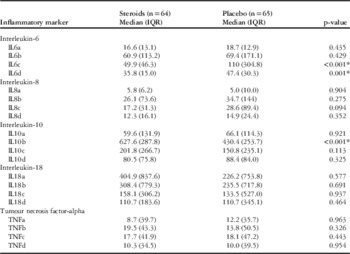
We determined the effect of steroid intervention by comparing serum levels of cytokines in both treatment and placebo groups at the four different time intervals studied. Data were first analysed using the entire treatment and placebo groups without any stratification (Table 2).
Comparison of Interleukin-6, Interleukin-8, Interleukin-18, tumour necrosis factor–alpha, and Interleukin-10 levels between the steroid and placebo groups.

Before induction of anaesthesia (a), At the time of wound closure (b), 6 hours after the second dose (c), and 24 hours after the second dose (d). Data between groups were compared using the Mann–Whitney U test.
*Denotes significant differences between groups, p<0.05
Interleukin-6
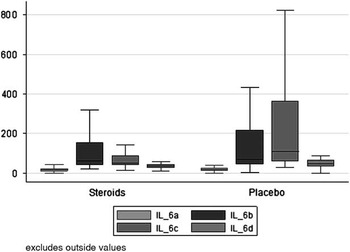
Although Interleukin-6 levels at baseline were similar between both the groups, the median level was significantly lower in the steroid group compared with the placebo group at 6 hours after the second dose (p<0.001), showing more than a two-fold difference between the two groups (Fig 2). The reduced Interleukin-6 level in the steroid group was persistent at 24 hours after the second dose (p=0.001).
Box and whisker plot showing the distribution of Interleukin-6 at four different points in steroids versus placebo groups. Before induction of anaesthesia ( a ), at the time of wound closure ( b ), 6 hours post-operatively after the second dose ( c ), 24 hours of post-operatively after the second dose ( d ).

Interleukin-8
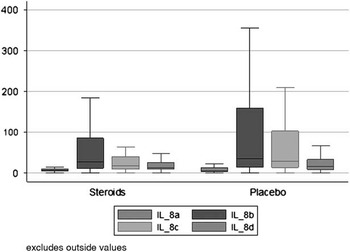
Apart from being similar at induction, the Interleukin-8 levels were reduced at the remaining time intervals in the steroid group compared with the placebo group (Fig 3), but it did not reach significance.
Box and whisker plot showing the distribution of Interleukin-8 at four different points in steroids versus placebo groups. Before induction of anaesthesia ( a ), at the time of wound closure ( b ), 6 hours after the second dose ( c ), 24 hours after the second dose ( d ).

Interleukin-10
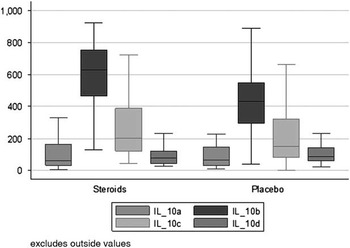
Serum Interleukin-10 levels were found to be similar at induction when compared between treatment and control groups. Subsequently, it was found that dexamethasone caused a significantly higher increase at time of wound closure (p<0.001) compared with the placebo group. The levels returned to normal 24 hours post-operatively (Fig 4).
Box and whisker plot showing the distribution of Interleukin-10 at four different points in steroids versus placebo groups. Before induction of anaesthesia ( a ), At the time of wound closure ( b ), 6 hours after the second dose ( c ), 24 hours after the second dose ( d ).

Interleukin-18
Levels of Interleukin-18 were elevated in the steroid group compared with the placebo group at the first three time intervals, but did not reach significance. The levels returned to normal 24 hours post-operatively.
Tumour necrosis factor-alpha
Tumour necrosis factor-alpha levels remained similar between the two groups at all time intervals, and the difference did not reach significance.
Clinical variables
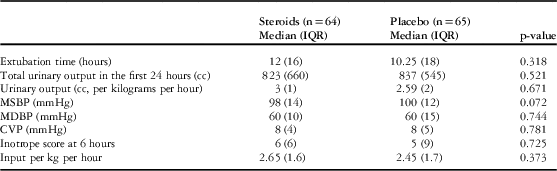
There were no differences in ventilator time, blood pressure, urinary output, and central venous pressure between the two groups. The fluid requirement and inotrope score during the first 24 hours were also similar (Table 3).
Clinical variables.

CVP=central venous pressure; MDBP=mean diastolic blood pressure; MSBP=mean systolic blood pressure
Sub-group analysis
Sub-group analysis 1
A sub-group analysis of patients with cyanotic CHD receiving steroids and placebo was evaluated for any differences in clinical parameters and cytokine levels. The results revealed significant differences in Interleukin-6 at 6 hours after the second dose (p<0.005) and Interleukin-10 at wound closure (p=0.000). There were no differences in any clinical parameters.
The analysis was also carried out for acyanotic CHD patients receiving steroids and placebo. The results revealed significant differences observed in Interleukin-6 at 6 hours after the second dose (p=0.006) and 24 hours after the second dose (p=0.009) as well as Interleukin-10 at wound closure (p=0.011), but no differences in clinical outcomes were observed.
Sub-group analysis 2
A sub-group analysis of patients receiving steroids with cyanotic and acyanotic CHD was evaluated for any differences in clinical parameters and cytokine levels. The results revealed significant differences observed in Interleukin-8 at 6 hours after the second dose (p=0.042) and at 24 hours after the second dose (p=0.017), Interleukin-10 at wound closure (p=0.003), and Interleukin-18 at 24 hours after the second dose (p=0.018). There were no differences in any clinical parameters.
The analysis was also carried out for the placebo group with cyanotic and acyanotic CHD patients with significant differences in Interleukin-8 at induction (p=0.024), 6 hours after the second dose (p=0.049) and 24 hours after the second dose (p=0.028), and Interleukin-10 at 6 hours after the second dose (p=0.048), but no differences in clinical outcomes were observed.
Sub-group analysis 3
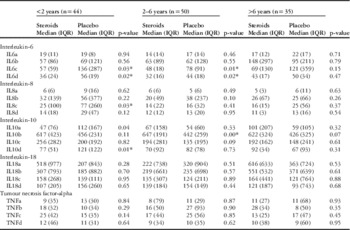
Age-specific comparisons were performed by dividing patients into <2 years (n=44); 2–6 years (n=50); and >6 years (n=35) receiving steroids or placebo (Table 4). The results revealed that in patients <2 years there was a significant difference in Interleukin-6 at 6 hours after the second dose (p=0.03) and 24 hours after the second dose (p=0.02), Interleukin-8 at 6 hours after the second dose (p=0.03), and Interleukin-10 at induction (p=0.04) and 24 hours after the second dose (p=0.01).
Comparison of Interleukin-6, Interleukin-8, Interleukin-18, tumour necrosis factor-alpha, and Interleukin-10 levels between age groups.

Before induction of anaesthesia (a), At the time of wound closure (b), 6 hours after the second dose (c), and 24 hours after the second dose (d). Data between groups were compared using the Mann–Whitney U test
*Denotes significant differences between groups, p<0.05
In patients aged between 2 and 6 years, there was a significant difference in Interleukin-6 at 6 hours after the second dose (p=0.01) and 24 hours after the second dose (p=0.02) as well as in Interleukin-10 at wound closure (p=0.00). There were no differences observed in the age group >6 years for interleukins.
There were no differences in clinical outcomes that were significant in any group.
Discussion
The Steroid and Congenital Heart Repair Inflammatory markers Trial is the largest paediatric randomised controlled trial on the biochemical and clinical influence of corticosteroid usage pre-, intra-, and post-operatively in paediatric open heart surgery. In our prospective, randomised study, we showed that dexamethasone administration leads to quantitative suppression of the systemic inflammatory response following cardiopulmonary bypass; however, clinical parameters including mechanical ventilation, urinary output, blood pressures, central venous pressure, and fluid requirement were not influenced.
The use of steroids with cardiopulmonary bypass was first reported in 1971.Reference Chaney 10 Steroids work at an intra-cellular level, upregulating RNA transcription in the cell nucleus, thereby modulating protein synthesis and molecular pathways. T-lymphocyte lines are the most affected. The steroids are able to rapidly reduce lymphocyte population either by re-distribution or lysis. The systemic response is brought about by a plethora of interleukins and chemokines.
Numerous side-effects are associated with steroid use; however, these are outweighed by the prospective benefits of their use in cardiac surgeries. The general side-effects listed are hyperglycaemia, immunosuppression, due to decreased T-cell function, impaired wound healing, peptic ulcers, suppression of the pituitary–adrenal axis, and other long-term metabolic effects. Although the described side-effects occur with long-term usage of steroids, these have not been reported with the bolus dose in the paediatric population. Moreover, three-dose steroid treatments have not been shown to increase the risk of peptic ulcer disease, pituitary–adrenal suppression, and infection.Reference Ando, Park, Wada and Takahashi 6 , Reference Stayer, Diaz and East 13 , Reference Brunow de Carvalho and Fonseca 16 It has been demonstrated in various studies that the pulse-dose steroids administered during cardiopulmonary bypass are safe.Reference Janeway and Flavell 17
The use of steroids is still controversial after many years of research. The dose, timing, method of administration, and clinical and laboratory parameters used to measure the therapeutic response are the various aspects under debate.Reference Trotter, Mück, Grill, Schirmer, Hannekum and Lang 18 – Reference Iqbal, Sharif, Mehboobali, Yousuf, Khan and Sellke 26 Owing to the fact that very little data are available, the benefits and adverse effects of using steroids in paediatric cardiac surgeries are still unclear.Reference Chaney 10 , Reference Seghaye, Engelhardt and Grabitz 27 – Reference Morton, Hiebert, Lutes and White 29 There are concerns over the use of steroids in premature babies, because of one report showing adverse effects on neuromotor and cognitive function at school age in babies who received a taper of dexamethasone for 28 days.Reference Yeh, Lin and Lin 30
A prospective double-blinded study carried out by BronickiReference Bronicki, Backer, Baden, Mavroudis, Crawford and Green 31 and team showed that administration of dexamethasone pre-operatively caused an attenuated response in Interleukin-6 and tumour necrosis factor-alpha after cardiopulmonary bypass compared with patients receiving normal saline. Schroeder et alReference Schroeder, Pearl, Schwartz, Shanley, Manning and Nelson 20 divided their participants into a group receiving methylprednisone, 30 mg/kg pre-operatively and intra-operative in bypass prime, and another group receiving intra-operative methylprednisone only. Combined pre-operative and intra-operative therapy resulted in reduced myocardial mRNA expression of Interleukin-6 both before and after bypass compared with patients receiving only intra-operative methylprednisone. Combined therapy patients also had lower serum Interleukin-6 levels and increased Interleukin-10 levels at the end of bypass. Although the immunosuppressive findings are in accordance with our findings, both studies also demonstrated substantial clinical improvement in mechanical ventilation, fluid supplementation, alveolar-arterial oxygen gradient, post-operative temperature, and length of ICU stay, which were not observed in our study.
Another prospective study by Lindberg et al used dexamethasone 1 mg/kg and saline placebo; the treated group showed decreased C-reactive protein concentration on the first post-operative day, but the levels of Von Willebrand Factor Antigen release were unaffected. There was no significant difference in days on mechanical ventilation and fluid balance, however, which is similar to our reported results. There was also no difference in oxygenation, leukocyte and platelet counts, and number of days in the ICU between the placebo and dexamethasone groups.Reference Lindberg, Forsell, Jögi and Olsson 21
The best evidence topic has been reported by Amanullah et al, in which six randomised controlled trials were compared for the efficacy of steroid use in paediatric cardiac surgery. It was noted that four out of the 6 randomised controlled trials showed either better clinical outcomes (ICU stay and decreased fluid requirement) or reduced inflammatory markers (Interleukin-6), or both. It was concluded that further trials will be needed to prove the benefits of steroid use.Reference Amanullah, Hasan, Roe and Dunning 32
A meta-analysis by Scrascia et alReference Scrascia, Rotunno and Guida 33 regarding peri-operative steroid administration in paediatric cardiac surgery reported that, although corticosteroid prophylaxis attenuated the inflammatory response, there was a large variability regarding its clinical outcome effects, with reduced prevalence of renal dysfunction but no changes in mechanical ventilation and duration of ICU stay.
Gessler et alReference Gessler, Hohl and Carrel 23 reported no immunosuppressive response in their patients after peri-operative administration of corticosteroids in comparison with a placebo group. They reported that this could have been because of the timing and dose of steroids, and suggested a combined pre- and intra-operative approach to have a greater impact on the inflammatory marker levels.
In lieu of these discrepancies, we evaluated changes in inflammatory markers and clinical parameters by administering a three-pulse steroid treatment – that is, pre-, intra- and post-operatively at 6 hours after surgery. In the present study, the results established the immune-modulatory effects of steroid administration but did not affect clinical parameters. The plasma concentrations of pro-inflammatory cytokines, Interleukin-6, Interleukin-8, and Interleukin-18, were found to be significantly lower at all three time intervals (intra- and post-operative) after the administration of dexamethasone. Tumour necrosis factor-alpha levels remained similar between the two groups.
The level of the anti-inflammatory cytokine, Interleukin-10, was significantly raised in the steroid group compared with the placebo group. Dexamethasone caused a significantly higher rise and faster decline in Interleukin-10 compared with placebo (Table 2). The anti-inflammatory effect was most pronounced immediately after cardiopulmonary bypass cessation, when ischaemia re-perfusion injury might develop.
A sub-group analysis (sub-group analysis 3) comparing the three different age groups shows that the changes in lowered Interleukin-6 and raised Interleukin-10 are consistent in the two younger age groups; however, the analysis also revealed that children <2 years had a more pronounced effect compared with children in the group 2–6 years and >6 years. Based on these findings, one might determine that steroids showed no impact over 6 years of age, given that there was no significance demonstrated in that age category. It would also be fair to say that the major effect of steroids is in the younger age group patients.
The strength of our study was the large sample size and comparable group demographics and intra-operative characteristics. The study was a randomised controlled trial, and blinding was maintained throughout. It achieved a negative result for clinical parameters. We used dexamethasone in comparison with methylprednisolone because it was highly cost effective (US$ 0.14 versus US$ 19.87).
Our limitations include that we evaluated our patients for the first 24 hours and could not look at morbidities such as respiratory and renal dysfunction, evaluated over a longer time period that may have shown differences. We also did not gauge the cardio-protective effects of steroids.
Conclusion
As the only trial of a three-pulse steroid regime in paediatric cardiac surgery, dexamethasone caused quantitative suppression of the systemic inflammatory response following cardiopulmonary bypass. Although its clinical effect could not be established, there were no adverse outcomes. The study, therefore, adds to the available evidence supporting the use of steroids to be considered as possible standard practice in younger children undergoing open heart surgeries.
Acknowledgements
The authors are grateful to Dr. Romina Hassan for her expertise, Muniba Islam and Firdaus Shahid from the Department of Pathology and Microbiology, Aga Khan University, for their technical assistance.
The study protocol was designed by the academic authors in collaboration with the Departmental Research Committee (DRC).
Financial Support
The SCHRIM trial was funded by the University Research Council Grant, The Aga Khan University (Grant number URC-0911024SUR).
Conflicts of Interest
None.
Ethical Standards
The authors assert that all procedures contributing to this work comply with the ethical standards of the relevant national guidelines on human experimentation (approved by the Ethical Review Committee, The Aga Khan University) and with the Helsinki Declaration of 1975, as revised in 2008, and has been approved by the institutional committees (Ethical Review Board).