Introduction
In insects, seasonality has resulted in the evolution of species toward strategies such as dormancy (escape in time) and migration (escape in space) that allow individuals to get through an unfavorable season (Danks, Reference Danks2007). Two dormancy strategies exist: quiescence, which is an immediate developmental arrest in response to limiting environmental factors; and diapause, which is a developmental arrest scheduled in advance of the visible developmental arrest (Danks, Reference Danks1987; Denlinger, Reference Denlinger2002). Diapause can be divided into three phases: pre-diapause, diapause and post-diapause (Kostal, Reference Kostal2006). The pre-diapause phase corresponds to the reception of signals that announce seasonal changes by insects in a susceptible developmental stage. These seasonal cues usually correspond to reliable signals for long-term prediction of environmental changes such as changes in photoperiod (Lehmann et al., Reference Lehmann, Lyytinen, Sinisalo and Lindstrom2012), temperature (Shintani et al., Reference Shintani, Hirose and Terao2011), food quality (Liu et al., Reference Liu, Gong, Li and Wei2010) or a combination of these signals (He et al., Reference He, Xian, Huang, Liu and Xue2009). The pre-diapause phase usually terminates when insects have stored reserves and have found a sheltered place. Insects then enter the diapause phase stricto sensu during their responsive stage. A period of diapause maturation occurs during this phase and stops insect development even when the environmental conditions are favorable. Nevertheless, physiological changes occur during this phase in response to environmental stimuli and internal cues (Ragland et al., Reference Ragland, Egan, Feder, Berlocher and Hahn2011). Environmental factors can modify the duration of this phase (Xiao et al., Reference Xiao, Mou, Zhu and Xue2010; Terao et al., Reference Terao, Hirose and Shintani2012). Finally, after the diapause maturation period, insects are ready to continue their development as soon as the conditions become favorable once again (Jiang et al., Reference Jiang, Huang, Luo, Liu and Zhang2010). During this post-diapause phase, insects are in a state similar to quiescence.
Diapause allows insects to survive during an unfavorable period of time, but also synchronizes reproduction and enables effective resource utilization (Tauber et al., Reference Tauber, Tauber and Masaki1986; Danks, Reference Danks1987). The synchronization with host plant phenology is a critical mechanism for phytophagous insects because it determines the quality and the quantity of available food resources (Yukawa, Reference Yukawa2000). In insects developing in temperate climates, diapause allows insect development to synchronize with the appearance of new plant organs after winter, and its completion often requires exposure to low temperatures (Roux & Roques, Reference Roux and Roques1997). In addition, monophagous insects associated with plants with mast flowering, i.e., flowering that is synchronous among individuals of a population with a large interannual variability in flowering intensity (Kelly, Reference Kelly1994), often develop prolonged diapause (i.e., lasting for 1 or more years) (Hanski, Reference Hanski1988; Soula & Menu, Reference Soula and Menu2005) in response to this temporal variability in resource availability (Satake & Bjornstad, Reference Satake and Bjornstad2004). Thus, a large part of the insect species that develop in the cones and seeds of conifers show such a behavior, in which the percentage of larvae entering prolonged diapause is inversely related to the change in resource magnitude from 1 year to the next (Turgeon et al., Reference Turgeon, Roques and De Groot1994; Auger & Roques, Reference Auger-Rozenberg and Roques2012). Similarly, a variable proportion of individuals in each generation of Eucalyptodiplosis chionochloae (Diptera: Cecidomyiidae), a midge that feeds on developing seeds in the inflorescences of tussocks (Chionochloa spp.), which are mast flowering grasses (Kelly et al., Reference Kelly, Turnbull, Pharis and Sarfati2008), exhibit prolonged diapause (Kolesik et al., Reference Kolesik, Sarfati, Brockerhoff and Kelly2007). Such within-generation variability in life-cycle duration may represent bet-hedging in order to decrease the risks due to unpredictable catastrophic events (Soula & Menu, Reference Soula and Menu2005).
Cecidomyiidae, commonly referred to as gall midges, is one of the largest families of nematocerous Diptera. The life cycle of Cecidomyiidae is closely associated with the phenology of their host plant, and gall midges have several adaptive synchronization strategies, including diapause (Yukawa, Reference Yukawa2000; Uechi & Yukawa, Reference Uechi, Yukawa, Ozaki, Yukawa, Ohgushi and Price2006). Synchronization has a critical meaning for adult cecidomyiids whose life span generally lasts for 1 to a few days (Yukawa, Reference Yukawa2000).
The mango blossom gall midge, Procontarinia mangiferae (Felt) (=Erosomyia mangiferae Felt) is a worldwide invasive monophagous mango pest, presumably native to India (Gagné, 2010). It is the only Procontarinia species able to feed on different organs of the mango tree: inflorescences and young leaves (Raman, Reference Raman2012). The final instar larvae leave the mango organ, fall to the ground and bury themselves in the soil. Adult gall midges emerge from pupae in the soil and induce serious outbreaks during mango flowering (Prasad, Reference Prasad1971; Vincenot & Normand, Reference Vincenot and Normand2009). The life cycle lasts between 14 and 25 days under natural conditions for invading populations in Iran (Pezhman & Askari, Reference Pezhman and Askari2004). There is little available information on the diapause mechanisms developed by P. mangiferae. In native tropical India, larvae enter into diapause at the end of the flowering period, but the biotic or abiotic conditions that induce diapause are unknown (Prasad & Grover, Reference Prasad and Grover1974). In subtropical Reunion Island, invading populations of P. mangiferae are observed all-year round (Amouroux et al., Reference Amouroux, Normand, Nibouche and Delatte2013) and the possible existence of dormancy (diapause or quiescence) in a subtropical climate such as on Reunion Island has never been documented. On Reunion Island, mango trees flower during the cool and dry season (monthly mean temperature of between 20 and 22 °C), from July to October, and the harvest extends from November to March (monthly mean temperature of between 24 and 26 °C; figs 1 and 2). Vegetative growth begins slowly with flowering, continues during fruit growth and flushes after harvest during the hot and rainy season, until May. About half of the vegetative growth occurs after harvest. A resting period, i.e., without emergence of new leaves or inflorescences, then continues for about 2 months (May and June) before the next flowering season.
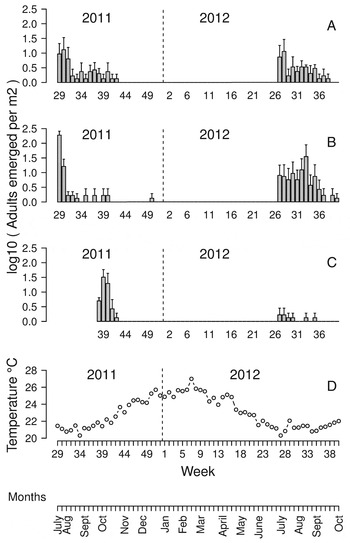
Log10-transformed weekly number of adults emerged (mean±SD) per square meter of soil below mango trees from July 2011 to October 2012 and caught with an emergence trap. Traps were installed under the trees at different dates and phenological stages: (A) beginning of the flowering period (week 29) under trees without recent growth or flowering activity; (B) beginning of the flowering period (week 29) under flowering trees with recent gall midge contamination; (C) end of the flowering period (week 38) under flowering trees with recent gall midge contamination. The mean weekly air temperature during the experiment is represented on graph D.

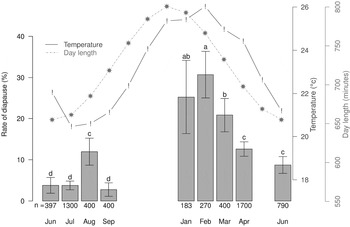
Monthly incidence (mean±SD) of diapause of P. mangiferae at 20 °C and LD 12:12 from June 2011 to June 2012. The dotted line indicates the mean monthly day length and the solid line indicates the mean monthly air temperature. Monthly incidences of diapause with the same letter are not significantly different (pairwise Fisher's exact tests, P<0.05). n: number of larvae sampled.

In this study, we conducted experiments under natural and controlled conditions on Reunion Island in order to (i) demonstrate the occurrence of diapause and quantify its duration, (ii) assess possible variations in the incidence of diapause induction throughout the year, (iii) determine the effects of temperature on diapause duration and (iv) attempt to link the diapause of P. mangiferae with the flowering phenology of mango trees and the climate observed on Reunion Island
Materials and methods
Dynamics of adult emergence under natural conditions
In order to investigate the existence of diapause and to determine its duration in natural conditions, we conducted an experiment in a commercial orchard planted with the ‘Cogshall’ mango cultivar, located along the dry west coast of Reunion Island (Saint-Paul, Lycée Agricole, 20°58′S, 55°18′E, 130 m a.s.l.). Air temperatures were recorded by an automatic weather station located 200 m from the orchard. Modified soil emergence traps designed by Kolesik et al. (Reference Kolesik, Rice, Bellis and Wirthensohn2009) were used to record the emergence of adults from the soil (Supplementary data 1). Each trap was covered by a fine mesh textile fabric and protected a 1-m2 soil area from any possible contamination by larvae falling from mango trees above. Three sets of three emergence traps each were successively installed under nine trees to account for different patterns of soil contamination by larvae. The first set, hereafter referred to as set A, was installed on the 11th of July 2011, at the beginning of the flowering period. The traps were installed under mango trees bearing no inflorescences or young leaves, i.e., organs attacked by gall midges, for at least 1 month. This ensured that the soil under these traps did not contain recently fallen larvae but only larvae in diapause, since non-diapausing larvae have been shown to emerge as adults within the 8 days following their drop to the ground under outdoor conditions (Pezhman & Askari, Reference Pezhman and Askari2004). The second set, hereafter referred to as set B, was installed on the 11th of July 2011 under mango trees bearing inflorescences in full bloom and recently damaged by P. mangiferae. The last set, hereafter referred to as set C, was installed on the 15th of September 2011, at the end of the flowering period, under mango trees bearing inflorescences recently damaged by P. mangiferae. The soil under traps B and C was assumed to contain recently fallen larvae, at the beginning and at the end of the flowering period, respectively, and, possibly, larvae in diapause from older contaminations. Emerging adults were collected and counted weekly over 15 months, from July 2011 to September 2012, using a collecting bottle filled with water and placed at the top of each trap.
Seasonal changes in the diapause incidence under natural conditions
In order to assess the diapause incidence during winter and summer, last instar larvae were collected at nine different periods from June 2011 to June 2012 in a commercial mango orchard planted with the ‘José’ mango cultivar, located along the dry west coast of Reunion Island (Saint-Gilles, 21°02′33″S, 55°13′45″E, 65 m a.s.l.). Air temperatures were recorded by an automatic weather station located approximately 2 km from the orchard. Tarpaulins of approximately 1 m2 were used as traps for larvae falling from mango organs at phenological stages susceptible to P. mangiferae, i.e., inflorescences or young leaves depending on the mango resources available in the orchard. Traps were placed at the end of the afternoon. Larvae were collected under one to eight trees, depending on the mango tree growth each month. Larvae were collected early the following morning. Each month, larvae were collected during one to four successive days in order to obtain a sufficient number of larvae, with a minimum of 180. Larvae collected during a single day from several trees were pooled and transported to the laboratory.
In the laboratory, between 100 and 250 living larvae were placed in a 0.5-liters plastic emergence box (BioQuip® mosquito breeder, USA) filled with 150 g of sterile sand, sieved at 0.8 mm and humidified at 5% (wt/wt) with distilled water. Sand humidity was adjusted every 2 weeks by weighing the emergence boxes and adding distilled water when necessary. The emergence boxes consisted of two clear plastic containers separated by an upside-down funnel-shaped pipe (Supplementary data 2). Ventilation was provided by an air vent covered with wire mesh on the top container. The sand and the midge larvae were placed in the lower container. After emergence, the adults flew up to the top container where they were collected and counted. Experiments were conducted in environmental chambers (Luminincube II, Analis, Belgium; MLR-350, Sanyo, Japan) maintained at a constant temperature of 20±1 °C and under a LD 12:12 photoperiod. These environmental chambers were also used for the two other laboratory studies (see below).
At 20 °C, P. mangiferae larvae completed their development in 7–11 days (8.4±1.1 days), and no emergence was observed between 14 and 20 days (Supplementary data 3). Consequently, we assumed that midges whose pupal instar lasted more than 21 days were in diapause. During the first 3 weeks, corresponding to emergences of non-diapausing individuals, adult emergences were recorded weekly. The number of larvae in diapause was evaluated by sieving the sand at 21 days; living larvae at 21 days were considered as diapausing. The monthly diapause incidence was calculated as the number of living larvae at 21 days divided by the number of living larvae initially placed in the emergence boxes. Some larvae were parasitized by either two species of Plastygastridae or one species of Ptermalidae. The number of parasitized larvae (measured by the number of emerged parasitoids) was excluded from the calculation of the diapause incidence.
Diapause duration under constant temperatures
In order to compare the effect of two constant temperatures, 20 and 26 °C, on the diapause duration of larvae according to the season of collection, larvae were collected in winter and summer. These temperatures corresponded to the weekly mean soil temperature at a depth of 3 cm below a mango canopy, in winter and in summer, respectively (Supplementary data 4). At the Saint-Gilles orchard, 2500 larvae were collected from inflorescences over 4 days in winter (August 2011) as described above. Larvae collected over the same day from several trees were pooled before being placed in emergence boxes. Ten emergence boxes were set up with 250 larvae in each. Five emergence boxes were placed at 20 °C and five at 26 °C. A total of 1080 larvae were similarly collected from young leaves in summer (March 2012). Eleven emergence boxes were set up with 100 larvae in each (except one with 80 larvae). Five emergence boxes were placed at 20 °C and six at 26 °C. The photoperiod was set to LD 12:12. For larvae collected in summer 2012, the number of emerged adults was recorded weekly over 22 weeks. At week 22, the sand was sieved to find larvae that were still in diapause. For larvae collected in winter 2011, the number of emerging adults was recorded weekly over 48 weeks. At week 48, the sand was sieved to find larvae that could still remain in diapause. For analysis of winter 2011 data, we considered that the number of diapausing individuals at week 22 was the sum of the number of adults emerged as of week 22 and of the number of larvae in diapause at week 48. This approximation, which neglected the mortality of diapausing larvae between weeks 22 and 48, was used to allow comparison between summer and winter experiments and with the next experiment described below.
Effect of temperature decrease on diapause duration
To determine whether the temperature decrease at the beginning of winter triggered the post-diapause emergence, a laboratory study was carried out to assess the effect of a temperature decrease, from 26 to 20 °C, on post-diapause emergence of larvae collected in winter or in summer. Larvae were collected simultaneously with the larvae used in the previous experiment at constant temperature.
A total of 2500 larvae were collected from inflorescences over 4 days in winter (August 2011) as described above. Larvae collected over the same day from several trees were pooled before being placed in emergence boxes. Ten emergence boxes were set up with 250 larvae in each and stored at 26 °C. After 6 weeks at 26 °C, five emergence boxes were transferred to 20 °C. The remaining five emergence boxes were transferred to 20 °C after 9 weeks at 26 °C. In parallel, 1100 larvae were collected from leaves over 4 days in summer (March 2012) as described above. Larvae collected over the same day from several trees were pooled before being placed in emergence boxes. Eleven emergence boxes were set up with 100 larvae in each and stored at 26 °C. After 9 weeks at 26 °C, five emergence boxes were transferred to 20 °C. The remaining five emergence boxes were transferred to 20 °C after 13 weeks at 26 °C. The number of emerged adults was recorded weekly over 22 weeks. Twenty-two weeks after the beginning of the experiment, the sand was sieved to check the presence of diapausing larvae. Emergences of larvae from the first experiment at a constant temperature of 26 °C were used as a control.
Statistical analysis
To assess the seasonal variation of diapause incidences, data from the emergence boxes were summed for each month. Diapause incidences were compared between months using pairwise Fisher's exact tests. The significance of the tests was assessed using a 5% False Discovery Rate (Benjamini & Hochberg, Reference Benjamini and Hochberg1995) to control the experiment-wise Type-I error.
Because we stopped the experiments aimed at testing the effect of the temperature regime on the emergence of diapausing individuals after 22 weeks, data were right-censored. As a result, the diapause duration of larvae still in diapause 22 weeks after the beginning of the experiment was unknown. Analyzes for right-censored data were performed with a parametric survival regression model that was fitted with an exponential distribution. The effect of the temperature regime on diapause duration was tested using a Wald χ2 statistic. For the last experiment that included a temperature decrease, the restricted mean was calculated and the comparisons performed only on individuals that emerged between the week of temperature transfer and week 22. Restricted means were calculated by setting the duration of diapause to 22 weeks for individuals still in diapause at week 22. Analyzes were conducted using R software, version 2.15.2 (R Development Core Team, 2012) and the ‘car’ and ‘survival’ libraries.
Results
Dynamics of adult emergence under natural conditions
Under natural conditions, adult emergence from the soil was observed up to 60 weeks after trap installation (fig. 1A, B), demonstrating the existence of diapause. In the traps of set A (fig. 1A), adults that emerged in winter 2012 came from larvae that were in the soil for at least 50 weeks, i.e., before trap installation in July 2011. At the beginning of the 2012 winter flowering season, adult emergences in the three trap sets (A, B, C) were synchronized at week 27. The mean air temperature of week 27 was 20.9 °C, the lowest weekly temperature recorded in 2012 (fig. 1D). The emergence of diapausing individuals was never observed during a period when mean air temperature was above 22.0 °C, i.e., from week 43 in 2011 to week 26 in 2012, with the exception of one single adult that emerged in week 50 in 2011 (fig. 1B).
Seasonal changes in the diapause incidence under natural conditions
Diapause incidences observed from June 2011 to June 2012 varied significantly (χ2=297.95, df=8, P<0.001) between months and ranged from 3 to 31% (fig. 2). The diapause incidence ranged from 21 to 31% from January to March and was significantly higher than during the other months (fig. 2). This period corresponded to the highest temperature (monthly mean air temperature above 24 °C) and day length above 12 h (fig. 2). The lowest diapause incidences were observed in winter from June to September.
Diapause duration under constant temperature
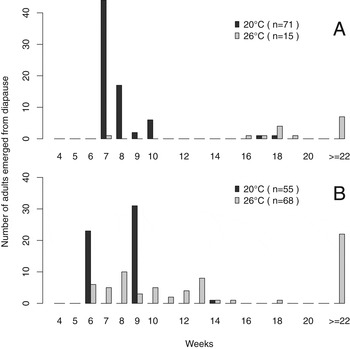
Among 2500 larvae collected in winter, 75.4% emerged during the first 3 weeks (non-diapausing larvae), 1.5% were parasitized, 19.7% were not found again (considered as dead) and 3.4% were in diapause. After 3 weeks, 71 and 15 adults emerged from diapause at 20 and 26 °C, respectively (fig. 3A). Duration of diapause at 20 °C (restricted mean±SEM: 6.9±0.2 weeks) was significantly shorter (χ2=28.5, df=1, P<0.001) than the duration of diapause at 26 °C (restricted mean: 18.0±1.0 weeks).
Number of adults emerged weekly from larvae in diapause at a constant temperature of 20 °C (black) and 26 °C (gray) for larvae collected in winter 2011 on inflorescences (A) and for larvae collected in summer 2012 on young leaves (B). n: number of individuals in diapause (emerged or found in the sand at week 22). In both seasons, mean duration of diapause was significantly shorter at 20 °C than at 26 °C (P<0.001).

Among 1080 larvae collected in summer, 73.2% emerged during the first 3 weeks (non-diapausing larvae), 1.8% were parasitized, 13.6% were not found again (considered as dead) and 11.4% were in diapause. After 3 weeks, 55 and 68 adults emerged from diapause at 20 and 26 °C, respectively (fig. 3B). The duration of diapause at 20 °C (restricted mean: 6.8±0.2 weeks) was significantly shorter (χ2=37.9, df=1, P<0.001) than the duration of diapause at 26 °C (restricted mean: 10.7±0.4 weeks).
The duration of diapause at 20 °C in larvae collected during winter was not significantly different (χ2<0.001, df=1, P=0.99) from the duration of diapause in larvae collected during summer. On the contrary, the duration of diapause at 26 °C for larvae collected in winter was significantly longer (χ2=7.4, df=1, P=0.006) than the duration of diapause for larvae collected in summer.
Effect of temperature decrease on diapause duration
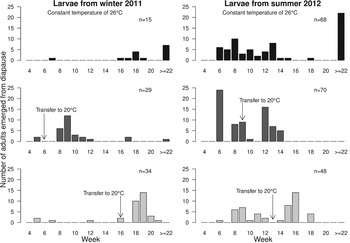
In all experiments, the transfer of larvae from 26 to 20 °C decreased the duration of diapause. A grouped emergence of adults from larvae in diapause occurred 2–3 weeks after the transfer from 26 to 20 °C (fig. 4).
Number of adults that emerged weekly from larvae in diapause for larvae collected in winter 2011 on inflorescences (left column) and for larvae collected in summer 2012 on young leaves (right column): first line at a constant temperature of 26 °C, second and third lines with transfer from 26 to 20 °C after 6 and 16 weeks, respectively. n: number of individuals in diapause (emerged and found in the sand at week 22). Mean duration of diapause was significantly shorter for individuals transferred from 26 to 20 °C than for those maintained at 26 °C (see P-values in the text).

Among 2500 larvae collected in winter, 77.0% emerged during the first 3 weeks (non-diapausing larvae), 2.3% were parasitized, 18.0% were not found again (considered as dead) and 2.7% were in diapause. Among the larvae collected in winter and maintained for 6 weeks at 26 °C, the time to emerge was significantly shorter (χ2=13.2, df=1, P<0.001) for the individuals subsequently transferred to 20 °C (restricted mean: 3.3±0.6 weeks) than for these maintained at 26 °C (restricted mean: 13.4±0.7 weeks). After 16 weeks at 26 °C, the time to emerge was significantly shorter (χ2=5.1, df=1, P=0.02) for individuals transferred to 20 °C (restricted mean, 1.8±0.1 weeks) than for larvae maintained at 26 °C (restricted mean, 4.0±0.7 weeks).
Among 1100 larvae collected in summer, 71.2% emerged during the first 3 weeks (non-diapausing larvae), 1.8% were parasitized, 16.3% were not found again (considered as dead) and 10.7% were in diapause. Among the larvae collected in summer and maintained for 9 weeks at 26 °C, the time to emerge was significantly shorter (χ2=23.3, df=1, P<0.001) for the individuals transferred to 20 °C (restricted mean: 2.6±0.1 weeks) than for these maintained at 26 °C (restricted mean: 8.4±0.8 weeks). After 13 weeks at 26 °C, the time to emerge was significantly shorter (χ2=39.1, df=1, P<0.001) for individuals transferred to 20 °C (restricted mean, 2.0±0.1 weeks) than for individuals maintained at 26 °C (restricted mean: 8.5±0.5 weeks).
Discussion
In this study, we demonstrated the occurrence, regardless of the season, of a facultative diapause that affects a variable part of the populations of P. mangiferae in the field, and we showed that the duration of this diapause may be longer than 1 year. The highest incidences of diapause induction were observed during summer for larvae collected from leaves. In controlled conditions, we showed that diapause duration was longer at 26 °C than at 20 °C. At 26 °C, the duration of diapause changed with the season of larva collection. A temperature decrease from 26 to 20 °C triggered the emergence of diapausing individuals.
Diapause is widespread among tropical species (Denlinger, Reference Denlinger1986), and diapause of P. mangiferae, whose dormant phase overlaps with the warmest part of the year, could be considered equivalent to a summer diapause under a temperate climate (Masaki, Reference Masaki1980). In tropical areas of India, Prasad (Reference Prasad1971) mentioned that the larval diapause of P. mangiferae was initiated at the end of the flowering period season in late March. Other Cecidomyiidae have developed diapause both in temperate zones, e.g., the Hessian fly, Mayetiola destructor (Say) (Benoit et al., Reference Benoit, Morton, Cambron, Patrick and Schemerhorn2010), and in the tropics, e.g., the sorghum grain midge Contarinia sorghicola (Coquillett) (Baxendale & Teetes, Reference Baxendale and Teetes1983; Denlinger, Reference Denlinger1986).
Diapause of P. mangiferae was induced in all seasons but at an incidence always lower than 30%. This facultative diapause is congruent with the presence of populations all year round in orchards, as observed by Amouroux et al. (Reference Amouroux, Normand, Nibouche and Delatte2013). Similarly, permanent populations of P. mangiferae were observed in the equatorial area of India (Prasad, Reference Prasad1971). The prerequisite to maintaining such permanent populations is the availability of resources all year round. In Jamaica, the tropical gall midge Asphondylia boerhaaviae (Mohn) can produce up to 17 generations per year by shifting on three host plants (Freeman & Geoghagen, Reference Freeman and Geoghagen1989). On Reunion Island, mango flowering occurs during the cool and dry season from July to October, and the main vegetative growth occurs after the harvest during the hot and rainy season, from January to May (Dambreville et al., Reference Dambreville, Lauri, Trottier, Guédon and Normand2013). The mango tree is characterized by within- and between-trees phenological asynchronisms, i.e., new inflorescences or new vegetative growth units do not appear synchronously on a tree or between trees in an orchard (Dambreville et al., Reference Dambreville, Lauri, Trottier, Guédon and Normand2013), leading to the more or less considerable presence of resources in an orchard for about 10 months of the year, with the exception of the vegetative rest before the flowering season. Exploitable mango resources are then almost continuously available for P. mangiferae, due to its peculiar ability to feed on both inflorescences and young leaves (Amouroux et al., Reference Amouroux, Normand, Nibouche and Delatte2013), allowing permanent populations in the orchards.
The highest diapause incidences were observed during summer in larvae collected from leaves, whereas the lowest ones were observed in these collected during winter from inflorescences. This variation in the diapause incidence could be due to abiotic cues (photoperiod and/or temperature) and/or biotic cues (nature and physiology of the mango organs hosting the larvae). Although variations in temperature and photoperiod are more limited in the tropics than in temperate areas, these cues have been shown to control the incidence of diapause induction in a number of tropical insects from several orders (Denlinger, Reference Denlinger1986). The highest diapause incidence was observed in summer when the weekly mean air temperature was the highest of the year, while the day length was longer than 12 h. The facultative aspect of diapause on Reunion differs from the observation of Prasad (Reference Prasad1971), who reported that in subtropical conditions of India (Allahabad), all larvae entered into diapause at the end of the flowering season in late May. The amplitude of day length variation is similar in Allahabad (latitude: 25°N) and on Reunion Island (latitude: 21°S) and can therefore not account for the difference observed in the incidence of diapause induction between the two locations. One explanation could reside in the temperatures, which are cooler on Reunion Island. In Allahabad, the monthly mean of maximum temperatures is above 41 °C in May (Hong Kong Observatory, 2012) when the whole population of P. mangiferae enters into diapause, while on Reunion Island, the monthly mean of maximum temperatures never exceeds 32 °C. The monthly variation in the incidence of diapause on Reunion Island could also be related to nutritional cues. The nutritional quality of the larval diet can affect diapause induction since a low-quality diet would tend to favor this induction (Hunter & McNeil, Reference Hunter and McNeil1997). For example, in Byasa alcinous Klug (Lepidoptera: Papilionidae), the incidence of pupal diapause was greater in individuals that fed on tough leaves than on soft leaves (Takagi & Miyashita, Reference Takagi and Miyashita2008). Nevertheless, in the experiment carried out under natural conditions, we could not separate the effects of season and mango organs. Further studies must attempt to uncouple the environmental factors and the nature of the available resources, especially by comparing the diapause patterns in midge larvae collected from leaves and inflorescences on the same trees during the same period.
Under laboratory conditions, the season of diapause induction (summer vs. winter) modified the pattern of emergence at a constant temperature of 26 °C. This suggests that different mechanisms of diapause could be induced in summer and winter. Such differences in gene expression and physiological changes were observed between summer and winter diapause of the onion maggot, Delia antiqua (Meigen) (Diptera: Anthomyiidae) (Hao et al., Reference Hao, Li, He, Si, Ishikawa and Chen2012). Some species can also exhibit several mechanisms of diapause induction, e.g., Helicoverpa armigera (Hübner) (Lepidoptera: Noctuidae), whose diapause can be induced either by a combination of low temperature and short day length (Mironidis & Savopoulou-Soultani, Reference Mironidis and Savopoulou-Soultani2012) or by high temperature alone (Nibouche, Reference Nibouche1998; Liu et al., Reference Liu, Gong, Wu, Sun and Li2006). Further studies under controlled conditions are needed to identify the biotic and abiotic cues involved in the diapause induction and the diapause maturation of P. mangiferae.
Under natural conditions, post-diapause emergence coincided with the lowest weekly mean air temperature (20.9 °C) in winter 2012, regardless of the season of diapause induction. Laboratory experiments confirmed that low temperatures synchronize emergence. A constant temperature of 26 °C delayed emergence of P. mangiferae compared to a continuous temperature of 20 °C, whereas a decrease from 26 to 20 °C triggered the grouped emergence of adults, regardless of the date of diapause induction. These mechanisms ensure the synchronization of the emergence of diapausing individuals with the appearance of mango inflorescences, which is also induced by cool winter temperatures (Nuñez-Elisea & Davenport, Reference Nuñez-Elisea and Davenport1994).
Under natural conditions, adults emerged from the soil up to 60 weeks after trap installation. Some P. mangiferae individuals did not emerge during winter 2011 but only during winter 2012. These individuals emerged when they were exposed to conditions favorable for diapause termination for the second time. These individuals were on prolonged diapause, i.e., a diapause that lasts 1 year or more (Danks, Reference Danks1987; Hanski, Reference Hanski1988; Soula & Menu, Reference Soula and Menu2005). Prolonged diapause is characteristic of many phytophagous insects that have wide fluctuations of abundance with periodic outbreaks (Saulich, Reference Saulich2010) and commonly occurs for insects in unpredictably changing environments or with unpredictable resources (Higaki & Toyama, Reference Higaki and Toyama2012). Prolonged diapause is observed in a number of gall midges that specialize in seeds or inflorescences of mast tree species, such as the Douglas-fir seed midge, Contarinia oregonensis Foote (Diptera: Cecidomyiidae) (Hedlin, Reference Hedlin1964), and the spruce cone midge, Plemeliella abietina Seitner and Kaltenbachiola strobi Winn. (Annila, Reference Annila1981). Similarly, mango inflorescences are not regular resources between years. However, unlike the gall midges associated with cones and seeds, which are monophagous and strictly dependent on the presence of the cone resource, the mango midge is capable of exploiting both inflorescences and foliage. Thus, prolonged diapause of P. mangiferae could be an adaptation to the alternate bearing habit of the mango tree, as well as a bet-hedging strategy that makes it possible to decrease the risks due to unpredictable catastrophic events (Soula & Menu, Reference Soula and Menu2005). Further experiments should be conducted on the prolonged diapause of P. mangiferae to determine the relationship between the duration of prolonged diapause and the nature and the availability of resources (inflorescences and young leaves) among years.
The present study confirmed the existence of diapause in P. mangiferae and underlined the existence of prolonged diapause and the mechanisms involved in diapause termination. However, the biotic and abiotic cues involved in diapause induction are still to be studied under controlled conditions. The diapause of P. mangiferae appeared to be well adapted to the climate and the phenological cycle of mango trees on Reunion Island. This model is particularly well suited to study the ecological role and the mechanisms that control the facultative and the prolonged diapause of a gall midge associated with trees that offer spatially and temporally heterogeneous resources.
The supplementary materials for this article can be found at http://www.journals.cambridge.org/BER
Acknowledgements
The authors would like to thank Mr Law-Yat for allowing us to visit frequently his orchards and collect larvae. We are also grateful to M. Grondin, C. Bourgart and E. Bricca for their technical assistance in the laboratory. This work was funded by the European Agricultural Fund for Rural Development (EAFRD, Bilan de Santé de la PAC, No. 11111D974000019) and CIRAD.