Introduction
Modern migration patterns have accelerated global cultural diversity (Williamson and Harrison, Reference Williamson and Harrison2010). In Australia, people born in mainland China, Hong Kong, and Taiwan comprise the largest non-English-speaking migrant population, with most speaking Mandarin and/or Cantonese at home (Australian Bureau of Statistics, 2017). As the number of Chinese migrants has grown in Australia, so too has the incidence of cancer in this population (Federation of Ethnic Communities’ Councils of Australia, 2010).
Culture can significantly influence individuals’ attitudes and beliefs regarding disease and treatment, as well as their health-related behaviors (Dayer-Berenson, Reference Dayer-Berenson2014; McFarland and Wehbe-Alamah, Reference McFarland, Wehbe-Alamah, McFarland and Wehbe-Alamah2015). Understanding people's culture-related health perspectives and needs is crucial for providing culturally congruent care that is respectful and effective (Dayer-Berenson, Reference Dayer-Berenson2014). However, Chinese migrants with cancer often experience suboptimal care, whose responses to psychological and physical symptoms vary and are largely determined by their cultural values and norms, which are often misunderstood by health professionals from different cultures (Dein, Reference Dein2005).
Pain is experienced by most people with cancer at some stage during their illness journey, either from the cancer itself or its treatment (Yarbro et al., Reference Yarbro, Frogge and Goodman2004; American Cancer Sociation, 2019). Pharmacological pain management, using self-reported numerical rating scales assessing cancer pain and orally administrating right doses of weak analgesics (paracetamol and non-steroidal anti-inflammatory drugs) for mild pain and opioids for moderate-severe pain around-the-clock (World Health Organization, 2015), is recommended as one of the most effective measures in controlling adult cancer pain (Australian Adult Cancer Pain Management Guideline Working Party, 2016).
Despite increasing efforts, persistent cancer pain remains a global health problem in people living with cancer (Van Den Beuken-Van et al., Reference Van Den Beuken-Van, Hochstenbach and Joosten2016). A recent systematic review on English and Chinese literature identified a range of patient-related barriers affecting cancer pain reporting and use of analgesics of Chinese cancer patients in mainland China, Hong Kong, and Taiwan (Xu et al., Reference Xu, Luckett and Wang2018). However, no studies reported Chinese migrants’ cancer pain experiences and cultural factors influencing their pharmacological pain management practices. Since people from diverse cultural groups conceptualize their pain differently which affects their pain management decision-making (Narayan, Reference Narayan2010), this gap in the evidence may limit non-Chinese health professionals’ ability to implement culturally congruent and individualized pain management plans for this population.
The aim of this study was to explore Chinese migrants’ cancer pain experiences and cultural factors influencing their perceptions and responses to cancer pain and its pharmacological management.
This study adopted a convergent mixed-method design including focus groups and a short version of Barrier Questionnaire–Taiwan (S-BQT) (Chou et al., Reference Chou, Rau and Lin2011) and was conducted between May and August 2017. Ethics approval was obtained from the South-Eastern Sydney Local Health District Human Research Ethics Committee (HREC reference no: 16/294) and informed written consent was obtained from all participants.
Leininger's Cultural Care Theory and Semi-Structured Inquiry Guide to assess culture and health (Wehbe-Alamah and McFarland, Reference Wehbe-Alamah, McFarland, McFarland and Wehbe-Alamah2015; McFarland and Wehbe-Alamah, Reference McFarland, Wehbe-Alamah, McFarland and Wehbe-Alamah2015), and Australian Guidelines for Cancer Pain Management in Adults (Australian Adult Cancer Pain Management Guideline Working Party, 2016) were used as a broad guide to develop the focus group question route, data analysis, and report.
Participants, settings, and language
To be eligible, participants had to be: (1) age ≥18 years and born in mainland China, Hong Kong, or Taiwan and currently living in Australia; (2) receiving and/or had received cancer pain treatment from an ambulatory cancer and/or palliative care service during the past 2 years; (3) well enough to take part in a focus group; (4) able to speak Mandarin or Cantonese; and (5) willing and able to give written consent in English, simplified Chinese, or traditional Chinese. We focused on pain experience over the past 2 years in an effort to reduce recall bias.
Purposive sampling and a snowball technique were used for recruitment. Invitations were extended through a cancer care center and two palliative care units of two public hospitals, as well as three Chinese cancer patient support groups run by a Chinese community organization in Sydney, New South Wales (NSW), Australia.
All focus group study materials were developed in English and reviewed by all co-researchers before being translated into Chinese by a bilingual-speaking researcher Xiangfeng Xu and cross-checked by a bilingual-speaking academic. The S-BQT has been validated in Chinese and published in English (Chou et al., Reference Chou, Rau and Lin2011). Participants could choose written study materials in either a simplified Chinese or traditional Chinese version.
Data collection methods
S-BQT
Immediately prior to the focus groups, participants completed a survey containing the S-BQT; a numerical rating scale (NRS) for worst pain intensity over the past 2 years; and closed-ended questions about demographics and pain management approaches. These questions provided additional insights into the participants’ cancer pain reporting and pain management practice.
The nine-item S-BQT was validated (Total Cronbach's alphas = 0.86; two-week test–retest reliability = 0.83) in Chinese cancer patients (Chou et al., Reference Chou, Rau and Lin2011), for which the Barrier Questionnaire was originally developed by western researchers (Wells et al., Reference Wells, Johnson and Wujcik1998). The scores of S-BQT and its subscales are graded as lower (0–1), moderate (2–3), and higher (>3) (Chou et al., Reference Chou, Rau and Lin2011). It may be used as a screening tool at clinics to assess cancer patients’ barriers of taking regular analgesics and/or reporting the presence of pain, which the higher scores indicate the higher barriers (Chou et al., Reference Chou, Rau and Lin2011).
Focus Groups
Focus groups were facilitated by a Mandarin-speaking researcher Xiangfeng Xu or a Cantonese-speaking research assistant using self-developed questioning route and audio-recorded. Field notes were taken by the researcher or research assistants.
Data analysis
Survey data were descriptively analyzed using SPSS 24 software. Focus group data were analyzed thematically using deductive and inductive reasoning methods described by Bazeley (Reference Bazeley2013) and Guest and MacQueen (Reference Guest and MacQueen2008) The transcripts were translated by the researcher Xiangfeng Xu and then cross-checked by two bilingual research assistants. Disagreements about the translation were resolved via discussion.
All translated transcripts were then coded by the researcher Xiangfeng Xu using NVivo 11 software to generate themes and sub-themes, with results checked through two cycles of coding to ensure the consistency and relevance. Then the coding results were reviewed by an Anglo-Australian researcher (TL). Identified themes and sub-themes were discussed within the research team.
Data integration
Upon completion of quantitative and focus group data analysis, findings were presented in a joint-display table to enable meta-inference about whether focus group findings and S-BQT results were confirmed, contradicted, or complemented one another within the context of Leininger's Cultural Care Theory (Leininger, Reference Leininger2002b; Wehbe-Alamah and McFarland, Reference Wehbe-Alamah, McFarland, McFarland and Wehbe-Alamah2015). Guided by the data integration approaches for mix-method studies of Creswell and Plano Clark (Reference Creswell and Plano Clark2018) and Tashakkori et al. (Reference Tashakkori, Johnson and Teddlie2020), initial meta-inference was carried out by the researcher Xiangfeng Xu and then refined after discussed with the research team.
Quantitative result
A total of 24 participants contributed to five focus groups conducted in Mandarin (n = 3) or Cantonese (n = 2). The mean age of participants was 59.4 years (SD ± 9.8). (Refer to Table 1 for other sample characteristics).
Characteristics of participants

Nearly all participants reported having current pain, with three-quarters reporting having had moderate to severe pain (x = 5.58, SD ± 2.62) over the past 2 years on the NRS. Only a third had used opioids to manage their cancer pain. Most preferred to use non-pharmacological pain management strategies, followed by traditional Chinese medicine (TCM) and paracetamol (Refer to Table 2).
Pain management strategies reported by patient participants

The total mean S-BQT score of 24 participants was 3.28 (SD ± 0.89) indicating that they had a higher barrier to using analgesics and/or reporting pain (22). The highest mean score of the S-BQT subscales was “side-effects”, followed by “tolerate” and “disease progress”, and the lowest mean score was “religious fatalism” (Refer to Table 3).
S-BQT scores of participants

*The scores of S-BQT and its subscales are graded as lower (0–1), moderate (2–3) and higher (>3) (Chou et al., Reference Chou, Rau and Lin2011).
Focus group findings
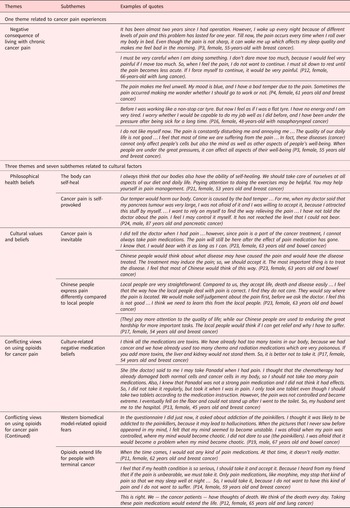
One theme related to participants’ cancer pain experiences that emerged from the data analysis is described below with exemplar quotes displayed in Table 4, together with another three themes relating to cultural factors underpinning their barriers of pharmacological pain management.
Themes, sub-themes, and examples of quotes identified via focus groups

Negative consequence of living with chronic cancer pain
All participants had lived with poorly controlled chronic cancer pain for months or years since their first cancer treatment started. They attributed the uncontrolled pain to the side-effects of their anti-cancer treatment, which had changed their lives forever.
While living with cancer adversely impacted on participants’ well-being, the burden of living with chronic cancer pain lowered their self-esteem and amplified the impact of cancer on their daily life (e.g., decreased mobility, inability to do housework, and poor sleep).
Nearly all participants described how their uncontrolled cancer pain adversely affected their psychological well-being and/or their ability to continue working. For some participants, an inability returning to work and loss of income had a roll-on effect that increased their social distress and sense of vulnerability and further lowered their self-esteem. The multi-dimensional impacts and burden of chronic cancer pain were omnipresent for these participants and negatively impact their quality of life.
Cultural factors influencing pharmacological pain management
Three themes and seven sub-themes that impeded participants to achieve an optimal outcome of pharmacological pain management are identified (Refer to Table 4) and interpreted in conjunction with S-BQT results in the data integration section.
Integration of focus group findings and S-BQT results
Key points extracted from focus group findings and S-BQT results, along with meta-interference regarding the degree of agreement between qualitative and quantitative data, are summarized in Table 5 and discussed as follows:
Integration of the focus group findings and S-BQT results

*The scores of S-BQT and its subscales are graded as lower (0–1), moderate (2–3) and higher (>3) (Chou et al., Reference Chou, Rau and Lin2011).
“Philosophical health beliefs” shape Chinese people's perceptions of cancer pain
Chinese people's philosophical health beliefs may shape their view on cancer pain in two main ways.
“Cancer pain is self-provoked” (Focus groups) and “religious fatalism” (S-BQT)
The lower mean score of “religious fatalism” suggested that participants’ religious beliefs were not a major contributing factor to their resistance to analgesics. However, this is somewhat contradictory to their belief that cancer pain is self-provoked.
Some participants believed that their cancer pain was brought on by their bad temper and unhealthy lifestyle and eating behaviors. They hence deserved getting cancer and having cancer pain and should accept the pain. Acceptance of cancer and its associated pain helped them to relieve their psychological distress and strengthen their ability to cope with their cancer treatment and pain.
The perception of deserving the pain, and a strong desire to control their own pain, influenced the way participants conceptualized their cancer pain experience, leading them to normalize their pain intensity. This was best exemplified by one participant (P24, male, 87-years-old with pancreatic cancer) who reported having a pain score of “0” for 2 years, even though during the focus group he mentioned suffering pain at night.
“The body can self-heal” — an indirect barrier for using analgesics (focus groups)
Participants expressed a belief that the body can heal itself. Adopting a health regimen, such as balanced diet and regular exercise, may promote a self-healing process. The cancer pain would be relieved when their body returns to normal functioning. Their belief of self-healing can lessen their interest in using analgesics and lead to a trend of normalization of pain intensity during a pain assessment.
This sub-theme is not associated with any S-BQT subscale but provides a complementary and extended view on the influences of philosophical health beliefs on Chinese people's pain management practice.
“Cultural values and beliefs” influence Chinese people's response to cancer pain
Participants agreed that cultural values and beliefs influence how Chinese people respond to their cancer pain. Three sub-themes were, respectively, related to S-BQT sub- scales of “fatalism”, “disease progress”, “fear of distracting physicians”, and “a desire to be good”, with different consequences.
“Cancer pain is inevitable” (focus groups) and “fatalism” (S-BQT)
Participants’ higher mean score of “fatalism” reflected their strong belief that “cancer pain is inevitable”, whereby they believed that having cancer pain during their cancer treatment is normal. Since their cancer pain was often triggered by chemotherapy, radiotherapy, and/or other cancer treatment, it seemed impractical to take analgesics for months or years. As a result, they would rather accept the pain and perhaps tell health professionals during a pain assessment that they had no pain.
“Cancer pain is inevitable” (focus groups) and “disease progress” (S-BQT)
Participants’ belief that “cancer pain is inevitable” and the higher mean score of “disease progress” had a contradictory impact on their help-seeking behavior.
Participants suggested that in Chinese culture, survival from cancer is more important than having their pain relieved, but understanding the cause of their cancer pain would help to reduce the level of distress and ease the pain. While the participants were eager to consult health professionals to discover their causes of pain, they often rejected analgesics because they believed that well-managed pain may conceal signs of cancer progressing or recurring.
“Chinese people express pain differently compared to local people” (focus groups) and “fear of distracting physicians” and “a desire to be good” (S-BQT)
Participants perceived that, compared to local people (non-Chinese Australians), Chinese people were less likely to talk about their pain for cultural reasons. For some, this difference was shaped by family traditions and social convictions and was most obvious among older Chinese people who tended to be more reserved and more reluctant to bother others with concerns about their difficulties in life, including pain. The findings were confirmed by participants’ higher mean score of “fear of distracting physicians” and moderate mean score of “a desire to be good”.
Participants also reached a consensus that local people's willingness to openly speak about their cancer pain and taking pain medication freely to control their pain reflected the value they placed on their quality of life. In contrast, both female and male participants highlighted a cultural view that Chinese people, in particular Chinese men, were socially obliged to bear their pain with stoicism rather than complaint.
Participants’ attitudes towards cultural differences did not negatively portray the views of local people. On the contrary, they acknowledged that the culture of asking for help might lead to better cancer pain management and they should learn from the local people.
“Conflicting views on using opioids” at different stages of cancer
Participants suggested that Chinese people hold a range of complex and often conflicting beliefs and views about the use of opioids and other weak analgesics to manage their cancer pain, which would have an impact on their decision of using opioids at different stages of cancer. As revealed in the following three sub-themes and results of S-BQT subscales, these views are nuanced and inextricably linked to both culture and cancer stages, as summarized below.
“Culture-related negative medications beliefs” (focus group) and “side-effects” (S-BQT)
Participants’ extreme resistance to opioids appeared to be associated with their strong “culture-related negative medications beliefs” and is confirmed by the higher scores of “side-effects”.
They suggested that negative medication beliefs are broadly held by Chinese people, with many believing that all medications, including anti-cancer and pain medications, are considered toxic. It was perceived that chemotherapy and other anti-cancer treatments caused an accumulation of toxins in the body. Taking strong analgesics while receiving cancer treatment was perceived to be an extra burden to the body and thus best avoided.
Although weak analgesics were considered less harmful, participants even stopped taking paracetamol to avoid further damage to their bodies during their cancer treatment.
“Western biomedical model-related opioid fears” (focus group) and “side-effects”, “addiction” and “as needed” (S-BQT)
Apart from “culture-related negative medication beliefs”, “western biomedical model-related opioid fears”, such as concerns on addiction, side-effects, and unexpected health implications also led participants to reject or poorly adhere to opioids. There was also a perception that the side-effects of opioids might be amplified during the cancer treatment.
Because of a misconception that taking too much medication could cause dependence and tolerance, they would only take weak analgesics even when they were in severe pain. These barriers to using opioids were confirmed by participants’ higher scores of “side-effects”, “addiction”, and “as needed”.
“Opioids extend life for people with terminal cancer pain” (focus group) and “tolerate” (S-BQT)
Despite these negative medication beliefs and opioid fears, participants stated that they would not hesitate to take these medications if they were at the end of life, due to fear of being touched by severe pain associated with disease progress. Some participants even believed that opioids might act to extend their life by reducing the severe pain. This belief was associated with a higher score of “tolerate”. Since participants perceived that opioids should be saved for severe pain at the end-stage of cancer, they would endure their pain and postpone taking opioids as long as they felt they were able to control their pain.
Discussion
The findings suggest that Chinese migrants living with cancer experienced uncontrolled chronic cancer pain, which has negatively affected their physical and psychosocial well-being. The drivers underpinning their reluctance to report pain and/or resistance to opioids are culture-related and require culturally congruent ways to ensure optimal pain management.
While Chinese migrants’ western biomedical model-related opioid fears are similar to those of people from western or Chinese cultures (Yates et al., Reference Yates, Edwards and Nash2002; Jacobsen et al., Reference Jacobsen, Møldrup and Christrup2009; Oldenmenger et al., Reference Oldenmenger, Smitt and van Dooren2009; Flemming, Reference Flemming2010; Luckett et al., Reference Luckett, Davidson and Green2013; Xu et al., Reference Xu, Luckett and Wang2018), their culture-related negative medication beliefs have deepened this fear. Their beliefs about being poisoned by cancer therapy drugs and the harm of opioids to their bodies may result in their extreme resistance to opioids and poor adherence to weak analgesics, particularly during their cancer treatment.
These culture-related negative medication beliefs are likely rooted in the ancient theory of TCM. Chinese people have an old saying that “a medication has three-point of poison components” (Wang, Reference Wang2018). This saying warns Chinese people about the side-effects of medications and addresses the importance of medication safety. Yet, some Chinese people may be overcautious about medication use if they interpret the side-effects as being toxic (Wang, Reference Wang2018).
Routine pain screening at each clinic visit combined with close monitoring of opioid side-effects may enable early educational interventions (Australian Adult Cancer Pain Management Guideline Working Party, 2016) addressing Chinese migrant cancer patients’ potential negative medication beliefs and cultural values and beliefs in relation to cancer pain, to assist them overcoming barriers of pain reporting and use of opioids when they are receiving cancer treatment.
Health professionals also need to be aware that Chinese migrant cancer patients’ attitudes towards opioids may change over time, especially as their cancer progresses. Being cognisant of the potential for this change in Chinese migrants’ acceptance of opioids is important for health professionals, in that they could adjust the focus of their consultations and interventions accordingly to introduce opioids towards the end of life of these patients.
As well as considering the role of Chinese migrants’ philosophical health beliefs in shaping the barriers to cancer pain reporting and using opioids, health professionals should understand that people's philosophical views can also make positive contributions to their capacity of coping with the difficulties related to their illness (Leininger, Reference Leininger2002a). An acceptance of cancer pain and, at the same time, strong willingness to control pain themselves, were central for participants in the current study to maintain their social identity and psychological well-being. These beliefs may drive them to find other healthy ways of strengthening their body and controlling their pain. For many patients, this means that a health regimen and non-pharmacological management including TCM may be more preferable over opioids for their pain treatment.
This preference is in keeping with the value Chinese people place on harmony, which is a philosophical idea originating from ancient Chinese culture and underpinning TCM (Chen and Yan, Reference Chen and Yan2010; Ip, Reference Ip2014). The strong willingness to self-control pain may reflect cancer patients’ desire to regain a sense of control over their life that has been eroded by both disease and its treatment (Narayan, Reference Narayan2010). Health professionals need to be careful not to undermine such positive contributions when trying to address related barriers. Managing this balance requires nuanced negotiation with each individual to explore the culturally acceptable parameters of behavioral change.
There are a number of methodological limitations to this study. Patients with poor health conditions were not able to participate, and most of the participants were older women with breast cancer recruited via three Chinese cancer support groups in Sydney. Men made up only 2/24 of the sample, especially limiting generalizability to male Chinese migrants with cancer. This is important because previous research with nationalist Chinese people with cancer has found men to be more accepting of pain (Xu et al., Reference Xu, Ou and Xie2019) but women to be more hesitant to take analgesics (Chou et al., Reference Chou, Fang and Sun2018). Indeed, such cultural factors may themselves have been responsible for the low participation rates by men. The findings also may not represent the perspectives of younger Chinese migrants, those living in other parts of Australia or other Western countries, or those who have not been proactive and/or culturally interested enough to join a Chinese cancer support group. Caution is especially needed not to derive any conclusions from the quantitative results alone, since the value of quantitative data in mixed methods studies lies in their integration with the qualitative component rather than in any stand-alone sense (Creswell and Plano Clark, Reference Creswell and Plano Clark2018). Future quantitative research with a large, representative sample is needed to test the generalizability of our findings to the whole population of Chinese migrants with cancer and pain.
Strengths of this study include the fact it was undertaken by a multi-disciplinary group of researchers, which included people with both Chinese and Anglo-Australian cultural backgrounds and associated languages. Inclusion of both emic and etic perspectives is likely to have improved the likelihood that culture-related data were not missed, and added to the richness of interpretation at analysis. At the same time, the similarity in views expressed by participants in the current study with those conducted in other Chinese populations suggests that findings may be generalized to people who strongly maintain a Chinese identity regardless of where they are living.
Conclusion
Cultural values and beliefs, as well as philosophical health beliefs of Chinese migrant cancer patient in relation to cancer, cancer pain, and opioids, may have an impact on their pain reporting and willingness to take opioids. There is a need to integrate conversations about these beliefs into routine cancer pain assessment and to work collaboratively with the person to devise an optimal culturally congruent pain management plan, which should include non-pharmacological strategies wherever possible and consider the use of TCM.
Acknowledgments
The authors would also like to express their gratitude to all investigators, care coordinators, and/or research nurses at the study sites, and CanRevive in Sydney for their assistance in promoting this study.
Funding
This study was funded by an Annual Research Grant of Cancer Nurses Society of Australia in 2017. It was part of the doctoral project of Dr Xu who was supported by an Australian Government Research Training Program.
Conflict of interest
The authors have no conflicts of interest to declare.