Introduction
In France, as in other Western countries, the settings where people live their last days have changed. Whereas most people died in their own homes up until the 1950s, since then increasing numbers of people spend their last years of life in institutions. While the majority now die in hospital (Aouba, Pequignot and Jougla Reference Aouba, Pequignot and Jougla2008), the proportion of deaths registered in care homes has been increasing steadily since the late 1980sFootnote 1 (Houttekier et al. Reference Houttekier, Cohen, Surkyn and Deliens2011). In 2009, this proportion was 11.5 per cent in France – twice as high as in 1980 (Niel and Beaumel Reference Niel and Beaumel2010).
These changes make it necessary to analyse the circumstances of end of life in care homes, especially as the care of people in this situation will be a more pressing problem in the decades to come as the baby-boom generation reaches advanced age in large numbers (Monnier and Pennec Reference Monnier, Pennec, Caselli, Vallin and Wunsch2006). When people are asked where they would like to die, ‘at home’ is the first choice (Gomes et al. Reference Gomes, Higginson, Calanzani, Cohen, Deliens, Daveson, Bechinger-English, Bausewein, Ferreira, Toscani, Menaca, Gysels, Ceulemans, Simon, Pasman, Albers, Hall, Murlagh, Haugen, Downing, Koffman, Pellenati, Finetti, Antunes and Harding2012; Higginson and Sen-Gupta Reference Higginson and Sen-Gupta2000) while ‘in a care home’ is the last choice (Calanzani et al. Reference Calanzani, Moens, Cohen, Higginson, Harding, Deliens, Toscani, Ferreira, Bausewein, Daveson, Gysels, Ceulemans and Gomes2014; Observatoire National de la Fin de Vie 2014). Care homes are associated with a lower quality of end of life (Teno et al. Reference Teno, Clarridge, Casey, Welch, Wetle, Shield and Mor2004) and many studies having revealed weaknesses in the care of residents, particularly owing to a lack of staff or poorly qualified staff (Kayser-Jones et al. Reference Kayser-Jones, Schell, Lyons, Kris, Chang and Beard2003; Trepied Reference Trepied2014).
However, sometimes people are obliged to enter an institution for medical or family reasons. Many authors have highlighted the importance of health factors on this transition and the fact that people of very advanced ages and those with dementia are the most likely to be in care homes (Aaltonen et al. Reference Aaltonen, Forma, Rissanen, Raitanen and Jylha2010; Banaszak-Holl et al. Reference Banaszak-Holl, Fendrick, Foster, Herzog, Kabeto, Kent, Straus and Langa2004; Gaugler et al. Reference Gaugler, Duval, Anderson and Kane2007; Geerlings et al. Reference Geerlings, Pot, Twisk and Deeg2005; Goodman et al. Reference Goodman, Evans, Wilcock, Froggatt, Drennan, Sampson, Blanchard, Bissett and Iliffe2010; Houttekier et al. Reference Houttekier, Cohen, Bilsen, Addington-Hall, Onwuteaka-Philipsen and Deliens2010; Luppa et al. Reference Luppa, Luck, Weyerer, Konig, Brahler and Riedel-Heller2010; Miller and Weissert Reference Miller and Weissert2000; Pennec et al. Reference Pennec, Gaymu, Monnier, Riou, Aubry, Pontone and Cases2013; Perrels et al. Reference Perrels, Fleming, Zhao, Barclay, Farquhar, Buiting and Brayne2014). Not all situations can be managed at home and some studies, particularly longitudinal ones, have shown that people usually enter institutions when all other care possibilities have been exhausted (Geerlings et al. Reference Geerlings, Pot, Twisk and Deeg2005; Thomése and Broese van Groenou Reference Thomése and Broese van Groenou2006). Entering an institution can be a way to lighten the burden on family carers (Escobar Pinzon et al. Reference Escobar Pinzon, Claus, Zepf, Fischbeck and Weber2012; Gott et al. Reference Gott, Seymour, Bellamy, Clark and Ahmedzai2004; Houttekier et al. Reference Houttekier, Cohen, Bilsen, Addington-Hall, Onwuteaka-Philipsen and Deliens2010). The family network, especially mutual support between spouses, plays a central role in keeping people in their own homes (Escobar Pinzon et al. Reference Escobar Pinzon, Weber, Claus, Fisher, Unrath, Martini and Münster2011; Houttekier et al. Reference Houttekier, Cohen, Surkyn and Deliens2011).
But moving into an institution does not necessarily mean dying there. A review of the literature shows that the rate of hospitalisation among care home residents varies widely, between 9 and 59 per cent, mainly by country and by type of institution (Grabowski et al. Reference Grabowski, Stewart, Broderick, Laura and Coots2008). Most studies agree that younger care home residents, men and those with no dementia are the ones most often transferred to hospital (Grabowski et al. Reference Grabowski, Stewart, Broderick, Laura and Coots2008; Houttekier et al. Reference Houttekier, Cohen, Surkyn and Deliens2011; Menec et al. Reference Menec, Nowicki, Blandford and Veselyuk2009). Medical analyses of transfers between care homes and hospital show that implementing care in care homes is complicated by the clinical situations of the residents, who often have multiple pathologies, and the difficulties associated with anticipating death (Barclay et al. Reference Barclay, Froggatt, Crang, Mathie, Handley, Iliffe, Manthorpe, Gage and Goodman2014). The question of avoidable hospitalisation of care home residents has been raised (Xing, Mukamel and Temkin-Greener Reference Xing, Mukamel and Temkin-Greener2013) and it has been shown that some conditions could be treated in the care home (Charette Reference Charette2003; Givens et al. Reference Givens, Selby, Goldfeld and Mitchell2012; Ouslander et al. Reference Ouslander, Lamb, Perloe, Givens, Kluge, Rutland, Atherly and Saliba2010). Setting up palliative care (Gozalo and Miller Reference Gozalo and Miller2007) or the presence of a sufficient number of medical staff (Porell and Carter Reference Porell and Carter2005) could avoid some end-of-life hospitalisations. Such moves to hospital are associated with a poor quality of life among older people, especially those with dementia (Gozalo et al. Reference Gozalo, Teno, Mitchell, Skinner, Bynum, Tyler and Mor2011); they can be a source of medical error, unnecessary treatment and stress for patients taken away from their day-to-day environment (Meier and Beresford Reference Meier and Beresford2008). In this context it is important to determine whether the difference between remaining in a care home or being hospitalised at the end of life is associated with particular demographic factors such as age and gender or medical factors such as cause of death and other observed symptoms. This question, which has scarcely been explored in France, is the issue addressed in this paper.
The paper has two aims. One is to show in what respect the circumstances of the end of life differ between care home residents and other older people. The other is to explore what differentiates those who stay in a care home until their death from those who are transferred to hospital and die there. We use the Fin de vie en France (End of Life in France) survey undertaken in 2010. This was a retrospective survey among physicians who had certified death certificates. The questionnaires contained information on the place where the decedent was at different moments during the end of life (home, care home or hospital). In this way they provided not only a description of residential trajectories during the last month of life but also the type of care the decedents received (types of treatment, palliative care or not, etc.). Our analyses provide further insights into end-of-life conditions for older people living in care homes and the reasons why some are transferred to hospital.
Data and methods
The survey
The sample used for the Institut national d’études démographiques' (INED) Fin de vie en France survey consisted of persons who had died, and for whom data on personal characteristics and the medical circumstances of their deaths had been entered on self-administered questionnaires by the physicians who had signed their death certificates (Legleye et al. Reference Legleye, Pennec, Monnier, Stephan, Brouard, Bilsen and Cohen2015). This retrospective procedure, largely inspired by a series of European surveys conducted in the 1990s and since (Chambaere et al. Reference Chambaere, Bilsen, Cohen, Pousset, Onwuteaka-Philipsen, Mortier and Deliens2008; Onwuteaka-Philipsen et al. Reference Onwuteaka-Philipsen, Fisher, Cartwright, Deliens, Miccinesi, Norup, Nilstun, van der Heide and van der Wal2006), provides the first representative data on the circumstances of deaths and end of life in France, whether at home, in hospital or in a care home.Footnote 2
The initial sample of 14,999 decedents aged 18 and over was representative, in terms of age, sex, place of death and region of residence, of the 47,872 deaths that occurred in France in December 2009. For each death certificate in the sample, the certifying physician was identified and asked a number of questions. If this physician did not know the patient, the protocol allowed for him or her to pass the questionnaire on to the physician who had cared for the patient.
The overall response rate was 40 per cent,Footnote 3 or 5,217 completed questionnaires. The response rate is within the average international range for surveys of this kind (Flanigan, McFarlane and Cook Reference Flanigan, McFarlane and Cook2008; Legleye et al. Reference Legleye, Bohet, Razafindratsima, Bajos and Moreau2014; Scott et al. Reference Scott, Jeon, Joyce, Humphreys, Kalb, Witt and Leahy2011). The final sample comprised 4,891 questionnaires or decedents, since 326 questionnaires were excluded from the analysis (deaths occurring outside the month specified for the survey, or questionnaire incorrectly filled in). The distribution by place of death was close to that observed in Metropolitan France for the year 2009 as a whole (Beaumel and Pla Reference Beaumel and Pla2012). In a telephone survey among 684 physicians who had not responded, the reasons given were rarely connected with the aim of the survey but rather with lack of time, and there were no major differences between the profiles of responding and non-responding physicians that might have made the responses less representative.
Population studied
Deaths classed as ‘sudden and unexpected’ by the certifying physician and for which they could give no information about the end-of-life period (N = 798) were excluded from the analysis. Only deaths of persons aged 70 and over were studied since it is rare for someone under 70 to die in a care home.
Each decedent's residential trajectory in their last month was pieced together from information on where they were living (at home, in hospital or in a care home) at particular dates: 28 days (D-28), 7 days (D-7) and 1 day (D-1) before their death and on the day of death (D). The place of stay on these four dates was known in 84 per cent of cases.Footnote 4 People who were in the same place on all four dates were assumed to have been there throughout; this gave a maximum estimate, as some may have moved back and forth during that month. Although such movements are most likely to occur during the longest period (D-28 to D-7), earlier studies have shown that moves intensify as death approaches (Abarshi et al. Reference Abarshi, Echteld, Van den Block, Donker, Deliens and Onwuteaka-Philipsen2010; Klinkenberg et al. Reference Klinkenberg, Visser, Broese van Groenou, van der Wal, Deeg and Willems2005). This later period is well covered in our study (D-7, D-1, D), so the bias introduced should be minimal. Furthermore, the above-cited studies covered the last three months of life, and while they observed that changes of place are concentrated towards the end of life, they also show that the residential situation one month before death is in most cases the same as two or three months earlier. In summary, our analyses concern non-sudden deaths of persons aged 70 and over, for whom full information on their residential trajectory was available (i.e. a location was recorded for each of the four dates prior to death) – a total of 2,720 decedents.
Variables used
In line with the literature, the end-of-life trajectories were analysed by the decedent's age, sex and medical characteristics (cause of death, symptom intensity during the last 24 hours). Medical care was illustrated by a number of variables, shown in Tables 3–5: purpose of treatment during the last week, types of treatment (artificial feeding, artificial hydration, palliative care, treatments altering consciousness or vigilance), whether the support of a psychologist had been organised, and end-of-life medical decisions, if any. Physicians had provided full information on sex, age and cause of death (non-response rate below 2%). They found it more difficult to describe the purpose of treatment (7% non-responses) and even more so to provide information on symptoms (between 9 and 12% of non-responses). To obtain more robust results for these last two factors, non-responses were imputed by the ‘nearest neighbour’ method (Andridge and Little Reference Andridge and Little2010).
Methods
Categorical data are given as numbers and as percentages (Tables 3 and 4, left-hand columns). Binomial logistic regressions were performed to measure the effect of each variable on the probability of having spent part or all of the last month of life in a care home and, if so, of having stayed there to the end or not (Tables 3 and 4, right-hand columns) (LeBlanc et al. Reference LeBlanc, Lollivier, Marpsat and Verger2000). All tests were conducted at a significance level of 10 per cent to take account of the small sample size in some categories. Statistical analyses were performed using the SAS version 9.4.
Results
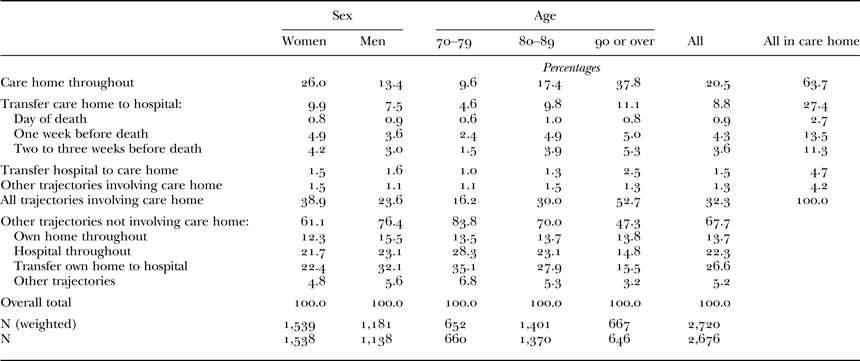
Given current mortality patterns, the population studied is of very advanced age (Table 1). The data show almost as many people dying non-suddenly at the age of 90 or more as at age 70–79 – about a quarter in both cases. Also, due to lower life expectancy among men, over half the decedents in the study were women (57%). There is wide variation in the possible trajectories between place of residence a few weeks before death and place of death. However, as death approaches, it becomes increasingly rare for a person to be in their own home and increasingly common to be in hospital (Pennec et al. Reference Pennec, Gaymu, Monnier, Riou, Aubry, Pontone and Cases2013). Leaving home to go into hospital and dying there is the most frequent trajectory (26.6%); 22.3 per cent of people spend the entire last month in hospital and 13.7 per cent spend the entire month at home. It is far rarer (2%) for people to return to their home from hospital; other, more complex trajectories, mainly oscillating between home and hospital, are also rarer (3%). The population studied therefore is people who spend all or part of their last month of life in a care home, amounting to 32.3 per cent of those who die non-suddenly at the age of 70 or over (Table 1).
Residential trajectories during the last month of life: people aged 70 and over, by sex and age

Source: Fin de vie en France (End of Life in France) survey, 2010.
Frequency of end of life in a care home
Among those who die other than suddenly at age 70 or over, a higher proportion of women than men live in a care home in their last month (38.9% compared to 23.6%; Table 1) and women are twice as likely to spend their entire last month of life there (26% compared to 13.4%). This is also the case for those aged 90 and over compared to those aged 70–79: 52.7 per cent in care homes compared to 16.2 per cent, with the oldest being four times as likely to spend their entire last month in a care home (37.8% compared to 9.6%).
For those who spent all or part of their last month in a care home, the most common situation (63.5%; Table 1 last column) is to spend the entire last month of life there. At this stage of life almost no care home residents return home (0.3%); if they leave the care home it is to enter hospital: 27.4 per cent die in hospital, the probability of transfer increasing as death approaches. The proportion of care home residents admitted to hospital in the last 7 days before death (13.5%) is slightly higher than the proportion for the preceding 21 days (11.3%); almost 3 per cent are hospitalised on the eve of their death. Transfers from hospital to a care home and more complex trajectories, mainly oscillating between the two, are very rare (4.7 and 4.2% of the total, respectively).
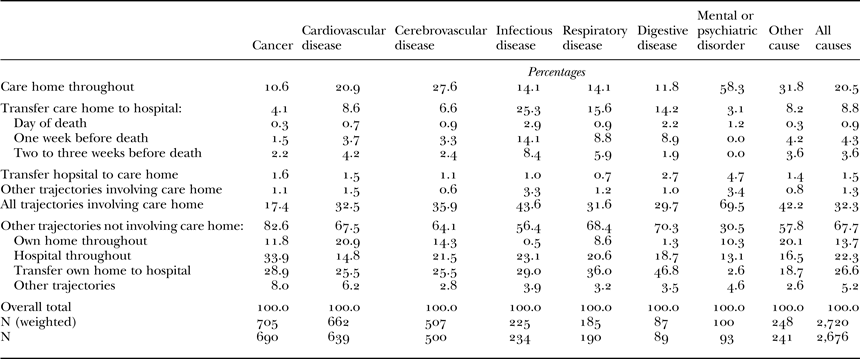
At this stage of life, the place where a person is cared for is closely related to their medical cause of death. Most of those for whom the cause of death is mental or psychiatric disorders live in a care home during this period (69.5%; Table 2) and more than half (58.3%) spend the entire last month of their life there.Footnote 5 Many (43.6%) of those who die of an infectious disease have been living in a care home, but they are more likely to be transferred to hospital and die there (25.3%). About 30 per cent of those who die from cardiovascular, cerebrovascular, respiratory or digestive diseases have been in a care home during their last month of life (a proportion close to the overall average). Of those with cardiovascular/cerebrovascular disease, the majority stay in their care home until death, whereas those with respiratory or digestive disorders are more likely to be transferred to hospital. Only 17.4 per cent of those whose cause of death is cancer have been living in a care home and only 10.6 per cent have spent their entire last month there. Whatever the pathology that causes death, the proportion of people transferred to hospital increases as death approaches: in the case of infectious diseases, for example, 17 per cent leave the care home in the last week of life or even on the last day, compared to 4.9 per cent during the previous three weeks.
Residential trajectories in the last month: persons aged 70 and over, by cause of death

Source: Fin de vie en France (End of Life in France) survey, 2010.
Demographic and medical factors associated with different patterns of care home residence
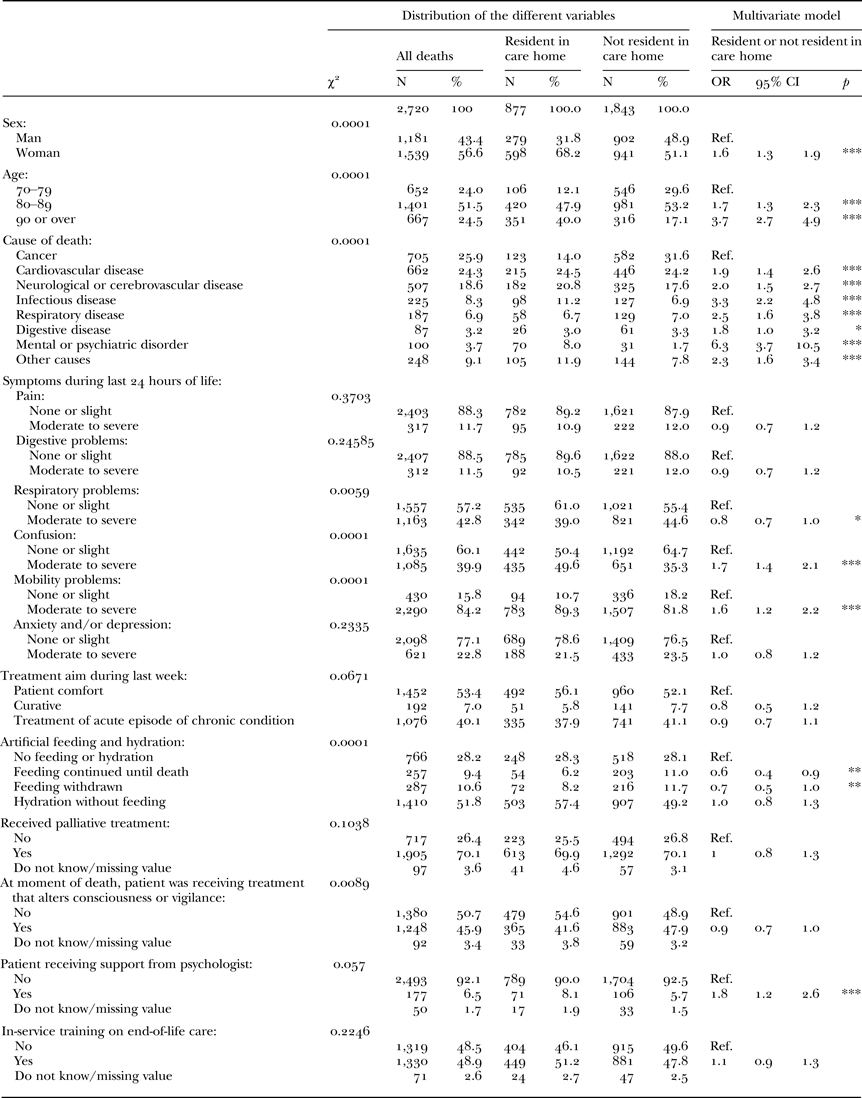
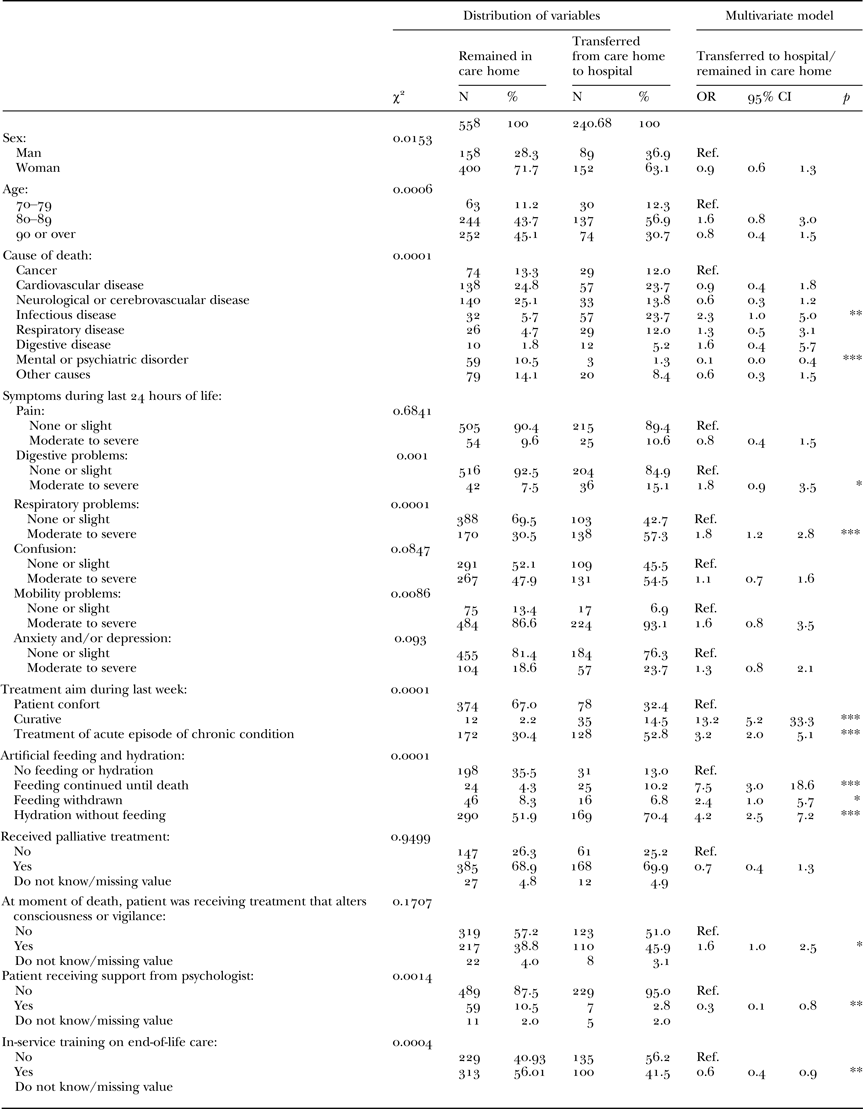
After adjusting for the available variables, particularly the medical variables, people of the most advanced ages (90 and over) and women are the most likely to have spent all or part of their last month in a care home (odds ratio (OR) = 3.7 and 1.6, respectively; Table 3). However, taking all care home residents and standardising with the same variables as before (Table 4), age and sex have no impact on the odds of being transferred to hospital.
Characteristics and type of medical care: persons aged 70 and over who die non-suddenly, according to whether or not they were living in a care home during their last month of life

Notes: OR: odds ratio. CI: confidence intervals. Ref.: reference category.
Source: Fin de vie en France (End of Life in France) survey, 2010.
Significance levels: * p < 0.1, ** p < 0.05, *** p < 0.01.
Characteristics and type of medical care: persons aged 70 and over who die non-suddenly, according to whether they remained in care home throughout or were transferred during the last month of life

Notes: OR: odds ratio. CI: confidence intervals. Ref.: reference category.
Source: Fin de vie en France (End of Life in France) survey, 2010.
Significance levels: * p < 0.1, ** p < 0.05, *** p < 0.01.
All else being equal, compared to deaths from cancer, all other causes of death are significantly positively associated with a higher probability of living in a care home. But the association is by far the strongest for mental and psychiatric disorders (OR = 6.3) and infectious diseases (OR = 3.3). Two causes of death are significantly associated with particular end-of-life trajectories for care home residents (Table 4): people who die of an infectious disease are more likely to have been transferred to hospital (OR = 2.3) and those who die with mental or psychiatric mental disorders are less likely to have been transferred (OR = 0.1).
The survey contains information on symptom intensity in the last 24 hours before death despite treatment (if any). On the one hand, the frequency of respiratory distress, signs of anxiety or depression, pain and digestive disorders of medium to severe intensity is comparable whether patients have been living in a care home or not (confirmed by a logistic regression model; Table 3). On the other hand, people displaying confusion or mobility problems in their last 24 hours are more likely to have been living in a care home (OR = 1.7 and 1.6, respectively; Table 3) and care home residents suffering from digestive disorders or respiratory distress are more likely to be moved to hospital (OR = 1.8; Table 4).
Is there a pattern of medical care specific to the care home?
It emerges from the multivariable models that the purpose of medical treatment during the last week of life varies according to type of place. Patients in care homes are more likely than those in hospital or at home to receive treatment that provides comfort only, and this is all the more the case for those who remain in the care home to the end (Tables 3 and 4). For those transferred from a care home to hospital, the treatment given is more often for one or more acute episodes of a chronic condition (OR = 3.2) or, more frequently, to cure an illness (OR = 13.2). However, almost a third of hospitalisations from care homes are for purposes of patient comfort, one out of ten such transfers being to palliative care units (three out of ten in geriatrics and three out of ten in medicine). Whatever the purpose of the treatment, the frequency of transfers from care home to hospital increases with the approach of death: about six out of ten occur in the last week of life in the case of curative treatment and treatment for a chronic condition, and more than one in two in the case of treatment for comfort.
Not only the purpose of treatment but also the measures taken to achieve them differ according to place of residence. All else being equal (purpose of treatment, in particular), care home residents are less likely than the other groups as a whole to be artificially fed (continuously until death or not) (OR ≈ 0.6, Table 3). Furthermore, on the one hand, those transferred to hospital are more likely to be artificially fed until the end (OR = 7.5) or to receive artificial hydration alone (OR = 4.2; Table 4) than those who spend all of their last month in a care home. On the other hand, palliative care is dispensed with the same frequency (about 70% of situations) regardless of whether or not the person lives in a care home and, in that case, whether they stay there or are transferred to hospital. This still applies when standardised by the other variables. But compared to those remaining in a care home, those transferred to hospital are more often given treatments that alter consciousness or vigilance (OR = 1.6; Table 4).
After adjusting for the other variables, those living in care homes are more likely to receive support from a psychologist (OR = 1.8; Table 3) and those transferred from care home to hospital are less likely to receive such support than those who remain in the care home to the end (OR = 0.3; Table 4). It is when the patients stay in the care home to the end that end-of-life conditions are most often judged ‘correct’ by the physician (31.7%, compared to 23.4% when the patient is transferred to hospital) and when the physician most often declares having received in-service training for end-of-life careFootnote 6 (56%, compared to 41% where patient transferred to hospital and 47.7% on average).
Are there specific end-of-life decisions for care home residents?
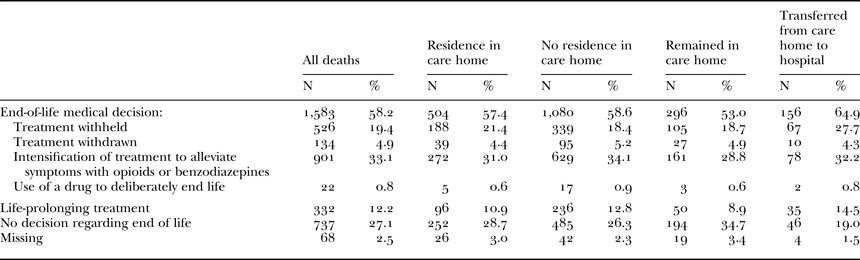
Regardless of whether or not the person was living in a care home during their last month of life, in nearly three out of five cases of non-sudden death at the age of 70 or over (58.2%), the physician declares having taken a medical decision in the knowledge that it might shorten the patient's life. The most frequent such decision is to intensify treatment to alleviate pain or other symptoms (for about two-thirds of deaths; Table 5). Otherwise, either the purpose of treatment is to do everything possible to prevent death (12.2%), or no end-of-life medical decision is made (27%). For care home residents, the end-of-life decisions differ according to the trajectory: medical decisions are taken less often for those who stay in the care home to the end than for those transferred to hospital (19% compared to 34.7%). This is due to the particular medical situations concerned in the two categories: if all else is equal, the difference is not significant.Footnote 7
End-of-life medical decision for persons aged 70 and over who die non-suddenly, according to whether they were in a care home during their last month of life and, if so, whether they were transferred to hospital or not

Source: Fin de vie en France (End of Life in France) survey, 2010.
The decision-making context is the same whether the person has been in a care home or not and, if so, whether they are transferred to hospital or not. Decisions are usually discussed with the nursing team (70% of cases) and the patient (75%) if the physician considers them capable of taking part in the decision. About 30 per cent of persons dying at age 70 or later have named a trusted third party and in some 85 per cent of these cases the third party is involved in discussions about terminal-phase decisions. With people in care homes the trusted third party is rather less often a family member (92% compared to 97%)Footnote 8 and rather more often the general practitioner (1.7% compared to 0.2%) or another person (6% compared to 3%). While the law allows for any person to express their end-of-life wishes by drawing up a living will, only 2 per cent of patients in the survey had done so (whether they had been in a care home or not). However, when there is a living will, in 72 per cent of cases the physicians state that it was an important factor in the end-of-life decision (Pennec et al. Reference Pennec, Monnier, Pontone and Aubry2012).
Discussion
Of persons dying non-suddenly after their 70th birthday, 32 per cent have spent all or part of their last month in a care home. Most of these people spend their whole last month there and die there. A quarter of them are transferred to hospital, where they die; this finding reflects other studies in France (Observatoire National de la Fin de Vie 2014). Whatever the cause of death and the purpose of treatment, the number of people transferred to hospital increases with the approach of death. This may reflect the difficulty staff in some care homes have in managing this last stage in the deterioration of a person's health (Klinkenberg et al. Reference Klinkenberg, Visser, Broese van Groenou, van der Wal, Deeg and Willems2005) and in some cases the lack of skilled nurses during the night (Morin et al. Reference Morin, Reynaud-Levy, Soriano, Hervy, Doutreligne and Aubry2014). It may also be that with the approach of death, multiple pathologies or their complications become less predictable, so that situations are experienced more as emergencies and hospitalisation may seem to be the only ‘solution’.
In the final weeks of life, age and sex make a major difference to the residential trajectory, the oldest people and women being the most likely to be living in a care home. This is probably because they are the most likely to be disabled by multiple pathologies and/or their family or social environment is too insecure to allow them to remain in their own home. They are more likely to be widowed, mostly women, and to have only a small network of family carers who are themselves older people. By contrast, all else being equal, age and sex have no impact on whether a person remains in the care home to the end or is transferred to hospital and dies there. Contrary to the findings of some studies (Givens et al. Reference Givens, Selby, Goldfeld and Mitchell2012; Menec et al. Reference Menec, Nowicki, Blandford and Veselyuk2009), this survey does not show that, for comparable medical situations (cause of death, purpose of treatments, estimated intensity of symptoms during the last 24 hours), people of very advanced age are less likely than younger ones to be transferred to hospital. However, the survey methods were different: Givens' survey focused on patients with advanced dementia living in nursing homes in a particular town, and Menec et al. (Reference Menec, Nowicki, Blandford and Veselyuk2009) had enough data to perform multi-level analyses.
There is a connection between medical condition and a person's likelihood of being in a care home and, if there, of remaining to the end or being transferred to hospital. In line with the literature (Houttekier et al. Reference Houttekier, Cohen, Bilsen, Addington-Hall, Onwuteaka-Philipsen and Deliens2010), people who die from mental or psychiatric disorders are the most likely to have been living in a care home and if so to stay there to the end. Care home residents who die from infectious diseases and those with moderate to severe digestive disorders or respiratory distress in their last 24 hours are the most likely to be moved from their care home to be treated in hospital.
As might be expected, for the same cause of death and observed intensity of symptoms during the last 24 hours, people are more likely to stay in a care home throughout the last month if the main purpose of treatment is to ensure their comfort, and to be transferred to hospital if the purpose is curative or to treat an acute episode of a chronic illness. For most French care home residents, the medical decision of end of life, if any, was reported to have been the alleviation of pain and other symptoms. Decedents had generally had the benefit of palliative treatments (under the broad definition of ‘alleviating symptoms and treating pain’). But no statistical link could be found between delivering palliative treatment and end-of-life trajectories, unlike the United States of America (USA), where it has been shown that hospice care reduces end-of-life hospitalisation rates (Casarett et al. Reference Casarett, Karlawish, Morales, Crowley, Mirsch and Asch2005; Gozalo and Miller Reference Gozalo and Miller2007). In the USA these hospice programmes have spread widely among nursing homes in recent years (Stevenson and Bramson Reference Stevenson and Bramson2009), which is not the case in France (Ministère chargé de la santé 2013).
For a given treatment goal, cause of death and severity of symptoms, people hospitalised at the end of life were more often artificially fed and/or hydrated and more often received treatments that alter consciousness or vigilance at the very end than those remaining in care homes. By contrast, when the entire last month of life was spent in a care home, support from a psychologist was more frequent, and more physicians declared having received in-service training in palliative care: 56 per cent of patients remaining in care homes until death receive support from a physician who has received in-service training in end-of-life care, compared to 41 per cent of those transferred to hospital. It seems easier to introduce psychological support in a care home, since death is more ‘expected’ for residents there. This survey seems to show that hospitals tend to medicalise the end of life more than do care homes, but the differences observed might also merely reflect differences in patients' care needs. In some cases hospitalisation in a palliative care unit may be useful to alleviate severe symptoms. It has been shown in other countries that some hospitalisations might be avoidable, particularly for patients with dementia (Ouslander et al. Reference Ouslander, Lamb, Perloe, Givens, Kluge, Rutland, Atherly and Saliba2010; Porell and Carter Reference Porell and Carter2005), and that most in-hospital technical acts might be inappropriate at the end of life (Teno, Mitchell and Gozalo Reference Teno, Mitchell and Gozalo2010).
Among the methodological limitations of our study is the fact that it was retrospective, based on the declarations of physicians, some of whom had only a partial knowledge of the situations they described. Thus, the medical variables give only an imperfect picture of the patient's state of health. The cause of death is not necessarily the only disease leading to a person moving into a care home (or being hospitalised) and can also be hard to determine, especially with people of very advanced age and with multiple pathologies. There may also be some degree of interpretation in a physician's description of symptom severity, especially when the patient is unconscious or is communicating little or not at all. But description of symptoms helps to understand some of the practices reported by the physicians and, despite their shortcomings, these questions are commonly used in similar surveys (Lofmark et al. Reference Lofmark, Nilstun, Cartwright, Fischer, van der Heide, Mortier, Norup, Simonato and Onwuteaka-Philipsen2008; van der Heide et al. Reference van der Heide, Deliens, Faisst, Nilstun, Norup, Paci, Van der Wal and Van der Maas2003). It should also be borne in mind that information on place of residence was only available at four moments in time during the last month of life, that the information on some variables was only collected for one particular period (symptoms in the last 24 hours, purpose of treatment during the last week), and that not all French care home settings have the same nursing or medical resources (Joël et al. Reference Joël, Dufour-Kippelen, Duchêne and Marmier2010). These limitations mean that our results should be interpreted with caution. More thorough observation of patients' needs and care at the end of life would be useful, but would require a prospective survey method, which is difficult to implement on a nationwide representative sample and may also lead physicians to alter their practices and behaviour towards the expected norm (Abarshi et al. Reference Abarshi, Echteld, Van den Block, Donker, Deliens and Onwuteaka-Philipsen2010).
Institutionalisation at the end of life is often seen as a last resort but it has been shown that people who have expressed the wish to die in a care home are less likely to be transferred to hospital in the last three months of life than those who would prefer to die at home or whose wishes are not known (Van den Block et al. Reference Van den Block, Deschepper, Drieskens, Bauwens, Bilsen, Bossuyt and Deliens2007). Care home staff might be better able to comply with a resident's wishes than carers at home, especially family members, who are often ill-equipped to cope with a relative's terminal phase.
Under French law, anyone can draw up advance directives and so express their wishes for the end of their life should they be incapable of taking part in decisions. In this survey, in care homes as elsewhere, only 30% had named a trusted third party and only 2% of the decedents aged 70 or over had drawn up a living will. When advance directives did exist, in 72% of cases the physician stated that they had been an important factor for end-of-life medical decisions. This points very clearly to a widespread ignorance of this law and a need to improve the level of patients' adoption of advance directives. Care planning in advance has been shown to improve end-of-life care and patient and family satisfaction (Detering et al. Reference Detering, Hancock, Reade and Silvester2010) and in any case it seems important to spread the practice of drawing up a living will in order to facilitate an ethical approach to end-of-life care and support.
Our study shows that medical cause of death affects place of death for older people in France, as it does in other industrialised countries. Residence in a care home is more frequent when people suffer from confusion, moderate to severe mobility problems, and cognitive and psychiatric disorders leading to death. Cognitive impairment has rapidly become more common in recent decades and should continue to increase in future as the population ages (Organisation for Economic Co-operation and Development 2013). Unless there are significant improvements in curing and caring for these disabilities, these trends should lead in future to increased demand for care home places. In view of this, and in line with international recommendations (van Riet Paap et al. Reference van Riet Paap, Vernooij-Dassen, Radbruch, Vissens and Engels2014), France needs to think about increasing specialised palliative care support for those in home care and care homes, and continuing in-service palliative care training for general practitioners and care home staff. Staff have to take ethical decisions in the course of their day-to-day practice, deciding whether or not to hospitalise someone, whether or not to limit or withdraw a treatment, choosing how to care for someone with dementia, etc. This shows that care homes ought to be among the key places for thinking and discussion about ethical issues, and it is important that they have the means to do this. According to Hall et al. (Reference Hall, Kolliakou, Petkova, Froggatt and Higginson2011), there is also a need for high-quality research to assess the impact of interventions aimed at improving palliative care in care homes.
Acknowledgements
The survey this research is based on could not have been done without the financial support of the Institut national d'etudes démographiques (INED; French Institute for Demographic Studies) and the Ministry of Health's Direction Générale de la Santé (represented by A. Fontaine and E. Gaillard). We would like to thank the following persons for their involvement in the data collection: the survey's steering committee for their support and constructive discussions throughout the design and first analysis of the survey [Piernick Cressard and Francois Stefani of the Conseil National de l'Ordre des Médecins (National Medical Council), Eric Jougla, Albertine Aouba, Grégoire Rey of CepiDc at the Institut national de la Santé et de la Recherche médicale (French Institute of Health and Medical Research)]; our ‘trusted third-party’ partners Jeanne Fresson of the Department of Medical Information at the Maternité Universitaire de Nancy and Epiconcept for the internet response channel; INED's surveys department, which was the pillar for data collection, and Amandine Stephan for her contribution in co-ordinating the survey; INED's administration, IT department and statistical methods department for their involvement in different aspects of this project; Johan Bilsen and Joachim Cohen from the End-of-life Care research group at the Vrije universiteit Brussel for their advice on the design of the survey; all those who have been involved in the different steps of this survey (questionnaire testing, pilot survey, data capture, etc.); and, of course, all our thanks and gratitude to all the physicians who gave of their time to take part in the survey. The survey used in this research was approved by the Comité Consultatif sur le Traitement de l'Information en Matière de Recherche dans le Domaine de la Santé (CCTIRS, consulting committee on data processing in health research) in January 2010 and authorised by the Commission Nationale de l'Informatique et des Libertés data protection committee (CNIL, authorisation number 1410166 at sitting 2010-107 of 15 April 2010).