The etiology of child conduct problems has been studied for decades within the fields of psychology, sociology, economics, criminal justice, and other related social science disciplines. Conduct problems (CP) is a collective term referring to elevated displays of oppositional defiant behaviors and/or elevated indicators of conduct disorder. CP is characterized by aggressive, deceitful, norm-violating, and sometimes violent behaviors (Lorber, Reference Lorber2004). It is estimated to affect between 2% and 16% of youth in the general population (Boylan, Vaillancourt, Boyle, & Szatmari, Reference Boylan, Vaillancourt, Boyle and Szatmari2007) and is one of the most common causes for mental health referrals by primary care providers (Rushton, Bruckman, & Kelleher, Reference Rushton, Bruckman and Kelleher2002). A major interest for developmental psychopathologists has been the heterogeneity within children who exhibit CP, with the hope that identifying homogenous subgroups of children with similar developmental etiologies may facilitate improved treatment approaches. To date, one of the most commonly used methods of subtyping is based on age of onset of CP (Frick & Viding, Reference Frick and Viding2009). Children who display CP prior to adolescence are more likely to continue antisocial behaviors into adulthood as compared to those who display CP beginning in adolescence (Odgers et al., Reference Odgers, Milne, Caspi, Crump, Poulton and Moffitt2007). Despite the utility of differentiating CP as a function of age of onset, there is still substantial variation among children with “early starting” CP. This has led to interest in considering whether the presence or absence of callous–unemotional (CU) behaviors may help subdivide children with early onset CP into more homogenous subgroups (Kimonis, Frick, & McMahon, Reference Kimonis, Frick, McMahon, Mash and Barkley2014). When CU, which is a component of psychopathy that can be identified and measured in early childhood, co-occurs with CP, it indexes children with a more severe, diverse, and possibly persistent set of antisocial behaviors than is the case for children who exhibit elevated CP without elevated CU behaviors (Frick & Morris, Reference Frick and Morris2004).
CU behaviors include emotional, affective, and cognitive deficits such as a lack of guilt, empathy, and fear and often characterize children who also demonstrate an overfocus on reward and insensitivity to punishment (Blair, Peschardt, Budhani, Mitchell, & Pine, Reference Blair, Peschardt, Budhani, Mitchell and Pine2006; Frick & White, Reference Frick and White2008; Kotler & McMahon, Reference Kotler and McMahon2005). Longitudinal studies suggest that CU behaviors are a distinct construct that can occur in the absence of CP (Fontaine, McCrory, Boivin, Moffitt, & Viding, Reference Fontaine, McCrory, Boivin, Moffitt and Viding2011; Frick et al., Reference Frick, Cornell, Bodin, Dane, Barry and Loney2003; Rowe et al., Reference Rowe, Maughan, Moran, Ford, Briskman and Goodman2010; Viding & McCrory, Reference Viding and McCrory2012; Willoughby, Mills-Koonce, Gottfredson, & Wagner, Reference Willoughby, Mills-Koonce, Gottfredson and Wagner2014; Willoughby, Waschbusch, Moore, & Propper, Reference Willoughby, Waschbusch, Moore and Propper2011). Furthermore, although most children with CP do not exhibit CU behaviors, approximately one third of all children with CP do display high levels of CU behaviors (e.g., Christian, Frick, Hill, Tyler, & Frazer, Reference Christian, Frick, Hill, Tyler and Frazer1997; Frick, Bodin, & Barry, Reference Frick, Bodin and Barry2000; Murrie & Cornell, Reference Murrie and Cornell2002; Woodworth & Waschbusch, Reference Woodworth and Waschbusch2008). In part due to these percentages, as well as distinct clinical outcomes and potential etiological processes (Frick, Ray, Thornton, & Kahn, Reference Frick, Ray, Thornton and Kahn2014), recently the presence of CU behaviors (which was operationalized as “limited prosocial behaviors,” possibly in order to avoid stigma), has been included as a modifier to conduct disorder diagnoses in DSM-5 (McMahon, Witkiewitz, Kotler, & Conduct Problems Prevention Research Group, Reference McMahon, Witkiewitz and Kotler2010; Pardini, Frick, & Moffitt, Reference Pardini, Frick and Moffitt2010).
This addition to the DSM-5 reflects over a decade of research on CU behaviors in youth, and it has also stimulated a flurry of new and innovative research on these topics. Although a downward extension of the scientific psychopathy literature originally presented childhood CU behaviors as maturational unfolding from a genetic predisposition for later antisocial and psychopathic behaviors in adolescence and adulthood (Blonigen, Hicks, Krueger, Patrick, & Iacono, Reference Blonigen, Hicks, Krueger, Patrick and Iacono2005; Viding, Jones, Paul, Moffitt, & Plomin, Reference Viding, Jones, Paul, Moffitt and Plomin2008), recent evidence suggests that environmental factors also play a role in the emergence, continuity, and change in CU behaviors over time (Farrington, Ullrich, & Salekin, Reference Farrington, Ullrich, Salekin, Salekin and Lynam2010; Waller, Gardner, & Hydem, Reference Waller, Gardner and Hyde2013). The current study adopts bioecological and family stress model perspectives on the development of both CP and CU behaviors by simultaneously examining the interplay of multiple aspects of children's early environments. These range from broader to more microlevels of developmental context, including family poverty, multiple dimensions of household chaos (disorganization and instability in family functioning), and multiple dimensions of observed parenting behaviors, all measured during the first 3 years of life. Of particular interest for this study is whether different sources of contextual risk are unique associates with CP or specific subcomponents of CU behaviors, whether variation in risk at one level of analysis constrains the effects of risk at another level of analysis, and whether the microcontext of parent–child interactions mediate the broader contextual effects of poverty and household chaos.
Family Factors Related to CP and CU Behaviors
Family socioeconomic variables
Most studies of family socioeconomic conditions related to child CP have focused primarily on poverty or family income. Far fewer studies have directly examined parental education other than as a control variable in analyses. Among the studies of family income, research repeatedly finds negative associations between family income and CP (Magnuson & Votruba-Dfzal, Reference Magnuson, Votruba-Drzal, Danziger and Cancian2009; Yoshikawa, Aber, & Beardslee, Reference Yoshikawa, Aber and Beardslee2012). Causal evidence for the effects of income on CP have been provided by quasi-experimental (Costello, Compton, Keeler, & Angold, Reference Costello, Compton, Keeler and Angold2003) and experimental (Gennetian & Miller, Reference Gennetian and Miller2002) studies. Although the depth of research on family income and CU behaviors is far less extensive than the CP literature, a recent set of meta-analyses reporting correlations between family income and CU behaviors reported an overall negative correlation between them (Piotrowska, Stride, Croft, & Rowe, Reference Piotrowska, Stride, Croft and Rowe2015). Many theoretical models linking the influence of family income on problem behaviors focus on intermediary and more proximal influences on child development (Shaw & Shelleby, Reference Shaw and Shelleby2014). For example, the family stress model outlining how economic hardship influences child mental health outcomes via its effects on parent–child interactions and relational dynamics is one of the most common explanations for how poverty affects development (McLoyd, Reference McLoyd, Carlo, Crockett and Carranza2011). In the case of child CP and CU behaviors, economic hardship is associated with declines in parental health and well-being, which in turn is associated with parenting behaviors associated with decreases sensitivity and involvement with children (Conger et al., Reference Conger, Wallace, Sun, Simons, McLoyd and Brody2002; McLeod & Shanahan, Reference McLeod and Shanahan1993). Extending this model forward, these parenting qualities (as discussed below) are associated with greater CP and CU behaviors (Waller et al., Reference Waller, Gardner and Hyde2013). Although it could be argued that both the parenting and the child variables in the family stress model presented above could all be the product of familial genetic factors that predispose both generations to maladaptive behaviors, studies taking into account such genetic selection factors demonstrate that, although reduced in strength, the associations between economic disadvantage, parenting, and child outcomes remain significant (Meyer et al., Reference Meyer, Rutter, Silberg, Maes, Simonoff and Shillady2000). Furthermore, recent analyses using a genetically informed adoption study identified persistent environmental associations with CU behaviors in early childhood even when accounting for gene–environment correlations (Waller et al., Reference Waller, Shaw, Neiderhiser, Ganiban, Natsuaki and Reissin press). The current study will examine family income and parental education as contextual factors independent of household chaos and parenting characteristics, as well as examine parenting behaviors as potential mediators of associations between socioeconomic status (SES) variables and CP and CU behaviors.
Household chaos
Recent studies of parental report on household chaos (e.g., residential instability, lack of routines, disorganization, and elevated noise) suggest that variation in this household variable (although correlated with family income) is distributed across SES (Dumas et al., Reference Dumas, Nissley, Nordstrom, Smith, Prinz and Levine2005) and is associated with parental stress and mental health (Evans, Lepore, Shejwal, & Palsane, Reference Evans, Lepore, Shejwal and Palsane1998; Pike, Iervolino, Eley, Price, & Plomin, Reference Pike, Iervolino, Eley, Price and Plomin2006) and parenting behaviors (Dumas et al., Reference Dumas, Nissley, Nordstrom, Smith, Prinz and Levine2005; Valiente, Lemery-Chalfant, & Reiser, Reference Valiente, Lemery-Chalfant and Reiser2007). Although much of the literature on parent-reported household chaos and child development has focused on cognitive outcomes (Evans & Wachs, Reference Evans and Wachs2010; Vernon-Feagans, Garrett-Peters, Willoughby, Mills-Koonce, & Family Life Key Investigators, Reference Vernon-Feagans, Garrett-Peters, Willoughby and Mills-Koonce2012), recent studies have also linked elevated chaos with higher levels of CP in young children. Deater-Deckard et al. (Reference Deater-Deckard, Mullineaux, Beekman, Petrill, Schatschneider and Thompson2009) reported that household chaos (measured by parent report with the Chaos, Hubbub, and Order Scale; Matheny, Wachs, Ludwig, & Phillips, Reference Matheny, Wachs, Ludwig and Phillips1995) was positively correlated with concurrent measures of child CP and that increases in household chaos over a 2-year period was correlated with increases in child CP over the same period. Although this study controlled for parental education instead of income, it also controlled for parental warmth and negativity, and the effects of household chaos were independently significant. It should also be noted that, similar to how the associations between economic disadvantage and child outcomes persisted even after controlling for potential genetic selection effects, recent research using genetically informed models of twin pairs reported cross-lagged associations between household chaos and children's CP behaviors that were environmentally mediated (Jaffee, Hanscombe, Haworth, Davis, & Plomin, Reference Jaffee, Hanscombe, Haworth, Davis and Plomin2012).
In addition to main effects, the context of elevated household chaos has also been observed as a moderator of proximal effects on children's CP. Chen, Deater-Deckard, and Bell (Reference Chen, Deater-Deckard and Bell2014) reported that the associations between parental negativity and child CP were stronger when families lived in more chaotic homes. Similarly, Oliver, Pike, and Plomin (Reference Oliver, Pike and Plomin2008) reported that children's negative perceptions of their classroom environments were associated with higher teacher ratings of child CP, but this effect was strongest for children living in more chaotic homes. This study is also important because it reports similar associations (but reversed) with teacher ratings of child prosocial behaviors. In addition to this study, we were able to identify only one other study with an outcome related to CU behaviors. Using trajectory analyses, Fontaine et al. (Reference Fontaine, McCrory, Boivin, Moffitt and Viding2011) reported that children from homes characterized by higher levels of household chaos were more likely to be in a trajectory characterized by high levels of CU behaviors as compared to a trajectory characterized by low CU behaviors.
The above findings highlight the potential effects of a chaotic household context on the emergence of CP and CU behaviors in early childhood. However, much of the previous research on this topic utilized either a single indicator (e.g., crowding or neighborhood noise) or a single composite measure based on parental report, methods that may be influenced by parental characteristics such as personality traits, mental and physical health symptoms, and stress and coping strategies (Corapci & Wachs, Reference Corapci and Wachs2002; Wachs, Reference Wachs2013). Recent research based on the sample used for this study has employed a multiple-method/multiple-informant approach to studying multiple dimensions of cumulative household chaos across time (Vernon-Feagans et al., Reference Vernon-Feagans, Garrett-Peters, Willoughby and Mills-Koonce2012). This approach examines two dimensions of household chaos (disorganization and instability) based on ratings across the first 3 years of the child's life. These constructs have also been observed by others; Sameroff (Reference Sameroff, Evans and Wachs2010) described disorder and disorganization as “high levels of noise, excessive crowding, clutter, and lack of structure” (p. 258), and instability has been described in terms of changes in setting and relationships in the home that lead to unpredictability in residential status (Brooks-Gunn, Johnson, & Leventhal, Reference Brooks-Gunn, Johnson, Leventhal, Evans and Wachs2010). Studies of disorganization chaos have reported negative association with child attention and regulatory behaviors (Blankson, O'Brien, Leerkes, Calkins, & Marcovitch, Reference Blankson, O'Brien, Leerkes, Calkins and Marcovitch2015; Lillard, Drell, Richey, Boguszewski, & Smith, Reference Lillard, Drell, Richey, Boguszewski and Smith2015; Miller et al., Reference Miller, Marks, Miller, Berwid, Kera and Santra2007), and studies of instability chaos have reported negative associations with children's behavioral and academic development, especially school-age children (Brooks-Gunn et al., Reference Brooks-Gunn, Johnson, Leventhal, Evans and Wachs2010; Brown, Ackerman, & Moore, Reference Brown, Ackerman and Moore2013; Fiese & Winter, Reference Fiese, Winter, Evans and Wachs2010; Tucker, Marx, & Long, Reference Tucker, Marx and Long1998).
Recent studies of chaos across childhood identify disorganization and instability as critical dimensions of household chaos in understanding the negative effects of chaos on children's development (Brooks-Gunn et al., Reference Brooks-Gunn, Johnson, Leventhal, Evans and Wachs2010; Evans & Wachs, Reference Evans and Wachs2010; Sameroff, Reference Sameroff, Evans and Wachs2010). Furthermore, it is possible that each of these dimensions of chaos influences children both directly and through more proximal experiences with the parent–child dyad. Prior research with the current sample reported associations between higher levels of both household chaos variables and less sensitive parenting, more harsh–intrusive parenting, and more dysfunctional child representations of family relationships (Zvara et al., Reference Zvara, Mills-Koonce, Garrett-Peters, Wagner, Vernon-Feagans and Cox2014), lower child ability to recognize and modulate negative emotions (Raver, Blair, Garrett-Peters, & Family Life Project Key Investigators, Reference Raver, Blair and Garrett-Peters2015), and lower levels of child expressive and receptive language development (Vernon-Feagans et al., Reference Vernon-Feagans, Garrett-Peters, Willoughby and Mills-Koonce2012). However, to our knowledge this is one of the first studies to examine the associations between this measurement of household chaos and CP and CU behaviors in young children.
Parenting behaviors
Longitudinal research suggests that early sensitive caregiving likely exerts enduring influence on children's behavioral problems (Haltigan, Roisman, & Fraley, Reference Haltigan, Roisman and Fraley2013) and externalizing psychopathology more broadly (Lorber & Egeland, Reference Lorber and Egeland2009). More specifically, parental sensitivity and harsh–intrusiveness have each been associated with CP and CU behaviors (Dodge & Pettit, Reference Dodge and Pettit2003; Waller et al., Reference Waller, Gardner and Hyde2013; Willoughby, Mills-Koonce, Propper, & Waschbusch, Reference Willoughby, Mills-Koonce, Propper and Waschbusch2013). With regard to parental sensitivity, multiple studies report that low levels of parental sensitivity were associated with high levels of CP and CU behaviors (Frick et al., Reference Frick, Cornell, Bodin, Dane, Barry and Loney2003; Kimonis, Cross, Howard, & Donoghue, Reference Kimonis, Cross, Howard and Donoghue2013; Kroneman, Hipwell, Loeber, Koot, & Pardini, Reference Kroneman, Hipwell, Loeber, Koot and Pardini2011), although the strength of effects have sometimes differed as a function of child sex (Pasalich, Dadds, Hawes, & Brennan, Reference Pasalich, Dadds, Hawes and Brennan2011; Barker, Oliver, Viding, Salekin, & Maughan, Reference Barker, Oliver, Viding, Salekin and Maughan2011). Even stronger evidence for this association has been reported by Pardini, Lochman, and Powell (Reference Pardini, Lochman and Powell2007) and Hawes, Dadds, Frost, and Hasking (Reference Hawes, Dadds, Frost and Hasking2011), who found that parental warmth and involvement predicted decreases in both CP and CU behaviors over time. In addition, recent papers by Waller et al. (Reference Waller, Gardner, Viding, Shaw, Dishion and Wilson2014) and Wagner, Mills-Koonce, Willoughby, Zvara, and Cox (Reference Wagner, Mills-Koonce, Willoughby, Zvara and Cox2015) demonstrated that CP and CU behaviors were predicted by observed measures of parental warmth while controlling for earlier measures of CP and CU behaviors. These findings collectively suggest that sensitive caregiving is associated not only with the occurrence of CP and CU behaviors but also with their continuity and change across early development.
The associations between sensitive parenting and CP and CU behaviors are not surprising given the role of sensitive parenting in the development of both basic and complex emotions such as empathy and guilt (Kiang, Moreno, & Robinson, Reference Kiang, Moreno and Robinson2004; Knafo, Zahn-Waxler, Van Hulle, Robinson, & Rhee, Reference Knafo, Zahn-Waxler, Van Hulle, Robinson and Rhee2008; Kochanska, Forman, Aksan, & Dunbar, Reference Kochanska, Forman, Aksan and Dunbar2005; Kochanska, Gross, Lin, & Nichols, Reference Kochanska, Gross, Lin and Nichols2002) as well as the conscience development in children (Kochanska, Reference Kochanska1997; Swain, Lorberbaum, Kose, & Strathearn, Reference Swain, Lorberbaum, Kose and Strathearn2007). In addition, sensitive and contingent responsiveness to children's physical and emotional needs is also associated with attachment security (De Wolff & van IJzendoorn, Reference De Wolff and van IJzendoorn1997) and effective stress reactivity and regulation (Blair et al., Reference Blair, Granger, Kivlighan, Mills-Koonce, Willoughby and Greenberg2008; Moore et al., Reference Moore, Hill-Soderlund, Propper, Calkins, Mills-Koonce and Cox2009). These milestones of early social and emotional development are negatively correlated with later CP and CU behaviors (Blair et al., Reference Blair, Peschardt, Budhani, Mitchell and Pine2006; Frick & White, Reference Frick and White2008), and are likely components of a developmental cascade starting with early (in)sensitive caregiving and culminating in later behavioral (mal)adaptation. Whereas an insensitive and emotionally detached parent may fail to provide the necessary scaffolding necessary for children to coregulate and eventually self-regulate their distress and arousal over time, harsh and intrusive parenting may actually serve as elicitors of child distress and dysregulation. Furthermore, this harsh and controlling style of parenting may be indicative of broader patterns and coercive caregiving predictive of later CP and CU (Madigan, Moran, Schuengel, Pederson, & Otten, Reference Madigan, Moran, Schuengel, Pederson and Otten2007; Smith et al., Reference Smith, Dishion, Shaw, Wilson, Winter and Patterson2014), as well as more atypical parenting behaviors that have been related to antisocial personality disorder symptoms and diagnoses in later adulthood (Shi, Bureau, Easterbrooks, Zhao, & Lyons-Ruth, Reference Shi, Bureau, Easterbrooks, Zhao and Lyons-Ruth2012).
Interplay between household chaos and parenting
Bioecological and family stress models of development situate the proximal effects of parenting behaviors on child outcomes as both nested within and responsive to the broader family context. For example, numerous studies have documented how associations between family SES and child outcomes are often fully or partially mediated by variation in parenting and parent–child relationship quality (Mistry, Vandewater, Huston, & McLoyd, Reference Mistry, Vandewater, Huston and McLoyd2002). These mediating effects of parenting apply to more intermediary levels of family context, such as neighborhood quality (Mrug & Windle, Reference Mrug and Windle2009) and, in the case of the current study, household chaos (Zvara et al., Reference Zvara, Mills-Koonce, Garrett-Peters, Wagner, Vernon-Feagans and Cox2014). For example, analyses based on data from the current study have identified indirect effects from family income and household chaos to children's representations of family functioning as mediated by observed parenting variables (Zvara et al., Reference Zvara, Mills-Koonce, Garrett-Peters, Wagner, Vernon-Feagans and Cox2014). It would not be surprising to find similar pathways from family context to CP and CU behaviors also mediated by parenting experiences. Furthermore, the family context can also exert constraining effects on the associations between parenting and child outcomes, with proximal factors exerting their strongest effects within the highest risk households (Bronfenbrenner & Morris, Reference Bronfenbrenner, Morris, Lerner and Damon2006). The findings described above indicate that the positive association between parental harshness and CP behaviors was strongest for children from more chaotic homes (Chen et al., Reference Chen, Deater-Deckard and Bell2014). To our knowledge, this study is one of the first to apply the family stress model to the study of CU behaviors in young children by examining independent main effects as well as moderation and mediation effects of multiple indicators of distal (family SES and household chaos) and proximal (parental sensitivity and harsh–intrusiveness) on CP and CU behaviors in early childhood.
Current Study
The current study poses three distinct questions regarding the interplay among SES, household chaos, and parenting variables in the prediction of child CP and CU behaviors. First, we examine whether multiple dimensions of household chaos and observed parenting behaviors during the first 3 years of life are independently associated with child CP, CU behaviors, and empathetic–prosocial behaviors when the child is in first grade. Second, we examine whether the strength of associations between parenting variables and child outcomes are contingent on the levels of household chaos in the home. Third, we examine whether parenting behaviors serve as a proximal mediator of the effects of household chaos in predicting child outcomes. Contextual experiences during this early developmental period have been identified as significant for later psychopathology given their associations with attachment formation (Mills-Koonce, Gariepy, Sutton, & Cox, Reference Mills-Koonce, Gariepy, Sutton and Cox2008), emerging self-regulation (Propper & Moore, Reference Propper and Moore2006), executive functioning (Bernier, Carlson, & Whipple, Reference Bernier, Carlson and Whipple2010), empathy (Kochanska et al., Reference Kochanska, Gross, Lin and Nichols2002), and externalizing behaviors (Wang, Christ, Mills-Koonce, Garrett-Peters, & Cox, Reference Wang, Christ, Mills-Koonce, Garrett-Peters and Cox2013); and emergent CP and CU behaviors in early childhood have been associated with long-term patterns of elevated and stable aggressive behaviors in children (Willoughby et al., Reference Willoughby, Mills-Koonce, Gottfredson and Wagner2014). Using data from the Family Life Project, this is one of the first studies to (a) simultaneously investigate these associations using multiple measures of household chaos and multiple measures of observed parenting behaviors, and (b) test both mediation and moderation models of the interplay between household chaos and parenting in the prediction of child CP and CU behaviors.
Methods
Participants
The Family Life Project is a large longitudinal study of children and families living in nonurban, lower income communities in the United States. Families and their newborns that lived in two major geographical areas of high child rural poverty (including three counties in eastern North Carolina and three counties in central Pennsylvania) were recruited using a stratified random sampling procedure yielding a representative sample of families with a child born between September 15, 2003, and September 14, 2004. Recruitment occurred 7 days per week during this time span using a standardized script and screening protocol. The coverage rate was over 90% for all births that occurred to women in these counties in that 1-year period. In Pennsylvania, families were recruited in person from three hospitals. These three hospitals represented a weighted probability sample (hospitals were sampled proportional to size within county) of seven hospitals that delivered babies in the three target Pennsylvania counties. This approach was adopted because the number of babies born in all seven target hospitals in Pennsylvania far exceeded the number needed for the purposes of the study design for this state. In North Carolina, in-person recruitment occurred in all three of the hospitals that delivered babies in the target counties. Phone recruitment occurred for families who resided in target counties but delivered in nontarget county hospitals. These families were located through systematic searches of the birth records located in the county courthouses of nearby counties. Recruiters identified 5,471 women who gave birth during this period. A total of 1,515 (28%) were determined to be ineligible for participation due to any one of the following: not speaking English as the primary language in the home, permanent residence in a nontarget county, and/or intent to move within 3 years. Of the 2,691 eligible families who agreed to be considered, 1,571 families (58%) were randomly selected to participate using the sampling fractions that were continually updated based on screening data. Of those families selected to participate in the study, 1,292 families (82%) completed a home visit at 2 months of child age, at which point they were formally enrolled in the study. See Burchinal, Vernon-Feagans, and Cox (Reference Burchinal, Vernon-Feagans and Cox2008) for more information on the recruitment of the Family Life Project sample.
The current study uses parent-report, home visitor, and observational parenting data collected during home visits when the target children were 2, 6, 15, 24, and 36 months of age as well as a home visit during the first-grade school year. For the analyses below, 1,230 families contributed to the measurement of household chaos, 1,221 families contributed to the measurement of parenting behaviors, 1,078 families contributed to the measurement of CP and CU behaviors, and all 1,292 families contributed to the measurement of demographic variables. Independent sample t tests were estimated to compare demographic differences between participants with full and missing data on key variables; there is no evidence that missing versus nonmissing groups varied as a function of income, state, sex, or race. The final sample used in the current study consisted of 1,230 families that had at least partial data at one of the assessment points. Of these families, approximately 40% lived in Pennsylvania (60% in North Carolina), 41% were African American (59% were White), and 50% of the children were female (50% were male).
Procedures
Data were collected during home visits completed when children were approximately 2, 6, 15, 24, and 36 months old and again during the first-grade year of school. Visits consisted of interviews, questionnaires, child assessments, and observations of caregiver–child interactions (more than 95% of caregiver–child interactions were done with biological mothers). All interviews and questionnaires were computerized. At the 6- and 15-month home visits, parents and children were asked to play together as they normally would whenever they had free time during the day. Families were provided with a standardized set of developmentally appropriate toys and video recorded for 10 min and later coded for parenting behaviors. At the 24- and 36-month visit home visits, parents and children were asked to complete a 10-min puzzle task that consisted of three puzzles of increasing difficulty. Mothers were instructed that the task was for the child to complete, but she could help as needed. The interaction was recorded and later coded for parenting behaviors.
Measures
Family SES
The Family Life Project adopted the approach taken by Hanson, McLanahan, and Thompson (Reference Hanson, McLanahan and Thomson1998) and based household income on anyone who resides in the household, not just those related by blood, marriage, or adoption. Individuals were considered to be coresidents if the spent three or more nights per week in the household. Using this information, the total annual household income was divided by the yearly federal poverty threshold for a family of that size and composition (thresholds vary based on number of adults and children) to create an income/needs ratio. Average income/needs ratios were calculated across data collected during the 6-, 15-, 24-, and 36-month home visits. Maternal education was based on maternal report of either (a) completed years in school or (b) highest education degree attained if the degree was received based on fewer years of education than would be otherwise expected.
Household chaos composites
Ten cumulative indicators of household chaos were derived from data collected at home visits when target children were approximately 2, 6, 15, 24, and 36 months old. Six indicators were based on data that were collected at all five possible home visit periods (i.e., at 2-, 6-, 15-, 24-, and 36-month visits). Thus, from the data at each time point, we were able to construct changes from one time point to the next for each of these variables. They included Item 1, the total number of times the child moved (physically to another residence); Item 2, the total number of changes in the primary caregiver (usually involved change in primary responsibility for child from mother to other adult); Item 3, the total number of changes in the secondary caregiver (either primary caregiver partner or primary caregiver grandmother); Item 4, the total number of different people in the household; Item 5, the total number of times household members moved into or out of the household; and Item 6, report of the average number of hours that the TV was on each day (this was a simple average of the number of hours the TV was reported to be on at each separate visit). Item 7, average household density, was created using data that were collected at four home visits (i.e., 2, 6, 24, and 36 months). At each visit, the number of rooms in the home was divided by the number of people residing in the home to create a time-specific household density score. This item reflected the average density across these three time points. The final items were consensus ratings by the two research assistants who completed the initial home visit at each time point. These indicators and the consensus procedure were selected from the postvisit inventory used in the Fast Track intervention study (Dodge, Pettit, & Bates, Reference Dodge, Pettit and Bates1994) at the 2, 6, 24, and 36-month home visits that captured the disorganization in the household. Item 8 was home visit preparation by the household (0 = cannot rate, 1 = surprise/difficulty, 2 = aware, but unprepared, 3 = aware/ready, and 4 = good hosts). Item 9 was the cleanliness of the household (0 = cannot rate, 1 = very dirty, 2 = slightly dirty, 3 = messy, and 4 = clean). Item 10 was the neighborhood noise level around the home (0 = cannot rate, 1 = very quiet, 2 = average, 3 = noisy, and 4 = very noisy). Scores of 0 on these indicators were treated as missing in the analyses.
A principal components analysis (PCA) was performed on the 10 cumulative indicators of household chaos. The PCA indicated that two eigenvalues optimally represented the covariation in these 10 items. Following best practices, scree plots and parallel analyses were evaluated to determine the optimal number of factors to retain (Dinno, Reference Dinno2009; Floyd & Widaman, Reference Floyd and Widaman1995). Both methods favored a two-factor solution. A follow-up exploratory factor analysis model was examined that forced extraction of two correlated factors. We labeled the first factor household instability; it included 5 items: number of people moving in and out of the household, the total number of people in the household, the number of household moves, the number of changes in the primary caregiver, and the number of changes in the secondary caregiver. The second factor we labeled household disorganization; it also included 5 items: household density, the numbers of hours of TV watching, the preparation for home visits, the cleanliness of the home, and the neighborhood noise factors. It is interesting that these factors map very closely onto the constructs identified as central to the definition of chaos (Evans & Wachs, Reference Evans and Wachs2010). PCA and exploratory factor analysis results were consistent across weighted and unweighted analyses. These 10 indicators were standardized (M = 0, SD = 1) and averaged to create two composite scores. The household instability and household disorganization composites have reasonable internal consistency (Cronbach αs = 0.76 and 0.67, respectively) and were positively correlated with each other (r = .38, p < .0001). For more detailed information on the factor analyses supporting these composites, see Vernon-Feagans et al. (Reference Vernon-Feagans, Garrett-Peters, Willoughby and Mills-Koonce2012).
Observed parenting behaviors
The 10-min video recorded parent–child interactions at 6, 15, 24, and 36 months were observed by trained and reliable coders and rated globally on the following dimensions of parenting behavior: sensitivity, detachment, intrusiveness, stimulation, positive regard, negative regard, and animation (Cox & Crnic, Reference Cox and Crnic2002; see also NICHD Early Child Care Research Network, 1999). Coders gave a single rating for each code based on the overall quality of the entire interaction using Likert-type scales. Ratings ranged from 1 (not at all characteristic) to 5 (highly characteristic) at the 6- and 15-month assessments and from 1 to 7 at the 24- and 36-month assessment (these scores were rescaled to a 1–5 range for the current analyses). At least 30% of all interactions at each assessment were double coded for reliability; differences in scores were conferenced to create a final score for double-coded videos. Reliability was calculated using the intraclass correlation for the independent ratings made for the overlapping coding assignments. Reliability across subscales and composites was high (intraclass correlations > .80 for all subscales).
Factor analyses guided the creation of a sensitive parenting composite and a harsh–intrusive parenting composite at each time point. Sensitive parenting is composed of the mean of sensitivity (level of responsiveness and support offered to the child contingent on the child's needs), positive regard (positive feelings and warmth directed toward the child), stimulation (developmentally appropriate language use), animation (level of facial and tonal affect), and detachment (reversed scored; degree to which the mother is disengaged). Harsh-intrusive parenting is composed of the mean of intrusiveness (controlling, parent-agenda driven behaviors) and negative regard (hostile verbal and physical treatment of the child). For more detailed information on the factor analyses of these variables, see Mills-Koonce et al. (Reference Mills-Koonce, Garrett-Peters, Barnett, Granger, Blair and Cox2011).
For the purpose of the current analyses, a two-factor confirmatory factor analytic model was estimated in order to create aggregate measures of observed sensitive and harsh–intrusive parenting behaviors from the 6- through 36-month assessments. A total of 1,221 parent–child dyads contributed to this analysis. The model was specified such that the sensitive and harsh–intrusive composite scores from each assessment were used as indicators of the sensitive and harsh–intrusive latent variables, and residual correlations were estimated between each pair of sensitive and harsh–intrusive indicators at each assessment (e.g., 6-month sensitivity was correlated with 6-month harsh–intrusiveness). This model fit the observed data well, χ2 (15) = 77.9, p < .0001, root mean square error of approximation 90% confidence interval = 0.059 (0.046–0.072), and comparative fit index = 0.97. All of the standardized factor loadings were of large magnitude (λs = 0.48–0.84) and statistically significant (ps < .001). Factor score estimates of aggregate levels of sensitive and harsh–intrusive parenting across the first 3 years of life were used as predictors in a subsequent path model. Factor scores were used to facilitate testing interactions between parenting and chaos composite scores.
Child behavioral outcomes
Parent-rated items were drawn from the Disruptive Behaviors Rating Scale (Barkley, Reference Barkley1997; Pelham, Gnagy, Greenslade, & Milich, Reference Pelham, Gnagy, Greenslade and Milich1992) and the Inventory of Callous Unemotional Traits (ICU; Frick, Reference Frick2004), which were administered at the first-grade home visit. All reports were completed by the primary caregiver (over 95% were biological mothers). We have previously used confirmatory factor analysis to represent individual differences in children's parent-rated CP (17 items from the Disruptive Behaviors Rating Scale), empathetic–prosocial behaviors (13 items from the ICU), and callous behaviors (13 items from the ICU; Willoughby, Mills-Koonce, Waschbusch, & Gottfredson, Reference Willoughby, Mills-Koonce, Waschbusch and Gottfredson2015). We reestimated a three-factor confirmatory factor analysis model here to obtain factor score estimates of each dimension of behavior. A total of 1,080 cases contributed to this analysis. Moreover, a weighted least squares estimator with mean and variance adjustment was used to accommodate the dichotomous items. This model fit the observed data well, χ2 (774) = 2141.8, p < .0001, root mean square error of approximation (90% confidence interval) = 0.04 (0.038–0.042), and comparative fit index = 0.96. As established previously, the items loaded strongly on their designated factors, and the resulting factors exhibited good criterion validity (e.g., conduct, empathetic prosocial, and CU behaviors were associated with parent, teacher, and peer relationship difficulties in expected ways; see Willoughby et al., Reference Willoughby, Mills-Koonce, Waschbusch and Gottfredson2015). Factor score estimates of children's conduct, empathetic–prosocial, and callous behaviors were used as the primary outcomes in the current study.
Demographic information (covariates)
Child sex, race, and age at the first-grade home visit were included to account for demographic influences on behavioral outcomes.
Infant temperament (covariate)
Two dimensions of children's early temperament, distress to limitations and fear/distress to novelty, were obtained from the revised version of Rothbart's Infant Behavior Questionnaire (IBQ-R; Gartstein & Rothbart, Reference Gartstein and Rothbart2003). Parents completed the fear/distress to novelty (16 items) and distress to limitations (16 items) subscales at the 6-month home visit. A 7-point Likert scale ranging from never (1) to always (7) was used to rate the frequency with which the child had exhibited the behaviors in the past 2 weeks. The IBQ-R subscales were administered via computer using Blaise software. Item values were averaged to produce a score for each of the subscales. The internal consistency of each subscale is high, fear/distress to novelty (α = 0.87) and distress to limitations (α = 0.82). These IBQ subscales were chosen for three reasons. First, distress to limitations was a conceptually relevant precursor of anger-related CP, while distress to novelty was a conceptually relevant precursor to empathy and especially (low) callousness. Second, the IBQ was completed at the 6-month home visit and reflected early impressions of children's behaviors that preceded (or occurred at the same time as) the two focal predictors, observed chaos and parenting behaviors. Third, we emphasized parent reports over more objective indicators of temperament in order to control for potential systematic biases in maternal reports of their child's behavior, which was important given our exclusive reliance on parental reports of behavioral outcomes.
Analytic strategy
A series of structural equation models with manifest variables were used to test all study questions simultaneously for each outcome: conduct problems, empathetic–prosocial, and callous behaviors. An initial question was whether and to what extent the experience of two dimensions of family SES (family income and primary caregiver education), two dimensions of household chaos (instability and disorganization), and two dimensions of observed parenting (sensitive and harsh–intrusive), all measured across the first 3 years of children's lives, were uniquely associated to children's CP, empathetic–prosocial, and CU behaviors at first grade. A secondary set of questions asked whether the effects of parenting behavior on child behavioral outcomes were conditional on (i.e., moderated by) levels of household chaos above and beyond the contributions of SES. A final set of questions tested whether the effects of SES and/or household chaos exerted indirect effects on children's behavioral outcomes through intermediary effects on parenting behaviors.
Given our focus on cumulative measures of chaos and parenting as predictors and our interest in testing for conditional associations, we used manifest variables in order to facilitate tests of interaction terms (two dimensions of chaos × two dimensions of parenting, for a total of four interaction terms). We used factor score estimates of parenting and behavioral outcomes in order to improve the precision of measurement. We used manifest measures of chaos because we conceived of them as cumulative indicators of risk that did not necessarily conform to conventional measurement assumptions. All models were estimated using version 7.11 of Mplus software (Muthén & Muthén, Reference Muthén and Muthén1998–Reference Muthén and Muthén2013) and took into account the complex sampling design (oversampling of children from low-income and, in North Carolina, African American households).
Results
Descriptive statistics
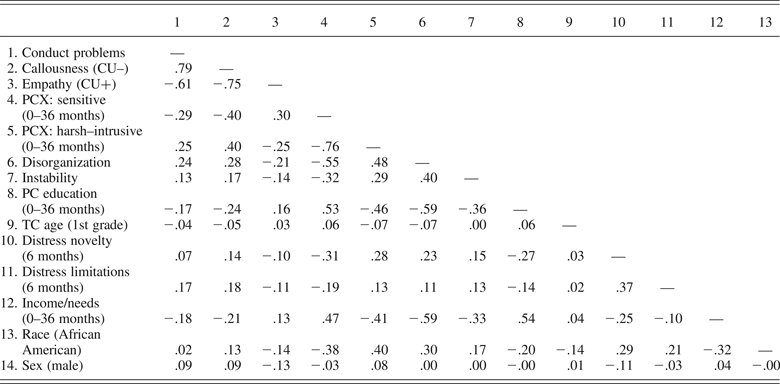
Bivariate correlations between all variables appear in Table 1. Three points are noteworthy. First, the three dimensions of children's behavior that served as the outcomes were strongly associated with each other (|r|s = .61–.79, all ps < .001). Similarly, the two dimensions of observed parenting (r = –.76, p < .001) were negatively correlated, as were the two dimensions of chaos (r = .40, p < .001). These correlations underscored the importance of testing the unique contributions of predictors of behavioral outcomes. Second, both sensitive and harsh–intrusive dimensions of observed parenting behaviors exhibited moderated-sized associations with conduct (rs = –.29 and .25, respectively), callous unemotional (rs = –.40 and .40, respectively), and empathetic (rs = .30 and –.25, respectively) behaviors at first grade (all ps < .001). These correlations were not informative of whether either dimension of parenting was more strongly associated with any behavioral outcome. Similarly, chaos disorganization, chaos instability, household income, and parental education were all significantly associated with all three behavioral outcomes, albeit of smaller magnitude than parental variables (|r|s = .13–.28, all ps < .001). Third, among the two indicators of chaos, disorganization appeared more strongly associated with parental education (rs = –.59 vs. –.36) and household income to needs (rs = –.59 vs. –.33) than did instability.
Bivariate correlations among key study variables

Note: N = 1,230. All |r|s > .06 were significant at p < .05. PCX, Parent–child interaction codes; PC, primary caregiver; TC, target child.
Path analysis (independent main effects)
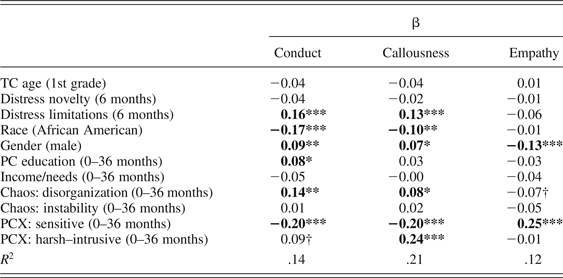
An initial path model simultaneously regressed conduct problems, callousness, and empathetic behavioral outcomes onto the set of child covariates (temperament, age, sex, and race), and two indicators each of SES (parental education and household income), chaos (disorganization and instability), and caregiver behaviors (sensitive, harsh–intrusiveness). A synopsis of standardized regression coefficients for all predictors is provided in Table 2. Although child gender (boys were rated as having more disruptive behaviors than girls), race (African American children were rated as having more disruptive behavior by their parents than were Caucasian children), and temperament (parent ratings of higher distress to limitations in infancy was predictive of parent ratings of disruptive behaviors) were consistently significant predictors, we focus on the unique contributions of SES, chaos, and parenting, because they directly inform study questions.
Standardized regression coefficients for the prediction of parent-reported conduct, callous, and empathetic behaviors at 1st grade

Note: N = 1,230. TC, Target child; PC, primary caregiver; PCX, Parent–child interaction codes.
†p < .10. *p < .05. **p < .01. ***p < .001.
CP
Maternal education (β = 0.08, p = .04), chaos disorganization (β = 0.14, p = .001), and positive parenting (β = –0.20, p < .001) were all significant predictors of children's CP. Whereas the point estimates for disorganization and sensitive parenting were in the expected directions (higher disorganization and lower levels of positive parenting were associated with higher levels of CP), the point estimate for educational attainment was counterintuitive (higher education was associated with modestly higher reports of CP). Neither household income, chaos instability, nor harsh–intrusive were uniquely predictive. The set of predictors explained 14% of the observed variation in CP.
CU behaviors
Chaos disorganization (β = 0.08, p = .05), sensitive (β = –0.20, p < .001), and harsh–intrusive (β = 0.24, p < .001) caregiving behaviors were all significant predictors of CU behaviors. None of the indicators of SES or chaos instability made unique contributions. The set of predictors explained 21% of the observed variation in CU behaviors.
Prosocial–empathetic behaviors
Sensitive (β = 0.20, p < .001) caregiving was a significant predictor of empathetic behaviors. None of the indicators of SES or chaos made unique contributions. The set of predictors explained 12% of the observed variation in empathetic behaviors.
Path analysis (chaos as moderator of caregiving behaviors)
A second path model was estimated that included four two-way interaction terms (i.e., Disorganization × Sensitivity, Disorganization × Harsh–Intrusiveness, Instability × Sensitivity, Sensitivity × Harsh–Intrusiveness) as predictors of all three behavioral outcomes. This model tested whether the predictive effects of parenting behaviors on CP were conditional on levels of chaos instability or disorganization. We conducted a block test of the joint significance of the set of four interaction terms in the prediction of each behavioral outcome. The block test was not significant for CP, χ2 (4) = 1.7, p = .80, CU behaviors, χ2 (4) = 1.8, p = .77, or empathetic behaviors, χ2 (4) = 3.3, p = .52. Moreover, none of the individual interaction terms in the prediction of any of the three outcomes was statistically significant (ps > .05).
Path analysis (caregiving behaviors as mediators of chaos and SES)
A third path model was estimated that represented an alternative parameterization to the first (main effects) model. Specifically, all three behavioral outcomes were regressed on the full set of predictors. In addition, sensitive and harsh–intrusive caregiving behaviors were regressed on the remaining predictors. This parameterization facilitated tests of whether any of the SES (caregiving education and household income) or chaos (instability and disorganization) indicators were indirectly associated with child behavioral outcomes through intermediate effects on caregiving behaviors.
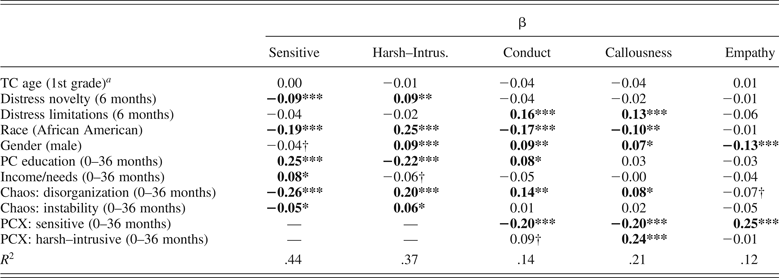
As summarized in Table 3, all four of the socioeconomic and chaos predictors were uniquely associated with sensitive caregiving behaviors (education β = 0.25, p < .001; household income β = 0.08, p = .01; chaos disorganization β = –0.26, p < .001; chaos instability β = –0.05, p = .03). A similar set of associations (though opposite in sign) were evident for harsh–intrusive caregiving behaviors (education β = –0.22, p < .001; household income β = –0.06, p = .07; chaos disorganization β = 0.20, p < .001; chaos instability β = 0.06, p = .02). The full set of child covariates, SES and chaos predictors, explained 44% and 37% of the observed variation in sensitive and harsh–intrusive caregiving behaviors, respectively. The predictive associations from sensitive and harsh–intrusive caregiving behaviors to children's behavioral outcomes were unchanged from the previous model (cf. coefficients from Tables 2 and 3).
Standardized regression coefficients from path model involving caregiver behaviors as mediators

Note: N = 1,230. TC, Target child; PC, primary caregiver; PCX, Parent–child interaction codes.
a Bivariate correlation, not regression coefficient.
†p < .10. *p < .05. **p < .01. ***p < .001.
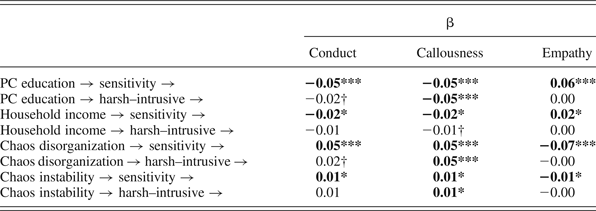
A synopsis of the standardized regression coefficients that reflect all 24 indirect effects (four predictors [education, income, chaos disorganization, chaos instability] × two mediators [sensitive and harsh–intrusive caregiving] × three behavioral outcomes [conduct, callous-unemotional, empathetic]) is provided in Table 4. Although the number of specific indirect effects was too numerous to consider individually, three points were evident. First, all four indicators of SES and chaos were significantly indirectly associated with all three behavioral outcomes (i.e., all 12 indirect effects involving sensitivity were statistically significant). Second, consistent with the main effects path model, harsh–intrusive caregiving behaviors were only indirect effects for CU but not CP or empathetic behaviors outcomes (i.e., 3 of the 12 indirect effects involving harsh–intrusive behaviors were statistically significant). Third, regardless of the predictor or caregiving mediator, the magnitude of all indirect effects were uniformly small (|βs| = 0.01–0.05).
Synopsis of indirect effects from socioeconomic status and chaos indicators to child behavioral outcomes through caregiving behaviors

Note: N = 1,230. PC, Primary caregiver.
†p < .10. *p < .05. ***p < .001.
Discussion
There is a growing scientific literature examining the associations between early environments and the emergence of CU behaviors in young children. Whereas decades of research have supported both correlational (Magnuson & Votruba-Dfzal, Reference Magnuson, Votruba-Drzal, Danziger and Cancian2009; Yoshikawa et al., Reference Yoshikawa, Aber and Beardslee2012) and causal (Costello et al., Reference Costello, Compton, Keeler and Angold2003; Gennetian & Miller, Reference Gennetian and Miller2002) associations between distal and proximal contextual influences on early CP, this literature is just beginning to accumulate for CU behaviors. This is largely due to a growing appreciation that CU-related behaviors (including their inverse, empathy) can be reliably measured in early and middle childhood (Dadds, Fraser, Frost, & Hawes, Reference Dadds, Fraser, Frost and Hawes2005; Muñoz & Frick, Reference Muñoz and Frick2007; Willoughby et al., Reference Willoughby, Mills-Koonce, Gottfredson and Wagner2014). Moreover, the inclusion of the new limited prosocial behavior qualifier in the DSM-5 criteria for conduct disorder promises to accelerate the accumulation of studies that consider precursors to CU behaviors in the presence of CP. Within the past several years, new studies have reported genetic and environmental influences interact in the prediction of CU behaviors (Sadeh et al., Reference Sadeh, Javdani, Jackson, Reynolds, Potenza and Gelernter2010; Willoughby et al., Reference Willoughby, Mills-Koonce, Propper and Waschbusch2013), developmentally informed interventions demonstrate success in reducing CP and CU behaviors in children (Hawes & Dadds, Reference Hawes and Dadds2007), and measures of CU behaviors in toddlerhood and early childhood are allowing for community and population-based samples of children to be studied much earlier than previously examined (Willoughby et al., Reference Willoughby, Mills-Koonce, Gottfredson and Wagner2014). The current study extends this growing literature by applying bioecological and family stress models to the study of CP and CU behaviors within distal (SES), intermediate (household chaos), and proximal (parent–child interactions) developmental contexts.
Much of the developmental research on CP and CU behaviors has characterized the parent–child relationship as the proximal source of environmental influence on young children's development. However, the parent–child relationship is nested within broader contexts of interest, such as the household dynamic and socioeconomic influences on the family. The current study examined the interplay among these contexts by considering potential interaction across levels in the prediction of CP and CU behaviors as well as mediating pathways through which more distal context may exert effects via more proximal contexts. Given that the key findings from these analyses come from the mediation analyses, we will begin by discussing those pathways.
This is one of the first studies to apply bioecological and family stress models to a simultaneous examination of associations between SES, household chaos, parenting behaviors, and CP and CU behaviors in early childhood. Based on the original path analysis examining independent main effects, there were weak associations between more distal contextual variables (parent education and household disorganization) and CP when parenting behaviors were included in the model. This was especially true for the callousness dimension of CU behavior (only household disorganization was significant), and none of the distal influences were significant predictors of the empathy dimension of CU behavior. In these models, household instability was not associated with any of the outcomes as a main effect, whereas sensitive parenting was moderately associated with all outcomes, and harsh–intrusive parenting was uniquely and moderately associated with callousness. However, these main effect models limited the overall picture of the dynamics between these developmental ecologies. Subsequent path analyses indicated that although SES and household chaos variables tended not to be directly associated with child behavioral outcomes, they were indirectly associated through their intermediate effects on observed parenting behaviors. Specifically, individual differences in parents’ education levels, family income, household disorganization, and household instability were associated with all three behavioral outcomes via their associations with maternal sensitivity. Furthermore, parental harsh–intrusiveness mediated associations between parents’ education levels, family income (marginal effect), household disorganization, and household instability with child callousness. These indirect effects provide empirical support for the long-held notion that distal ecologies are important for children's behavioral development due to their influence on more proximal ecologies.
The findings that parental sensitivity is a predictor of CP and CU behaviors as well as a mediator of broader contextual environments is consistent with findings from other studies on these topics (Mistry et al., Reference Mistry, Vandewater, Huston and McLoyd2002; Mrug & Windle, Reference Mrug and Windle2009; Zvara et al., Reference Zvara, Mills-Koonce, Garrett-Peters, Wagner, Vernon-Feagans and Cox2014). Sensitive parenting has been associated with many of the phenotypic and endophenotypic developmental constructs thought to underlie variation in CP and CU behaviors. For example, lower levels of sensitive parenting are associated with (a) higher levels of child emotional, behavioral, and psychophysiological reactivity (Perry, Calkins, & Bell, Reference Perry, Calkins and Bellin press), (b) lower levels of child self-regulation (Propper & Moore, Reference Propper and Moore2006) and executive functioning (Bernier et al., Reference Bernier, Carlson and Whipple2010), (c) lower levels of child mindfulness and emotion knowledge (Kujawa et al., Reference Kujawa, Dougherty, Durbin, Laptook, Torpey and Klein2014), and (d) lower levels of prosocial and empathetic functioning (Farrant, Devine, Maybery, & Fletcher, Reference Farrant, Devine, Maybery and Fletcher2012). It is interesting that parental harsh–intrusiveness, although often associated with CP behaviors, was only associated with callousness in the current analyses (when parental sensitivity was simultaneously considered). Given that the dimension of harsh–intrusive parental behavior is characterized by elevated parental intrusive control, low levels of support and validation for child autonomy, and verbal and physical hostility directed toward the child, it is not surprising that this interactive context is associated with higher levels of callousness directed toward others. From a cognitive learning perspective, such parenting behavior provides a model by which children learn that dominance and hostility with disregard for others is acceptable, if not appropriate, social behavior. Moreover, children may also attenuate their biobehavioral responses to parental hostility as an adaption to the chronic stress of their hypervigilant state and emotional insecurity (Sturge-Apple, Davies, Cicchetti, & Manning, Reference Sturge-Apple, Davies, Cicchetti and Manning2012). A by-product of this adaptation may an inadvertent reduction in children's own dissonant biobehavioral responses to their own displays of callousness that otherwise would generated negative biofeedback to limit and reduce such behaviors. The finding that sensitive and harsh–intrusive parenting were jointly predictive of callousness replicates and helps to integrate the results of two earlier studies that reported either positive (Hawes et al., Reference Hawes, Dadds, Frost and Hasking2011) or negative (Waller et al., Reference Waller, Gardner, Hyde, Shaw, Dishion and Wilson2012) aspects of parenting as being uniquely related to callousness.
Whereas the associations between parenting behaviors and CP and CU behaviors are consistent with both conceptual models and recent empirical findings, the current study is one of the first to simultaneously examine two domains of distal influence. Family stress models have long examined the roles of SES variables in family functioning and child development; however, household chaos has rarely been included in such analyses. The findings that both household disorganization and household instability each contributed to indirect effects on CP and CU behaviors, above and beyond family income and parental education, is an important contribution of this study. Perhaps this is not surprising given that household disorganization, although not as proximal to the child as direct parenting behaviors, is more proximal to the child's experience than family income and parent education. The unsafe home environments, high levels of noise and clutter, as well as a general lack of preparedness of the family for day-to-day events are ever-present conditions that children directly experience and to which they must adapt. In such contexts, children may adapt by developing hypervigilant biobehavioral profiles due to a lack of safe physical spaces to recover and regulate emotional experiences. They may develop more externalizing approaches to interacting with a world that is seen as competitive instead of supportive. In households characterized by instability (as well as disorganization), children may also reduce the amount of emotional connections they establish with others given the unpredictability of the presence or absence of these relationships over time. Although based on the current analyses, many of the associations between household chaos and CP and CU behaviors are mediated via parenting behaviors, household disorganized remained as a main effect predictor of CP and callousness, suggesting that more research is needed to better understand the ways in which these experiences may be associated with child outcomes.
In contrast to the findings by Chen et al. (Reference Chen, Deater-Deckard and Bell2014), we did not find evidence for household chaos to serve as a moderator of the effect of parenting behaviors on child CP or CU behaviors. This inconsistency may be a result of different forms of measurement. Like most previous studies, Chen et al. used parental report of household chaos that was calculated as a single index. The current study uses more objective data that were aggregated across time and that distinguished household disorganization from household instability as separate components of chaos. In addition to differences in measurement, it is possible that differences in samples produced distributions of household chaos variables and parenting variables that are more highly intercorrelated and thus reducing the likelihood of being able to detect a significant interaction between these variables (while perhaps increasing the likelihood of detecting mediating pathways between them). As such, although it is sensible that the effects of nonoptimal parenting would be most deleterious in the context of unstable and disorganized households, we did not find evidence to support such suppositions in the current study.
There are several aspects of the current study that strengthen the interpretations of the findings discussed above. First, there are few studies of CU behaviors that span measurements across infancy and toddlerhood and in turn report associations with child behaviors downstream in first grade. By utilizing a prospective longitudinal design, we are able to demonstrate potential effects of cumulative experiences across multiple levels of the child's early environment. Moreover, our results highlight the potentially central importance of early life experience as initiating children's prosocial (empathy) and antisocial (conduct and callous) behavioral development. Second, high-quality, intensive observational measures of SES, household chaos, and parent–child interaction behaviors were measured repeatedly over this period and apply multiple-method and multiple-informant approaches to data collection that reduce the likelihood of Type I errors due to same-source biasing of data across measures. Third, the size of the current birth cohort sample, and the rigorous sampling procedures and low levels of attrition, allow this study to examine the naturally occurring ranges of environmental contexts (including socioeconomic, familial, and parental) and child behavioral outcomes (including normative, subclinical, and clinical levels of child problem behaviors). The methodological rigor of the current study allows for sound empirical testing of several hypotheses previously unaddressed in the research literature on early CP and CU behaviors.
Despite these strengths, there are limitations to this study that should be acknowledged and considered when interpreting overall effects. The distal and proximal variables were measured contemporaneously, and each aggregated across the first 3 years of life. Although this is necessary for measures such as household instability (in that instability by definition must be measured across time), it does result in path models in which the predictors (SES and chaos) and mediators (parenting behaviors) are synced together in time. In addition, it prevents us from testing hypotheses regarding specific points of vulnerability across early developmental periods. Another limitation is that the child outcomes are based solely on parent report. We attempted to reduce potential bias by including other constructs using parental report as covariates; however, we cannot entirely eliminate the possibility of a reporter confound effect. In addition, regarding the interpretation of effects, we elected not to control for family-wise error rates or adjust significant values in the current analyses because there currently is no standard for expected associations between many of the variables examined in this study (i.e., household chaos and CU behavior). Given the sample size and subsequent statistical power available in these analyses, an adjustment of significance levels would likely not change most of the “significant findings”; however, we included effect sizes (standardized coefficients) for better interpretation of associations, and note that the magnitude of direct and indirect effects were relatively small to moderate in size (although consistent internally and with theoretical expectations).
As one of the first studies to apply bioecological and family stress models to examine SES, household chaos, parenting, and CP and CU behaviors from infancy to middle childhood, this paper highlights the potential relevance of multiple aspects of the environment for emerging problems behaviors. Furthermore, the importance of examining the interplay across ecological levels is also evidenced. Several questions remain for future research on this topic. Although studies such as this highlight the potential for environmental influences on CU behaviors, genetically informed studies that can reduce or eliminate potential gene–environment correlations are needed to provide stronger evidence that the presence of environmental associations with CU behaviors are not simply the product of passive or evocative genetic effects within the family. In addition, the associations between household disorganization and child outcomes were not fully mediated by parenting behaviors, suggesting either that household disorganization may serve as a proximal source of influence or that there are proximal mediators (other than the parenting behaviors studied here) that serve as mediators of household disorganization. These findings may inform ongoing and future applied research programs examining parent-based interventions as mechanisms for preventing or alleviating early CP and CU behaviors. Evidence suggests that externally manipulating parenting behaviors can reduce both CP and CU behaviors (Waller et al., Reference Waller, Gardner and Hyde2013), but rarely do these studies consider the broader context of the family system that may be influencing parenting or influencing children's development beyond the functioning of the parent–child dyad. In addition to replication of the current basic research findings, new applied research should consider incorporating multiple levels of household functioning as both targets and sources of potential moderation of intervention effects. Finally, the current analyses consider CP and CU behaviors independently from one another; future research should directly examine predictors of their co-occurrence to determine if there are unique pathways to their joint emergence as compared to their simultaneous but independent emergence across early development.