INTRODUCTION
The porbeagle shark Lamna nasus (Bonnaterre, Reference Bonnaterre1788) is a large lamnid shark distributed circumglobally in subtropical and temperate, pelagic and epipelagic waters (Last & Stevens, Reference Last and Stevens1994). This aplacental viviparous (Dulvy & Reynolds, Reference Dulvy and Reynolds1997) and long living (Campana et al., Reference Campana, Natanson and Myklevoll2002; Natanson et al., Reference Natanson, Mello and Campana2002) species is an apex predator feeding on intermediate to higher levels of the food web (Bowman et al., Reference Bowman, Stillwell, Michaels and Grosslein2000). The porbeagle shark populations are suffering from overexploitation, either as incidental or target catch, of their stocks worldwide (Stevens et al., Reference Stevens, Fowler, Soldo, McCord, Baum, Acuña, Domingo and Francis2006). These threats are particularly effective on all populations of Mediterranean larger sharks that have been dramatically declining in the area, even to local extinction of some species (Ferretti et al., Reference Ferretti, Myers, Serena and Lotze2008). The reduction or even extinction of those populations could consequently lead to a strong disequilibrium of the biomass and energy flows throughout marine trophic levels (Ferretti et al., Reference Ferretti, Worm, Britten, Heithaus and Lotze2010). The problem concerning conservation and management of porbeagle shark populations first was taken into consideration by some countries bordering the north-east Atlantic around the mid-1980s and then the species attracted an increasing conservation interest at international (Annex 1 of United Nations Convention on the Law of the Sea alias UNCLOS; Decision 13.42 of Convention on International Trade in Endangerd Species of Wild Fauna and Flora alias CITES) and regional level (catch levels and quotas for north Atlantic and southern Oceans; Appendix III of Bern Convention and Annex III of Barcelona Convention for Europe and Mediteranean Sea) (Stevens et al., Reference Stevens, Fowler, Soldo, McCord, Baum, Acuña, Domingo and Francis2006). Nevertheless, the dramatic decline of porbeagle shark populations is still in progress worldwide, as international political agreements are often not achieved, management and control of fisheries are often lacking and/or conservation measures undertaken are sometimes ineffective (Stevens et al., Reference Stevens, Fowler, Soldo, McCord, Baum, Acuña, Domingo and Francis2006). As a matter of fact, such a shark is actually classified as vulnerable (A2bd + 3d + 4bd) on the International Union for Conservation of Nature (IUCN) Red List.
Present in the Mediterranean in the past, though at low density (Ferretti et al., Reference Ferretti, Myers, Serena and Lotze2008), the porbeagle shark seems to have virtually disappeared from the Mediterranean Sea (Stevens et al., Reference Stevens, Fowler, Soldo, McCord, Baum, Acuña, Domingo and Francis2006). Based on the latest Mediterranean records (Marconi & De Maddalena, Reference Marconi and De Maddalena2001; Orsi Relini & Garibaldi, Reference Orsi Relini, Garibaldi, Vacchi, La Mesa, Serena and Seret2002), some authors (Stevens et al., Reference Stevens, Fowler, Soldo, McCord, Baum, Acuña, Domingo and Francis2006) have hypothesized the existence of a nursery area for this species in the central Mediterranean. The present findings were discussed in the context of historical occurrences of the porbeagle shark in the Mediterranean Sea. Overall, data confirmed on the one hand the rarity of the porbeagle shark in the Adriatic Sea also, and, on the other hand, they suggested some relation between the density of the findings for this species and the presence of a pit zone in the central part of the Adriatic Sea.
MATERIALS AND METHODS
The by-catch of the two sharks described in this paper occurred during the monitoring of gill net artisanal fishing activity in the central Adriatic Sea. Such a gear, that is usually used to target the Mediterranean hake Merluccius merluccius, was a 5 m high fixed gill net, called ‘Merluzzara', with a nylon square mesh of 5 cm side and for 25 mm in line diameter. The net is usually set at sea floor around dawn and recovered after a few hours depending on the sea state and the fishermen's experience. Taxonomic identification and morphometric measures were carried out according to the dichotomic keys and meristics provided by Compagno (Reference Compagno and Carpenter2002). Specimens were photorecorded, measured to nearest cm and weighted to nearest kg by means of a tape measure and of a 1000 kg dynamometer, respectively. Sexual maturity was assessed by external examination of claspers following the method proposed by Jensen et al. (Reference Jensen, Natanson, Pratt, Kohler and Campana2002).
RESULTS
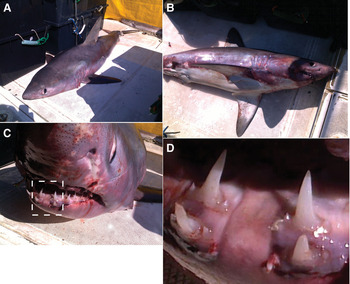
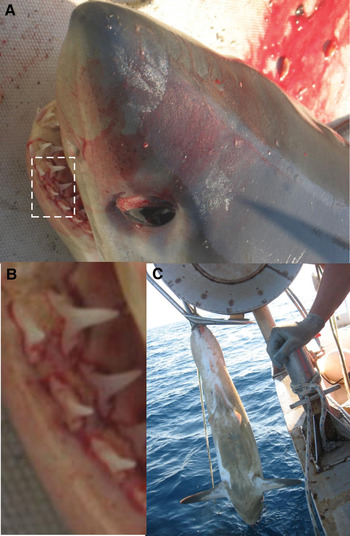
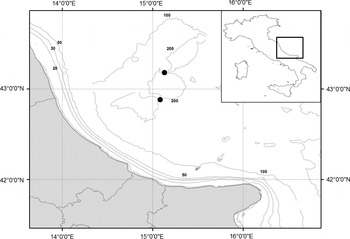
The 150 (Figure 1) and the 200 (Figure 2) cm total length (TL) porbeagle shark specimens were incidentally caught on 7 July 2010 and on 19 August 2011, respectively, during two distinct summer fishing trips in the central Adriatic Sea (Figure 3). Fishing data on the incidental catches are summarized in Table 1. Both individuals were brought on-board dead likely because suffocation occurred in the net. Based on the dichotomic key used, the two sharks were identified as porbeagle sharks mainly because of teeth shape provided with two lateral cusps (Figures 1D and 2B), the free rear tip of first dorsal fin whitish in colour, the origin of the second dorsal fin above that of anal fin and the caudal fin with a secondary keel. Essential morphometric data are summarized in Table 2. According to clasper length and consistency, the 150 and 200 cm TL specimens were found to be a sub-adult (Figure 1B) and an adult individual (Figure 2C), respectively. A hook was noticed inserted on the left side (frontal view) of the upper jaw in the subadult specimen (Figure 1C).
Images of a subadult Lamna nasus incidentally caught in the central Adriatic Sea: (A) dorsal view; (B) ventral view; (C) mouth; (D) tooth details. Dashed rectangle in picture (C) encloses the area magnified in picture (D).

Images of an adult Lamna nasus incidentally caught in the central Adriatic Sea: (A) head and mouth (B) tooth details; (C) ventral view. Dashed rectangle in picture (A) encloses the area magnified in picture (B).

Map of the central Adriatic Sea and GPS coordinates where incidental catches (dark dots) of two Lamna nasus specimens occurred. Depth contours are also reported.

Fishing data on the incidental catch of two Lamna nasus in the central Adriatic Sea.

Morphometric measurements of two Lamna nasus by-caught in the central Adriatic Sea: all lengths are expressed in centimetres and weight in kilograms.

DISCUSSION
The incidental catch of the two porbeagle sharks described in this paper is the first documented record in the last nine years after the latest two occurrences published for this species in the Adriatic Sea (Marconi & De Maddalena, Reference Marconi and De Maddalena2001; Orsi Relini & Garibaldi, Reference Orsi Relini, Garibaldi, Vacchi, La Mesa, Serena and Seret2002). The historical dataset for the Adriatic Sea indicated a very low abundance for the porbeagle shark with only nine records in the eastern Adriatic during a period of about 100 years (Soldo & Jardas, Reference Soldo, Jardas, Vacchi, La Mesa, Serena and Seret2002). In the western sector of the Italian seas the latest record dates back to 2002 with two young of the year specimens as by-catch in the western Ligurian Sea (Orsi Relini & Garibaldi, Reference Orsi Relini, Garibaldi, Vacchi, La Mesa, Serena and Seret2002). Historical data for western Italian waters also reported only 15 specimens in the North Tyrrhenian Sea and Ligurian Sea during a few decades of observation (Serena & Vacchi, Reference Serena and Vacchi1997). On a Mediterranean scale, the actual abundance of the porbeagle shark is reported to be dramatically low both as landing (1t in 1996 only by Malta) from Mediterranean official statitiscs (FAO, 2002, 2003) and as by-catch data (0 catches) from a quite recent study on swordfish longline by-catch in the western Mediterranean (De La Serna et al., Reference De la Serna, Valeiras, Ortiz and Macias2002). Other authors (Megalofonou et al., Reference Megalofonou, Domralas, Yannopoulos, De Metrio, Deflorio, De La Sema and Macias2000), evaluating by-catches and discards of sharks in the large pelagic fisheries, reported the by-catch of only 15 specimens by drift nets during a one year (1998–1999) sampling period in the southern Adriatic Sea and Ionian Sea. The present finding also highlights the importance of incidental catch as a major threat for the Mediterranean population of Lamna nasus, which, being a low density species in the Mediterranean has never been the target of a direct fishery (Tudela, Reference Tudela2004). Differently from the majority of by-catches reported for the Mediterranean, the present samples were incidentally caught by a gill net set for catching demersal bony fish, namely for the European hake Merluccius merluccius. Globally, porbeagle shark populations are affected by a variety of fishing gears and techniques, depending on the primary targeted species (longlines, gill nets, driftnets, pelagic and bottom trawls, handlines and recreational; Stevens et al., Reference Stevens, Fowler, Soldo, McCord, Baum, Acuña, Domingo and Francis2006) but longlines are actually the main source of by-catch for the porbeagle shark as reported by several authors (Gauld, Reference Gauld1989; Bonfil, Reference Bonfil1994; DFO 2001a, b; Heessen, Reference Heessen2003).
Conversely from the latest records on two young of the year individuals from the central Adriatic (Marconi & De Maddalena, Reference Marconi and De Maddalena2001; Orsi Relini & Garibaldi, Reference Orsi Relini, Garibaldi, Vacchi, La Mesa, Serena and Seret2002), the 150 and 200 cm TL males described in this paper were a subadult and an adult specimen, respectively, according to external examination of their clasper and this is in agreement with size at first maturity estimated by other authors for other areas of the northern hemisphere (Kohler et al., Reference Kohler, Casey and Turner1995; Anonymous, 2009). Based on the present, the latest (Marconi & De Maddalena, Reference Marconi and De Maddalena2001; Orsi Relini & Garibaldi, Reference Orsi Relini, Garibaldi, Vacchi, La Mesa, Serena and Seret2002) and the historical (Soldo & Jardas, Reference Soldo, Jardas, Vacchi, La Mesa, Serena and Seret2002) records for the Adriatic sea, the porbeagle shark appears to be somehow more dense in the central Adriatic Sea with respect to other Mediterranean sub-basins. In fact, the present specimens were caught near a pit area of the sea bed, namely the Jabuka-Pomo pit. Such an area represents a very important nursery area for M. merluccius and Nephrops norvegicus (Arneri & Morales Nin, Reference Arneri and Morales-Nin2000), owing to its high productivity resulting from one of the most important geo-oceanographic and hydrological peculiarities in the Adriatic Sea (International Commission for Scientific Exploration of the Mediterranean Sea alias CIESM, Reference Briand2011). Overall, this could be an indication of some relation existing between such a higher occurrence density for this species and the presence of a hydrologically important pit zone (i.e. Jabuka-Pomo pit) in the central Adriatic Sea. The Jabuka-Pomo pit could function as a favourable environment for some key life history stages of the porbeagle shark, for instance for mating, pupping and nursery areas, and/or for feeding ground. The importance of deep environments as essential habitat for key life history stages of large migratory sharks has been recently discussed by other authors (Campana et al., Reference Campana, Joyce and Fowler2010) who, based on data from pop-up archival transmission tags, hypothesized the existence of a porbeagle shark pupping group in the Sargasso Sea.
The Jabuka-Pomo pit, an area of 2100 km2 located outside the national boundaries, was jointly declared a Biological Protection Zone by Italy and Croatia in 1998 (CIESM, Reference Briand2011) but it is actually considered a vulnerable habitat, mainly due to unregulated trawl fishing activity (AdriaMed, 2000), in the Mediterranean high seas (de Juan & Lleonart, Reference de Juan and Lleonart2010). As confirmed by the rare occurrences described in the present paper, the Jabuka-Pomo pit could represent an area of even greater biological value which urgently needs conservation and management measures on an international scale. A similar conservation perspective should be adopted for the entire central Mediterranean Sea, which is supposed to be an important nursery area for the highly migratory lamnid sharks, such as L. nasus (Stevens et al., Reference Stevens, Fowler, Soldo, McCord, Baum, Acuña, Domingo and Francis2006) and the great white shark Carcharodon carcharias (Fergusson, Reference Fergusson, Klimley and Ainley1996).
ACKNOWLEDGEMENTS
We are particularly grateful to Enzo Natale and his crew for hospitality on-board and collaboration. We also thank the anonymous referees who reviewed this note. This research received no specific grant from any funding agency, commercial or not-for-profit sectors.