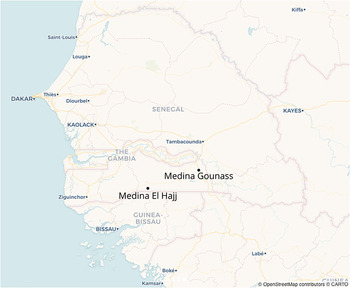
In 1935, The Fulɓe Islamic community of Medina El Hajj in southern Senegal faced a test following the death of its founder, Al-Hajj Aali Caam. As a result of a succession crisis, the community splintered, with about eleven hundred people leaving alongside a charismatic young cleric, Mamadou Saidou Ba. Ba and his disciples traveled one hundred miles to the east to the district of Kantora. The district chief Yero Sabaly was desperate to increase the population under his control, so he welcomed Ba’s followers and gave them land in an unpopulated area of his district, far from any significant road or population center. He also exempted this new community from taxation and forced labor (interview with Idrissa & Mohamadou Sow, Medina Gounass, Senegal, March 1, Reference Sow2017). The location of Medina Gounass, less than forty miles from Senegal’s borders with the Gambia, Guinea-Bissau, and Guinea, would prove crucial in the town’s development (Figure 1). Within a decade, this new village grew to be the largest community in its subdivision and the second largest in the entire region. By that point, Ba was, according to colonial reports, the “only important marabout [cleric]” in the subdivision, whose “influence extends from French and Portuguese Guinea to the Gambia and to neighboring subdivisions and cercles [regions]” (ANS 1945). Despite the town’s rapid growth, it did not engage with the French colonial state. The community was focused on religion and agriculture, and there was no French language education—only Qur’anic schooling was allowed. To this day, the nearly fifty thousand people who live in Medina Gounass exist in an extra-national territory, within the bounds of Senegal but in many ways not fully part of it (ANSD 2017).Footnote 1
Location of Medina Gounass and Medina El Hajj. Made by the author using CARTO.

Medina Gounass represents an alternative conception of geography to that put forth by colonial or postcolonial states. Because of their location near three of Senegal’s borders, the clerics of Medina Gounass and their disciples were able to create a relatively autonomous community. The town’s leadership has actively cultivated a detachment from local and national governments since its founding in 1935, seeing state control as detrimental to the religious lives of its citizens, as well as to its own religious and economic networks. The residents of Medina Gounass have essentially exiled themselves within the bounds of the Senegalese state in an attempt to create a space “uncorrupted” by secular colonial and postcolonial governments. While other religious groups—such as the Muridiyya—have built their autonomy through a close, if often fraught and complicated, relationship with the Senegalese state, the Tijaniyya of Medina Gounass developed and reinforced this autonomy through their borderland location and connections. They also developed internal spatial dynamics in an attempt to limit interactions with the outside world, yet they simultaneously cultivated external economic and religious relationships across borders that helped create distance from the Senegalese state. These dynamics follow Michel Ben Arrous’ concept of “geography from below,” geographies of the spatial networks of dissidence (Reference Ben Arrous1996, Reference Ben Arrous, Arrous and Ki-Zerbo2009). However, in recent decades, this autonomy has increasingly come under threat.
The clerics of Medina Gounass refer to their larger community of disciples—in the city and elsewhere—as a dental. In Pulaar, the Fulɓe language, “dental” refers to community in the broadest possible sense. The term is often specifically used to define the bounds of a religious community, as is the case with Medina Gounass. Though the dental stretches outside of Medina Gounass, its separation from colonial and postcolonial states is limited to the boundaries of the city. However, there are other communities related to Medina Gounass that have similarly distanced themselves from governments. Viewing Medina Gounass’ autonomy as a geographic and territorial undertaking opens up space for understanding other alternative geographic visions in colonial and postcolonial Africa.
In a manner similar to communities along the South Africa-Lesotho border, the residents of Medina Gounass formed an “interior world” that was essentially an “autonomous node[s] of power, trade, and kinship” (King & Challis Reference King and Challis2017:216). The idea of interior or “indigenous worlds” comes out of indigenous communities and polities in the United States. Through these interior worlds, communities developed new spatial relationships despite the growing presence of settler colonialism (Hele Reference Hele2008; Zappia Reference Zappia2014). Modern maps obscure the contested nature of sovereignty in North America well into the nineteenth century, an observation that holds for much of twentieth century Africa as well (Barr Reference Barr, Sleeper-Smith, Barr, O’Brien and Shoemaker2015). In the case of Medina Gounass, maps suggest a reality unrepresentative of conditions on the ground. Clear cartographic boundary lines conceal a complicated and murky contestation over sovereign space and the ways states are sometimes unable to exercise authority in the face of alternative governmental, social, and religious structures.Footnote 2 Moreover, these overlapping authorities have long histories in Africa, where heterogenous, overlapping spaces and networks exist throughout the continent (Ben Arrous Reference Ben Arrous1996:14; Amselle Reference Amselle, Amselle and M’Bokolo1999:23–24). These overlapping spaces included those of Fulɓe communities speaking several variations of the same language, known as Pular in Fuuta Jalon, Pulaar in Fuuta Tooro, and Fulakunda in southern Senegal. Medina Gounass features speakers of each of these variations of Pulaar, primarily Pulaar and Fulakunda.
Medina Gounass was founded under French colonial rule; the town existed physically within Senegal’s geographic territory, but its residents did not accept the jurisdiction of colonial rule within the town’s boundaries. As Penny Edwards argues regarding Cambodia, colonial rule “did not bring about a universal, homogenizing compression of time and space. Instead, it introduced a parallel realm with its own sense of time, its own lines of authority, and its own skein of power relations” (Reference Gutelius2007:248). This disjuncture was even more extreme in the example of communities such as Medina Gounass, where the town’s leaders set up parallel institutions of governance in a rejection of colonial sovereignty.
Colonial governments sought to create bounded containers with legible populations contained by borders. However, the reality on the ground was quite different, as “the expansion of European spatiality and the logics of the territorial state did not eradicate alternative visions of boundary and spatial order but were negotiated into complex hybrid borderscapes” (Diener & Hagen Reference Diener and Hagen2009:1205). Though these alternative concepts of “boundary and spatial order” existed across the colonial world, they are most apparent in communities such as Medina Gounass. The community existed like a city-state, with its institutions of governance disconnected from colonial institutions. Across the region, Fulɓe populations have been conscious of how borders were created and, while accepting them as geographical markers, have often acted as if those borders are illegitimate in structuring everyday activities. As such, they have rejected what William Connolly (Reference Connolly1991:465) has referred to as the “politics of forgetting.” Many borders globally function through the idea that in order to legitimize territorial boundaries, one must forget or ignore their violent and undemocratic origins (Anderson & O’Dowd Reference Anderson and O’Dowd1999:596). Instead of accepting these geographies as legitimate, the clerics of Medina Gounass established their own boundaries between the “sacred” space of their community and the “corrupted,” external, colonial and postcolonial world of Senegal and its neighbors. However, this moral rejection of the secular world exists alongside a seedier side of the city, which has come to be associated by many with drug trafficking, sexual violence, and lawlessness.
The leaders of Medina Gounass have constructed this internal and external geography by mediating the community’s relationship with the outside world, controlling the town’s economics, keeping governmental structures out of the town, and creating parallel structures under their control. The community’s economic ties across borders have given it the capacity to reject valuable governmental resources, resources that at times have been wanted by many. The dental of Medina Gounass provides both economic and spiritual resources for the town, allowing it to distance itself from Senegal despite its location within the country’s boundaries. This incomplete autonomy is part of a larger tradition of fergo, or self-imposed exile, whereby Fulɓe communities have sought to remove themselves from impure, non-Islamic spaces. Many citizens in and around Medina Gouanss have acted within several overlapping geographies: those of religion, ethnicity, language, colonial boundaries, and larger spaces marked by cultural and ecological similarities. Mapping these geographies shows the multiplicity of geographic thought in the region, where a variety of networks often supersedes any semblance of governmental control.
A Geographic Reorientation
Much research on religious and political movements for autonomy falls into what John Agnew refers to as “the territorial trap,” or “the privileging of a territorial conception of the state.” The territorial trap assumes territories are “fixed units of sovereign space,” with no other actors exercising sovereignty within the bounds of a geographic space (Reference Agnew1994:59). Perhaps most significantly, it assumes that the boundaries of a state and a society are one and the same. Though historians of various parts of Africa often assume a disjuncture between state and society, they typically do not articulate how communities view this disconnect geographically.Footnote 3 This is part of a larger struggle across postcolonial Africa, where many states inherited a colonial legacy of classifying and determining citizenship based on descent and ancestry (Dorman, Hammett, & Nugent Reference Dorman, Hammett and Nugent2007).
The geographic vision of Ba and his successors in Medina Gounass has centered on disengaging from colonial and postcolonial states, despite their physical location within the country of Senegal.Footnote 4 Their vision is of “spatial dynamics and social processes that resist the principle of territorial division, shirk, challenge or subvert it” (Ben Arrous Reference Ben Arrous, Arrous and Ki-Zerbo2009:5). This vision contrasts with Islamic communities in Senegal and elsewhere in West Africa that have cultivated relationships with governments for their own advancement and autonomy, or who did not seek political control over their followers (Robinson Reference Robinson2000; Robinson & Triaud Reference Robinson and Triaud1997). While mid-nineteenth century marabouts such as Umar Tal rejected colonial rule, by the 1920s his successors had a close relationship with the ruling French administration (Garcia Reference Garcia, Robinson and Triaud1997). Other religious leaders operated in tandem with the expanding colonial state in Senegal and Mauritania, as exemplified by Malick Sy, founder of the Tivaouane branch of the Tijaniyya (Robinson Reference Robinson2000). Conversely, the founder of the Muridiyya, Amadou Bamba, had a complicated relationship with the French that eventually ended with accommodation after multiple exiles (Babou Reference Babou2007). While Bamba did not seek political power over his followers, as Ba did, the French colonial state considered Muridiyya autonomy a greater threat than that posed by Ba and his community (Babou Reference Babou2005:412–13). Despite, or perhaps because of, this fraught early history, the Muridiyya have been closely tied to the colonial and postcolonial states of Senegal, which have granted them autonomy in exchange for political support, or at least tacit acceptance.Footnote 5 Though legally speaking, Medina Gounass and Touba, the holy city of the Muridiyya, are both autonomous rural communities (Ross Reference Ross2006:5), Medina Gounass operates differently than Touba because of its unique geographic context. Ba’s community was located in a sparsely populated part of one of the most rural and least important regions of French Senegal, closely tied to neighboring colonies. The community’s historical connections to neighboring Portuguese territory bolstered its independence from the colonial regime, since it had a clear capacity to flee French territory.
Because of the location of Medina Gounass at a geographic crossroads, its leaders have been able to leverage governmental fears of emigration and resistance in order to sustain their autonomy from the Senegalese state. Due to immigration, the town continued to grow rapidly from its founding through the mid-1970s, with this growth fueled by a desire for economic security, religious piety, and withdrawal from colonial and postcolonial states. In addition to Medina Gounass’ important location as a space outside of colonial rule, similar to Touba, it also served as an important physical location of spiritual power. Ba attracted disciples by following in the tradition of traveling clerics who proselytized across the region, moving between parts of Senegal, the Gambia, and Portuguese and French Guinea (Glovsky Reference Glovsky2020). The weakness of colonial rule in the region allowed these clerics to move relatively unencumbered throughout the region (Sow Reference Sow2011:167–68). However, unlike the situation in Touba, this autonomy was built on the ability to build alternative, transnational networks outside of the reach of state power through trade and religious proselytization.
In sharp contrast to complex relationships of “accommodation,” millenarian movements of the early twentieth century such as the Chilembwe uprising and the Maji Maji Rebellion actively and violently sought to overthrow the colonial regimes (Fields Reference Fields1985; Iliffe Reference Iliffe1967). Less than a decade after Medina Gounass’ founding, the Joola prophetess Aline Sitoé Diatta led a revolt in southwestern Senegal against French colonial rule with followers from Senegal, the Gambia, and Portuguese Guinea (Baum Reference Baum2016). Colonial governments attempted to persuade religious leaders from ideas of revolt to accommodation, exiling religious leaders such as Bamba before pushing them toward accommodation in order to return home. However, these processes were often messy and did not result in the clear relationships of dependency colonial governments sought to employ.
In developing the city as an extra-colonial and later extra-national space within the confines of Senegal, the residents of Medina Gounass have put forward a third model: neither of accommodation nor of active—often violent—resistance, but rather of detachment. In this manner, they created a space simultaneously inside and outside of Senegal. Medina Gounass’ borderland location has allowed the community and its leaders to operate transnationally and to create a sense of community across borders that operates outside of formal state structures while still resembling the apparatus of a state. Although many throughout Africa have created political movements in exile, the community of Medina Gounass has created parallel administrative units while serving as the focal point of a transnational, and lately transregional, religious movement.
Colonial governments made conscious decisions about where and when to exercise their limited resources, and borderland regions were often not seen as worthy of investment. The ability of borderland residents to cross into neighboring colonies when they chose to do so contributed to the colonial dismissal of these regions as marginal. While open, armed resistance was rare, subterfuge and border crossing were crucial tools for exercising “forms of weak agency” (Roche Reference Roche1985:302; McGovern Reference McGovern2017:27). While armed resistance against colonial regimes was a quixotic strategy, simply crossing the border or finding a location with less oppressive colonial governance was more feasible.Footnote 6 This was rarely an organized strategy, but an organic movement of individuals, families, and communities as a response to colonial rule. Tax evasion was a common occurrence, referred to by A. I. Asiwaju (Reference Asiwaju1976) as “migration as revolt,” but often much more quotidian.Footnote 7 In the case of Medina Gounass, it was not migration that led to the community’s relative autonomy with regard to the colonial state, but rather the looming specter of potential emigration.
In Niger, Camille Lefebvre (Reference Lefebvre2015:420) has argued, “Borders are only what men make or will make of them.” The specifications and degree of border controls are choices that governments have made in analyzing the costs and benefits of monitoring borders. Colonial states tended to focus their limited resources on spaces where they saw the greatest benefit. As a result, colonial mobility resulted in divides between the coast and hinterland (Mbembe Reference Mbembe2000:282–83). In Senegal, areas south of the Gambia such as Medina Gounass were marginalized through governmental actions. This marginalization furthered the ties of people living in the region to the Gambia and Guinea-Bissau, both of which were geographically closer than Senegal’s own capital of Dakar. These cross-border connections reinforced the strength of elites in Medina Gounass and the community as a whole.
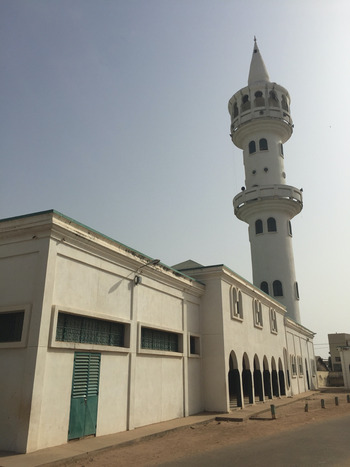
Ba is difficult to define as a political figure, even though he used political separatism to facilitate the development of his religious community. More broadly, the presence of charismatic religious figures has been a crucial and neglected factor in the development of proto-nationalist movements globally, particularly in Africa (Tiryakian Reference Tiryakian2011:1411). Ba qualifies as such a figure; however, he did not urge his followers to rebel against the colonial state or to push for formal independence. Instead, he sought to create a pure Muslim space outside of state control, within the boundaries of Senegal but not mediated through it. To create this “pure” Muslim space, Ba insisted on managing the community’s relationship with the French government, in an effort to isolate its residents, thereby promoting religious piety, social harmony, and collective enterprise. The community was centered around the central mosque and Ba’s compound, located directly opposite one another (Ba Reference Ba1964:51–54, 86). This location remains to this day the focal point of life in the community (Figure 2).
The central mosque in Medina Gounass (taken March 2, 2017, by the author).

Much of our knowledge of the early history of Medina Gounass comes from a Reference Ba1964 study by M. Cheikh Ba, who conducted research on the town’s geography. This research included a household survey, tracking when each family had arrived in the community and their motivations for migration. Mamadou Saidou Ba himself only conducted one public interview, held in 1968. In it, the ceerno [religious teacher] expanded on the community’s religious history (Wane Reference Wane1974). While there has been other contemporary scholarly research on Medina Gounass, it has not focused on the community’s significance as a geographic and territorial undertaking (for example, N’Gaïdé Reference N’Gaïdé2012; Ross Reference Ross, Salm and Falola2010; Smith Reference Smith2008; Hardin Reference Hardin2013).
Founding a Community of Émigrés
The settling of Medina Gounass was the culmination of a nearly two-decade attempt by Fulɓe migrants to establish autonomous religious communities. Unlike other religious movements of the period, these migrants sought not to topple colonial governments, but rather to live autonomously outside of them in small religious settlements. In 1916, hundreds of Fulɓe living in Portuguese Guinea crossed into Senegal after a dispute with the Portuguese colonial government, who feared that their cleric, Al-Hajj Aali Caam, sought political power. This border crossing was conceived of as part of a longer tradition of self-imposed exile (fergo) for the purpose of achieving spiritual autonomy, similar to other nineteenth century Fulɓe migrations fleeing French colonial expansion (Robinson Reference Robinson1985; Hanson Reference Hanson1996). However, unlike these movements, Caam did not seek to establish a larger state apparatus but simply a village of piety. In 1918, following a khalwa, a mystical retreat designed to help Caam ponder his future, he founded the community of Medina El Hajj (N’Gaïdé Reference N’Gaïdé, Stauth and Bierschenk2003:202). Medina El Hajj was founded as a community dedicated to work and religion outside of French colonial structures. As its population grew, fed by immigration from Fuuta Tooro and the Gambia, more than three hundred splinter villages formed (interview with Ibrahima Thiam, Medina El Hajj, Senegal, February 20, Reference Thiam2017; Fanchette Reference Fanchette2011:109). Caam emphasized political and economic control over Medina El Hajj and forbade the growing of rice, most likely in a desire to transform the lowland areas into orchards (N’Gaïdé Reference N’Gaïdé, Guillaud, Seysset and Walter1998:190). These migrants sought not just to benefit from the cleric’s spiritual prestige, but to also stay at a distance from the expanding colonial states of greater Senegambia. To these migrants and their leader, spiritual, political, and economic autonomy went hand in hand.
While many other marabouts of the early twentieth century had close—if often fraught—relationships with the French, Caam presented his followers with a different model: escape. The contrast of his approach to that of the “rising new star” of the era, Seydou Nourou Tall, is particularly stark. Tall was the grandson of Umar Tal, and his popularity grew throughout the 1920s, with his influence extending across French West Africa. However, his ability to preach across French territory without any hindrance was tied to his support of the French regime (Garcia Reference Garcia, Robinson and Triaud1997:247–54; Robinson Reference Robinson, Robinson and Triaud1997:566).
In 1927, a young cleric named Mamadou Saidou Ba arrived in Medina El Hajj. Born in Fuuta Tooro, Ba studied the Qur’an under Caam until the latter left for Portuguese Guinea in 1908 (interview with Diadie Ba by David Robinson, April 20, Reference Ba1968). Almost two decades after Caam left for Portuguese Guinea, Ba left northern Senegal for Medina El Hajj to rejoin his former teacher, with Caam later naming Ba as his spiritual successor (interview in Wane Reference Wane1974:680; Ba Reference Ba1964:51). After Caam’s death, his sons challenged Ba for the leadership of the community. After being passed over, Ba fled with his disciples and headed east, where he was given the land for Medina Gounass. Ba, for his part, viewed this migration as part of a tradition of hijrah dating back to the Prophet Muhammad himself (ANS 1934:8). Both Caam and Ba exercised forms of territoriality grounded in religious practice that differed from those put forward by the French colonial government, which saw Senegal’s borders as fixed and inviolable (Ba Reference Ba1964:51–52, 68).
The First Forty Years
Medina Gounass saw a series of migrations into the community over its first forty years. Of the community’s 133 founding families, nearly four-fifths came from Medina El Hajj, with almost all the remainder coming from Portuguese Guinea. As a result, the migrants to the town represented not just a disengagement from colonial rule in Senegal, but colonial governments in the broader region. Medina Gounass’ first decade saw substantial growth, mostly from Portuguese Guinea. These Fulɓe immigrants arrived for a variety of reasons, including the harsh fiscal and economic regime and hostility toward Islam present in the Portuguese colony. Other, less political, reasons for immigration cited included better availability of pastureland and better soil for agriculture. Other migrants came from elsewhere in Senegal, French Guinea, British Gambia, and the Senegal River Valley, the last of which became demographically dominant later on (Ba Reference Ba1964:68–74).
These migrations reflected a larger rejection of the colonial states of the region, and a desire to escape these states and create a largely autonomous space whose connections—if not its autonomy—reached into neighboring colonies. For those living in Medina Gounass, they had, for the most part, disengaged from colonial governance by creating a space outside of colonial taxation and forced labor demands. By this point, in addition to its immigrant population, the clerics of the town already had many followers in Senegal, the Gambia, and Portuguese and French Guinea (Ba Reference Ba1964:72). Most of these almuɓɓe (disciples) did not remove themselves from life under colonial rule, but those who moved into the town withdrew from colonial governance entirely.
Starting in the mid-1940s, migrants started to arrive from even farther away. From 1945 to 1955, a more geographically diverse set of migrants arrived at Medina Gounass, from Portuguese Guinea, southern Senegal, Fuuta Tooro, the Gambia, and French Guinea (Ba Reference Ba1964:72).Footnote 8 By 1950, only fourteen years after its founding, Medina Gounass was the largest town in its subdivision (ANS 1951a:3). For many cross-border migrants, familial ties and ethnic and religious affinity facilitated migration across colonial borders (Carreira & de Meireles Reference Carreira and Meireles1959). Most notably, nearly all the Fulɓe who immigrated to Medina Gounass from Portuguese Guinea already had family members in the community (Ba Reference Ba1964:75).
From the mid-1950s onward, “massive” numbers of Haalpulaar Fulɓe from Fuuta Tooro arrived in Medina Gounass from the Senegal River Valley. M. Cheikh Ba speculated that the migration of the Haalpulaar was due to a “dramatic breakdown under the influence of the market economy” (Reference Ba1964:72–76). Outmigration from the Senegal River Valley during this period was massive, and by 1963, 20 percent of the population of the river valley had migrated elsewhere within Senegal and even to France (Diop Reference Diop1960). Limited quantities of land and the harsh desert climate exacerbated economic changes occurring across the region, as well as a societal and cultural conservatism. As a result, Medina Gounass came to be seen as a “promised land” for many Haalpulaar, especially those disadvantaged societally. These movements followed two centuries of migration from the Senegal River Valley to the south, making many familiar with the routes to be traveled (Ba Reference Ba1964:76–83).
As of 1963, most of Medina Gounass’ population of almost four thousand consisted of migrants from Portuguese Guinea and their descendants. Within that group, more than half had come via Medina El Hajj, and they formed an elite class within the town. Holding conservative religious views, they “imposed their lifestyle on the whole village” (Ba Reference Ba1964:123). The Haalpulaar formed an additional 30 percent of the population; with the remainder being immigrants from Senegal, Guinea, and the Gambia. Arguably the greatest commonality among the residents of Medina Gounass was the rurality of their heritage. The only resident of the community who had been educated in French-language schools was Mamadou Saidou Ba’s secretary, who facilitated the community’s dealings with the outside world (Ba Reference Ba1964:70, 83).
As early as the 1950s, the constant stream of immigrants into Medina Gounass led to land shortages, as the town grew to be the fifteenth largest in Senegal. Due to overcrowding, the community organized the clearing of the surrounding forest and the establishment of new villages focused on large-scale farming, primarily of groundnuts. While the production of groundnuts tied these new villages more closely to the national economy, Ba’s highly visible backing for these villages lent him “profound…spiritual prestige.” In 1964, it was remarked that “there is not today a region of Senegal, the Gambia, and eastern Portuguese Guinea where Ceerno [Ba] does not have disciples” (Ba Reference Ba1964:25–31, 61, 223). Simultaneously, villages loosely affiliated with Medina Gounass sprang up farther afield—north of the Gambia, along the Senegal River Valley, in Portuguese Guinea, and in Guinea—with each village prominently featuring centers of Islamic education (Ba Reference Ba1964:232–36). One village in this category, Fass, was founded in 1954 in Portuguese Guinea with Ba’s support. From the outset, like Medina Gounass, Fass designated itself a place of “pure” Sufism, where the tenets of Islam would be practiced without government interference. Today, Fass still operates outside of Guinea-Bissau’s national government, fashioning itself as a smaller Medina Gounas, created in its image. As in Medina Gounass, Fass’ most important person is not the essentially ceremonial village chief, but the chief cleric (interviews with Ma Tidjani Sall, Yunusa Balde & Mama Salu Cande; and Abibulai Boiro & Amadu Tidjani Cande, Fass, Guinea-Bissau, April 6, 2017).
Following the outbreak of war in Portuguese Guinea in the early 1960s, tens of thousands of Fulɓe fled across its borders, with some ending up in Medina Gounass. At the same time, migrants continued to arrive from the Senegal River Valley and eastern Senegal, leading the population to triple in a period of just six years, to 12,551 in 1971 (N’Gaïdé Reference N’Gaïdé and Momar-Coumba2002:627). Guinean Fulɓe also moved to the town, primarily to escape the economic and political policies of Sékou Touré’s government, which branded them as neocolonial traitors. Migrants arrived from the Gambia as well, though not in as significant numbers (van Hoven 1999:25; interview with El Haji Malick Ba, Medina Gounass, Senegal, March 1, Reference Ba2017).
Decentralization: Medina Gounass enters Senegalese politics
For four decades, Medina Gounass’ religious importance and borderland location allowed it to operate essentially outside of domestic politics, without any serious challenge to its territorial vision. Then, in the mid-1970s, this isolation was threatened by the increased importance assigned to cotton production.Footnote 9 Previously, the economy of Medina Gounass had centered on groundnut production: Ba would buy up the crop and sell it to outsiders on the community’s behalf, a process that effectively allowed him to control his people’s relationship with the formal Senegalese economy. Cotton cultivation, on the other hand, was first controlled by a French company, the Compagnie française pour le développement des fibres textiles (CFDT), and then beginning in 1974 by the Senegalese public-private enterprise SODEFITEX (the Société de développement et des fibres textiles). In the 1960s, cotton cultivation increased rapidly in the town, and by 1971, Medina Gounass was the largest cotton producer in all of Francophone West Africa. However, in 1975, Ba banned the cultivation of cotton, which he claimed “would lead to a serious reduction in women’s fertility,” perhaps due to the pesticides used in cotton production or demands on women’s labor in cotton fields from their husbands (Hardin Reference Hardin2013:229; van Hoven 1999:25). However, others have speculated that he perceived cotton as a threat to his power, insofar as its cultivation would integrate the community into the market economy and the outside world more generally.Footnote 10 The communal ban on cotton production, meanwhile, cut off a major source of income for many, some of whom departed for nearby villages where they continued to cultivate cotton while remaining close to Ba (Magassouba Reference Magassouba1985:51; N’Gaïdé Reference N’Gaïdé and Momar-Coumba2002:631). This was symptomatic of the fact that both the market economy and the Senegalese government had, over four decades, crept nearly to the edge of his community, threatening his community’s economic autonomy.
In 1976, the Senegalese government embarked on a campaign of decentralization, with villages organized into small groupings known as “rural communities,” each managed by an elected council. This policy change further destabilized Medina Gounass, by involving it in electoral politics for the first time. Despite the fact that most of the townspeople refused to place themselves on the voter rolls, the 1978 election can be seen as a tipping point in Medina Gounass’ isolation, at least in terms of national politics (Ross Reference Ross, Salm and Falola2010:259; Dia Reference Dia1980:129).
Autonomy in a Religious Border Community
During the colonial period, the community’s interactions with the French government were limited, and it featured in only a few scattered colonial reports. A 1936 annual report mentions that the town had been founded, and despite being the subdivision’s largest town, Medina Gounass did not even feature in a 1950 colonial map (ANS 1936:20; ANS 1951a:3). Oral histories shared by members of the community tell a similar story, that the French colonial government did not dare to interfere in Medina Gounass for fear that Ba would lead his followers, both inside and outside of the community, out of the colony (interview with Abdoul Hayou Diallo, Medina Gounass, Senegal, March 3, Reference Diallo2017).
In any case, colonial governments made no effort to challenge Medina Gounass’ territorial vision, establishing minimal governmental structures, even as the town grew to be the second largest in the region. However, on rare occasions Ba would ask French officials for things such as poison to kill hyenas who threatened the community’s livestock (Hardin Reference Hardin2013:246). At independence, the community remained essentially outside the administrative purview of the new state of Senegal, which initially attempted—without any success—to establish that Medina Gounass existed within its confines. Within the town, such efforts were generally greeted with disdain, like the rejection of a government health facility and school in the early 1960s (Ba Reference Ba1964:241). At that time, the nearest representative of the Senegalese government was an agent of the Comité Régional d’Assistance pour le Développement, based about forty miles away. On the agent’s visits to Medina Gounass, Ba’s secretary served as an interpreter. The town’s autonomy was also represented through its distinctive time zone and radio broadcasts in Arabic, the town’s only written language.Footnote 11 In short, Ba and the rest of the town’s leadership “jealously conserved and defended, with a great deal of relentlessness, the autonomy it…gained since its founding” (Ba Reference Ba1964:141–42, 241–42). Moreover, this high level of autonomy continued even as the community’s leaders lost hold of its economy in the face of growing integration into wider markets.
Despite Medina Gounass’ administrative apartness, its leadership was unable to stop the infiltration of new products and desires during the 1960s. In and of themselves, these luxuries—radios, bicycles, refined sugar, Chinese green tea, coffee—seemed innocuous enough; but collectively, they brought the town into a closer relationship with the rest of Senegal. Given Medina Gounass’ outside ties of ethnicity, language, and religion, it was never truly isolated. Yet, its loss of control over the importation of particular products did alter it in meaningful ways. Young men who left the village to go to “Senegal” exerted “a certain influence” over their peers; knowing basic Wolof or French enhanced their status, and Ba (Reference Ba1964:242–43) went so far as to describe this as a “crisis of ‘liberation’ that some young people go through.” In the late 1960s, Amadou Moussa Diallo left Medina Gounass for the Gambia, where he apprenticed as a tailor. After thirteen years there, he worked in Dakar, Côte d’Ivoire, Nigeria, and Mali before eventually returning to Medina Gounass. Diallo noted that even today, because children do not study French, they have difficulty assimilating into the modern economy (interview with Amadou Moussa Diallo, Medina Gounass, Senegal, April 29, Reference Diallo2017).
In the early 1970s, Medina Gounass was described as “a true model of communal self-management since its founding” (Wane Reference Wane1974:672). While Ba still led the community spiritually, he delegated its day-to-day management to his subordinates. The village chief, Mamadu Yoro Jallo, was in effect “a Minister of the Interior, charged to transmit to the population the general directives of the grand ceerno” as well as being responsible for tax collection. These taxes went to another cleric, Usmaan Caam, a “sort of Minister of Finances” who also served as the “Minister of Foreign Affairs” in charge of relations with the Senegalese state. In addition to his dual ministerial role, Caam’s lineage gave the community further spiritual legitimacy, as he was the son of Ba’s mentor, Al-Hajj Aali Caam (Hardin Reference Hardin2013:244).Footnote 12 Additionally, there was a Minister of Religious Affairs (in charge of Islamic education and propaganda), a Minister of Work and Housing, and a Minister of Agriculture (Wane Reference Wane1974:674).
The leadership of the community also managed its internal and external commerce, supervised the activity of the marabout’s stores, and organized the transportation of imports and exports.
It should be reiterated that this administrative organization, which runs smoothly, is entirely out of the official state structures now found in all the bush villages. To be honest, Madiina Gunaas is a virtually independent village, which ignores services such as schools, dispensaries, police, agriculture, animal husbandry, etc.…Madiina Gunaas, more than ignoring the said services, has duly challenged them since colonial times, and the administration of independent Senegal has had the good taste not to override it, but to recognize the autonomy of the village and to let it pursue a sociological and economic experiment that is without a doubt one of a kind. (Wane Reference Wane1974:674)
The reluctance of the state to challenge Medina Gounass’ autonomy allowed Ba to create an alternative imagined community to that put forward by the state of Senegal. Moreover, the parallel state structures of the town were only one element of Medina Gounass’ larger spatial project of creating an alternative, not-Senegalese territory. This disconnect between the people of Medina Gounass and their internationally recognized government has been facilitated by the community’s leaders banning direct relations with the Senegalese state since its founding (interviews with Abdoul Hayou Diallo; and Saidou Ba, Medina Gounass, Senegal, April 29, Reference Ba2017; N’Gaïdé Reference N’Gaïdé and Momar-Coumba2002:629). Despite this and other efforts to prevent corruption by “Occidentalization” (Magassouba Reference Magassouba1985:49), however, in 2015 the Senegalese government established a hospital on the outskirts of the city, a development that was welcomed by local residents, who do not all share their leaders’ disdain for modern medicine. Similarly, the arrival of electricity and running water have also been welcome additions for many living in Medina Gounass.
The autonomy of Medina Gounass is also evidenced by its harsh gender-segregation policies and public punishments for consuming alcohol and tobacco, which do not apply in the rest of Senegal. Anyone found guilty of theft is whipped publicly, and local ordinances continue to align with a particular interpretation of Qur’anic law (Ba Reference Ba1964:145; Magassouba Reference Magassouba1985:48; Smith Reference Smith2008:26). Medina Gounass thus “others” the Senegalese state and its “constitutional ethos of civil liberties and egalitarianism” (Smith Reference Smith, Grodz and Smith2014:58). Even as the increasing integration of Medina Gounass into national politics has inevitably brought it into closer relations with the Senegalese state, migrants leaving the community for overseas destinations have reinforced its economic autonomy, via remittances with a significant aggregate value (van Hoven 1999:25).
Cross-Border Ties, Then and Now
Perhaps the key to the town’s strength as an autonomous religious community was its cross-border connections. Within fifteen years of Medina Gounass’ founding, it had undergone “a spectacular development that…brought fame beyond national borders” (Magassouba Reference Magassouba1985:48). As of the early 1960s, it had long “turned its back” on southern Senegal and turned instead toward cross-border ties. Bicycle routes across borders were difficult for customs officials to police; they favored cross-border contacts, and generally strengthened “the conception of the inexistence of borders that the Fulɓe of the village have” (Ba Reference Ba1964:202–3). Because of its central location near three borders, Medina Gounass was well positioned to attract followers in neighboring countries, giving it transnational religious prestige and access to wider economic opportunities.
Given Ba’s origins in Fuuta Tooro, he was well connected to religious and political leaders in the region, and so too was his community. In 1951, he facilitated the visit of a cleric from Fuuta Tooro to Medina Gounass and southern Senegal (ANS 1951b). By the early 1960s, Tierno Seydou Kane (interview with David Robinson, July 2, Reference Ba1971) had heard that thirty-five thousand people were visiting Medina Gounass annually, and by 1971, he claimed that number had risen to fifty thousand. Unsurprisingly, this influence cut both ways: Ba also regularly traveled to Fuuta Tooro to preach and proselytize, and he preached and appointed delegates in neighboring territories both in and out of Senegal (interview with Diadie Ba; Ba Reference Ba1964:231; Abdoulaye Kane Reference Kane2010:4). In the easternmost part of the Gambia, Ba convinced many Fulɓe to adopt the particular path of Medina Gounass, rather than that of competing Sufi orders. He is also credited with having strengthened Islam through his visits there in the 1950s and 1960s (Diallo Reference Diallo2014:208). According to Ahmadou Fadel Kane (Reference Kane2010:1821), all Fulɓe communities of the eastern Gambia belong to “the Gounass allegiance.” Medina Gounass’ greater Senegambian ties were also reinforced by the migrants who moved to the community from the wider region.
On January 23, 1971, Ba arrived in the border town of Ouassadou, less than four miles from Portuguese Guinea. His plan was to minister to his followers in Senegal before crossing into Portuguese Guinea. However, the Portuguese colonial government refused to allow Ba to enter. Confidential reports from this time mention that Amilcar Cabral (Portuguese Guinea’s independence leader) and Sékou Touré had both sent emissaries to Ba in an effort to establish good relations. Cabral allegedly even offered to pay for the damage done by his soldiers to Medina Gounass’ splinter village, Fass (AHD 1971).
During the instability that characterized the late 1970s, Medina Gounass became tied more closely to both the Senegalese government and the market economy, in ways that also brought it into a closer economic relationship with Senegal’s neighbors. This period included the reopening of the Guinea-Senegal border in 1978 following economic liberalization in Guinea. This further strengthened the connections between Medina Gounass and Guinea, as people passed more easily through the town. The opening of the border furthered both religious and economic linkages, reinforcing Medina Gounass’ strength and autonomy relative to the Senegalese state.
In 1980, former prime minister Mamadou Dia (Reference Dia1980:129) noted that Medina Gounass had ties not just to neighboring countries, but also to Mauritania, Mali, Côte d’Ivoire, and even as far away as Cameroon. In recent years, the current leader of the community, Amadou Tidiane Ba, has welcomed delegations from every region of Senegal, a variety of countries in West Africa—especially Mauritania—as well as from countries further abroad such as France and the United States (N’Gaïdé Reference N’Gaïdé and Momar-Coumba2002:626). Medina Gounass has thus served to bring together its Fulɓe disciples across the broader region (Diallo Reference Diallo2014:208). Qur’anic schooling has also helped foster regional ties, as students arrive in Medina Gounass from every surrounding country and across Senegal. In parts of the eastern Gambia, most people travel to Medina Gounass on an annual basis for religious festivities and to show their devotion to the community’s spiritual leaders (interview with Souleymane Saidy, Alassan Mbaye, and Doro Sy, Sare Bojo, the Gambia, July 19, Reference Saidy, Mbaye, Sy and Bojo2017). Across the region, the annual daaka pilgrimage is an important occasion for strengthening the ties between the disciples and their spiritual guides, as well as for showcasing the power of Medina Gounass. It also serves as a location for the Senegalese state to show its support for the pilgrims through the provision of particular services.
Medina Gounass’ transnational ties also extend past West Africa. Ba was aligned closely during his life with Ceerno Mamoudou Barro from Mbour, whom he had studied under as a young man (interview with Al-Hajj Bokar Ba and Moussa Gueye by David Robinson, Kaedi, Mauritania, April 5, Reference Ba and Gueye1968). Barro’s son, Tierno Mansour Barro, who was born in 1925, began to lead spiritual retreats among the Fulɓe diaspora, first elsewhere in West Africa, then in Central Africa, before finally making his way to Europe in the 1970s. His goal was to bring Fulɓe emigrants in France back to Islam. The target was not conversion, but rather to encourage Muslims seen as in need of returning to the faith. Because many could not afford to return to Senegal regularly, the younger Barro began to hold an altered version of Medina Gounass’ annual pilgrimage in Mantes-La-Jolie, in the western suburbs of Paris. He also went several times to Côte d’Ivoire, Cameroon, Gabon, the Central African Republic, and both the Democratic Republic and the Republic of the Congo in order to preach to Fulɓe migrants there (Abdoulaye Kane Reference Kane2010:4–7).
Transnational Smuggling
The movement of goods through Medina Gounass by extralegal means has played a crucial role in the town’s development dating back to the colonial period and has contributed strongly to the power and wealth upon which it relies to maintain its distance from the region’s governments. This recalls the ways in which smuggling has served as a “long-cherished symbol of autonomy and control” in northern Mali and in Central Africa (Gutelius Reference Gutelius2007:70; Roitman Reference Roitman2005). From its foundation, Medina Gounass was at the center of contraband routes to the Gambia and to Portuguese and French Guinea. During the 1960s and 1970s, merchandise from those three countries coming into and through Medina Gounass remained almost entirely outside of government supervision, despite the existence of customs posts (interview with Oumar Ba by David Robinson, January 26, Reference Ba1974; Ba Reference Ba1964:223–24). Individuals in Medina Gounass would travel to the Gambia regularly to buy goods as well (interview with Mokhtar Sow, Medina Gounass, Senegal, April 29, Reference Sow2017). The movement of goods across Senegal’s borders with virtually no oversight represents a subversion of the country’s sovereignty, and an acceptance that religious communities such as Medina Gounass have autonomy from the Senegalese state. The illicit movement of goods across borders was aided by the historic relationship between religious leaders and smuggling in Senegal. Religious towns across Senegal have traditionally served as key nodes in smuggling operations, since customs agents are not permitted to work in them. Medina Gounass has been noted in particular as a “safe haven for smugglers.” After violence broke out in the early 1980s in Ziguinchor, smugglers based in that region moved their trade routes further east, nearer to Medina Gounass (Ka Reference Ka1994:42–43, 71, 134).
Governments in the region made few efforts to suppress the smuggling networks. In 1992, one newspaper article declared, “Customs agents that venture into religious centers know beforehand that their actions are futile and even prejudicial to their department” (Le Soleil 1992). In most post-independence border posts, customs agents were few and underpaid. Guinean customs agents were particularly well known “for their lax behavior, bribery, complacency, and extreme negligence” (Ka Reference Ka1994:124). Senegalese customs officers were better, but still easily bought off, especially when religious leaders were involved. As of 1998, some smugglers regularly brought large amounts of merchandise from the Gambian capital of Banjul and crossed the border, heading for Medina Gounass. The standard bribe to customs agents at that time was XOF250,000–300,000 (USD400–500), and Medina Gounass was essentially a “free zone” (Fanchette Reference Fanchette2001:98, 103). In response to the Senegalese government’s returning of contraband to smugglers, an article in the newspaper Wal Fadjri (Dieng Reference Dieng2003) warned that the state’s authority was being tested: “The whole department of Velingara is sitting on a powder keg called Medina Gounass.” The ten-day daaka, now as much as an economic event as a religious one, is today known as a place where one can buy guns, motorcycles, and other expensive products free of customs duties (interview with Thiedo Balde, Kolda, Senegal, Febuary 11, 2017). The town’s religious leaders have developed an understanding with border officials on the basis of “politics,” i.e., agreements with government officials not to bother those visiting or returning to the community (interview with Saidou Ba). Essentially, therefore, the leadership of Medina Gounass operates a customs-free town on the fringes of the Senegalese state. However, there are limits to what the government will allow. In 2016, the commandant of the gendarmerie in Kolda barred the road leaving Medina Gounass in an attempt to stop the trafficking of fraudulent and stolen goods, seizing items worth an estimated XOF13.55 million (USD23,000) (Wal Fadjri 2016). The relative autonomy given to Medina Gounass and to smugglers has given the city a sordid reputation as a waypoint for drugs, a refuge for criminals, and a site of high rates of sexual violence. Most publicly, in January 2020, the Senegalese government arrested four members of a drug smuggling operation in the city, charging them with drug trafficking and illegal possession of Kalashnikov firearms (Ba Reference Ba2020).
The 2017 Daaka Fire and COVID-19
Medina Gounass’ autonomy has been tested by two recent events: a fire during the 2017 daaka pilgrimage that killed at least thirty-four pilgrims, and most recently, the ongoing COVID-19 pandemic that began in 2020. In 2017, during the ten-day daaka spiritual retreat held outside of Medina Gounass, a fire spread rapidly through a group of temporary wood-and-thatch structures housing pilgrims (Dakaractu 2017). The pilgrims, primarily Fulbe, come from several countries in West Africa, and—increasingly—from Morocco, France, and beyond. Due to water-supply problems, fires were a regular occurrence in the decade leading up to 2017, but they had yet to result in any fatalities (RFI Afrique 2017). In the month following the fire, President Macky Sall announced a project in cooperation with the community’s religious leaders to modernize the infrastructure of the community (RTS1 2017). In 2018, for the following year’s daaka, religious leaders worked closely with the community’s radio station, local governor, and prefect to station 380 firefighters around the pilgrimage site (Kamara Reference Kamara2018).
In contrast, the recent COVID-19 pandemic has offered a case study for the durability of Medina Gounass’ autonomy. Following the first cases of COVID-19 in Senegal, President Macky Sall banned public events for thirty days, a decision at first accepted by Amadou Tidiane Ba, the current Khalif of Medina Gounass, and the clerics of Tivaouane, who cancelled their daaka and ziarra respectively (Seneplus 2020). The clerics of Medina Gounass even made the announcement on various forms of media, in both Pulaar and Wolof, albeit in front of a crowded mosque (DakarBuzz 2020). Despite the cancellation of the daaka, the city’s religious leadership and most of its residents refused to take measures to slow the spread of the virus, and they continued to host public prayers at the city’s mosques. In April 2020, members of the gendarmerie arrived on two occasions in an attempt to stop people from congregating at the central mosque, only to withdraw when their presence failed to intimidate worshippers. Some residents, speaking anonymously, blamed the close ties between Macky Sall and the community’s clerics for the ineffectual state response (Mballo Reference Mballo2020).
In early May 2020, Medina Gounass became the location of a COVID-19 outbreak, with fifty-five cases in less than a week. Despite these cases and the infection of the city’s chief doctor, Friday prayer in the central mosque continued uninterrupted (Sud Quotidien Reference Précieux2020; Le Quotidien 2020). In fact, videos released by the city’s Daakaa TV show crowded religious gatherings while masked members of the gendarmerie stand by (Daakaa TV 2020). For the Haalpulaar clerics and elite of Medina Gounass, their relative autonomy and defiance of the Senegalese state continues.
Conclusion
Since the town’s foundation in 1935, the actions of the people of Medina Gounass have demonstrated an alternative territorial vision to those put forward by the colonial and postcolonial governments. This geography implicitly rejects the territorial visions of Senegal and its neighbors, and instead connects Fulɓe communities across the wider region. The persistence of these networks, coupled with the building of what amounts to a shadow state, disengaged from the colonies and states of its origin, highlights the incomplete nature of the region’s various nation-building projects. It also represents the durability of alternative geographic visions in southern Senegal’s borderlands. Since the mid-1970s, the Senegalese government has begun to encroach on Medina Gounass; and yet, the town’s territorial vision and numerous other facets of its de facto independence have survived, most recently through the community’s rejection of COVID-19 restrictions.
Though Medina Gounass has a high degree of autonomy from the Senegalese state, it is able to selectively engage with the Senegalese government when it is beneficial to do so, while also remaining deeply connected to the outside world. The town has thus been able to establish and perpetuate its autonomy due in large part to the strength of its religious community throughout Senegal, greater Senegambia, and the African diaspora. Senegal’s current president, Macky Sall, attends the annual daaka regularly, and maintains a close relationship with the community’s religious leaders. In many ways, Medina Gounass represents a form of self-imposed exile necessary to remove oneself from the demands of colonial and postcolonial governments. Rather than actively resisting or accommodating colonial and postcolonial state forms, the inhabitants of Medina Gounass have created an extra-territorial space. This article calls on other scholars to look at the multiplicity of territorial forms in colonial and postcolonial Africa, pushing past the “territorial trap” to examine how local actors throughout the continent have viewed geographic spaces in ways unrecognized by colonial and postcolonial governments.
Acknowledgments
Like most essays, this article benefitted from the thoughts and perspectives of many people, who read drafts or discussed its themes with me. In particularly, an early version of this paper was presented at the 2018 African Studies Review Pipeline for Emerging African Studies Scholars Workshop. Among others, I would like to thank Cheikh Babou, Robert Baum, Joseph Bradshaw, Dawne Curry, Douglas Falen, Sarah Hardin, Walter Hawthorne, Charles Keith, Dougoukolo Alpha Oumar Konaré, Benjamin Lawrance, Abderrahmane N’Gaïdé, Katrien Pype, David Robinson, and Assan Sarr. I would particularly like to highlight the contributions of Falaye Danfakha and Mady Camara, who accompanied me on my research trips to Medina Gounass in 2017. Kodda Sow and the larger Sow family welcomed me into their home while I conducted this research, and more broadly, I am grateful to the people of Medina Gounass for their hospitality and for sharing their personal and community histories with me. This work would also not be complete without the contributions of the ASR editors and anonymous reviewers who provided detailed and invaluable feedback. Lastly, this research and writing were made possible by the Fulbright-Hays DDRA program and the Mellon/ACLS Dissertation Completion Fellowship.