Introduction
Unhealthy environments are thought to be responsible for a significant proportion of morbidity and mortality worldwide (WHO, 2007, 2009). The World Health Organization estimates that the global burden of disease due to environmental factors is 24%, and these factors are responsible for 23% of all deaths each year. Preventing environmental risks could reduce the number of child deaths by nearly 4 million every year, mostly in developing countries (WHO, 2007).
Between 40% and 70% of the population in African cities live in informal settlements or slums, characterized by dense, precarious and unhealthy habitats (Vlahov et al., Reference Vlahov, Freudenberg, Proietti, Ompad, Quinn and Nandi2007). Previous studies have revealed that levels of morbidity and mortality among children tend to be higher in informal settlements than in other parts of African cities, and perhaps even more than in rural areas (Montgomery & Hewett, Reference Montgomery and Hewett2005; Kimani-Murage et al., Reference Kimani-Murage, Madise, Fotso, Kyobutungi, Mutua and Gitau2011). In Nairobi, for example, where 60% of the population live in slums, mortality rates are substantially higher than in other neighbourhoods of the city (UN-Habitat, 2013). Using data from Demographic and Health Surveys in several countries, however, a recent study revealed that, while children living in slums experienced worse health than their counterparts in formal settlements, their health was nonetheless generally better than that of children living in rural areas (Fink et al., Reference Fink, Günther and Hill2014; see also Lalou & LeGrand, Reference Lalou and LeGrand1997). The higher health risks in slums appear to be offset by overall better access to health services compared with rural areas (Günther & Harttgen, Reference Günther and Harttgen2012).
In African cities, infectious diseases like malaria, acute respiratory infections and diarrhoeal diseases contribute to a longstanding critical health situation (ONU-Habitat, 2011). The growth of African cities over the last three decades has also led to profound changes in the local environmental context in which many people live. Rapid population growth, combined with a lack of access to basic sanitation services (access to clean water, management of household waste and water, etc.) and poor housing conditions, have harmful effects on the health and well-being of urban populations (UNICEF, 2012). A better understanding of the links between environmental risk factors and public health is essential for the development of effective policies and programmes, and ultimately to the well-being of West African urban populations.
The determining factors of child health are both diverse and complex (Mosley & Chen, Reference Mosley and Chen1984; Lalou & LeGrand, Reference Lalou and LeGrand1997; Montgomery & Hewett, Reference Montgomery and Hewett2005). Several studies have suggested that environmental factors play a decisive role in the occurrence of numerous pathologies including malaria, diarrhoeal diseases and acute respiratory infections (Merrick, Reference Merrick1985; Chevalier et al., Reference Chevalier, Cordier, Dab, Gérin, Gosselin, Quénel, Gérin, Gosselin, Cordier, Viau, Quénel and Dewailly2003; Kojima, Reference Kojima2006; Sy et al., Reference Sy, Tanner, Cissé, Koita, Traoré and Keita2011). Published literature on the topic reveals the importance of factors such as access to water, sanitation and hygiene for child health in cities in developing countries (Woldemicael, Reference Woldemicael2000; Adjibade, Reference Adjibade2004). Improvements in these environmental dimensions should lead to a substantial reduction in the spread of diseases (Dégbey et al., Reference Dégbey, Makoutode, Ouendo, Fayomi and De Brouwer2008). Other studies on urban areas, including one in Cameroon in 2007 and another in Mauritania in 2011, have brought to light the importance of other environmental factors that may affect child health, such as soil composition and the quality of a child's play area (Ngwé & Banza-Nsungu, Reference Ngwé and Banza-Nsungu2007; Sy et al., Reference Sy, Tanner, Cissé, Koita, Traoré and Keita2011).
Population-based studies on the relationship between the immediate environment and childhood fever remain scarce and fragmented. Data from the Demographic and Health Surveys (DHSs) and the Multiple Indicator Cluster Surveys (MICSs) provide information on a limited set of environmental factors (access to water, waste water management and waste), restricting researchers' ability to examine in detail many aspects of the environment–health relation (Kojima, Reference Kojima2006; Ngwé & Banza-Nsungu, Reference Ngwé and Banza-Nsungu2007). When more specific surveys exist, they tend to be based on the DHS or MICS questionnaires and also contain limited data on local environmental conditions. This is the case, for example, with the survey data used by Sy and colleagues (Reference Sy, Tanner, Cissé, Koita, Traoré and Keita2011) in Mauritania.
The population-based analysis of the causal linkages between environmental exposures and child health raises both conceptual and methodological/data issues (Chevalier et al., Reference Chevalier, Cordier, Dab, Gérin, Gosselin, Quénel, Gérin, Gosselin, Cordier, Viau, Quénel and Dewailly2003; Kojima, Reference Kojima2006). These difficulties arise both from the fact that the relevant dependent variables (health, fever, diarrhoea, etc.) are multifactorial and that the independent variables (access to water, sanitation and hygiene) are broad and poorly measured, when available. In addition, assessing the true effects of the environment on health is complicated by interrelations between socioeconomic and demographic variables and the local environment (Mosley & Chen, Reference Mosley and Chen1984; Kandala et al., Reference Kandala, Ji, Stallard, Stranges and Cappuccio2008). Wealthy households can relocate to healthier neighbourhoods or take steps to improve their surrounding environments. Better educated mothers may be more likely to proactively reduce the presence of pathogens and/or their vectors in their homes by doing things such as making sure their children sleep under a mosquito net. Higher levels of schooling may also cause mothers to seek effective medical care more quickly than their less educated counterparts when their children fall ill (Filmer, Reference Filmer2005). Richer and more educated parents may better ensure that their children are well fed and vaccinated, thereby increasing their resistance to environmental risks. Some studies have shown that the children of rural–urban migrants are at higher risk of poor health than those of the urban-born, and children born in slums to migrant mothers may face an even higher risk of death (Konseiga et al., Reference Konseiga, Zulu, Bocquier, Muindi, Yé, Collinson, Adazu, White and Findley2009; Bocquier et al., Reference Bocquier, Beguy, Zulu, Muindi, Konseiga and Yé2010, Reference Bocquier, Madise and Zulu2011). Neglecting the effects of such socioeconomic and demographic factors when modelling the effects of environmental factors on child health is, thus, likely to lead to biased results. For instance, an effect of a poor environment may be highlighted, while its estimated impact is partly the result of omitted demographic and socioeconomic factors (Dongo et al., Reference Dongo, Kouamé and Koné2008; Kandala et al., Reference Kandala, Ji, Stallard, Stranges and Cappuccio2008).
Several studies recognize the role that the neighbourhood environment plays in behavioural change, even though it is not always easy to separate the effects of the neighbourhood itself from the socioeconomic factors that characterize it (Riva et al., Reference Riva, Gauvin and Barnett2007; Chaix et al., Reference Chaix, Merlo, Evans, Leal and Havard2009). The influence of local social groups, the proximity of health infrastructures and other resources in a given community, as well as the perceptions of health by residents are known to be associated with neighbourhood effects (Browning & Cagney, Reference Browning and Cagney2002; Wickes et al., Reference Wickes, Zahnow, White and Mazerolle2009). Taking into account the specific effects of neighbourhood has increasingly become an essential part of urban health research (Gauvin & Dassa, Reference Gauvin and Dassa2004), most notably in studying the links between household environmental conditions and the facilities available in the neighbourhood (e.g. waste management systems or waste water management). Many studies have focused on the poorer health conditions in informal neighbourhoods and slums (e.g. Dongo et al., Reference Dongo, Kouamé and Koné2008; Fobil et al., Reference Fobil, Kraemer, Meyer and May2011), which are neighbourhoods characterized precisely by their lack of basic urban infrastructure (water, electricity and sanitation) (UN-Habitat, 2013). Social cohesion – mutual trust and neighbourhood co-operation – can have beneficial effects on health and survival even in such contexts, and for the overall well-being of populations (Sharkey & Faber, Reference Sharkey and Faber2014). Empirical results indicate that the estimated effects of neighbourhoods sometimes persist even after controlling for the socioeconomic and demographic characteristics of children (Browning & Cagney, Reference Browning and Cagney2002).
The goal of this study was to contribute to environmental health research by analysing childhood fever in five neighbourhoods on the periphery of Ouagadougou, the capital of Burkina Faso. The empirical analysis controlled for demographic and socioeconomic factors of the local population, including household wealth, mother's schooling, and neighbourhood of residence. A better understanding of the effect of the environment itself on health should help inform public policies aiming to reduce childhood morbidity and mortality in urban West Africa.
Methods
Study area and sample
The analysis was based on data collected by the Ouagadougou Health and Demographic Surveillance System (Ouaga HDSS). Ouagadougou, the capital city of Burkina Faso, had approximately 2 million inhabitants in 2010, representing about 45% of the urban population of the country (Guengant, Reference Guengant2011; INSD & ICF International, 2012). With population growth, the city has experienced a rapid geographical expansion, growing in size from 14 km2 in 1960 to 520 km2 in 2009 (INSD, 2009). This mostly unplanned and uncontrolled spread of the urban population has reinforced its social and spatial segregation (Boyer, Reference Boyer2010). The ‘unincorporated’ neighbourhoods – spontaneous settlements where land has not been officially apportioned and deeded by the government – make up a third of the total area of the city, and approximately 35% of Ouagadougou's households live in those neighbourhoods (Janique, Reference Janique2006; Boyer, Reference Boyer2010). With 64% of residents born in rural areas (Rossier et al., Reference Rossier, Soura, Lankouandé and Millogo2011), these spontaneous neighbourhoods are populated mostly by migrants and are characterized by a lack of infrastructure and access to basic urban services such as piped water, sanitation, schools, health clinics and electricity (Janique, Reference Janique2006).
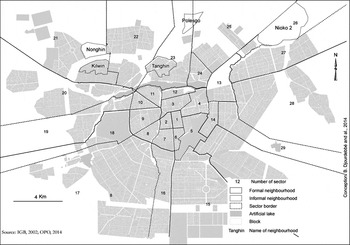
The five neighbourhoods studied in this article are located in the northern periphery of the city (Fig. 1). The Ouaga HDSS study population is comprised of 86,071 inhabitants (in 2012) and includes all residents of two formal (zoned) neighbourhoods with access to basic urban services (Kilwin and Tanghin) and three informal neighbourhoods lacking such services (Polesgo, Nonghin and Nioko-2) (Rossier et al., Reference Rossier, Soura, Baya, Compaoré, Dabiré and Dos Santos2012). The surveillance system has been operating in the area for several years and interviewers and data collection managers spend much time, during every round in each neighbourhood, going to every housing unit in the study areas. Unlike the typical survey, the poorer segments of the population are therefore fully present in the data. Between February and August 2010, a survey on health- and care-seeking behaviour collected cross-sectional data on a random sample of the Ouaga HDSS population. More precisely, data from the health survey used by this study were collected from a sample of individuals under longitudinal surveillance by the Ouaga HDSS – a surveillance system that follows 100% of the population residing in five neighbourhoods of the city. The health survey was conducted on a sample of residents aged under 5 or over 15 years of age, over-sampling children and the elderly. A sample of 1941 households was drawn, of which 1699 responded (a response rate of 87.5%). In all, 3307 individuals (their mothers for children) were interviewed: 950 (living in 736 households) were under 5 years, 1371 were between 15 and 49 years and 986 were 50 years and over (Rossier et al., Reference Rossier, Soura, Baya, Compaoré, Dabiré and Dos Santos2012). Data were collected on episodes of fever during the two weeks preceding the survey, along with a series of variables on the household living environment, including the household waste management, the management of waste water, the drinking water supply, the composition of the interior floor and the use of mosquito nets. This information is somewhat more extensive than that collected by the DHS surveys, and the frequent presence of three of the four authors of this article in the study sites is an additional advantage, providing them with an in-depth awareness of the local living conditions and insight into the importance of various environmental factors to children's lives. These data were merged with other data collected by the Ouaga HDSS platform to provide additional demographic and socioeconomic information on both households and individual respondents.
The Ouagadougou Health and Demographic Surveillance System areas of study.

Variables
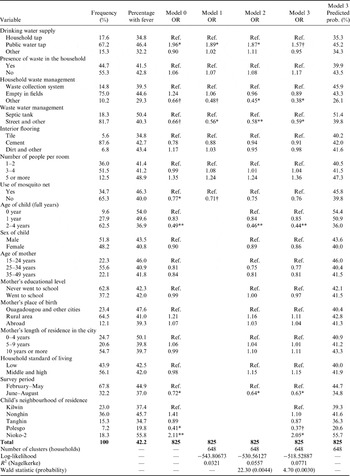
The definition and frequencies of the variables used in the regressions are presented in the first columns of Table 1. Of the 825 children in the analysis without missing data, 42% were reported to have a fever during the two weeks prior to the survey.
Occurrence of fever according to various characteristics and effects of factors that influence childhood fever in the Ouaga HDSS, 2010

Results are weighted. OR: odds ratio; Ref.: reference category.
Model 0 considers the gross effect of each independent variable. Model 1 presents the estimated effects of all the environmental variables by themselves. Model 2 includes all the demographic and socioeconomic variables, in addition to the environmental variables of Model 1. Model 3 integrates all variables in Model 2 with the child's area of residence. The crude results are obtained by performing a logistic regression between the occurrence of fever and each independent variable. The predicted probabilities are calculated from Model 3.
**Significant at 1%; *significant at 5%; †significant at 10%.
Due to the small sample size, a factor analysis approach was employed to limit the number of covariates (see Dos Santos et al., Reference Dos Santos, Bouba Djourdebbé, LeGrand, Soura and Peumi2011, for details). As a result, the type of toilets was omitted from the set of covariates as it was not found to be associated with fever. Of the other environmental variables, source of drinking water was grouped into three categories: 1) household taps, 2) public water taps and protected boreholes located in neighbourhoods, and 3) other sources (buying water from door-to-door salespeople, collecting rainwater or gathering water from streams, ponds, irrigation canals, etc.). The presence of waste stored in a household was captured as a dichotomous variable. Waste disposal was categorized into three groups: 1) formal collection from a public or private service, 2) disposed of waste in nearby empty fields, and 3) other – for the most part, incineration of waste at home. Waste water management was coded into two categories: 1) septic systems, and 2) throwing the water into the street. Interior floors were grouped into three categories: 1) tile, 2) cement, and 3) dirt or other. The number of people per room in the lodging unit was calculated by dividing the total number of people in the household by the number of inhabitable rooms (an inhabitable room was defined as the room used for sleeping) in the household and then grouped into three categories: 1) 1–2 people per room, 2) 3–4 people per room, and 3) 5 or more people per room. Finally, a dummy variable captured the use of a mosquito net over a child's bed the night before the survey was conducted.
A number of demographic and socioeconomic control variables were also included in the regressions: the age and sex of the child; the mother's age; whether she had been to school, her birthplace and length of time she had lived in the city; and household wealth. The child's age was grouped into three modalities: 0 year old, 1 year old and 2–4 years old. Mother's place of birth and length of residence in the city were used to capture migration status. Mother's birth place was grouped in three categories: 1) born in Ouagadougou or in another urban area, 2) born in a rural setting, and 3) born abroad (mostly in the Ivory Coast). Mother's length of residence in the city was defined as had lived in the city for 1) less than 5 years, 2) 5–10 years, and 3) more than 10 years. Household wealth was calculated from information on household possessions and creature comforts, using the principal component method (see Kobiané, Reference Kobiané2004, for details). The first component, which accounts for the largest share of the variance, was chosen to reflect living standards and re-grouped into two levels: 1) low and 2) medium to high. Due to the strong positive correlation between the living standards indicator and anthropometric indexes for children, and the relatively small sample size, a parsimonious statistical model had to be used (McDade & Adair, Reference McDade and Adair2001; Sheppard et al., 2008) and anthropometric indexes were not included among the covariates. The effects of the living standards indicator should thus capture a considerable part of the effects of children's anthropometry. As the health survey lasted 6 months (from February to August), the date of the interview was included among the covariates to account for seasonality. Interviews dates were divided into two categories: 1) February–May (the hot/dry season) and 2) June–August (the humid summer). Finally, a set of four dummy variables for area of residence (Kilwin, Tanghin, Polesgo, Nonghin and Nioko-2) captured neighbourhood effects.
A calculation of the factors of variance inflation was performed to detect problems with multicollinearity between the explanatory variables (results not presented). The average of the variance inflation factor was equal to 1.67, indicating that the overall correlation between explanatory variables was relatively low. That said, it should be noted that, given the small sample size and the probable high degree of random variation intrinsic to occurrence of reported childhood fevers at a point in time, even a small degree of multicollinearity can affect the precision of the results and hinder the possibility of attaining significant results. For that reason, significance levels are shown for the 1%, 5% and 10% levels in the results.
Analysis
Many studies have used bivariate methods for this type of analysis, failing to take into account the simultaneous effects of other relevant and often correlated factors on the outcome variables (Dongo et al., Reference Dongo, Kouamé and Koné2008; Sy et al., Reference Sy, Tanner, Cissé, Koita, Traoré and Keita2011). To address this shortcoming, multivariate logit models were estimated to assess the effects of immediate environmental factors on the probability that a child had a reported fever in the two weeks preceding the survey, after controlling for various demographic and socioeconomic variables. After withdrawing 125 observations with missing values, the regressions were estimated from information on 825 children aged below 5. To ensure the non-selectivity of these missing observations, model tests were conducted and the results showed that the missing data were not disproportionately related to certain modalities of other explanatory variables. While these missing data thus do not appear to be selective, the remaining observations were weighted so as to be more fully representative of the resident Ouaga HDSS population. The cluster option in Stata was used to calculate robust standard errors and significance levels, given the statistical dependence in the outcomes (reported fevers) for children residing in the same household.
Four regression models (or sets of models) were estimated. Model ‘0’ is effectively a set of simple logit regressions in which reported fever is regressed one-by-one on each of the covariates. The estimated odds ratios represent the gross ‘effects’ of the variables when no other variables are taken into account. Model ‘1’ is limited to the set of environmental covariates and is, as such, similar to other multivariate studies that do not control for socioeconomic and demographic factors. Model ‘2’ adds in the demographic and socioeconomic variables, and comparing Model ‘1’ and Model ‘2’ results should reveal the extent of biases that occur when those additional variables are omitted. Finally, Model ‘3’ adds in the child's area of residence – a catch-all variable that reflects the effects of all other unobserved factors whose effects are concentrated at the level of neighbourhood. To better perceive the importance of the various covariates on the probability of having a fever, predicted probabilities were estimated for each child from the full model (Model 3) given the regression odds ratio and the child's own characteristics – the values of the independent variables. These characteristics were then modified one by one, keeping all other characteristics of the child constant, and the probabilities were recalculated. Thus, for example, predicted probabilities were calculated for all children presuming that they all had piped water in their home, and then again presuming that they relied on outside public sources of water, holding all their other characteristics constant. Mean predicted probabilities were then estimated for the independent variables, revealing the net effects of the variables, and the true relative risk is the ratio of two such predicted probabilities.
Results
Table 1 presents the logit regression results. In the comments below, the focus is on the estimated effects of aspects of the local living environment. Given the small sample size and the likelihood of considerable intrinsic random variation of children's fever, as expected a good number of the estimated effects were statistically insignificant. For that reason, significance levels are shown to the 10% level (equivalent to the 5% level for one-tailed tests, when justified). The overall estimated effects of the environmental variables were found to be highly robust to changes in model specification. Model 2 estimates, which control for socioeconomic and demographic factors, were seen to be very close to those of Model 1, and often even to those of Model 0 (which are equivalent to simple cross-tabs). The estimated effects of the control variables were, furthermore, mostly small and statistically insignificant, and their limited impact on reports of child fevers in the context of Ouagadougou may underlie this finding. Only the variables for children's age and seasonality were seen to have important significant effects, and those variables should be uncorrelated with the various aspects of the local environment. However, to the extent that the robustness of the estimated effects of the environmental variables to model specification can be generalized to other settings, it suggests that the results of prior studies that did not take into account the effects of other covariates will be largely unbiased.
The estimated effect of drinking water supply, however, became weaker and less significant in Model 3, which adds in the neighbourhood controls, although the odds ratio of having had a fever remained significant at the 5% level (one-tailed test) for children whose water supply comes from public water taps located outside the housing unit versus those with in-home tap water. Yet even in Model 3, the predicted probability that children are reported as having had a fever was 0.45 when their home relied on water from public water taps and protected boreholes located in neighbourhoods, versus 0.35 for those with a tap in their home or courtyard – a relative risk of 1.28.
The results show that children from households that used ‘other’ modes of waste management (dumping waste in a nearby street, burning waste at home or piling it in the yard) had a lower occurrence of fever than those living in households with a waste collection system in place: their Model 3 estimated relative risk was 0.58 (predicted probabilities of having had a fever being 0.261 and 0.459, respectively).
In terms of waste water management, compared with the use of septic tanks, tossing waste water into the street and other such types of elimination were associated with a decreased chance of childhood fever (Model 3 estimated relative risk=0.77; the corresponding predicted probabilities were 0.398 versus 0.514).
The estimated effects of the presence of waste in the household and a greater household density, measured by the number of people per room, were associated with a higher likelihood of reported child fevers, as expected. Type of flooring was seen to have little association with fevers. The estimated effects of the other variables related to the domestic environment were not statistically significant, although at times the estimated odds ratios were relatively sizable. Children who did not sleep under a mosquito net the night prior to the survey had a lower reported occurrence of fever.
Two other variables in the regressions reflect aspects of the local context: seasonality and neighbourhood of residence. The occurrence of fever was found to be considerably lower in the humid summer (June to August: predicted probability=34.8) than in the very hot, dry and dusty spring (February to May: predicted probability=44.7).
The child's neighbourhood of residence was at times strongly associated with reports of fever. The effect of the child's neighbourhood of residence was largely persistent, suggesting that the effect is other than those variables in the regression (or which are poorly measured in the regression).
Discussion and Conclusion
The objective of this article was to analyse the relationships between immediate environment and reported fevers among children in areas monitored by the Ouaga HDSS. One of the strengths of the study is the inclusion of recognized control variables from the literature known to have an effect on health, allowing more precise assessment of the true effects of the environment on childhood fever. In addition, information collected on the local environment is somewhat more extensive than in the usual surveys (DHSs), and the fact that three of the co-authors spent much time working in the Ouaga HDSS study areas provides them with insight on how to interpret the findings. In contrast, weaknesses of this analysis include the relatively small sample size and the limited number of neighbourhoods in the same city, which reduces the range of contextual and socioeconomic diversity, and makes it impossible to use a multilevel analytical approach (Mohnen et al., Reference Mohnen, Groenewegen, Völker and Flap2011). It should also be noted that children's fevers were reported by mothers and were not medically verified. As a result, it is possible that some estimates are biased by systematic reporting errors; this is likely to have occurred for mother's schooling in particular, as other studies have indicated that better educated mothers are more likely to report health problems compared with others (Hobcraft, 1997; Al-Eissa et al., Reference Al-Eissa, Al-Sanie, Al-Alola, Al-Shalaan, Ghazal and Al-Harbi2000).
The results show that the estimated effects of aspects of the living environment persist at roughly the same level, even after controlling for socioeconomic and demographic variables. However, the estimated effect of water source decreased to some extent in the presence of demographic, socioeconomic and especially neighbourhood variables, while the effect of household waste management increased. If this finding of the overall robustness of the effects of environmental variables to model specification can be generalized to other contexts, it suggests that the results of previous studies that did not control for other covariates may not be all that biased. That said, it may also be the case that the study areas are simply too homogenous or that some key socioeconomic variables are too crudely measured to allow for their effects to be fully captured.
Along the same lines, Kojima (Reference Kojima2006) reported a decreasing estimated effect of access to clean water in the context of Asian countries. These results are also similar to those found by Dos Santos & LeGrand (Reference Dos Santos and LeGrand2007) for Ouagadougou, although their analysis focused on child mortality for which the causes are still more multifactorial. Although classified as potable, water from public pumps may be easily contaminated between the time it leaves the tap and the time it is consumed, depending on the methods used for transport and storage (Dos Santos, Reference Dos Santos2006; Lavie & El-Tayib, Reference Lavie and El-Tayib2014). In this regard, other research has revealed that the health benefits of providing a safe water source diminish with the distance between the source and the home (Prost, Reference Prost, Gendreau, Gubry and Véron1996; Dos Santos, Reference Dos Santos2012). In Bangladesh, for example, a study estimated that when the distance between a clean water source and residence exceeds 200 metres, the health impact ceases to be measurable (Prost, Reference Prost, Gendreau, Gubry and Véron1996). The use of contaminated water in food preparation may also cause illness (Dégbey et al., Reference Dégbey, Makoutode, Ouendo, Fayomi and De Brouwer2008). However, the size of the effect of water source on child health remains controversial in the literature for methodological reasons (Dégbey et al., Reference Dégbey, Makoutode, Ouendo, Fayomi and De Brouwer2008). With a myriad of mechanisms at play, along with multiple data sources (DHSs, MICS surveys, epidemiologic surveys, etc.) and diverse analytical approaches (descriptive analyses, logistic regressions, survival analyses, etc.), unambiguous conclusions are hard to attain (Dos Santos & LeGrand, Reference Dos Santos and LeGrand2007).
The results of the present study indicate that children from households who use ‘other’ modes of waste management (dumping waste in a nearby street, burning waste at home or piling it in the yard) have a lower occurrence of fever. This unexpected finding raises questions about the effectiveness of private and public waste collection systems, as well as the pre-collection system in the context of Ouagadougou. Although the town council has issued waste bins, these are often filled to the brim and waste collects around them. Stray domestic animals often spread waste around the bins and unsupervised children may also play inside of them (Traoré, Reference Traoré2007). For the most vulnerable children, this may be the reason why a formal waste collection system does not translate into less fever and illness. When there is no formal system of waste collection, waste is usually promptly – often on a daily basis – incinerated in the yard, before children are exposed to pathogens (Dos Santos & LeGrand, Reference Dos Santos and LeGrand2007). When formal waste collection systems are in place, the waste is instead more likely to sit and fester, with children living in the surrounding areas being exposed to the unhygienic mess. This finding serves to underscore the complexities involved in measuring the health risks of characteristics of the local environment, as well as the difficulties involved in ‘modernizing’ waste management in ways that lead to a more hygienic domestic setting.
Using the street and other such types of waste water elimination is associated with a decreased chance of childhood fever compared with the use of septic tanks. This result again runs contrary to those found by other studies, in which a positive effect was discovered for septic tanks on child health (Koffi-Tessio, Reference Koffi-Tessio2004; Barreto et al., Reference Barreto, Genser, Strina, Teixeira, Assis and Rego2011; although see Dos Santos et al., Reference Dos Santos, Rautu, Le Hesran, Diop, Mourtala and Ndonky2014, for similar findings in Dakar). From the authors' knowledge of the local context, they can offer several reasons that may explain this finding. Septic tanks built in informal areas are often made of poor materials that quickly degrade. These septic tanks are rarely properly covered with concrete slabs, but rather with scraps of sheet metal or wood, allowing them to flood easily into the yard where the children play. Poorly closed septic tanks can, moreover, provide a moist environment even during the dry season, leading perhaps to a greater proliferation of mosquitoes. In addition, septic tanks are sometimes secretly emptied at night into public roads, in violation of both the law and good hygiene (SHADYC-GRIL, 2002; Atta Koffi & Téré, Reference Atta Koffi and Téré2013). During the rainy season, the contents of poorly constructed septic tanks can seep into the ground water, risking the contamination of drinking water and the food supply at home (SHADYC-GRIL, 2002; Sy et al., Reference Sy, Tanner, Cissé, Koita, Traoré and Keita2011).
Children who did not sleep under a mosquito net the previous night had a lower reported occurrence of fever, another counter-intuitive result that has been reported elsewhere (Diallo et al., Reference Diallo, Ndam, Moussiliou, Dos Santos, Ndonky and Borderon2012). If true, it may be the case that mosquito nets are positively correlated with an elevated presence of mosquitoes around the home and thus to an often higher exposure to mosquito-borne diseases (Aikins et al., Reference Aikins, Pickering and Greenwood1994; Pulford et al., Reference Pulford, Hetzel, Bryant, Siba and Mueller2011). From the authors' knowledge of the local context, several plausible reasons are offered for these findings: why, for example, the use of bed nets may not be associated with fewer mosquito bites and a lower reported incidence of fever, or why the use of sceptic tanks may result in a more fevers among young resident children. More generally, these results seem to support the notion that the variables commonly used to operationalize aspects of the local environment may poorly capture the underlying complexity of the various environmental risks faced by children in the urban African context. Thus, for example, bed net use may be a proxy for the presence of mosquitoes (Yohannes et al., Reference Yohannes, Dulhunty, Kourleoutov, Manuopangai, Polyn and Parks2000), and poorly constructed and maintained sceptic tanks may represent a nearby source of contamination and a breeding ground for mosquitoes. These findings indicate the need to develop better, more refined data collection tools (e.g. Sorry, Reference Sorry2013) and for methodological approaches to more accurately assess the myriad factors at play in studies on environmental threats to health.
The results indicate that the occurrence of fever is higher in children during February to May, a hot and dusty period of the year that is known to be favourable to respiratory diseases (Sorge et al., Reference Sorge, Imbert, Laurent, Minodier, Banerjee and Khelfaoui2007; Carnevale et al., Reference Carnevale, Trari, Izri and Manguin2012). During this dry season, the significant proportion of fevers may not be malarial, but rather related to other infectious diseases such as typhoid fever (Swoboda et al., Reference Swoboda, Fuehrer, Ley, Starzengruber, Ley-Thriemer and Jung2014).
An intriguing finding of this study is the enduring importance of the neighbourhood in which the child resides on their health, even after the full set of environmental, socioeconomic and demographic variables are taken into account. Even in the Model 3 regression, the neighbourhood variables remained jointly significant at the 1% level, and the predicted probabilities of a child being reported as having had a fever ranged from 0.206 in Polesgo to 0.557 in Nioko-2. Using data from the same survey, Peumi (Reference Peumi2012) similarly found persistent effects of area of residence in his study of skin and eye disorders (see also Browning & Cagney, Reference Browning and Cagney2002). This persistence of neighbourhood effects suggests that other factors whose effects are geographically concentrated remain omitted from the analysis.
One such factor is access to both preventive and curative health care services – services that are highly correlated to area of residence and mostly present in the formal zoned study neighbourhoods. That factor, however, cannot fully explain the observed neighbourhood effects, as the largest difference in reported child fevers occurs between two spontaneous slum neighbourhoods that are both largely bereft of public health services (Polesgo and Nioko-2). Other aspects of context are also likely to underlie these findings. Polesgo, for instance, has a relatively low population density compared with the other study zones (Dos Santos et al., Reference Dos Santos, Bouba Djourdebbé, LeGrand, Soura and Peumi2011), and that may result in a lower intensity of environmental contamination from the disposal of household waste and sewage. To some extent, place of residence may also be capturing the effects of imperfectly measured variables in the regressions, such as the fact that richer formal neighbourhoods tend to have better functioning septic tanks or more regular, frequent public (or private) waste disposal. That said, it is too simple to describe differences between formal and spontaneous slum neighbourhoods as being simply rich versus poor. For example, in Ouagadougou, it is not uncommon for relatively wealthy young households to choose to move into a spontaneous neighbourhood as part of a longer-term strategy to acquire land and property (Rossier et al., Reference Rossier, Soura, Lankouandé and Millogo2011; Dos Santos & Le Grand, Reference Dos Santos and Le Grand2013). Thus, while important social class differences do exist between neighbourhoods, there remains considerable diversity within the areas. Lastly, certain factors such as inter-ethnic relationships, local social networks and community support can vary from neighbourhood to neighbourhood, and these can also play a role in child health outcomes (Mohnen et al., Reference Mohnen, Groenewegen, Völker and Flap2011). In any case, the finding of persistent effects of place of residence on child fevers merits further study, and again points to the need to devise better measures of environmental characteristics of the local living area that are more appropriate to capturing threats to health.
To conclude, this study highlighted the importance of several aspects of the immediate environment on the occurrence of childhood fever in Burkina Faso. These results call out for more efforts to promote access to tap water for households at prices that are affordable by the local population, in particular in Nioko-2, where threats to child health appear to be greatest. The study suggests therefore the need for the municipal government to review their public health policies to render them more effective for promoting child health and survival.
Acknowledgments
Financial support was received from the Population and Health in Sub-Saharan Africa Program, funded by the Bill & Melinda Gates Foundation, and thanks are also due to the Laboratoire Population, Environnement et Développement of the Institut de Recherche pour le Développement (France) and to the University of Montreal for support, and to the Institut Supérieur des Sciences de la Population of the Université de Ouagadougou for providing access to data from the Ouagadougou Health and Demographic Surveillance System. The authors also thank Clementine Rossier, Solène Lardoux and Valery Ridde for their comments.