The palace of memory as a mnemotechnic tool and as a paradigm of interpretation has increasingly become the focus of research in art history since the 1980s.Reference Yates1 The essence of this ancient mnemotechnic method is that the orator imagines himself a building – a house, a temple or a palace – and then he invents for each thing to remember, for example the successive parts of the oration, a visual sign that he leaves in the strategically important places of the building during his imaginary walks through the rooms. Then, whenever he needs it, he repeats the imaginary walk, and the visual signs linked to the places recall in his memory the associated information. The method became extremely popular through the mediation of the Rhetorica ad Herennium attributed to Cicero in early modern Europe, but recent literature has also pointed out its reception in the Middle Ages, and even in the Far East.
The changes of European public memory culture in the eighteenth and nineteenth centuries have also offered an opportunity to use the ancient mnemotechnic tool as a metaphor and interpretive paradigm in the relevant literature. The Enlightenment and Romanticism created the new genre of the ‘Denkmal’, the public political memorial, which, in the definition of Jan Assmann, focuses the collective memory of the society on ‘fixed points’ (Fixpunkte), the ‘fateful events’ (schicksalbare Ereignisse) of constructed history.Reference Assmann2 With the spread of the Denkmalkult, the city also increasingly becomes an Erinnerungslandschaft, the landscape or map of memory. Its streets and squares, whose names earlier referred to the public buildings to be found there or accessible through them, now assume the names of political actors, and the formerly almost exclusively sacred objects are replaced by public monuments and memorial plaques. The member of the society during his or her repeated walks in the city unconsciously absorbs the political nuances associated with the respective places, which revive in his or her memory the ‘fateful events’ of the constructed history. The city becomes the palace of the public and official collective memory.
However, within any society there may exist multiple registers of collective memories and constructed histories, any or all of which may compete for the rank of public and official history. This is especially true in the case of cities existing on the fault lines of ethnic and political cultures, and thus hosting well-elaborated parallel registers of collective memories. In such places the events of history may elevate quite complete registers of collective memory to the rank of public and official memory, which can result in a full redistribution of the mnemonic set of signs of the city as a palace of memory. Below, I present one such case in the example of one city, Lemberg/Lwów/Lvov/Lviv.
Lviv stands out even among the multinational Eastern European cities because of its historical and ethnic diversity. Founded by the Ruthenian kingdom of Halicz in 1256, the city was conquered and made an integral part of the Polish kingdom by Casimir the Great in 1340. He gave important privileges of foreign trade to the Armenian and Jewish merchants of the city, which stood at the intersection of important trade routes, and these have preserved their autonomy and remained major components of Lwów's population and elite well into the twentieth century. In 1772, with the division of Poland, Lwów became part of the Habsburg Empire, and as the Habsburg administration intended to make it a model of the multi-ethnic empire, due to its ethnic tolerance it became a centre of Polish, Ukrainian and Jewish cultural renewal. After the breakup of the empire (1918) a civil war broke out between the Polish and Ukrainian party, which ended in 1921 with the annexation of Lwów and Eastern Galicia to Poland, but the city remained a theatre of the competition of ethnic parties and movements throughout the interwar period. In September 1939, the city was besieged by the German army, which, in terms of the Molotov-Ribbentrop Pact, rendered it to the Red Army. In late 1939 it was annexed to Soviet Ukraine, and then begins the deportation and liquidation of the Polish and Ukrainian elite. In June 1941 the city was invaded by the German army, which during a three-year occupation destroyed the 200 thousand strong Jewish population of the city. In this action, as elsewhere in Galicia, the Germans were strongly supported by the Ukrainian Insurgent Army of Roman Sukhevich and Stepan Bandera, whose centre was also Lviv. In 1945, in terms of the border agreement signed by the Soviet Union and Poland, the Polish population of the then still Polish-majority (66.7%) city had to emigrate to Poland. Their place was occupied by a new population arriving from rural Ukraine and the eastern territories of the Soviet Union. Since 1991, and the independence of Ukraine, the city has become the centre of Ukrainian nationalism, which in the development of a new public memory heavily relies on the historical traditions of Bandera and the collaborationist Ukrainian Insurgent Army.
The urban fabric of Lviv as a changing Erinnerungslandschaft offers several opportunities for the study of post-1918 regimes of politics and memory. One of these is the multiple change of the registers of street names, where the efforts for the construction of a new political and national regime of memory can be observed both in detail and in the whole. Another, very characteristic and promising opportunity is the recent discovery, renewal and imitation of the ‘civil’ public street labels of the past century of Lviv, and thus a conscious return to the traditions of a multicultural city. A third, obvious option is the study of the changes of the public political monuments of the city, for which there are several examples in such dense nodes as the competing Polish and Ukrainian military pantheons of the Lyczakowski cemetery, the memorials crowning the High Castle, or the Bandera sculpture park under development in front of the central railway station. The present study focuses on one case from this range: the changes of the city promenade, the present Liberty Avenue, during the twentieth century.
Until the late nineteenth century, the eastern side of Lwów's walled medieval town core was bordered by the river Poltva. Along the river, a rampart ran parallel to the city walls, and while this once had a defensive function, by the late nineteenth century it rather served as a promenade. Three statues stood here until the very end of the century. One represented Hetman Stanisław Jabłonowski, who was the leader of the Polish cavalry in 1683, at the liberation of Vienna from the Turkish siege, and who in 1695 repelled the Tatar army, united with the Cossacks, from the walls of Lwów. For the latter he was honoured with a statue by the city in 1752. This is now considered the first secular monument of modern Ukraine, and the rampart used as a promenade was also named Wały Hetmańskie, the Hetman's Rampart, after him. The second statue was that of the city-protector St. Michael, the Archangel, and was located next to the Jesuit church. The third statue, of the Virgin Mary, was erected by Countess Seweryna Badeni in 1862 in the southernmost part of the rampart, at the well above a local source.
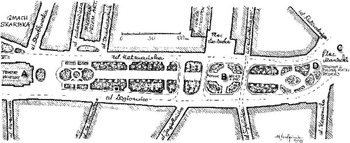
In 1895, the city of Lwów published a tender for the building of a great theatre, worthy of the rank of the city. The location was a particularly delicate issue of the tender. Within the walls of the medieval city core there was no free room for such a representative building, while the suburbs outside the walls were considered inferior. The winner of the tender, Zygmunt Gorgolewski, a graduate of the Berlin Academy, and the director of Lwów's higher art-industrial school solved the problem by proposing to cover the bed of the Poltva with concrete iron arches, thus creating an elegant promenade along the walls, with the new Opera House (marked A in Figure 1) in its northern area. During the development of the promenade, the two statues standing here were removed. The statue of Jabłonowski was taken to the courtyard of the Jesuit convent, from where it disappeared during the Soviet occupation of the city (while the leader of the Cossacks repelled by him, Pyotr Doroshenko, as an early representative of the Ukrainian element connected with the city, now has a street named after him in the centre), and St. Michael's statue was taken to the city museum. In the central part of the newly created square, as a southern endpoint of the representative square of the opera house, a new statue appeared, that of Jan III Sobieski, King of Poland (point B in Figure 1).3
Lwów, showing the location of the Opera House (A) and the statue of Jan III Sobieski, King of Poland (B).

The symbolism of the newly formed Karl Ludwigs-Straße faithfully expressed the political ambitions of the city of Lemberg and of the Polish-dominated government of Habsburg Galicia. The opera house, modelled on that of Vienna, which was consecrated in 1899 by the high priests of the five main churches of the city, represented at once the cultural emancipation of the city as well as its surpassing any ethnic divisions and focusing on Vienna. The statue erected at the same time (1897) at the other end of the promenade, to the Polish king who in 1683 first rushed to assist Vienna against the Turkish siege, symbolizes the awakening of a Lemberg-based Polish nationalism, whose main aspiration was the autonomy of Galicia within the Habsburg empire.Reference Prokopovych4
The new urban space shaped in this way has played a decisive role in the definition of the city. The space, in a special way, covers all the five elements – paths, edges, districts, nodes, landmarks – of the urban mental maps as defined by Kevin Lynch, and thus, although it is not the city's main square, it has become a fundamental organizing focus of the city's mental map.Reference Lynch5 That's why it was so important to every new political system to inflict on the space the stamp of its own regime of memory by way of new memorials.
Until the end of the Habsburg rule, this ensemble was enriched by only one more important element, the memorial column erected at the southern focus of the square in 1904, at the centenary of the birth of the Polish national poet Adam Mickiewicz (point C in Figure 2). The column took the place of the statue of the Virgin Mary, which therefore had to be moved a little further north (to point D). The new monument stretched the representative square to in the entire length of the city core, while further strengthening its Polish symbolism.Reference Szolginia6
The locations of memorial column to Adam Mickiewicz (C) and the new location of the statue of the Virgin Mary (D).

Due to the autonomous Polish component of the balanced symbolism, the memorial composition of the square – now ulica Legiónow after the Pilsudski Legions – remained unchanged even after Lwów, together with Galicia, became part of the newly created Republic of Poland. Both Jan Sobieski and Mickiewicz could be interpreted not only in the framework of a Polish Galicia faithful to Vienna, but also in that of an independent Poland. The first major intervention took place only after the Red Army marched into Lwów, on 21 September 1939, and the Ukrainian National Assembly, convoked in the opera house, voted in favour of the union of ‘Western Ukraine’ with Soviet Ukraine. For the time being, the new system did not remove any of the old memorials, but set up a new one in front of the opera house. The new monument was the statue of the Stalinist Constitution, which, according to its official ideology, brought freedom and equality for the peoples of the Soviet Union (point E in Figure 3) Accordingly, its inscriptions were in three languages, Polish, Ukrainian and Yiddish. The new monument created a new focal point on a hitherto symbolically unused point of the square, which, as we shall see, will continue to be reckoned with.
The location of the statue of the Stalinist Constitution (E).

This monument proved to be the shortest-lived of all. In the last days of June 1941, after the last units of the fleeing Soviet army left the city, the population spontaneously crushed it even before the German army entered the city. The symbolism of the square thus created was not modified by the German city commanders until July 1944, unless we count that from the side façade of the Polish cathedral to the east of the Sobieski statue (in the plan, above it) they removed and destroyed the relief representing the victory of Grünwald in 1410 by the Polish-Lithuanian Army over the Teutonic Order.
A new rearrangement of the square's symbolism took place only after the displacement of the Polish population and the destruction of the last partisan units of the Ukrainian Insurgent Army, when the new Soviet power considered the situation stable enough to introduce the new regime of memory into the urban fabric. In 1950, the Soviets offered to Poland to remove the Sobieski statue, which was then set up first in Warsaw, and then, in 1965, in Gdańsk. Owing to its multiple layers of history, by transmitting its symbolic power of space and social organization, in the 1980s the statue became the focus of the demonstrations of Solidarność. In its place in Lvov a flowerbed was established. The statue of the Virgin Mary was removed from the Lenin Avenue, and saved by the few remaining Poles in the Polish cathedral. Finally, in 1952 they set up in the former place of the Stalinist Constitution, in front of the opera house, the bust of Lenin placed on a tall square pedestal (location F), which was called by folk tradition ‘the chimney-sweep piercing out of the chimney’. The Mickiewicz column has been preserved, but this one, without the Sobieski statue, around the bend of the main square, could not play the role of a visual counterpoint of the opera house. There remained no visual focus that could have been the final point of a walk starting from the opera house, while the statue of Lenin generated a static space around itself, calling for standing, celebrating and wreathing, thus discouraging the former community function of the square, and encouraging a new, centralized function.
The bust of Lenin was placed at location F.

After the independence of Ukraine in 1991 new changes took place in the square. By eliminating the central flowerbed that was in the place of the Sobieski statue, which had lost its function for more than a generation, the authorities opened a wide cross street on Liberty Avenue, which was thus cut into two distinct parts. The metamorphosis that took place in the northern part was similar to that of most of Ukraine's main squares: the statue of Lenin was removed, and that of the national poet Taras Sevchenko was erected. A novelty, however, was the place of the new statue (location G). In contrast to most other Ukrainian cities, it was set up not in the place of the former Lenin statue, but in the southernmost focus of the square's northern section, as close as possible to the former Sobieski statue.
The statue of Taras Sevchenko was erected at point G.

Thus the memorial, while fitting to the just emerging Ukrainian public regime of memory, also reflects two local regimes: it rejects the Soviet register, and – similarly to several urban innovations – reaches back to the Habsburg and Polish era, thus trying to create a continuity with them. Another consequence of the restoration of the southern focus is that the northern section of the square today again works as a promenade, with a festive crowd walking up and down between the Opera and the Sevchenko statue every Saturday and Sunday afternoons. The former place of the statue of Lenin and of the Stalinist Constitution is, however, still marked by a flowerbed.
In the southern section of the square, the statue of the Virgin Mary was restored, thus lending a greater sacral importance to this section, and reinforcing the religious component of the Ukrainian national identity.
Tamás Sajó, art historian and translator, is Co-Director, together with Antonio Bernat Vistarini (Universidad de las Islas Baleares) and John Cull (University of Holy Cross) of the Studiolum electronic publisher, issuing key works of early modern European emblematics and visual symbolism. Their annotated English publication of the Libro de las Honras de la Emperatriz María de Austria (2011) won the Eleanor Tufts Book Award. The main focus of his research is political visual symbolism from early modern to twentieth-century Europe.