





Autism is a neurodevelopmental condition that is characterized by restricted and repetitive behaviors or interests (RRBIs), differences in social communication, and altered response to sensory information (American Psychiatric Association, 2013) with a current estimated diagnostic rate of 1 in 31 school-age children (Shaw, Reference Shaw2025). Diagnostic features of autism may impact functioning across contexts and are hypothesized to relate to heightened susceptibility of emotional and behavioral challenges throughout the lifespan (Gotham et al., Reference Gotham, Cassidy and Weiss2020; Mazefsky & White, Reference Mazefsky and White2014; Samson et al., Reference Samson, Phillips, Parker, Shah, Gross and Hardan2014). Autistic youth experience co-occurring mental health conditions more frequently than non-autistic peers (Mazefsky et al., Reference Mazefsky, Borue, Day and Minshew2014; Samson et al., Reference Samson, Phillips, Parker, Shah, Gross and Hardan2014), particularly in the domains of internalizing (e.g., depressive and anxiety related behaviors) and externalizing (e.g., observable behaviors related to oppositionality, inattention, and hyperactivity) behaviors. Meta-analyses on co-occurring psychiatric conditions in autism reveal that Attention Deficit/Hyperactivity Disorder (ADHD) and anxiety are among the most prevalent diagnoses, with estimated rates of 28% and 20%–40%, respectively (Lai et al., Reference Lai, Kassee, Besney, Bonato, Hull, Mandy and Ameis2019; van Steensel et al., Reference Van Steensel, Bögels and Perrin2011). Adolescence, a period marked by rapid hormonal and neurodevelopmental changes, is associated with higher rates of psychiatric conditions, making it a critical time to examine mental health (Blakemore, Reference Blakemore2019). Elevated internalizing and externalizing behaviors have been linked to significantly poorer clinical outcomes, including higher rates of psychiatric hospitalizations, suicidal ideation, psychotropic medication use, school disciplinary actions, difficulties with peers, and failed transitions to college and employment, compared to lower expression of these emotional challenges (Cai et al., Reference Cai, Richdale, Uljarević, Dissanayake and Samson2018; Conner et al., Reference Conner, Golt, Righi, Shaffer, Siegel and Mazefsky2020; Goldsmith & Kelley, Reference Goldsmith and Kelley2018; Gotham et al., Reference Gotham, Brunwasser and Lord2015; Mazefsky & White, Reference Mazefsky and White2014; Mazefsky et al., Reference Mazefsky, Herrington, Siegel, Scarpa, Maddox, Scahill and White2013; Nader-Grosbois & Mazzone, Reference Nader-Grosbois and Mazzone2014; Samson et al., Reference Samson, Hardan, Lee, Phillips and Gross2015; Stringer et al., Reference Stringer, Kent, Briskman, Lukito, Charman, Baird and Simonoff2020). However, more research is necessary to understand the developmental pathway by which autism-related behaviors may be associated with later co-occurring mental health problems.
Ritualistic behavior and mental health
Autistic children exhibit significantly more RRBIs (including adherence to routine, insistence on sameness, and repetitive motor behaviors) than non-autistic children and other psychiatric populations (Berry et al., Reference Berry, Russell and Frost2018; Bodfish et al., Reference Bodfish, Symons, Parker and Lewis2000; Harrop et al., Reference Harrop, McConachie, Emsley, Leadbitter and Green2014; Kim & Lord, Reference Kim and Lord2010; Richler et al., Reference Richler, Bishop, Kleinke and Lord2007; Watt et al., Reference Watt, Wetherby, Barber and Morgan2008). In a school-age autistic sample, Samson et al. (Reference Samson, Phillips, Parker, Shah, Gross and Hardan2014) found that RRBIs emerged as the strongest predictor of emotional and behavioral dysregulation above and beyond other core autism features including social communication and sensory sensitivities. This relationship has also been demonstrated in a non-clinical adult sample, in which autism-like RRBIs were associated with maladaptive emotional outcomes including rumination, self-blame, and catastrophizing (Nagase, Reference Nagase2023). RRBIs broadly have been strongly linked to specific internalizing symptoms among autistic samples, particularly anxiety and obsessive-compulsive behaviors (Glod et al., Reference Glod, Riby and Rodgers2019; Martínez-González et al., Reference Martínez-González, Cervin and Piqueras2022; Russell et al., Reference Russell, Frost and Ingersoll2019). Longitudinal studies have also demonstrated that the greater expression of RRBIs in toddlerhood predicted elevated anxiety symptoms in adolescence (Ben-Itzchak et al., Reference Ben-Itzchak, Koller and Zachor2020). Notably, though, these associations may vary across RRBI subdomains. For example, in a sample of non-autistic children with behavioral concerns aged 4–8 years, insistence on sameness was more strongly correlated to anxiety severity than repetitive sensory and motor behaviors as well as total RRBI score (Keating et al., Reference Keating, Van Goozen, Uljarevic, Hay and Leekam2023), highlighting the importance of examining specific subdomains in relation to internalizing and externalizing outcomes.
Within the RRBI domain, some features such as compulsive behaviors, ritualisms, and insistence on sameness are characterized by rigid cognitive patterns and structured routines, and have been most closely linked with internalizing symptoms in autistic youth (Berry et al., Reference Berry, Russell and Frost2018; Bishop et al., Reference Bishop, Richler and Lord2006; Bodfish et al., Reference Bodfish, Symons, Parker and Lewis2000; Carcani-Rathwell et al., Reference Carcani-Rathwell, Rabe-Hasketh and Santosh2006; Cuccaro et al., Reference Cuccaro, Shao, Grubber, Slifer, Wolpert, Donnelly, Abramson, Ravan, Wright, DeLong and Pericak-Vance2003; Turner, Reference Turner1999). Intolerance of uncertainty, in particular, has garnered significant attention in predicting anxiety symptoms among autistic youth. A recent meta-analytic review showed a positive association between intolerance of uncertainty and anxiety, wherein intolerance of uncertainty explained a significant portion of variance across autistic participants aged 4–24 (Jenkinson et al., Reference Jenkinson, Milne and Thompson2020). Ritualistic behavior, characterized by resistance to change in routines and insistence on sameness in the environment, may also serve as a meaningful RRBI subdomain contributing to the development of emotional and behavioral symptoms in autistic youth. Ritualistic behavior shares close conceptual overlap with intolerance of uncertainty, yet is less well understood in relation to internalizing and externalizing outcomes. While preliminary evidence suggests that ritualistic behaviors are associated with anxiety and emotional dysregulation (Lidstone et al., Reference Lidstone, Uljarević, Sullivan, Rodgers, McConachie, Freeston and Leekam2014), its role in longitudinal developmental pathways has not yet been examined, particularly in relation to externalizing behaviors.
Social diagnostic features and mental health
The core social diagnostic features of autism include differences with socio-emotional reciprocity (e.g., with back-and-forth conversation), nonverbal communicative behaviors (e.g., eye contact and gestures), and behavior in social contexts (e.g., making and maintaining friendships; American Psychiatric Association, 2013). These differences may have downstream effects on emotional and behavioral functioning. Specifically, youth exhibiting strong emotional reactions may be less accepted by peers and miss key learning opportunities in social and academic environments, exacerbating existing challenges in attention, problem-solving, communication, and social interaction (Samson et al., Reference Samson, Hardan, Lee, Phillips and Gross2015). Conversely, stronger social communication skills have been linked to more effective coping strategies and greater emotional stability among autistic adolescents (Martínez González et al., Reference Martínez-González, Cervin and Piqueras2022). Despite growing interest in connecting social diagnostic features to internalizing and externalizing behaviors, the directionality and development of these associations over time remains poorly understood.
Although research has increasingly examined links between social diagnostic features and internalizing and externalizing symptoms, most studies have focused on the effects of these emotional and behavioral difficulties on later social communication outcomes. For example, alexithymia (i.e., difficulty identifying and describing emotions) was found to be significantly associated with later self-reported social communication difficulties in autistic adolescents and young adults but not in non-autistic comparison groups (Oakley et al., Reference Oakley, Jones, Crawley, Charman, Buitelaar, Tillmann and Loth2022). This relationship persisted even after controlling for participant demographics and core autism features including repetitive behaviors and earlier social communication differences (Oakley et al., Reference Oakley, Jones, Crawley, Charman, Buitelaar, Tillmann and Loth2022). Similar findings have been reported in a school-age autistic sample, wherein early emotional and behavioral difficulties predicted poorer social communication at one-and two-year follow-ups (Berkovits et al., Reference Berkovits, Eisenhower and Blacher2017). While the interdependence of social communication and emotional and behavioral functioning is clear, few studies have examined the inverse relationship. This direction is theoretically plausible, as challenges with understanding, expressing, and responding to social-emotional cues may limit opportunities to develop effective coping strategies, thus increasing vulnerability to co-occurring internalizing and externalizing symptoms over time (Martínez González et al., Reference Martínez-González, Cervin and Piqueras2022). Previous research has shown that social communication is a significant concurrent predictor of externalizing behaviors within a school-age autistic sample but not among non-autistic peers (Shea et al., Reference Shea, Payne and Russo2018). However, no studies to our knowledge have examined this relationship longitudinally and relations with internalizing symptoms are especially limited. As social communication differences are a defining core feature of autism, clarifying their role in the development of these outcomes is an important area of exploration.
Individual and family factors in the development of internalizing and externalizing behaviors
Additional factors may contribute to the development of co-occurring mental health conditions, including individual characteristics such as age, IQ, sex, and gender. Internalizing conditions tend to become more prevalent during adolescence, potentially due to increasing social demands and apparent interference with social functioning (Lai et al., Reference Lai, Kassee, Besney, Bonato, Hull, Mandy and Ameis2019). In contrast, externalizing conditions are often diagnosed earlier in childhood (Sainsbury et al., Reference Sainsbury, Carrasco, Whitehouse, McNeil and Waddington2023), possibly because these behaviors are more outwardly observable. The role of IQ is less consistent across studies. Some research has linked higher IQ to increased internalizing symptomatology (Mazurek & Kanne, Reference Mazurek and Kanne2010; Salazar et al., Reference Salazar, Baird, Chandler, Tseng, O’sullivan, Howlin and Simonoff2015, Sukhodolsky et al., Reference Sukhodolsky, Scahill, Gadow, Arnold, Aman, McDougle and Vitiello2008), while other findings suggest the opposite (van Steensel et al., Reference Van Steensel, Bögels and Perrin2011). Further, lower IQ has been associated with greater externalizing behaviors in childhood, though developmental outcomes are variable (de Ruiter et al., Reference de Ruiter, Dekker, Verhulst and Koot2007; Flouri et al., Reference Flouri, Papachristou, Midouhas, Joshi, Ploubidis and Lewis2018). Sex or gender differences in co-occurring conditions have similarly produced mixed findings. Some studies have suggested higher rates of internalizing behaviors among autistic girls and greater externalizing behaviors among autistic boys (Solomon et al., Reference Solomon, Miller, Taylor, Hinshaw and Carter2012; Young et al., Reference Young, Sabbah, Young, Reiser and Richardson2010). More recent work, however, has shown no significant differences across sex or gender (Humphreys et al., Reference Humphreys, Schouboe, Kircanski, Leibenluft, Stringaris and Gotlib2019; Mayes et al., Reference Mayes, Castagna and Waschbusch2020).
Caregiver characteristics, including education level, may also contribute to the development of co-occurring internalizing and externalizing behaviors. For example, Gadow et al. (Reference Gadow, Perlman, Ramdhany and de Ruiter2016) found that lower parental education was associated with greater psychiatric challenges among children. However, these associations should be interpreted with caution, as they may reflect broader contextual factors, such as systemic stressors or resource accessibility, rather than direct effects of caregiver behavior or capability.
Present study
While both ritualistic behavior and autism social diagnostic features have been strongly associated with emotional and behavioral functioning, their distinct contributions to the development of co-occurring internalizing and externalizing behaviors remain unclear. A critical challenge within this literature concerns whether the high co-occurrence of autism and co-occurring mental health conditions reflects genuine comorbidity or diagnostic overlap (Barlattani et al., Reference Barlattani, D’Amelio, Cavatassi, De Luca, Di Stefano, Di Berardo and Pacitti2023; Mazefsky et al., Reference Mazefsky, Filipink, Link and Lubetsky2011; Rosen et al., Reference Rosen, Mazefsky, Vasa and Lerner2018). Longitudinal designs that control for baseline mental health conditions are particularly valuable in this context, as they allow for the examination of whether specific autism features (i.e., ritualistic behavior and social communication) predict new or worsening psychopathology over time above and beyond pre-existing symptom levels. Middle childhood through early adolescence represents a critical developmental period to explore these relations as many co-occurring mental health diagnoses emerge during early teen years and extend through adulthood. However, no studies to our knowledge have examined these associations in a single, longitudinal sample that includes both internalizing and externalizing outcomes.
As such, the present study examined the longitudinal relations between ritualistic behavior, autism social diagnostic features, and the later expression of internalizing and externalizing behaviors in autistic youth. We first assessed the baseline association between ritualistic behavior and autism social diagnostic features (Aim 1) to establish their relation as core diagnostic features. Then, we examined how these features may differentially contribute to the later development of internalizing and externalizing behaviors. Specifically, we examined how baseline ritualistic behavior and autism social diagnostic features predicted later internalizing behaviors (Aim 2) and externalizing behaviors (Aim 3). Given the potential role of individual demographic characteristics, child and caregiver factors related to age, IQ, sex, and parent education were included as covariates. We hypothesized that, concordant with existing literature, ritualistic behavior and autism social diagnostic features would correlate positively with each other, reflecting their shared role as core autism diagnostic features. Further, we hypothesized that early ritualistic behavior would predict later internalizing behaviors, given that related RRBI constructs have been closely linked with internalized distress. We hypothesized that early autism social diagnostic features would predict later externalizing behaviors as cross-sectional findings demonstrate that social communication differences are associated with externalizing challenges in autistic youth.
Methods
Participants
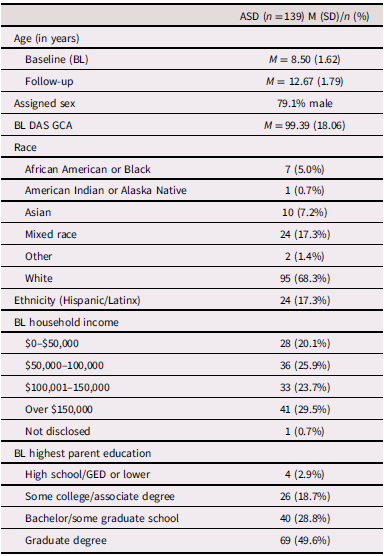
Participants included children with an autism spectrum diagnosis enrolled in the Autism Biomarkers Consortium for Clinical Trials (ABC-CT), a multi-site study evaluating the viability of autism biomarkers for use in clinical trials. Of the 280 participants enrolled at baseline, 178 returned for long-term follow-up, and 139 completed all relevant measures for the present study. At baseline, participants were between ages 6.0 and 11.5 years of age. At long-term follow-up, participants were between ages 8.7 and 16.1 years of age. Presence of an autism spectrum disorder diagnosis was confirmed by a licensed clinical psychologist using the Autism Diagnostic Observation Schedule, Second Edition (ADOS-2; Lord et al., Reference Lord, Rutter, DiLavore, Risi, Gotham and Bishop2012), the Autism Diagnostic Interview-Revised (ADI-R; Rutter et al., Reference Rutter, Le Couteur and Lord2003), and DSM-5 criteria (American Psychiatric Association, 2013) upon enrollment. Children were included if their Differential Ability Scales, Second Edition (DAS-II; Elliott, Reference Elliott2007) General Conceptual Ability (GCA) score was between 60 and 150. Participant and caregiver demographics are presented in Table 1.
Participant demographics

Table 1. Long description
One hundred thirty-nine participants were included. At baseline, the mean age was 8.5 years (SD = 1.62) and at follow-up it was 12.67 (SD = 1.79). 79.1% were male. The baseline Differential Ability Scales GCA mean was 99.39 (SD = 18.06). 5% were African American or Black; 0.7% were American Indian or Alaska Native; 7.2% were Asian; 17.3% were Mixed Race; 1.4% were Other races; and 68.3% were White. 17.3% were Hispanic or Latinx. Household income for the sample was below $50,000 for 20.1%; $50-100,000 for 25.9%; $100-150,000 for 23.7%; over $150,000 for 29.5% and not disclosed for 0.7%. Highest parent education at baseline was 2.9% high school/GED or lower; 18.7% some college/associate degree; 28.8% bachelor/some graduate school; 49.6% graduate degree.
Procedure
After providing informed consent, caregivers were invited to complete a series of questionnaires to describe their child’s current behaviors. Clinical instruments, including the Pervasive Developmental Disorder Behavior Inventory (PDDBI; Cohen et al., Reference Cohen, Schmidt-Lackner, Romanczyk and Sudhalter2003), Social Responsiveness Scale, Second Edition (SRS-2; Constantino & Gruber, Reference Constantino and Gruber2012), and Child and Adolescent Symptom Inventory-5 (CASI-5; Gadow & Sprafkin, Reference Gadow and Sprafkin2013) were administered at baseline and at 2.7–5.2 year follow-up (M = 4.13 years, SD = 0.656). The Behavior Assessment Scale for Children, 3rd edition (BASC-3; Reynolds & Kamphaus, Reference Reynolds and Kamphaus2015) was administered to caregivers at follow-up only. Participant race, ethnicity, and highest parent education were measured categorically via a caregiver-report demographics survey.
Primary measures
Pervasive Developmental Disorder Behavior Inventory (PDDBI)
The PDDBI is a caregiver report survey that measures autism related behaviors. It contains items that assess adaptive behaviors, social communication, and approach/withdrawal. The Ritualisms/Resistance to Change (RITUAL) domain measures a child’s tendency or desire to carry out routines or communicate discomfort with change in schedules or the environment via four-point Likert scale ranging from 0 = Does not Show Behavior to 3 = Typically Shows Behavior. It consists of three clusters – resistance to change in the environment (i.e., Insists that certain room lights stay on or off at inappropriate times) resistance to change in schedules/routines (i.e., Becomes upset when own schedule or order of the routine is changed), and rituals (i.e., Resists changing own location in room or wants others to stay in some fixed place). Higher scores indicate a greater presence of ritualistic behavior. The RITUAL domain scores were utilized at baseline as a measure of ritualistic behavior.
Social Responsiveness Scale, Second Edition (SRS-2)
The SRS-2 is a caregiver report survey and measures autism-related behaviors via four-point Likert scale ranging from 1 = Not True to 4 = Almost Always True. The Social Communication and Interaction (SCI) score is a combination of the Social Awareness, Social Cognition, Social Motivation, and Social Communication subscales. Higher scores on the SCI reflect more autism-related features of social communication and interaction. Baseline SCI scores were used as a measure of social features.
Child and Adolescent Symptom Inventory, Fifth Edition (CASI-5)
The CASI-5 is a caregiver report survey designed to screen for the presence of a variety of childhood internalizing and externalizing conditions. CASI-5 scores were utilized at baseline in order to control for baseline levels of symptoms of common clinical conditions related to internalizing and externalizing behavior, although the CASI-5 does not provide a single score for either internalizing or externalizing behaviors. Specifically, to understand the predictive ability of ritualistic behavior and social features on internalizing behaviors at follow-up, the following baseline CASI-5 T scores were utilized: Generalized Anxiety, Social Anxiety, and Major Depression. To understand the predictive ability of ritualistic behavior and social features of externalizing behaviors at follow-up, the following baseline CASI-5 scores were utilized: Attention-Deficit/Hyperactivity Disorder (ADHD) Hyperactivity Scale, ADHD Inattention Scale, Oppositional Defiant Disorder Scale (ODD), and Conduct Problems Scale.
Behavior Assessment Scale for Children, Third edition (BASC-3)
The BASC-3 is a caregiver report survey and measures behavioral and emotional strengths and challenges via four-point Likert scale ranging from 1 = Never to 4 = Almost Always. Caregivers completed the child (PRS-C, ages 6–11 years) or adolescent (PRS-A, ages 12–21 years) form based on child age at follow-up. The Internalizing T score includes the Anxiety, Depression, and Somatization domains. The Externalizing T score includes the Aggression, Hyperactivity, and Conduct domains. The follow-up Internalizing and Externalizing composites were utilized as separate outcome variables to address aims 2 and 3, respectively.
The BASC-3 was selected as the primary outcome measure for several reasons. Most notably, the BASC-3 provides validated composite scores for internalizing and externalizing behaviors that offer a broader and more conceptually robust characterization of mental health outcomes than diagnosis-specific symptom measures. Importantly, this composite structure allows for the mapping of specific baseline symptom profiles onto a more comprehensive index of emotional and behavioral functioning over time.
Analytic plan
All analyses were conducted using IBM SPSS Statistics version 30. Only participants who had complete data were included in analyses. Data were inspected for the presence of outliers and assumptions of normality and homoscedasticity were assessed prior to analysis; one child with extreme scores was removed from Aim 3 analyses. Alpha level was set at p < .05.
Aim 1
To understand the baseline relation between ritualistic behavior and social features in our sample, Pearson correlations were computed for baseline SRS-2 SCI and PDDBI RITUAL domain T scores.
Aims 2 and 3
We used hierarchical linear regressions to predict follow-up internalizing and externalizing behaviors. Model 1 included the baseline CASI scores for either the internalizing or externalizing domains (dependent upon outcome variable). The inclusion of baseline co-occurring mental health conditions in the model allows for the examination of whether autism features predict change in internalizing or externalizing profiles beyond concurrent symptom overlap. Model 2 additionally included child factors (age at baseline, assigned sex at birth, baseline IQ), parent factors (highest parent education), and study protocol variables (time measured in days between baseline and follow-up). Model 3 additionally included child baseline ritualistic behavior and baseline autism diagnostic features as predictors.
Results
Aim 1: social and ritualistic behaviors
In line with our hypotheses, Pearson correlations revealed that baseline ritualistic behaviors were significantly, moderately related to baseline social features, r(139) = .590, p < .001, such that as ritualistic behaviors increased, autism social diagnostic features also increased. This relation is depicted in Figure 1. Bivariate correlations among baseline variables are presented in Tables 2 and 3.
Correlation between BL SRS-2 SCI and BL PDDBI RITUAL.

Figure 1. Long description
The PDDBI RITUAL t-score at baseline is on the x axis. The SRS=2 SCI t-score is on the y axis. The correlation is moderate and positive. Data points are shown for 139 participants.
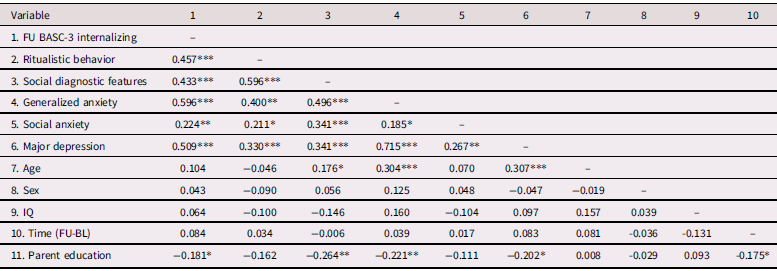
Correlation matrix for baseline variables with internalizing behavior at follow-up (FU)
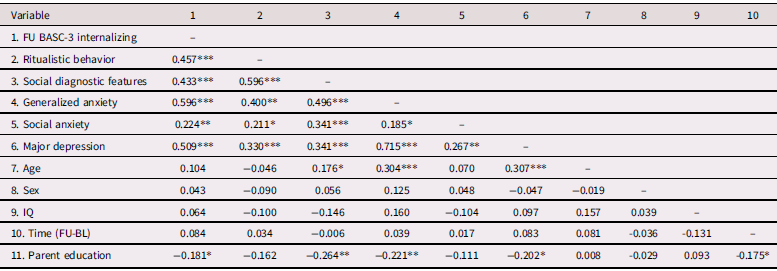
Table 2. Long description
Internalizing behaviors at follow-up were significantly correlated with baseline ritualistic behaviors (.433), social diagnostic features (.433), generalized anxiety (.596), social anxiety (.224), major depression (.509), and parent education (-.181) but not with age, sex, IQ, or the duration between baseline and follow-up.
*** p ≤ .001; ** p ≤ .01; * p ≤ .05.
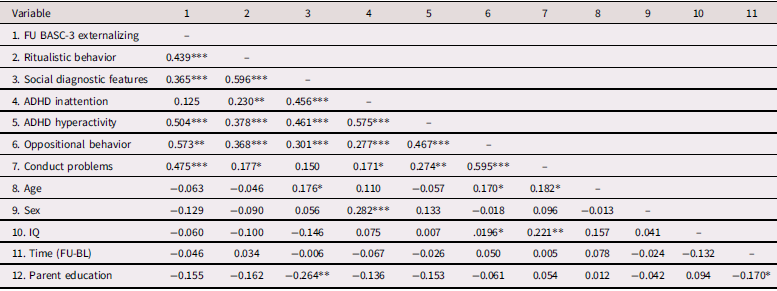
Correlation matrix for baseline variables with externalizing behavior at follow-up (FU)

Table 3. Long description
Externalizing behaviors at follow-up were significantly correlated with baseline ritualistic behaviors (.439), social diagnostic features (.365), ADHD Hyperactivity (.504), oppositional behavior (.573), and conduct problems (.475), but not with ADHD inattention, age, sex, IQ, the duration between baseline and follow-up, or parent education.
*** p ≤ .001; ** p ≤ .01; * p ≤ .05.
Aim 2: predicting internalizing behavior
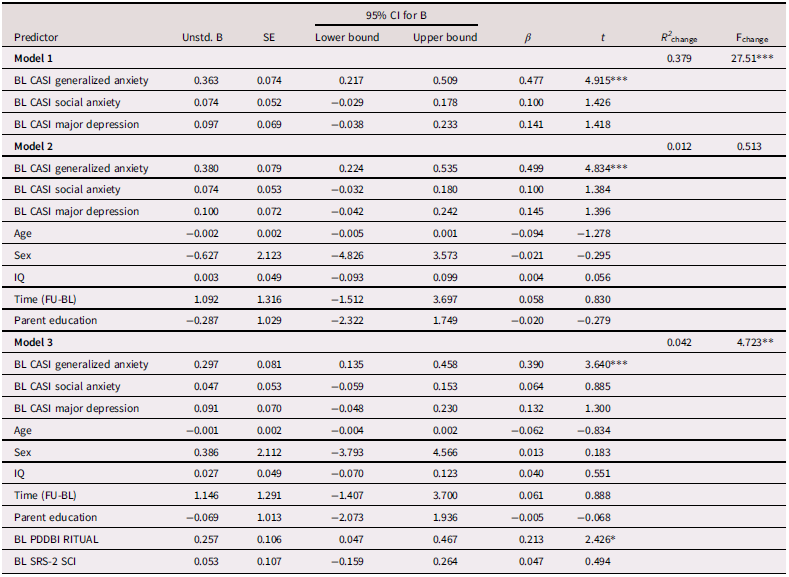
Model 1 (R 2 = 0.379, p < .001) showed that only baseline Generalized Anxiety T scores were a significant predictor of follow-up internalizing behaviors. In Model 2, the addition of child and family demographic variables did not significantly explain more variance (R 2 change = 0.012, p = .77) beyond baseline child internalizing symptoms. However, in Model 3, the addition of baseline ritualistic behavior and autism social diagnostic features explained significantly more variance in the overall model (R 2 change = 0.042, p = .010). While baseline Generalized Anxiety T scores remained a significant predictor, baseline ritualistic behavior emerged as a significant predictor of follow-up internalizing behaviors. Thus, we observed that children who initially exhibited more baseline ritualistic behaviors had higher levels of internalizing behaviors at follow-up, even after accounting for initial levels of internalizing symptoms, supporting the proposed hypotheses. The full model and regression coefficients are depicted in Table 4.
Regression outputs for internalizing behavior at follow-up

Table 4. Long description
In Model 1, baseline CASI generalized anxiety, social anxiety, and major depression were entered. Fit was significant with F = 27.51 and of those variables, generalized anxiety was significant with standardized beta = .477, t = 4.915. In Model 2, age, sex, IQ, the time between baseline and follow-up, and parent education were added and did not significantly improve model fit. Generalized anxiety remained significant with standardized beta = .499, t = 4.834. In Model 3, baseline PDDBI RITUAL and SRS-2 SCI were added, which improved the model fit. F change = 4.723. In the full model, generalized anxiety remained significant with standardized beta = .390, t = 3.640 and PDDBI RITUAL was also significant with standardized beta = .213, t = 2.426.
*** p ≤ .001; ** p ≤ .01; * p ≤ .05.
Unstd. = unstandardized; SE = standard error; CI = confidence interval.
Sex = 0, Male; 1, Female; BL = baseline; FU = follow-up.
Of note, only baseline Generalized Anxiety emerged as a significant baseline symptom predictor of follow-up internalizing behaviors in each model. This pattern may reflect construct consistency between the BASC-3 and CASI-5 scales, in which the BASC-3 internalizing composite captures dimensions of anxiety, depression, and somatization symptoms broadly. The CASI-5 Social Anxiety and Major Depression scales may capture more diagnostically specific constructs not captured by the BASC-3 internalizing composite. This is supported by concurrent correlations between follow-up CASI-5 subscales and the follow-up BASC-3 internalizing composite, wherein the correlation between BASC-3 internalizing and CASI-5 Generalized Anxiety was strong (r = .725, p < .001), follow-up Major Depression was moderate (r = .577, p < .001), and follow-up Social Anxiety was weak (r = .372, p = .007).
Aim 3: predicting externalizing behavior
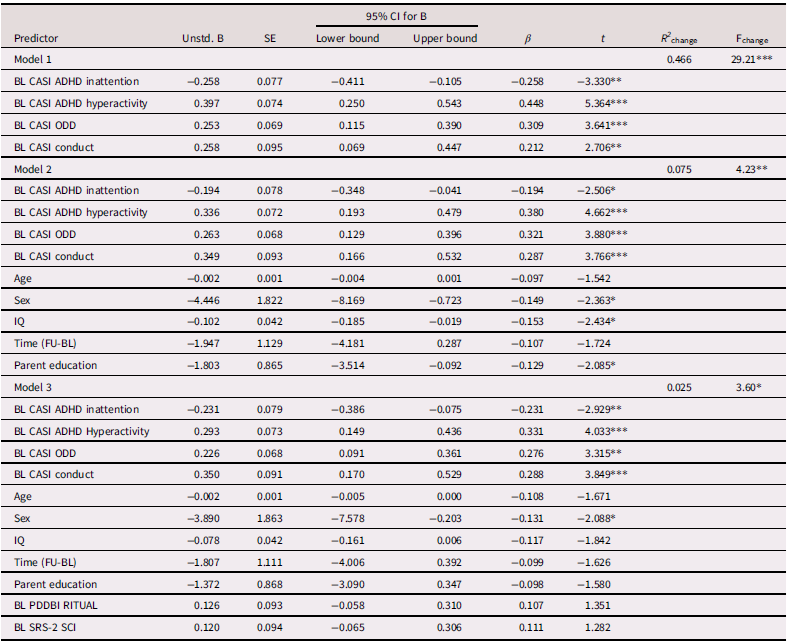
Model 1 (R 2 = 0.466, p < .001) showed that all BL externalizing symptom T scores were significant predictors of follow-up externalizing behaviors. Greater baseline ADHD Hyperactivity, ODD, and Conduct were associated with greater externalizing behaviors at long-term follow-up. Baseline ADHD Inattention showed an unexpected negative association with follow-up externalizing outcomes although no relation was detected when zero order correlations were examined (r = .125, p = .140; Table 3). In Model 2, the addition of child and family demographic variables explained significantly more variance in the overall model (R 2 change = 0.075, p = .001). Baseline externalizing symptoms measured by CASI T scores continued to be significant predictors. Baseline demographic variables including IQ, sex, and parental education emerged as significant predictors, wherein children who demonstrated lower cognitive abilities, were male, and had parents with lower education exhibited a greater presence of externalizing behaviors at follow-up. In Model 3, the addition of baseline ritualistic behaviors and autism social diagnostic features explained significantly more variance in the model (R 2 change = 0.025, p = .030), though baseline IQ and parental education were no longer significant predictors. Child assigned sex at birth continued to be a significant predictor. Neither baseline ritualistic behavior nor autism social diagnostic features were a significant predictor of later externalizing behavior. The full model and regression coefficients are reported in Table 5.
Regression outputs for externalizing behavior at follow-up

Table 5. Long description
In Model 1, baseline CASI ADHD inattention, ADHD hyperactivity, ODD, and conduct were entered. Fit was significant with F = 29.21 and of those variables, all were significant. ADHD inattention had standardized beta = -.258, t = -3.330; ADHD hyperactivity had standardized beta = .448, t = 5.364; ODD had standardized beta = .309, t = 3.641; and conduct had standardized beta = .212, t = 2.706. In Model 2, age, sex, IQ, the time between baseline and follow-up, and parent education were added and significantly improved model fit. F change = 4.23. The four CASI variables remained significant and age, sex, and parent education were significant. In Model 3, baseline PDDBI RITUAL and SRS-2 SCI were added, which improved the model fit. F change = 3.60. In the full model, the four CASI variables and sex were significant.
*** = p <.001; ** = p <.01; * = p <.05.
Unstd. = unstandardized; SE = standard error; CI = confidence interval.
Sex = 0, Male; 1, Female; BL = baseline; FU = follow-up.
Discussion
Autistic adolescents experience higher rates of internalizing and externalizing symptoms than their non-autistic peers (Mazefsky et al., Reference Mazefsky, Borue, Day and Minshew2014; Samson et al., Reference Samson, Phillips, Parker, Shah, Gross and Hardan2014). As such, the present study examined how core autism-related features in childhood, including ritualistic behavior and social diagnostic features, predicted internalizing and externalizing behaviors later in development. Consistent with prior work, our results suggested that ritualistic behavior and social diagnostic features were significantly, positively associated at baseline, suggesting overlap in their core diagnostic expression. Longitudinal analyses, however, revealed a unique predictive association. Specifically, higher levels of early ritualistic behavior were associated with greater internalizing behaviors at follow-up. This association persisted despite controlling for baseline symptoms and demographic variables, suggesting that ritualistic behaviors uniquely contribute to co-occurring emotional difficulties across development. Contrary to hypotheses, neither baseline ritualistic behavior nor autism social diagnostic features significantly predicted later externalizing behaviors. Rather, baseline externalizing symptoms and assigned sex at birth were consistent predictors of behavioral difficulties at follow-up. These findings highlight the importance of examining heterogeneity among core diagnostic features when identifying trajectories of mental health symptoms.
When examining early predictors of internalizing behaviors, we found that early ritualistic behaviors at baseline significantly predicted later internalizing behaviors at long-term follow-up. This finding suggests that autistic children who exhibit more characteristics such as resistance to change and insistence on sameness may be at a greater likelihood of developing internalizing difficulties such as anxiety, depression, or withdrawal. Notably, this association remained when we controlled for baseline internalizing behaviors (i.e., generalized anxiety, social anxiety, and major depression) and demographic characteristics (i.e., age, sex, IQ, and parent education), suggesting that early ritualistic behaviors uniquely predicted later internalizing challenges above and beyond co-occurring internalizing behaviors at baseline. These findings align with previous research demonstrating that RRBIs, particularly insistence on sameness and intolerance of uncertainty, are influential in the development of anxiety symptoms in autistic youth (Baribeau et al., Reference Baribeau, Vigod, Pullenayegum, Kerns, Mirenda, Smith and Szatmari2021, Reference Baribeau, Vigod, Pullenayegum, Kerns, Vaillancourt, Duku and Szatmari2023; Keefer et al., Reference Keefer, Kreiser, Singh, Blakeley-Smith, Duncan, Johnson and Vasa2017). The present study also extends this literature by focusing on ritualistic behavior, an infrequent target in the domain of RRBIs. Specifically, in our sample, ritualistic behavior was primarily measured by resistance to change, whereas existing literature has emphasized related but distinct RRBI constructs such as cognitive inflexibility and intolerance of uncertainty (Ozsivadjian et al., Reference Ozsivadjian, Hollocks, Magiati, Happé, Baird and Absoud2021). The unique variance explained by ritualistic behavior above and beyond baseline mental health symptoms suggests that ritualistic behavior may capture unique trait-level vulnerabilities that contribute to the development of internalizing symptoms over time. Specifically, ritualistic behavior may reflect how autistic children behaviorally structure and respond to their environment to manage unpredictability beyond internal experiences of rumination and negative affect.
Clinical interpretations of the observed longitudinal association between ritualistic and internalizing behaviors in autism are complex and likely multifaceted. In the context of anxiety, ritualistic behaviors may function as compensatory strategies to temporarily decrease distress related to sensory input or unpredictability (Lidstone et al., Reference Lidstone, Uljarević, Sullivan, Rodgers, McConachie, Freeston and Leekam2014; Wigham et al., Reference Wigham, Rodgers, South, McConachie and Freeston2015). However, reliance on ritualistic behavior as a primary coping strategy may unintentionally increase risk for later internalizing challenges. This is consistent with established avoidance models of anxiety, wherein short-term symptom relief through avoidance prevents the development of more adaptive coping strategies and thus exacerbates anxiety over time (Newman & Llera, Reference Newman and Llera2011). This cycle may be particularly pronounced in autistic youth given prior evidence of the key role of intolerance of uncertainty in the development of anxiety (Bird et al., Reference Bird, Moid, Jones and Surtees2024; Boulter et al., Reference Boulter, Freeston, South and Rodgers2014; Cai et al., Reference Cai, Richdale, Uljarević, Dissanayake and Samson2018; Jenkinson et al., Reference Jenkinson, Milne and Thompson2020; Vasa et al., Reference Vasa, Kreiser, Keefer, Singh and Mostofsky2018). The tendency for autistic youth to find unpredictable situations aversive may drive a reliance on inflexible behavioral strategies, such as ritualistic behavior. Notably, higher intolerance of uncertainty is associated with increased anxiety symptoms in autistic youth before and after modified cognitive behavioral therapy (Keefer et al., Reference Keefer, Kreiser, Singh, Blakeley-Smith, Duncan, Johnson and Vasa2017). It has further served as an effective treatment target in reducing anxiety-related challenges in a non-autistic adult sample (Talkovsky & Norton, Reference Talkovsky and Norton2016). Preliminary evidence suggests that the greater presence of pretreatment RRBIs is associated with less favorable intervention outcomes among standard and personalized CBT protocols (Storch et al., Reference Storch, Wood, Guzick, Small, Kerns, Ordaz, Schneider and Kendall2022). Taken together, these findings highlight the importance of parsing constructs that make up RRBIs, as distinct features may make unique contributions to the development and treatment of co-occurring internalizing challenges among autistic individuals.
Contrary to hypotheses, baseline autism social diagnostic features did not significantly predict later externalizing behaviors above and beyond baseline externalizing symptoms and demographic characteristics. This suggests that the unique contribution of social diagnostic features to the development of later behavioral difficulties may not hold over time. Prior cross-sectional findings demonstrated a significant concurrent association between social diagnostic features and externalizing behaviors in an autistic sample (Shea et al., Reference Shea, Payne and Russo2018). However, our findings suggest that this longitudinal association does not persist once baseline externalizing symptoms and demographic variables are accounted for. Notably, the current conceptualization of autism social diagnostic features is broad (i.e., social communication, social motivation, social cognition) and may have dampened more specific associations. Future research should consider if specific aspects of social diagnostic features may confer risk for later behavioral difficulties. For example, pragmatic language differences have been consistently linked to externalizing challenges in both autistic and non-autistic samples (Boonen et al., Reference Boonen, Maljaars, Lambrechts, Zink, Van Leeuwen and Noens2014; Crutcher et al., Reference Crutcher, Butler, Burke, Naigles, Fein and Eigsti2023; Helland et al., Reference Helland, Lundervold, Heimann and Posserud2014; Ketelaars et al., Reference Ketelaars, Cuperus, Jansonius and Verhoeven2010; Rodas et al., Reference Rodas, Eisenhower and Blacher2017).
Assigned sex at birth also emerged as a significant predictor of later externalizing behaviors, with boys exhibiting higher levels of externalizing behaviors at follow-up relative to girls. This finding is consistent with broader developmental literature demonstrating that boys are more likely to exhibit externalizing behaviors such as aggression, hyperactivity, and oppositionality across childhood and adolescence (Mayes et al., Reference Mayes, Castagna and Waschbusch2020; Solomon et al., Reference Solomon, Miller, Taylor, Hinshaw and Carter2012; Young et al., Reference Young, Sabbah, Young, Reiser and Richardson2010). Within the autism literature, sex differences in behavioral presentation are well-documented, though the underlying mechanisms remain unclear. One explanation is that autistic girls may be more likely to internalize distress rather than externalize it, resulting in different behavioral profiles despite comparable dysregulation (Solomon et al., Reference Solomon, Miller, Taylor, Hinshaw and Carter2012). Indeed, previous work has demonstrated that autistic girls are more likely than boys to engage in masking or camouflaging behaviors and may outwardly present as more regulated (Dean et al., Reference Dean, Harwood and Kasari2017), which may lead to a lower caregiver report of behavioral difficulties. Alternatively, this finding may reflect broader diagnostic and sampling bias, such that autistic girls exhibiting externalizing concerns are systematically underrepresented in research samples (D’Mello et al., Reference D’Mello, Frosch, Li, Cardinaux and Gabrieli2022). Future research should prioritize balanced, representative samples to better understand how sex assigned at birth may moderate developmental trajectories of externalizing behaviors in autistic youth.
An important clinical consideration for these findings concerns the distinction between symptom overlap and true diagnostic comorbidity. High co-occurrence rates between autism and internalizing and externalizing symptomatology have been well-documented (Barlattani et al., Reference Barlattani, D’Amelio, Cavatassi, De Luca, Di Stefano, Di Berardo and Pacitti2023; Mazefsky et al., Reference Mazefsky, Filipink, Link and Lubetsky2011; Rosen et al., Reference Rosen, Mazefsky, Vasa and Lerner2018). However, prevalence rates may partially reflect shared clinical presentations rather than the independent presence of distinct conditions. The present study’s finding that baseline ritualistic behavior predicted later internalizing behaviors above and beyond baseline internalizing symptoms suggests a developmental pathway unique to autism features. While the present study cannot definitively establish that autism features and mental health outcomes are entirely distinct, the observed longitudinal associations extend beyond concurrent shared symptom presentation. This finding highlights the need for deliberate differentiation of core autism features and co-occurring internalizing and externalizing symptoms as well as monitoring presentations over time.
Strengths and limitations
To our knowledge, this study is the first to examine the longitudinal associations between core autism characteristics and the later emergence of internalizing and externalizing behaviors in autistic youth. By differentiating the contributions of ritualistic behavior and autism social diagnostic features above and beyond baseline symptoms, the current findings offer insight into potential developmental pathways through which emotional and behavioral challenges may manifest. However, some limitations are suggested to inform future research directions. Firstly, the COVID-19 pandemic occurred immediately prior to longitudinal data collection (FU) and may have uniquely impacted the relationship between pre-pandemic (baseline) and post-pandemic (follow-up) outcomes. As such, it is possible that we are more likely to have seen elevated internalizing and externalizing behaviors at FU. However, longitudinal association between pre-pandemic predictors and outcomes is still meaningful, as directionality of the association would not have changed. We also accounted for baseline internalizing and externalizing behaviors in our analyses. Nonetheless, replication of the current study with an independent sample is encouraged. Further, our outcome measure was only introduced at the follow-up time point. Therefore, symptoms of common clinical conditions related to internalizing and externalizing behaviors were captured using the CASI-5 at baseline (BL) and internalizing and externalizing behaviors the BASC-3 at follow-up (FU). While these measures capture similar dimensions of behavior, their psychometric properties and available scales limit direct comparability. Future studies may increase validity with the consistent use of a single measure across time points. Lastly, the present sample was predominantly White, male, and of relatively high SES, which may limit the generalizability of findings. Contextual factors such as environmental stressors or reduced access to mental health resources have been previously linked with elevated internalizing and externalizing symptoms in autistic youth (Adams & Young, Reference Adams and Young2021; Fung et al., Reference Fung, Lunsky and Weiss2015). These factors may also interact with autism features in ways that may amplify or buffer the developmental pathways suggested by these findings. Future research should prioritize diverse, representative samples to further examine how demographic and contextual factors may moderate the relationship between core autism features and co-occurring emotional and behavioral outcomes.
Conclusions
The present study sought to evaluate how baseline ritualistic behavior and autism social diagnostic features relate to later internalizing and externalizing behaviors. Findings indicated that while ritualistic behaviors and autism social diagnostic features were positively correlated at baseline, only higher levels of ritualistic behavior at baseline predicted more internalizing behaviors over time. Neither ritualistic behavior nor social diagnostic features were significantly associated with later externalizing behaviors. These unique patterns underscore the value of separately examining core autism features in relation to emotional and behavioral outcomes. These findings may help improve early identification of children at the greatest likelihood of developing co-occurring mental health conditions and support the use of targeted intervention efforts prior to adolescence.
Data availability statement
The experiments and supporting documents detailing our standard operation procedures and manuals of operation for the ABC-CT main study and follow-up study can be accessed by request from the principal investigator (james.mcpartland@yale.edu) and data are available via the NIMH Data Archive (identifier: 2288; https://nda.nih.gov/edit_collection.html?id=2288).
Acknowledgments
Thank you to all the families and children who participated, without whom this work would not be possible.
Funding statement
Research reported in this publication was supported by the National Institute Of Mental Health of the NIH under Award Number U19MH108206 (McPartland). The content is solely the responsibility of the authors and does not necessarily represent the official views of the NIH.
Competing interests
Geraldine Dawson is on the scientific advisory boards of the Nonverbal Learning Disability Project, Bristol Myers Squibb, Ignite BioMedical, Tris Pharma, and YAMO Pharmaceuticals; is a consultant for Guidepoint Global, LLC; receives funding for continuing education from University of California, Davis, and receives book royalties from Guilford Press, Oxford University Press, and Springer Nature.
Shafali Jeste serves on the data safety monitoring board for IONIS.
James C. McPartland consults or has consulted with Customer Value Partners, Bridgebio, Determined Health, Apple, Neumarker, and BlackThorn Therapeutics, has received research funding from Janssen Research and Development, serves on the Scientific Advisory Boards of Pastorus and Modern Clinics, and receives royalties from Guilford Press.
Dr. Shic has served as a consultant for BlackThorn Therapeutics, Janssen Research and Development, and Hoffmann–La Roche.
Dr. Webb has served as a consultant for Janssen Research and Development.
The other authors report no financial relationships with commercial interests.
Pre-registration statement
The study design for this project was pre-registered at ClinicalTrials.gov (NCT04841525) located at https://clinicaltrials.gov/study/NCT04841525 although this analysis was secondary to the primary objectives.


 Open access

