Scholars from disparate traditions in political science and international relations (IR) agree that status—standing or rank in a hierarchy—is a critical element of international politics.Footnote 1 The first aspect of this consensus is scholars’ strong belief that status affects outcomes of interest across IR, including behavior related to international organizations, nuclear proliferation, and international political economy.Footnote 2 Horowitz and colleagues are typical of this assumption and conclude that “status seeking and dominating behavior may be as important as raw aggression in affecting the likelihood of international conflict.”Footnote 3 The second element is general agreement that status has been an important factor in particular cases of real-world importance, where scholars have been confident in attributing status-seeking motives to states and leaders. For example, Mastanduno, in describing the Cold War dynamic, states that “US officials worried greatly, some would say obsessively, about the costs to US credibility and prestige of failed or aborted interventions.”Footnote 4
Although there is considerable agreement within the political science discipline and the foreign policy community that status matters in world affairs, there is little focused research on how and when it matters. Qualitative work has been illuminating, but unable to establish patterns across time and space, while cross-national research on status and conflict has established a foundation for future inquiries, but has yet to generate concrete, replicable findings on the subject.Footnote 5 Recent experimental work on political and military leaders has touched on the subject as well, though without the direct link to international conflict that is still the gold standard in IR.Footnote 6
I present a series of methodological and theoretical innovations intended to break new substantive ground in the study of status and world politics. On the theoretical side, I clarify the relationship between status and conflict through a theory of “status dissatisfaction.” Although the desire to show that status matters has been a valuable building block, I propose an approach that focuses on status concerns that vary over time and context, rather than the traditional focus on status-seeking or general preferences for status. This is critical because, while preferences for higher status can be taken as a constant, the level of concern over relative status is not and thus provides far greater analytical leverage in examining the effects of status in world politics.
Status dissatisfaction also explains how status is linked to international conflict, beginning with the critical issue of how states make status comparisons. In particular, it focuses on how states group themselves into “status communities” of peer competitors. Although previous work has noted that status is relative, it has failed to ask: relative to whom? Thus, one notable advancement of this theory is its treatment of these reference groups, long cited as one of the key elements of status by virtually every other field in the social sciences, but severely neglected in IR.
Finally, the theory provides an explicit link between status dissatisfaction—a heightened concern for status triggered by status deficits within a given status community—and conflict. Previous theories have relied on “frustration” or “unthinking” aggression that presupposes a degree of irrationality that is difficult to prove and serves to underemphasize the strategic nature of status-seeking in world politics, one that is consistent with both psychological and rationalist accounts of IR.Footnote 7 States seek status commensurate with their abilities because it is a valuable resource for coordinating expectations of dominance and deference in strategic interactions. Rather than a response to failing to change an actor's status position, the initiation of conflict is better conceptualized as one way that states seek to alter the beliefs of other members of the international community. This strategy works: states that initiate and win conflicts receive substantively and statistically significant boosts in their status ranks after both five and ten years.
The ephemeral (that is, ideational and social) nature of status implies that several methodological issues must be tackled to provide a convincing demonstration of status dissatisfaction. The two most prominent are the measurement of status itself and the identification of “status communities.” Following previous work, I use the diplomatic exchanges between countries as a measure of status, but I identify three issues that have limited the usefulness of these data thus far:
-
1. All countries are equal (representation from smaller states “counts” as much as representation from superpowers).
-
2. All diplomats are equal (previous work has ignored the different levels of diplomatic representation by collapsing the data into binary form).
-
3. There is only one hierarchy, composed of all states.
To rectify the first issue, I innovate by measuring status through a network centrality measure that—unlike previous work—sensibly takes into account the importance of the sending country so that states are allowed differential abilities to confer status on other actors. To address the latter two issues, I use a “community detection” algorithm that weights edges (connections between states) by the level of diplomatic representation to form “status communities” based on the number and intensity of real-world interactions between states.
Status in International Relations
In empirical IR, the most prominent manifestation of status has been the idea that conflict arises from status “inconsistency,” a disjuncture between the status attributed by the international community and the status one actually deserves.Footnote 8 Attributed status was indexed using the number of diplomatic representatives received and achieved status—what countries would feel they “deserved”—was measured as military and industrial capacity.Footnote 9 Findings in this tradition were mixed: some research found greater inconsistencies associated with the onset and severity of international conflict while others found either no relationship or a negative relationship between status inconsistency and war.Footnote 10 Still others argued that these mixed results might be explained by temporal shifts in the relationship between status inconsistency and conflict.Footnote 11
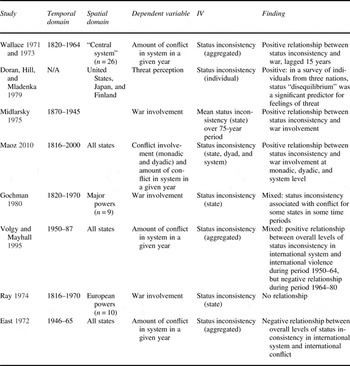
In Table 1, what at first glance seem to be many “failed” replications are an agglomeration of different research designs, hypotheses, and subsets of data: no analysis has examined the entire international system over the entire span of time for which data exist. And while some studies examined the overall levels of status inconsistency and its relationship to levels of international violence, most works examine status inconsistency for individual states.Footnote 12 This means that we have little sense of whether the mixed results are the “fault” of the general intuition, the specific theory (based on frustration and aggression), or the multiple and conflicting ways it has been tested.
Previous research on status inconsistency

Related work can be found in the “causes of war” literature as well as research on the acquisition and demonstration of both conventional and nuclear weapons.Footnote 13 In power transition and hegemonic war theory, status has been a focus of the theories, but neglected in empirical efforts. Gilpin and Organski and Kugler have all argued for the importance of prestige as one of the central benefits denied to rising powers by the reigning hegemon who “locks in” a hierarchy of prestige that may no longer accurately reflect the balance of capabilities.Footnote 14 Yet, “satisfaction” with the system has been measured—not directly through careful construction of status dissatisfaction measures—through second- or third-order implications, such as an alliance portfolio that aligns with that of the “system leader.”Footnote 15
A growing literature on status in IR has drawn from Social Identity Theory (SIT), a particularly useful lens that focuses our attention on social comparison. Larson and Shevchenko have used SIT to explore strategies that great powers have used to maintain or increase their status, such as emulating the practices of higher-status groups.Footnote 16 In a similar vein, Wohlforth has proposed a theory of great power status competition that predicts more “status conflict” (wars whose motivating factor is competing for primacy in the status hierarchy) in multipolarity than in bipolar or unipolar systems.Footnote 17 Related work has focused on the dynamics of status recognition, how status concerns affect the decision making of political and military leaders and how states balance trade-offs between status and material capabilities.Footnote 18
Many of these works are bounded by a strict set of conditions, such as an equal power distribution among major powers.Footnote 19 In other cases, they rely on a set of assumptions that consider status-seeking irrational or noninstrumental, despite evidence that there are strategic rationales for acquiring status.Footnote 20 While many of the ideas generated by a SIT-based approach are valuable, they have proven difficult to test systematically in IR. For example, experimental findings on social comparison and “which of many possible identity-maintenance strategies they [states] will choose” have been difficult to operationalize in the context of world politics.Footnote 21
A much larger problem, however, is that we have ignored several key conceptual features of status that would help us to refine both our theoretical and empirical work. Here, a large body of literature on status in economics and psychology helps in generating more definitive hypotheses about social comparison, the most important feature of status still unaccounted for in existing work. Frank, for example, has argued that human beings are motivated by a biological mechanism to improve or maintain their status and that this mechanism is far more responsive to local rather than global comparisons.Footnote 22 “Local” in this case implies comparisons to actors that are similar along a range of dimensions, or ones that are forced upon the actor through proximity (such as workplace associates, or countries in a similar region).
A related area in need of improvement is our measurement of status itself. Although there is general agreement that the diplomatic exchange data set provides a crucial window into status dynamics in world politics, all previous research has simply counted the total number of diplomats a state has received (the more diplomats received, the higher status that state is).Footnote 23 This, too, ignores several important features of status, foremost among them that the status of the sending state matters; status is more effectively gained from high—not low—status actors. To rectify this, I use the tools of network analysis to provide a measure of diplomatic importance that conforms to the conceptual requirements of status far better than previously used measures. In response to the importance of “local” status, I extend the network-based analysis using the formal method of community detection to recover “status communities” in the international system.
Status Dissatisfaction
One basic problem that must be addressed before a useful theory of status in IR can be developed is the entanglement of status with related terms like honor and reputation, both of which are often used interchangeably with “status.”Footnote 24 This problem has been exacerbated by the varying understanding of these terms in different historical eras and cultures, complicating our ability to use historical quotations as evidence.
One way to disentangle these concepts is to imagine a hierarchy of beliefs, as suggested by O'Neill.Footnote 25 The 0th level of beliefs is the objective situation, for example, the number of nuclear missiles possessed by the United States. First-order beliefs are one actor's beliefs about another actor (more specifically, beliefs about how an actor will behave in a particular situation or beliefs that another actor possesses a certain quality or trait). China's belief about whether a US president would use those nuclear missiles in a crisis over the Taiwan strait would be a first-order belief. First-order beliefs do not require agreement among a group of actors, nor do they require knowledge of what any other actor believes or thinks.
Second-order beliefs are one actor's beliefs about the beliefs of another actor or group of actors. For O'Neill, prestige is located at this second level.Footnote 26 An actor has status with a group for a certain quality if
-
1. The members generally believe that they generally believe that the actor has the quality.
-
2. They generally believe that they see the quality as desirable.
-
3. They generally believe on account of the considerations in [a] and [b] that the party holds power within the group.
Although it is reasonable to view status as a second-order belief, a small but important modification is in order. Status is not one actor's beliefs about one other actor. Rather, status describes many actors’ beliefs about what many other actors also believe. At this level of higher-order beliefs, it is probably easier to refer to status beliefs as “common” or “shared beliefs,” with the addendum that these beliefs are not just convergent, but shared (and that the actors know that they are shared). It is at this level that beliefs about status reside, since they rely on shared agreement among a community about where each actor stands in some hierarchy.Footnote 27
“Status” is typically used as shorthand for one of two specific concepts, the most common of which is standing: an actor's position in a social hierarchy.Footnote 28 It is in this sense of rank that we can speak of status as a unidimensional metric: for example, “German leaders in 1908 sought higher status.” Notice that even when the emphasis is on rank, the rank itself is important only insofar as it clarifies what rights, respect, and patterns of deference the actor should expect from others, as well as how the actor is expected to behave with respect to others of higher or lower rank.Footnote 29
Status is also sometimes used to refer to an identity or membership in a group, for example: “status as a major power.”Footnote 30 Some have gone further to argue that status is either not zero-sum, or is better conceptualized as a “club good.”Footnote 31 However, the positional nature of status is still a critical factor in those situations. First, the status associated with becoming a member of a group is to a large extent fixed and thus every additional member of the group inevitably lessens the value associated with it (being a “major power” becomes less meaningful the more major powers there are); this is the classic definition of “zero-sum.” Membership in the group still relies upon the notion of positionality, only the unit of observation has changed: in these cases it is about the relative position of members and nonmembers of the group, or perhaps the relative rankings of different groups to which they might belong.
Other key features of status are that it is perceptual, positional, and social. It is positional in the sense that absolute values do not matter as much as comparisons to salient “reference groups.” This matters both theoretically (it helps us distinguish status from similar concepts like honor, which is not inherently positional) as well as empirically (by suggesting the importance of distinguishing between different reference groups). That it is both perceptual (based on beliefs) and social (in that it requires some shared consensus about relative position) aids in empirical investigation since these qualities imply what is termed the “visibility” or “publicity” hypothesis: the only way to obtain status is through actions that can be seen by others or actions that have visible consequences.Footnote 32
Status here is compatible with many of the dominant approaches in IR, including psychological and constructivist accounts, but also rationalist paradigms. O'Neill writes that “it is important even within a strategic approach to international relations since states may use it [prestige] to judge quality or they may bandwagon, choosing who to support depending on what they expect others to do.”Footnote 33 More broadly, as Dafoe and colleagues write, status “informs patterns of deference and expectations of behavior, rights and responsibilities.”Footnote 34 Status-oriented behavior does not have to be irrational. Status is a valuable resource, and conflict is status enhancing, so states deprived of the status they deserve may well turn to conflict (among other strategies) to attain their goals. Thus, though this is not a self-consciously rationalist theory, it fits in easily with such approaches insofar as they take into account nonmaterial stakes or preferences, such as other work on prestige, reputation or honor.Footnote 35
Status refers to the actual position or identity of a state. While either position or identity might have some explanatory power on its own, my focus is on status concerns. Status concerns denote the level of focus on status-related issues, and the likelihood of acting to advance or salvage one's status. A concern for status might be sparked by a perceived threat to one's status position or rank, but this is not a necessary condition. In this manner, status concerns are a larger conceptual category that includes “status threats” as one precipitating cause among several. Put slightly differently, status concerns may lead to status seeking—behavior or actions undertaken to gain status—but may also lead to actions designed to preserve one's current position or slow one's decline (neither of which is accurately captured by the term “status-seeking”). Status concerns are orthogonal to status itself, since both high- and low-ranked actors may evince powerful status concerns.
Motives for Status
Early social scientists such as Veblen saw status as an intrinsically valued social good and some in IR have taken similar positions.Footnote 36 Others see its value as instrumental, for example, in its ability to signal competence or provide access to power and resources.Footnote 37 Evidence for this comes from the laboratory, where even weak and artificial inductions of “high status” provide significant material benefits to its holders.Footnote 38 In IR, these benefits have been summarized as “decision-making autonomy and deference on the part of others.”Footnote 39 Additionally, there may be explanations from evolutionary biology that help to elucidate the larger sense in which status is instrumentally valuable, for instance, as a costly signal of other characteristics.Footnote 40
In reality, actors may pursue status for either, or both of these reasons. Although actors sometimes pursue status for the intrinsic psychological benefit that it confers, this does not mean that actors do not also sometimes pursue status because they believe it will confer direct benefits in the near future (or even indirect benefits in the long term). In fact, to the extent that high status is evolutionarily adaptive, status might be “instrumental” (in the broader sense) even when actions provide no discernible material benefit to the actor seeking increased status. This is, if anything, further evidence that an exclusive focus on the dichotomy between the instrumental and intrinsic benefits of status is unlikely to be fruitful.Footnote 41
Status and Reputation
Although beliefs about status are second-order, or shared beliefs, reputations are first-order beliefs about how an actor will behave in a particular situation or that another actor possesses a certain quality or trait. Status is thus distinguishable from reputation in that the former is inherently social. Reputations can form in interactions with only two actors, while it makes little sense to talk about status with fewer than three actors. More to the point, a status hierarchy cannot be said to form with only two actors. Of course, once formed (with n > 2), a status hierarchy can affect dyadic interactions.
While any number of actors may acquire reputations for a particular trait or behavior (for example, “standing firm”) without affecting any other actors’ reputations, status is inherently positional, and one actor moving up in a hierarchy requires some other actor's downgrading. Actors can also manipulate and affect their own reputation to a greater extent than status. While actors manipulate their reputations by taking particular actions, changing one's status requires changing the beliefs of multiple other actors, and since it is positional, there are both winners and losers in this process. In other words, while actors “invest in or seize” their reputations, status is “accorded by others.”Footnote 42
Of course, reputations (for example, for toughness) can affect an actor's status. But because status is a multidimensional attribute in which there are many inputs (reputations, but also a host of other material and ideational factors), it is not itself determinative. Thus to the extent that we are able to measure status, such ranks will encompass information about important reputations as well. Of course, both reputations and standing—along with myriad other factors—influence expectations about how actors will behave in the future.
All Status Concerns Are Not Created Equal
There is evidence, on both the individual and the state level, that political actors care a great deal about status. “If there is one feature of … status that scholars are in agreement upon, it is that leaders, policy elites, and national populations are often concerned, even obsessed, with their status.”Footnote 43 But knowing that leaders have strong preferences for status does not provide much inferential leverage; we must know when status moves up the list of priorities. In short, we must focus on variation in preferences for status. To do so, and following my earlier experimental work, I propose a focus on status concerns and suggest that (1) those concerns will be especially sharp when states experience “status deficits” (a status ranking that falls below a level set by expectations); (2) those expectations will be viewed through the prism of “local” comparisons to some salient reference group; and (3) dissatisfied states will take actions to alter their rankings in the hierarchy, which in turn requires changing the shared beliefs of a group of actors.Footnote 44
Status communities and local comparisons
The first thing one learns about status in a college economics course is that it is a positional good, and relative, but relative to whom? Earlier works noted that a state's position in a hierarchy was important, but stopped short of specifying which hierarchy we should examine. Instead, states were all placed in a de facto global hierarchy.Footnote 45
This is acceptable to the extent that one assumes the global hierarchy to be the most salient structure for all states. However, in the context of world politics, such a perspective would imply some odd rivalries. Do small island nations in the Pacific care about a struggle for relative status in Eastern Europe? Did major powers in the 1800s (primarily located in Western Europe) care about the jostling for relative standing that took place on the periphery of the system? Decades of research have demonstrated that actors construct reference groups that are similar to them on important dimensions. Or, to paraphrase Frank for the political domain: even internationally, status is local.Footnote 46
The oft-cited maxim that status is “positional” is thus true, but incomplete. Status is positional (in that comparisons are intrinsically important) but this does not tell us anything about the relevant “status community,” the reference group that actors see themselves belonging to and competing against. In theory, actors can compare their status with a multitude of targets along an almost infinite array of dimensions. However, work on social comparison suggests that the most important comparisons will be on dimensions that are widely regarded as important (for example, size of house or salary on the individual level; economic or military capability on the international level) and the comparisons will be made against some salient reference group.
This has important implications for our research design and theory: status communities will be more salient as the number or importance of shared attributes increases. The logic is straightforward: a hypothetical IR scholar at a research institution is more likely to see other IR scholars at similar institutions as their reference group, rather than broader groups sharing fewer attributes in common (for example, political theorists at similar institutions, or IR scholars in think tanks). Thus, one innovation of this research is to identify status communities other than the global system that might be relevant to states. Although there are many candidate possibilities (as a first cut) I operationalize this in two ways: (1) regional geographic hierarchies and (2) detected communities—groups of states in which the internal diplomatic links are more numerous and intense than those links to external states.
What triggers status dissatisfaction?
Even when we have a theory of how status communities are formed, we need a clearer understanding of how actors evaluate whether they have “enough” status. Where do beliefs about our own status come from? Status dissatisfaction theory focuses on expectations—what actors believe they “deserve”—which are then filtered through a comparison to the most salient reference group.
Although there are any number of possible comparisons that political actors might make—status quo, goals, aspirations, or even past states—there are significant gains to be made by modeling comparisons as a function of expectations, which subsume these other categories. A large body of work in psychology and political science has demonstrated the importance of expectations in evaluating prospects, or in this case, comparisons.Footnote 47
To say it is expectations that matter only pushes us one level deeper: on what are those expectations based? Here, we are on firmer ground—a number of theories from both IR and individual decision making suggest that actors’ beliefs about how much status they deserve will be set by their “asset levels” of other attributes, such as power or economic capacity. For example, power transition theory suggests that wars occur when status does not match up to material capabilities, while earlier work on status inconsistency suggested that it was specifically material or military capabilities that set an expectation level for status.Footnote 48 On the individual level, experimental work has corroborated some of these ideas: for example, a disjuncture between status and levels of other attributes is psychologically aversive and causes both decreased cognitive functioning and increased risk seeking.Footnote 49
How do actors know where they each stand with respect to one another? Broadly, beliefs about where each actor stands in a hierarchy are formed via observation of interactions between a group's members. Some attributes of status (for example, strength or wealth) are easily visible and accounted for. In other cases, there are unobservable elements, such as “toughness,” “influence,” or “quality” that must be inferred through patterns of deference and dominance behavior.Footnote 50
Just as important, there is considerable evidence that human beings are rather good at detecting where they stand. The scourge of overconfidence is not omnipresent, and “status considerations offer an important exception to predictions made by the theory of positive illusions.”Footnote 51 In fact, individuals seem to be just as good at judging where they themselves stand as they are at determining where others stand, both difficult tasks that require inferring the mental states and interactions of numerous other actors.Footnote 52 While our motivation for accuracy might be to avoid social sanctioning, our ability to be accurate likely derives from the evolution of our cognitive and neural architecture, which has developed to help us interpret myriad, subtle cues related to status.Footnote 53
How Do States Seek Status?
We are on safe ground in assuming that leaders and states care about status in general, and I have provided a rationale for why certain situations—namely status deficits within a given “status community”—might trigger particularly sharp status concerns. But what are the implications of these status concerns for international behavior? Research on status inconsistency has coalesced around an answer, summarized by Volgy and Mayhall:
Countries may diverge on a number of status dimensions which are considered salient for decision makers. For example, a country may rank relatively high on economic and/or military capabilities (i.e., achieved status) but may be accorded little prestige (i.e., ascribed status) by the international community. Under such conditions … it is plausible that a nation's decision makers would evidence a strong desire to change the status quo, and failing to do so, to engage in conflict and violence.Footnote 54
In this formulation, dissatisfied states resort to violence only after failing to change the status quo, that is, out of frustration. This explanation can be traced to the “frustration-aggression” hypothesis in psychology on which much of the status-inconsistency research in IR was originally based.Footnote 55
However, positing that states act out of “frustration” or “negative feelings” is a rather weak mechanism by which status might be linked to war. It presupposes an irrationality (acting out of frustration rather than strategic interests) that obscures the more likely way in which status concerns might relate to conflict. Because states can expect to profit from higher status and because status is positional (and thus other states can be expected to be reluctant to cede status voluntarily), violence may be one way of achieving higher status, rather than a last resort after having failed to do so.Footnote 56 It also attributes individual-level emotional states (“frustration”) to state actors, confusing the levels of analysis even further while also playing a role in de-emphasizing the strategic rationale for violence described earlier.
Why would violence bring higher status? To answer this, we must ask a more basic question: What types of events are capable of changing our status position? Because actors’ status rankings are based on the collective beliefs of the community to which they belong, changing their position requires changing other actors’ beliefs. This suggests the need to take into account how exactly beliefs are updated. In fact, a number of cognitive limitations affect our ability to update our beliefs in response to new information.
Chief among these restrictions is that beliefs are updated sporadically—not continuously—and only in response to large events.Footnote 57 Since beliefs about status require some consensus in the international community, events are not likely to change a state's position unless they are highly public (visible to all actors in the community), dramatic or salient (to capture the attention of potential observers), and convey unambiguous information. This last requirement is perhaps the most important. Status requires a shared consensus on a given state's “standing” in the relevant community—it requires agreement among multiple actors. To the extent that no two actors in a system agree on which actors have the highest status, there is no group consensus and thus no discernible status hierarchy. Thus, for an event to change status beliefs, it must change all (or the vast majority) of observers’ beliefs in the same way. Events that might be interpreted differently by different observers are unlikely to cause shifts in status beliefs.
Taking these conditions into account, one likely candidate—though not the only possibility—for an event that is capable of changing a state's place in a status hierarchy is the initiation of a military conflict. Rationalist scholars have argued that war reveals private information on relative strength otherwise unavailable to potential belligerents. I propose a variant on this argument. Although war (or militarized disputes in which force is used) does reveal private information about capabilities, it also reveals other things. The capabilities, along with behavior of the two opponents and the outcomes observed by the international audience, combine to influence the status beliefs of others in the hierarchy. Militarized conflicts—which are public, dramatic, and salient—are thus a chance for the international community to simultaneously calibrate their judgments concerning how much international standing a given state possesses (or should possess).Footnote 58
Research Design: Status by the Numbers
I follow the convention of using the diplomatic exchange data set to generate a measure of status.Footnote 59 Everything other than the actual raw data, however, represents a series of innovations designed to more closely align a cross-national measure of status with its conceptual foundations. There are a number of ways one might use such data to construct a measure of international status, but in practice, it has often been done by counting the number of diplomats sent or received by each state in a given year and transforming that into a ranking.Footnote 60
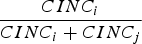
However, this neglects one critical aspect of status: who sends diplomats to an actor matters as much as (perhaps more than) the raw number of diplomats the state receives. All diplomats are not created equal: a diplomat from the United Kingdom was a greater indicator of status in 1817 than one from Sweden. But how do we operationalize this? How much value a diplomat from i has in year t could be based on i's status at t − 1, but such a system still requires initial starting values for status that risk being arbitrary.
To account for the sending country's importance, I use a simple network centrality measure of status based on Google's PageRank algorithm. This class of network centrality measure has enjoyed growing popularity as a tool for constructing hierarchies of influence and prestige in varied applications, such as doctoral programs or citation networks.Footnote 61 It also follows naturally on efforts to model the international diplomatic system using the tools of network analysis and Maoz's efforts to use network measures to construct status rankings.Footnote 62
This measure assumes that each diplomat sent by j to i is a “vote” for i's importance. For every year, the algorithm calculates this by picking a random starting point in the system and tracing all the diplomatic connections (based on the receipt of diplomats), repeating this process 10,000 times, and calculating, for that year, how much time was spent at each state relative to all other states in that year. Because the algorithm will spend comparatively more time at states that receive many diplomats (higher-status states), states will benefit more from being connected to those higher-status states than lower-status states. In this way, the importance of the sending state is taken into account in a sensible manner. This process is repeated for every year in the data set. The end result is a value [0, 1] which is then transformed into an ordinal rank, since that more closely conforms with our notion of status as inherently positional.Footnote 63
Two possible concerns are of note. First, PageRank might do an adequate job separating very low- from very high-status countries, but a poor job discriminating at the very top or very bottom of the hierarchy. I note that no state in the data ever receives diplomats from all other states (so it is not the case that states at the top have identical profiles of diplomatic representation, effectively tying them all for first place). Even at the top, there are significant differences. For example, in 2005, the top five ranked countries received 145, 179, 154, 151, and 134 diplomats, respectively. The focus on local hierarchies should assuage this concern even more because high-status countries are spread out across both geographic regions and status communities, so that within a given region or community, the differences are even starker than in the global hierarchy.
A second concern is that my measure of international status may reflect only a noisy measure of material capabilities. Although recent work would suggest that this is unlikely to be true, more systematic analysis might uncover other patterns.Footnote 64 In fact, the correlation between material capabilities and status typically hovers between 0.5 and 0.75, though with considerable variation over time.Footnote 65 The variation over time differs for different types of states; major powers, for example, see a substantial decline in the correlation between their material capabilities and international status in the twentieth century. Put more directly, status is manifestly not just material capabilities. Of course, strength is a factor in determining status, but there are also other inputs.Footnote 66 It is for this reason that there are countries with “normative” or “soft” power, or moral authority, that are high-status without being militarily powerful.Footnote 67 It is also for this reason that some instruments of hard power or military capabilities are not only not status-enhancing, but actually detrimental in some cases.Footnote 68
Detecting Status Communities
If status is local, we must ascertain where status concerns lie, and, for every state, i, which group of states forms the relevant comparison group. Previous works assumed that all states are in competition with all other states in one immense global hierarchy.Footnote 69 However, my theory of status implies that status concerns should matter most among reference groups, or status communities, in which states have salient attributes in common.
In a perfect world, we could survey leaders of every state in the system, past and present, to ascertain which states they view as peer competitors. Practically, however, there are two broad approaches. The first is to hypothesize salient attributes that might correlate with communities. It is easy to imagine that geography might matter a great deal in determining the reference groups of states: countries located close to one another would share languages, culture, and history in such a way that makes them obvious comparison groups. This approach is not perfect, however, since some salient communities (for example, major powers, or those based on ideological movements) would cut across regional geographic boundaries.
The second broad approach is inductive and relies on observations of interstate interactions. Earlier, I showed how one can use network analysis methods to provide centrality or authority scores that are more meaningful than simply counting the number of diplomats a state has received. Here, I continue along that track by using formal “community detection” methods developed in network science that are designed precisely to detect underlying communities of actors “in a way that is both methodologically rigorous and produces results that are substantively meaningful.”Footnote 70
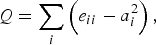
Broadly speaking, a community is “a group of nodes with more and/or better interactions amongst its members than between its members and the remainder of the network.”Footnote 71 Whether the interactions are, in fact, more and/or better is measured through the concept of modularity, or Q. Formally, modularity is expressed as
 $$Q = \sum\limits_i {\left( {e_{ii} - a_i^2} \right)\comma} $$
where Q is the proposed community grouping's quality, e i is the fraction of all edges (connections) that exist entirely within community i, and a i is the expected fraction of all edges that would exist across communities if edges were assigned to communities at random. As modularity increases, the proportion of edges that connect two actors in a single community (e ii ) increases relative to the proportion that would be found if the edges were assigned randomly (a i ).
Modularity thus measures the quality of a proposed network-partitioning scheme by comparing the fraction of all network edges (diplomatic connections, in this case) that fall entirely within each proposed community to what would be expected in a network with the same number of nodes (states) but edges assigned at random (with the same total number of degrees for each node). If a particular division gives no more within-community edges than would be expected by random chance, then modularity (Q) is 0. Values greater than 0 indicate “better than random” groupings and relatively higher modularity values suggest more efficient network partitions.Footnote 72
Choosing one's method of community detection often involves comparing Q values (in this sense, they function similarly to log likelihoods) and combining that with substantive knowledge about the data.Footnote 73 I use the Fast Greedy (FG) algorithm, developed by Clauset and Newman, and widely used throughout network science.Footnote 74 Weights are an optional feature of such algorithms, and if not assigned, imply that all connections are equal. Here, I weight the edges by the type of diplomatic link, from 1 to 4, ranging from “interest section” to “ambassador.”Footnote 75 The FG algorithm works by assigning each node to its own community and then iteratively pairing these communities in a search for the “greatest increase (or smallest decrease)” in modularity.Footnote 76 This process forms larger communities with each iteration. Once all communities have been merged into one super-community, the algorithm selects the partition that produced the highest modularity.
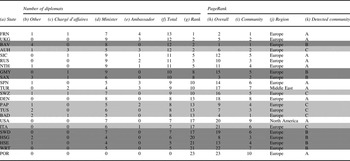
To see how this works, consider a snapshot of the international system in 1817, depicted in Table 2.Footnote 77 The table is sorted by column (f), the total number of diplomats received by each state in the system. It is worth remembering that nearly all past works have discarded all other information except this total. Columns (b–e) break down the total number of diplomats by type, arranged on a scale from least (“other,” which includes personnel assigned to a country's “interest section” hosted by another embassy) to most important (“ambassador”). A country's status rank was determined in the past simply by counting the total number of diplomats received from all other states. Note the potential limitations of such an approach: (1) all countries are equal—representation from smaller states “counts” as much as representation from more powerful states; (2) all diplomats are equal—we ignore the different levels of diplomatic representation by collapsing it in to a binary form; and (3) there is only one hierarchy, composed of all states, whether in the Middle East, North America, or Europe.
Detecting status communities (a snapshot of 1817)

Notes: Row shading indicates detected status community. States are sorted by rank (total number of diplomats received). AUH = Austria-Hungary; BAD = Baden; BAV = Bavaria; DEN = Denmark; FRN = France; GMY = Germany; HSE = Hesse Electoral; HSG = Hesse Grand Ducal; ITA = Italy; NTH = Netherlands; PAP = Papal States; POR = Portugal; RUS = Russia; SAX = Saxony; SIC = Sicily; SPN = Spain; SWD = Sweden; SWZ = Switzerland; TUR = Turkey; TUS = Tuscany; UKG = United Kingdom; USA = United States; WRT = Wuerttemburg.
The first issue can be properly accounted for using PageRank measures of network centrality in which the importance of the sending state is sensibly taken into account. This innovation is depicted in column (h), where rankings are based on PageRank scores, not simply raw counts of the number of diplomats hosted by each nation. Already, we can see that the overall picture changes from the traditional methods, such that some countries ranked high in (g)—Germany, for example—rank much lower in (h). These adjustments result from some states hosting a large number of diplomats from relatively unimportant countries; Germany's numbers are inflated by a large representation from other Germanic states.
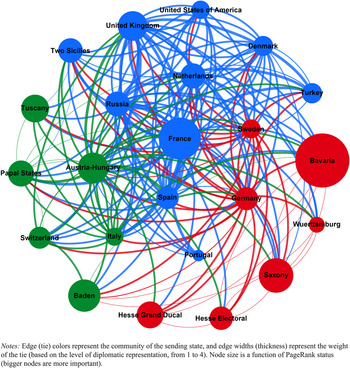
Even once this adjustment is made, however, the second two issues remain. Here, we can see the advantages of community detection. Column (k) lists each state's detected status community: A, B, or C. These communities cut across regional geographic boundaries, demonstrating the potential advantage of formalized community detection over other approaches. One can see a clear cluster of powerful states in Community A (for example, United Kingdom, Russia, France, and the United States), a cluster of Germanic states in Community B (for example, Hesse Grand Ducal, Hesse Electoral, Wuerttemburg, Saxony, Germany, and Bavaria) and Italian regions in Community C (for example, Tuscany, Papal States, and Italy). The structure of the status communities of 1817 are easily visualized in Figure 1. The algorithm also does well on face validity in other periods, for example, by accurately recovering US-Soviet dynamics during the Cold War.Footnote 78
Status Communities of 1817

Now that we have detected the relevant status communities, we can create status ranks within the relevant status community for each state, depicted in column (i). For these to represent an improvement over the overall rankings in column (h), we must ask: Is the leadership of Wuerttemburg in 1817 likely to care more about its status in the hierarchy of all states (in which it ranks twenty-second) or in its status community composed of other states that are similar in size, power, culture, and language (where it ranks seventh)? Intuitively, the latter grouping seems more plausible, though confirmation must wait until we can more formally test the relevance of the different potential status communities.
Construction of Variables
The main predictor variable is a measure of the status deficit for a given state in a given year. The inputs to this measure are the status rank (described earlier) and the rank on material capabilities, based on a country's Composite Index of National Capabilities (CINC) score. It is constructed by subtracting the rank on status from the rank on material capabilities, which are then standardized by year. This standardization process aids in interpreting the results, while allowing for fluctuating patterns in the relationship between status and power—the “exchange rate” between status and power—over time. The result is then multiplied by −1 so that positive (negative) numbers indicate greater (lesser) status deficits. Because both components of the status deficit measure (status and power) are likely to be affected by military disputes, all analyses described here lag this measure by one year, so that the relationship examined is status deficit in year t − 1 and conflict in year t.Footnote 79 The main outcome variables are binary measures indicating whether or not a state initiated a war (MID level 5) or a militarized interstate dispute (MID).
I used the EUGene software program to generate a directed-dyad data set of MIDs, both wars and nonwars, from 1816 to 2005.Footnote 80 Only originators involved on day 1 of a conflict could be coded as an initiator (this is the most restrictive coding). Control variables used in various models include: share of dyadic capabilities, cinc, distance, contiguity, ongoing mid, polity, peace years, joint democracy, major power, syscon (concentration of power in the international system), and alliance type.Footnote 81
Theoretical Expectations
First, we must establish that violent interstate conflicts—public, dramatic, and salient—will serve as “status-altering events.” We should thus expect to see evidence that conflict initiation—and particularly victory in conflict—provides status boosts to the victor/initiator. The “null” here is that conflict would have no effect on status rankings, or perhaps depress status rankings as other states withdraw diplomats in protest of the initiator's belligerence. However, for conflict to be “status enhancing,” states must reveal capabilities (military or otherwise) in conflict that provide new information on where they should stand in a given hierarchy. This is not necessarily accomplished by victory—since one could defeat a weak foe and reveal nothing new about capabilities—but by exceeding the expectations of observers. This suggests that we take additional care in our research design.
Second, we should expect to see evidence that dissatisfied states should initiate at a greater rate than “satisfied” states. Building on decades of evidence in cognate fields, the theory also posits that more “local” or fine-grained reference groups are likely to be more salient to states, and in turn have larger consequences for conflict behavior. To that end, we should see evidence that status deficits within the detected communities predict conflict over and above status concerns within either the regional or global hierarchy. Finally, if conflict is, in fact, status-enhancing when states exceed observers’ expectation, we should see evidence that dissatisfied states target the states that suit those purposes best. In particular, they should focus on targets that give them the best chance of prevailing (by targeting less powerful states) and gaining status (by targeting higher status states).Footnote 82
These hypotheses can be summarized as follows:
H1
(Winning status): Exceeding expectations in conflict will increase the initiator's status rank.
H2
(Status deficits and war): Status deficits will be associated with an increased probability of war and MID initiation.
H3
(Status is local): Status deficits within detected communities will be better predictors of conflict behavior than deficits within regional or global hierarchies.
H4
(The targets of status aggression): Dissatisfied states will pick fights that are most likely to provide the status benefits they seek (namely, against states they believe they can defeat).
Fighting for Status
Can Conflict Provide Status Benefits?
There is some anecdotal evidence that leaders believe that conflict initiation and victory will bring greater status.Footnote 83 Leaders’ perceptions are key since the theory relies on their mental models of how status is gained. However, there is little empirical evidence to corroborate this relationship between conflict and increased status.
As a preliminary exercise, and to supplement the intuitions and anecdotal data of previous scholars, I analyzed the effect of conflict initiation and victory on status. Unlike other analyses, this relies on a country-year data set of conflict initiation in which country i is coded “1” if they initiated a MID in year t or “0” if they did not (multiple MIDs in a given year by the same country are still coded as a “1”).Footnote 84
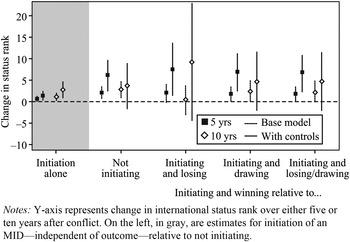
To examine this, I regressed change in status rank on a series of independent variables relating to conflict victory.Footnote 85 Figure 2 plots the results of the analysis.Footnote 86 Models are shown in their bivariate and “full” versions, and dependent variables include changes in status rank over both five- and ten-year periods after the initiation of conflict.
Status benefits of conflict initiation and victory

In fact, we do find support for H1: initiating and winning conflicts provides a boost to status over both five- and ten-year periods following the conflict initiation, relative to the following:
-
1. Not initiating at all
-
2. Initiating and losing
-
3. Initiating and drawing
-
4. Initiating and losing/drawing
For example, initiating and winning vaults the initiator state six rankings over states that did not initiate at all, and seven ranks over states that initiated but fought to a stalemate.
However, the theoretical expectations in H1 relate specifically to exceeding expectations of observers in combat, not necessarily winning. Fighting a superior opponent to a stalemate might generate as much status benefits as defeating an inferior opponent. Moreover, even victory itself is subjective.Footnote 87 Many factors—including material changes, achieving goals of war, expectation of participants and observers, and satisfaction with the settlement terms—affect perception of victory and defeat. We might expect COW's codings to line up with those subjective understandings over a large sample, but the relatively small numbers for any analysis of these outcomes (for example, there are only 105 states in the data that initiated and then lost a MID) combined with measurement error (particularly in the cases where a state both won and lost in the same year) suggests that we should not rely too heavily on codings of victory and defeat.
To provide a broader perspective, Figure 2 plots (in the left-hand gray panel) results for initiation alone (compared with not initiating). While the substantive effects are smaller, there is considerably less uncertainty. This fits with the explanation: while “victory” and “defeat” are variable and subjective terms, and multiple MIDs present difficult problems for this design, conflict initiation is (compared to these concepts at least) clear and unambiguous. Thus, I find that, on average, conflict initiation by itself—regardless of the outcome—provides a status boost to initiator states of 1.4 ranks over five years and 2.7 ranks over ten years.
Status Deficits and War
The theory's centerpiece is the hypothesis that dissatisfied states will initiate conflicts at greater rates than satisfied states. Because the dependent variable is binary, the appropriate regression model is binomial logit. And because the vast majority of observations are zeroes (there are very few conflicts in the data set relative to the number of total observations), I use rare events logit to correct for the noted tendency of traditional logit models to underestimate low-probability events.Footnote 88 The reported results use robust (dyad-clustered) standard errors, though, encouragingly, analyses using normal standard errors generate virtually identical results.Footnote 89 The main results appear in the online appendix.Footnote 90 In all models—from bivariate regressions to those that include a variety of controls, as well as squared polynomials of the IV to account for nonlinear effects and a lagged dependent variable to address temporal dependenceFootnote 91 —the coefficient for status deficits within the detected community is positive and statistically significant. This implies that more positive values for that measure—in effect, larger status deficits—are associated with an increased probability of war and MID initiation.
The results are robust to a wide variety of model specifications. For example, the results are not driven by underlying disputes that would cause both j to withdraw diplomats from i (inflating i's status deficit) and i to initiate. To address this, I constructed a variable, diplomatic change, that takes on a 1 if j has withdrawn diplomats from i in year t − 1 and a 0 otherwise. Including this covariate in models for MID and war initiation changes neither the size of the status deficit coefficient nor its statistical significance.
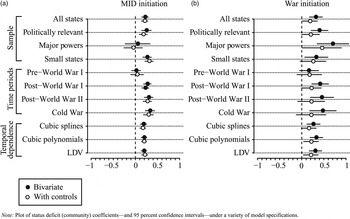
More broadly, we can visualize the results’ robustness through a coefficient plot, here used to depict status deficit coefficients from a variety of model specifications, including different samples of states, different time periods, and different corrections for temporal dependence. As is evident in Figure 3, the status deficit coefficient is quite stable in the MID initiation models, remaining positive in all specifications, and highly statistically significant in all but two (where it is only marginally significant; results are highly similar—with more uncertainty—for war initiation models).
MID and war initiation models: Status dissatisfaction coefficients

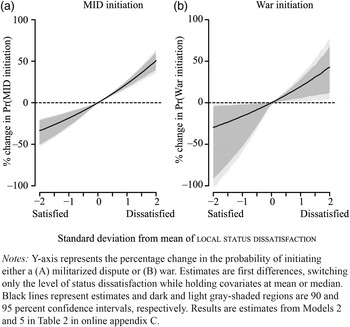
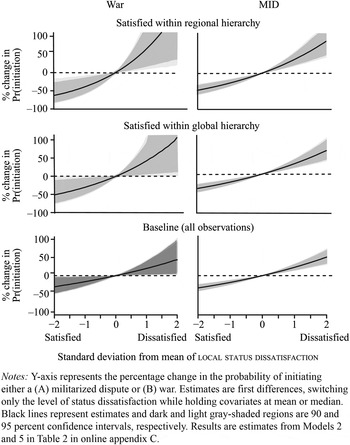
That the results are “stable,” however, does not tell us much about the effects of status deficits in the real world. To assess this, Figure 4 plots first differences—the difference between pr(DV = 1) at two different levels of the IV—for (A) MID and (B) war initiation. They answer the question: What is the change in the probability of a state initiating a war if we hold every control variable at some constant (mean or median) level, but switch status deficits from one level to another?
Status deficits and war

As is easily seen, larger status deficits are associated with an increased chance of both MID and war initiation. In fact, the substantive impact of status deficits is rather large, even compared with other variables commonly implicated in explaining conflict initiation: a state that is switched from “no status deficit” to “a status deficit one standard deviation from the mean” is roughly 35 percent more likely to initiate a war or an MID. This is clear support for our hypothesis (H2) that status deficits are associated with the initiation of violent interstate conflict.
Status Is Local
IR scholars have yet to grapple with the “local” nature of status. Typically, previous works assumed that all states interacted primarily within a global hierarchy; and if a smaller grouping of states was analyzed (for example, just major powers), it was assumed that those were the only states for whom status concerns were likely to affect conflict behavior. Decades of research on status suggest that this view is incomplete, at best.
I classified two broad approaches to identifying reference groups for states in the international system, one deductive and one inductive. The deductive approach starts by positing attributes that might define a reference group (for example, geographic region) and proceeds from there. The inductive uses data to identify—here through “community detection”—reference groups through real-world interactions. H3 (status is local) states that status deficits within detected communities will be better predictors of conflict behavior than deficits within regional or global hierarchies. However, direct tests of this hypothesis are difficult because multicollinearity between ranks in different communities present inferential difficulties.
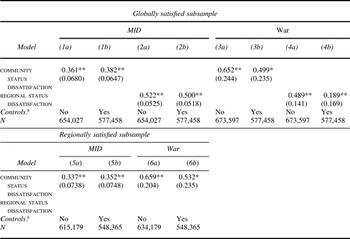
To combat this and separate out the effects of status deficits within local communities from those within the global system, I subset the data to examine the effects of status deficits (within detected communities and within the regional geographic hierarchy) for only those states who are satisfied within other, broader hierarchies. Table 3 displays the results of this analysis. Models 1 and 3 show that status deficits within detected communities significantly predict war even when those states are “satisfied” within the larger, global hierarchy. Models 2 and 4 show similar effects for regional status deficits; they are significant predictors of conflict even for those globally satisfied states. Models 5 and 6 extend this and show that even among states satisfied within their regional hierarchy (itself a “local” hierarchy of sorts), community status deficits are significant predictors of dispute and war initiation.
Status is local

Notes: Standard errors in brackets. p < 0.10, *p < 0.05, ** p < 0.01
These results can also be seen in Figure 5. Even for states who are “satisfied” within the larger, global hierarchy, status deficits within their local community emerge as reliable predictors of conflict initiation. This is true even when we subset to states satisfied within their regional, geographic hierarchy (itself a type of “local” hierarchy). Thus, we find initial support for H3: even internationally, status is local.
Even internationally, status concerns are local

The Targets of Status Aggression
Finally, I turn to the characteristics of the targets of status aggression. More specifically, I test the hypothesis (H4) that dissatisfied states pick fights with different sorts of states than satisfied states. Because conflict as a strategy for gaining status should work only in cases where the dissatisfied state either wins or performs better than expected, we should see evidence that dissatisfied states pick winnable fights.
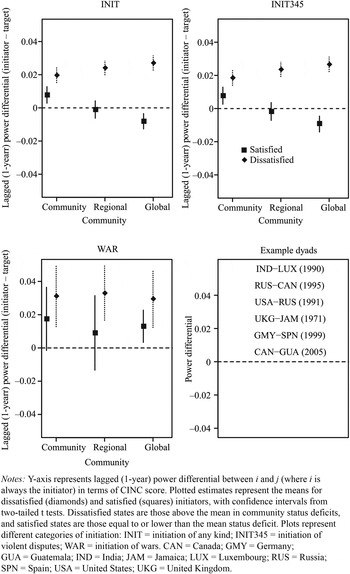
To conduct this analysis, I created a dummy variable, dissatisfied, equal to 1 when states’ status deficit was above the mean in their community, and equal to 0 when it was equal to or below the mean. To assess whether a fight was “winnable,” I constructed a measure, power differential that is the difference between i and j's CINC score; positive values indicate that i had greater military capabilities than j, negative values mean the opposite.Footnote 92 Because conflict at time t is likely to affect the power differential between i and j in that same year, I lag power differential one year to better proxy beliefs about the likelihood of winning a conflict.
Using simple t-tests, it is plain that the power differential between initiator and target is greater for dissatisfied states than satisfied states (t(2450) = −3:37, p < .001). In fact, this pattern persists in all the hierarchies examined—community, regional, and global—and for a variety of operationalizations of conflict initiation—all MIDs, violent MIDs, and wars.Footnote 93 As is evident in Figure 6, differences between satisfied and dissatisfied states targets are significant under all specifications for MIDs and violent MIDs. Moreover, the power differentials for the different groups are substantively significant, as illustrated by the third panel that plots example dyads along the same y axis.
Targets of status aggression

Conclusion
Despite a widespread consensus that status “matters,” we lack a basic understanding of fundamental questions concerning status dynamics in world politics. How does status matter: What specific behaviors do status concerns trigger, and what strategies do states use to maximize (or salvage) their standing? When does status matter: Under what circumstances do concerns over relative position overshadow the myriad other concerns that leaders face? How are status comparisons made: how do leaders select the group of states with whom they are in competition and what attributes (for example, wealth, power) form the basis of these comparisons?
I argued for an emphasis on relative status concerns that vary over time and context. I then proposed that status deficits—a disjuncture between status an actor is accorded and what they believe themselves to deserve—are likely to trigger particularly sharp status concerns. Although many scholars have acknowledged that status is “local,” the powerful implications of that maxim have been largely overlooked. To rectify this, I showed how we can use “community detection” methods borrowed from network analysis to infer status communities; clusters of states defined by the number and intensity of real-world diplomatic interactions.
Finally, because status is a perceptual construct, I demonstrated how we can use our understanding of how beliefs are updated to predict the types of events that states might use to update (and improve) the community's beliefs about their relative position. Conflict is thus not the result of unthinking aggression triggered by concerns over status, but a way of updating one's position in a status hierarchy.
It should (but may not) go without saying that many questions remain unresolved. For example, I operationalized “local” status communities as those inferred by a community detection algorithm. However, it is possible that some amount of dissatisfaction results not from a disjuncture between power and status, but from a lack of interactions with the community that one sees themselves as being part of. In these cases, community detection would fall short by placing a state in the “wrong” status community. Although this is an improvement over ignoring the issue entirely, my methods still provide only a coarse measure of “belonging.” Religion, shared history, culture, and ideology are all likely to produce status hierarchies even more fine-grained than regional geography or detected communities. Moreover, states may see themselves as belonging to more than one community at any given time, with different domains or behavior triggering one community or another.
Another important element of status research concerns the strategies states use to acquire rank. I argued that violent international conflict was one plausible strategy for dissatisfied states. It seems extremely unlikely, however, that this is the only such strategy. Future work might uncover other effective strategies, with the larger goal in mind of accounting for how states choose between multiple possible actions designed to alter their place in a hierarchy.
Finally, future work should seek to better understand the dynamics that lead actors to coalesce around a commonly agreed-upon reference group. There is the additional question of whether the modern international system might provide new avenues for measuring international status. For example, because the ease of travel has made state visits more common over time, we might be able to use systematic data on these meetings to construct new status rankings or corroborate past measures.Footnote 94 Perhaps most importantly, any status research agenda must begin to focus on other methods of status-seeking apart from conflict. Given the costs of armed violence (both in the short term, but also including reputational consequences and the provocation of balancing coalitions), it seems likely that states might use multiple strategies to alter their status community's beliefs about where they “stand.” Possibilities include economic growth, technological development, or behavior in international governmental organizations.
Supplementary Material
Supplementary material for this article is available at https://dataverse.harvard.edu/dataverse/Jrenshon.