Introduction
Paphiopedilum hirsutissimum (Lindl. ex Hook. f.) Stein (Orchidaceae), one of the famous slipper orchids, is an endangered species endemic in crevices, rocks or rocky and well-strained places in limestone area of southwest China, including Guangxi, Guizhou and Yunnan Province (Liu et al., Reference Liu, Chen, Chen and Lei2009). It is highly variable in its floral structure, which makes it an important germplasm as ornamental plant resources. Due to human activities and habitat destruction, the populations and individuals of P. hirsutissimum have been decreasing in the past decades. This orchid is listed as a vulnerable species (Vulnerable B2ab) in IUCN Red Lists of Threated Species (http://www.incnredlist.org/search). Many studies on this orchid have focused on the transcriptome analysis (Li et al., Reference Li, Wu, Zhang, Liu, Liu and Lin2015a, Reference Li, Zhao, Liu, Liu, Lin, Liu, Chen and Lvb) and propagation (Ng and Saleh, Reference Ng and Saleh2010; Zeng et al., Reference Zeng, Wu, Teixeira da Silva, Zhang, Chen, Xia and Duan2012, Reference Zeng, Wang, Wu, Teixeira da Silva, Zhang and Duan2013, Reference Zeng, Huang, Wu, Zhang, Teixeira da Silva and Duan2016) or hybridization (Zeng et al., Reference Zeng, Tian, Chen, Wu and Duan2010) of some species in this genus. However, little research has been done on the genetic diversity of P. hirsutissimum. Considering the severe population decline and germplasm loss, it is urgent to develop high-quality genetic markers in this species, which will contribute to the conservation and related genetic research in Paphiopedilum. In this study, fourteen polymorphic simple sequence repeat (SSR) markers were isolated and characterized from the flower's transcriptome data of P. hirsutissimum based on high-throughput sequencing, which will be used as an efficient tool for the genetic diversity study.
Experimental
Plants of P. hirsutissimum were collected from Guangxi Yachang Orchid National Natural Reserve (106°13′32.73″E, 24°49′1.52″N), in Leye County, Guangxi Zhuang Autonomous Region, China. Young leaves of 32 individuals were collected with 50 m apart from each other at least and individually dried by the silica-gel desiccant. DNA was isolated from dried leaves using DNeasy Plant Mini Kit (Qiagen, Hilden, Germany). Total RNA was extracted from flowers with RNeasy Plant Mini Kit (Qiagen, Hilden, Germany) for transcriptome sequencing on Illumina Hiseq 2500 platform (Illumina, San Diego, USA).
SSRs were identified using MIcroSAtellite (MISA) search module (http://pgrc.ipk-gatersleben.de/misa/misa.html) by the parameters of mono-, di-, tri-, tetra-, penta- and hexanucleotide motifs with a minimum of 10, six, five, five, five and five repeats, respectively (Xu et al., Reference Xu, Liu, Wang, Teng, Shi, Li and Huang2017). The Primer 3.0 (http://primer3.sourceforge.net/releases.php) was used to design primers.
PCR reactions were carried out under the following conditions: an initial denaturation at 94 °C for 3 min, followed by 30 cycles of 30 s at 94 °C, 30 s at 56 °C and 30 s at 72 °C, and then a final extension 3 min at 72 °C. A typical 20 µl reaction: 1× PCR buffer, 1.6 mM MgCl2, 0.2 mM of each dNTPs, 0.5 µM of each primer, 0.25 U of Taq DNA polymerase (Takara, Kusatsu, Japan) and 10–25 ng genomic DNA. Polymorphic PCR products were detected by capillary electrophoresis using the ABI 3730 DNA Analyser (Applied Biosystems, Waltham, USA).
For each locus, the alleles number (Na), effective alleles number (Ne), observed heterozygosity (Ho) and expected heterozygosity (He) were calculated by the software POPGENE 1.32 (Yeh et al., Reference Yeh, Yang and Boyle1999).
Discussion
After RNA purification, reverse transcription, library construction, transcriptome sequencing and assembly, 56,688 unigenes were obtained with an average length of 709 bp and an N50 of 1330 bp, and 36,114 (63.71%) were ranged from 200 to 500 bp, 8674 (15.30%) were 500 to 1000 bp, 7644 (13.48%) were 1 to 2 kb, and 4256 (7.51%) were more than 2 kb long. Among all unigenes, 7406 potential SSRs were identified, with 905 containing more than one SSR, and 369 compound SSRs (online Supplementary Table S1).
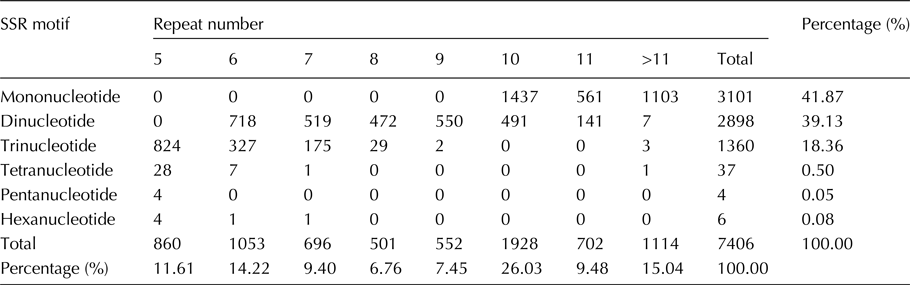
On average, one SSR loci was found for every 5.42 kb in a unigene, which corresponded to an SSR frequency of 13.06%. The SSR frequency was more than 7.58% of Paphiopedilum concolor (Bateman) Pfitzer (Li et al., Reference Li, Zhao, Liu, Liu, Lin, Liu, Chen and Lv2015b) and consistent with the dicotyledonous SSR frequencies of 2.65–16.82% (Kumpatla and Mukhopadhyay, Reference Kumpatla and Mukhopadhyay2005). The largest fraction of repeat motif was mononucleotide (41.87%), followed by dinucleotide (39.13%) and trinucleotide (18.36%), while tetranucleotide, pentanucleotide and hexanucleotide were just very few numbers of <1% altogether. The frequencies of SSRs with different repeat units were also calculated, and the most common unit was SSRs with 10 repeat motifs (26.03%), followed by 6 (14.22%), 5 (11.61%), 11 (9.48%), 7 (9.40%), 9 (7.45%) and 8 (6.76%) (Table 1). Especially, mononucleotide repeats maintained a major part of the most common SSRs with 10 repeat motifs.
Frequency of different SSR repeat motif types in the Paphiopedilum hirsutissimum transcriptome

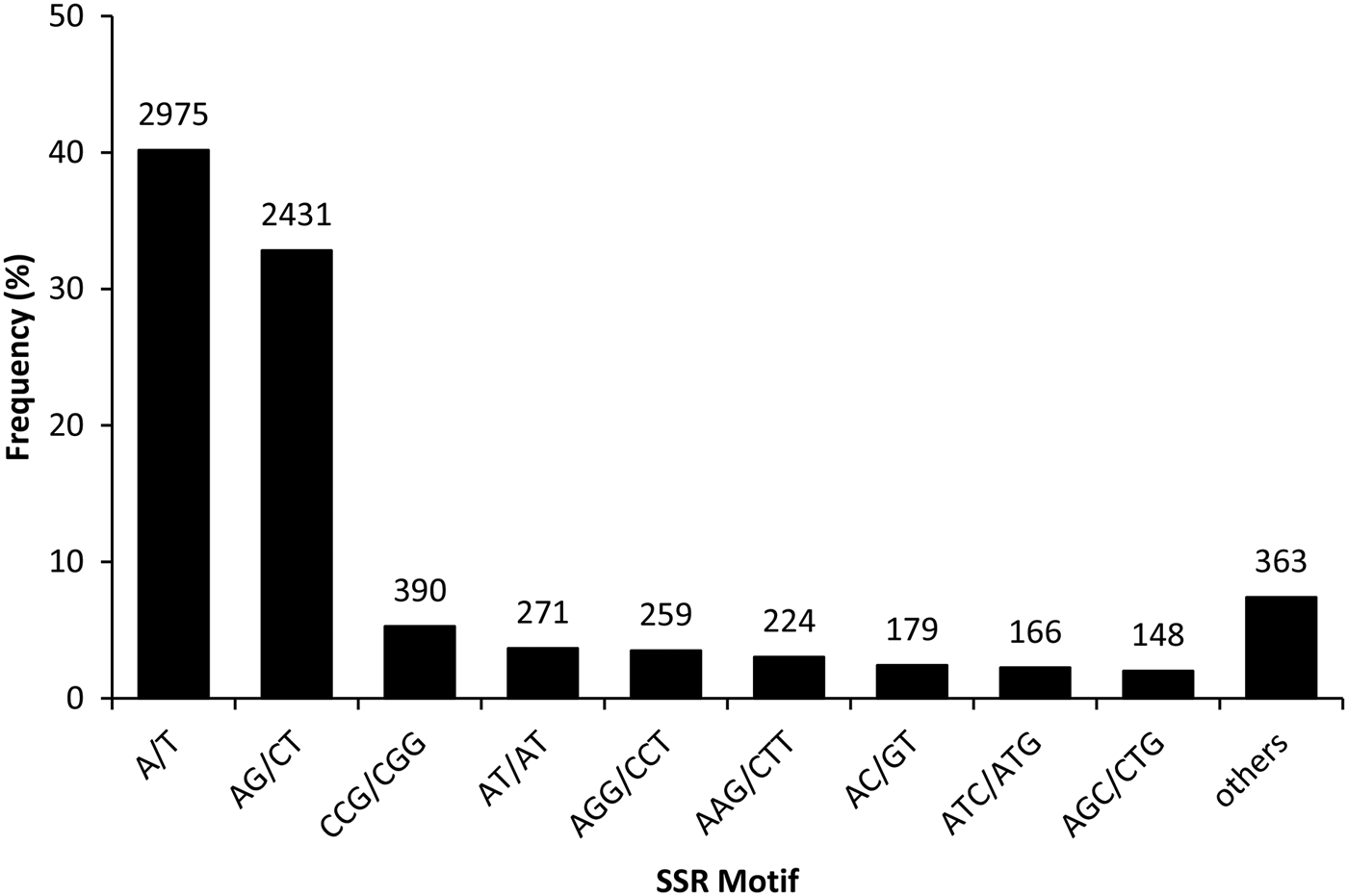
Among the SSRs identified, A/T and AG/CT were the most abundant repeats, accounting for 40.17 and 32.82% of all SSRs, respectively, followed by CCG/CGG, AT/AT, AGG/CCT and AAG/CTT with the percentage of 5.27, 3.66, 3.50 and 3.02%, respectively (Fig. 1). The most abundant trinucleotide repeat type was CCG/CGG, such as P. concolor (Li et al., Reference Li, Zhao, Liu, Liu, Lin, Liu, Chen and Lv2015b), which commonly found in monocots (Wang et al., Reference Wang, Li, Luo, Huang, Chen, Fang, Li, Chen and Zhang2011). In contrast, there was no CG/CG repeat identified, which infrequent in plant transcriptome.
Frequency distribution of SSRs based on motif types from the transcriptome of Paphiopedilum hirsutissimum.

A total of 3748 primer pairs were designed from 7406 SSRs, including 1804 pairs of mononucleotide repeat motifs. From 2090 primer pairs except for mononucleotide repeats, 150 pairs were randomly selected for synthesis to check the amplification and polymorphism in 32 wild adult individuals of P. hirsutissimum clusters as genetic markers. Among them, 14 primer pairs were successfully amplified (online Supplementary Table S2), accounted for 9.33% of the tested primers, which may be useful tools for genetic diversity research. The number of detected alleles per locus in 32 individuals ranged from 2 to 4, with an average of 2.93 alleles, and 2.22 effective alleles. The observed and expected heterozygosity varied from 0 to 0.6333 (mean 0.2407) and 0.1979 to 0.6721 (mean 0.5313), respectively. Especially, the locus ph61_PhSSR61 has the highest expected heterozygosity, indicating high polymorphism, while the locus ph143_PhSSR143 was totally homozygous.
The wild shaggy Paphiopedilum populations are concentrated in Guangxi Yachang Orchid National Natural Reserve, under the evergreen broad-leaved forest. A single population of 32 individuals was collected from the biggest wild population in the world to validate the polymorphism of these markers. And these 14 SSR markers would be useful in revealing the genetic diversity, and population genetic structure of P. hirsutissimum, and helpful to make more effective conservation and management strategies.
Supplementary material
The supplementary material for this article can be found at https://doi.org/10.1017/S1479262117000375
Acknowledgements
This research was supported by the National Natural Science Foundation of China (grant no. 31300558), the Natural Science Foundation of Jiangsu Province (grant no. BK20130972), and the Priority Academic Program Development of Jiangsu Higher Education Institutions (PAPD).