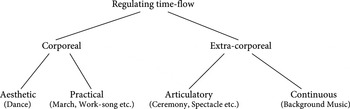
Introducing iconism
For many who encountered him there was something iconic about David Osmond-Smith, a man whose sharp intellect, as Nicholas McKay has noted, ‘was matched by his striking chisel-featured face and athletic physique’.Footnote 1 The notion of the icon as a readily recognizable person or object charged with cultural significance and import has become ubiquitous in everyday language. The screenprint portraits of Andy Warhol (paintings of figures such as Elvis Presley and Marilyn Monroe) are ‘iconic’ both because the images are widely recognized and because they carry with them a complex of cultural resonances that have been amplified across time and space. But it is this implication of cultural significance that marks out the everyday use of the term icon from its technical counterpart: the semiotic icon. In fact, in the study of semiotics, the term icon is used often for the very reason that it indicates an exclusion of culturally established meanings. Thus, for a semiotician, the concept of iconism will be aligned with a stricter etymological definition of the term: that is, as a derivation of the Greek eikṓn, meaning likeness or image.
For instance, a picture, many semioticians would claim, is deemed ‘realistic’ on the basis of likeness: in other words, the observable qualities it shares with whatever it depicts. This can be contrasted with the situation in language, where, according to Saussure at least, no connection exists between, say, the word ‘cow’ and an actual cow, other than that established arbitrarily by cultural means.Footnote 2 Thus a distinction can be drawn between iconic, natural, and motivated signs (such as pictures) and symbolic, cultural, and unmotivated signs (such as those of spoken and written language).Footnote 3
This apparently simple distinction between the iconic and the symbolic, the natural and the cultural, has provided a particularly fertile site for semiotic inquiry, especially for those thinkers with an interest in the potential of semiotics to underpin sociopolitical critique. It formed, for example, a recurrent strand in Barthes's critical readings of mass culture (although he placed greater emphasis on the related concepts of denotation and connotation than on icon and symbol as such).Footnote 4 Umberto Eco, meanwhile, adopted a different approach to iconism: whereas Barthes tended to draw on iconic/symbolic distinctions as one of a number of semiotic tools, Eco's concern has tended more towards questioning the very theoretical substance of iconism. Iconism, Eco claims, if it exists at all, is a far more complex phenomenon than the naive definition given above would suggest. Eco approaches this complication in a number of ways, and a clear connection can be discerned between his work and Osmond-Smith's. This will be explored in some detail below, but I shall first consider David Osmond-Smith's work on musical iconism and its scholarly context.
The background to Osmond-Smith's music semiotics
In order to understand the use of iconism in David Osmond-Smith's early essays it may be useful first to consider two broad tendencies of the musicological discourse with which his work engaged. The first of these concerns the dominance of formalist thinking; the second consists of a tendency, still commonplace, to categorize musical meaning in terms of either internal signification (musical sounds referring to other musical sounds) or external signification (musical sounds referring to non-musical entities).Footnote 5 These two tendencies are closely related, in that formalist thinking can manifest itself in terms of a privileging of internal signification over external signification or, as is the case in Leonard B. Meyer's work, in terms of attempts to theorize external signification as to some degree immanent to (or contained within) internal signification.Footnote 6
Explorations of these related aspects of what might be termed ‘music-and-meaning discourse’ can be traced back to the early 1960s, when they were deployed as a means of theorizing the differences between language and music. In 1961, for example, Charles Seeger claimed that
Expressed more precisely, speech-communication serves both endosemantic [internal signification] and ektosemantic [external signification] functions in highly developed forms, but music-communication – so far as Occidental music is concerned – serves the former almost exclusively and the latter in only rudimentary ways.Footnote 7
The reference to the Occident is of interest here, as it indicates a recognition that such characterizations of music and language may be culturally contingent, and hence not inevitable. When William Bright addressed this field of inquiry in an article of 1963, he posited music as inherently more endosemantic or bound up with internal signification:
Some pieces of music have, to be sure, extra-musical associations for the members of that culture; thus for us a military march may have a content related to the emotion of patriotism. But such content is not inherent in the nature of music, as exolinguistic content is inherent in the nature of language. […] We may thus refer to similar content structures found in music and in language with the term endosemantic, contrasting with the exosemantic structure which is an essential part of language but not of music.Footnote 8
The treatment of musical signification in terms of two clear categories has been widely adopted in more recent studies,Footnote 9 but less readily accepted has been the emphasis on internal signification. Wilson Coker's book Music and Meaning (1972), drawing the same division using the terms congeneric and extrageneric, adopts a formalist position (unsurprising given his reliance on Hanslick) in his privileging of internal signification (the congeneric) over the external (extrageneric), but there is some recognition of the latter too. In Kojak, Fifty Seconds of Television Music (1979) Philip Tagg adopts the same terminology, but his work is some of the earliest to insist on the importance of music's external signification, thereby challenging the dominance of formalist thought. By the late 1980s external signification was receiving greater attention, and in 1989 the prominent music semiotician Jean-Jacques Nattiez gave a general account of the development of music semiotics which, while endorsing Bright's notions of the endosemantic and exosemantic, called for a balanced conception of the relative importance of these terms:
Bright (1963) was probably right to see in music an element which is at once endosemantic (the structures refer to structures) and exosemantic (referral to the outside world). It is my belief that the distribution of importance accorded to these two dimensions varies according to historical period, aesthetics, culture and the individual, and that one cannot favour one to the detriment of the other: these are all the forms of referral which a semiology of music worthy of the name must be prepared to take into consideration.Footnote 10
Although Nattiez's early work was key to the development of what Kofi Agawu has termed ‘hard semiotics’ and a concern for a so-called neutral level of internal musical relations, his later writings map out a broader scope for music semiotics of the kind outlined in the above quotation.Footnote 11 And, over the past two decades, scholars have become increasingly concerned to recognize the importance of music's external signification. Seminal studies such as Raymond Monelle's The Sense of Music (2000) and The Musical Topic (2006), and Melanie Lowe's Pleasure and Meaning in the Classical Symphony (2007) have, in their conception of music as a component of an interconnected cultural universe, done much to promote the more balanced approach to musical signification advocated by Nattiez.Footnote 12
David Osmond-Smith's articles on music semiotics, when read alongside each other, embody something of this balance and in that sense anticipate the more recent trends I have outlined. Of the three articles published between 1971 and 1976 in the Italian semiotics journal Versus: Quaderni di studi semiotici two focus on external signification and one is exclusively concerned with internal signification. In an article published considerably later in 1989 Osmond-Smith confessed:
I find difficulty in assigning cognitive (or indeed semiological) significance on the grounds of intra-musical, or purely formal relationships alone.Footnote 13
But despite this unambiguous recognition in his later writing of the importance of both external and internal signification, one can detect in Osmond-Smith's early semiotic essays the effects of the formalist thinking that dominated musicology in the 1970s. Like the music semioticians that preceded him, David Osmond-Smith tends to fashion approaches to iconism that are able to sit reasonably comfortably within a predominantly formalist framework. In the case of internal signification, this means that iconism can be used to theorize the common-sense assumption that musical elements with much the same structure (i.e. that sound similar) can be understood as referring to one another. In the case of external signification (which is always played down but rarely excluded altogether in formalist thought) iconism can be deployed to explain the connection through resemblance of musical and non-musical entities.
Osmond-Smith addresses these areas with insight and subtlety,Footnote 14 and is mindful of Eco's extensive problematization of the apparently simple mechanisms of iconism. But his embrace of Ecovian criticism, rather than leading him to abandon iconism, leads somewhat ironically to a notion of the icon as a kind of essence of meaning. Eco's unrelenting efforts to lay plain the constructed nature of the icon appear to bring his thinking, along with that of Osmond-Smith, full circle, so as to suggest an appeal not to enculturation but to essences. This complex point will become clearer when we look at Osmond-Smith's early essays in some detail.
David Osmond-Smith's early essays on music semiotics (1972–6)
i) Explicit and instrumental iconism
Osmond-Smith's first essay on music semiotics, reprinted as an appendix to this article, is entitled ‘The Iconic Process in Musical Communication’. It begins by grappling with some of the key issues surrounding formalism and the possibility of theorizing music on a semantic level, i.e. in terms of external signification. As I have already suggested, Osmond-Smith's tendency at this early stage in his career is to accept certain formalist tenets; he thus makes a distinction between, on the one hand, communicative systems involving two formally determined levels of articulation (internal and external, e.g. language) and, on the other, those with only one (internal only, e.g. music and abstract visual arts). He even goes so far as to characterize musical communication in terms of ‘purely formal processes’ and music as ‘basically an end in itself’; a little later he describes formal considerations as ‘music's primary concern’ (see below, ‘The Iconic Process’, 201 and 204).
At the close of his introductory section, however, Osmond-Smith draws in that aspect of music that continually thwarts a straightforwardly formalistic account of its meaning: namely music's widely acknowledged ability to communicate emotion or, at least, to engender an emotional response. Osmond-Smith is critical of other music semioticians’ approaches to the question of emotion in music and points to the ‘metalinguistic impasse’ that undermines much semiotic work in this area (‘The Iconic Process’, 202). He therefore chooses to set aside the question of music's relationship to emotion (at least for the time being) and proposes instead to pursue two potentially more fruitful areas of music-semiotic analysis. These are the analysis of explicit iconic elements and the analysis of social and historical connotations, or instrumental iconic elements.Footnote 15
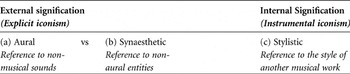
One might expect an analysis of these two sets of elements to map respectively onto internal and external signification. Social and historical connotations in particular, one would guess, might involve music referring beyond itself. However, Osmond-Smith in effect reverses this mapping; Table 1 might usefully represent his basic points of reference.
Osmond-Smith's basic points of reference in considering non-emotive musical reference.

Instances of the external signification of aural entities, (a), we are told, are few. Osmond-Smith gives examples that include the use of a trilling figure on a flute to represent birdsong and kettle-drumming to represent thunder. It is worth noting here the influence of Eco, in that Osmond-Smith considers the connection of, say, a trilling flute to birdsong as derived primarily from conventionalized codification and not from an instinctive connecting of two entities as a result of likeness or shared quality. In the same way the synaesthetic signification of non-aural entities, (b), is discussed in terms of a set of conventionalized codes, such that ‘high and low pitches correspond to the vertical spatial dimension’ (‘The Iconic Process’, 203) or degrees of luminosity. Some of the musical examples mentioned here demonstrate both the aural (a) and the synaesthetic (b) as outlined in Table 1. Britten's Peter Grimes, no doubt the famous ‘Storm’ interlude in particular, exemplifies aural signification through the use of timpani, as well as the ‘synthaesthetic suggestion of a downpour […], and flashes of lightning’ (‘The Iconic Process’, 203). The emphasis in all cases, as in Eco's work, is on the sense in which such mappings are derived from a shared code rather than any natural connection between the music and its supposed referent. This is a particularly useful and important aspect of Osmond-Smith's contribution to music semiotics, as claims for musical meanings unmediated by culture are clearly problematic and all too readily assumed or implied.Footnote 16 But we are left in a somewhat confusing position wherein conventionalization appears to be one of the defining features of iconism, even though such a feature tends more generally to be associated with another (apparently opposing) sign-type: the Peircian symbol.
We start to gain further insight into this apparent theoretical inconsistency when Osmond-Smith discusses ‘social and historical connotations’. These connotations are pursued in terms not of external signification (as one would expect) but rather of internal signification, whereby one musical work refers to another via stylistic traits, (c) in Table 1.Footnote 17 This approach is justified by the argument that the connotations deriving from a given work's genesis are not indicative of signhood. In such instances music is acting as an index.Footnote 18 In order for music to have social and historical connotations via a sign-function, then, it must make reference to another musical work by means of stylistic traits or suchlike. The outcome of this line of reasoning would seem to be the counterintuitive belief that a musical work can signify the social and historical connotations of another work but not its own. Such a conclusion highlights the apparent theoretical inconsistency whereby the conventional appears to define both iconism and a further key Ecovian concept, which Osmond-Smith now goes on to explore: the intrinsically coded act.
The connection between Osmond-Smith's arguments will be explored once we have outlined the intrinsically coded act, a concept introduced by Eco as a means of critiquing iconism. An intrinsically encoded act is not an icon, because it does not refer by way of similarity to something else; it simply is the thing it is taken to represent. One of Eco's most frequently cited examples is that of a drawing of a red flag. The red in the drawing, Eco asserts, is not similar to the red of the flag: it is the red of the flag.Footnote 19 In the same way Osmond-Smith claims that musical quotation, when it is ‘exact’, constitutes an intrinsically coded act, as does the timbral component of a musical sound when it is made by the same instrument (or class of instrument, e.g. trumpet) as that of another musical sound.
We have, then, three related arguments that I would suggest can be usefully connected. They are that:
(a) iconism is partly defined by conventionalized codification;
(b) a work can signify the social and historical connotations of another work but not its own (it is an index of its own social and historical connotations);
(c) a quality shared between music and meaning does not indicate an iconic reference but an intrinsically coded act.
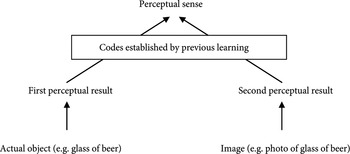
To understand the connection between these assertions we can consider Eco's persistent claim that sign-functions are conventionalized and never natural or without codification. The claim that an image (the study of images is central to Eco's early semiotic thought) has a direct connection with that which it depicts makes no sense for Eco when an image and its referent have no material element in common. In such cases, Eco argues, the correspondence of image and referent is derived from a shared ‘perceptual sense’, which, in turn, is the result of a conventionalized process of viewing two ‘perceptual results’ as one and the same.Footnote 20 This is schematized in Figure 1.
Schematization of Eco's account of iconic signification.

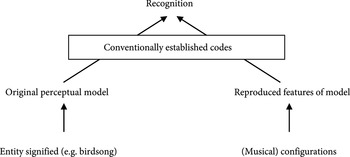
When Osmond-Smith considers iconic signs, he (following Eco) defines them as ‘configurations that reproduce such pertinent features of an original perceptual model as will serve for its recognition according to conventionally established codes’ (‘The Iconic Process’, 202). Since Osmond-Smith's terminology, like Eco's, is rather variable, Figure 2 (when compared with Figure 1) may help to clarify the correspondence between their respective accounts of iconism. This conception of iconism explains the first assertion in our list of arguments above – that is, that ‘iconism is partly defined by conventionalized codification’. The difficulty that now arises with this theory of iconism, however, is the question of how one accounts for those examples of iconic signification that involve a more or less precise equivalence between sign and entity signified (or a component of the entity signified). If I have a leaflet containing a chart of colour patches used in the selection of different pots of paint and an identical chart has been cut up and each patch stuck onto the relevant paint pot for the purposes of identification, does not the use of this system to find a paint pot then entail an iconic process of signification? Each colour patch will signify a different paint pot based on the correspondence of the colour patches used, and this signification does not involve the reading of two perceptual results as one and the same because the colour patches in my hand and the ones stuck on the paint pots are materially equivalent. Eco's response to this problem is to reject the classification of such a process as iconic and to class it instead as an intrinsically encoded act. In this way, any sharing of qualities can be extracted from an otherwise iconic sign situation (such as that of the red flag), and we can come to observe the codified processes that make iconic signification possible. This helps to explain argument (c) in the list above and to further elucidate (a), because one way to tell an icon from an intrinsically coded act is to consider whether or not conventionally established codes are involved.
Schematization of Eco's account of iconic signification using Osmond-Smith's terminology.

The second argument in the list, argument (b), has a more oblique relation to the others; still, a useful parallel can be drawn. In the same way that qualitative entities shared between sign vehicle and referent are deemed external to iconism, so a musical work cannot signify its own historical and social connotations because it simply has them. The idea here seems to be that signification cannot venture too close to tautology; otherwise it loses any sense of sign-function. Just as qualities do not signify themselves (they simply are those qualities) so musical works do not signify the social and historical circumstances of their genesis and subsequent life; rather, musical works in a certain sense embody these circumstances.
These arguments were quite radical ones to be bringing to the study of music in the early 1970s, and they continue to be of much interest and relevance. Some of the problems they throw up will be considered in relation to Osmond-Smith's most striking and complex theory in the article under consideration: his theory of ‘the iconic basis of emotive communication in music’ (‘The Iconic Process’, 207).
ii) Emotive/unconscious iconism
The musical meaning processes discussed thus far are classed by Osmond-Smith as different forms of iconism. The first two – (a) and (b) in Table 1 – are defined as explicit iconic processes; reference via style – (c) in Table 1 – is defined as an instrumental iconic process. To these classes Osmond-Smith adds a third, concerning the communication of emotion in music, which he conceives as an unconscious iconic process.
The theory laid out at this point is quite tentative and was never developed systematically by Osmond-Smith. But it is significant in its implications for the theorizing of the icon in music more generally and for the way it draws attention to and even sidesteps some of the problematic consequences of Ecovian thought.Footnote 21 In formulating this theory, Osmond-Smith arrives at something that might be viewed as descending into an essentialist account of musical meaning. While I prefer a more sympathetic reading (as will become clear below), there is indeed a sense in which Osmond-Smith's ideas on music and emotion seem quite out of step with the constructivist arguments that dominate Eco's work on iconism. Nevertheless, Eco's semiotics remains vital to an understanding of Osmond-Smith's work, and we can explore this further by looking again at Figures 1 and 2.
The first point to note in comparing these two figures is that Figure 2, which uses Osmond-Smith's terminology, suggests a degree of connection between the middle-level terms ‘original perceptual model’ and ‘reproduced features of model’. While Eco talks of two distinct perceptual results (first perceptual result and second perceptual result – see Figure 1), Osmond-Smith's equivalent terms suggest a (deliberate) reproduction in one entity of features in the other. In making this connection via reproduced features, Osmond-Smith is close to falling back on a notion of shared qualities; and this sharing, it would seem, takes place prior to the process of codification. Eco's key point that the two entities of an iconic sign situation are not the same at all is somehow slipping out of theoretical focus, and this leads to a quite striking proposal that appears to run counter to the central thrust of Ecovian semiotic thought.
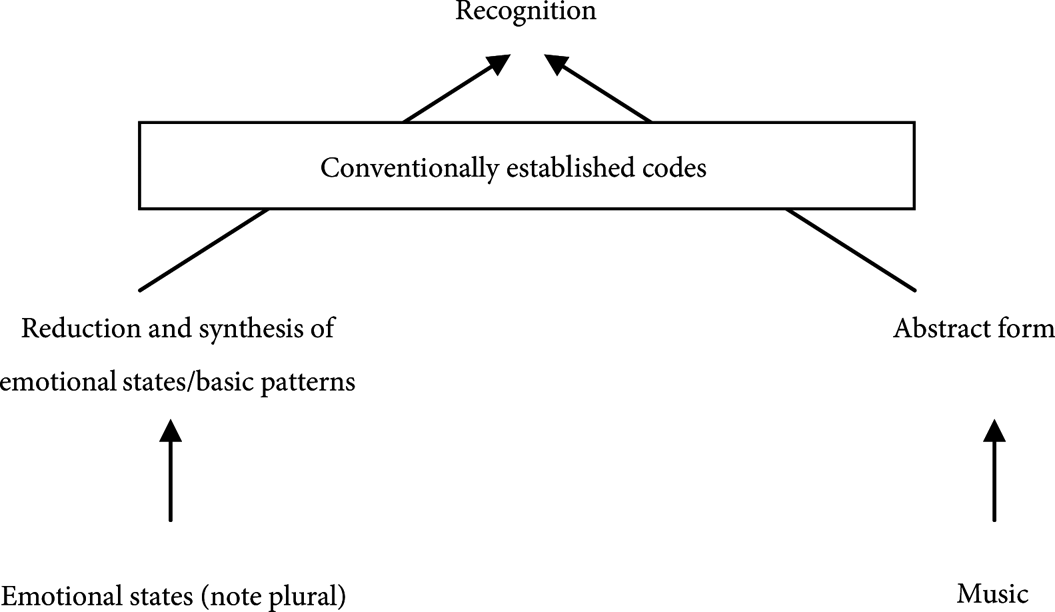
Assuming a correspondence between an original perceptual model and its reproduced features, Osmond-Smith now considers how his model might apply to a musical sign situation in which music signifies emotion. He suggests that the entity signified (i.e. the emotion) would consist of many instances of an emotion that are then reduced and synthesized to form the original perceptual model. The sign (i.e. the music) would entail a reproduction of this synthesized perceptual model as an abstract form. This is schematized in Figure 3.
Schematization of Eco's account of iconic signification using Osmond-Smith's terminology relating to emotive meanings in music.
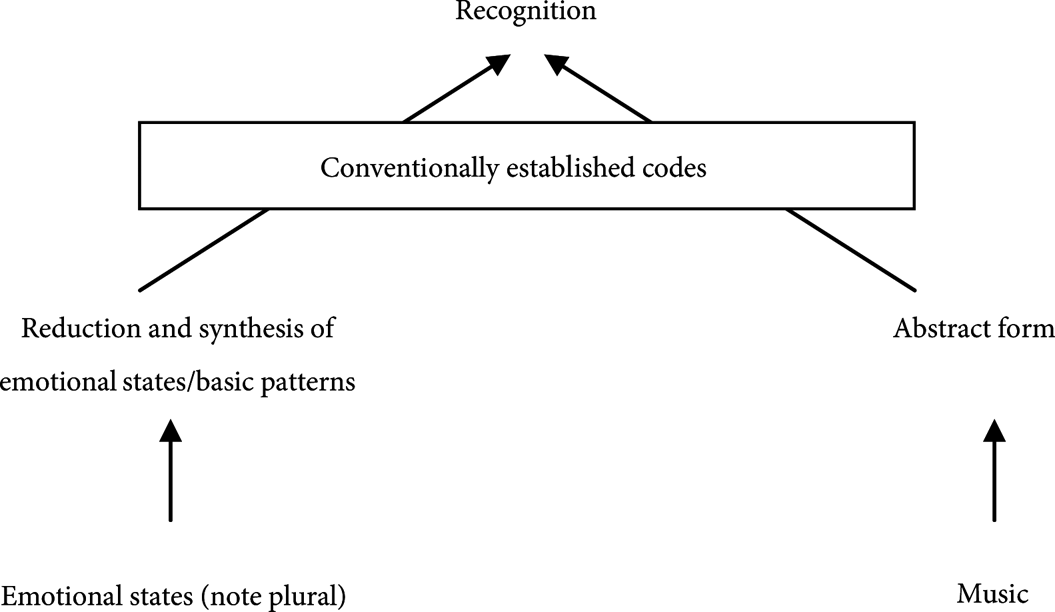
Osmond-Smith labels the ‘abstract form’ in Figure 3 an unconscious icon:
[I]f an iconic sign is a structure in either space or sound that concentrates within itself the pertinent relational features of a perceptual model, itself derived from a reductive synthesis of various differing examples of the entity in question [see Figure 2], then an abstract form standing in close relation to the basic patterns to which a wide variety of experiences have been reduced in the brain, and thus effecting a synthesis amongst them, may be regarded an ‘unconscious icon’ [see Figure 3]. (‘The Iconic Process’, 210)
We do seem to have travelled a considerable distance from the Ecovian emphasis on conventionally established codes. The operation of the code seems somehow excluded from the processes described here, because the relation of (in the case of Figure 3) abstract form or unconscious icon to the reduction opposite it seems to be effected through a simple reproduction of pertinent features, rather than through some more complex process of encoding. I would suggest, however, that there is a perceptible tendency in Eco's writing towards the kind of thinking we find here in the work of Osmond-Smith. This tendency might be described as a reliance on psychological description.
Around the time of writing ‘The Iconic Process in Musical Communication’ Osmond-Smith translated an essay by Eco entitled ‘Introduction to a Semiotics of Iconic Signs’. This essay is a summary of Eco's arguments concerning the icon presented in his book La struttura assente of 1968, which was later reworked into English with the aid of Osmond-Smith under the title A Theory of Semiotics.Footnote 22 Towards the end of the essay Eco gives another account of his conception of iconism as a culturally determined process that does not entail the sharing of actual qualities. He gives the example of sugar and saccharine, which, he claims, are taken to resemble one another even though science can demonstrate that the two entities are very different in their chemical composition. Like the examples in Figure 1, then, these two entities have an effect that is taken to be similar when more careful examination shows that ‘the presumed “naturalness” of resemblances [between them] dissolves itself into a network of cultural stipulations that determine and direct ingenuous experience’.Footnote 23 But having reasserted his key argument, Eco begins to suggest points of contact between his theory (or developments of it) and the psychology of perception:
A semiotics in which iconic signs are defined as similar to the object is a paleosemiotics that tautologically repeats the reply of common sense. A real semiotics of iconic signs will have to descend deep within these structures, meeting up with the investigations of the psychology of perception, but it will reach this threshold by penetrating further into the formal analysis of iconic objects in order to discover to what degree the presumed icons can be segmented into differential, non-iconic, and codifiable elements.Footnote 24
It seems to me that Osmond-Smith's conception of abstract form is, in part, inspired by Eco's suggestion that psychological processes might serve to explain iconism. Eco is generally committed to his belief that any investigation (psychological or otherwise) will still point up the difference between apparently similar sign entities; so in that sense it may still seem strange that Osmond-Smith should suggest a quite straightforward correspondence between his abstract form and the basic patterns of emotional states. But consider two further points. Firstly, it is important to recall that formalist thought, in which formal processes are often presumed to contain some kind of distillation of emotive meaning, still dominated musicological thinking in the early 1970s. Osmond-Smith is therefore in one sense bringing musicological thinking to bear upon Ecovian semiotics. Secondly, iconism in its traditional sense is a very difficult concept to dispose of altogether.
Something of this second point is evident in Eco's ‘Introduction to a Semiotics of Iconic Signs’. In discussing iconism in relation to linguistics, Eco argues that two instances of the same phoneme may be perceived as the same when they actually differ or, as he puts it, that
two etically [or objectively] differing vocal emissions are perceived as emically equal because of their structural homology. But this is so because the homology is constructed by an act of abstraction on the part of the linguist […] who identifies within the etic phonic substance a series of features rendered emically pertinent, so that the homology is only established between these emergent [i.e. constructed] features[.]
But once Eco has asserted the digital rather than analogical correspondence of such entities, he goes on to point out that:
Naturally the problem of analogy returns when one asks how it is that, when faced with two emically equal features, we recognize them as belonging to the same emic category. Why are two equal distinctive features equal? At this point we are once again confronted with an explanation that can only be made in terms of resemblance or analogy. But this explanation concerns the mechanics of perception, and not the mechanics of signification that has already been given an explanation in digital terms.Footnote 25
The problem of iconism, therefore, never really goes away in Eco's thought. Instead it appears to be placed at the door of the psychology of perception. Furthermore, Eco is not entirely clear whether semiotics should concern itself with the psychology of perception or not, because (as will be recalled from the quotation above) he imagines that a ‘real semiotics of iconic signs will have to descend deep within […] structures, meeting up with the investigations of the psychology of perception’. More generally, it is important to recognize that there is a tendency towards infinite regression in Eco's thinking on iconism. This can be seen by returning to the example of sugar and saccharine mentioned earlier. In attempting to define what he means by ‘sugar’ as opposed to saccharine, Eco informs us that the ‘basic formula’ for sugar is C12H22O11. There is a problem here, however, in that the term sugar itself refers to a class of substances, a number of which involve different chemical compounds; it too therefore relies on positing a similarity between disparate but related entities.Footnote 26 As in the discussion of phonemes, Eco's attempts to undermine the possibility of iconism or similarity are constructed by means of arguments that are founded on the assumption of just such a possibility. To put this the other way round, Eco assumes the relatedness found in, say, sugars, but his theories militate against any explanation of this relation in terms of shared qualities or similarity of structure (recall that, according to the theory of intrinsically encoded acts, if entities share qualities they are, in that respect, the same).Footnote 27
For these reasons Osmond-Smith's attempt to assume some correspondence between an abstract form and basic emotive patterns (Figure 3), or between the reproduced features of a perceptual model and an original perceptual model (Figure 2), does not sit well with Ecovian arguments concerning iconism. But these Ecovian arguments, I would suggest, are problematic, since they make claims that are both somewhat inconsistent and – in the assertion that qualities have to differ between entities or thereby be considered identical – liable to infinite regression. Osmond-Smith in this sense, wittingly or not, sidesteps key aspects of Eco's thought; but these aspects may nonetheless be worth sidestepping, as they entail serious philosophical problems concerning classification and identity. Osmond-Smith indeed appears to have been aware at this time of the need for continued debate concerning the status of the iconic process. A few years later in 1976, in ‘L'iconisme formel: pour une typologie des transformations musicales’, he notes that
one of the habitual difficulties of studying iconism concerns determining the extent to which the perception of analogy is innate and the result of a universal function of the brain's physiological structure, and the extent to which it is determined by cultural convention.Footnote 28
We are left, I would suggest, with an interesting balance in Osmond-Smith's theoretical ideas between a general acceptance of common-sense conceptions of qualitative connection and a recognition of the importance of culturally established codes or conventions in the process of signification. Such a balance sits reasonably well with the theories of C. S. Peirce. The potential for developing Osmond-Smith's work along these lines will be considered a little later.
iii) Formal iconism
‘The Iconic Process in Musical Communication’ is the most involved and significant of Osmond-Smith's early semiotic essays. Two further articles, however, are used by him to fill out some of the details of his ideas; the first of these was subsequently translated into French and developed a little in the process.
Early on in ‘Formal Iconism in Music’ Osmond-Smith noted his concern that he had overlooked the full implications of his work on instrumental iconism: in particular, he had disregarded (c) in Table 1, which concerns internal signification, namely reference in one part of a work to another part of the same work via resemblance or a matching of qualities (i.e. through iconic connection). (Remember also that this area is taken, somewhat counter-intuitively, to concern social and historical connotations, because one work can refer to another via such stylistic reference as pastiche, parody, and quotation.) The distinction between this type of signification and the type of signification already dealt with by Osmond-Smith can be described using the terms interwork or intermusical signification (reference between works) and intrawork or intramusical signification (reference between parts of a work).Footnote 29Table 2 adapts Table 1 to show this development.
Osmond-Smith's extended points of reference in considering non-emotive musical reference.

Important to note here is the way in which emotive reference, as defined by Osmond-Smith, cannot be fitted easily into this table. Osmond-Smith's theory of musical emotion, close as it is to that expounded by Meyer in Emotion and Meaning in Music, short-circuits the external vs internal distinction of Tables 1 and 2. Because emotional meaning is, according to that theory, conceived in terms of a homology between abstract form and emotional essence, music's meaning is contained within the music while simultaneously acquiring a status that is usually only afforded living (emotion-feeling) creatures, not sounds.Footnote 30 It is useful also to note the difference here to, say, literature. The narrative of a novel may refer to sad events but music, in terms of this theory, does not so much refer to sad events as embody the essence of sadness. I shall propose a way of rethinking these points in semiotic terms a little later.
Although the idea of considering the intramusical dimension, (d), came a little later to Osmond-Smith, it is significant that he now devotes an entire article to this one aspect of musical signification. This mirrors one of the ironies of the history of music semiotics. One might assume that the appeal of semiotics to the musicologist would derive from the possible insights it offers concerning questions of musical meaning, by which I mean music's apparent power to refer to something beyond itself. However, the tendency for those musicologists who embraced semiotics in the 1970s to focus on internal signification – especially intramusical signification (see Table 2) – is clearly manifest. This is a point underlined by Raymond Monelle, who, in his book Linguistics and Semiotics in Music, notes that a ‘rigorous scientific approach, which turned its back on any idea of musical semantics or discernible musical meaning, dominated music semiotics in the seventies’.Footnote 31
The most prominent figures in this dominant mode of music-semiotic investigation were Nicolas Ruwet and Jean-Jacques Nattiez. It is therefore notable that, whereas the bibliography of Osmond-Smith's first article contains only one reference to Nattiez's work (his first article, entitled ‘Situation de la sémiologie musicale’), the bibliography of ‘Formal Iconism in Music’ now contains both the major early works of Ruwet and the early Nattiez articles that laid the foundation for Fondements d'une sémiologie de la musique, the first comprehensive account of paradigmatic or distributional analysis.
In one sense, then, Osmond-Smith's ‘Formal Iconism in Music’ adheres readily to what is today still regarded as a kind of music-semiotic orthodoxy. In confining his study to what he describes as the ‘one-dimensional’ parameters of music – pitch, intensity, and rhythm – Osmond-Smith might be read as having abandoned the wider questions of musical meaning so innovatively explored in his earlier article. However, it must be remembered both that Osmond-Smith did return to the question of external signification in ‘The Semantics of Pluralism: a Study of Connotations of Origin and Use in Music’, published a few years later, and that he does not at any point suggest that studies of musical iconism should be confined to a consideration of form. He had even addressed the issue of external signification with characteristic insight in a review of 1974, despite the fact that the publication under consideration was concerned primarily with the syntactical study of music.Footnote 32 It is also interesting to note the rigour with which ‘Formal Iconism in Music’ addresses the process of theorizing those parameters that allow an iconic relationship to be established between two musical entities and the extensive use he continues to make of Ecovian notions of coding.
Osmond-Smith's discussion of pitch in ‘Formal Iconism’ is particularly interesting and warrants further discussion. Pitch, intensity, and rhythm are all recognized as continua. There is a tendency, however, for cultures to subject both pitch and rhythm to ‘more restrictive codification’.Footnote 33 The examples given here are the Western system of dividing the octave into twelve equal semitones and the Bharata system of India that divides the octave into twenty-two unequal shruti-s. A system of this type is understood in terms of a ‘set of paradigmatic elements’ that allows the establishment of a ‘syntactic code determining which element may occur in conjunction with which, and with what degree of probability’. From this assertion we arrive at a further distinction between uni-probable codes (such as the determined sequence of pitches in raga fragments or tâna-s, which establish only one possible sequence of events) and multi-probable codes (such as a Western tonal melody, which offers ‘a hierarchy of more or less probable sequences to a given event’).Footnote 34
The extensive use here of the term code clearly indicates the influence of Eco. But it is important to note that the codes to which Osmond-Smith refers are what Eco would term syntactic systems or ‘sets of signals ruled by internal combinatory laws’.Footnote 35 For such a system to become a code it must be coupled with a semantic system or a set of behavioural responses. The simpler systems outlined by Osmond-Smith would be termed s-codes by Eco, to distinguish them from codes proper. Osmond-Smith's use of the term ‘code’ is nevertheless important, in that it appears to indicate a conception of musical syntactic systems that resembles what Eco refers to as ‘pure combinational structure[s] that only tak[e a particular] form […] by chance, an interplay of empty positions and mutual oppositions’.Footnote 36 This might be taken to anticipate some of Robert Hatten's work on markedness and correlation;Footnote 37 but, perhaps more significantly, it highlights an important contrast between Osmond-Smith's thinking and that formalist strand of musicological discourse that both divorces form from meaning and points to the possibility of a necessary correspondence between tonal movement and the shape of emotional experience, a tendency found in the work of key figures such as Hanslick and, later, Meyer. Osmond-Smith's suspicion of any necessary connection between musical systems and states of affairs is further underlined by his insistence on taking into account both Western and Indian music systems, which again highlights the contingency of the codes (or, in Ecovian terms, s-codes) that underpin musical practices.
In this sense Osmond-Smith's ‘Formal Iconism in Music’ can be allied to aspects of Nattiez's work in the 1970s. This is particularly true of the way in which Osmond-Smith looks to demystify tonal processes by conceiving them in terms of combinatorial rules rather than necessary connections traceable to physiological states of affairs. However, even in an essay that is focused so closely on form, Osmond-Smith does not exclude the possibility that the syntactical system he describes might connect with further semantic systems, and it is to this area that he turns his attention in a particularly succinct semiotic essay, ‘The Semantics of Pluralism: a Study of Connotations of Origin and Use in Music’.
iv) Moving beyond the icon: associative networks in music
Both ‘The Semantics of Pluralism’ and an extended French-language version of ‘Formal Iconism in Music’Footnote 38 were published in 1976. In ‘The Semantics of Pluralism’ iconism is no longer afforded the central theoretical position that it had enjoyed in previous publications. Instead Osmond-Smith looks to give a brief summary of how the spatiotemporal positioning of musical practice underpins those meanings that develop in relation to it. From a Peircian perspective, Osmond-Smith's investigative focus has shifted from the iconic to the indexical, from the qualitative dimension to the actual. Thus, rather than considering how musical qualities (shape, intensity, etc.) might map onto entities of reference, be they musical or unmusical, aural or non-aural, he now considers how the actual location of music in different cultures or different periods of history will determine interpretation.
The essay is intended only as ‘a brief surv[e]y of a comparatively neglected area of musical semantics’, but it contains some useful insights that remain underexplored in music semiotics. These include the distinction between the temporal and spatial dimensions in the process of musical signification, a distinction that articulates the contrast between historically immediate/removed and geoculturally immediate/removed. These areas are considered in terms of social origin, and further insights are developed by addressing the closely connected consideration of the general aura that develops around a composer. Lastly, Osmond-Smith offers a succinct analysis of the associative network of meanings that develops through music's various uses. These are classed as contemplative (music as an end in itself ) and agential (music as a means to other ends). While such a distinction has been rather heavily problematized over the last thirty years or so, Osmond-Smith's subdivision of agential forms remains an interesting tool. He schematizes his subdivision thus:
Osmond-Smith's own subdivision of agential form in music.

Although short, ‘The Semantics of Pluralism’ holds a significant place in Osmond-Smith's publications because it indicates a clear understanding of music's position within a wider cultural universe of meaning and signification. In this sense it anticipates those more recent studies by Monelle and Lowe that pay close attention to cultural context as an essential arbiter of musical meaning. The importance placed on spatiotemporal positioning alongside iconic processes also sits well with the development and integration of Osmond-Smith's work on music semiotics that I propose below. This development will be derived from a return to Peircian semiotics with some reference to recent work that elucidates Peircian thought.
After the icon: developing Osmond-Smith's music-semiotic theories
Osmond-Smith's conception of iconism, like Eco's, is derived from developing the bipartite conception of the sign, found in the work of key semiotic thinkers such as Saussure and Hjelmslev, to incorporate the first and most celebrated of Peirce's tripartitions of sign types: icon, index, and symbol. In this way the notion of iconism is conceived as one possible means of connecting two entities which might be termed sign vehicle and denotata, signifier and signified, or sign and object.
There are places in Peirce's work where the icon is explained in a similar manner (Peirce uses the last pair of terms: sign and object).Footnote 39 But at such points Peirce is intentionally simplifying his system in order to make it more widely accessible.Footnote 40 The concept of iconism needs to be approached with care if we are to understand it more fully. Floyd Merrell provides a useful point of departure, while highlighting the difficulty of grasping the term:
A totally isolated icon, were that to be possible, would be nothing more than a ‘possibility involving a possibility, and thus the possibility of its being represented as a possibility’ (CP 2.311). Which is about as clear as mud until one becomes aware that iconicity in isolation is not yet anything to which there is any relation or of which there can be any consciousness on the part of some semiotic agent.Footnote 41
An icon, then, is a pure potentiality; it is prior to cognition, prior even to existence. Iconism concerns quality, but it is quality in its pure form; it is not a quality that can be conceived. To get to an icon proper we need to work back from cognition to existence, and then to quality as a possibility. This process of ‘working back’ Peirce calls prescinding: I see a red ball; I then prescind or separate out my cognition of the ball and consider the ball as existing without my conception of it. If I then prescind or separate out from this situation the existence of the ball, I begin to conceive of such qualities as shape, colour, and so forth as possibilities: that is, as entities that are not embodied but which must have the potential to exist.
Once we have grasped iconism as qualitative potentiality, we are given a new perspective on some of the issues raised by Eco and Osmond-Smith. Both writers are, of course, right to emphasize the point that signification will always involve conventionalized codes of some sort. In my example of the colour patches and paint pots, some understanding of the conventions involved in paint selection would be needed by anyone using the chart of colour patches to successfully identify the desired pot: that is, for signification to take place. Furthermore, the qualitative dimension is not sufficient for any connection to actuality to be made. Icons are, in Merrell's words, ‘narcissistic […]; they are signs of themselves and themselves only’.Footnote 42 Thus, in his theory of intrinsically coded acts, Eco is right to point to the red of a drawing as (at least in qualitative terms) identical to and indistinguishable from the red of the flag it depicts. But such a sign situation will also involve existence and cognition. The red of the flag and the red of the drawing are embodied in two separate existent objects that are cognizable such that one can be taken as a sign of the other. Such a process of semiosis involves qualities (iconism), existent entities (indices), and cognitive habits (symbols). This understanding of signification as involving not only the iconic dimension but also the indexical and symbolic may provide a means to develop further some of the insights offered in Osmond-Smith's work on music semiotics.
The remainder of this article will look at two broad areas in which this development might be pursued. These areas are those set out in Tables 1 and 2 in their distinction between external and internal signification. As we have noted, this distinction has been adopted in many studies of musical meaning. Like all theoretical distinctions it is subject to challenge. However, in the study of music the assumption that it is possible to distinguish broadly between that which can and that which cannot be classed as music seems a reasonable one to retain.
Turning first to internal signification, Osmond-Smith's identification of iconism as a key principle in intra-work and inter-work reference is important. Any connection made by a listener between two occurrences of the same motive (or a derivation thereof) is surely due primarily to the qualitative match between those sounding ideas. This qualitative iconic connection is not the only mechanism involved, however. If we proceed with care, it will always be possible to identify indexical and symbolic functions in conjunction with any iconic function.
In the case of intra-work connections the indexical dimension can be identified as that which concerns the close proximity of two occurrences of a motive in time and space. Thus it is not simply the qualitative connections between musical ideas that lead a listener to consider one as a sign of the other; it is also the fact that a performance of the musical work in question entails actualizing the motives within a limited spatiotemporal frame.Footnote 43 The symbolic dimension plays a similarly important role. The connecting of motives within a work is not an entirely natural process. It relates to what might be termed innate qualities (the iconic) and the world as it actually is (the indexical), but such ways of connecting or reading a sounding form are also governed by cultural habit (the symbolic). Thus we need to engage a complex of cultural expectations and traditions to enact even the simplest reading of one motive as a reference to another. Furthermore, the very act of performing a work as an integrated entity derives primarily from a complex of cultural habits.
This symbolic dimension becomes more important when we come to consider inter-work signification. When the actualization of two musical ideas becomes more spatially and/or temporally distant, their connection through cultural channels may become a more important factor in establishing a signifying process. The iconic dimension will, of course, also play a significant role, in that qualitative connections will remain key to the ensuing semiosis, but abstract concepts such as style (symbols) become more important when there is greater separation between entities in time and/or space.
In turning to external signification I shall focus on that area addressed by Osmond-Smith as unconscious/emotive iconism. As one might imagine, the development of Osmond-Smith's theory in this area is a more complex matter. Whereas formal iconism involved the connection of relatively concrete entities, i.e. musical sounds, emotive iconism involves the more elusive notion of emotional response and its connection to such sounds. As with formal iconism Osmond-Smith sets a useful precedent by emphasizing the central role of the iconic in theorizing the semiotic processes involved, but we might again develop his work by considering the role of actuality (indices) and cognition/habit (symbols) in this process.
Osmond-Smith's conception of emotive icons can be regarded as sitting reasonably comfortably within a more complex Peircian semiotic framework. Consider a musical sound and an emotive response to it. In connecting sound to emotion we have an icon in the qualitative potentialities that both dimensions can embody: they may share, for example, a particular dynamic shape, but recall that we arrive at such shapes through prescision, hence they cannot be straightforwardly cognized or described. In enacting this prescision we need to strip away the symbolic dimension, which in this case would concern the habits established in Western culture of reading or cognizing music in emotional terms. We can then consider and remove the dimension of actuality, which in this case concerns an actual musical utterance and a response to it, a particular listening instance quite apart from any generalization of such a connection. Once we remove or prescind the actuality of such instances there must still be a qualitative dimension that is shared by both music and emotional response. In conceiving of such a dimension, one will tend to generalize (such is the process of cognition), but to remain focused on the icon in a stricter Peircian sense we must avoid this tendency.
In this way we begin to develop Osmond-Smith's emotive icon by placing it within a wider matrix of sign-functions that are rendered coherent through the simultaneous action of icons, indices, and symbols. In this example we have considered the level of a more or less immediate emotional response to music, but it is also possible to use Peirce in order to theorize responses to larger expanses of musical syntax. A useful point of departure on this point is the invaluable distillation offered by Christopher Hookway of Peirce's theory of the proposition. Hookway writes:
[A]mong the symbols employed in […] a language [adequate for articulating the content of propositions] must be some whose meaning fits them to function as indices and some that work like icons. It is primarily singular terms and quantifiers that are indices, and predicates that are icons; but recall that the functioning of all these expressions has a symbolic aspect.Footnote 44
We can detect a comparable process in music. Osmond-Smith's icons concern the specific shape of musical ideas; but at a higher structural level we can identify iconic signs in the arrangement of musical ideas into particular relational patterns. For Peirce, the iconic aspect of propositions in language is exemplified by constructions such as:
The brackets indicate unsaturated bonds that require indices – signs of objects in the world – to saturate them. The construction ( ) loves ( ) is iconic, because it asserts, in Hookway's words, ‘that a dyadic relation holds between two objects by using a representation in which a dyadic relation holds between indices for the two objects – they saturate the bonds of a relational expression’.Footnote 45
In the same way larger-scale musical structures can be conceived as icons, because the musical syntax is such that separate musical ideas are placed in relation to one another so as to form slots or unsaturated bonds. Their saturation is partly explained by the notion of the emotive icon, proposed by Osmond-Smith and developed above. Through a combination of iconic, indexical, and symbolic processes particular ideas and experiences are brought to bear upon the musical syntax such that the unsaturated bonds are rendered meaningful.
There is an important qualification to be made, however, regarding this theory of saturation in music, and it is a qualification that draws us back to a consideration of formalism. As was noted in relation to Osmond-Smith's early essays, the reception of music has been dominated for a considerable time by formalist precepts. This tendency towards formalism (as well as its associated claims for music's autonomy) has meant that the indexical function of musical signs has been contested. The more nebulous aspects of human experience, such as the emotive dimension, have been more readily accepted as possible indices, firstly because they appear further removed from the world and more easily located in a ‘music in itself’ and secondly because the very act of contesting the musical index works to render personal (especially emotive) experience a ready means of saturating musical patterns (larger-scale musical icons). The contesting of the musical index gives such listeners greater freedom to engage those (emotional) memories and ideas that they consider relevant in a listening situation. And yet, by simultaneously stripping these memories of their actuality (a further act of contestation), it appears to make reference to the world of objects while at the same time somehow transcending it.
Musical icons at this level, then, consist of the larger-scale relations that are ‘diagrammed’ by the patterning of musical ideas. These icons can be understood to contain bonds that are saturated by musical indices. The symbolic aspect of the process again concerns the habit of choosing emotional experience as that which is most relevant to the sign situation, but we can also theorize a further function of the symbolic realm at this level. While the emotive icons of Osmond-Smith might be contained within a semiotic matrix that allows readings of particular gestures and ideas as representations of emotional experience, larger-scale relations allow such remembered emotive experience to form gestalts that can be brought into new relations. The icon in this sense may be key to the more recent concern of music scholarship to explain music's role in identity formation.Footnote 47 In saturating larger-scale musical relations with remembered experiences, experiences that are often coloured by emotion, the listener renegotiates a conception of their past such that their conception of self is developed, transformed even, in the present.
Such theories, I hope, do much to help us explore and consider further the place of iconism in the study of music. Those who continue to study music in semiotic terms are indebted to David Osmond-Smith for the exceptional clarity and insight he brought to our subject. His early essays on iconism remain a fascinating source of insights for all those with an interest in music and its meanings.