Introduction
Anxiety disorders – including generalized anxiety disorder, separation anxiety, social anxiety, specific phobia, panic disorder, and agoraphobia – represent the largest group of mental health problems in many western societies (Murray et al., Reference Murray, Barber, Foreman, Ozgoren, Abd-Allah, Abera and Del Pozo-Cruz2015). Subclinical levels of anxiety are also common and represent a significant portion of internalizing problems (Bell-Dolan et al., Reference Bell-Dolan, Last and Strauss1990; Ranta et al., Reference Ranta, Kaltiala-Heino, Fröjd and Marttunen2012). The age of onset of most anxiety disorders ranges between early childhood and early adulthood (Kessler et al., Reference Kessler, Merikangas, Wang, Levin, Hennessy and Petrila2010), with one in four individuals experiencing an anxiety disorder in their lifetime (Kessler et al., Reference Kessler, Amminger, Aguilar-Gaxiola, Alonso, Lee and Ustun2007). Further, anxiety disorders tend to be taxing, persistent, and chronic if left untreated (Beesdo et al., Reference Beesdo, Knappe and Pine2009) and are a primary cause of disability (Wittchen et al., Reference Wittchen, Jacobi, Rehm, Gustavsson, Svensson, Jönsson and Steinhausen2011). Importantly, the negative sequela of anxiety disorders and symptoms reverberate both in childhood and adulthood (Albano et al., Reference Albano, Chorpita, Barlow, Mash and Barkley2003) and include other disorders such as depression (Beesdo et al., Reference Beesdo, Knappe and Pine2009) and substance abuse (Kessler et al., Reference Kessler, Berglund, Demler, Jin, Merikangas and Walters2005), as well as poorer salient developmental competencies such as problematic peer functioning (Chiu et al., Reference Chiu, Clark and Leigh2021), emotional competence (Mathews et al., Reference Mathews, Koehn, Abtahi and Kerns2016), and work impairment and higher unemployment in adulthood (Kessler & Greenberg, Reference Kessler, Greenberg, Davis, Charney, Coyle and Nemeroff2002). Thus, anxiety disorders and symptoms emerge as particularly impairing across the lifespan.
Academic achievement is an important developmental outcome as it predicts one’s future education success and well-being (Bücker, et al., Reference Bücker, Nuraydin, Simonsmeier, Schneider and Luhmann2018), creativity (Gajda et al., Reference Gajda, Karwowski and Beghetto2017), and health (Groot & Maassen van den Brink, Reference Groot and Maassen van den Brink2007). General (e.g. overall grade point average [GPA]) and domain-specific academic performance (e.g., math grades), school dropout, and academic self-evaluations (i.e., academic self-concept) are all markers of competence in the academic realm (Hansford & Hattie, Reference Hansford and Hattie1982; Honicke & Broadbent, Reference Honicke and Broadbent2016; Huang, Reference Huang2011; Marsh & Craven, Reference Marsh and Craven2006; Möller et al., Reference Möller, Pohlmann, Köller and Marsh2009; Richardson et al., Reference Richardson, Abraham and Bond2012; Robbins et al., Reference Robbins, Lauver, Le, Davis, Langley and Carlstrom2004; Valentine, et al., Reference Valentine, DuBois and Cooper2004; Wu et al., Reference Wu, Guo, Yang, Zhao and Guo2021). While narrative reviews have suggested that children experiencing anxiety are at risk for academic difficulties (e.g., de Lijster et al., Reference de Lijster, Dieleman, Utens, Dierckx, Wierenga, Verhulst and Legerstee2018), a significant gap exists in our understanding of the robustness of the effect sizes of the relations between anxiety disorders or symptoms and academic outcomes such as academic achievement, dropout, and academic self-concept. When anxiety has been examined in educational settings, test anxiety has been the central construct of interest, as testing has a high-stake role in key educational decisions ranging from passing a grade to university acceptance. Hembree (Reference Hembree1988) provided early meta-analytic evidence that test anxiety is linked with poor academic performance. Von der Embse et al.’s (Reference von der Embse, Jester, Roy and Post2018) meta-analysis that included studies conducted in the three subsequent decades since Hembree’s publication further demonstrated that test anxiety was significantly related to academic achievement outcomes such as class quizzes (rs ranged from −.16 to −.25 across school-grade clusters), standardized tests (pooled r = −.26), and GPA (pooled r = −.16). While test anxiety is a clearly established risk factor for academic achievement, it is not a mental health problem, and it does not address the questions of whether clinical anxiety or different types of anxieties that do not have academic testing as a focus (e.g., social anxiety) relate to academic outcomes. Thus, the goal of this meta-analytic review is to determine the nature and strength of the associations between clinical anxiety disorders and symptoms and academic outcomes. To address this question comprehensively, we relied on multiple indicators of academic outcomes including achievement (i.e., GPA/grades, results of standardized test scores), drop out, and academic self-concept.
Anxiety and academic achievement
Several theoretical models have postulated a link between internalizing problems and academic difficulties. The adjustment-erosion model suggests that internalizing or externalizing difficulties may undermine adaptive functioning, including academic achievement and academic self-efficacy (Masten et al., Reference Masten, Roisman, Long, Burt, Obradović, Riley and Tellegen2005; Moilanen et al., Reference Moilanen, Shaw and Maxwell2010), by eroding cognitive functioning or the use of adaptive learning strategies (Maughan et al., Reference Maughan, Rowe, Loeber and Stouthamer-Loeber2003; Roeser et al., Reference Roeser, van der Wolf and Strobel2001). Wood (Reference Wood2006) suggested that the elevated physiological arousal associated with anxiety narrows the focus of attention onto perceived threat, affecting the ability to concentrate on other nonthreatening situations. Thus, chronic anxiety may limit exposure to opportunities to learn (Lupien et al., Reference Lupien, Maheu, Tu, Fiocco and Schramek2007), leaving children experiencing greater anxiety at risk for academic problems. Further, the academic-incompetence model suggests that problems that accompany academic difficulties may in turn initiate or potentiate existing internalizing problems (Moilanen et al., Reference Moilanen, Shaw and Maxwell2010; see also Masten et al., Reference Masten, Eisenberger, Pfeifer and Dapretto2010). Thus, perceived academic failure could lead to negative self-perceptions and judgements of others, as well as negative experiences with peers and teachers, which may further perpetuate increased levels of internalizing (and externalizing problems) over time (Masten et al., Reference Masten, Eisenberger, Pfeifer and Dapretto2010). Struggles with academic achievement may lead to feelings of low self-esteem or perceived control, both key markers of anxiety (Chorpita & Barlow, Reference Chorpita and Barlow1998). In addition, the “common cause” or “shared risk” hypothesis emphasizes that an association between internalizing (or externalizing problems) and academic difficulties may be attributed to common causes such as low socioeconomic status (SES) (Bornstein et al., Reference Bornstein, Hahn and Suwalsky2013; Masten et al., Reference Masten, Roisman, Long, Burt, Obradović, Riley and Tellegen2005; Moilanen et al., Reference Moilanen, Shaw and Maxwell2010). Despite variation in hypothesized causal pathways, these models are all premised on evidence that anxiety is indeed linked to poorer academic outcomes.
There are some prior reviews of the literature on the link between anxiety and academic achievement. Two of these are restricted to adolescence. Three decades ago, Seipp’s (Reference Seipp1991) meta-analysis showed that adolescents experiencing greater anxiety have poorer academic performance. Although thoughtfully addressing the construct of anxiety by evaluating various facets (worry versus emotionality; test versus general anxiety, and state versus trait anxiety), the studies included in the meta-analysis assessed anxiety only with questionnaires, thus, missing potential anxiety diagnoses. More recently, de Lijster et al.’s (Reference de Lijster, Dieleman, Utens, Dierckx, Wierenga, Verhulst and Legerstee2018) narrative review revealed that most adolescents with anxiety disorders, compared to their peers without an anxiety disorder, feel impaired at school, have a higher risk for school refusal, and are less likely to enter higher education. Findings regarding average school results (e.g., failing a grade, GPA, or exam scores) were based on three studies and mixed (i.e., did not show lower school performance of adolescents with anxiety disorders compared to healthy peers across the studies). Although this narrative review highlighted that adolescents with anxiety disorders encounter difficulties with academic performance, most of the conclusions were based on a limited number of studies. In addition, we cannot assume that the findings from studies in adolescence will apply equally to studies across developmental periods.
Erzen’s (Reference Erzen and Karadag2017) meta-analytic review revealed that anxiety and achievement have a significant relation (r = −.28), although it is not clear to what extent the authors followed the PRISMA procedures (Moher et al., Reference Moher, Liberati, Tetzlaff and Altman2009). The criteria for inclusion of anxiety and academic achievement measures were not specified, although perusal of the included papers suggests that the author mixed a broad range of conditions (trait anxiety, math anxiety, test anxiety) under the term anxiety, and that test scores in specific courses might have been the focus of the paper. The lack of specificity in conceptualization and operationalization of terms, along with methodological issues, precludes drawing any firm conclusions from this study regarding the associations between academic achievement and clinical anxiety. Further, systematic meta-analytic synthesis is needed to more fully describe the pattern of academic challenges faced by individuals experiencing anxiety so that preventive and intervention efforts are tailored to address their particular need. Importantly, meta-analytic reviews that disentangle whether anxiety is related to achievement in general, or with specific key domains of achievement such as language/reading, mathematics, and science performance, would enhance our understanding of how to practically address these potential relations.
Anxiety and high school dropout
Importantly, while some markers of academic outcomes included in previous meta-analyses overlap (e.g., GPA; standardized achievement tests), high school dropout – generally defined as lack of enrollment in high school or not earning a high school diploma – is rarely addressed. School dropout is associated with greater unemployment and lower earning potential (de Brey et al., Reference de Brey, Musu, McFarland, Wilkinson-Flicker, Diliberti, Zhang, Branstetter and Wang2019; Northeastern University–Center for Labor Market Studies, 2009), greater reliance on public economic assistance (Waldfogel & Garfinkel, Reference Waldfogel, Garfinkel, Belfield and Levin2007), and greater substance use (Townsend et al., Reference Townsend, Flisher and King2007), and therefore high school completion is a critical academic outcome. Although many factors may contribute to school dropout, anxiety could play a role if it erodes learning opportunities or academic self-concept (e.g., Moilanen et al., Reference Moilanen, Shaw and Maxwell2010) or if it affects one’s ability to engage with educational establishments effectively, thus preventing success in those settings (McLeod & Fettes, Reference McLeod and Fettes2007). Negative social interactions with adults in charge (i.e., parents, teachers) may also limit one’s ability to attain school completion. For example, adults might have low academic expectations and inadvertently discourage individuals with mental health difficulties, including anxiety, from succeeding (McLeod & Fettes, Reference McLeod and Fettes2007). Gubbels et al. (Reference Gubbels, van der Put and Assink2019) addressed the important, yet broad question of what are risk factors for school dropout in Western countries; the search strategy for studies was broad (e.g., included school, family, and mental health factors) rather than targeting anxiety specifically. The results based on the two studies examining the relation between anxiety and dropout only revealed a small and nonsignificant effect size (r = .009). Given that school dropout can have serious cascade effects on one’s developmental trajectory across the lifespan, it is important to systematically search and re-evaluate if the relation of anxiety and school dropout is negligible.
This meta-analysis systematically evaluates how anxiety is related with a comprehensive set of markers of academic outcomes. Such an endeavor allows for a more integrative conclusion regarding the relation between anxiety and academic outcomes across multiple methodologies and across the full developmental spectrum. Results would be critical for clinicians, educators, and the lay public alike, as both anxiety and poor academic outcomes are serious enough to warrant attention, and an understanding of how they relate to each other would inform preventive and intervention efforts. Findings would also provide guidance for future studies.
Thus, the first aim of our review was to evaluate the association between anxiety and overall academic achievement, and between anxiety and academic achievement in the language/reading, mathematics, and science domains. We also tested whether anxiety is related to school dropout given its importance for life success. We did expect that lower levels of anxiety would be related to better overall academic achievement, including lower dropout rates. Because some academic domains could be perceived as more challenging (e.g., math) depending on cultural and societal emphasis and because other domains (e.g., reading/language) enhance fundamental skills relevant to other domains (e.g., math, Peng et al., Reference Peng, Lin, Ünal, Lee, Namkung, Chow and Sales2020), we analyzed the relations of anxiety with each academic domain separately, although we did not make a prediction regarding the association between anxiety and specific academic domains.
Anxiety and academic self-concept
Importantly, theoretical tenets postulating a relation between anxiety and achievement also suggest that anxiety may endanger the development of self-efficacy beliefs and a positive self-concept (Moilanen et al., Reference Moilanen, Shaw and Maxwell2010), most likely because anxiety may decrease the ability to regulate emotion and arousal in performance related environments. Further, low self-evaluations also seem to play a unique role in the etiology and maintenance of anxiety (see Keane & Loades, Reference Keane and Loades2017 for a review). Specifically, they may undermine motivation and effort, which in turn contribute to feelings of low self-control over events in one’s life and anxiety (Bandura, Reference Bandura1997; Chorpita, & Barlow, Reference Chorpita and Barlow1998).
Of particular interest are academic self-evaluations or academic self-concept reflecting individual judgement and perceptions about one’s performance in the academic domain or one’s self-evaluation of ability or chances for success in the academic environment (Bong & Skaalvik, Reference Bong and Skaalvik2003; Harter, Reference Harter, Feldman and Elliott1990; Marsh & Shavelson, Reference Marsh and Shavelson1985; Robinson, Reference Robinson, Colangelo, Assouline and Gross2004; Susperreguy et al., Reference Susperreguy, Davis-Kean, Duckworth and Chen2017; Wigfield et al., Reference Wigfield, Eccles, Yoon, Harold, Arbreton, Freedman-Doan and Blumenfeld1997). It is likely that individuals experiencing greater anxiety may worry about navigating the school environment, feel inadequately prepared, and may have inherent concerns about their academic efficacy and potential to succeed. In addition, a positive self-concept is associated with meeting academic challenges (e.g., Möller et al., Reference Möller, Pohlmann, Köller and Marsh2009; Wu et al., Reference Wu, Guo, Yang, Zhao and Guo2021), which in turn may alleviate the experience of anxiety. Individuals self-evaluating themselves more favorably and believing more in their ability to succeed may gain more confidence in their abilities to perform academically, may experience less uncertainty about academic tasks, and thus, subsequently feel less anxiety (Bandura, Reference Bandura1997). Because self-evaluations in one domain may or may not affect self-evaluations in others, they might be better understood as domain-specific constructs to some degree (Bandura et al., Reference Bandura, Barbaranelli, Caprara and Pastorelli1996; Bong & Skaalvik, Reference Bong and Skaalvik2003). Including academic self-concept as well as more objective indicators of academic success in our review allowed us to examine whether anxiety might especially undermine academic self-evaluations, as might be expected given that anxiety is associated with negative interpretive biases such as attention to threat (Liu & Bell, Reference Liu and Bell2020) and catastrophizing about problems (Brumariu et al, Reference Brumariu, Kerns and Seibert2012).
To our knowledge, no meta-analyses have examined the associations between anxiety and indicators of academic self-evaluations or self-concept. To address this limitation, we examine both the relations between anxiety and global academic self-concept and between anxiety and academic self-concept in specific academic domains (mathematics, language/reading, and science). Whereas we made no specific predictions for specific academic domains, we hypothesized that greater academic achievement would be related to greater overall academic self-concept.
Moderators of the associations between anxiety and academic achievement or academic self-concept
Lastly, we examined differences in the relations between anxiety and academic outcomes based on key potential moderators. Although anxiety types share similarities (e.g., excessive fear, avoidance of perceived threat), they also vary in manifestations and, to some extent in prevalence and risk factors (Craske et al., Reference Craske, Stein, Eley, Milad, Holmes, Rapee and Wittchen2017). Further, diagnosis of anxiety entails functional impairment (American Psychiatric Association, 2013). Thus, we evaluated whether findings are more robust in relation to specific types of anxiety, or at the diagnosis level. We also included measurement approaches of anxiety (i.e., diagnostic interviews, questionnaires, clinical judgement) and of achievement (grades/GPA, standardized achievement tests, measures developed for a specific study such as Mock report cards) to evaluate whether measurement modality influences the strength of the association between anxiety and achievement.
A cumulative risk models suggests that risk factors may potentiate each other such that their combined effect may be worse than a sum of their separate effects (Rutter, Reference Rutter, Kent and Rolf1979). Thus, we were also interested in evaluating whether specific risk factors might accentuate the risk for poor academic outcomes when co-occurring with anxiety (i.e., may amplify the effects of anxiety). Learning disabilities/disorders, health, and minority statuses, have been, unfortunately, associated with lower academic outcomes (e.g., US Department of Education, 2019; de Brey et al., Reference de Brey, Musu, McFarland, Wilkinson-Flicker, Diliberti, Zhang, Branstetter and Wang2019, La Salle & Hagermoser Sanetti, Reference La Salle and Hagermoser Sanetti2016), thus, we evaluated whether the strength of the association between anxiety and achievement is greater for individuals with a learning disorder, having a medical diagnosis, or a minority status. We made a similar prediction for low SES and high risk status, as both are associated with increased risk for psychopathology (Zahn-Waxler et al., Reference Zahn-Waxler, Shirtcliff and Marceau2008) and lower academic outcomes (e.g., Sirin, Reference Sirin2005).
Further, we evaluated gender, the developmental period and ages of when anxiety and academic outcomes were assessed across the lifespan, as well as geographical location. We had no a priori hypotheses for these moderators. For example, although females are more likely to experience clinical anxiety than are males (i.e., American Psychiatric Association, 2013), there is no a priori reason to expect that anxious girls would be more likely to experience academic difficulties than would anxious boys (such assumptions could reflect stereotypes about gender). We assessed these additional moderators because it is important to identify whether specific co-occurring demographic factors intensify the effects of anxiety. Because this meta-analysis includes studies that span several decades, we also evaluated publication year. Finally, we assessed whether the strength of the associations between anxiety and academic outcomes depends on two aspects of study quality: (a) the type of research design utilized (e.g., cross-sectional vs. longitudinal; whether anxiety or academic outcomes was measured first in longitudinal studies); and (b) publication status (i.e., dissertation vs. publication, to evaluate possible publication bias).
Method
Literature search
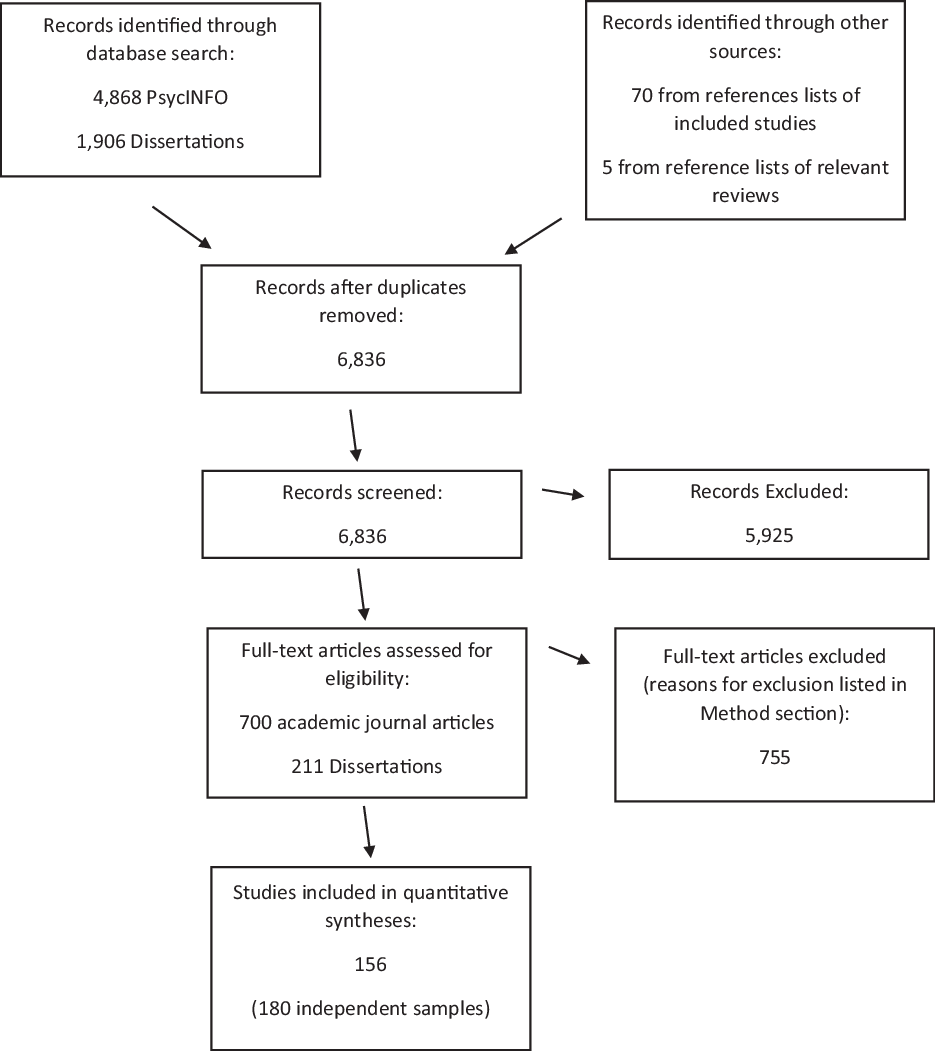
Per PRISMA guidelines (Moher et al., Reference Moher, Liberati, Tetzlaff and Altman2009), studies were located using PsycINFO, Dissertation & Theses Full Text (ProQuest Dissertations & Theses, Full Text), and by reviewing the reference lists of included articles found through these database searches as well as by reviewing reference lists of relevant reviews. In PsycINFO, the following keywords in the abstract were used: anx* or worry or phobia or panic AND academic* or “school performance” or “grade point average” or GPA or math or “language arts” or reading or “school completion” or “school dropout”. Our search was restricted to academic journals and studies in English that were published through December 2018. This search yielded 4868 abstracts (see Figure 1), and we identified an additional 75 studies from reference lists of included articles and relevant reviews. A comparable search was conducted in the Dissertation & Theses Full Text database, with the additional restriction to specific subject categories [e.g., educational psychology, psychotherapy, higher education, mathematics education, etc. (please contact the authors for the full list of subjects)]. This search yielded an additional 1906 abstracts (see Figure 1).
PRISMA flow diagram for studies included.

To ensure independence of effect sizes, we created a protocol for selecting non-overlapping samples. First, we identified overlapping samples by cross-referencing authorship across multiple publications. If multiple articles existed for the same authors, we examined their methods to determine if the same sample was used. When a sample was published in more than one study, only the study with the most comprehensive data was included in the meta-analysis. We also examined whether dissertations had later been published by cross-referencing authorship. When a dissertation had been published, we selected the published paper, however, if the dissertation presented additional relevant effect size information beyond the scope of the published paper, we kept that independent effect size information. Five coders screened all abstracts for inclusion with Coder 1 serving as the reliability coder and overlapping on 10% of abstracts with each coder. Kappa agreements between Coder 1 and the other coders ranged from .76 to .90 (yes/no) and .80 to .93 (yes/no/maybe). In total, after removing duplicates, we screened 6836 abstracts, reviewed 911 full text articles, and identified k = 156 studies (180 independent samples) that met final inclusion criteria and were included in at least one meta-analysis (see Figure 1).
Inclusion and exclusion criteria used for article screening
Studies were included if the following criteria were met (see Figure 1):
1. Studies had to have an independent measure of anxiety related symptoms and disorders as conceptualized by the DSM-5 (American Psychiatric Association, 2013). Thus, studies that measured global or total anxiety (including trait anxiety), agoraphobia, generalized anxiety, panic, separation anxiety, social anxiety, specific anxiety (e.g., arachnophobia), or worry were included. Studies were excluded if they examined: samples with diagnoses comorbid with anxiety (e.g., depression/anxiety) without presenting results for anxiety separately; test anxiety or school subject specific anxiety or worries (e.g., math anxiety); temperament or temperamental traits (e.g., fearfulness, anxious solitude, shyness, behavioral inhibition); state anxiety; measures of affect (e.g., PANAS) or emotional symptoms (e.g., Strength and Difficulties Questionnaire); internalizing scores when presented as a total score with no details; or the anxiety sensitivity index (i.e., propensity to be anxious). We also excluded single item measures of anxiety or measures that were study-specific (e.g., created by study authors for that study) and measures of anxiety that asked study participants to rate another’s anxiety (e.g., self-report of friend’s anxiety; Tu et al., Reference Tu, Erath and Flanagan2012) due to concerns about the reliability of these measures.
2. Studies had to assess one of three academic outcome constructs. The first was achievement, which we defined as studies that contained measures of grades, GPA, or achievement test scores (e.g., national tests). Although school dropout reflects a level of academic (under)achievement, given its powerful consequences (e.g., greater unemployment probability, de Brey et al., Reference de Brey, Musu, McFarland, Wilkinson-Flicker, Diliberti, Zhang, Branstetter and Wang2019), we evaluated it separately. Thus, the second academic construct was school non-completion or dropout. The third was academic self-concept, which we defined, consistent with previous meta-analyses (von der Embse et al., Reference von der Embse, Jester, Roy and Post2018), as including studies that measured academic self-concept or related terms such as academic self-efficacy, academic confidence, or academic self-esteem. These measures could examine academic self-concept broadly, or in regard to specific academic subjects (e.g., math self-concept). Studies that used measures of IQ (e.g., Stanford-Binet Intelligence Scale, Wechsler Intelligence Scale for Children, Woodcock-Johnson Test of Cognitive Abilities), nonacademic self-concept attitudes such as “liking school” that did not include any behavioral items, and school refusal (ambiguous term, unclear if it is anxiety or achievement related or both) were excluded.
3. Studies also had to have available effect size data for the association of anxiety and achievement. Studies were excluded if they were not empirical, quantitative studies. When studies did not provide sufficient information for the calculation of an effect size, the corresponding authors (N = 64) were contacted. Of those contacted, 13 replied with the necessary statistics and the remaining studies were subsequently excluded.
4. We excluded studies of children with developmental disorders such as autism.
5. We did not include post-intervention longitudinal data as these might reflect the impact of intervention rather than anxiety or academic outcomes. For example, studies that examined anxiety at time 1 and math achievement at time 2 (after intervention), were excluded.
Coding of studies
A standard coding form was developed by the authors to rate each study on measurement characteristics as well as study-level and sample-level moderators.
Anxiety
We made several distinctions based on how anxiety was measured in a study. First, we coded a study as assessing either global/total anxiety (e.g., trait anxiety, worry) or a more specific form of anxiety (generalized, social anxiety, agoraphobia, panic, arachnophobia). We also examined how each study assessed anxiety (i.e., disorders, symptoms, both) and the percent of the sample with an anxiety diagnosis. Then, we coded the type of assessment method for each measure of anxiety was recorded (i.e., questionnaire, diagnostic interview, clinical judgement, behavioral observations); based on the data obtained, we coded studies as using questionnaire or interview methods.
Academic outcomes
We first coded studies based on the type of achievement outcome: academic achievement/performance, dropout, or academic self-concept. The academic achievement category included grades/GPA, standardized achievement measures such as achievement test scores/other types of objective tests, as well as measures developed for a specific study or other idiosyncratic measures. The dropout studies included studies of individuals who did not complete high school or did not complete the academic year in younger grades. The self-concept category included studies that measured any of several markers of academic self-concept: academic self-concept, academic self-efficacy, academic self-competence, and academic self-confidence. This included 11 effect sizes that measured self-concept, 12 effect sizes that measured self-efficacy, and 14 effect sizes that used measures that assessed both self-concept and self-efficacy. Then, for studies that had measures of academic achievement or academic self-concept, we also coded whether the measure was general or domain specific (e.g., math, language/reading, science).
Additional moderators
In addition to the way anxiety and academic outcomes were measured, we also coded several other moderators to evaluate the generalizability of the findings. These included: (a) learning disorder status (i.e., no learning disorder, portion of sample has learning disorder, entire sample has learning disorder); (b) health status (i.e., no medical disorder; medical disorder); (c) participant ethnicity (% of sample Caucasian); (d) minority (% of sample that is a minority in the country that data were collected in); (e) SES (low SES, moderate to high SES), (f) risk sample (no risk, risk); (g) participant gender (% male); (h) mean age at which anxiety and academic outcomes were, respectively, measured; (i) developmental period at which anxiety and academic outcomes were, respectively, measured; (j) geographic region (region in which study was conducted); (k) publication year; (l) type of research design (cross-sectional, longitudinal); (m) publication status (i.e., unpublished dissertation; publication); (n) longitudinal time difference (i.e., length of time in months between anxiety and achievement measurement in longitudinal studies); and (o) anxiety or achievement first (i.e., was anxiety or achievement measured first). It should be noted that there was no age or developmental period restriction as we were interested in a lifespan developmental approach. Also, not all of these moderators could be examined in each meta-analysis due to a lack of studies. In addition, the health status, minority representation in sample, and mean age at achievement moderators could not be examined in any of the meta-analyses due to a lack of studies with relevant data for those moderators.
Coding agreement
The second and third authors each coded studies, overlapping on a random sample of 30% of studies to calculate reliability. Agreement was calculated using percent agreement and kappas. Agreement between coders was greater than 85% for all categories with the exception of type of research design (82%, kappa = .56), mean age at anxiety (84%), developmental period anxiety (80%, kappa = .83) and developmental period of achievement (80%, kappa = .83). All disagreements were discussed by coders and a final conferenced code was retained.
Appendix A provides a description of all studies included in any of the meta-analyses, and Appendix B includes the references of all studies included in the meta-analyses.
Effect size calculation
Effect sizes (Pearson’s r) were analyzed using comprehensive meta-analysis (CMA) Version 2.0 (Borenstein et al., Reference Borenstein, Rothstein and Cohen2005). Consistent with Cohen (Reference Cohen1988), we interpreted the magnitude of effect sizes as follows: Pearson’s r = .10 small, r = .30 medium, and r = .50 large. When other effect size data were reported (e.g., F tests), statistics were converted to r using CMA.
Each study could contribute only one effect size to a particular analysis. But, because we conducted separate analyses for each type of anxiety with each type of achievement construct, it was possible for a study to contribute to more than one meta-analysis (e.g., a study measuring both general anxiety and social anxiety; a study measuring both academic achievement and academic self-concept). In cases where a study generated more than one effect size for a given analysis, to ensure the inclusion of only a single effect size, the following aggregation rules were applied. Variables were standardized through transforming r coefficients into Fischer’s z, averaging these, and then transforming the average back to Pearson’s r.
1. If effect size information was reported separately for independent groups (e.g., boys and girls), these were not aggregated (i.e., gender, ethnicity, multiple age groups in cross-sectional studies) but instead effects sizes for each group were included.
2. If both cross-sectional (anxiety time 1 × math achievement time 1) and longitudinal effect size information was reported (e.g., anxiety time 1 × math achievement time 2), we only included the longitudinal effect size to take a more conservative approach and to maximize the benefits of longitudinal research in our meta-analyses (e.g., longitudinal designs allow to assess if time between assessments and order of assessments may moderate associations.)
3. If there were multiple informants for anxiety, we used diagnostic interviews of anxiety, if available. If not, then we selected for self-reported anxiety and excluded effect sizes based on other informants; if diagnostic interviews or self-report was not available and the study participants were under 18, we selected parent-report of their child’s anxiety, and teacher-report was used as the last resort.
4. If there were multiple informants for academic achievement or dropout, we used teacher-reports, if available. If not, then we selected self-reports and excluded effect sizes based on other informants. For academic self-concept, we used self-reports only.
After following the rules above, some studies still had multiple effect sizes to select from or aggregate in order to eliminate dependent data:
5. If a study used multiple measures of anxiety or academic achievement at one time point that were from the same reporter (e.g., two self-report measures of anxiety), we aggregated them.
6. If a study used the same measure of anxiety or academic achievement or self-concept across multiple time points and longitudinal data were not provided (e.g., associations provided for anxiety time 1 and math performance time 1 and for anxiety time 2 × math performance time 2), we aggregated them.
7. For the “aggregate” (i.e., not type of anxiety or achievement subject specific) meta-analyses (anxiety and academic achievement; anxiety and dropout; anxiety and self-concept), if a study included measures of multiple anxiety domains (e.g., general anxiety, social anxiety, phobia), or achievement domains (e.g., math grades, language grades), we aggregated effects sizes for these domains.
Data analysis
We conducted a series of seven meta-analyses on the relationship between anxiety and academic outcomes: (a) anxiety and overall achievement; (b) anxiety and math achievement; (c) anxiety and language/reading achievement; (d) anxiety and science achievement; (e) anxiety and dropout; (f) anxiety and overall academic self-concept; and (g) anxiety and math concept. We performed random-effects meta-analyses as they more adequately mirror heterogeneity in behavioral studies (Hedges & Olkin, Reference Hedges and Olkin1985).
To test and correct for publication bias, we used the Duval and Tweedie (Reference Duval and Tweedie2000) trim-and-fill procedure. We examined the funnel plot of sample and effect sizes (see Appendix C). When publication bias is present, more studies with smaller samples are located to the right of the mean, and the funnel plot is considered symmetrically unmatched. The trim-and-fill procedure then enters symmetrically extreme values to balance the plot and derives an adjusted effect size.
Finally, we formally assess heterogeneity of effect sizes using Q-statistics (Borenstein et al., Reference Borenstein, Hedges, Higgins and Rothstein2009) and evaluated the significance of moderators when there was significant heterogeneity and sufficient numbers of studies for a moderator. Continuous moderators (percent of sample with anxiety diagnosis, percent Caucasian, mean age at anxiety, percent male in sample, publication year; longitudinal time difference) were tested when there were four or more studies in the analysis. Categorical moderators (type of anxiety, assessment method for anxiety, how anxiety was assessed, assessment method for achievement, learning disorder status, SES, risk status, developmental period at time of anxiety measurement, developmental period at time of achievement measurement, geographic region, type of research design, publication type; anxiety or achievement first) were tested using a grouped analysis when there were four or more studies per level of the moderator. Because most types of anxiety were underrepresented (e.g., n studies assessing separation anxiety = 1), we combined these studies and created an “other” category. In the tables we included effect sizes for each level of the categorical moderators and Q between tests, even when there were not four or more studies per level, for descriptive purposes. Statistics for significant categorical moderators with four or more studies per level and significant continuous moderators are presented in text.
Results
Associations between anxiety and overall academic achievement
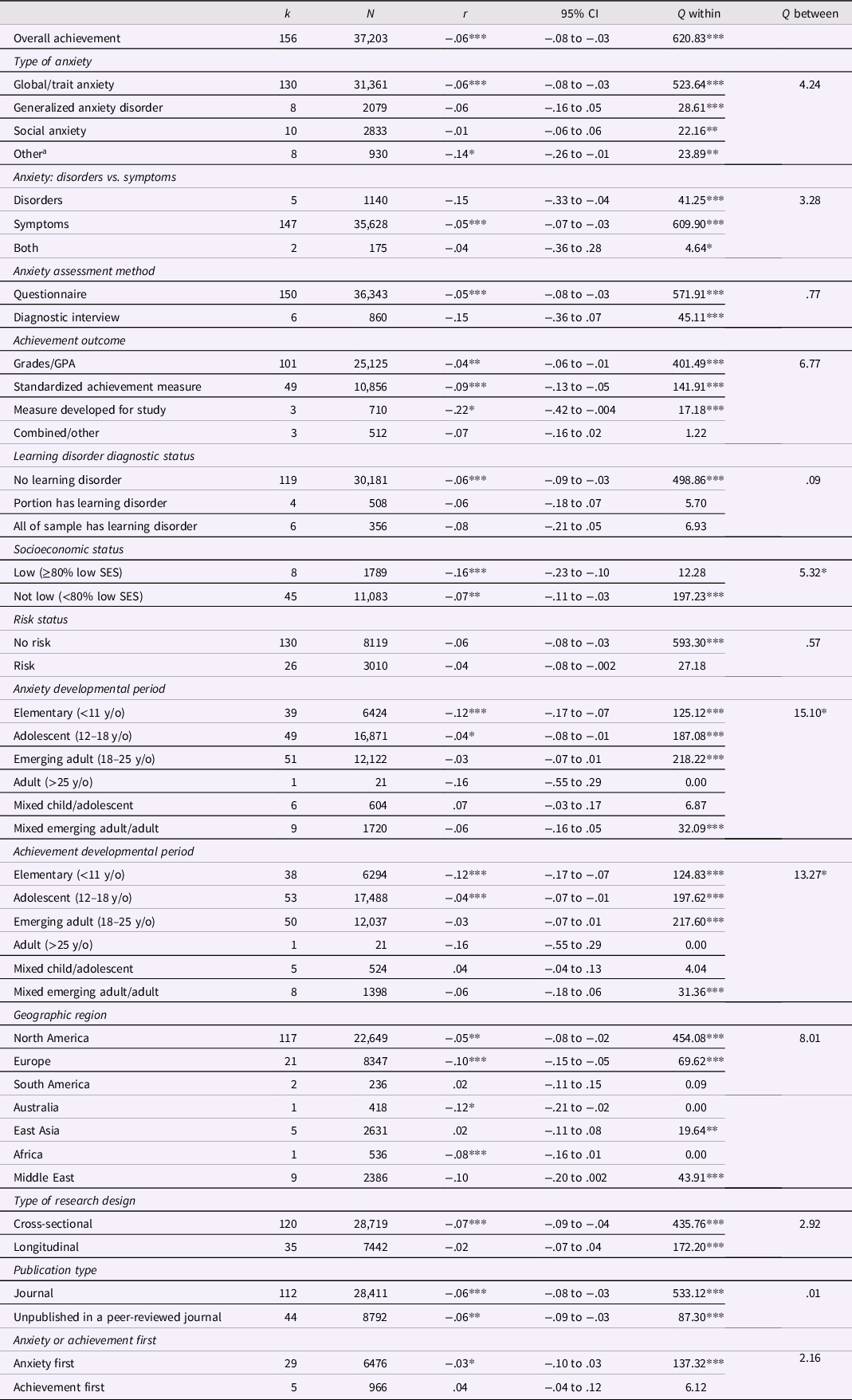
We tested whether higher levels of anxiety were associated with lower levels of overall academic achievement (Table 1). The meta-analysis (k = 156 samples, N = 37,203) yielded a very small but significant overall effect size (r = −.06, p < .001) with a 95% CI [−.08, −.03] indicating that participants with higher anxiety had lower academic performance. The trim-and-fill approach indicated publication bias was unlikely. There was significant heterogeneity indicating that moderators should be examined (Q = 620.83, p < .001). We were able to test the type of anxiety, whether disorders or symptoms were assessed, the measurement approaches of anxiety, the measurement approaches of achievement, learning disorder diagnostic status, percent Caucasian, SES, cumulative risk, gender, developmental period and ages when anxiety was assessed, developmental period when achievement was assessed, geographical location, publication year, type of research design, publication status, longitudinal time difference, and anxiety or achievement first. Moderators related to participant age were significant. Specifically, the developmental period when anxiety was tested (Q between = 14.88, p < .01), the mean age at anxiety assessment (Q model = 4.89, p = .03; slope point estimate = .01, p = .03), and the developmental period when achievement was tested (Q between = 13.04, p < .05) were significant, such that studies with younger or elementary school aged participants tended to have stronger effect sizes. Regarding the developmental period when anxiety was tested, follow-up tests revealed that the elementary (b = −.12, p < .001) subgroup differed from the adolescent (b = −.04, p = .02), Q between = 7.38, p = .007; adulthood (b = −.03, p = .21), Q between = 8.63, p = .003; and mixed age (b = −.02, p = .62), Q between = 4.94, p = .03 subgroups. Subgroup analyses for developmental period when achievement was tested showed similar results, with the elementary subgroup significantly different from (b = −.12, p < .001) adolescent (b = −.04, p = .02), Q between = 7.40, p = .007; adulthood (b = −.03, p = .18), Q between = 7.60, p = .006; and mixed age subgroups (b = −.04, p = .41), Q between = 2.91, p = .08. In addition, SES was significant (Q between = 5.32, p < .05); studies with low SES samples had stronger effect sizes than studies with moderate to high SES samples.
Results of meta-analyses of the associations between anxiety and academic achievement and their categorical moderators

a Includes agoraphobia (n = 3) as well as combined categories including GAD/trait (n = 1), trait/social (n = 2), GAD/social (n = 1), and separation/social (n = 1).
* p < .05.
** p < .01.
*** p < .001.
Associations between anxiety and language, math, and science achievement
Anxiety and language achievement
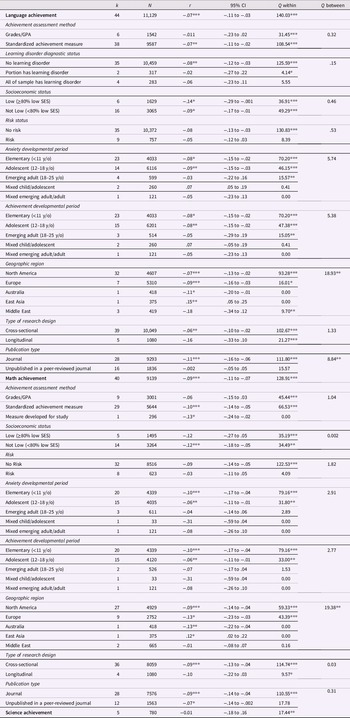
We tested whether higher levels of anxiety were associated with lower levels of language performance (Table 2). The meta-analysis (k = 44 samples, N = 11,129) yielded a significant very small overall effect size (r = −.07, p < .001) with a 95% CI [−.11, −.03] indicating that participants with higher anxiety had lower language performance. The trim-and-fill approach indicated publication bias was unlikely. There was significant heterogeneity (Q = 140.03, p < .001). We tested the measurement approaches of achievement, learning disorder diagnostic status, percent Caucasian, SES, gender, developmental period when anxiety was assessed, the mean age when anxiety was assessed, the developmental period when achievement was assessed, the geographical location, publication year, the type of research design utilized, and publication status as moderators. Only publication status (Q between = 8.84, p < .01) was significant. Studies published in a journal had stronger effect sizes than dissertations unpublished in a peer-reviewed journal.
Results of meta-analyses of the associations between anxiety and language, math, and science achievement, and their categorical moderators

* p < .05.
** p < .01.
*** p < .001.
Anxiety and math achievement
We tested whether higher levels of anxiety were associated with lower levels of math achievement (Table 2). The meta-analysis (k = 40 samples, N = 9139) yielded a significant very small overall effect size (r = −.09, p < .001) with a 95% CI [−.11, −.07] indicating that participants with higher rated anxiety had lower math performance. The trim-and-fill approach indicated publication bias was unlikely. There was significant heterogeneity (Q = 128.91, p < .001); however, none of the tested moderators (measurement approaches of achievement, percent Caucasian, SES, gender, the developmental period when anxiety was assessed, mean age when anxiety was assessed, developmental period when achievement was assessed, geographical location, publication year, type of research design, and publication status) explained this heterogeneity.
Anxiety and science achievement
The meta-analysis of anxiety and science achievement (k = 5 samples, N = 780) yielded a nonsignificant overall effect size (r = −.01, p = .54) with a 95% CI [−.05, .09]. (Table 2). The trim-and-fill approach indicated publication bias was unlikely. There was significant heterogeneity (Q = 17.44, p < .01), and we were able to test gender, mean age when anxiety was assessed, and publication year. Gender was significant (Q model = 4.78, p = .03), such that studies with a larger percentage of male participants had stronger negative effect sizes (slope point estimate = .01, p = .03, 95% CI: .001, .017). Publication year was also significant (Q model = 5.96, p = .02), such that older studies had stronger positive effect sizes (slope point estimate = −.01, p = .02, 95% CI: −.03, −.003).
Associations between anxiety and high school dropout
We tested whether higher levels of anxiety were associated with increased rates of high school dropout/high school non-completion. The meta-analysis (k = 6 samples, N = 2136) yielded a small but significant overall effect size (r = .11, p = .01) with a 95% CI [0.029, 0.191] indicating that participants with higher levels of anxiety were more likely to drop out or otherwise not complete high school. The trim-and-fill approach indicated publication bias was unlikely. We found significant heterogeneity in effect sizes (Q = 17.106, p = .004). We tested percent Caucasian, gender, mean age when anxiety was assessed, and publication year as moderators. Only gender was significant (Q model = 12.717, p < 0.001); studies with a larger percentage of male participants had smaller effect sizes (Slope point estimate = −.002, p < .001, 95% CI: −.003, −.001).
Associations between anxiety and academic self-concept
Anxiety and Overall Academic Self-concept
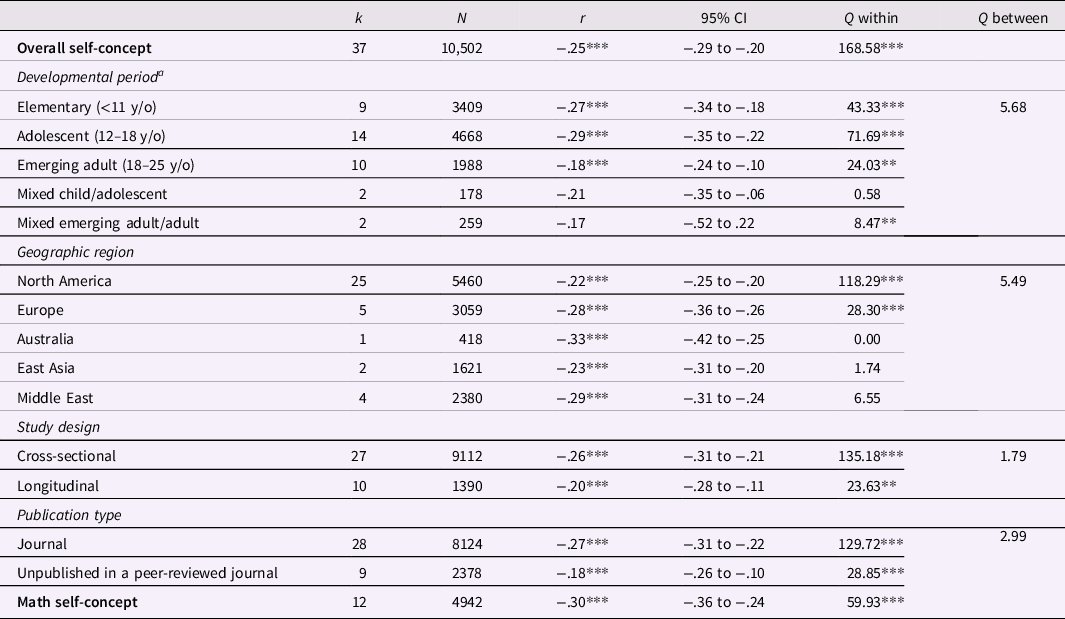
We tested whether higher levels of anxiety were associated with lower levels of overall academic self-concept (Table 3). The meta-analysis (k = 37 samples, N = 10,502) yielded a significant small-to-medium-overall effect size (r = −.25, p < .001) with a 95% CI [−.29, −.20] indicating that participants with greater anxiety had lower levels of academic self-concept. The trim-and-fill approach indicated publication bias was unlikely. There was significant heterogeneity (Q = 168.58, p < .001); however, none of the tested moderators (percent Caucasian, gender, developmental period when anxiety was assessed, mean age when anxiety was assessed, developmental period when achievement was assessed, geographical location, publication year, the type of research design, and publication status) explained this heterogeneity.
Results of meta-analyses of the associations between anxiety and academic self-concept and their categorical moderators

a Anxiety and achievement developmental period variables combined because included studies were identical.
** p < .01.
*** p < .001.
*p < .05.
Anxiety and math self-concept
We tested whether higher levels of anxiety were associated with lower levels of math self-concept (Table 3). The meta-analysis (k = 12 samples, N = 4942) yielded a significant medium overall effect size (r = −.30, p < .001) with a 95% CI [−.36, −.24], indicating that participants with higher anxiety had lower self-rated levels of academic self-concept. The trim-and-fill approach indicated publication bias was unlikely. There was significant heterogeneity (Q = 59.93, p < .001), but none of the tested moderators (gender, developmental period when anxiety was assessed, mean age when anxiety was assessed, developmental period when achievement was assessed, geographical location, and publication year) explained this heterogeneity.
Discussion
The main goals of the current study were to examine the magnitude of the associations between clinical anxiety and academic outcomes in children and adults. Cutting across developmental stages and including several decades of research, we quantified effect sizes from 156 samples of the association between anxiety and achievement, 6 samples of the association between anxiety and school dropout, and 37 samples of the association between anxiety and academic self-concept. In addition, when data were available, we conducted meta-analyses by three key subject domains: language/reading, mathematics, and science. We found that higher anxiety was significantly related to most of our indicators of academic outcomes, although most effect sizes for academic achievement were weaker than theory suggests.
Anxiety and academic achievement
We anchored our prediction that participants experiencing greater anxiety would have lower overall academic achievement as indexed by grades/GPA and standardized test results in developmental models that suggest anxiety and other internalizing problems may interfere with learning (Masten et al., Reference Masten, Roisman, Long, Burt, Obradović, Riley and Tellegen2005; Moilanen et al., Reference Moilanen, Shaw and Maxwell2010). We found that participants experiencing greater anxiety have lower overall academic achievement as indexed by grades/GPA and standardized test results, although effect sizes were very small, and weaker than theory suggests. These results are in line with prior narrative and meta-analytic reviews that drew similar conclusions (de Lijster et al., Reference de Lijster, Dieleman, Utens, Dierckx, Wierenga, Verhulst and Legerstee2018; Seipp, Reference Seipp1991). This result, however, should also be evaluated in light of the significant moderators: the mean age and developmental period when anxiety was tested, the developmental period when achievement was assessed, and the level of SES. Specifically, studies of anxiety and achievement with elementary school age samples had stronger effect sizes than studies with adolescents or adults. Younger children’s investment in learning tends to be higher compared to the next developmental stage (i.e., adolescence, Wigfield et al., Reference Wigfield, Eccles, Fredricks, Simpkins, Roeser and Schiefele2015), but they are less effective emotion regulators (Saarni, Reference Saarni1999). It is possible that older anxious individuals benefit from their increased emotion competence, such as recognition and discernment of their emotional experience (including fear), and a broader range of coping strategies (e.g., John & Gross, Reference John and Gross2004), and can develop strategies that buffer the effect of anxiety on their academic achievement. Alternatively, the most anxious individuals may drop out of school by adulthood (see below) and thus, might not be included in studies of adults.
Further, studies with low SES samples had stronger effect sizes for overall academic achievement than studies with moderate to high SES samples. Thus, individuals with a low-income background and greater anxiety emerged at a particular risk for poorer academic achievement. This result points out the importance of early identification and preventive efforts to deter anxiety in students with struggling financial backgrounds, as they already are likely to experience lower success rates and their academic skills tend to be behind those of high-income students due to inequalities in opportunities (Doerschuk et al., Reference Doerschuk, Bahrim, Daniel, Kruger, Mann and Martin2016; Reardon et al., Reference Reardon, Valentino, Kalogrides, Shores and Greenberg2013). Regarding the temporal relation between anxiety and achievement, moderation analyses of the longitudinal studies indicated that effect sizes did not differ significantly based on whether anxiety or achievement was measured first. Thus, our results are consistent to some extent with both adjustment-erosion and academic-incompetence models (Masten et al., Reference Masten, Roisman, Long, Burt, Obradović, Riley and Tellegen2005; Moilanen et al., Reference Moilanen, Shaw and Maxwell2010) and suggest that anxiety and academic achievement might have very small, but bidirectional effects.
In three separate meta-analyses, we also evaluated the magnitude of the relations between anxiety and language/reading, math, and science performance. We found very small effect sizes for the associations of anxiety with both language/reading and math achievement. These associations (although weaker than postulated) are expected to some extent. Specifically, language and math skills are moderately associated, most likely due to the use of language for thinking and reasoning during mathematics acquisition and performance, and as a tool to communicate, understand, and retrieve mathematics knowledge (i.e., the thinking and medium functions of language in mathematics), which in turn further strengthens linguistic abilities (Peng et al., Reference Peng, Lin, Ünal, Lee, Namkung, Chow and Sales2020). Our findings for anxiety also expand on studies showing that achievement emotions (e.g., enjoyment, anger) are related to one’s learning and performance in subject domains (Camacho-Morles et al., Reference Camacho-Morles, Slemp, Pekrun, Loderer, Hou and Oades2021; Pekrun et al., Reference Pekrun, Lichtenfeld, Marsh, Murayama and Goetz2017) and suggest that articulating clear strategies for supporting the success of more anxious individuals in language/reading and math domains specifically might be helpful. Although we did not find evidence of publication bias, we did nevertheless find that samples published in a peer-reviewed journal had stronger effect sizes for the relation between anxiety and language/reading achievement than unpublished dissertations. The smaller effect sizes in unpublished studies may be due to smaller sample sizes, which in themselves are a proxy, even if not a flawless one, for study quality (N for studies published in peer-reviewed journals = 9293, k = 28; N unpublished dissertations = 1836; k = 16).
The magnitude of the relation between anxiety and academic achievement in science was nonsignificant and negligible, further suggesting that anxiety in itself might not be a hindrance for some academic outcomes. Although this finding is surprising to some extent, it should be interpreted with caution due to the small number of samples (k = 5) and overlapping confidence intervals with the relation between anxiety and language/reading which suggests nonspecificity of results. It also could be due to the fact that, unlike language/reading and mathematics which are fundamental skills relevant to other academic domains, science skills are more domain specific. Further, studies with a larger percentage of male participants had more negative effect sizes. Overall, we found few gender effects, and we had no a priori hypothesis in regard to gender. Speculatively, the gender effect for science achievement could be due to other intervening aspects/characteristics not assessed here (e.g., differential interests). Publication year was also a significant moderator of the relation between anxiety and academic achievement in science, such that older studies had stronger positive effect sizes. Perhaps other factors such as personal interests have become more important over time for science success.
Anxiety and high school dropout
Our fifth meta-analysis filled a gap by synthesizing the strength of the relation between anxiety and school dropout, and yielded a small effect size, suggesting that participants with higher levels of anxiety were more likely to drop out of school. The divergence between our finding and those of Gubbels et al. (Reference Gubbels, van der Put and Assink2019) may stem from the difference in the numbers of studies included in the meta-analyses (six versus two). In comparing our study with factors examined by Gubbels et al. (Reference Gubbels, van der Put and Assink2019), our results show that anxiety is as powerful a correlate of dropout as physical or mental health difficulties (other than anxiety/depression), parenting difficulties (e.g., under involvement and low levels of control), school characteristics (e.g., negative school climate), and peer group characteristics (e.g., popularity). Among tested moderators, only the percent male was significant, so that studies with a larger percentage of male participants had smaller effect sizes. This suggests that anxiety is a weaker risk factor for school dropout (or vice versa) in samples with more boys than in girls, perhaps because factors other than anxiety (e.g., tendencies toward criminality) are a stronger influence on boys’ decision to drop out of school.
Anxiety and academic self-concept
Further, our meta-analytic results revealed that participants with higher levels of anxiety have poorer academic self-concepts. The effect size was small-to-medium, suggesting that individuals experiencing fear arousal and worries about potential future threat have also a negative view about their abilities to meet academic standards and potential to succeed. Because self-concepts in specific academic domains may not always be congruent with each other (Bandura et al., Reference Bandura, Barbaranelli, Caprara and Pastorelli1996; Bong, Reference Bong2001; Goetz et al., Reference Goetz, Cronjäger, Frenzel, Lüdtke and Hall2010), we also intended to assess how anxiety relates to academic self-concept in language/reading, math, and science. We were able to identify enough studies only for the mathematics area. Results yielded a medium effect size, and we found that participants with higher anxiety have lower levels of academic self-concept in math. Thus, our finding also depicts a profile of individuals whose arousal of fear gets in the way of forming positive beliefs of their ability to perform, overall, in school, but also in the math domain in particular. Our novel results expand the previous finding that academic self-concept is linked negatively with unpleasant emotions (Goetz et al., Reference Goetz, Cronjäger, Frenzel, Lüdtke and Hall2010) to show that clinical anxiety specifically is related to academic self-concept. Interestingly, despite evidence of substantial variability in effect sizes, none of the moderators we tested were significant. Indeed, the association between anxiety and overall academic self-concept or math self-concept appears to be quite robust and not dependent on child age or gender. Research is needed to understand what factors (e.g., interpretive biases, emotion regulation, sensitivity to feedback) might lead more anxious individuals to develop self-views of their academic ability that appear to be more negative than their actual academic performance.
Strengths, limitations, and future research
Besides quantifying the relations between anxiety and academic achievement, dropout, and academic self-concept, this meta-analytic review maps out the topography of the empirical work in these areas and point to several priorities in future studies. In six of seven meta-analyses, we could not examine whether there were differences by the type of anxiety (e.g., generalized anxiety, social anxiety, specific anxiety) due to the limited number of studies assessing them in relation to achievement in specific subjects, drop out, and academic self-concept. We found that type of anxiety did not moderate the relation between anxiety and overall academic achievement, however only global/trait, generalized, social, and other (a mix of anxiety types) were included in the analyses. We were not able to locate any study focusing on specific phobia or panic disorder, and we identified an extremely low number of studies assessing agoraphobia and separation anxiety (which were combined in the mixed category). Given that each type of symptomatology entails unique clinical presentations and unique challenges, there is an urgent need for research on different types of anxiety. For example, one could speculate that agoraphobia may impede one’s academic achievement because school, where foundation of learning is set, may be seen as an enclosed and crowded space and one might fear that escape is difficult. Further, some effects might be larger for some specific forms of anxiety such as separation anxiety due to its impact on physical attendance in schools.
Similarly, the moderators of anxiety symptoms versus disorders and type of measurement of anxiety (i.e. diagnostic interviews versus questionnaires) could not be examined for six meta-analyses due to a lack of studies assessing anxiety disorders and/or relying on diagnostic interviews. Given the functional impairment associated with disorders, the field would benefit from studies of clinical samples and studies assessing continuity and discontinuity in anxiety over time. Relatedly, most of the studies assessed anxiety symptoms rather than diagnoses, and some of the relations between anxiety and academic outcomes may be curvilinear, which might have attenuated some effect sizes. Academic self-concept is likely to have a degree of domain-specificity (Bong & Skaalvik, Reference Bong and Skaalvik2003), however, studies assessing the relation of anxiety with self-concept in language/reading and science domains are missing in the literature. Largely underrepresented are also studies assessing anxiety and academic outcomes in samples of individuals with learning disorders, in samples experiencing a medical disorder, in samples at risk due to multiple factors, and in minority samples, further pointing out that we currently have only a partial understanding of their relations.
Several caveats and limitations of the current findings should be also noted. Although we followed the PRISMA procedure and completed a comprehensive literature search that included multiple sources, we did not exhaust all potentially relevant databases. As described in our method section, for certain studies aggregation was used as it accounts for non-independence of effect sizes. It is possible that the aggregation technique could have led to less precise estimates in each of the meta-analyses conducted as aggregation of effect size estimates does not allow for multilevel explorations of both within-study variance and between-study variance (Van den Noortgate et al., Reference Van den Noortgate, López-López, Marín-Martínez and Sánchez-Meca2013). Future meta-analyses could implement multilevel techniques when there is enough variability within studies to strengthen our understanding of the influence of within-study differences on these estimates.
We evaluated each academic outcome separately to obtain a comprehensive picture of the field. However, academic outcomes covary (Möller et al., Reference Möller, Pohlmann, Köller and Marsh2009; Richardson, et al, Reference Richardson, Abraham and Bond2012; Wu et al., Reference Wu, Guo, Yang, Zhao and Guo2021). For example, Wu et al. (Reference Wu, Guo, Yang, Zhao and Guo2021) demonstrated meta-analytically that academic self-concept and achievement affected each other mutually, and Gubbels et al. (Reference Gubbels, van der Put and Assink2019) showed that low academic achievement is a strong correlate of school dropout. Thus, future studies should assess multiple academic outcomes to evaluate their covariation and interactive or explanatory mechanisms relations with anxiety. For example, based on this study and previous meta-analytic results, it is possible that individuals experiencing greater anxiety form a negative academic self-concept that may further affect their academic performance. Alternatively, greater anxiety combined with poorer academic self-concept may promote poorer achievement than either factor alone. Because anxiety disorders also tend to be comorbid with each other and with other disorders (e.g., depression; Craske et al., Reference Craske, Stein, Eley, Milad, Holmes, Rapee and Wittchen2017), an equally important follow-up will be to evaluate these ideas in samples experiencing comorbid anxiety and other clinical conditions.
Further, we assessed academic self-concept broadly, however, some distinguish between academic self-concept, referring to one’s beliefs about their academic ability (Marsh, Reference Marsh1990; Susperreguy et al., Reference Susperreguy, Davis-Kean, Duckworth and Chen2017; Wigfield et al., Reference Wigfield, Eccles, Yoon, Harold, Arbreton, Freedman-Doan and Blumenfeld1997) and academic self-efficacy, encompassing one’s convictions of what one can accomplish in academic tasks in order to achieve one’s goals (Bandura, Reference Bandura1997). (Note that self-confidence is also a commonly used term in regard to self-evaluation.) Another distinction is anchored in measurement: appropriately designed self-efficacy items are descriptive, whereas self-concept items also include an evaluative aspect (see Marsh et al., Reference Marsh, Pekrun, Parker, Murayama, Guo, Dicke and Arens2019). Unfortunately, empirical studies often do not clearly make this distinction. There is also acknowledgement that the two constructs (academic self-concept, academic self-efficacy) overlap conceptually as both are academic self-related beliefs focusing on perceived competence and relying on past experiences and reflected appraisals from other people (Bong & Skaalvik, Reference Bong and Skaalvik2003). Further, both constructs are thought to explain one’s thoughts, emotions, and behaviors, and are shown to facilitate academic performance and motivation in varied degrees (see Bong & Skaalvik, Reference Bong and Skaalvik2003). The difficulty of clearly dividing studies in a category due to measurement and conceptualization approaches precluded us from conducting separate meta-analyses to further distinguish among the measures of academic self-concept. Future studies should evaluate the potential unique relations of anxiety with academic self-concept and self-efficacy narrowly defined, as well as contrasting their effects, to further clarify how anxiety might relate to self-evaluations.
Lastly, while we were interested particularly in anxiety from a clinical perspective, academic anxieties have been a long-standing focus in educational settings. For example, academic and math anxieties show medium effect size associations with aspects of math achievement in meta-analytic reviews (Barroso et al., Reference Barroso, Ganley, McGraw, Geer, Hart and Daucourt2021; Caviola et al., Reference Caviola, Toffalini, Giofrè, Ruiz, Szűcs and Mammarella2021; Namkung et al., Reference Namkung, Peng and Lin2019; Zhang et al., Reference Zhang, Zhao and Kong2019). Given that clinical anxiety has been conceptualized as a risk factor for academic anxieties and some empirical studies revealed significant associations between them (e.g., Carey et al., Reference Carey, Devine, Hill and Szűcs2017), we echo Caviola et al. (Reference Caviola, Toffalini, Giofrè, Ruiz, Szűcs and Mammarella2021) in suggesting that academic anxiety may act as a mediator between clinical anxiety and academic achievement and studies should investigate this possibility.
The practical implications of the robustness of the effect sizes require some further reflection. With the exception of the magnitude of the relations between anxiety and overall academic self-concept or math self-concept, the effect sizes were in the very small to small range (Cohen, Reference Cohen1988). Nonetheless, the principle of equifinality suggests that many pathways may lead to the same outcome (Cicchetti & Rogosch, Reference Cicchetti and Rogosch1996), and anxiety is one of many factors (e.g., school climate, achievement goal; Scherrer et al., Reference Scherrer, Preckel, Schmidt and Elliot2020) related to academic outcomes. Abelson (Reference Abelson1985) also pointed out that small effect sizes should not be disregarded, particularly when there is a potential for cumulative effects, as they could accrue across many years of schooling. Both anxiety and academic outcomes have the potential to have long-standing effects on each other, as well as on adulthood outcomes such as career success (Kessler & Greenberg, Reference Kessler, Greenberg, Davis, Charney, Coyle and Nemeroff2002). Thus, the findings from this meta-analytic synthesis inform to some extent intervention and preventive efforts. Although there is room for improvement, there is extensive empirical support for cognitive-behavioral therapy approaches for preventing and addressing anxiety symptomatology across developmental stages (Craske et al., Reference Craske, Stein, Eley, Milad, Holmes, Rapee and Wittchen2017; Higa-McMillan et al., Reference Higa-McMillan, Francis, Rith-Najarian and Chorpita2016; Springer et al., Reference Springer, Levy and Tolin2018). These approaches are goal-oriented and focus on changing one’s cognitive biases to evidence-based thoughts, and teaching coping strategies (e.g., Craske et al., Reference Craske, Stein, Eley, Milad, Holmes, Rapee and Wittchen2017). Our findings suggest that importance of targeting academic self-concept for those affected by anxiety. In addition, given that age was a significant moderator for academic achievement, it could be worth exploring to what extent some academic outcomes, such as achievement, are perceived at younger ages as threatening. Mitigating these beliefs about outcomes might improve children’s educational experience. Enhancing one’s sense of control over academic trajectories is likely to promote positive academic outcomes (e.g., academic self-concept; Dresel & Haugwitz, Reference Dresel and Haugwitz2008) and this may be particularly relevant for students showing signs of anxiety. Dropout prevention programs (e.g., school or class restructuring programs, community service programs, mentoring and counseling; additional academic services, etc.) are also effective at reducing the rate of dropout overall (Wilson et al., Reference Wilson, Lipsey, Tanner-Smith, Huang and Steinka-Fry2010). Our findings suggest that these school-based prevention efforts should also take into account individuals’ nonacademic anxieties and fears because they might be related to some of their academic outcomes (i.e., academic self-concept, dropout).
In summary, the current meta-analytic review synthesizes the empirical evidence regarding the associations of anxiety with academic outcomes. We found very small effect sizes between anxiety and overall academic achievement and achievement within the language/reading and mathematics achievement domains. Individuals experiencing anxiety have a small increased chance of school dropout. Small to medium and medium effect sizes emerged for the relation between anxiety and global academic self-concept and mathematics self-concept, respectively. We found few moderation effects, mostly related to age or methodological moderators (e.g., percent of sample male). Our review underscores how little we know (rather than what we know) regarding the relations of clinical anxiety and academic outcomes in the context of other risk factors such as type of anxiety, the presence of anxiety disorder v. symptoms, health, learning disorders, and minority statuses. Understanding these relations in the context of cumulative risks, as well as studying how anxiety and academic outcomes influence one another across time, is particularly needed. Our findings also suggest that intervention and preventive efforts for individuals with clinical anxiety could incorporate a focus on academic self-concept and academic related cognitions. In addition, school-based programs designed to improve scholastic outcomes may be more effective if they take in account participants’ (nonacademic) level of anxiety.
Supplementary material
The supplementary material for this article can be found at https://doi.org/10.1017/S0954579422000323
Funding statement
This research received no specific grant from any funding agency, commercial or not-for-profit sectors.
Conflicts of interest
None.