Implication
The present study elucidates how different dietary fat sources influence digestion and fermentation activity of the endogenous microbiota in broiler chickens. The study demonstrates the secondary effects of Clostridium perfringens challenge and fat type in broiler chickens, indicating that both factors affect fermentation in the broiler gastrointestinal tract.
Introduction
Clostridium perfringens is ubiquitous in the environment and may thus be ingested with soil, feces, dust, feed or even drinking water (Van Immerseel et al., Reference Van Immerseel, Rood, Moore and Titball2009; Schocken-Iturrino et al., Reference Schocken-Iturrino, Vittori, Beraldo-Massoli, Delphino and Damasceno2010). Avirulent C. perfringens strains are often found in the gastrointestinal tract (GIT) of healthy chickens where they may reside without harming the host bird. However, simultaneous blooming of virulent C. perfringens strains and colonization of the small intestine by Eimeria spp. may trigger the development of necrotic enteritis (NE). There are many dietary factors influencing C. perfringens colonization of the chicken GIT. In this connection, the role of dietary carbohydrates and protein has received much attention. The inclusion of certain grains containing high amounts of viscous carbohydrates, for example rye, wheat or barley in poultry diets, leads to higher colonization of C. perfringens, which may impair chicken performance (Choct, Reference Choct2009). Further, it has been reported that the growth of C. perfringens is greatly supported by dietary protein – in particular, protein of animal origin, like fish meal (Dahiya et al., Reference Dahiya, Wilkie, Van Kessel and Drew2006). However, the influence of lipids on the GIT microbiota is still not completely clarified. Lipids are known to influence the intestinal microbiota indirectly through their impact on digesta viscosity, intestinal transit time and digestion in the small intestine. Apart from the microbial population, the absorption of fats is influenced by many other factors – for example fat source and type, carbon chain length and degree of fatty acid saturation, bile salt concentration in the digesta, and finally chicken age (Engberg et al., Reference Engberg, Lauridsen, Jensen and Jakobsen1996; Knarreborg et al., Reference Knarreborg, Simon, Engberg, Jensen and Tannock2002). However, in the literature there is only limited information about possible interactions between dietary fat source and C. perfringens challenge. It is well documented that a highly digestible and unsaturated fat source, for example soy oil, decreases small intestinal numbers of C. perfringens compared with poorly digestible lard and tallow (Knarreborg et al., Reference Knarreborg, Simon, Engberg, Jensen and Tannock2002). Moreover, in our earlier studies, we observed that a C. perfringens challenge resulted in significantly decreased pH of crop, gizzard and ileum contents and reduced the numbers of lactic acid bacteria in the ceca (Józefiak et al., Reference Józefiak, Sip, Rutkowski, Rawski, Kaczmarek, Wolun-Cholewa, Engberg and Hojberg2012); however, the manner in which it affects microbial fermentation activity remains unclear.
Therefore, the aim of the present study was to examine how different fats commonly used in the feed industry affect broiler performance, nutrient digestibility and microbial fermentation in the GIT of broilers, challenged with virulent C. perfringens strains.
Material and methods
Two experiments were carried out, each including 480-day-old male broilers (Ross 308), which were randomly distributed to eight experimental groups using six replicate pens per treatment and 10 birds per pen. The birds were kept in floor pens (1.2×0.8 m) over a production period of 42 days. The lightning regime provided 23 h of light and 1 h of dark during the 1st week, 19 h of light and 5 h of dark from 7 to 21 days, and 23 h of light and 1 h of dark from 22 to 42 days of age. In Experiment 1, birds were fed with diets containing soybean oil (SO), palm kernel fatty acid distillers (PKFDs), rendered pork fat (RPF) and lard (L). In Experiment 2, birds were fed diets containing rapeseed oil (RO), coconut oil (CO), beef tallow (BT) and palm oil (PO). In both experiments, the birds were either not challenged or challenged with a mixture of three C. perfringens type A strains: 73.70560-e (PFGE type S11), strain 200302–1-1-Ba (PFGE type S48) and strain 97.73338–3 (PFGE type T7). Isolated from birds with dignosed necrotic enteritis and all producing α-toxin and NetB as described in detail by Józefiak et al. (Reference Józefiak, Sip, Rutkowski, Rawski, Kaczmarek, Wolun-Cholewa, Engberg and Hojberg2012).
Diets and feeding program
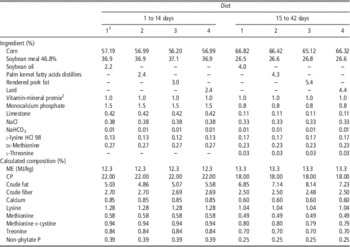
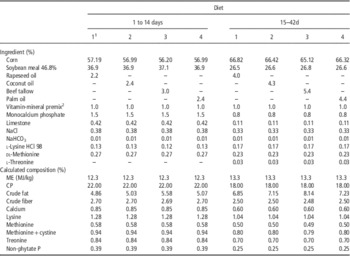
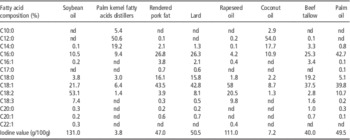
The composition of the experimental diets is shown in Tables 1 and 2. The fatty acid composition of the applied fats is shown in Table 3. The diets were provided in the form of mash; all raw materials were ground in a disc mill (Skiold A/S, Denmark) at 2.5-disc distance, mixed without any heat treatment and fed ad libitum to all birds. In the last 5 days (37 to 42 days) of the experiment, 0.2% of the wheat was replaced by titanium oxide as an internal marker for the calculation of nutrient digestibility. The experiment complied with the guidelines of the Local Ethic Commission (Poznań University of Life Sciences, Poland) with respect to animal experimentation and care of animals under study.
Composition of the basal diets: Experiment 1

ME=metabolizable energy.
1 1, soybean oil; 2, palm kernel fatty acids distillers; 3, rendered pork fat; 4, Lard.
2 Provided the following per kilogram of diet: vitamin A, 11.166 IU; cholecalciferol, 2.500 IU; vitamin E, 80 mg; menadione, 2.50 mg; B12, 0.02 mg; folic acid, 1.17 mg; choline, 379 mg; d-pantothenic acid, 12.50 mg; riboflavin, 7.0 mg; niacin, 41.67 mg; thiamine, 2.17 mg; d-biotin, 0.18 mg; pyridoxine, 4.0 mg; ethoxyquin, 0.09 mg; Mn (MnO2), 73 mg; Zn (ZnO), 55 mg; Fe (FeSO4), 45 mg; Cu (CuSO4), 20 mg; I (CaI2O6), 0.62 mg; Se (Na2SeO3), 0.3 mg.
Composition of the basal diets: Experiment 2

ME=metabolizable energy.
1 1, rapeseed oil; 2, coconut oil; 3, beef tallow; 4, palm oil.
2 Provided the following per kilogram of diet: vitamin A, 11.166 IU; cholecalciferol, 2.500 IU; vitamin E, 80 mg; menadione, 2.50 mg; B12, 0.02 mg; folic acid, 1.17 mg; choline, 379 mg; d-pantothenic acid, 12.50 mg; riboflavin, 7.0 mg; niacin, 41.67 mg; thiamine, 2.17 mg; d-biotin, 0.18 mg; pyridoxine, 4.0 mg; ethoxyquin, 0.09 mg; Mn (MnO2), 73 mg; Zn (ZnO), 55 mg; Fe (FeSO4), 45 mg; Cu (CuSO4), 20 mg; I (CaI2O6), 0.62 mg; Se (Na2SeO3), 0.3 mg.
Fatty acid composition and iodine value of the fat sources used in Experiments 1 and 2

nd=not detectable.
Data collection
The feed intake (FI) and BW of the chickens were measured on d 14, 28 and 42. Mortality was registered throughout the experimental period. At the end of the trial (42 days) from each experimental group 18 randomly picked chickens (three chickens from six pens) were killed by cervical dislocation. For digesta analyses (pH and organic acid concentrations), the contents of crop, ileum and ceca from three birds per pen were pooled (n=6, replicate digesta samples per segment of ~10 g each). Approximately 5 g of the samples was used immediately for the pH analyses. The rest of the samples was immediately frozen and stored at −20°C for later analysis of organic acids. For the evaluation of apparent metabolizable energy (AMEn) and total tract fat digestibility, 100 g of the excreta from each pen was collected at 42 days (n=12). The excreta samples were immediately frozen, freeze-dried and ground before further analyses.
Chemical analyses
Feed samples were analyzed in duplicate for CP, crude fat and crude fiber using AOAC (2005) methods 976.05, 920.39 and 2002.04, respectively. The iodine value in all fats was analyzed according to the AOAC (2005) 993.20 method and the fatty acid profile by methods described in detail by Edwards (Reference Edwards1967). The concentration of titanium dioxide was determined according to the method described by Short et al. (Reference Short, Gorton, Wiseman and Boorman1996), and the samples were prepared according to the procedure reported by Myers et al. (Reference Myers, Ludden, Nayigihugu and Hess2004). Gross energy was determined using an adiabatic bomb calorimeter (KL 12Mn, Precyzja-Bit PPHU, Poland) standardized with benzoic acid. The nitrogen content was analyzed using the Kjel Foss Automatic 16210 (A/S N. Foss Electric, Hillerød, Denmark) and the CP content was calculated using a multiplication factor of 6.25. Fat content was determined using Soxtex System HT 1043, Extraction Unit (Foss Tecator, Hillerød, Denmark).
Digestibility calculations
The apparent digestibility coefficients of fat was analyzed as described in detail by Józefiak et al. (Reference Józefiak, Sip, Rawski, Rutkowski, Kaczmarek, Hojberg, Jensen and Engberg2011). The AMEn content of the experimental diets was calculated according to Hill and Anderson (Reference Hill and Anderson1958) using titanium dioxide as an indigestible marker.
Organic acids and pH analyses
The pH of pooled digesta samples from crop, ileum and ceca was measured immediately after slaughter using a combined glass and reference electrode (Elmetron, Zabrze, Poland). The concentration of short-chain fatty acids and lactic acid in the contents of the different gastrointestinal segments was determined by gas chromatography, as described earlier by Canibe et al. (Reference Canibe, Hojberg, Badsberg and Jensen2007), using a Hewlett Packard gas chromatograph (model 6890; Hewlett Packard, Agilent Technologies, Naerum, Denmark) equipped with a flame ionization detector and a 30-m ZB-5 column with an internal diameter of 0.32 mm and coated with 5%-phenyl 95%-di-methylpolysiloxane with a film thickness of 0.25 μm. The data are presented as total organic acids (acetate+propionate+butyrate+iso-butyrate, valerate, iso-valerate and lactic acid).
Statistical analysis
Statistical analysis of the results was performed using the GLM of SAS, (1990) according to the following general model:
 $$Y_{{ij}} =\mu {\plus}\alpha _{i} {\plus}\beta _{j} {\plus}\left( {\alpha \beta } \right)_{{ij}} {\plus}\delta _{{ij}} ,$$
where Y ij was the observed dependent variable; μ was the overall mean; α i was the effect of fat source; β j was the effect of C. perfringens challenge; (αβ) ij was the interaction between fat and C. perfringens challenge; and δ ij was the random error. In cases in which the overall effect was significant (P<0.05), means were compared pairwise (p diff). Results are presented as least square mean values with pooled standard error of the mean (s.e.m.).
Results
Experiment 1
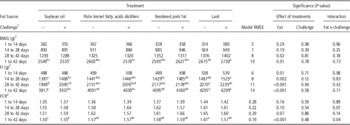
The performance results are summarized in Table 4. During the period from 1 to 14 days and from 14 to 28 days, none of the dietary fats affected the BWG of broiler chickens. From 28 to 42 days (P=0.015) and during the entire experiment (P=0.004), a significant response to dietary fat source was observed. From 28 to 42 days, the highest BWG was observed in birds fed L, being significantly higher than that of birds fed diets with PKFDs and SO. The birds fed diets with RPF did not differ significantly from the rest of the treatments. FI was significantly affected by dietary fat type throughout the experiment. Irrespective of the experimental period, birds receiving SO had the lowest FI, being significantly lower than that of other treatments from 28 to 42 days and in the entire experimental period. In the period from 1 to 14 days and 14 to 28 days and during the entire experiment, dietary L significantly increased FI; however, from 14 to 28 days the intake was not statistically different from that seen in the RPF group. The feed conversion ratio (FCR) was affected by dietary fat source in the period from 1 to 42 days (P=0.0002) and a significant interaction between fat and C. perfringens challenge was also recorded. At the end of the experiment (42 days), the lowest FCR was noted in the SO treatment (Table 4); however, this was the only fat source in which the C. perfringens challenge caused significantly higher FCR in the period of 1 to 42 days.
The effect of fat type and Clostridium perfringens challenge on the performance of broiler chickens: Experiment 1

RMSE=root mean square error; BWG=body weight gain; FI=Feed intake; FCR=feed conversion ratio.
a–dMeans not sharing a common superscript differ significantly (P<0.05).
1 With (+) or without (−) C. perfringens challenge.
2 Means represent six pens of 10 chicks each.
The nutrient digestibility and AMEn values are summarized in Table 5. The crude fat digestibility (P<0.001) and apparent metabolizable energy value (P<0.0001) depended on the fat source. The C. perfringens challenge lowered the nitrogen retention (P=0.024). The lowest crude fat digestibility and AMEn were recorded in challenged birds fed the high-quality pig lard diets. The highest AMEn was observed in the PKFD treatment; however, the crude fat digestibility of PKFD birds did not differ between the SO and RPF groups. No significant interaction was observed between fat source and C. perfringens challenge.
The effect of fat and Clostridium perfringens challenge on fat digestibility, nitrogen retention (%) and apparent metabolizable energy value (kcal/kg) of broiler chickens: Experiment 1Footnote 1

RMSE=root mean square error; AMEn=apparent metabolizable energy.
a–dMeans not sharing a common superscript differ significantly (P<0.05).
1 Means represent six pens of 10 chicks each.
2 With (+) or without (−) C. perfringens challenge.
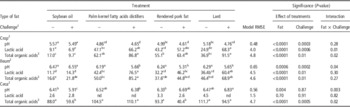
Intestinal fermentation in terms of total organic acid and lactic acid concentrations as well as digesta pH has been summarized in Table 6. The pH of the digesta in crop and ileum was affected by dietary fat type as well as by C. perfringens challenge. In cecal content, only an effect of dietary fat was observed (P=0.004). The C. perfringens challenge significantly lowered digesta pH in the crop and ileum. In the crop and ileum, the lowest pH was observed in challenged birds fed RPF. In the ceca, dietary SO caused the lowest pH among all treatments (P=0.004). The total concentration of organic acids was significantly affected by the C. perfringens challenge and fat type throughout the GIT. Total organic acid concentrations in the ileum were two to three times lower for the SO diets as compared with the other dietary treatments. Moreover, a significant interaction between challenge and fat was observed in the crop and ileum. Irrespective of the dietary fat source, C. perfringens challenge increased the total organic acid concentration in the crop and ileum and lowered its value in the ceca. The lactic acid concentration was triggered in the crop and ileum, wheras no effect was observed in the ceca.
Concentrations of total organic acids and lactic acid and digesta pH in different segments of the gastrointestinal tract: Experiment 1

RMSE=root mean square error.
a–eMeans not sharing a common superscript differ significantly (P<0.05).
1 With (+) or without (−) C. perfringens challenge.
2 Means represent 18 chicks – three chicks pooled from six pens.
3 Total organic acids=acetate+propionate+butyrate+iso-butyrate+ valerate+ iso-valerate +lactic acid.
Experiment 2
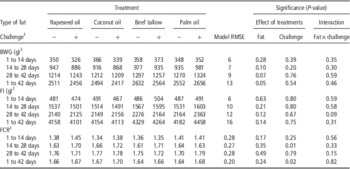
The performance results are summarized in Table 7. In the period of 1 to 14 days and 14 to 28 days, none of the dietary fats affected BWG of broiler chickens. A significant response of broiler growth (P=0.045) to the dietary fat source was recorded only for the entire experimental period. FI and FCR were not affected by the dietary fat type irrespective of the experimental period. The challenge with C. perfringens did not affect BWG and FI in any of the experimental periods. However, the FCR was impaired in the period from 14 to 28 days (P=0.009) and during the entire trial period (P=0.021). In general, irrespective of the dietary fat type, C. perfringens challenge significantly impaired FCR in the period from 14 to 28 days (1.63 v. 1.69) and from 1 to 42 days (1.65 v. 1.68).
The effect of fat and Clostridium perfringens challenge on the performance of broiler chickens: Experiment 2Footnote 1

RMSE=root mean square error; BWG=body weight gain; FI=feed intake; FCR=feed conversion ratio.
1 With (+) or without (−) C. perfringens challenge.
2 Means represent 18 chicks – three chicks pooled from six pens.
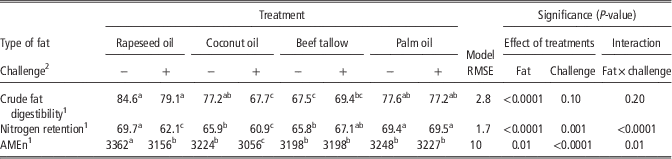
The nutrient digestibility and AMEn values are summarized in Table 8. The crude fat digestibility (P<0.001), nitrogen retention (P<0.001) and apparent metabolizable energy value (P<0.01) depended on the fat source, whereas C. perfringens challenge lowered the nitrogen retention (P<0.01) and AMEn values. The highest crude fat digestibility and AMEn was recorded in birds in the RO group. Moreover, significant interaction between challenge and fat was observed with respect to nitrogen retention (P<0.01) and AMEn values (P=0.001), indicating that C. perfringens challenge decreased nitrogen retention and AMEn to a higher extent when RO and CO were fed as compared to PO and BT.
The effect of fat and Clostridium perfringens challenge on fat digestibility (%) and apparent metabolizable energy value (kcal/kg) of broiler chickens: Experiment 2Footnote 1

RMSE=root mean square error; AMEn=apparent metabolizable energy.
a–cMeans not sharing a common superscript differ significantly (P<0.05).
1 Means represent 18 chicks – three chicks pooled from six pens.
2 With (+) or without (−) C. perfringens challenge.
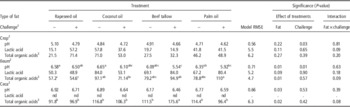
Intestinal fermentation expressed as total digesta concentration of organic acids, lactic acid and digesta pH is summarized in Table 9. The pH of the digesta in crop was affected by C. perfringens challenge (P=0.03). In the ileum, fat source (P=0.01) as well as C. perfringens challenge (P=0.01) had an effect on digesta pH values, whereas in the ceca only dietary fat showed an effect (P=0.03). In the ileum, the lowest pH was observed in challenged birds receiving beef tallow. The total organic acids were influenced by fat type in ileum and ceca (P=0.01 and 0.02, respectively). In the ileum, the lowest concentration of organic acids was observed in case of RO treatment (P=0.01). In the ceca, the highest fermentation was observed in challenged birds fed diets with BT (P=0.02).
Concentrations of total organic acids and lactic acid and digesta pH in different segments of the gastrointestinal tract: Experiment 2

RMSE=root mean square error.
a–cMeans not sharing a common superscript differ significantly (P<0.05).
1 With (+) or without (−) C. perfringens challenge.
2 Means represent 18 chicks – three chicks pooled from six pens.
3 Total organic acids=acetate+propionate+butyrate+iso-butyrate+ valerate+ iso-valerate +lactic acid.
Discussion
Broiler performance and nutrient digestibility
The aim of the present study was to investigate the potential changes in the nutritive value of the different types of dietary fat in C. perfringens-challenged birds. Irrespective of the fat type present in the diet, C. perfringens challenge did not affect broiler chicken BWG and mortality. Only in Experiment 2 feed utilization was impaired in the second growth phase (15 to 28 days) and in the entire experimental period. This is in agreement with other studies, in which the feed utilization of broilers was impaired (Skinner et al., Reference Skinner, Bauer, Young, Pauling and Wilson2010) without increasing mortality (Olkowski et al., Reference Olkowski, Wojnarowicz, Chirino-Trejo and Drew2006; Józefiak et al., Reference Józefiak, Sip, Rutkowski, Rawski, Kaczmarek, Wolun-Cholewa, Engberg and Hojberg2012). In contrast, in a recent study by Star et al. (Reference Star, Rovers, Corrent and van der Klis2012), a simultaneous infection with C. perfringens and Eimeria maxima caused lower BWG and FI and a mortality of 15%. The present challenge strategy was applied to stress the birds without inducing high mortality. Therefore, we did not use viscous cereals (rye, barley) and/or fishmeal, which are known to be predisposing factors for the development of NE (Dahiya et al., Reference Dahiya, Wilkie, Van Kessel and Drew2006). Further, in contrast to work performed by other authors (Wu et al., Reference Wu, Rodgers and Choct2010; Star et al., Reference Star, Rovers, Corrent and van der Klis2012), we only used C. perfringens, without Eimeria challenge, which may explain the low mortality in the study. However, even in this model, probably also due to the lack of coccidiostats in the diets, we still observed some negative effects of C. perfringens on fat utilization and bird performance. In Experiment 1, the dietary fat type interacted with the C. perfringens challenge in terms of final FCR values. Interestingly in both experiments, the dietary fat type did not affect feed utilization in the first growth period (1 to 14 days), whereas the results from the entire experimental period in the first trial differed significantly (P<0.05). In contrast, the BWG was affected by dietary fat type in both experiments, indicating that the fatty acid composition of the fat source affects broiler growth performance. In particular, the inclusion of animal fats tended to improve final BW to a greater extent compared with unsaturated vegetable oils. In Experiment 1, birds fed diets with SO had a lower BWG (P<0.05) as compared with L. Further, in Experiment 2, RO inclusion resulted in a numerically lower BWG as compared with BT. This is in agreement with the work of Skrivan et al. (Reference Skrivan, Skrivanova, Marounek, Tumova and Wolf2000), in which chickens receiving diets containing rapeseed oil gained less weight than those receiving lard (P<0·05). In contrast, Wongsuthavas et al. (Reference Wongsuthavas, Yuangklang, Vasupen, Mitchaothai, Alhaidary, Mohamed and Beynen2011), feeding broiler chickens with diets based on soybean oil or beef tallow, did not observe any changes in daily weight gain and FCR, even though FI was decreased in birds fed a soybean oil-based diet. In contrast, studies conducted by other authors show a close correlation between fat sources, their chemical characteristics and broiler performance (Dei et al., Reference Dei, Rose and MacKenzie2006), indicating that saturated fats are characterized by lower digestibility, particularly in young birds, thus negatively affecting bird performance. In the present trial, the dietary fat source also affected the FI of birds; however, the differences were only statistically significant in the first experiment. In general, SO reduced FI as compared with PKFD, RPF and L. However, it was not reflected in the AMEn values, in which SO was characterized by lower AMEn compared with PKFD and did not differ from L. However, it is known that linoleic and oleic acids may lead to lower FI in broilers, whereas animal-origin fats such as lard are documented to increase FI in birds (Newman et al., Reference Newman, Bryden, Fleck, Ashes, Buttemer, Storlien and Downing2002). Thus, the lower BWG of birds fed diets with inclusion of SO and/or RO could also be explained by their fatty acid profile in which linoleic acid was much higher as compared with animal-origin fats (Table 3). Moreover, PKFD is mainly composed of medium-chain fatty acids, which are known to have bacteriostatic effects. Thus, the higher AMEn observed in birds fed this type of fat could be associated with changes in GIT microbiota, which were reflected in the profiles of the organic acids. The intestinal microbiota compete with the host for nutrients and also impair bile salt activity (Engberg et al., Reference Engberg, Lauridsen, Jensen and Jakobsen1996; Knarreborg et al., Reference Knarreborg, Simon, Engberg, Jensen and Tannock2002) and thus fat utilization. Therefore, medium-chain fatty acids can play an indirect role in the availability of nutrients for the birds by reducing some negative effects of the microbial activity.
The negative effect of C. perfringens challenge on AMEn is in agreement with our earlier studies, in which the same challenge model was applied (Józefiak et al., Reference Józefiak, Sip, Rutkowski, Rawski, Kaczmarek, Wolun-Cholewa, Engberg and Hojberg2012). Moreover, in Experiment 2, interactions between fat type and challenge were noted regarding nitrogen retention as well as AMEn level, suggesting an important role of fat during the C. perfringens challenge.
The differences between dietary fat sources regarding AMEn might be explained by their chemical structure, the necessary concentration of bile salts and intestinal lipase activity, which are essential for fat digestion. Unsaturated fatty acids have been shown to act as emulsifiers enhancing the micellar capacity of other more non-polar substances. (Knarreborg et al., Reference Knarreborg, Simon, Engberg, Jensen and Tannock2002 and Reference Knarreborg, Jensen and Engberg2003). Therefore, the digestion of soybean oil and other plant oils differs from saturated animal fats and is generally much easier, particularly in younger birds. Moreover, C. perfringens can actively impair fat digestion and absorption through deconjugation of bile salts. Knarreborg et al. (Reference Knarreborg, Simon, Engberg, Jensen and Tannock2002) demonstrated that the incidence of C. perfringens was significantly reduced in chickens fed soybean oil as compared with beef tallow. Thus, even though in the present trial we could not demonstrate significant effects of the C. perfringens challenge on the nutritive value of some fats, it can be suggested that animal-origin fats (i.e. tallow) have a lower nutritive value during C. perfringens challenge and should be omitted from broiler chicken diets.
Fermentation status in the GIT
In the present study, the results regarding total intestinal concentrations of organic acids and intestinal pH were in agreement with earlier findings (Engberg et al., Reference Engberg, Hedemann and Jensen2002 and Reference Engberg, Hedemann, Steenfeldt and Jensen2004). Irrespective of the fat type present in the diet, C. perfringens lowered the pH value of the digesta in crop and ileum, but had no effect in cecal contents. The pH-lowering effects of the C. perfringens challenge are in agreement with our earlier experiment (Józefiak et al., Reference Józefiak, Sip, Rutkowski, Rawski, Kaczmarek, Wolun-Cholewa, Engberg and Hojberg2012). Interestingly, in both of the present experiments, dietary fat type also affected pH values. The changes in the pH value related to the fat source as well as to C. perfringens challenge could also be linked to the fat utilization, since intestinal lipase activity is pH-dependent and is inhibited at low pH (Knarreborg et al., Reference Knarreborg, Jensen and Engberg2003).
The differences in fermentation end products are most likely due to the activity and density of the resident microbiota. Moreover, in Experiment 1, significant interactions between challenge and dietary fat were observed in crop and ceca. Therefore, the results of the present study also confirm that the dietary fat type as well as C. perfringens challenge may play an important role in the development of the microbial populations and their activity. The increased fermentation in the ileum, which was observed in both experiments, should be considered a negative aspect of C. perfringens challenge. Moreover, the increased fermentation in the ileum leads to lower pH, which was also observed in the present study, particularly after C. perfringens challenge. Although all endogenous and exogenous enzymes are pH sensitive, it should be stressed that pH changes should be considered as negative for nutrient digestibility, which further affects AMEn values.
The data from the present study demonstrate that dietary fat, which is actually present in lower concentrations in the poultry feeds compared to carbohydrates, can also influence the activity of the endogenous microbiota. Moreover, the fat utilization based on the chemical composition and fatty acid profiles can be changed considerably during a C. perfringens challenge. Although only a minor response of broiler performance was observed for the C. perfringens challenge in the present study, significant changes in gastrointestinal fermentation were recorded, suggesting indirect effects of C. perfringens challenge and dietary fat source on the activity and density of the indigenous microbiota.
Acknowledgements
This study was supported by the National Centre for Research and Development (Warsaw, Poland; Project No. NN311 239938). The authors thank Dr S. Kaczmarek for his contribution in data collection and statistical analyses.