INTRODUCTION
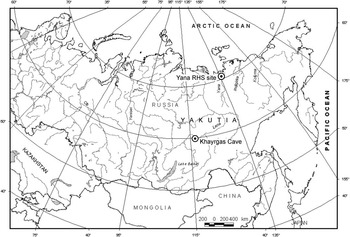
The Khayrgas Cave in the Middle Lena region of Yakutia (59°56′N, 117°28′E) is now one of the richest sites in the central part of eastern Siberia (Figure 1) in terms of archaeological and faunal data. Its discovery is an important step in the study of the Paleolithic in the Lena River basin since pioneering work done in the 1960–1970s (Mochanov and Fedoseeva Reference Mochanov and Fedoseeva1996; Mochanov Reference Mochanov2010). This site is also significant in terms of the issue of human presence in Siberia at the Last Glacial Maximum (LGM), a topic that has been hotly debated for the last 10–15 yr (e.g. Hoffecker Reference Hoffecker2005; Kuzmin and Keates Reference Kuzmin and Keates2005, Reference Kuzmin and Keates2013, Reference Kuzmin and Keates2016; Kuzmin Reference Kuzmin2008; Pitulko et al. Reference Pitulko, Pavlova, Nikolskiy, Ivanova, Basilyan, Anisimov and Remizov2015). This paper presents new information on the chronology and faunal remains from this site, and discusses its implication for the broader area of northern Eurasia.
Position of the Khayrgas Cave and Yana RHS site in eastern Siberia

MATERIAL AND METHODS
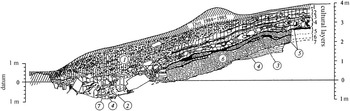
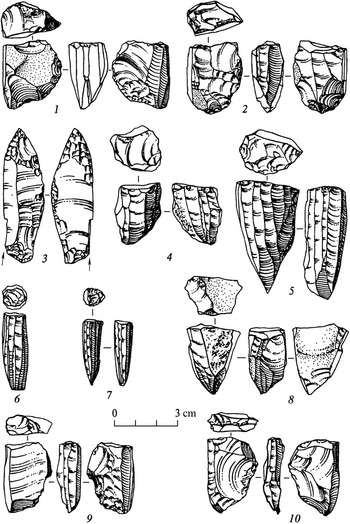
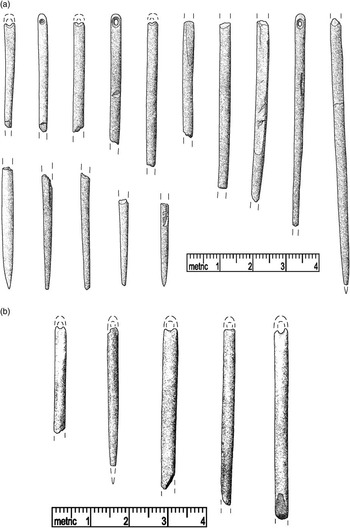
The Khayrgas Cave was found and initially excavated in 1984–1985 by N M Cherosov and A S Kirillin (Yakutsk State University, now North-Eastern Federal University). Excavation continued in 1998–1999, with a total of 103 m2 unearthed (Stepanov et al. Reference Stepanov, Kirillin, Vorobiev, Solovieva and Efimov2003). The general stratigraphy in shown in Figure 2. The most important cultural material was obtained from Layers 5–7 (Figures 2–3); it has an Upper Paleolithic appearance, and belongs to the Dyuktai cultural complex of Yakutia (e.g. Mochanov and Fedoseeva Reference Mochanov and Fedoseeva1996). Archaeological material is described in Stepanov et al. (Reference Stepanov, Kirillin, Vorobiev, Solovieva and Efimov2003); here we briefly describe the characteristics. In Layer 5, 522 stone artifacts and more than 75 bone artifacts were recovered (including adornments). Several cores (wedge-shaped, flattened, and prismatic) were found, as well as tools including burins, arrowhead, skreblos (large scrapers), scrapers, points, knives, and insets. Bone tools are represented by a smoother, beads, awls, points, pendants, arrowheads, fish hooks, and a harpoon. Of particular interest is the bone dagger made of mammoth rib, 34 cm long and 2.9 cm wide. In Layer 6, 1203 stone artifacts and 59 bone items were found. Cores (conical, flat-faced, and wedge-shaped), retouched blades, and scrapers constitute the stone tool assemblage. Bone tools are represented by arrowheads, harpoons, pendants, and items with grooves for stone insets. From Layer 7, 705 stone artifacts and 20 bone artifacts were recovered. The stone assemblage includes mostly wedge-shaped cores, blades, scrapers, and numerous flakes. Bone items are represented mainly by inset points and arrowheads. Of particular importance are numerous eye needles made of mammal bones from Layers 5–7 (Figure 4).
Stratigraphy of the Khayrgas Cave (modified after Stepanov et al. Reference Stepanov, Kirillin, Vorobiev, Solovieva and Efimov2003). Numbers in circles are sedimentary strata: 1 – dark-brown sandy loam (contains cultural Layers 1–2); 2 – brown sandy loam with gruss and large stone blocks (might contain cultural layer 2); 3 – greenish-brown sandy loam (contains cultural layer 2); 4 – greenish-brown laminated sandy loam (contains cultural layer 3); 5 – “black layer”: sandy loam with pieces of charcoal and soot, and gruss (contains cultural layer 5); 6 – gruss with dark-gray sandy loam (contains cultural Layers 6–7); 7 – sandy lens.

Stone tools from Upper Paleolithic layers (Reference Kuzmin5–Reference Kuzmin and Keates7) of the Khayrgas Cave (modified after Stepanov et al. Reference Stepanov, Kirillin, Vorobiev, Solovieva and Efimov2003): 1–6 – Layer 5; 7, 8–9 –Layer 6; 10 – Layer 7. Scale in centimeters.

Fragmented eye needles from the Khayrgas Cave: A – Layer 6; B – Layer 7. Scale in centimeters.

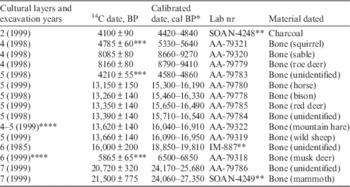
The first 14C dates from the Khayrgas Cave were generated on large samples of animal bones in the late 1990s: Layer 2 (1998–1999 pit), ~4100 BP; Layer 6 (1985 pit), ~16,000 BP; and Layer 7 (1998–1999 pit), ~21,500 BP (Stepanov et al. Reference Stepanov, Kirillin, Vorobiev, Solovieva and Efimov2003). In 2007, more bone samples were taken from the material collected during the 1999 excavations and AMS 14C dated at the University of Arizona (Table 1). Sample preparation followed the standard procedure for bones (e.g. Ovodov et al. Reference Ovodov, Crockford, Kuzmin, Higham, Hodgins and van der Plicht2011: 3).
14C dates from the Khayrgas Cave.

* IntCal13 data set (see Reimer et al. Reference Reimer, Bard, Bayliss, Beck, Blackwell, Bronk Ramsey, Buck, Cheng, Edwards, Friedrich, Grootes, Guilderson, Haflidason, Hajdas, Hatté, Heaton, Hoffmann, Hogg, Hughen, Kaiser, Kromer, Manning, Niu, Reimer, Richards, Scott, Southon, Staff, Turney and van der Plicht2013), with ±2 sigma, and all calibrated intervals are rounded to the next 10 yr and combined.
** These dates are from Stepanov et al. (Reference Stepanov, Kirillin, Vorobiev, Solovieva and Efimov2003); others were not published previously.
*** Outlier.
**** Sample was obtained from disturbed layer.
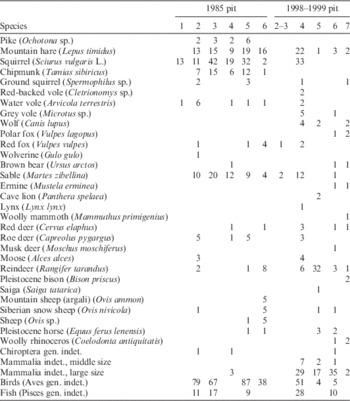
In total, there have been about 17,000 bones found at the Khayrgas Cave (Stepanov et al. Reference Stepanov, Kirillin, Vorobiev, Solovieva and Efimov2003). Most of them are too fragmentary for species and genera identification, and only a small fraction (about 6%) can be examined zooarchaeologically. Initially, only a small part of the collection was identified from the excavations of 1985 (Kasparov Reference Kasparov1998) and 1998–1999 (Boeskorov Reference Boeskorov2003). Later on, an additional zooarchaeological study was conducted, and this is why current data are different from previous ones (Table 2).
Mammal bones from the Khayrgas Cave (1985 and 1998–9 excavation campaigns); numbers for each pit correspond to cultural layers.

RESULTS AND DISCUSSION
All 14C dates available for the Khayrgas Cave are given Table 1. Layer 2 can be dated to ~4100 BP, and Layer 4 to ~8100–8200 BP. Archaeologically, Layers 2–3 can be assigned to the Neolithic, and Layer 4 to the Mesolithic (Sumnagin cultural complex), which has numerous 14C dates in the range of ~6000–10,300 BP (Mochanov Reference Mochanov2010; see also Kuzmin and Orlova Reference Kuzmin and Orlova1998: 40). Layer 5 can be dated to ~13,200–13,700 BP; Layer 6 to ~16,000 BP; and Layer 7 to ~20,700–21,500 BP.
There are some outliers in the 14C date series (Table 1), which can be easily identified due to inconsistencies in general chronology of the site. Some of the samples, such as the one that produced a 14C date AA-79318 from Layer 6, were collected in disturbed strata, and this was not easy to recognize at the time of excavation because of the mixed nature of stratigraphy on the periphery of cave. This value, however, is a clear outlier. Another sample (AA-79322) gave a reasonable 14C date, although it was obtained from the disturbed part of Layer 5.
For archaeozoological purposes, we divided material from the 1985 pit and 1998–1999 pit (Table 2). The reason is that in the 1985 pit the largest disturbance of strata was noted. From the 1985 pit, mammals from Layers 2–5 belong to the forest and forest steppe ecosystems representative of the Holocene (only extant species), and assemblage from Layer 6 can be correlated with the open landscapes of the final Pleistocene. However, from Layer 6, bones of typical forest species, squirrel and Siberian chipmunk, were identified. These bones have a Holocene appearance, and they were redeposited into older sediments.
From the 1998–1999 excavation pit, two kinds of mammalian complexes can be distinguished. In Layers 2–4, only extant species are known; ecologically they belong to the forest-type ecosystem and are 14C dated to ~4100–8200 BP. In Layers 5–7, several extinct species were identified, including cave lion, woolly mammoth, and rhinoceros, and Pleistocene bison and horse. These species correspond to the open and semi-open ecosystems common for the final Pleistocene of Yakutia. According to the 14C data, this complex belongs to the final Late Pleistocene, ~13,200–21,500 BP. 14C dates also confirm the existence of redeposition: bones of musk deer were found in the Pleistocene strata (Table 1, date AA-79318). This could be related to human activity in the Holocene.
Human-modified bones are detected in the Pleistocene Layers 5–6 (1985 pit), Layers 5–7 (1998–1999 pit), and in the Holocene layers of the 1985 and 1998–1999 excavations. Some of the mammal and bird remains have traces of carnivore activity (gnawed bones and digested bone fragments). Thus, bone accumulation in the Khayrgas Cave during the Late Pleistocene and the Holocene was due to activity of predatory mammals and birds of prey (cave lion, wolf, red fox, ermine, and eagle-owl), and humans.
The new data from Khayrgas Cave confirm that it was occupied by humans in the LGM, ~20,700–21,500 BP. Currently, the duration of the LGM was set at ~16,000–22,000 BP, corresponding to ~19,000–26,500 calendar years ago (cal BP) (Clark et al. Reference Clark, Dyke, Shakun, Carlson, Clark, Wohfarth, Mitrovica, Hostetler and McCabe2009). The coldest conditions were observed during the GS-3 interval dated to ~23.3–27.5 ka (Rasmussen et al. Reference Rasmussen, Bigler, Blockley, Blunier, Buchardt, Clausen, Cvijanovic, Dahl-Jensen, Johnsen, Fischer, Gkinis, Guillevic, Hoek, Lowe, Pedro, Popp, Seierstad, Steffensen, Svensson, Vallelonga, Vinther, Walker, Wheatley and Winstrup2014), which on a 14C timescale is equal to ~19,300–23,300 BP (Reimer et al. Reference Reimer, Bard, Bayliss, Beck, Blackwell, Bronk Ramsey, Buck, Cheng, Edwards, Friedrich, Grootes, Guilderson, Haflidason, Hajdas, Hatté, Heaton, Hoffmann, Hogg, Hughen, Kaiser, Kromer, Manning, Niu, Reimer, Richards, Scott, Southon, Staff, Turney and van der Plicht2013). There is growing evidence that humans were well adapted to the cold and dry conditions of Siberia during the LGM (e.g. Kuzmin Reference Kuzmin2008; Kuzmin and Keates Reference Kuzmin and Keates2016). Recently, new data on the LGM presence of Paleolithic people were published by Pitulko et al. (Reference Pitulko, Pavlova, Nikolskiy, Ivanova, Basilyan, Anisimov and Remizov2015), with several sites in the extreme northern part of eastern Siberia (~70°N) around the pre-LGM Yana RHS site and on the neighboring Yana-Indigirka interfluve (Figure 1), with 14C dates of ~21,300–22,700 BP. Therefore, the occupation of the Khayrgas Cave at ~60°N throughout the LGM does not look unrealistic anymore. The sophisticated bone technology, including the making of eye needles, which were necessary for manufacture of warm cloths, confirms the high degree of adaptation to cold environment. Prey animals were plentiful, and people easily existed during the LGM in the middle course of the Lena River.
CONCLUSIONS
Khayrgas Cave represents unequivocal evidence of human presence in deep continental regions of eastern Siberia (60°N) during the LGM (~20,700–21,500 BP), Late Glacial (~13,100–16,000 BP), and the Holocene (~4100–8200 BP). The inhabitants exploited a wide range of natural resources, including mammals, fish, and birds.
ACKNOWLEDGMENTS
This research was partly funded by the US NSF (EAR 04-48461), Russian Foundation for Basic Sciences (RFBR; 15-04-03882 and 15-44-05109 r_vostok_a), and by the Tomsk State University Program “Academician D I Mendeleev Fund” (2015–6) for Laboratory of Mesozoic and Cenozoic Continental Ecosystems.