Historians need to listen to the past. This is the charge of recent developments in the history of the senses, the cultural history of music, and the burgeoning field of sound studies.Footnote 1 Why is it, then, that historians, despite the substantial and growing body of literature in these fields, still find it hard to integrate music into their interpretations of past worlds?Footnote 2
One reason for music's relative absence from scholarly work outside musicology is obvious: music demands specific skills to access and evaluate its notations, its harmonic traditions, and music-specific analytical models – Renaissance modal theory, say, or Schenkerian analysis. Then there is the drama of translation (or ‘transduction’) within the study of sound.Footnote 3 The representation of sound in both notation and words confronts in complicated ways the problems of representation faced by any academic discipline. How can we mediate experiences of phenomena like music in ways that pay attention to the visual and textual media of its transmission, its sounds and performances, and to the material, social and cultural worlds within which it appears?
This problem is intensified by the difficulty of locating ‘music’ – in a score, an historically ‘informed’ or ‘uninformed’ performance, a thickly reconstructed event, a memory, or that elusive concept, the ‘work’. The category of music is neither transtemporal nor transcultural (does it include Qur'an recitations, keening rituals, or postmodern noise installations?). In other words, music's ‘presence’ or ‘existence’ seems particularly unstable – although it might better be said that sound foregrounds epistemological and ontological difficulties endemic to any historical object of study.
To compound difficulties, a strong strand in nineteenth-century thought made music a paradigm of the aesthetic. In the process, music was often constructed as escaping articulable meaning, instrumental reason and historical mediation; music is imagined as underdetermined and resistant to the verbal and hermeneutic procedures underpinning the humanities and social sciences. Paradoxically, these developments secured enormous cultural value for music, but made its study vulnerable to marginalisation and trivialisation within the academy. Historians sometimes persist in caricaturing musicologists as arcane specialists, closed formalists, or technicians who do not wish to contribute to a wider scholarly programme of integration. And we, of course, risk perpetuating another caricature by inventing a realm of ‘historians’ as opposed to ‘musicologists’, musicologists who are not already historians of sound, art, performance, politics, economics, devotion, liturgy and more.Footnote 4
A final observation: the knowledge required to understand music notations, and traditions of elite conoisseurship associated particularly with Western art music, has meant that many historians have found the languages of sound and soundscape more congenial to analysing experiences of the world as heard across the social spectrum. We absolutely agree that the study of sound is critical to rich historical practice. But sound includes music, and we can miss critical aspects of social and cultural life if we do not analyse all facets of the sonic world.
What does this mean for our arguments here about music and history? Firstly, we will not use a language of novelty: current generations are not the first to think historically about music. Rather, a language of amplification and interaction between disciplines and methodologies will help us continue the task of understanding music's roles within integrative interpretations of the past. Secondly, engagements with particular compositions and techniques (like the ones discussed in the following) should be located within broader thinking about how ‘music’ is positioned as ‘music’. This will involve considering music's changing others and its partners: from sound itself, noise, silence, chant, language and emotion, to ratio, astronomy, geometry, mathematics and magic.Footnote 5 Thirdly, we need to think about how our histories can be musicalised, to consider how music might contribute to and modify histories which seek to unite the study of culture with its material and social settings. In what follows, we fail to perform these tasks adequately. But we hope the failure is productive and will contribute to wider attempts to musicalise history.
Our argument is divided into three parts. We begin with some forms of fifteenth-century music and the language used to describe them. This section gives in miniature some of the problems in approaching music as a subject of historical investigation. More pointedly, it suggests how fifteenth-century theories of diversity might offer resources for creative historicising responses to music, then and now. The second section continues to interrogate fifteenth-century music, widening to imagine a musicalisation of the history of time, and a history of music informed by research on temporality. We then turn, by means of an interpretive tradition strong in fifteenth-century culture, to the musicalisation of psalm interpretation, taking as our case study a single verse of Psalm 109/110. Uniting a hermeneutic of diversity with a long history of this psalm, this final section continues to explore how reflection on past sounds can contribute to other areas of history, in this case histories of emotions, religions and temporalities.
I
In fifteenth-century Europe, polyphonic music was changing. Historians of music have somewhat obsessively turned to a passage from Martin le Franc's Le Champion des Dames to discuss the possible influence of an English polyphonic style (associated with composers such as John Dunstaple (c. 1390–1453) on Burgundian composers like Gilles Binchois (c. 1400–1460) and Guillaume Du Fay (c. 1397–1474):Footnote 6
For they have a new way
of making lively concord,
in loud and soft music,
in fainte, in pause, and in muance.
And they have taken up something of the
English style [or manner], and followed Dunstable;
This is why wonderful pleasure makes
Their song joyful and noteworthy [or memorable].Footnote 7
What might have been meant by describing consonance as ‘lively’ (frisque) or music as ‘joyous’ (joieux)? How do we historicise terms like this? The history of musicological discussions of this passage shows just how vexed such questions can be. One contested explanation is that Dunstaple allowed ‘imperfect’ thirds and sixths into the range of acceptable consonances, thus marking a change from earlier ‘perfect’ harmonies. Others dispute the passage's reference to harmonic change, and see it evoking performance style, or as not necessarily reflecting any ‘real’ change in practice at all. Whatever we make of these debates, the passage does deploy a range of words to describe experiences of music – but the sounds described seem to slip beyond our grasp.
If we turn from the Champion des Dames to the evidence of musical notation, we face similar problems. The famous fifteenth-century composer associated with Cambrai Cathedral, Guillaume Du Fay, seems to have set texts relating to peace and unity using a technique known as faux bourdon, where (usually) two notated voices moving in parallel sixths were supplemented by an improvised third voice.Footnote 8 This might suggest that Du Fay linked such sonorities with order, harmony and stability.Footnote 9 Faux bourdon is known to have been used frequently in Cambrai's liturgy, but how might listeners have experienced it? One contemporary who gives some indication of his reception of choral music at Cambrai is the cathedral's dean, Gilles Carlier (c. 1400–1472). In the 1450s, Carlier reflected on the role of liturgical music in a short treatise, the Tractatus de duplici ritu cantus ecclesiastici in divinis officiis (Treatise on the Twofold Practice of Church Music in the Divine Offices).Footnote 10 The treatise repeatedly refers to ‘sweet’ (dulcis) and ‘jubilant’ music. Its opening specifically describes the ‘sweet jubilation (iubilatio) of harmoniously blended voices’, clearly referring to a variety of elaborate ecclesiastical music celebrating divine blessings.Footnote 11
Carlier's theorisation of ‘sweet jubilation’ enlarges, and goes beyond, the connotations of unity and brightness possibly associated with Du Fay's faux bourdon. Sometimes referred to in fifteenth- and sixteenth-century sources as a quality of English singing, jubilation here more broadly relates to a theological tradition found in Augustine's (354–430) Enarrationes in Psalmos and elsewhere.Footnote 12 Augustine's use of the term iubilatio is connected with a joyous response to God characterised by both ‘sighing’ and ‘singing’. Sweet jubilation and longing for God commingle. The relationship of the sweet music of jubilation to wider Augustinian emotional vocabularies becomes clearer as Carlier goes on to quote directly from Augustine's Confessions (Book 9.6). Augustine confesses that he ‘wept at [God's] hymns and canticles, pierced to the quick by the voices of thy sweet-sounding church’. While for Augustine the sweet sound of the church was marked not by polyphony but by plainchant hymnody, we might say that for both writers dulcis is a polyphonic concept. For the ‘voices of Thy sweet-sounding church’ effect both jubilation and tears. All this indicates something of the semantic complexity of musical sweetness, which in medieval traditions could often link joy and sorrow through the ‘sweetness’ of Christ's passion and the taste of the Eucharist, events which combined suffering and sorrow with redemption and joy.Footnote 13
The rich, allusive and imprecise language used to describe music within medieval liturgical and theological discourses draws attention to the crucial observation that responses to music are framed by the situation in which it is heard. Augustine's emotional response to hymnody is framed by his narrative setting, grounded in his discussion of sin and God's graciousness. Augustine was, of course, also aware of music's potential for different effects, arguing that music could direct the heart towards God or ensnare the soul in sensual distraction. Carlier similarly indicated that responses to music could not be essentialised. Following his citation of Augustine, he immediately acknowledged that responses to music would differ according to ‘rank, person, time and place’.Footnote 14
This potentially radical language of diversity has recently been traced by Carlo Ginzburg to origins in the writings of Paul and Augustine.Footnote 15 In On Christian Doctrine, Augustine argued that differences in time, place and person should shape the interpretation of texts and acts.Footnote 16 As Klaus Schreiner has shown, this hermeneutic became increasingly important in the later Middle Ages.Footnote 17 It was applied to music by Carlier's uncle, the influential theologian and reformer Jean Gerson (1363–1429).Footnote 18 For Gerson, the value of music depended on the relationship of the soul with God.Footnote 19 In this way, the ‘same’ song might be the old song of a sinful soul for one singer, and in the mouth of another the song of the new creation and a soul properly directed to God.Footnote 20 Music's meaning is not fixed, but varies according to person, time and setting.Footnote 21
If we return to the implications of this excursus for the modern historian, we can see that understanding fifteenth-century polyphony requires not only knowledge of particular sounds (e.g. intervals of thirds and sixths), but also a sense of their aural quality in relation other sounds (e.g. fourths and fifths), and, further, the history of their use in earlier polyphony – we need something like a ‘period ear’, attuned to earlier sonic horizons of expectation.Footnote 22 Understanding, then, requires interpretation of these aural qualities alongside the cultural structures which helped give these sounds meaning. We have drawn attention to only some of the linguistic and theological possibilities here; visual culture, social networks and spatial and performative dimensions remain unexamined.Footnote 23 From the inherently slippery figurative representation of aural qualities, to more specific but less evocative technical designations (‘third’ or ‘sixth’), the discussion of fifteenth-century music is fraught with theoretical and practical complexity.Footnote 24
A specific question for historians dealing with music is how we relate to these vocabularies, both the technical (sixth, fifth, etc.) and the qualitative (sweetness, joy, etc.). Trained musicians within the humanities have a set of skills not available to many historians. They can (typically) hear internally a melodic leap like a sixth with a variety of timbres, and (perhaps) hear sixths internally as a concurrent sonority. A choral singer might know how it feels when sixths and thirds are absent from the harmonic structure. For modern singers, this might feel ‘bare’ or ‘raw’. But such apparently immediate feelings, of course, grow from particular experiences, including habituation to an harmonic tradition that values major and minor triads, with their mediating or sweetening third.Footnote 25 A historian trained in music might well internally hear individual lines of a score, although hearing these concurrently becomes increasingly difficult the more parts or lines are present. This ‘internal hearing’, however, is itself a fraught process with historical baggage, linked with idealising mental performance over and above the physical impermanence of external performance.Footnote 26
Even armed with these (perhaps dubious) resources, we still face a problem of how to be convinced, or unconvinced, by a musical interpretation – how can we evaluate descriptions of sonority? This is partly a problem of expertise, but also of intellectual process. We cannot normally press a book's page to hear a recording of the score in front of us, although new technologies can help us here. Still, in the main, the author who discusses music relies either on readers conjuring up an internally heard performance, or remembering a work already heard; or presupposes that the reader has an instrument, recording or YouTube to hand to consult mid-argument. In all of these cases difficulties multiply. To take only an obvious example: sounding out fifteenth- or sixteenth-century vocal music on a twenty-first-century keyboard will bring ‘anachronisms’ in timbre and tuning, and technical impediments when it comes to music with, say, forty vocal lines. So the difficulties of accessing and evaluating the ephemeral physical sound of music are a barrier to scholarly conversation in their own right.
This terminology – ‘physical sound’ – should itself ring methodological alarm bells. Even if we can hear a choir singing a mass by a fifteenth-century composer like Du Fay, it is impossible for the performance to create the same sets of harmonic, rhythmic and textural relations created and heard in the fifteenth century by particular voices and instruments in particular listening environments.Footnote 27 Nor can one recreate the situations and communities of hearing in the particular places and times when music was heard. These difficulties do not, however, bar the historian and musicologist from reconstructing a diversity of interpretations of musical practices, nor bar musicians from reinterpreting works in ways not entirely divorced from the sounds of the past.Footnote 28 These attempts must be made in the knowledge that the musical past cannot be recaptured, any more than other alterities.
II
How then might we integrate musical analysis into the understanding of the past? In the following, we pursue one possible answer, through a particular case study: we consider what music might bring to the history of time. We begin with a hoary old musicological chestnut: the relationship between music and scholasticism. In his Geschichte der Musik (1864–8), the musicologist August Wilhelm Ambros (1816–1876) drew analogies between structures of fifteenth-century liturgical music and the methods of scholasticism.Footnote 29
In these [composers], though, here and there, something can still be sensed which has a kind of analogy with scholasticism – at that time already being overcome by an altered world view – and its ‘nit-picking, word-rummaging method’ (Schopenhauer). Some lengthy passages of music above a motive in the tenor consisting of just a few notes taken from Gregorian chant, constantly repeated or returning under changing time signatures, upon which motive the most artful canonic imitations and every possible contrapuntal subtlety are then built in the contrapuntal voices, can recall quite directly the intellectual edifices that the scholastic philosopher piled up over some thesis taken from the dogma of the church.Footnote 30
While we would dissent from Ambros's Hegelian schematisation of history, with its negative appraisal of scholasticism, his structural observation is significant. The method of composition from a tenor does have intriguing similarities with scholastic argument. But what are the temporal characteristics of this similarity? To answer the question, we first review the structure of a basic scholastic argument. Our example is the article from Aquinas's Summa Theologiae: ‘should songs be used in praising God?’ (2.2.91.2), a text Carlier also deploys in the opening to his Tractatus.
The article begins with a question (‘whether God should be praised with song’?). It then moves to five objections. The first opens with the negative proposition that ‘it would seem that God should not be praised with song’ and then cites an authority (Colossians 3:16), from which is derived the argument that humans should ‘employ not corporeal but spiritual canticles’. This structure is common to the first four objections: each derives its authority from a variety of pre-existing texts. The fifth objection, however, purports to derive from experience: if singers pay too much attention to the process of chanting, and chanting makes the words less comprehensible, then the music presents a barrier to the heart's true praise of God. Then follows the sed contra: ‘Blessed Ambrose established singing in the Church of Milan, as Augustine relates (Confessions, ix)’. From this authoritative statement, Aquinas moves to his answer, that music is necessary ‘to arouse man's devotion towards God’. He substantiates his answer by referring to his response to the previous question (Whether God should be praised with the lips?) and drawing on the authority of Aristotle, Boethius and, finally, Augustine. The argument then replies individually to each of the five objections.
The temporal structure involved in reading scholastic argument is highly discursive; it runs to and fro (discurrere) between different positions. From the initial objections, the reader familiar with the method can derive the form of the positive proposition, projecting the argument's future shape. The turning point of the argument is the invocation of an authoritative text, followed by an explication and elaboration in the answer which the reader, again, already expects. The replies to the objections that conclude each section demand a mode of reading where the negative and positive arguments are held in tension, despite their temporal position at either end of the argument, and where the reader's mind oscillates between objection and reply.
Guillaume Du Fay certainly made use of argumentative principles similar to those of the scholastic tradition in a short work, Iuvenis qui puellam, composed in Italy around 1436/7.Footnote 31 Iuvenis qui puellam sets sections of a letter from Pope Eugenius III (r. 1145–53) that had been incorporated into Gratian's authoritative twelfth-century collection of canon law, the Decretum. The sole and damaged surviving manuscript of the piece has the title ‘William Du Fay's Decretal’ (Decretalis Guillermus dufay).Footnote 32 After the legal text is stated, the piece turns to a sterile academic disputation on the subject:
A young man, who married a girl not yet seven years old, was tempted perhaps, however, on account of human weakness, to complete that which he was not able to, although her age should have repelled him.
Since therefore in doubtful matters we ought to hold to the safer course, and because she is said to have been his wife, both for the honour of the church and because of the aforesaid doubt, we order that the cousin of the girl, whom the young man married later, be separated from him.
The first argument. It is argued against you where it is suggested by you that the attempt will be punished and not take effect; which would be clearly proved, but brevity does not permit.
Solution to the first argument. To this I reply briefly thus: in not reciting the case which you have made against me in due form, that which is maintained by you is not open to the justice of public honour.
The second argument. Although you have spoken well, nevertheless I argue against you. For you conclude by saying that she should be separated from him, and yet you can see the opposite in the single chapter which you cited elsewhere, under the sixth heading.
Solution to the second argument … [manuscript incomplete]Footnote 33
Several attempts have been made to clarify the text's meaning. The least helpful attempt quasi-allegorical readings of the girl as the Council of Basel, the young man as the Duke of Savoy. Far more persuasive is the interpretation of the piece as a parody legal dispute in the tradition of satirical quodlibetal questions.Footnote 34
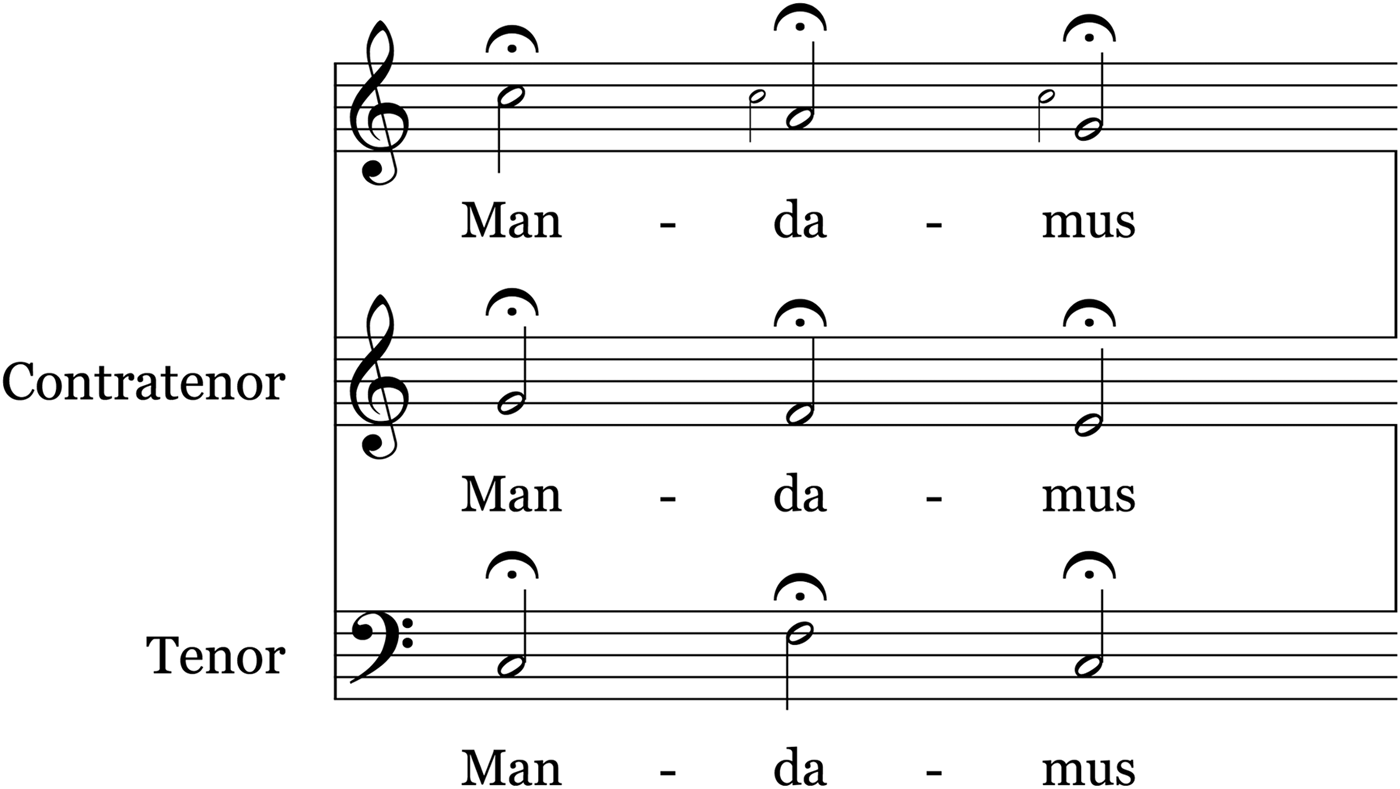
In following the conventions of the law, the arrangement of Du Fay's text resembles, rather than precisely follows, scholastic argument. But, significantly, there is a stark musical contrast between the legal order Mandamus (‘We order’) and those sections of argument articulated by the objector. Du Fay set the authoritative text with breves topped with fermata marks, which have the effect of slowing the harmonic rhythm (Figure 1). The meaning of these fermatae or cantus coronatus (crowned song) is, again, a matter of disagreement among musicologists. Whether we take these marks to signal slow and reverent performance or as a trigger for rhythmically and melodically complex improvisation above sustained chords, the wider point remains clear: the structure of meaning effected by the sonority and fermatae at this point links authority with harmonic and temporal stability (perhaps with emphatic decoration).Footnote 35
Measure 52, Guillaume Du Fay, Iuvenis qui puellam.

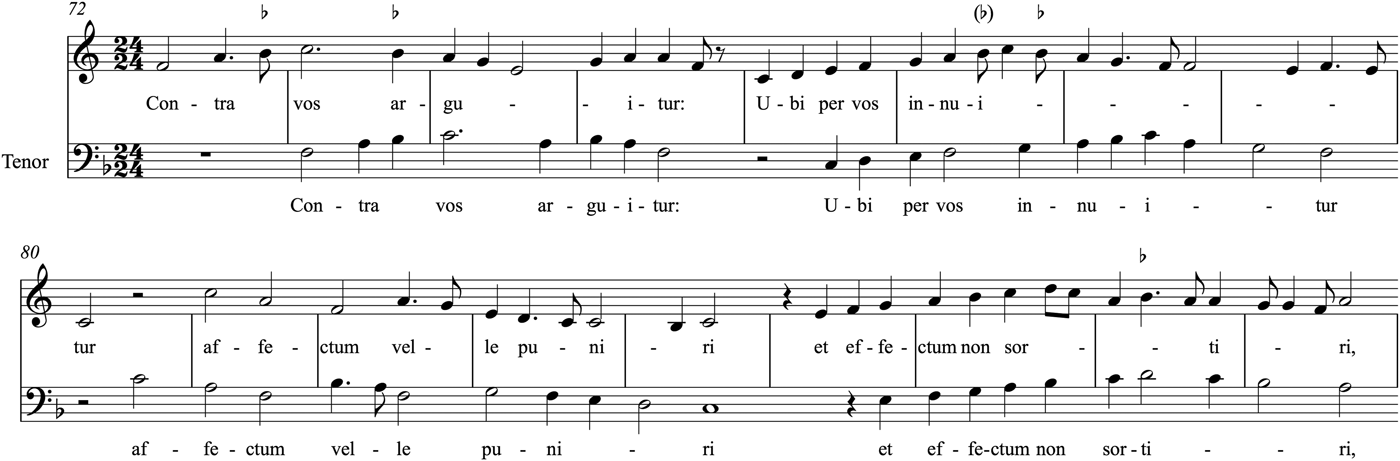
In contrast, the first objection is set to rhythmically intricate and highly imitative polyphony between the upper voice (cantus) and the lower voice (tenor). The listener might notice the academic sophistication (and potential for sophistry) of this dense imitation. As well as having a strong implication of forward motion, created amongst other things by the numerous scalar passages and through their imitation (in modern score, measures 76ff, 85ff), the parts create a highly discursive mode of listening (Figure 2). The ear is drawn, entry by entry, to switch backwards and forwards between the initial statement and its imitation.
Measures 72–88 (Primum argumentum), Guillaume Du Fay, Iuvenis qui puellam.

The appearance of such imitation and its accompanying sense of oscillation mirrors the temporal structure embedded in the typical arrangement of objection and reply in traditional medieval legal and scholastic argumentation. By contrast, those sections in which the harmonic rhythm slows and points of authority are specifically marked resemble forms of textual authority and their direct and emphatic statement at the heart of each question. The fermatae can even be read as analogous to citations within brackets. They not only slow the process of reading, but are also crucial markers of textual authority.
This relationship between musical and verbal structures is underscored by the form of Iuvenis qui puellam’s manuscript. Like almost all fifteenth-century polyphony, the song is notated in parts. Unlike score notation, where imitative parts are synchronised and surveyable at a glance, the separation of parts (for example the cantus and tenor in the first objections) requires forms of composition and transcription which mirror the discursive process of reading scholastic objections and replies. Consonances between voices must be verified and maintained across physical manuscript space, just as argumentative consonance must be maintained across scholastic argument.
The performance of the motet complicates this temporal arrangement, as various areas of the manuscript page are brought together into a single moment. The discursive patterns of listening described above curiously coincide with a synchronisation of musical parts within the flow of time. This is the same kind of temporal process which must occur as a result of scholastic reasoning: arguments made at different times in the process of the argument (objection, reply) must be placed together with the answer to form a coherent sense of the argumentative ‘whole’. This movement between part and whole is a characteristic both of writing and reading scholastic logic, on the one hand, and of singing and listening to fifteenth-century polyphony, on the other.
Similar temporal structures are created by Du Fay's four-voice Missa Ecce ancilla Domini. The mass, written in 1464 in Cambrai, is a cantus firmus mass, based on the plainchants Ecce ancilla Domini (Behold the handmaiden of the Lord) and Beata es Maria (Blessed art thou, Mary).Footnote 36 It was this process of building music around earlier authoritative melodies which led Ambros to associate ‘Netherlandish’ composers like Du Fay with ‘gothic’ scholasticism.
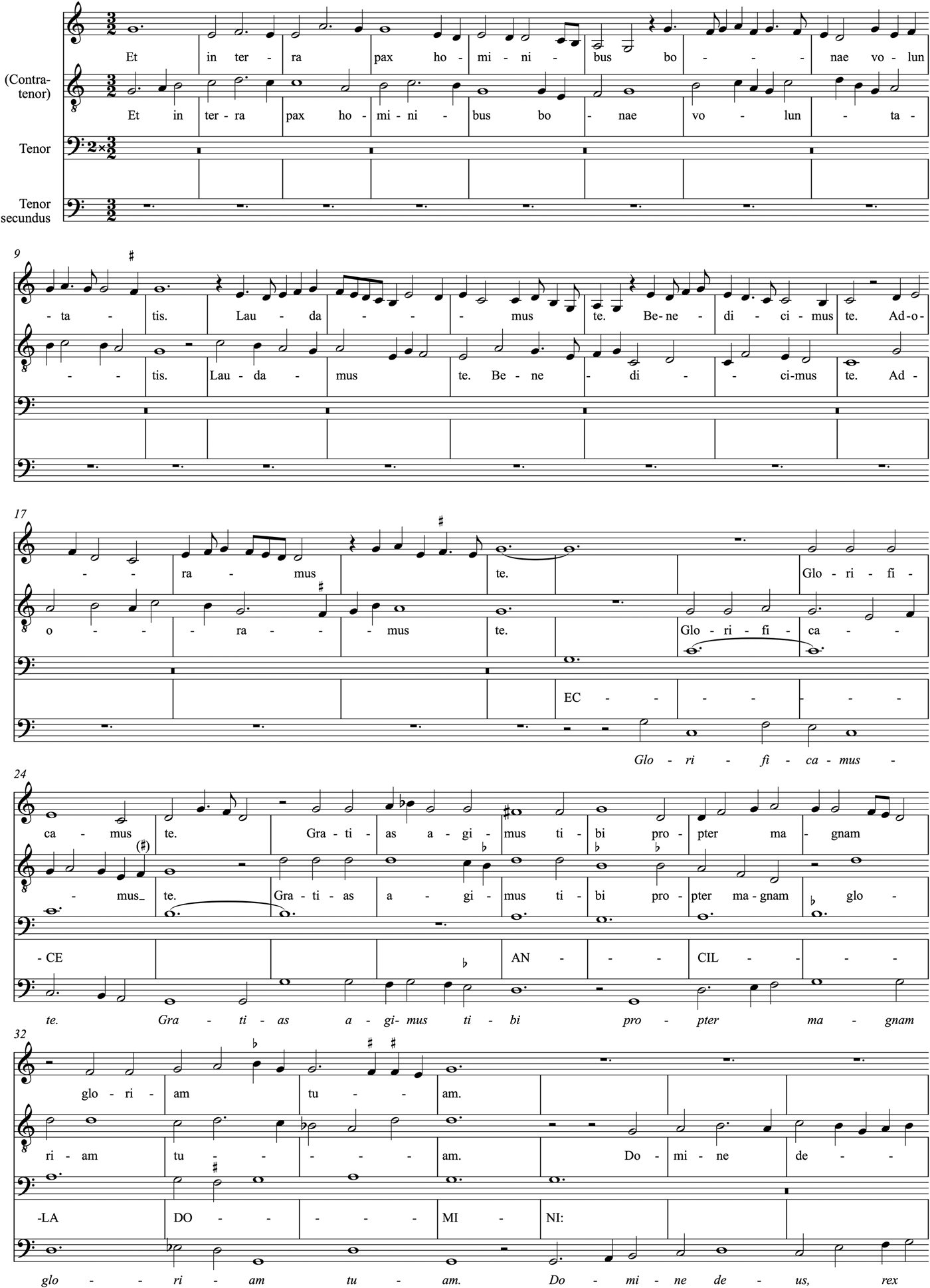
The temporal persistence of chant's authority is embedded in musical works like Ecce ancilla. In the Gloria, for example, temporal persistence or permanence is signalled by the length and slow movement of the first statement of the chant (the cantus firmus). Against an intricate duet between cantus and contra, it enters in the tenor in slow and stable breves (measure 21, Figure 3). This entry is striking. The texture thickens from two to four voices, and rich sonorities contrast starkly with the intricate and discursive movement of the upper parts which precedes and follows. This cantus firmus functions in a way particularly similar to Aquinas's citation of Augustine in the section of the Summa analysed above. The authoritative citation appears near the centre both of the mass's four voices (in the tenor) and of the Summa article (in the sed contra). Its placement within the discursive structures of polyphony mirrors the placement of authoritative proof texts within the Summa’s discursive oscillation between objection and reply.
Measures 1–38, Gloria, Guillaume Du Fay, Missa Ecce ancilla Domini.

The temporalities of reading, listening and citation implied by scholastic argument and by Du Fay's music also resonate with explicit arguments about time propounded within scholasticism and widely accepted in fifteenth-century learned culture. These arguments contrast synchronic and diachronic knowledge. For Aquinas, God's intellective knowledge in eternity encompasses all time, enfolding past, present and future into a single ‘intellective’ glance (Summa contra gentiles 1.66.7).Footnote 37 God's vision of time can be formulated as the relationship between a circle's central point (God's eternity) and its circumference (time). This image resonates strongly with the musical structures of Missa Ecce ancilla. The chant Ecce ancilla sits within the arc of the surrounding counterpoint. This repeated cantus firmus melody provides the points which harmonically define and underpin the diachronic arcs of the surrounding parts.Footnote 38
As opposed to God's eternal intellective knowledge of time, human knowledge for Aquinas is always temporally bound: ‘we see what is future because it is future with respect to our seeing, since our seeing is itself measured by time’ (De veritate 2.12). This means that human thinking always involves ‘a kind of motion, running from one thing to another’ (Summa Theologiae 1.1.79.9; 1.1.58.3). For Aquinas, imperfect human thought involves ‘partial views’ from different moments being resolved into some form of ‘intelligible unity’. Following this logic, we might make the case that the diversity of partial comprehensions of music makes it a human art par excellence. Yet by its modes of representing the comprehension of complex wholes, those ways of comprehending many voices in a single ear-glance (for want of a better word), music might also model ways of ascending from human discursivity, approaching an intellective understanding of the ratios of the created order. The waning of this kind of metaphysical understanding of music and harmony separates much modern musical thought from its classical and medieval forebears, and is a reminder that music is a cultural resource that extends beyond often more limited modern definitions, crossing artificial boundaries of human knowledge and praxis.
The preceding discussion is only one way of approaching a history of time and music. We have suggested resonances between the temporalities of verbal texts and music, set with wider cultural structures of time; we have not properly considered, however, the difficult question of how to interpret – or even identify – conceptual ‘dissonances’ and lack of synchronisation between music and words. What might music tell us about the history of time that differs from that which words can tell us, and how would we articulate and maintain this ‘musical’ knowledge without citing authoritative (because more explicit) verbal texts?Footnote 39 (Ambros's progress-oriented discussion in fact alludes to this problem: he criticised ‘scholastic’ fifteenth-century polyphony for seeming old-fashioned and out-of-synch with the rest of culture, which was in the process of ‘overcoming’ medieval scholasticism.) And we have not touched on the performance contexts of Du Fay's music, its social production, its possible roles in forming and maintaining identity, or its possible functions as (bad) comedy in elite cultures of masculine learning. But this partial analysis nonetheless suggests one way of drawing Du Fay's piece into a wider, intermedial history of tensions between discursivity and synchronicity, dispute and authority, time and eternity in late medieval culture.
III
As numerous scholars have noted, questions of eternity and time are deeply bound up with textual interpretation in the Christian tradition. Central to this tradition are ways of reading the Hebrew scriptures as figural announcements of Christ – his advent, crucifixion, resurrection and ascension.Footnote 40 In this final section, we explore how this tradition functions in relation to the long and intermedial history of the psalm Dixit Dominus (Psalm 109/110). Our hope is that threads from the previous two reflections – vocabularies of affect, hermeneutics of diversity, synchrony and diachrony, eternity and time – might tie into some thoughts on the roles of music and of Jews in this story (bringing us as far as eighteenth-century music and its performances in the present).
In early Christianity, Psalm 110 became a prominent proof text for the claim that Jesus was the prophesied Messiah.Footnote 41 In the words of Augustine's influential interpretation: ‘Our psalm deals with these promises [of the coming of Christ]. It speaks prophetically of our Lord and Savior Jesus Christ with such certainty and clarity that we cannot doubt that it is he who is proclaimed here.’Footnote 42
For Augustine, the psalm's first verse, ‘The Lord said to my Lord: sit at my right hand until I make thine enemies thy footstool,’ unequivocally showed David acknowledging that God the Father (‘the Lord’) had decreed that Jesus (‘my Lord’) should sit at his right hand. Asked who Jesus was, the Jews ‘should have found the answer in the scriptures which they read but did not understand’; ‘[t]hey did not seek after [Jesus] as the Lord, for they did not recognize him as David's descendant’.Footnote 43 This failure justifies Augustine's inclusion of the Jews among Christ's enemies:
Now you reign amid your enemies, Lord: now in this transient age while the centuries roll on, while mortal humanity propagates itself and the generations succeed each other, while the torrent of time (torrens temporum) slips by, now is the scepter of your power sent forth from Zion that you may hold sway in the midst of your enemies. Be Lord of them: be Lord, you son of David who are also David's Lord, be Lord amid pagans, Jews, heretics and false brethren. Have dominion in the midst of your foes.Footnote 44
A particular language of time appears here: time as a torrent. For Augustine, it was this torrent that washes away the Old, allowing the new age of Christian knowledge and social order to emerge. This appearance of the torrent of time foreshadows Augustine's discussion of the psalm's enigmatic final verse, de torrente in via bibet, propterea exaltabit caput (‘He will drink from the torrent beside the way, and therefore he will raise his head’):Footnote 45
Let us also contemplate him drinking from the torrent on his journey. But first, what torrent is this? The cascade of human mortality. A stream is formed by rainwater; it swells, roars, rolls swiftly, and as it surges forward it is running downward to the end of its course. The course of mortal life is like this …
The torrent is the stream of birth and death, and Christ accepted it. He was born and he died; thus he drank from the torrent beside the way, for he leapt up like a giant to run his course with joy (Ps. 19:5). Because he refused to stand still and linger in the way of the sinner (Ps.1:1) he drank from the torrent beside the way, and therefore he will raise his head. Because he humbled himself and was made obedient to the point of death, even death on a cross, God raised him high and gave him a name above every other name, that at the name of Jesus every knee should bow, in heaven, on earth or in the underworld, and every tongue confess that Jesus Christ is Lord, in the glory of God the Father. (Phil. 2:8–11)Footnote 46
Read this way, the final verse of Dixit Dominus becomes the moment both of God's intense temporalisation – his incarnation, passion and death – and an affirmation of his eternity – his exultation, ascension and immortality.
This interpretation was dominant until historicist readings emerged in the nineteenth century. Even before then, its inflections changed – as Augustine himself would have it – according to time, person and place. In thirteenth-century Paris, following the famous arrival of the relic of the crown of thorns, a new liturgy was composed that featured De torrente as a responsory.Footnote 47 Now the exulted head was not Augustine's risen and ascended Christ, but the bloodied head of Christ on the cross, crowned, as another antiphon for the Feast has it, by Jewish men: ‘Drinking of the torrent (De torrente bibens) of misery, the king of glory lifted up his head (exultavit caput), crowned with thorns of agony.’Footnote 48
Christ suffering at Jewish hands became the keynote of the de torrente motif in the later Middle Ages. As others have shown, the psalm episode became attached to increasingly elaborate descriptions of Christ's passion.Footnote 49 There was precedent for this. The Jews’ role in Christ's suffering was explicit in the early commentary of Cassiodorus (c. 485–c. 583), where the psalm's torrent was ‘the turbulent persecution of the Jews, of which the Lord Christ drank on the way’.Footnote 50 The narrative of Jews as Christ-killers was combined with Jerome's reading of the torrent as the brook Cedron over which Christ was led to his crucifixion. This was elaborated in texts and images portraying Christ falling into, or being dragged through, the brook. Here is one account from a fifteenth-century vernacular Dutch version:
And the cursed Jews led Jesus through the valley of Josaphat, and when they came to the bridge over the stream or brook of Cedron, they … dragged Jesus through the water so that the prophesy spoken by David, He shall drink of the brook in the way, would be fulfilled.Footnote 51
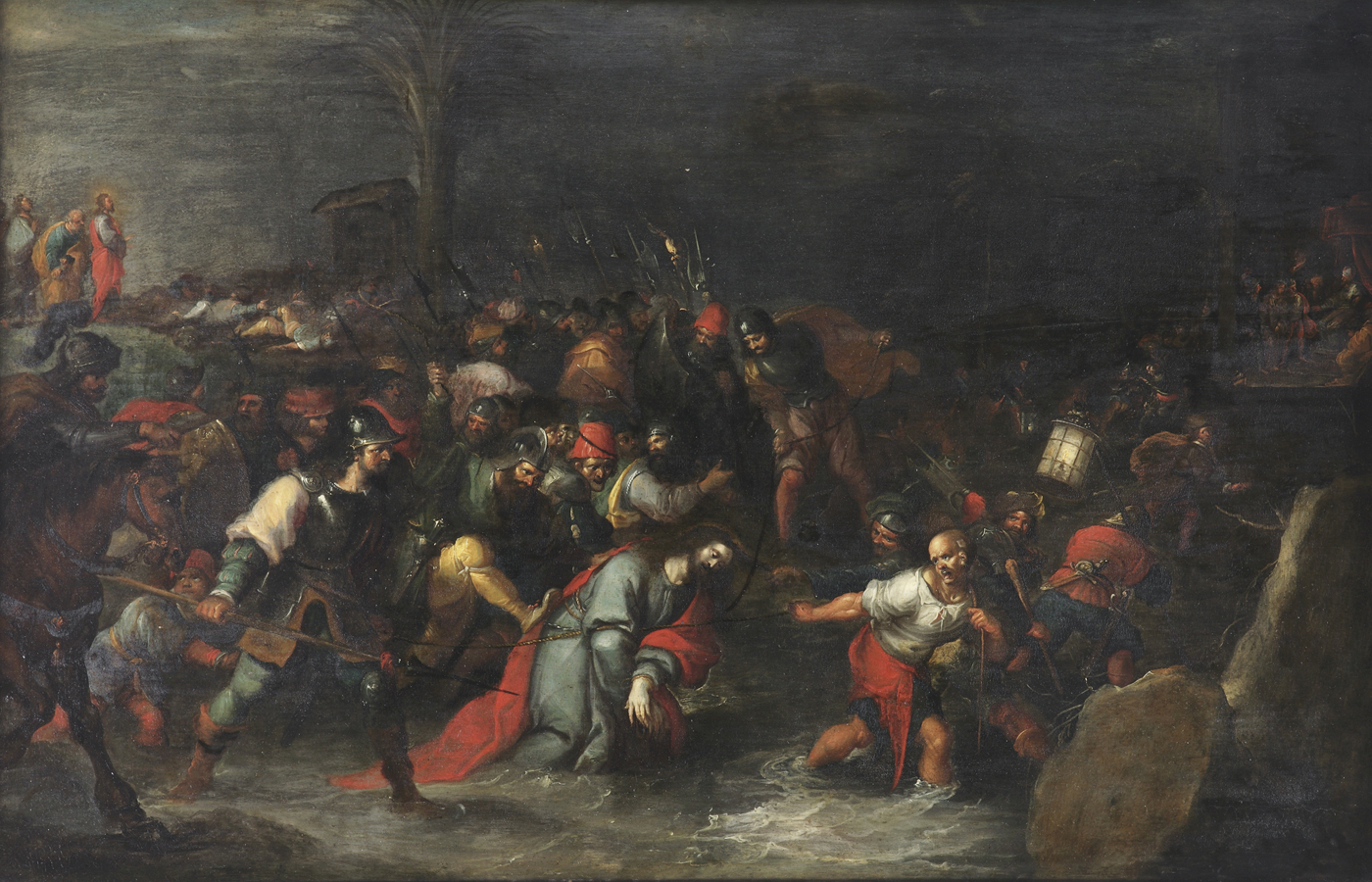
The survival of this trope in the Catholic Low Countries into the seventeenth century is shown in three images by the Antwerp artist Frans Francken II (1581–1642).Footnote 52 Here, Christ's passage through Cedron is framed by the deformed faces of his Jewish and Roman persecutors (Figure 4).Footnote 53 The darkness of this scene amplifies Jerome's early gloss on the meaning of the brook's name – ‘Cedron in the Hebrew tongue means shadows … All who hate the light, love shadows.’Footnote 54
Frans Francken the Younger, Christ being dragged through the brook of Cedron. Private Collection. © Christie's Images/Bridgeman Images.

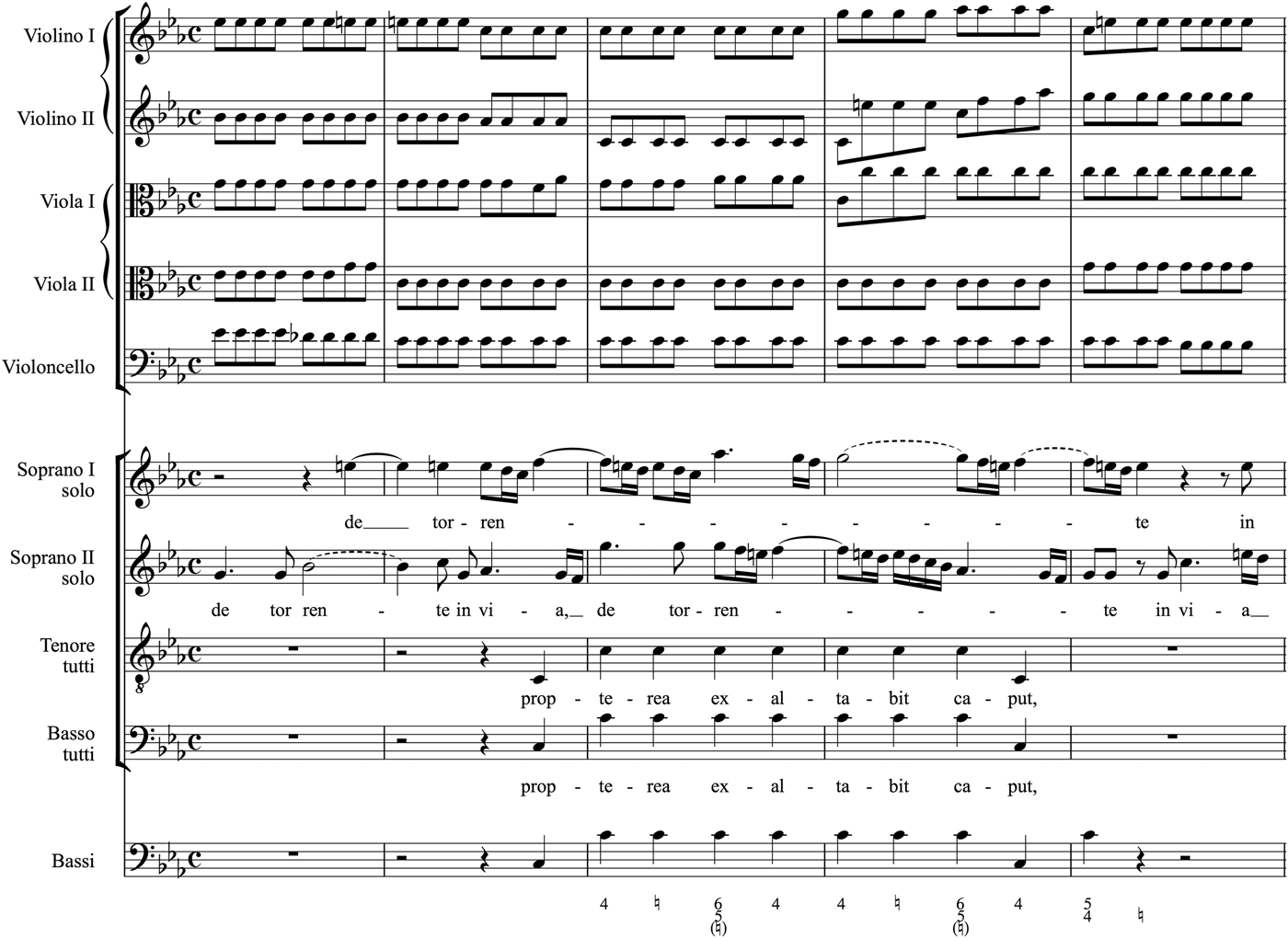
Which brings us to the best-known musical interpretation of De torrente: George Frideric Handel's (1685–1759) setting of Dixit Dominus (1707). Handel's De torrente is an intricate, chromatic and affective duet for two sopranos (Figure 5). The intertwined soprano duet, comprised of plangent suspensions and dissonant leaps, presents the text de torrente in via bibet (‘he will drink from the torrent beside the way’) until almost the movement's close. In the sopranos’ oscillating semiquaver exchanges, we might hear a kind of dialogue. The melismatic duet is punctuated by syllabic, unison interjections from a lower chorus singing propterea exaltabit caput (‘therefore he shall lift up his head’). After the first entry, each choral interjection commences with one octave leap and closes with another.Footnote 55 Apart from these leaps, each phrase sung by the men remains fixed on a single note. By contrast, the soprano duet weaves a plaintive, thorny path to its final resolution.
Measures 12–16, De torrente, George Frideric Handel, Dixit Dominus.

In this description we are, of course, suggesting an interpretation, a reading of Handel's music in relation to the textual tradition of interpreting Psalm 110. This typological tradition helps understand the intense pathos of Handel's setting – something even a listener attuned to eighteenth-century harmonic culture might recognise with puzzlement on a first hearing. (It must be recognised, however, that trained listeners will not be unanimous: John Eliot Gardiner recently noted De torrente’s ‘grinding harmony clashes’, yet summed up its mood as ‘gentle and soothing’.Footnote 56)
We could enrich this interpretation by examining other musical settings of the psalm, or by comparing Handelian instances of word-painting which explicitly portray the Passion, Resurrection, darkness, torrents and so on. Or we could cite early modern commentaries on the psalms from Handel's lifetime: the reading of the psalm text as a prophecy of Christ's suffering and final victory by the Lutheran professor of Hebrew and court preacher Martin Geier (1614–1680);Footnote 57 the commentary of the eminent Catholic theologian Joseph Maria Thomasius (1649–1713), published in Rome in 1697, that draws on Cassiodorus, Jerome and Augustine to speak of the torrent ‘of great and heavy afflictions’ which Christ drank in his sufferings;Footnote 58 or we could turn to the English traditions so relevant to Handel's later career, and find Symon Patrick (1626–1707), the latitudinarian bishop first of Chichester and then of Ely, defending figural interpretations of the psalm against
the Jews [who] have taken a great deal of pains, to wrest this Psalm to another sense; yet they are so divided in their opinions about it, (speaking inconsistent things, like drunken men, as Saint Chrysostom's words are, or rather, says he, like men in the dark, running against one another) that from thence alone we may be satisfied they are in the wrong, and have their eyes blinded.Footnote 59
Alongside interrogating the affective range of the movement, we might also interpret Handel's setting as playing with the long musical tradition in which a cantus firmus might be aligned with a synchronic apprehension of time, and an interwoven imitation might emulate the diachronic, discursive flow of time (time's torrent). The flow of sorrowful time in the upper voices contrasts with the stable male synchrony of the exulted Lordship of Christ over creation. We could work this interpretation into a series of reflections on the gendering of time and creation, the weeping women at the foot of the cross, or the women who weep because they know not where the Lord has been taken – those very women who are comforted in the Gospel by an angelic (and male) voice speaking of Christ's resurrection and freedom from the bonds of mortality.
But we want to return to the untied threads of our discussion, to consider other historical ways of hearing Handel's music. It is possible that Dixit Dominus was first performed within an elaborate liturgy for the Feast of Our Lady of Mount Carmel for Rome's Carmelite church, S. Maria di Montesanto, in 1707.Footnote 60 These feasts became a remarkable spectacle in early eighteenth-century Rome, with illuminations, fireworks, elaborate newly commissioned music for orchestral and choral forces, and large crowds of spectators and participants. A learned Carmelite, or visiting cleric, might indeed have perceived in this music something of the arcs of interpretation we have traced here.
Beyond this possibility, how did the work's liturgical placement frame its reception as sacred object, as entertainment, or object of incomprehension? Would the music be the same for a devout Catholic spectator as for, say, a curious Protestant attracted by the immense scenery erected on the processional via leading to the church?Footnote 61 One such Protestant visitor to the Carmelite festivities was Prince Anton Ulrich of Saxe-Meiningen. He noted in his diary the ‘lovely music’ directed by ‘the German Handel from Halle’, but was seemingly less concerned with devotion to Our Lady of Mount Carmel – whose church he records as ‘la Madonna dell Clementini’, before correcting this to ‘Carmi’ – than with seeing and being seen (‘Cardinal Ottoboni himself spoke to me as he passed by’; ‘I spoke … with a certain French Marquis’).Footnote 62 Or how might Handel have heard his own music, or his music have been heard by a fellow composer? Would perceptions have changed with the memory of previous liturgies with different settings of Dixit Dominus; might there be some element of ‘emulation, competition, and homage’ in operation?Footnote 63 What roles did the power of Handel's music play in exalting the Carmelite Order, or constructing the power of the festival's patron, Cardinal Colonna, and his family? Could a listener possibly be transported to a vision of Christ's passion, seeing the bleeding crown of thorns and a crowd of persecuting Jews? Or, indeed, might one hear Handel's work as the violent appropriation of a Jewish psalm in the service of the false cult of a false Messiah? Might an equally historicised account imagine the work's vigorous energy and ‘sublimity’ overwhelming a visiting music lover – anticipating the response to Dixit Dominus of a later Jewish and Christian reader of the work, Felix Mendelssohn?Footnote 64 How is the gendered interpretation of the psalm altered if we recall that the soprano parts would have been sung by castrati in Rome?Footnote 65 We are returned to the question of diversitas. Handel's Dixit is part of time, of space, of people, and its ‘is-ness’ is therefore full of diverse receptions and constructions of meaning, embedded in a rich historical sediment, in the limitations and possibilities of this musical setting as it was and is appropriated, re-inscribed, re-performed and re-heard according to a variety of times, places and persons.
An emphasis on diversity does not lend itself to a simple summary of the difficulties and gains of incorporating music into historical practice. Still, the argument on one level should be clear from the cases sketched here: histories of sweetness should consider sweet sonorities; histories of temporality should include compositional techniques; histories of liturgy, biblical interpretation, and of anti-Jewish thought, should be alert to musical word-painting, as well as to musical perception and unperceptiveness; histories of emotion should incorporate musical genres and discourses of diverse kinds.Footnote 66 Sonic sources belong in general historical practice, just as we increasingly accept as the case for visual sources. (Indeed, one fertile direction for methodology is to consider the parallel between ‘high’ art/visual culture and ‘classical’ music/sonic culture.) This is true despite the need for particular kinds of expertise, and despite music's ability to generate a tide of methodological and interpretive questions. Why? Not least because these questions also make music a model among our sources. Take the plunge into the torrent: this is musicalised history – to realise that musical sounds, musical works, musical texts and images, exist in their genesis and performances, in their receptions and interpretations, and that these ephemeral presences can both be touched and flow out of our reach, even as we attempt to hold them fast.