Introduction
Major depressive disorder (MDD) and bipolar disorder (BD) are major sources of global disability (WHO, 2008). These disorders are usually chronic, characterized by relapsing remitting courses and significant impairment persisting even during periods of remission (Fagiolini et al. Reference Fagiolini, Kupfer, Masalehdan, Scott, Houck and Frank2005; Conradi et al. Reference Conradi, Ormel and de Jonge2011). Despite effective treatments, some patients will not experience symptomatic relief despite several adequate trials of medication and psychotherapy (Rush et al. Reference Rush, Trivedi, Wisniewski, Nierenberg, Stewart, Warden, Niederehe, Thase, Lavori, Lebowitz, McGrath, Rosenbaum, Sackeim, Kupfer, Luther and Fava2006).
The search for novel targets has stimulated interest in the glutamatergic system (Skolnick et al. Reference Skolnick, Layer, Popik, Nowak, Paul and Trullas1996; Sanacora et al. Reference Sanacora, Zarate, Krystal and Manji2008; Skolnick et al. Reference Skolnick, Popik and Trullas2009). Post-mortem characterizations support the notion of dysfunctional glutamatergic signaling in MDD and BD (Knable et al. Reference Knable, Barci, Bartko, Webster and Torrey2002; Sequeira et al. Reference Sequeira, Mamdani, Ernst, Vawter, Bunney, Lebel, Rehal, Klempan, Gratton, Benkelfat, Rouleau, Mechawar and Turecki2009; Deschwanden et al. Reference Deschwanden, Karolewicz, Feyissa, Treyer, Ametamey, Johayem, Burger, Auberson, Sovago, Stockmeier, Buck and Hasler2011). Indeed, there is evidence for the efficacy of agents that directly target glutamatergic system such as lamotrigine (Geddes et al. Reference Geddes, Calabrese and Goodwin2009) in bipolar depression and riluzole in major depression (Zarate et al. Reference Zarate, Payne, Quiroz, Sporn, Denicoff, Luckenbaugh, Charney and Manji2004). Moreover, animal data suggests that antagonism of N-methyl-d-aspartate (NMDA) receptors, an ionotropic subpopulation of glutamate receptors, is associated with antidepressant effects (Trullas & Skolnick, Reference Trullas and Skolnick1990; Przegalinski et al. Reference Przegalinski, Tatarczynska, Deren-Wesolek and Chojnacka-Wojcik1997).
Ketamine is an NMDA receptor antagonist that has been the focus of significant clinical, research, and media interest. Since the initial report by Berman et al. (Reference Berman, Cappiello, Anand, Oren, Heninger, Charney and Krystal2000) that ketamine produces a rapid and marked antidepressant effect, there have been several efforts to replicate and extend this finding (aan het Rot et al. 2012). Indeed, there have been several trials in both MDD and BD, yet this literature is disparate, predominantly characterized by small sample sizes and has involved several methodological variations.
The purpose of our systematic review and meta-analysis of randomized, double-blind, placebo-controlled trials was to assess the efficacy of ketamine in the treatment of major depressive episodes. In order to maximize the clinical relevance of our findings, we focused on clinical remission and response, but we also examined changes in clinician-rated depression scores to allow meaningful comparison of the efficacy in MDD and BD.
Methodology of the literature review
Search strategy
We identified articles for inclusion in this meta-analysis by:
Searching Medline, EMBASE, PsycINFO, and the Cochrane Central Register of Controlled Trials (CENTRAL) until 14 January 2014, and reviewing the bibliography of retained studies for additional unidentified studies. The search procedures are described in detail in the Supplementary online material.
Study selection
Studies were included if they satisfied all of the following criteria (Higgins & Green, Reference Higgins and Green2008):
• Study validity: Random allocation; allocation concealment; double-blind; placebo-controlled; parallel or cross-over design; ⩾5 subjects per study arm; clinician-rated primary outcome measure.
• Sample characteristics: Subjects aged 18–75 years with a diagnosis of primary major depressive episode (unipolar or bipolar) according to DSM-IV (APA, 1994) or ICD (WHO, 1992) criteria.
• Treatment characteristics: Treatment with ketamine as a single administration (oral, intranasal or parenteral).
• Publication-related: Written in English.
Exclusion criteria:
• ‘Narrow’ diagnoses (e.g. postpartum depression) or secondary depression (e.g. vascular depression).
• Absence of response and/or remission rates.
• Ketamine as an ECT adjunct.
In cases where potentially eligible studies were missing key data, their corresponding authors were contacted by e-mail. All cross-over trial corresponding authors were contacted in order to obtain data relating to the first arm of the study.
Data extraction
Data were recorded by two independent observers with subsequent review and consensus in a structured fashion as follows:
Sample characteristics: Mean age, sex, and primary diagnosis.
Ketamine related: Route, dose, duration of infusion, and frequency.
Control condition: Substance, route, dose, duration and frequency.
Primary outcome measure: Clinical remission, defined as a Hamilton Depression Rating Scale (HAMD; Hamilton, Reference Hamilton1960) score of <7 or a Montgomery–Asberg Depression Rating Scale (MADRS; Montgomery & Asberg, Reference Montgomery and Asberg1979) score of <10. Clinical response, defined as a ⩾50% reduction in post-treatment clinician-rated depression scores.
Secondary outcome measures: Depressive symptoms as assessed by clinician-rated depression instruments (i.e. HAMD or MADRS). Psychotomimetic and dissociative symptoms as measured by the Brief Psychiatric Rating Scale (BPRS; Overall & Gorham, Reference Overall and Gorham1962) and the Clinician Administered Dissociative States Scale (CADSS; Bremner et al. Reference Bremner, Krystal, Putnam, Southwick, Marmar, Charney and Mazure1998).
Acceptability of Treatment: Adverse events and dropout rates.
Data synthesis and analyses
Analyses were performed using Comprehensive Meta-Analyses Version 2.0 (Biostat, USA).
Given that true treatment effects likely vary between studies given methodological differences, we used a random-effects model (Riley et al. Reference Riley, Higgins and Deeks2011). Analyses were restricted to intention-to-treat data (Fergusson et al. Reference Fergusson, Aaron, Guyatt and Hebert2002). The efficacy of ketamine was investigated by odds ratios (ORs) (Deeks, Reference Deeks2002), number needed to treat (NNT), and standardized mean differences (SMD). With respect to SMDs, we followed the recommendation by Rosenthal (Reference Rosenthal1993) and assumed a conservative estimation of r = 0.7. Subgroup analyses were conducted to determine the potential impact of primary diagnosis (MDD v. BD) and placebo condition (saline v. midazolam) on effect-size estimates.
Heterogeneity was assessed using Q statistics and I 2 (Cooper et al. Reference Cooper, Hedges and Valentine2009) and two-tailed p values reported. Values of p < 0.1 for the former and >35% for the latter were deemed as indicative of study heterogeneity (Borenstein et al. Reference Borenstein, Hedges, Higgins and Rothstein2009). Finally, we used funnel plots, Rosenthal's fail-safe N (Rosenthal, Reference Rosenthal1979), and Egger's regression intercept (Egger et al. Reference Egger, Davey Smith, Schneider and Minder1997) to test for the presence of publication bias (Borenstein et al. Reference Borenstein, Hedges, Higgins and Rothstein2009; Cooper et al. Reference Cooper, Hedges and Valentine2009).
Results
Literature search
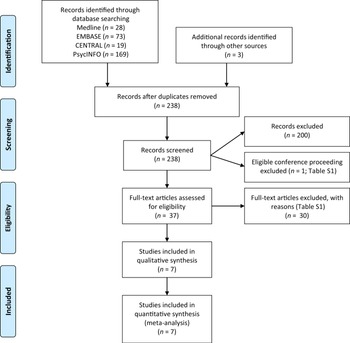
Our literature search is detailed in Fig. 1 and the Supplementary material (Supplementary Figs S1–S4). We identified six double-blind randomized controlled trials (RCTs) (Berman et al. Reference Berman, Cappiello, Anand, Oren, Heninger, Charney and Krystal2000; Zarate et al. Reference Zarate, Singh, Carlson, Brutsche, Ameli, Luckenbaugh, Charney and Manji2006, Reference Zarate, Brutsche, Ibrahim, Franco-Chaves, Diazgranados, Cravchik, Selter, Marquardt, Liberty and Luckenbaugh2012; Diazgranados et al. Reference Diazgranados, Ibrahim, Brutsche, Newberg, Kronstein, Khalife, Kammerer, Quezado, Luckenbaugh, Salvadore, Machado-Vieira, Manji and Zarate2010; Murrough et al. Reference Murrough, Iosifescu, Chang, Al Jurdi, Green, Perez, Iqbal, Pillemer, Foulkes, Shah, Charney and Mathew2013a; Sos et al. Reference Sos, Klirova, Novak, Kohutova, Horacek and Palenicek2013) through our systematic review, all of which met inclusion criteria. An additional double-blind RCT was published during manuscript preparation and included in our analyses (Lapidus et al. Reference Lapidus, Levitch, Perez, Brallier, Parides, Soleimani, Feder, Iosifescu, Charney and Murrough2014). Study quality was assessed using the Cochrane Collaboration's Tool for Assessing Risk of Bias (Higgins et al. Reference Higgins, Altman, Gotzsche, Juni, Moher, Oxman, Savovic, Schulz, Weeks and Sterne2011) (Supplementary Table S2).
Study selection PRISMA flowchart.

A double-blind RCT in a surgical setting was identified, but could not be assessed as it was available in abstract form (Bastos et al. Reference Bastos, Pereira and Pereira2012) and correspondence with the authors did not successfully yield the required information to assure quality or data for analyses.
Included RCTs: main characteristics
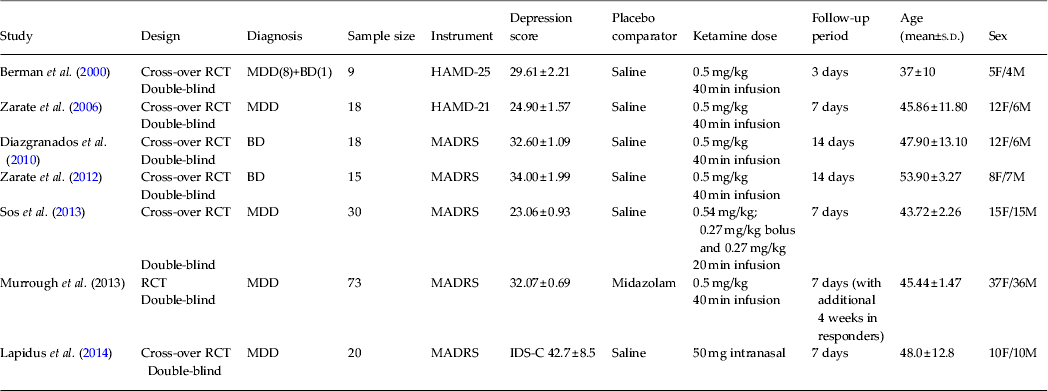
Overall, seven RCTs (Berman et al. Reference Berman, Cappiello, Anand, Oren, Heninger, Charney and Krystal2000; Zarate et al. Reference Zarate, Singh, Carlson, Brutsche, Ameli, Luckenbaugh, Charney and Manji2006, Reference Zarate, Brutsche, Ibrahim, Franco-Chaves, Diazgranados, Cravchik, Selter, Marquardt, Liberty and Luckenbaugh2012; Diazgranados et al. Reference Diazgranados, Ibrahim, Brutsche, Newberg, Kronstein, Khalife, Kammerer, Quezado, Luckenbaugh, Salvadore, Machado-Vieira, Manji and Zarate2010; Murrough et al. Reference Murrough, Iosifescu, Chang, Al Jurdi, Green, Perez, Iqbal, Pillemer, Foulkes, Shah, Charney and Mathew2013a; Sos et al. Reference Sos, Klirova, Novak, Kohutova, Horacek and Palenicek2013; Lapidus et al. Reference Lapidus, Levitch, Perez, Brallier, Parides, Soleimani, Feder, Iosifescu, Charney and Murrough2014) were included in our meta-analysis, totaling 183 subjects with a major depressive episode (n = 34 with BD, n = 149 with MDD; Table 1). Six of the studies were double-blind cross-over RCTs (Berman et al. Reference Berman, Cappiello, Anand, Oren, Heninger, Charney and Krystal2000; Zarate et al. Reference Zarate, Singh, Carlson, Brutsche, Ameli, Luckenbaugh, Charney and Manji2006, Reference Zarate, Brutsche, Ibrahim, Franco-Chaves, Diazgranados, Cravchik, Selter, Marquardt, Liberty and Luckenbaugh2012; Diazgranados et al. Reference Diazgranados, Ibrahim, Brutsche, Newberg, Kronstein, Khalife, Kammerer, Quezado, Luckenbaugh, Salvadore, Machado-Vieira, Manji and Zarate2010; Sos et al. Reference Sos, Klirova, Novak, Kohutova, Horacek and Palenicek2013; Lapidus et al. Reference Lapidus, Levitch, Perez, Brallier, Parides, Soleimani, Feder, Iosifescu, Charney and Murrough2014) (n = 110), while one was a parallel arm RCT (Murrough et al. Reference Murrough, Iosifescu, Chang, Al Jurdi, Green, Perez, Iqbal, Pillemer, Foulkes, Shah, Charney and Mathew2013a) (n = 73). When our efforts to obtain data relating to the initial arm of cross-over studies were unsuccessful, remission and response rates as presented in the published manuscripts were analyzed. Only one study had a mixed MDD and BD sample (MDD, n = 8; BD, n = 1) (Berman et al. Reference Berman, Cappiello, Anand, Oren, Heninger, Charney and Krystal2000) and was pooled with MDD studies in analyses.
Characteristics of included studies

RCT, Randomized controlled trial; MDD, major depressive disorder; BD, bipolar disorder; HAMD, Hamilton Depression Rating Scale; MADRS, Montgomery–Asberg Depression Rating Scale; IDS-C, Inventory of Depressive Symptoms – Clinician rated; F, Female; M, Male.
Ketamine was administered intravenously in all but one study, which employed intranasal ketamine at a dose of 50 mg (Lapidus et al. Reference Lapidus, Levitch, Perez, Brallier, Parides, Soleimani, Feder, Iosifescu, Charney and Murrough2014). Intravenous infusion protocols most commonly used 0.5 mg/kg over 40 min (Berman et al. Reference Berman, Cappiello, Anand, Oren, Heninger, Charney and Krystal2000; Zarate et al. Reference Zarate, Singh, Carlson, Brutsche, Ameli, Luckenbaugh, Charney and Manji2006, Reference Zarate, Brutsche, Ibrahim, Franco-Chaves, Diazgranados, Cravchik, Selter, Marquardt, Liberty and Luckenbaugh2012; Diazgranados et al. Reference Diazgranados, Ibrahim, Brutsche, Newberg, Kronstein, Khalife, Kammerer, Quezado, Luckenbaugh, Salvadore, Machado-Vieira, Manji and Zarate2010; Murrough et al. Reference Murrough, Iosifescu, Chang, Al Jurdi, Green, Perez, Iqbal, Pillemer, Foulkes, Shah, Charney and Mathew2013a). One study involved an intravenous bolus of 0.27 mg/kg and an additional 0.27 mg/kg infused over 20 min (Sos et al. Reference Sos, Klirova, Novak, Kohutova, Horacek and Palenicek2013).
Five of the studies used a saline infusion as a placebo condition (Berman et al. Reference Berman, Cappiello, Anand, Oren, Heninger, Charney and Krystal2000; Zarate et al. Reference Zarate, Singh, Carlson, Brutsche, Ameli, Luckenbaugh, Charney and Manji2006, Reference Zarate, Brutsche, Ibrahim, Franco-Chaves, Diazgranados, Cravchik, Selter, Marquardt, Liberty and Luckenbaugh2012; Diazgranados et al. Reference Diazgranados, Ibrahim, Brutsche, Newberg, Kronstein, Khalife, Kammerer, Quezado, Luckenbaugh, Salvadore, Machado-Vieira, Manji and Zarate2010; Sos et al. Reference Sos, Klirova, Novak, Kohutova, Horacek and Palenicek2013), while one used midazolam (0.045 mg/kg) (Murrough et al. Reference Murrough, Iosifescu, Chang, Al Jurdi, Green, Perez, Iqbal, Pillemer, Foulkes, Shah, Charney and Mathew2013a). Saline was employed as an intranasal placebo (Lapidus et al. Reference Lapidus, Levitch, Perez, Brallier, Parides, Soleimani, Feder, Iosifescu, Charney and Murrough2014).
Participants’ mean age was 46.5 (s.d. = 12.3) years, with 84 males and 99 females. Primary outcome measures were as follows: one study (Zarate et al. Reference Zarate, Singh, Carlson, Brutsche, Ameli, Luckenbaugh, Charney and Manji2006) utilized the 21-item HAMD, one study used the 25-item HAMD (Berman et al. Reference Berman, Cappiello, Anand, Oren, Heninger, Charney and Krystal2000), and five studies used the MADRS (Diazgranados et al. Reference Diazgranados, Ibrahim, Brutsche, Newberg, Kronstein, Khalife, Kammerer, Quezado, Luckenbaugh, Salvadore, Machado-Vieira, Manji and Zarate2010; Zarate et al. Reference Zarate, Brutsche, Ibrahim, Franco-Chaves, Diazgranados, Cravchik, Selter, Marquardt, Liberty and Luckenbaugh2012; Murrough et al. Reference Murrough, Iosifescu, Chang, Al Jurdi, Green, Perez, Iqbal, Pillemer, Foulkes, Shah, Charney and Mathew2013a; Sos et al. Reference Sos, Klirova, Novak, Kohutova, Horacek and Palenicek2013; Lapidus et al. Reference Lapidus, Levitch, Perez, Brallier, Parides, Soleimani, Feder, Iosifescu, Charney and Murrough2014). Baseline mean scores are presented in Table 1.
In three studies (Berman et al. Reference Berman, Cappiello, Anand, Oren, Heninger, Charney and Krystal2000; Zarate et al. Reference Zarate, Singh, Carlson, Brutsche, Ameli, Luckenbaugh, Charney and Manji2006; Murrough et al. Reference Murrough, Iosifescu, Chang, Al Jurdi, Green, Perez, Iqbal, Pillemer, Foulkes, Shah, Charney and Mathew2013a) involving MDD patients, patients were medication free after a washout period that ranged from 1–4 weeks, and in the remaining study involving MDD patients, patients maintained a stable pharmacological regimen for 4 weeks prior to entering the study (Sos et al. Reference Sos, Klirova, Novak, Kohutova, Horacek and Palenicek2013). One study required stable medication for an unknown time period prior to entering and then during the study (Lapidus et al. Reference Lapidus, Levitch, Perez, Brallier, Parides, Soleimani, Feder, Iosifescu, Charney and Murrough2014). Both studies in BD involved concomitant lithium or valproate (Diazgranados et al. Reference Diazgranados, Ibrahim, Brutsche, Newberg, Kronstein, Khalife, Kammerer, Quezado, Luckenbaugh, Salvadore, Machado-Vieira, Manji and Zarate2010; Zarate et al. Reference Zarate, Brutsche, Ibrahim, Franco-Chaves, Diazgranados, Cravchik, Selter, Marquardt, Liberty and Luckenbaugh2012).
Remission and response rates
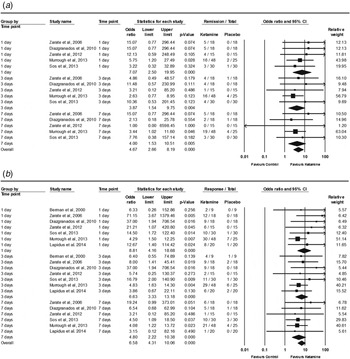
Rates of clinical remission were available for five RCTs (Zarate et al. Reference Zarate, Singh, Carlson, Brutsche, Ameli, Luckenbaugh, Charney and Manji2006, Reference Zarate, Brutsche, Ibrahim, Franco-Chaves, Diazgranados, Cravchik, Selter, Marquardt, Liberty and Luckenbaugh2012; Diazgranados et al. Reference Diazgranados, Ibrahim, Brutsche, Newberg, Kronstein, Khalife, Kammerer, Quezado, Luckenbaugh, Salvadore, Machado-Vieira, Manji and Zarate2010; Murrough et al. Reference Murrough, Iosifescu, Chang, Al Jurdi, Green, Perez, Iqbal, Pillemer, Foulkes, Shah, Charney and Mathew2013a; Sos et al. Reference Sos, Klirova, Novak, Kohutova, Horacek and Palenicek2013) while response rates were available for all seven RCTs (Berman et al. Reference Berman, Cappiello, Anand, Oren, Heninger, Charney and Krystal2000; Zarate et al. Reference Zarate, Singh, Carlson, Brutsche, Ameli, Luckenbaugh, Charney and Manji2006, Reference Zarate, Brutsche, Ibrahim, Franco-Chaves, Diazgranados, Cravchik, Selter, Marquardt, Liberty and Luckenbaugh2012; Diazgranados et al. Reference Diazgranados, Ibrahim, Brutsche, Newberg, Kronstein, Khalife, Kammerer, Quezado, Luckenbaugh, Salvadore, Machado-Vieira, Manji and Zarate2010; Murrough et al. Reference Murrough, Iosifescu, Chang, Al Jurdi, Green, Perez, Iqbal, Pillemer, Foulkes, Shah, Charney and Mathew2013a; Sos et al. Reference Sos, Klirova, Novak, Kohutova, Horacek and Palenicek2013; Lapidus et al. Reference Lapidus, Levitch, Perez, Brallier, Parides, Soleimani, Feder, Iosifescu, Charney and Murrough2014). Analyses are presented at 24 h, 3 days (Sos et al. Reference Sos, Klirova, Novak, Kohutova, Horacek and Palenicek2013 – 4 days), and 7 days post-infusion (Fig. 2a, b).
Meta-analysis of (a) rates of clinical remission and (b) rates of clinical response for ketamine v. placebo in major depression.

After 24 h, the pooled OR was 7.06 (95% CI 2.50–19.95, z = 3.69, p < 0.001) for clinical remission and 9.10 (95% CI 4.28–19.34, z = 5.74, p < 0.001) for clinical response, indicating a significant difference in outcome favoring ketamine. This translated into NNTs = 5 with respect to clinical remission and NNTs = 3 with respect to clinical response. There was no evidence of heterogeneity in clinical remission (Q = 0.25, df = 1, p = 0.61) or response (Q = 1.27, df = 1, p = 0.25) between MDD and BD samples.
After 3 days, the pooled OR was 3.86 (95% CI 1.53–9.74, z = 2.87, p < 0.01) for clinical remission and 6.77 (95% CI 3.40–13.50, z = 5.44, p < 0.001) for clinical response, indicating a significant difference in outcome favoring ketamine. This translated into NNTs = 6 for clinical remission and NNTs = 3 for clinical response. There was no evidence of heterogeneity with respect to clinical remission (Q = 0.36, df = 1, p = 0.54) or response (Q = 0.62, df = 1, p = 0.42) between MDD and BD samples.
After 7 days, the pooled OR was 4.00 (95% CI 1.52–10.51, z = 2.81, p < 0.01) for clinical remission and 4.87 (95% CI 2.24–10.55, z = 4.01, p < 0.001) for clinical response, indicating a significant difference in outcome favoring ketamine. This translated into NNTs = 6 for clinical remission and NNTs = 5 for clinical response. There was no evidence of heterogeneity with respect to clinical remission (Q = 0.30, df = 1, p = 0.58) or response (Q = 0.00, df = 1, p = 0.94) between MDD and BD samples.
Cross-over studies and control interventions
Saline as a placebo was compared to midazolam to assess the influence of the placebo condition.
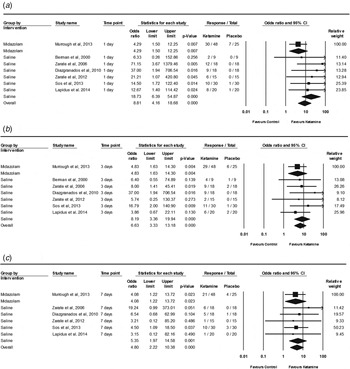
After 24 h (Fig. 3a), no difference was noted between saline and midazolam with respect to clinical remission (Q = 0.56, df = 1, p = 0.45); however, a trend towards lower response in midazolam-placebo conditions was observed for clinical response (Q = 3.39, df = 1, p = 0.06) with sensitivity analyses limited to studies employing intravenous administration showing a significant difference (Q = 4.06, df = 1, p < 0.05). Nevertheless, ketamine was superior to both midazolam (OR 4.53, 95% CI 1.57–12.05, z = 2.80, p ⩽ 0.01, NNT = 3) and saline placebo conditions (OR 18.73, 95% CI 6.39–54.87, z = 5.34, p ⩽ 0.001, NNT = 3). However, at 3 and 7 days (Fig. 3b, c) a significant difference was no longer observed (Q ⩽ 0.43, p ⩽ 0.51), nor when performing sensitivity analyses limited to trials utilizing intravenous ketamine (Q ⩽ 0.96, p ⩾ 0.33).
Subgroup analyses of ketamine in cross-over v. parallel arm designs and saline placebo v. psychoactive placebo. (a) 24 h, (b) 3 days, (c) 7 days.

Depression scores
Data relating to continuous scores for outcome measures were available at 24 h for all seven RCTs.
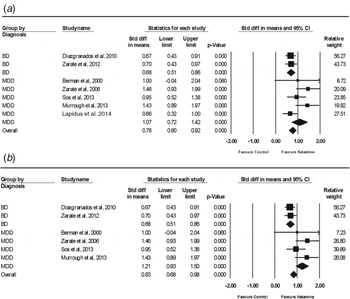
Overall, a SMD of 0.90 (95% CI 0.66–1.13, z = 7.59, p ⩽ 0.001) was observed, indicating a significant difference in outcome favoring ketamine (Fig. 4). Comparison of MDD and BD samples revealed a marginally significant difference favoring MDD (MDD = 1.07, 95% CI 0.72–1.42 v. BD = 0.68, 95% CI 0.50–0.86; Q = 3.73, p = 0.053; Fig. 4a), and sensitivity analyses limited to intravenous ketamine demonstrated a strong significant difference in outcome favoring MDD. Specifically, MDD was associated with a SMD of 1.21 (95% CI 0.93–1.49, z = 8.47, p ⩽ 0.001) while BD was associated with a SMD of 0.68 (95% CI 0.50–0.86, z = 7.54, p ⩽ 0.001, Q = 9.81, df = 1, p ⩽ 0.01; Fig. 4b).
(a) Standardized mean difference in depression scores at 24 h and subgroup analysis of ketamine in bipolar v. unipolar depression and (b) sensitivity analysis limited to intravenous administration studies.

Potential carry-over in cross-over studies
To address the possibility of cross-over effects, we were able to obtain data from the first arm of the majority of cross-over design studies (N = 81, Zarate et al. Reference Zarate, Singh, Carlson, Brutsche, Ameli, Luckenbaugh, Charney and Manji2006, Reference Zarate, Brutsche, Ibrahim, Franco-Chaves, Diazgranados, Cravchik, Selter, Marquardt, Liberty and Luckenbaugh2012; Diazgranados et al. Reference Diazgranados, Ibrahim, Brutsche, Newberg, Kronstein, Khalife, Kammerer, Quezado, Luckenbaugh, Salvadore, Machado-Vieira, Manji and Zarate2010; Sos et al. Reference Sos, Klirova, Novak, Kohutova, Horacek and Palenicek2013). Pooled effects were calculated including the parallel study (Murrough et al. Reference Murrough, Iosifescu, Chang, Al Jurdi, Green, Perez, Iqbal, Pillemer, Foulkes, Shah, Charney and Mathew2013a). With respect to response rates, at 24 h there was a significant benefit for ketamine (OR 6.18, 95% CI 2.61–14.62, p < 0.001, NNT = 3), with similar benefit at 3 days (OR 6.30, 95% CI 2.56–15.52, p < 0.001, NNT = 3) and 7 days (OR 5.53, 95% CI 1.98–15.41, p < 0.001, NNT = 4).
When considering depression scores for first arm and parallel design studies, there was evidence of a significant benefit in favor of ketamine (SMD = 1.53, 95% CI 0.85–2.21, p < 0.001).
Although we were unable to obtain data relating to the first arm of all cross-over studies, null analyses relating to order effects were reported in all cross-over studies for which data pertaining to the first arm was not available. Examining study withdrawal after clinical response as a proxy for this potential limitation revealed that 7/17 (7.7%) patients in ketamine arms and 1/6 (1.1%) patients in placebo arms who withdrew from cross-over studies did so after a clinical response.
Psychotomimetic and dissociative symptoms – blinding efficacy
Blinding efficacy was not reported; however, all studies assessed psychotomimetic symptoms as measured by the BPRS, and therefore this was analyzed as a proxy. In some cases, the study reported the full positive subscale (Zarate et al. Reference Zarate, Singh, Carlson, Brutsche, Ameli, Luckenbaugh, Charney and Manji2006, Reference Zarate, Brutsche, Ibrahim, Franco-Chaves, Diazgranados, Cravchik, Selter, Marquardt, Liberty and Luckenbaugh2012; Diazgranados et al. Reference Diazgranados, Ibrahim, Brutsche, Newberg, Kronstein, Khalife, Kammerer, Quezado, Luckenbaugh, Salvadore, Machado-Vieira, Manji and Zarate2010; Sos et al. Reference Sos, Klirova, Novak, Kohutova, Horacek and Palenicek2013) while three studies reported a reduced item positive BPRS (Berman et al. Reference Berman, Cappiello, Anand, Oren, Heninger, Charney and Krystal2000; Murrough et al. Reference Murrough, Iosifescu, Chang, Al Jurdi, Green, Perez, Iqbal, Pillemer, Foulkes, Shah, Charney and Mathew2013a; Lapidus et al. Reference Lapidus, Levitch, Perez, Brallier, Parides, Soleimani, Feder, Iosifescu, Charney and Murrough2014). Overall, a maximal SMD occurred at 30–60 min post-infusion of 1.43 (95% CI 0.80–2.07, z = 4.45, p < 0.001; Supplementary Fig. S5A) before returning to baseline. There was no evidence of heterogeneity between studies employing the full- and reduced-item BPRS (Q = 0.02, df = 1, p = 87). Three studies reported data with respect to the CADSS, with an overall maximal SMD at 40 min post-infusion of 3.70 (95% CI 1.27–5.91, z = 3.28, p < 0.001; Supplementary Fig. S5B).
Adverse events and dropout rates
The majority of studies reported no serious adverse events (Zarate et al. Reference Zarate, Singh, Carlson, Brutsche, Ameli, Luckenbaugh, Charney and Manji2006, Reference Zarate, Brutsche, Ibrahim, Franco-Chaves, Diazgranados, Cravchik, Selter, Marquardt, Liberty and Luckenbaugh2012; Diazgranados et al. Reference Diazgranados, Ibrahim, Brutsche, Newberg, Kronstein, Khalife, Kammerer, Quezado, Luckenbaugh, Salvadore, Machado-Vieira, Manji and Zarate2010; Sos et al. Reference Sos, Klirova, Novak, Kohutova, Horacek and Palenicek2013; Lapidus et al. Reference Lapidus, Levitch, Perez, Brallier, Parides, Soleimani, Feder, Iosifescu, Charney and Murrough2014). One study did not comment on adverse events (Berman et al. Reference Berman, Cappiello, Anand, Oren, Heninger, Charney and Krystal2000). One study reported cardiovascular side-effects in 2/47 patients (n = 1 refractory hypertension, n = 1 hypotension and bradycardia) who received ketamine and no such side-effects among control patients (Murrough et al. Reference Murrough, Iosifescu, Chang, Al Jurdi, Green, Perez, Iqbal, Pillemer, Foulkes, Shah, Charney and Mathew2013a).
The only recorded induction of mania/hypomania occurred in a patient with BD who was receiving saline placebo infusion (Diazgranados et al. Reference Diazgranados, Ibrahim, Brutsche, Newberg, Kronstein, Khalife, Kammerer, Quezado, Luckenbaugh, Salvadore, Machado-Vieira, Manji and Zarate2010). No severe psychotic symptoms occurred in any patient.
Study completion and drop-out rates were used as a proxy for tolerability. Of the 158 patients who were to receive ketamine, 21 (13.3%) dropped out (in cross-over studies, they dropped out of the arm they had just received), compared to 10/135 (7.4%) of patients who were to receive control interventions (OR 1.95, 95% CI 0.86–4.42, z = 1.59, p = 0.11).
Publication bias and heterogeneity
With respect to clinical remission, the fail-safe N was 14 at 24 h, 7 at 3 days, and 4 at 7 days. For response rates, the fail-safe N was 59 at 24 h, 47 at 3 days, and 17 at 7 days post-infusion. This suggests that 15–43 unpublished or missing null-finding studies would be needed to render the difference in clinical response statistically non-significant, and 1–11 studies for clinical remission. The risk of publication bias was also assessed with Egger's regression intercept, which for clinical remission was 1.12 (t 3 = 1.49, p = 0.23) at 24 h, 1.06 (t 3 = 2.31, p = 0.10) at 3 days, and 0.20 (t 3 = 0.34, p = 0.75), and for response data was 1.70 (t 5 = 3.37, p ⩽ 0.05) at 24 h, 1.02 (t 5 = 1.56, p = 0.17) at 3 days, and 0.35 (t 4 = 0.67, p = 0.53) at 7 days. Additionally, the associated funnel plots revealed broadly symmetrical distributions (Supplementary Figs S6 and S7), indicating a marginal risk of publication bias.
For continuous data, the fail-safe N was 247, while Egger's regression intercept was 2.72 (t 5 = 2.39, two-tailed p = 0.06) and the funnel plot revealed an asymmetrical distribution (Supplementary Fig. S8). These findings suggest relatively low potential for publication bias.
With respect to continuous data at 24 h, heterogeneity between RCTs exceeded that expected by chance (df = 6, Q = 14.16, p ⩽ 0.05, I 2 = 57.63). Yet, this appeared to be related to the effect of diagnosis and method of ketamine administration, as heterogeneity did not exceed that expected by chance in infusion studies with MDD samples (df = 3, Q = 3.11, p = 0.37, I 2 = 3.78) or BD samples (df = 1, Q = 0.02, p = 0.86, I 2 = 0.0).
Discussion
To our knowledge, this is the first meta-analysis of RCTs to assess whether intravenous ketamine is an efficacious and acceptable treatment in MDD and BD. Our analyses suggest that this NMDA receptor antagonist is superior to placebo interventions and well tolerated, yet is accompanied by transient psychotomimetic and dissociative symptoms. After 24 h, 3 days, and 7 days, we observed significantly higher rates of clinical remission (ORs ⩾ 3.86, NNTs ⩽ 6) and response (ORs ⩾ 4.87, NNTs ⩽ 4) associated with ketamine. Though a psychoactive placebo intervention evidenced a lower pooled OR at 24 h than saline placebo, the difference from saline studies no longer held by 3 days post-intervention. Finally, we found evidence for higher effect sizes in MDD compared to BD (SMD of 1.07 v. 0.68).
We excluded two RCTs from our analyses as they were not double-blind placebo-controlled trials. The first of these involved randomizing MDD patients (n = 70) to ketamine or propofol in a surgical setting (Kudoh et al. Reference Kudoh, Takahira, Katagai and Takazawa2002), and the second involved randomizing MDD patients (n = 18) to repeated ketamine infusions or a similar number of electroconvulsive therapy treatments (Ghasemi et al. Reference Ghasemi, Kazemi, Yoosefi, Ghasemi, Paragomi, Amini and Afzali2013). In support of the generalizability of our findings, these studies revealed a pooled SMD of 1.24 after 24 h (95% CI 0.78–1.70, z = 5.34, p < 0.001) in favor of ketamine.
One critique of the clinical applicability of ketamine trials is the conclusion that treatment response is short-lived. Nevertheless, Murrough et al. (Reference Murrough, Iosifescu, Chang, Al Jurdi, Green, Perez, Iqbal, Pillemer, Foulkes, Shah, Charney and Mathew2013a) present the longest treatment follow-up reported in an RCT to date, in which 9/48 of ketamine-treated patients compared to 0/25 midazolam-treated patients with treatment-refractory MDD demonstrated sustained response 5 weeks after a single infusion.
Nevertheless, early clinical adoption of ketamine as a treatment for depression is likely to occur in areas of medicine undeterred by the potential for early relapse and where the potential for misuse is negligible. Indeed, the palliative field has shown great interest in the potential for the use of ketamine in the management of depressive symptoms at the end of life (Irwin et al. Reference Irwin, Iglewicz, Nelesen, Lo, Carr, Romero and Lloyd2013).
While controlled clinical trials to date have examined the efficacy of single dose of ketamine, few treatments in psychiatry or medicine are deemed sufficient after a single dose. Indeed, given the substantial efficacy of single infusion, research groups are now turning their attention to administering repeated infusions in order to maximize and sustain clinical response. These efforts, while still involving open label designs, suggest that higher and sustained rates of response and remission can be achieved with repeated doses (aan het Rot et al. Reference aan het Rot, Collins, Murrough, Perez, Reich, Charney and Mathew2010; Murrough et al. Reference Murrough, Perez, Pillemer, Stern, Parides, aan het Rot, Collins, Mathew, Charney and Iosifescu2013b; Rasmussen et al. Reference Rasmussen, Lineberry, Galardy, Kung, Lapid, Palmer, Ritter, Schak, Sola, Hanson and Frye2013; Shiroma et al. Reference Shiroma, Johns, Kuskowski, Wels, Thuras, Albott and Lim2014); however, comparison to single dose is still lacking. Similarly, from a clinical standpoint, additional research is required to elucidate appropriate follow-up and maintenance protocols in ketamine, in addition to its role as an adjunct to existing treatments.
Currently, all but one RCT have employed intravenous administration (Lapidus et al. Reference Lapidus, Levitch, Perez, Brallier, Parides, Soleimani, Feder, Iosifescu, Charney and Murrough2014), which is constrained by medical and infrastructure requirements. There is currently open-label evidence to suggest benefit of oral ketamine (Irwin et al. Reference Irwin, Iglewicz, Nelesen, Lo, Carr, Romero and Lloyd2013; Lara et al. Reference Lara, Bisol and Munari2013), including sublingual administration (Lara et al. Reference Lara, Bisol and Munari2013); however, efficacy data is lacking. Oral ketamine, however, has limited bioavailability, and therefore other methods of administration are being investigated, including intramuscular and intranasal routes (Mathew et al. Reference Mathew, Shah, Lapidus, Clark, Jarun, Ostermeyer and Murrough2012; Lapidus et al. Reference Lapidus, Levitch, Perez, Brallier, Parides, Soleimani, Feder, Iosifescu, Charney and Murrough2014).
An additional concern that has been the psychotomimetic side effects experienced during ketamine infusions and the ensuing safety concerns; however, there is some evidence to suggest that such side-effects may be related to ketamine's antidepressant effectiveness (Luckenbaugh et al. Reference Luckenbaugh, Niciu, Ionescu, Nolan, Richards, Brutsche, Guevara and Zarate2014). A growing area of research is the exploration of NMDA antagonists without the psychotomimetic effects of ketamine, and there are already positive trials with such agents [AZD6765 (Sanacora et al. Reference Sanacora, Smith, Pathak, Su, Boeijinga, McCarthy and Quirk2013; Zarate et al. Reference Zarate, Mathews, Ibrahim, Chaves, Marquardt, Ukoh, Jolkovsky, Brutsche, Smith and Luckenbaugh2013)], albeit with a lower level of efficacy.
Ketamine's mechanism of action in depression remains elusive (Murrough, Reference Murrough2012). In clinically depressed samples, peripheral brain-derived neurotrophic factor increases with NMDA antagonism (Haile et al. Reference Haile, Murrough, Iosifescu, Chang, Al Jurdi, Foulkes, Iqbal, Mahoney, De La Garza, Charney, Newton and Mathew2014). Yet, agonism of the NMDA receptors also induces synaptic plasticity, and several trials support the antidepressant effects of NMDA agonists, for example a recent report of oral sarcosine in depressed patients (Huang et al. Reference Huang, Wei, Huang, Chen, Tsai, Tsai, Tun, Huang, Chang, Lane and Tsai2013) and d-cycloserine administered chronically in treatment-resistant depression (Heresco-Levy et al. Reference Heresco-Levy, Gelfin, Bloch, Levin, Edelman, Javitt and Kremer2013). It is likely that NMDA-dependent cellular mechanisms are exquisitely finely tuned, and additional research is needed in order to identify individuals whose major depressive episodes may be improved by NMDA antagonism or agonism.
Limitations
The first limitation is the predominance of small samples and crossover designs. A second limitation is the adequacy of saline placebo, as our analyses clearly demonstrate a marked psychotomimetic effect in ketamine conditions compared to placebo conditions that was least pronounced in the intranasal trial. While efficacy is nevertheless observed using psychoactive placebo such as midazolam, an adequate control for ketamine's psychotomimetic effects has not been evaluated. A third limitation is the limited duration of follow-up, and therefore it is not possible to estimate the long-term benefit or cost-effectiveness. The safety and potential for long-term consequences has not been addressed, and will require additional attention from researchers. To date, all of the placebo-controlled trials have involved single administrations, and therefore the efficacy of repeated administrations is unknown. Further, a minimal effective dose in treating depression has yet to be identified.
A limitation levied against the meta-analytical method is the combination of heterogeneous studies, poor-quality or unrepresentative studies, or the potential of publication bias. While we cannot definitively rule out these influences, we have attempted to temper these by using a comprehensive systematic review of the literature, assessing the quality of studies, and by examining both publication bias and heterogeneity.
Conclusion
Our meta-analysis of RCTs demonstrates that ketamine, whether intravenously or intranasally administered, in the treatment of depression is well tolerated, and associated with rapid and persistent clinical remission (NNTs ⩽ 6) and response (NNTs ⩽ 4) for up to 7 days following a single dose. While effective in both MDD and BD, ketamine appears to be less effective in BD.
Areas requiring additional research and clarification include the specificity of effect to NMDA antagonism, the minimal effective dose and the potential benefit of repeated ketamine infusions, optimizing non-parenteral administration, long-term safety and the identification of other NMDA agents with fewer psychotomimetic effects, reduced potential for abuse, and agents with fewer systemic effects.
Supplementary material
For supplementary material accompanying this paper visit http://dx.doi.org/10.1017/S0033291714001603
Acknowledgements
There were no sources of funding or industry involvement in this systematic review and meta-analysis.
Declaration of Interest
D.J.B. has received speaking fees or sat on advisory boards for: the Canadian Network for Mood and Anxiety Treatments (CANMAT), the Canadian Psychiatric Association, Pfizer, Sunovion, BMS, Otsuka, AstraZeneca, and Janssen-Ortho; and has received research support from: the Canadian Institutes of Health Research (CIHR), the UBC Institute of Mental Health/Coast Capital Depression Research Fund, and Pfizer. L.N.Y. has received research grants from or is on speaker ⁄ advisory boards for AstraZeneca, Bristol–Myers Squibb, Canadian Institutes of Health Research, Canadian Network for Mood and Anxiety Treatments, Eli Lilly & Co., GlaxoSmithKline, Janssen, Michael Smith Foundation for Health Research, Novartis, Pfizer, Ranbaxy, Servier, and the Stanley Foundation. R.W.L. is on ad hoc speaker/advisory boards for, or has received research funds from, AstraZeneca, Biovail, Bristol–Myers Squibb, Canadian Institutes of Health Research, Canadian Network for Mood and Anxiety Treatments, Canadian Psychiatric Association Foundation, Eli Lilly, Litebook Company, Lundbeck, Lundbeck Institute, Mochida, Pfizer, Servier, St Jude Medical, Takeda, and UBC Institute of Mental Health/Coast Capital Savings.