Introduction
The endoparasitoid habit of the larvae, as well as the great diversity of taxa, host use, and oviposition strategies exhibited by tachinid flies characterise them as one of the most diverse and remarkable families among Diptera (Stireman et al. Reference Stireman, O’Hara and Wood2006; O’Hara Reference O’Hara2013; Stireman et al. Reference Stireman, Cerretti, O’Hara, Blaschke and Moulton2019). Members of the tribe Goniini make a clear example of this diversity, due to its unusual habit of depositing microtype eggs that are ingested by their hosts, mostly caterpillars (Bess Reference Bess1936; Ho et al. Reference Ho, Ichiki and Nakamura2011; Nakamura Reference Nakamura2018). The females are attracted to volatile compounds released by host plants in response to the herbivory of caterpillars and oviposit on the leaves near the hosts (Mondor and Roland Reference Mondor and Roland1997; Ichiki et al. Reference Ichiki, Ho, Wajnberg, Kainoh, Tabata and Nakamura2012). The eggs are then ingested and hatch when in contact with the host’s gut digestive fluid (Severin et al. Reference Severin, Severin and Hartung1915; Thompson Reference Thompson1953; Wishart Reference Wishart1956; Kahrer Reference Kahrer1984).
One of the better known genera that employs the microtype-egg reproductive strategy is the New World genus Leschenaultia Robineau-Desvoidy, 1830 (Diptera: Tachinidae) (Mondor and Roland Reference Mondor and Roland1998). Classified in the tribe Goniini (O’Hara and Wood Reference O’Hara and Wood2004), the genus includes 40 valid species distributed from Canada to Argentina (Toma and Guimarães Reference Toma and Guimarães2002; O’Hara et al. Reference O’Hara, Henderson and Wood2019; Toma Reference Toma2019). According to Guimarães (Reference Guimarães1977) and Arnaud (Reference Arnaud1978), specimens of Leschenaultia have been recorded from 32 species of Lepidoptera within the families Erebidae, Lasiocampidae, Noctuidae, Saturniidae, and Sphingidae, mostly from the Nearctic region. Some economically important pests, such as the lasiocampids Malacosoma disstria Hübner and M. californica pluvialis (Dyar) and the erebid Estigmene acrea (Drury) (Stehr and Cook Reference Stehr and Cook1968; Capinera Reference Capinera2001), are naturally attacked by species of Leschenaultia, which has encouraged the study of these flies as potential biological control agents (Iwao and Wellington Reference Iwao and Wellington1970; Jackson et al. Reference Jackson, Bryan, Butler and Patana1970; Witter and Kulman Reference Witter and Kulman1979; Parry Reference Parry1995; Parry et al. 1997, Reference Parry, Herms and Mattson2003; Cobbold et al. Reference Cobbold, Roland and Lewis2009; Nixon and Roland Reference Nixon and Roland2012).
Despite being common in collections, specimens of Leschenaultia are difficult to identify, and the taxonomy of the genus is based mostly on males, using characters of the terminalia, mainly from the cercus and surstylus (Toma and Guimarães Reference Toma and Guimarães2002; Toma Reference Toma2019). In some species, however, the females have been associated with the males (Brooks Reference Brooks1947; Thompson Reference Thompson1963), but they remain unknown for most of the species. Females potentially bear important characters correlated with host use (e.g., egg morphology, antennal sensilla, tarsal sensilla, and terminalia), making them essential to understand better the ecological roles and host associations of the species. Since host records are scarce for most of the species, particularly in the Neotropical region (Guimarães Reference Guimarães1977), characters from females would be useful to infer both host associations and the evolution of host use.
Taxonomic issues of parasitoids and hosts also add complexity to understanding host associations. Changes in classification, possible misidentification of taxa, and new species yet to be described make it difficult for the non-specialist to deal with questions about ecological roles and host use of the species involved. Improvements in biological control studies, for instance, are hampered by the lack of basic knowledge about the agents involved, especially with tachinids (Grenier Reference Grenier1988; Dindo and Grenier Reference Dindo and Grenier2014; Cock et al. Reference Cock, Murphy, Kairo, Thompson, Murphy and Francis2016; Stireman et al. Reference Stireman, Cerretti, O’Hara, Blaschke and Moulton2019).
We record herein a new host for L. bicolor (Macquart), obtained from Halysidota pearsoni Watson (Lepidoptera: Erebidae) in Ouro Preto, Minas Gerais, Brazil. The host record is described, including relevant information about the host and the parasitoid. A comparative diagnosis for the identification of L. bicolor is also provided, illustrating important diagnostic characters for males and females in comparison to other similar species of Leschenaultia. The male terminalia of L. bicolor is redescribed and illustrated, complementing the descriptions by Brooks (Reference Brooks1947) and Toma and Guimarães (Reference Toma and Guimarães2002), and the female terminalia is described and illustrated for the first time. Finally, considering recent changes in the systematics of Leschenaultia and their hosts (Evenhuis et al. Reference Evenhuis, Hara, Pape and Pont2010; Pohl et al. Reference Pohl, Patterson and Pelham2016), the large numbers of host records that have been reported since the most recent catalogues (Guimarães Reference Guimarães1977; Arnaud Reference Arnaud1978), and the potential of species of Leschenaultia as biological control agents, we provide an annotated and up-to-date catalogue of hosts for the genus, including an overview about host use and host association.
Materials and methods
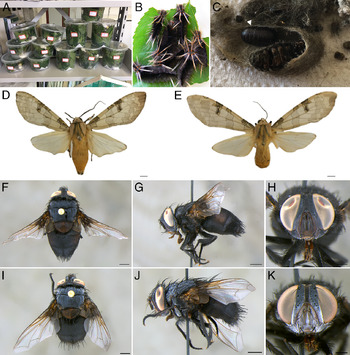
Third-instar larvae of H. pearsoni were collected on 26 November 2017 in the city of São Sebastião de Águas Claras (20.049 S, 43.916 W; 20° 02′ 56.4″ S, 43° 54′ 57.6″ W), Minas Gerais, Brazil, and kept in the Laboratory of Biodiversity in the Universidade Federal de Ouro Preto (20.396 S, 43.509 W; 20° 23′ 45.6″ S, 43° 30′ 32.4″ W), Minas Gerais. These individuals were used to rear two generations of H. pearsoni in the laboratory to study aspects of their life cycle. Larvae of both generations reared in the laboratory were kept in environmental conditions inside one-litre plastic containers with perforated lids for ventilation and fed daily with fresh leaves of Morus sp. (Moraceae) collected on the campus (Fig. 1A), as described by Pereira et al. (Reference Pereira, Zanuncio, Mielke, de Oliveira, Paiva and da Canevari2007). As soon as they reached prepupal and pupal stages (Fig. 1B), the specimens were isolated in plastic vials. When opening the cocoons to take measurements of the pupae of the second generation, we found some puparia and kept them until the emergence of adult flies. We identified the specimens of Leschenaultia using the keys in Toma and Guimarães (Reference Toma and Guimarães2002) and Toma (Reference Toma2019) and by comparing them with the material deposited at the collection of the Museu de Zoologia da Universidade de São Paulo (MZSP), São Paulo, Brazil, where these specimens are also deposited. Specimens included in the “Material examined” section are listed alphabetically according to country, with localities organised from the most inclusive administrative level to the most precise locality. In a similar way, we identified the specimens of Halysidota pearsoni using the key in Watson (Reference Watson1980) and by comparing them with the material deposited at the private collection of Vitor Becker (Coleção Becker), Bahia, Brazil.
Record of Leschenaultia bicolor (Macquart) obtained from Halysidota pearsoni Watson (Erebidae). A, plastic containers used to rear the larvae of H. pearsoni with leaves of Morus sp. (Moraceae); B, sixth-instar larvae (prepupal stage) of H. pearsoni; C, puparium of L. bicolor (white arrow) alongside a dead larva of H. pearsoni; D, male adult of H. pearsoni; E, female adult of H. pearsoni; F–H, male of L. bicolor, showing the dorsal habitus, lateral habitus, and head in frontal view, respectively; I–K, females of L. bicolor, showing the dorsal habitus, lateral habitus, and head in frontal view, respectively. The dented eyes in F–J are an artefact generated when drying specimens fixed in ethanol. Scale bars: 2 mm (D–G and I–J) and 1 mm (H and K).

Morphological terminology follows Cumming and Wood (Reference Cumming and Wood2017). For the study of male and female terminalia, the abdomens were detached from the pinned specimens, placed in a 10% KOH solution, and heated for 10 minutes to soften the membranes and clear the tissues. The terminalia were then dissected and heated for 10 more minutes to lighten the structures. Both terminalia and abdomens were neutralised in a 5% acetic acid solution and rinsed with water. The abdomens were dried and glued back to the specimens, and the terminalia were placed in glycerine in plastic microvials and pinned with their respective specimens. For the female terminalia, the inner segments were gently extended posteriorly using entomological pins and forceps to make all of the segments visible.
Photographs were taken with a Leica MC170 HD digital camera attached to a Leica MZ16 stereomicroscope, using the software Leica Application Suite version 4.12.0 (Leica Microsystems, Wetzlar, Germany). Photographs were stacked with the software Helicon Focus 6.7.1 (HeliconSoft, Ukraine) and edited in Adobe Photoshop Creative Suite 6 (CS6; Adobe, San Jose, California, United States of America). Illustrations of terminalia were made using a Leica MZ16 stereomicroscope with camera lucida and were edited in Adobe Illustrator CS6. Plates were composed in Adobe Photoshop CS6.
We conducted an exhaustive search of the literature in July 2019 to update the records for Leschenaultia using the following set of keywords on Google Scholar (Google, Mountain View, California, United States of America) and Web of Science (Clarivate, Philadelphia, Pennsylvania, United States of America): (Leschenaultia OR tachinid*) AND (host OR caterpillar OR Lepidoptera). Additionally, all the available names for Leschenaultia (Toma and Guimarães Reference Toma and Guimarães2002) were searched on Biodiversity Heritage Library. Only published records were considered, which do not include dissertations and theses. References merely citing previous records were not included in the catalogue, except those already listed by Arnaud (Reference Arnaud1978) for the purpose of clarification of the origin of the record (e.g., Brooks (Reference Brooks1947) lists many records actually made by Schaffner and Griswold (Reference Schaffner and Griswold1934)). Most of the original literature was checked to ensure the accuracy of dates, titles, pagination, names, and localities. Three references could not be accessed; these are identified in the catalogue with an asterisk. The host catalogue follows an adapted format presented by Guimarães (Reference Guimarães1977) and Arnaud (Reference Arnaud1978). Species are listed alphabetically, with valid names accompanied by authorship. The species names of Leschenaultia are in bold, followed by the names of their respective hosts and references with the authors, year, page number, locality, and notes about the record. When necessary, we include, in square brackets, comments and emendations regarding taxonomic nomenclature. The classification used for Leschenaultia follows O’Hara et al. (Reference O’Hara, Henderson and Wood2019); that used for Lepidoptera follows Vincent and Laguerre (Reference Vincent and Laguerre2014) and Pohl et al. (Reference Pohl, Patterson and Pelham2016).
Results and discussion
Record of Leschenaultia bicolor in Halysidota pearsoni
Between 30 May and 7 June 2018, when opening the cocoons of the second generation of H. pearsoni to take measurements of the pupae, we noticed 10 puparia of L. bicolor alongside the pupae of the host, one puparium per specimen (Fig. 1C). After two weeks, only seven adults emerged, consisting of one male and six females (Fig. 1F–K). The specimens were identified as L. bicolor, based on characters of the legs, abdomen, and terminalia of the male, as described and discussed below.
Halysidota pearsoni is bivoltine, with larvae exhibiting gregarious behaviour until the third instar (Pereira et al. Reference Pereira, Zanuncio, Mielke, de Oliveira, Paiva and da Canevari2007) and completing to six or seven instars before pupation (Fig. 1B). According to Watson (Reference Watson1980), adult specimens are distinguished from other species of Halysidota by the darker discocellular and costal markings and the narrower medial fascia on the fore wings (Fig. 1D–E). Distributed throughout the Atlantic Rainforest, H. pearsoni extends to the states of Rio Grande do Sul and Goiás, in Brazil, and to Paraguay (Watson Reference Watson1980). Knowledge about host plants for this species is still scarce, with records only in Gossypium hirsutum Linnaeus (Malvaceae) and Morus alba Linnaeus (Moraceae) (Pereira et al. Reference Pereira, Zanuncio, Mielke, de Oliveira, Paiva and da Canevari2007; Guerra et al. 2009).
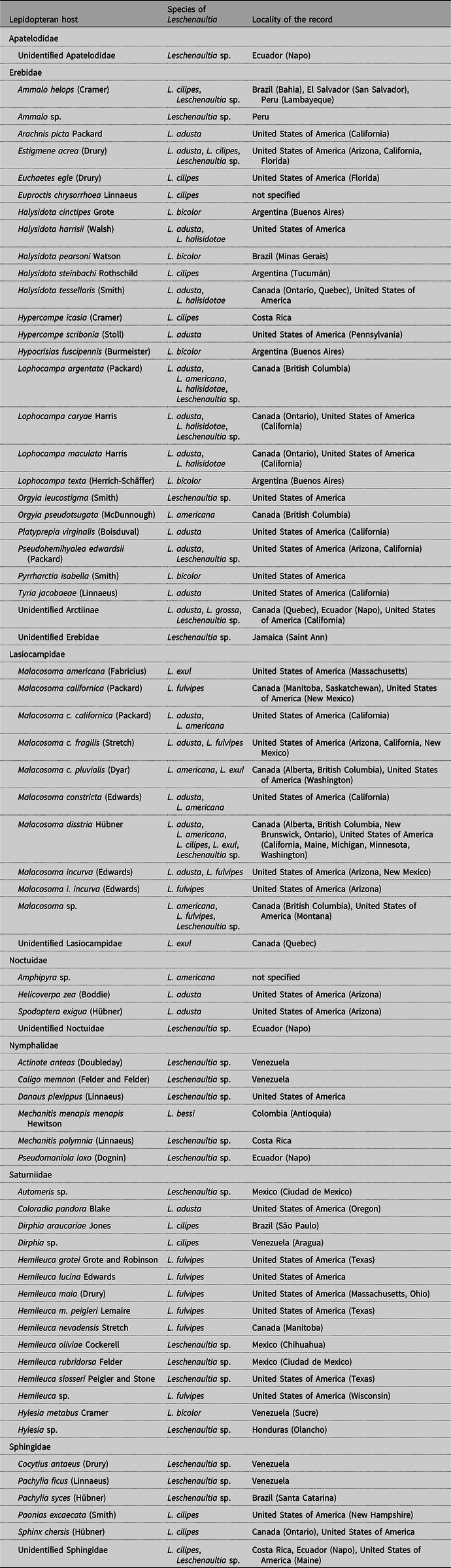
Although several records of specimens of Leschenaultia reared from species of Halysidota have been documented (see host catalogue and Table 1), the record of L. bicolor in H. pearsoni was accidental due to the way the parasitism may have occurred. Because of their large body size, females of L. bicolor could not have entered in the plastic containers and interacted with the larvae of H. pearsoni. The only way the moth larvae could eat the microtype eggs of L. bicolor is if the leaves of Morus sp. collected from the campus already had the eggs laid upon them. In fact, wild populations of Halysidota sp. were observed feeding on leaves of Morus sp. found on the campus. Since the same leaves were offered to the larvae of H. pearsoni kept in the laboratory, it is expected that females of L. bicolor had been attracted by the herbivory of wild larvae of Halysidota sp. on the campus. In a similar way, artificial feeding of eggs to induce parasitism was accomplished in experiments with L. adusta for different species of Lepidoptera with successful results (Jackson et al. Reference Jackson, Bryan, Butler and Patana1970).
Synopsis of host–parasitoid interactions between species of Lepidoptera and species of Leschenaultia Robineau-Desvoidy. The countries where each species was recorded are listed, with departments, parishes, provinces, regions, or states mentioned in parentheses when these are provided in the original literature. Details about the records, localities, and the respective references can be found in the host catalogue.

Characterisation of Leschenaultia bicolor and description of terminalia
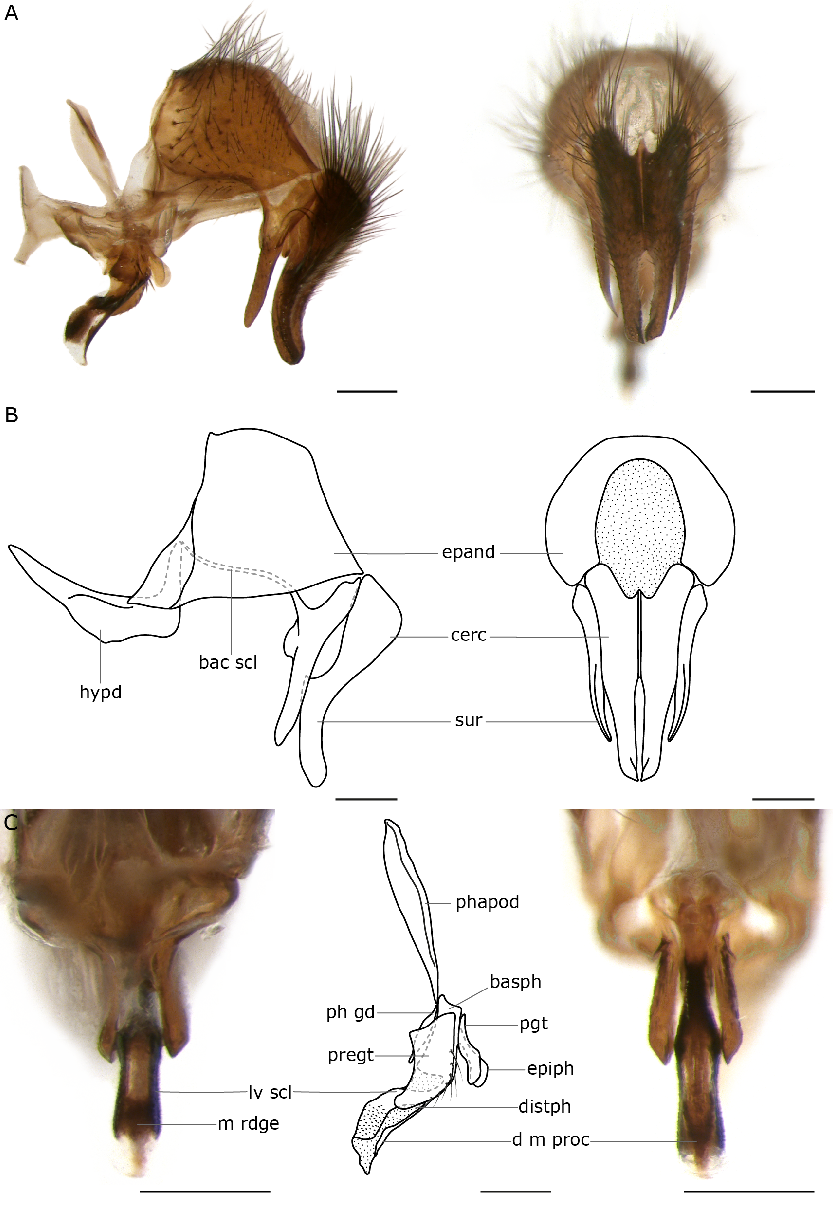
Diagnosis. Leschenaultia bicolor can be distinguished from other species of Leschenaultia by the males having the fore tarsal claw shorter than the second tarsomere, by the absence of both median marginal setae on the abdominal syntergite 1 + 2 and tergite 3 and discal setae on tergite 3 (Fig. 1F), and by the median portion of the male cercus evenly curved posteriorly in lateral view (Fig. 2A–B) (Brooks Reference Brooks1947; Toma and Guimarães Reference Toma and Guimarães2002). However, as already pointed out by Townsend (Reference Townsend1909), females of L. bicolor exhibit sexual dimorphism in the chaetotaxy of the abdomen, having a pair of median marginal setae on tergite 3 (Fig. 1I). Furthermore, as in other females of Leschenaultia, the head has two strong pairs of proclinate orbital setae (Fig. 1K), and the ventral surface of fore tarsal segments 3–4 is covered with patches of sensilla.
Male terminalia of Leschenaultia bicolor (Macquart). A, lateral and posterior views, exhibiting epandrium, surstylus, hypandrium, phallus, and cercus; B, line drawings of lateral and posterior views, highlighting outer and inner structures (grey dashed lines); C, phallus in ventral, lateral, and dorsal views, respectively, with associated sclerites. Dotted areas in line drawings correspond to membranous surfaces. Scale bars: 0.25 mm. Abbreviations: bac scl = bacilliform sclerite, basph = basiphallus, epand = epandrium, cerc = cercus, d m proc = dorsal median process, distph = distiphallus, epiph = epiphallus, hypd = hypandrium, lv scl = lateroventral sclerite, m rdge = median ridge, pgt = postgonite, ph gd = phallic guide, phapod = phallapodeme, pregt = pregonite, sur = surstylus.

The holotype female of Blepharipeza bicolor Macquart is from Galveston, Texas, United States of America, and is supposed to be deposited in the collection of the Muséum National d’Histoire Naturelle, in Paris, where most of the collection of Pierre-Justin-Marie Macquart is deposited. The location of the holotype, however, is currently unknown (O’Hara and Wood Reference O’Hara and Wood2004). Toma and Guimarães (Reference Toma and Guimarães2002) expanded the concept of L. bicolor by including examined specimens from the United States of America, Mexico, and South American countries, although they did not examine the holotype of B. bicolor. The specimens of L. bicolor we identified herein are based on the extended concept of Toma and Guimarães (Reference Toma and Guimarães2002) for the species, because we did not examine the type material of L. bicolor. The reader, therefore, should be aware that L. bicolor may be either a widespread species in the New World or a complex of morphologically similar species, with L. bicolor being a species restricted to the Nearctic region.
Males of L. bicolor are very similar externally to L. braueri Toma and Guimarães, L. brooksi Toma and Guimarães, and L. barbarae Toma, due to the absence or reduction of abdominal setae. Although Toma and Guimarães (Reference Toma and Guimarães2002) state that L. braueri and L. brooksi have short median marginal setae on the abdominal syntergite 1 + 2 and tergite 3, this character is not clearly visible in the paratypes deposited at the MZSP, giving the impression of absence of marginal setae. However, L. braueri exhibits in the male terminalia a surstylus subequal in width to cercus in lateral view (narrower than the width of cercus in L. bicolor; Fig. 2A–B), a cercus curved posteriorly only at the tip (Toma and Guimarães Reference Toma and Guimarães2002, p. 50, Fig. 51) (evenly curved in L. bicolor), and only one strong seta followed by weaker setae on the pregonite (strong row of setae on the pregonite of L. bicolor; Fig. 2C). Leschenaultia brooksi is also distinguished by characters of the male terminalia, having a surstylus subequal in width to cercus in lateral view and a cercus straight in lateral view (Toma and Guimarães Reference Toma and Guimarães2002, p. 50, Fig. 52). Leschenaultia barbarae is very similar to L. bicolor, and its diagnosis is based only on the relative length of the fore tarsal claw of the male – longer than the second tarsomere – and on the intensity of the curvature of the cercus in lateral view (Toma Reference Toma2008, p. 354, Fig. 2). These characters alone, however, provide insufficient support for the validity of this species, suggesting that L. barbarae and L. bicolor may be synonymous.
Material examined of L. bicolor. 1 ♂, 6 ♀. BRAZIL: 2 ♂ [two dissected], 3 ♀, Bahia, Ilheus, Fazenda Olga, 3.xii.1979, E. Ferraz leg., examined by Toma and Guimarães (Reference Toma and Guimarães2002); 1 ♂ [dissected], 6 ♀ [one dissected], Minas Gerais, Ouro Preto, Universidade Federal de Ouro Preto, 20.396S, 43.509W, 18.vi.2018, I.M.M. Carneiro leg. (MZSP); 1 ♀, Minas Gerais, São João del Rei, vi.1965, J.C. Santiago leg., examined by Toma and Guimarães (Reference Toma and Guimarães2002) (MZSP). ECUADOR: 3 ♂ [three dissected], Loja, Zamora, 1200 m, 23.xi.1970, L. Peña leg., examined by Toma and Guimarães (Reference Toma and Guimarães2002) (MZSP).
Material examined of L. braueri: BRAZIL: 1 ♂ [dissected], Goiás, Anápolis, 7.x.1936 [no collector]; 1 ♂ [dissected], Mato Grosso, Chapada, xi, S.W. Willinston collection, paratype (MZSP); 1 ♂ [dissected], Mato Grosso do Sul, Maracajú, iii.1937, S. Lane leg. (MZSP); 2 ♂ [dissected], Minas Gerais, Arceburgo, iii.1945, M.P. Barreto leg. (MZSP); 1 ♂ [dissected], São Paulo, Cajuru, Cássia dos Coqueiros, x.1954, M.P. Barreto leg. (MZSP).
Material examined of L. brooksi: BRAZIL: 1 ♂ [dissected], Distrito Federal, Guaratiba, 6.viii.1961, J.H. Guimarães (MZSP); 1 ♂ [dissected], Goiás, Anápolis, ii.1936 [no collector] (MZSP); 3 ♂ [dissected], Mato Grosso do Sul, Maracajú, ii–iii.1937 [no collector] (MZSP); 1 ♂ [dissected], Rio de Janeiro, Universidade Rural, ix.1961, O. Tavares leg., paratype (MZSP).
Description of male terminalia (Fig. 2)
Sternite 5 short, wider than long, with anterior margin well curved inward; posterior margin with a pair of lobes delimiting a U-shaped notch more constricted towards the base; lobes with posterior margin setose and inner margin without microtrichia. Tergite 6 divided into two hemitergites, with right hemitergite reduced to a small sclerite; pair of spiracles on the membrane. Sternite 6 asymmetrical; connection with the right hemitergite of tergite 6 sclerotised. Syntergite 7 + 8 with anterior half bare, bearing a pair of spiracles, and posterior half setulose. Anterior epandrial process continuous with ventral epandrial margin, not pronounced. Epandrium setose, with dorsal surface slightly curved and posterior margin straight in lateral view. Surstylus flattened, straight and parallel with cercus in posterior view, narrower than apex of cercus in lateral view; apex of surstylus extending to two-thirds of the apex of cercus in posterior view; outer surface covered with short, upward directed setae; connection with epandrium membranous, not fused, and connection with bacilliform sclerite sclerotised, completely fused. Hypandrial apodeme as long as central plate of hypandrium, subtriangular in ventral view; hypandrial arms not fused with each other and well developed, extending upward to connection with bacilliform sclerite. Phallapodeme flattened, subequal to hypandrium length, with a median ridge on the anterior surface. Ejaculatory apodeme lost during dissection. Phallic guide well developed, not fused with phallapodeme and extending to the apex of basiphallus. Phallus with epiphallus well developed, attached to the base of distiphallus and extending downward; basiphallus without basal process, stout and short, with apex wider than base; dorsal sclerite of distiphallus fused with basiphallus, with a long median process extending to the apex of the distiphallus; distiphallus with a pair of lateroventral sclerites strongly sclerotised and with granules associated with the membrane; median ridge short and sclerotised, located between lateroventral sclerites and distad on the ventral surface of the distiphallus. Pregonite not fused with hypandrium, broad on basal half, narrowing towards apex, with dorsal margin bearing 6–7 setae. Postgonite bare and bacilliform, extending to the apex of epiphallus. Cercus entirely setose, with continuous suture; basal lobe subrectangular in posterior view; inner surface of the apex of each cercus with two short teeth; cercus slightly and evenly curved posteriorly in lateral view.
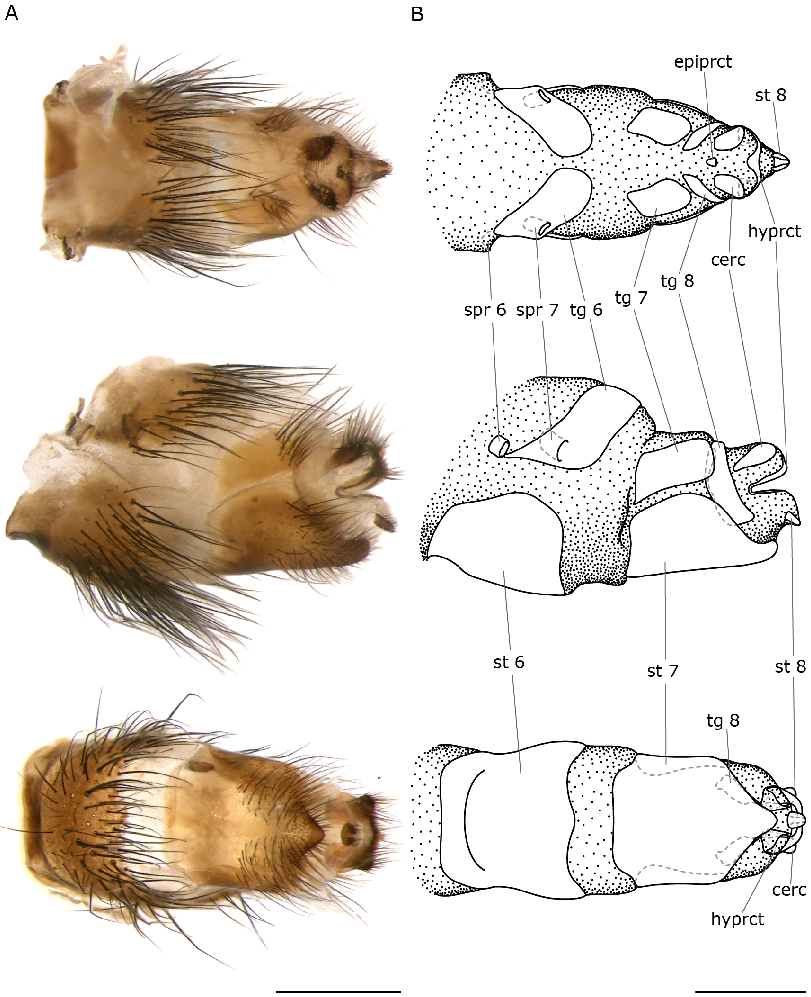
Description of female terminalia (Fig. 3)
Female terminalia of Leschenaultia bicolor (Macquart). A, dorsal, lateral, and ventral views, respectively; B, line drawings of dorsal, lateral, and ventral views, respectively, highlighting outer and inner structures (grey dashed lines). Dotted areas in line drawings correspond to membranous surfaces. Scale bars: 0.5 mm. Abbreviations: cerc = cercus, epiprct = epiproct, hyp = hypoproct, spr = spiracle, st = sternite, tg = tergite.

Ovipositor short, with membranous space between sclerites narrower than in oviparous species with macrotype eggs. Tergite 6 divided into two hemitergites, setulose. Sixth pair of spiracles in membrane and seventh pair of spiracles on tergite 6. Sternite 6 with posterior margin slightly pointed medially, setulose. Tergite 7 divided into two hemitergites, longer than wide, setulose only on apical third. Sternite 7 of irregular pentagonal shape, with posterior margin strongly projected medially, setulose on posterior half. Tergite 8 divided into two hemitergites, wider than long, extending in lateral view up to half of hemitergite 7, posterior margin weakly sclerotised, bare. Sternite 8 small and V-shaped, setulose. Epiproct smaller than sternite 8 and weakly sclerotised, bare. Hypoproct U-shaped, with a pair of arms folded and directed posteriorly pointed at tip, setulose only on dorsal median surface. Cercus free, not fused, setulose.
Distribution. Leschenaultia bicolor exhibits a widespread distribution throughout the American continents, with records in Argentina, Brazil, Canada, Colombia, Ecuador, Mexico, Peru, Puerto Rico, United States of America, and Venezuela. More information about the distribution of L. bicolor can be verified in Toma and Guimarães (Reference Toma and Guimarães2002), O’Hara and Wood (Reference O’Hara and Wood2004), O’Hara et al. (Reference O’Hara, Henderson and Wood2019), and Toma (Reference Toma2019).
Host catalogue of Leschenaultia
The search for host records of Leschenaultia resulted in 210 references on Google Scholar and 26 on Web of Science. After checking and sorting all references found, a total of 47 new references were added to the host catalogue of Leschenaultia, resulting in 96 references. At least nine species of Leschenaultia (L. adusta (Loew), L. americana (Brauer and Bergenstamm), L. bessi Toma and Guimarães, L. bicolor (Macquart), L. cilipes Robineau-Desvoidy, L. exul (Townsend), L. fulvipes (Bigot), L. grossa Brooks, and L. halisidotae Brooks) are recorded from 53 species of Lepidoptera (not including subspecies and undetermined specimens), including the families Apatelodidae, Erebidae, Lasiocampidae, Noctuidae, Nymphalidae, Saturniidae, and Sphingidae (Table 1) and representing an increase of 65% in the total number of host species recorded in the previous catalogues. Apart from the families listed before, Wood and Zumbado (Reference Wood and Zumbado2010) also mention records in Megalopygidae in Costa Rica. The records of L. bicolor and L. cilipes made by Wolcott (Reference Wolcott1923, Reference Wolcott1948) in mice listed by Arnaud (Reference Arnaud1978) were not included in the catalogue due to the lack of evidence supporting that these flies were obtained from rodents. The material listed by Wolcott was identified mostly by the Diptera specialist Aldrich (Wolcott Reference Wolcott1923, p. 209), indicating that the identification of the species should be right. However, eggs of Goniini hatch only when in contact with the host’s digestive fluid (Kahrer Reference Kahrer1984), and the larvae of tachinids are exclusive endoparasitoids of arthropods (Stireman et al. Reference Stireman, O’Hara and Wood2006). Therefore, these records are not reliable and are not included in the host catalogue.
Although misidentification of parasitoids and hosts may have occurred, some interesting patterns can be verified in the associations between species of Leschenaultia and their hosts (Table 1). The majority of hosts are from the family Erebidae, with 14 genera and 23 species, followed by Saturniidae, with five genera and 11 species. Although many species are parasitised by more than one species of Leschenaultia, there seems to be a specific association between some hosts and their parasitoids; for example, L. cilipes in sphingids, L. exul in Malacosoma, and L. fulvipes in Hemileuca. These patterns of host associations may be important to understand the evolution of host use (Stireman et al. Reference Stireman, Cerretti, O’Hara, Blaschke and Moulton2019), but a more cautious approach should be taken. The study of host use usually assumes that there is a straight correspondence between traits of hosts and parasitoids, but in the case of Goniini and, specifically, Leschenaultia, the cues used by the females to locate the hosts derive from the host plant rather than the host itself (Mondor and Roland Reference Mondor and Roland1997, Reference Mondor and Roland1998). Therefore, in the case of Goniini and other lineages of tachinids that locate hosts by detecting volatile compounds released by plants, additional knowledge about the host–plant associations, the compounds released by host plants, and the sensorial organs of females (e.g., antennal and tarsal sensilla) are required to understand the association and evolution of host use. Because tachinids are frequently polyphagous or at least broadly oligophagous (Stireman Reference Stireman2002; Stireman et al. Reference Stireman, Dyer and Greeney2017), a focus on host traits rather than the cues used by females may produce many artefacts in inferences about the evolution of host use in Tachinidae.
The stages from which the larvae of Leschenaultia emerge to pupate that are recorded in the references of the host catalogue comprise the final instars of caterpillars, usually the fifth or higher, and the pupae. The number of reared larvae per host reported in the references varies from one to three, reaching in some exceptional cases to eight (Selfridge et al. Reference Selfridge, Parry and Boettner2007). References about immature stages of Leschenaultia are not cited in the catalogue. To assess details about eggs, larvae, and puparia of Leschenaultia, the reader is referred to the works of Townsend (Reference Townsend1893a), Bess (Reference Bess1936), Brooks (Reference Brooks1947), Ross (Reference Ross1953), Sippell (Reference Sippell1961), Thompson (Reference Thompson1963), and Salkeld (Reference Salkeld1980).
Leschenaultia adusta (Loew)
Erebidae: Arctiinae
Arachnis picta Packard
Coquillett (Reference Coquillett1897, p. 10, record [as Blepharipeza, locality not specified]; p. 24, host–parasitoid list); Essig (Reference Essig1962, p. 583, record from California, United States of America [as Blepharipeza]).
Estigmene acrea (Drury)
Loew (Reference Loew1872, p. 97, record from California, United States of America [as Blepharopeza, misspelling], host as Spilosomae aeraea [Spilosoma acrea, misspelling, locality not specified]); Osten Sacken (Reference Osten Sacken1875, p. 72, record [as Blepharopeza, misspelling, locality not specified], host as Spilosomae acrea [Spilosoma, misspelling]); Brauer and Bergenstamm (Reference Brauer and Von Bergenstamm1895, p. 545, record of Osten Sacken (Reference Osten Sacken1875), p. 607, host–parasitoid list, host as Spilosoma acrea); Coquillett (Reference Coquillett1897, p. 10, record of Loew (Reference Loew1872) [as Blepharipeza]; p. 26, host–parasitoid list, host as Leucarctia acraea [acrea, misspelling]); Johnson (Reference Johnson1925a, p. 202, note on checklist of Diptera from New England area, United States of America [as Blepharipeza], host as Leucarctia acraea [acrea, misspelling]); Essig (Reference Essig1962, p. 583, record from California, United States of America [as Blepharipeza]); Brooks (Reference Brooks1947, p. 172, parasitoid–host list, record of Loew (Reference Loew1872) [as Rileymyia]); Taylor (Reference Taylor1954, pp. 526–529, record from Salt River Valley, Arizona, United States of America [as Rileymyia], description of laboratory rearing, comparisons between biological and chemical control); Stevenson et al. (Reference Stevenson, Kaufman and Sheets1957, p. 280, record from Salt River Valley, Arizona, United States of America [as Rileymyia]); Bryan et al. (Reference Bryan, Jackson and Stoner1969, p. 1, parasitoid–host list; pp. 7–8, record from Arizona, United States of America, description of laboratory rearing); Jackson et al. (Reference Jackson, Bryan, Butler and Patana1970, pp. 1396–1397, record from Casa Grande, Arizona, United States of America, description of laboratory rearing); Stireman and Singer (Reference Stireman and Singer2003, p. 637, record from Arizona, United States of America, assessment of tachinid–host associations).
Halysidota harrisii (Walsh)
Schaffner and Griswold (Reference Schaffner and Griswold1934, p. 35, host–parasitoid list [as Blepharipeza]; p. 121, record from New England area, United States of America, host as Halisidota [Halysidota, misspelling]).
Halysidota tessellaris (Smith)
Schaffner and Griswold (Reference Schaffner and Griswold1934, p. 34, host–parasitoid list [as Blepharipeza]; p. 121, record from New England area, United States of America, host as Halisidota [Halysidota, misspelling]).
Hypercompe scribonia (Stoll)
Daecke (Reference Daecke1916, p. 286, record from Rockville, Pennsylvania, United States of America [as Blepharopeza, misspelling], host as Ecpantheria deflorata [Pohl et al. (Reference Pohl, Patterson and Pelham2016) lists E. deflorata from authors as H. scribonia]).
Lophocampa argentata (Packard)
Townsend (Reference Townsend1893a, p. 403, record [as Blepharipeza, locality not specified], host as Halisidota [Halysidota, misspelling]); Brauer and Bergenstamm (Reference Brauer and Von Bergenstamm1895, p. 545, record of Townsend (Reference Townsend1893a) [as Blepharipeza], host as Halesidota [Halysidota, misspelling]; p. 593, host–parasitoid list); Silver (Reference Silver1958, p. 76, record from British Columbia, Canada [as Rileymyia], host as Halisidota [Halysidota, misspelling]).
Lophocampa caryae Harris
Tothill (Reference Tothill1913, p. 69, record from Ottawa, Ontario, Canada [as Blepharipeza], host as Halisidota [Halysidota, misspelling]); Essig (Reference Essig1962, p. 583, record from California, United States of America [as Blepharipeza], host as Halisidota [Halysidota, misspelling]); Schaffner and Griswold (Reference Schaffner and Griswold1934, p. 33, host–parasitoid list [as Blepharipeza]; p. 121, record from New England area, United States of America, host as Halisidota [Halysidota, misspelling]).
Lophocampa maculata Harris
Tothill (Reference Tothill1913, p. 69, record from Ottawa, Ontario, Canada [as Blepharipeza], host as Halisidota [Halysidota, misspelling]); Essig (Reference Essig1962, p. 583, record from California, United States of America [as Blepharipeza], host as Halisidota [Halysidota, misspelling]); Schaffner and Griswold (Reference Schaffner and Griswold1934, p. 34, host–parasitoid list [as Blepharipeza]; p. 121, record from New England area, United States of America, host as Halisidota [Halysidota, misspelling]).
Platyprepia virginalis (Boisduval)
Karban and English-Loeb (Reference Karban and English-Loeb1999, p. 72, record from Sonoma County, California, United States of America [as L. adusta (Wulp) [authorship in error]).
Pseudohemihyalea edwardsii (Packard)
Coquillett (Reference Coquillett1897, p. 10, record from Los Angeles, California, United States of America [as Blepharipeza]; p. 25, host–parasitoid list, host as Halisidota [Halysidota, misspelling]); Essig (Reference Essig1962, p. 583, record from California, United States of America [as Blepharipeza], host as Hemihyalea).
Tyria jacobaeae (Linnaeus, 1758)
Hawkes (Reference Hawkes1973, p. 143, record from Todd Point, California, United States of America).
Unidentified Arctiinae
Winn and Beaulieu (Reference Winn and Beaulieu1915, p. 142, record from Montreal, Quebec, Canada [as Blepharipeza], host as Halesidota [Halysidota, misspelling]); Johnson (Reference Johnson1925b, p. 87, record [as Blepharipeza, locality not specified]).
Lasiocampidae: Lasiocampinae
Malacosoma californica californica (Packard)
Coquillett (Reference Coquillett1897, p. 10, record from Glen Ellen, California, United States of America [as Blepharipeza]; p. 24, host–parasitoid list, host as Clisiocampa thoracica Stretch).
Malacosoma californica fragilis (Stretch)
Stelzer (Reference Stelzer1968, p. 10, record from Arizona and New Mexico, United States of America, host as M. fragile Stretch).
Malacosoma constricta (Edwards)
Coquillett (Reference Coquillett1897, p. 10, record from Santa Helena, California, United States of America [as Blepharipeza]; p. 24, host–parasitoid list, host as Clisiocampa constricta Stretch [authorship in error]); Essig (Reference Essig1962, p. 583, record from California, United States of America, host as M. constricta Stretch [authorship in error]).
Malacosoma disstria Hübner
Tothill (Reference Tothill1913, p. 69, record from New Brunswick and Ontario, Canada [as Blepharipeza]); Essig (Reference Essig1962, p. 583, record from California, United States of America [as Blepharipeza]).
Malacosoma incurva (Edwards)
Stelzer (Reference Stelzer1968, p. 10, record from Arizona and New Mexico, United States of America, host as M. fragile incurva); Stireman and Singer (Reference Stireman and Singer2003, p. 637, record from Arizona, United States of America, assessment of tachinid–host associations, host as M. incurvum).
Noctuidae: Heliothinae
Helicoverpa zea (Boddie)
Jackson et al. (Reference Jackson, Bryan, Butler and Patana1970, p. 1397, record from Arizona, United States of America, host as Heliothis).
Noctuidae: Noctuinae
Spodoptera exigua (Hübner)
Jackson et al. (Reference Jackson, Bryan, Butler and Patana1970, p. 1397, record from Arizona, United States of America).
Saturniidae: Hemileucinae
Coloradia pandora Blake
Patterson (Reference Patterson1929, p. 17, record from Oregon, United States of America [as Blepharipeza]).
Leschenaultia americana (Brauer and Bergenstamm)
Erebidae: Arctiinae
Lophocampa argentata (Packard)
Silver (Reference Silver1958, p. 76, record from British Columbia, Canada [as Rileymia [Rileymyia, misspelling] triseta Brooks], host as Halesidota [Halysidota, misspelling]).
Erebidae: Lymantriinae
Orgyia pseudotsugata (McDunnough)
Torgersen (Reference Torgersen1981, p. 4, record from Otter Lake, British Columbia, Canada).
Lasiocampidae: Lasiocampinae
Malacosoma californica californica (Packard)
Brauer and Bergenstamm (Reference Brauer and Von Bergenstamm1895, p. 571, record [as Rileya, locality not specified]; p. 588, host–parasitoid list, host as Clisiocampa thoracica Stretch).
Malacosoma californica pluvialis (Dyar)
Ross (Reference Ross1953, p. 19, record from Vernon, British Columbia [as Rileymyia]; p. 20, key to puparia of parasitoids, host as M. pluviale); Dailey (Reference Dailey1957, p. 628, record from Washington, United States of America [as Rileymyia], host as M. pluviale); Johansen (Reference Johansen1957, p. 70, record from Puyallup, Washington, United States of America [as Rileymyia triseta Brooks], host as M. pluviale); Dailey (Reference Dailey1958, p. 269, record from Washington, United States of America [as Rileymyia], host as western tent caterpillar); Iwao and Wellington (Reference Iwao and Wellington1970, pp. 86–97, record from Vancouver Island, British Columbia, Canada [as Rileymyia], assessment of parasitism rates, host as M. californicum pluviale); Iwao (Reference Iwao1970, pp. 103–104, record [as Rileymyia, locality not specified], assessment of parasitism rates, host as M. californicum pluviale).
Malacosoma constricta (Edwards)
Brauer and Bergenstamm (Reference Brauer and Von Bergenstamm1895, p. 571, record [as Rileya, locality not specified]; p. 588, host–parasitoid list, host as Clisiocampa constricta Stretch).
Malacosoma disstria Hübner
Ross (Reference Ross1953, p. 19, record from Vernon, British Columbia, Canada [as Rileymyia]; p. 20, key to puparia of parasitoids); Dailey (Reference Dailey1957, p. 628, record from Washington, United States of America [as Rileymyia]); Johansen (Reference Johansen1957, p. 70, record from Puyallup, Washington, United States of America [as Rileymyia triseta Brooks, misidentification]); Dailey (Reference Dailey1958, p. 269, record from Washington, United States of America [as Rileymyia], host as forest tent caterpillar); James (Reference James1976, p. 324, record from South Prairie, Washington).
Malacosoma sp.
Brooks (Reference Brooks1947, p. 172, parasitoid–host list [as Rileymyia triseta Brooks]; p. 182, record from Vernon, British Columbia, Canada, list of examined material).
Noctuidae: Amphipyrinae
Amphipyra sp.
Brauer and Bergenstamm (Reference Brauer and Von Bergenstamm1895, p. 571, record [as Rileya, locality not specified]; p. 604, host–parasitoid list, host as Pyrophila sp.).
Leschenaultia bessi Toma and Guimarães
Nymphalidae: Ithomiinae
Mechanitis menapis menapis Hewitson
Muñoz et al. (Reference Muñoz, Restrepo and Muriel2013, pp. 71–73, record from Antioquia, Colombia).
Leschenaultia bicolor (Macquart)
Erebidae: Arctiinae
Halysidota cinctipes Grote
Blanchard (Reference Blanchard1959, p. 158, key to parasitoids [as Parachaetopsis proseni Blanchard]; p. 166, record from Buenos Aires, Argentina, host as Halisidota [Halysidota, misspelling]).
Erebidae: Arctiinae
Halysidota pearsoni Watson
Gudin and Carneiro, record from Ouro Preto, Minas Gerais, Brazil.
Hypocrisias fuscipennis (Burmeister)
Blanchard (Reference Blanchard1959, p. 158, key to parasitoids [as P. proseni]; p. 166, record from Buenos Aires, Argentina, host as Halisidota [Halysidota, misspelling]).
Lophocampa texta (Herrich-Schäffer)
Blanchard (Reference Blanchard1959, p. 158, key to parasitoids [as P. proseni]; p. 166, record from Punta Lara, Buenos Aires, Argentina, host as Halisidota [Halysidota, misspelling]).
Pyrrharctia isabella (Smith)
Schaffner and Griswold (Reference Schaffner and Griswold1934, p. 37, host–parasitoid list [as Parachaeta fusca Townsend]; p. 122, record from New England area, United States of America, host as Isia); Brooks (Reference Brooks1947, p. 172, parasitoid–host list [as Parachaeta], record of Schaffner and Griswold (Reference Schaffner and Griswold1934), host as Isia).
Saturniidae: Hemileucinae
Hylesia metabus Cramer
Hernández et al. (Reference Hernández, Osborn, Herrera, Liendo-Barandiaran, Perozo and Velásquez2009, pp. 246–247, record from Valdez, Sucre, Venezuela).
Leschenaultia cilipes Robineau-Desvoidy
Erebidae: Arctiinae
Ammalo helops (Cramer)
Gonçalves and Gonçalves (Reference Gonçalves and Gonçalves1974, p. 337, record from Água Preta, Bahia, Brazil [as L. leucophrys (Wiedemann)], host as A. helops megapyrrha (Walker)).
Estigmene acrea (Drury)
Patton (Reference Patton1958, p. 39, record from Gainesville, Florida, United States of America [as L. leucophrys]).
Euchaetes egle (Drury)
Patton (Reference Patton1958, p. 39, record from Gainesville, Florida, United States of America [as L. leucophrys], host as Euchaetias).
Halysidota steinbachi Rothschild
Blanchard (Reference Blanchard1959, p. 158, key to parasitoids [as L. leucophrys]; p. 162, record from Tucumán, Argentina, host as Halisidota [Halysidota, misspelling]).
Hypercompe icasia (Cramer)
Harrison and Stephens (Reference Harrison and Stephens1966, p. 673, record from Palmar, Costa Rica [as L. leucophrys], description of laboratory rearing, host as Ecpantheria).
Erebidae: Lymantriinae
Euproctis chrysorrhoea (Linnaeus)
Howard and Fiske (Reference Howard and Fiske1911, p. 93, record [as Blepharipeza leucophrys, locality not specified]).
Lasiocampidae: Lasiocampinae
Malacosoma disstria Hübner
Balch and Simpson (Reference Balch and Simpson1935, p. 36, record from New Brunswick, Canada [as B. leucophrys]); Baird (Reference Baird1938, pp. 81, 137, 140, record from British Columbia, Canada [as B. leucophrys]).
Saturniidae: Hemileucinae
Dirphia araucariae Jones
Guimarães (Reference Guimarães1977, p. 47, record from São Paulo, Brazil [as L. leucophrys]).
Dirphia sp.
Terán (Reference Terán1974, p. 35, record from El Limón, Aragua, Venezuela [as L. leucophrys]; p. 58, parasitoid–host list).
Sphingidae: Smerinthinae
Paonias excaecata (Smith)
Aldrich (Reference Aldrich1932, p. 2, record from Canobie Lake, New Hampshire, United States of America [as B. leucophrys], host as P. excoecata [excaecata, misspelling]); Schaffner and Griswold (Reference Schaffner and Griswold1934, p. 21, host–parasitoid list [as B. leucophrys]; p. 122, record from New England area, United States of America); Brooks (Reference Brooks1947, p. 172, parasitoid–host list, record of Schaffner and Griswold (Reference Schaffner and Griswold1934) [as B. leucophrys]).
Sphingidae: Sphinginae
Sphinx chersis (Hübner)
Tothill (Reference Tothill1913, p. 70, record from Ottawa, Ontario, Canada [as B. leucophrys]); Schaffner and Griswold (Reference Schaffner and Griswold1934, p. 18, host–parasitoid list [as B. leucophrys]; p. 122, record from New England area, United States of America, host as Hyloicus); Brooks (Reference Brooks1947, p. 172, parasitoid–host list, record of Schaffner and Griswold (Reference Schaffner and Griswold1934) [as B. leucophrys]).
Unidentified Sphingidae
Ballou (Reference Ballou1936a*, p. 142, record from Costa Rica); Ballou (Reference Ballou1936b*, p. 48, record from Costa Rica); Procter (Reference Procter1946, p. 433, record from Mount Desert, Maine, United States of America [as L. jurinoides Townsend, misidentification]).
Leschenaultia exul (Townsend)
Lasiocampidae: Lasiocampinae
Malacosoma americana (Fabricius)
Schaffner and Griswold (Reference Schaffner and Griswold1934, p. 88, host–parasitoid list [as Blepharipeza]; p. 121, record from New England area); Bess (Reference Bess1936, p. 594, record from Melrose, Massachusetts, United States of America, description of laboratory rearing; pp. 600–604, biology of parasitoid); Bess (Reference Bess1937, pp. 411–412, record from Massachusetts, United States of America, description of laboratory rearing, biology of parasitoid); Brooks (Reference Brooks1947, p. 172, parasitoid–host list [as Blepharipeza], record of Schaffner and Griswold (Reference Schaffner and Griswold1934)); Witter and Kulman (Reference Witter and Kulman1972, pp. 5–6, review of host records; p. 24, catalogue, host as M. americanum).
Malacosoma californica pluvialis (Dyar)
Parry (Reference Parry1995, p. 888, record from Alberta, Canada, host as M. californicum pluviale).
Malacosoma disstria Hübner
Schaffner and Griswold (Reference Schaffner and Griswold1934, p. 89, host–parasitoid list [as Blepharipeza]; p. 121, record from New England area, United States of America); Bess (Reference Bess1936, p. 594, record from Limerick, Maine, United States of America, description of laboratory rearing; pp. 600–604, biology of parasitoid); Brooks (Reference Brooks1947, p. 172, parasitoid–host list [as Blepharipeza], record of Schaffner and Griswold (Reference Schaffner and Griswold1934)); McGugan et al. (Reference McGugan, Haliburton and MacDonald1952, p. 45, record from Ontario, Canada); Sippell (Reference Sippell1961, p. 436, key to puparia of parasitoids); Ives (Reference Ives1971, p. 28, record from Alberta, Canada); Witter et al. (Reference Witter, Kulman and Hodson1972, p. 29, record from Koochiching County, Minnesota, United States of America); Witter and Kulman (Reference Witter and Kulman1972, pp. 5–6, review of host records; p. 24, catalogue); Witter and Kulman (Reference Witter and Kulman1979, pp. 724–729, assessment of parasitism rates); Parry (Reference Parry1995, p. 881, record from Alberta, Canada; pp. 881–890, assessment of parasitism rates); Mondor and Roland (Reference Mondor and Roland1997, pp. 161–168, record from Ministik Hills, Alberta, Canada, description of laboratory rearing, assessment of olfactory cues used by the parasitoid); Parry et al. (Reference Parry, Spence and Volney1997, pp. 100–105, record from George Lake, Alberta, Canada, assessment of parasitism rates); Roland and Taylor (Reference Roland and Taylor1997, pp. 710–713, record from Edmonton, Alberta, Canada, assessment of parasitism rates); Mondor and Roland (Reference Mondor and Roland1998, pp. 583–590, description of parasitoid behaviour); Rothman and Roland (Reference Rothman and Roland1998, p. 387, record from Ministik Hills, Alberta, Canada, assessment of parasitism rates); Parry et al. (Reference Parry, Herms and Mattson2003, pp. 1772–1780, record from East Lansing, Michigan, United States of America, assessment of parasitism rates); Nixon and Roland (Reference Nixon and Roland2012, p. 18, record from Alberta, Canada, assessment of parasitism rates).
Unidentified Lasiocampidae
LeRoux (Reference LeRoux1960, p. 114, record from Quebec, Canada [as Rileymyia], host as tent caterpillars).
Leschenaultia fulvipes (Bigot)
Lasiocampidae: Lasiocampinae
Malacosoma californica (Packard)
Stehr and Cook (Reference Stehr and Cook1968, p. 267, list of examined material of host; p. 300, record from Hopewell, New Mexico, United States of America, host as M. californicum); Williams et al. (Reference Williams, Parry and Langor1996, p. 20, record from Manitoba and Saskatchewan, Canada, host as M. californicum).
Malacosoma californica fragilis (Stretch)
Stehr and Cook (Reference Stehr and Cook1968, p. 278, list of examined material of host; p. 301, record from Morongo Valley, California, United States of America, host as M. californicum fragile); Stelzer (Reference Stelzer1968, pp. 10–13, record from Arizona and Carson National Forest, Tres Piedras, New Mexico, United States of America, host as M. fragile).
Malacosoma incurva (Edwards)
Stelzer (Reference Stelzer1967, p. 39, record from Sabino Canyon, Tucson, Arizona, United States of America [as L. fulvipes (Bigelow [Bigot, misspelling]), host as M. fragile incurva); Stelzer (Reference Stelzer1968, p. 10, record from Arizona and New Mexico, United States of America, host as M. fragile incurva).
Malacosoma incurva incurva (Edwards)
Stehr and Cook (Reference Stehr and Cook1968, p. 280, list of examined material of host; p. 301, record from Winkelman, Arizona, United States of America, host as M. incurvum incurvum).
Malacosoma spp.
Stehr and Cook (Reference Stehr and Cook1968, pp. 277–278, list of examined material of host; p. 301, record from Helena, Montana, United States of America, host listed as being an intermediate population between M. californicum pluviale (Dyar) and M. californicum lutescens (Neumoegen [Neumögen, misspelling] and Dyar)).
Saturniidae: Hemileucinae
Hemileuca grotei Grote and Robinson
Kendall and Peigler (Reference Kendall and Peigler1981, p. 45, record from Bexar and Eastland counties, Texas, United States of America).
Hemileuca lucina Edwards
Schaffner and Griswold (Reference Schaffner and Griswold1934, p. 29, host–parasitoid list [as Blepharipeza]; p. 122, record from New England area, United States of America); Brooks (Reference Brooks1947, p. 172, parasitoid–host list, record of Schaffner and Griswold (Reference Schaffner and Griswold1934) [as Rileymyia]).
Hemileuca maia (Drury)
Schaffner and Griswold (Reference Schaffner and Griswold1934, p. 29, host–parasitoid list [as Blepharipeza]; p. 122, record from New England area); Brooks (Reference Brooks1947, p. 172, parasitoid–host list, record of Schaffner and Griswold (Reference Schaffner and Griswold1934) [as Rileymyia]); Tuskes et al. (Reference Tuskes, Tuttle and Collins1996, p. 26, record from Lucas County, Ohio, United States of America, description of parasitoid behaviour, figure of female ovipositing); Selfridge et al. (Reference Selfridge, Parry and Boettner2007, pp. 216–219, record from Cape Cod, Massachusetts, United States of America, assessment of parasitism rates); Parry et al. (Reference Parry, Boettner and Selfridge2008, p. 544, record from Cape Cod, Massachusetts, United States of America).
Hemileuca maia peigleri Lemaire
Steele and Peigler (Reference Steele and Peigler2015, pp. 2–3, record from Bexar County, Texas, United States of America, host as H. peigleri).
Hemileuca nevadensis Stretch
Henne and Diehl (Reference Henne and Diehl2002, p. 112, record from Manitoba Tall Grass Prairie Preserve, Manitoba, Canada).
Hemileuca sp.
Gratton (Reference Gratton2006, pp. 1185–1187, record from Wisconsin, United States of America [sometimes as L. flavipes, misspelling], assessment of parasitism rates).
Leschenaultia grossa Brooks
Erebidae: Arctiinae
Unidentified Arctiinae
Brooks (Reference Brooks1947, p. 172, parasitoid–host list, record [locality not specified]).
Leschenaultia halisidotae Brooks
Erebidae: Arctiinae
Halysidota harrisii (Walsh)
Brooks (Reference Brooks1947, p. 172, parasitoid–host list, record [locality not specified], host as Halisidota [Halysidota, misspelling]).
Halysidota tessellaris (Smith)
Brooks (Reference Brooks1947, p. 172, parasitoid–host list, record [locality not specified], host as Halisidota [Halysidota, misspelling]); Raizenne (Reference Raizenne1952, p. 24, record from Ontario and Quebec, Canada, [as Leschenaultis, misspelling], host as Halisidota [Halysidota, misspelling]).
Lophocampa argentata (Packard)
Brooks (Reference Brooks1947, p. 172, parasitoid–host list, record [locality not specified], host as Halisidota [Halysidota, misspelling]).
Lophocampa caryae Harris
Brooks (Reference Brooks1947, p. 172, parasitoid–host list; p. 176, record from Ottawa and Quebec, Canada, list of examined material, host as Halisidota [Halysidota, misspelling]); Raizenne (Reference Raizenne1952, p. 22, record from Ontario, Canada).
Lophocampa maculata Harris
Brooks (Reference Brooks1947, p. 172, parasitoid–host list, record [locality not specified]).
Leschenaultia spp
Apatelodidae
Unidentified Apatelodidae
Stireman et al. (Reference Stireman, Greeney and Dyer2009, p. 8, record from Quijos Valley, Napo, Ecuador [as Leschenaultia sp. 2 nr. leucophrys], assessment of tachinid–host associations).
Erebidae
Unidentified Erebidae
Townsend (Reference Townsend1893b, p. 314, record from Saint Ann, Jamaica [as Blepharipeza sp.], host described as “cocoon of a moth allied to Euchaetes, but with an Orgyia-like larva”).
Erebidae: Arctiinae
Ammalo helops (Cramer)
Korytkowski et al. (Reference Korytkowski, Ojeda and Amaya1968, p. 28, record from Lambayeque, Peru); Horgan (Reference Horgan2005, p. 228, record from San Salvador, El Salvador).
Ammalo sp.
Lamas (Reference Lamas1970, pp. 119–121, record from Avenida Venezuela, between Lima and El Callao, Peru, assessment of parasitism rates, host as “probably A. trujillaria Dognin”).
Estigmene acrea (Drury)
Singer et al. (Reference Singer, Rodrigues, Stireman and Carriere2004, pp. 2750–2751, record from Arizona, United States of America [as Leschenaultia nr. adusta], assessment of parasitism rates).
Lophocampa argentata (Packard)
Guppy (Reference Guppy1950, p. 4, record from Wellington, British Columbia, Canada [as Rileymyia n. sp.], host as Halisidota [Halysidota, misspelling]).
Lophocampa caryae Harris
Brooks (Reference Brooks1945, p. 185, record from Ottawa, Ontario, Canada [as Leschnaultia, misspelling], host as Halisidota [Halysidota, misspelling]).
Pseudohemihyalea edwardsii (Packard)
Stireman and Singer (Reference Stireman and Singer2003, p. 637, record from Arizona, United States of America [as Leschenaultia nr. malacosomae], assessment of tachinid–host associations, host as Hemihyalea).
Unidentified Arctiinae
Duncan (Reference Duncan1933*, p. 240, record from California, United States of America [as tachinid fly], Figure 123, host as “woolly bear caterpillar”); Duncan and Pickwell (Reference Duncan and Pickwell1939, p. 344, record from California, United States of America [as tachinid fly], Figure 177, host as “woolly bear caterpillar”); Stireman et al. (Reference Stireman, Greeney and Dyer2009, p. 8, record from Quijos Valley, Napo, Ecuador [as Leschenaultia sp. 1, sp. 1a, sp. 2 nr. leucophrys and sp. 2a nr. leucophrys], assessment of tachinid–host associations).
Erebidae: Lymantriinae
Orgyia leucostigma (Smith)
Schaffner and Griswold (Reference Schaffner and Griswold1934, p. 55, host–parasitoid list [as Blepharipeza], record from New England area, United States of America, host as Hemerocampa).
Lasiocampidae: Lasiocampinae
Malacosoma disstria Hübner
Tothill (Reference Tothill1919, p. 12, record from New Brunswick, Canada [as Blepharipeza]); Tothill (Reference Tothill1923, p. 180, comments about using specimens of Leschenaultia for biological control [as Blepharipeza]); Williams et al. (Reference Williams, Parry and Langor1996, p. 14, key to parasitoids; p. 20, overview of host records of species of Leschenaultia).
Malacosoma sp.
Guppy (Reference Guppy1950, p. 4, record from Wellington, British Columbia, Canada [as Rileymyia n. sp.]).
Noctuidae
Unidentified Noctuidae
Stireman et al. (Reference Stireman, Greeney and Dyer2009, p. 8, record from Quijos Valley, Napo, Ecuador [as Leschenaultia sp. 2a nr. leucophrys], assessment of tachinid–host associations).
Nymphalidae: Danainae
Danaus plexippus (Linnaeus)
Oberhauser et al. (Reference Oberhauser, Elmquist, Perilla-López, Gebhard, Lukens and Stireman2017, pp. 538–542, record from United States of America [as Leschenaultia n. sp.], assessment of parasitism rates).
Nymphalidae: Heliconiinae
Actinote anteas (Doubleday)
Terán (Reference Terán1974, p. 35, record from Venezuela; p. 53, parasitoid–host list).
Nymphalidae: Ithomiinae
Mechanitis polymnia (Linnaeus)
Gentry (Reference Gentry2003, p. 408, record from La Selva Biological Station, Costa Rica).
Nymphalidae: Morphinae
Caligo memnon (Felder and Felder)
Terán (Reference Terán1974, p. 35, record from Venezuela; p. 55, parasitoid–host list).
Nymphalidae: Satyrinae
Pseudomaniola loxo (Dognin)
Stireman et al. (Reference Stireman, Greeney and Dyer2009, p. 8, record from Quijos Valley, Napo, Ecuador [as Leschenaultia sp. 2a nr. leucophrys], assessment of tachinid–host associations).
Saturniidae: Hemileucinae
Automeris sp.
Peigler (Reference Peigler1994, p. 81, record from Ciudad de Mexico, Mexico, host as “probably A. cecrops (Boisduval)”).
Hemileuca oliviae Cockerell
Fritz et al. (Reference Fritz, Frater, Owens, Huddleston and Richman1986, pp. 688–689, record from Cuauhtemoc, Chihuahua, Mexico).
Hemileuca rubridorsa Felder
Gardiner (Reference Gardiner1967, p. 55, record from Ciudad de Mexico, Mexico [as Leschenaultia sp. near leucophrys (Wied.) and fusca Tns.], host as Euleucophaeus).
Hemileuca slosseri Peigler and Stone
Peigler and Stone (Reference Peigler and Stone1989, p. 160, record from Texas, United States of America [as Leschenaultia sp. near fulvipes and Leschenaultia sp.]).
Hylesia sp.
Peigler (Reference Peigler1985, p. 104, record from La Unión, Olancho, Honduras).
Sphingidae
Unidentified Sphingidae
Stireman et al. (Reference Stireman, Greeney and Dyer2009, p. 8, record from Quijos Valley, Napo, Ecuador [as Leschenaultia sp. 2a nr. leucophrys], assessment of tachinid–host associations).
Sphingidae: Macroglossinae
Pachylia ficus (Linnaeus)
Terán (Reference Terán1974, p. 35, record from Venezuela; p. 62, parasitoid–host list).
Pachylia syces (Hübner)
Lima (Reference Lima1945, p. 248, record from Florianópolis, Santa Catarina, Brazil).
Sphingidae: Sphinginae
Cocytius antaeus (Drury)
Terán (Reference Terán1974, p. 35, record from Venezuela; p. 56, parasitoid–host list).
Acknowledgements
We would like to thank Carlos Lamas (MZSP) for providing access to the Diptera collection. We are especially thankful to the staff of the libraries of the Instituto de Biociências (Universidade de São Paulo) and the Harvard Library (Harvard University), Bruno de Medeiros and James O’Hara, for helping us to have access to the references. We are also grateful to Marcelo Santis, Silvio Nihei, and three anonymous reviewers for valuable comments and suggestions on an earlier version of the manuscript. We also acknowledge financial support to Filipe Gudin from Conselho Nacional de Desenvolvimento Científico e Tecnológico – CNPq (Proc. no. 140113/2016-9) and to Isabela Maciel from Coordenação de Aperfeiçoamento de Pessoal de Nível Superior – CAPES (Proc. no. 1747411 and 1844018).