


Introduction
The presence of unwanted intrusive thoughts (UITs) about everyday concerns could be an ordinary experience for the majority of the population (Berry, May, Andrade and Kavanagh, Reference Berry, May, Andrade and Kavanagh2010). UITs have been defined as “unwanted thoughts that enter conscious awareness, and that are experienced as nonvolitional, ego-dystonic, distracting, discomforting, and difficult to control” (Najmi, Riemann and Wegner, Reference Najmi, Riemann and Wegner2009, p. 494).
Individuals often try to decrease UITs by thought suppression (ThS; Wegner and Erskine, Reference Wegner and Erskine2003). ThS means to intentionally avoid thinking about problems, desires, feelings or experiences that cause discomfort. Although it sometimes could be useful, ThS could increase the rebound into the consciousness of those thoughts that the subject wants to avoid (Wegner, Reference Wegner1994, Reference Wegner1997) and can have adverse effects on the immune system (Petrie, Booth and Pennebaker, Reference Petrie, Booth and Pennebaker1998). It has been observed that the rebound effect could be better explained on the basis of the failures of UITs suppression. (Iijima and Tanno, in press).
UITs are on a continuum that ranges from normal to pathological. The contents of UITs are similar to clinical obsessions (García-Soriano, Reference García-Soriano2008), worries (Hazlett-Stevens and Graske, Reference Hazlett-Stevens and Graske2003), negative self-referent thoughts (Markowitz and Borton, Reference Markowitz and Borton2002) or intrusive memories (Davies and Clark, Reference Davies and Clark1998; Ehlers and Steil, Reference Ehlers and Steil1995). As ThS could be an important risk factor in the formation of some psychopathological disorders (Aldao and Nolen-Hoeksema, Reference Aldao and Nolen-Hoeksema2010; Aldao, Nolen-Hoeksema and Schweizer, Reference Aldao, Nolen-Hoeksema and Schweizer2010), techniques aiming at the reduction of UITs could be an important prophylaxis. A recent meta-analytic review found no general differences in the recurrence of thoughts associated with ThS between psychopathology and nonclinical groups (Magee, Harden and Teachman, Reference Magee, Harden and Teachman2012), so to set a “clinical” cut-off would be subjective and many people could benefit from those techniques, even though they do not show the necessary indicators of a psychological disorder.
In attempts to reduce the presence of UITs and their accompanying discomfort, numerous interventions have been developed (see for example, Marino-Carper, Negy, Burns and Lunt, Reference Marino-Carper, Negy, Burns and Lunt2010; Masuda, Feinstein, Wendell and Sheehan, Reference Masuda, Feinstein, Wendell and Sheehan2010; Masuda et al., Reference Masuda, Hayes, Twohig, Drossel, Lillis and Washio2009; Najmi et al., Reference Najmi, Reese, Wilhelm, Fama, Beck and Wegner2010; Najmi et al., Reference Najmi, Riemann and Wegner2009; Watson and Purdon, Reference Watson and Purdon2008). A new technique aimed at ameliorating intrusive thoughts is Association Splitting (AS). AS targets obsessive thoughts in patients with manifestations of obsessive-compulsive disorder (OCD), who are taught to connect neutral or positive associations to thoughts that trigger their rituals (Moritz and Jelinek, Reference Moritz and Jelinek2006). In patients with OCD, dysfunctional beliefs and values are at the core of their UITs; they are restricted to specific domains and are more intense than in nonclinical samples (Belloch, et al., Reference Belloch, Morillo, Luciano, García-Soriano, Cabedo and Carrió2010; Belloch, Morillo and García-Soriano, Reference Belloch, Morillo and García-Soriano2009; Cabedo, Belloch, Morillo, Jiménez and Carrió, Reference Cabedo, Belloch, Morillo, Jiménez and Carrió2004; Moritz et al., Reference Moritz, Wahl, Ertle, Jelinek, Hauschildt, Klinge and Hand2009; Moritz and Pohl, Reference Moritz and Pohl2009). While several studies have demonstrated that AS is effective for the reduction of OCD (Moritz and Jelinek, Reference Moritz and Jelinek2011; Moritz, Jelinek, Klinge and Naber, Reference Moritz, Jelinek, Klinge and Naber2007), it is unknown whether this technique is useful to reduce UITs in everyday life. However, this technique could also be effective in nonclinical populations with attenuated UITs similar to obsessions (e.g. worries about family, work or couple relationships).
Since it is likely that the use of alternative thoughts could reduce the frequency of UITs, then AS may also be considered as an intervention to help people with a potential vulnerability to a clinical problem so as to control their UITS. The aim of this study was to evaluate the effectiveness of AS for reducing a) the frequency of intrusive thoughts and b) for reducing the usage of thought suppression in a nonclinical sample with elevated intrusions.
Method
Participants
Initially, 62 participants who reported a regular presence of UITs in their everyday life were recruited (see also Procedure) and randomly allocated to an AS versus waitlist control group (WL). The participants were classified as healthy by the Cuban National Health Care System (in Cuba each individual is regularly seen by the family physician who classifies his or her illness status), and they were not receiving psychological intervention or any drug treatment. In the AS group, five participants were excluded: three of which did not participate in the final evaluation and two did not report their daily associations. In the WL, seven participants could not be reached for the final evaluation. The final sample was composed of 49 participants: 26 in the AS condition (18 females and 8 males) and 23 (18 females and 5 males) in the WL. The age of participants ranged from 18 to 60 years; the average age was 35.67 (± 10.79) years.
Association Splitting guide
First, the original self-help guide proposed by Moritz (Moritz and Jelinek, Reference Moritz and Jelinek2006) was translated into Spanish and modified for nonclinical subjects (Rodríguez-Martín and Molerio-Pérez, Reference Rodríguez-Martín and Molerio-Pérez2011), as our trial did not target patients with obsessive-compulsive disorder but a nonclinical population. The adapted manual aimed at providing information about the intrusive thoughts, their prevalence in the general population, the usage of suppression as a mechanism of thought control, and its paradoxical (rebound) effect on intrusive thoughts.
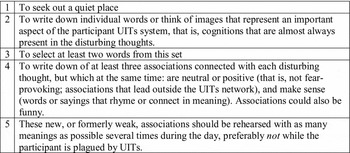
For adopting AS, participants should first identify intrusive thoughts that regularly cause discomfort. They were then encouraged to look for positive or neutral associations (see Figure 1). Participants were instructed to imagine and rehearse the associative pairs (unwanted thought-neutral association) approximately 10 minutes over the course of each day.
Example of instructions offered to the participants

Materials
White Bear Suppression Inventory (WBSI). The WBSI was developed by Wegner and Zanakos (Reference Wegner and Zanakos1994) to evaluate individual differences on ThS. Fifteen items have to be answered on a 5-point Likert scale (ranging from 1 = “strongly disagree” to 5 = “strongly agree”). The highest scores are considered an indicator of a high trend in the use of ThS. For our study, we composed two subscales based on a 2-factor solution (Luciano et al., Reference Luciano, Belloch, Algarabel, Tomás, Morillo and Lucero2006) measuring UITs (sum of items 2–7, 9 and 15) and ThS (sum of items 1, 8, 10–14).
In addition, two questions were posed. The first referred to the core theme of the intrusions: “What is the content of thought that repeatedly plagues you?” The second question addressed the difficulty experienced by the participants to get rid of their intrusions: “What difficulties do you experience when trying to get rid of these thoughts?” (ranging from 1 = “none” to 3 = “I barely get rid of them”). For the final evaluation the first question was removed and two additional questions were added for the AS group only: (1) on the effectiveness of the treatment (“Do you think this treatment is effective?”) and (2) regarding the day improvement was noticed due to the treatment (“If you considered the intervention effective, can you indicate the specific day when you noticed improvements?”)
Procedure
We posted invitations for a self-help technique aimed at reducing UITs. It was specified that only individuals who reported the regular presence of UITs in their everyday life were the ones who should participate in the evaluation. Invitations were posted through the University Well-being Center (CBU) of the Faculty of Psychology in the Central University “Marta Abreu” of Las Villas, between March and July 2011. Written consent to participate in the study was obtained from all participants. We performed an initial evaluation of the participants that included the WBSI and the two questions described above. Then they were divided into two groups. The participants of the AS group were handed in person the self-help guide in Spanish and were instructed to comply with the tasks. The WL did not receive any treatment or guidance. After a period of 2 weeks, the final evaluation was performed in the two groups. At the end of the last evaluation, the WL group received the manual. No compensation was offered for study participation except for the printed free manual given to participants.
Data analyses were performed using SPSS for Windows (version 18.0). Group differences were assessed using mixed ANOVA (GLM repeated measures), with Group as the between-subject and Time as the within-subject factor. Effect sizes were expressed with ηpartial2 whereby values of .01, .06, and .14 defined as small, medium and large effects, respectively (Sink and Mvududu, Reference Sink and Mvududu2010). Group comparisons at baseline were conducted using either t-tests (for dimensional variables) or cross tables (for nominal data).
Results
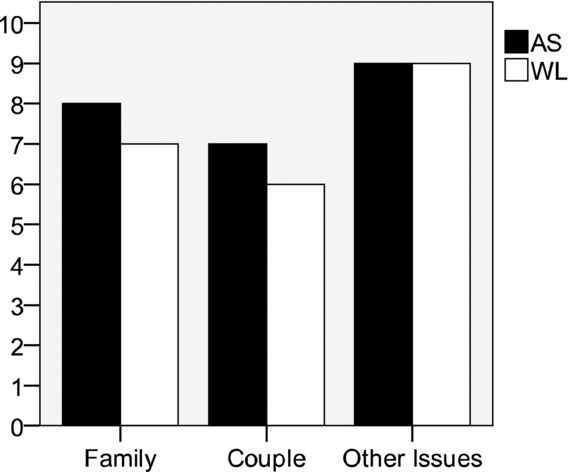
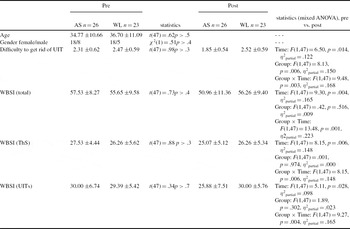
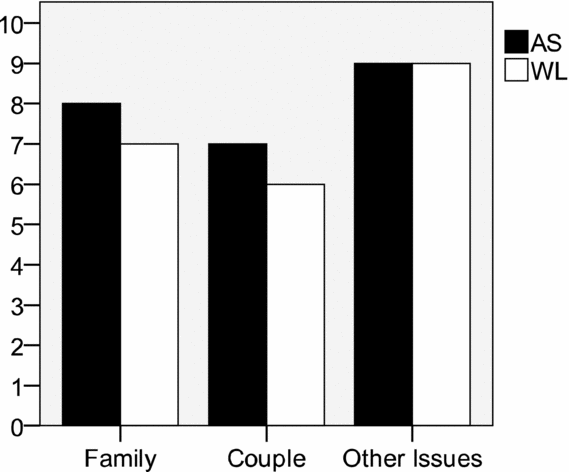
As can be seen in Table 1, groups did not differ in age, gender distribution, difficulty experienced by the participants to get rid of UITs or WBSI baseline subscale or total scores. Figure 2 displays the core theme of the intrusion for each group. No significant differences emerged, χ2(2) = .057, p > .9. The main themes were as follows: family (e.g. “my child had an accident”), couple (e.g. “my partner is cheating”) and other issues (e.g. “I'm going to be fired from work”).
Baseline characteristics and change over time on the White Bear Suppression Inventory (WBSI)

Distribution of the UITs cores across themes at baseline
WBSI total score and subscores were entered as the respective dependent variables for the mixed ANOVA models. The main analysis considered completers only. As can be derived from Table 1, the effect of Time was significant throughout for the two WBSI subscores and the total score. This was qualified by a Group × Time interaction, which achieved significance at a large effect size (ηpartial2 = .168) owing to a much steeper symptom decline in the AS relative to the WL group. Subsequent paired t-tests revealed that the WL group did not change over time, t(22)<1, p > .3, whereas for the AS group a significant improvement was noted across all scales, t(25)>3, p < .01.
The variable measuring difficulty to get rid of UITs achieved significance for all main effects and the interaction (Table 1). The effects for Group and the Time × Group interaction showed a large effect size (ηpartial2 = .165). A paired t-test revealed similar results as shown for the WBSI: the WL group did not change over time, t(22) = .569, p > .5, whereas for the AS group a significant improvement was noted, t(25) = 3.333, p < .01.
Finally, all AS participants considered the treatment effective. On average initial improvement was experienced on the sixth day (Mean = 6.23; SD = 2.86).
Discussion
Our results suggest that association splitting (AS) is effective for the reduction of UITs as well as the difficulty to get rid of such thoughts. However, these results should be interpreted cautiously in view of the limitations of the study, for example the reliance on self-report measurement, the lack of a follow-up, a wide range of intrusive contents and the absence of a diagnostic interview to verify the healthy status of the nonclinical participants at baseline.
Reductions on mean scores of WBSI (from 57.53 to 50.96) were mainly due to reductions in UITs’ subscale (from 30 to 25.88). Reductions on the ThS subscale were somewhat smaller (from 27.53 to 25.07). For the WL group, mean WBSI scores slightly increased from baseline to follow-up. Similar increases in WBSI's total mean scores were observed by Marino Carper and his colleagues (Reference Marino-Carper, Negy, Burns and Lunt2010) who assessed the effect of psychoeducation on thought-action fusion (TAF) and ThS, in a sample of undergraduate students with slightly elevated levels of TAF.
Overall, participants undergoing AS reported fewer problems to get rid of intrusions and all participants considered AS an effective technique. Positive effects were noted within the first week of treatment demonstrating the potential of AS for the treatment of UITs in a nonclinical population. Although the WBSI could be an indicator for the evaluation of the effect of the AS over the frequency of UITs, it should be taken into account that the final evaluation of every participant's treatment effect can be considered as a measure of its effect on specific UITs.
The results suggest that the AS technique could be a useful intervention to help people with a potential vulnerability to a clinical problem, to control the frequency of their UITs as well as the use of ThS. It is suggested for future studies to evaluate the effect of non-specific factors for treatment outcome such as expectations, motivation or treatment compliance (Hyland, Reference Hyland2011) and the use of active control interventions.



Comments
No Comments have been published for this article.