In 1786, the 13-year-old Sarah Brown of Providence, Rhode Island, gave herself the nickname ‘L’aimable fille’. Sally, as she was called, wrote the appellation on a page of music manuscript paper, which was then gathered with pages of hand-copied and printed music and bound into an album with a sturdy leather spine.Footnote 1 Thus began Sally’s lifelong habit of collecting music. By the time she died at the age of 72 in 1846, she had amassed a considerable library consisting of two manuscript music books, two bound volumes of printed and manuscript music, eight printed scores and one gathering from a larger collection of printed sheet music (held together by stab stitching), two binder’s collections of sheet music and one hymnal.Footnote 2 Her collection was uncommonly large in early national America, putting Sally on a par with elite British women.Footnote 3 Tracing how Sally accumulated this library sheds new light on the history of music consumerism, and in particular on how provincialism tempered privilege in eighteenth-century America. In this context, the effort and expertise of collecting – particularly by means of copying music by hand – should be reframed as a form of domestic labour, the gendered connotations of which have led to their historical and historiographical obscurity. Additionally, although seldom acknowledged in scholarship on music books, consumerism in this period relied on a trade network that was global in scale and that relied on exploited workers. This article makes a case for the need to recognize the various levels of labour operative in collecting music.
Building a large music collection required considerable economic and social capital, which in Sally’s case came from her family’s trading business. James and Obadiah Brown, her grandfather and great-uncle, forayed into maritime trade in the Caribbean in the 1730s, eventually expanding to transatlantic routes. Pork, beef, fish, flour, lumber, tools and spermaceti candles left Rhode Island on their ships, which returned carrying molasses and sugar from Surinam, Hispaniola and St Eustatius. They made sporadic stabs at the slave trade as well.Footnote 4 By 1760, the year Sally’s father, John Brown, married her mother, Sarah Smith, the family owned a fleet of 84 ships.Footnote 5 Thanks to advantageous smuggling and trading during the Seven Years War and the American Revolution, the family was wealthy and politically influential when Sally was growing up in the 1770s and 1780s.Footnote 6
Even the most privileged eighteenth-century Americans faced hurdles if they wished to acquire a substantial music collection. Geographic provincialism strained the seams of the music-book trade. Traders circulated music publications readily in European cities, but faced obstacles in reaching American audiences: the challenges of transoceanic communication, limited infrastructure, unreliable supplies and a transient (and often volatile) readership accustomed to an entrenched manuscript culture.Footnote 7 The early national period witnessed an expansion of the music trade, thanks to the growing number of music sellers and printers in US cities, but access to music goods was capricious.Footnote 8 American music consumers waited weeks or even months for transatlantic voyages to bring the latest repertory from Britain and Europe.Footnote 9 Expense was a key factor, as merchants recognized that the distance and time required for transportation made music a luxury commodity. Sally, like others, supplemented her print collection by copying music by hand, an activity that came at a cost of time and effort, and was far from independent of international trade: the very materials out of which music books were made – paper and ink – relied on imported raw supplies.Footnote 10 Her music collection is noteworthy for its size, but also reveals a broader pattern in how it was imbricated in both an economy of individual, gendered and domestic production and a worldwide mercantile network.
The differences and difficulties of the early American music trade afford new views into two areas of book-historical scholarship. The first pertains to bibliographical classification and the history of music reproduction technologies. Printed and hand-copied music must be considered in tandem, not separately, in the eighteenth century. Much scholarly attention has been paid to music printers and publishers, tracking technological innovations and engagement with authors (or composers) beginning in the sixteenth century.Footnote 11 Yet the creation and circulation of manuscript music continued to be robust into the nineteenth century.Footnote 12 This was particularly true in the USA, where the establishment of the print publishing industry was delayed in comparison with both Europe and Spanish America (music was not printed in British North America until the ninth edition of the Bay Psalm Book in 1698). Additionally, early Americans were accustomed to the dissemination via manuscript not only of music, but also of political documents, poetry and other written genres.Footnote 13 Attending to the interconnection between manuscript and printed music helps to illuminate the various formats through which music lovers consumed repertory, dispelling the anachronistic sense that manuscripts always precede (and give way to) print.Footnote 14
Secondly, early American music-book culture highlights, and begins to dismantle, the gender imbalance of book-historical studies by focusing on women copyists and collectors. Scholarly attention to male printers and publishers has advanced at the expense of women, whose roles in the production of music’s material formats have been sidelined. Female composers, printers and publishers are typically granted an exceptional status against the male norm.Footnote 15 Of course, this gender hierarchy was intertwined with curtailment of opportunities for women in a patriarchal society, which itself encouraged a misogynistic attitude towards women musicians generally. The most common roles for women were as consumers or players, which – although both were far from passive – were denigrated discursively and discouraged practically. Young women’s musical accomplishments fitted uneasily in a society that required women to train rigorously in order to subordinate themselves to some form of pleasing gentility.Footnote 16 In prescriptive literature women were considered gullible receptacles for fashionable repertory, liable to embarrass themselves and their families through their inept performances. Writers recommended ornamental accomplishments with caution, expressing scepticism about the practicality of such pursuits given the time and expense required (although the utility of musical skill during courtship was widely acknowledged). Thus, women were expected to acquire skills that would cultivate refinement both in their homes and in society broadly, yet they were meant not to invest too much effort in such skills, lest they waste valuable resources or become too enamoured with impractical (and, worse still, selfish or self-aggrandizing) hobbies. Such an account of the discourse of female accomplishments is well known, and this article does not argue for a re-evaluation of the subordinate status afforded women as players of music. Instead, it proposes to blur the gendered construction of a producer–consumer binary by shifting focus from the commercial centres of music printing and publishing in Europe to the early USA and by attending to manuscript and printed music together.
The following examination of Sally’s music collection is a microhistory, narrow in scale but broad in scope.Footnote 17 Through this microhistory of Sally we can identify the external factors that influenced and constrained amateur musicians, how their efforts were perceived (by themselves and others) and, to a certain extent, the nature of their emotional connections with and through music. Although Sally had resources to collect more music than her American peers, her experiences were not exceptional. Like others, she was limited in her choice of repertory by what was available to her (although, as we shall see, she expressed her preferences). It is because she was not unique that Sally’s story is a good candidate for a microhistorical study. The intervention made possible by microhistory, as opposed to biography, stems from the focus on ordinary subjects whose lives serve as prisms of their worlds, whereas biography examines the lives of noteworthy individuals who made exceptional contributions to history.Footnote 18 Indeed, many microhistories focus on people who, because they were not in positions of power, are not usually captured in the historical record.Footnote 19 Sally was marginalized owing to her gender, but in other ways she was privileged: what makes her unusual is the existence of a significant archival record of her life and music collection, which testifies to her position as a white woman from a wealthy family whose members were politically, socially and economically influential.Footnote 20 Her family position makes it possible to trace the reverberations of Sally’s music collection at a broad level, both geographically and thematically.
Undergirding the microhistorical approach is the premiss that it is possible to generate a productive intimacy with the subject, and in what follows we come to know Sally well enough to establish, perhaps, a sense of sympathy with her.Footnote 21 Sympathetic attachment is familiar to musicologists, many of whom harbour abiding love of the music and musicians they study; exploring sympathy’s potential usefulness for analysing the experiences of amateur musicians is a contribution this article seeks to make. The microhistorical analysis presented below also brings into intimate focus the structural dynamics of gender, labour and the book trade. Such intimacy prompts, by way of conclusion, a consideration of the importance of attending to easily overlooked historical subjects – both topics and people.
Luxury and the American consumer of music
Sally Brown’s collection reflects the vexed status of music books and sheet music as consumer goods. All consumer goods carried complex symbolic meanings, politicized whether they were domestically made or imported, and gendered if they were considered useful or ornamental.Footnote 22 In the Revolutionary era, political economy and gender hierarchy collided in the evaluation of goods. Such was the case when more than 100 women formed an ‘Economical Association’ in Hartford, Connecticut, in 1786. Facing a post-war depression, the women vowed to avoid silk and decorative clothes that followed English or French fashions, making a moral and economic argument that manufacturing the ‘infinite variety of gewgaws and frippery’ of such clothes might provide useful work for people in England and France, but did little to support the US economy. They decried ‘foreign nations’ for making American consumers ‘dependent on the interest, or caprice, of foreigners, both for taste and manners; it prevents the exercise of our own ingenuity, and makes us the slaves of milliners and mantua-makers in London or Paris’.Footnote 23 Despite the heightened focus on transatlantic trade following the Revolution, Americans had in fact been purchasing imported goods for decades, for such goods were favoured for their quality and fashionableness. The politicized, gendered response to fashionable goods was part of a broader consumer revolution shadowing the American Revolution.Footnote 24 The ramifications of this revolution for music can be witnessed in the increasing number of music purveyors in the 1780s and 1790s, which provided buyers like Sally with more sources of printed music. Not surprisingly, printed music was implicated in the broader debates about the value and threat of imported commodities.
American consumers were most likely to find music at non-specialized shops that carried a variety of books, paper and other supplies. Several Providence printers and shopkeepers sold music. John Carter operated a long-standing print shop and bookshop, where he offered sacred and secular music, almanacs, textbooks for Rhode Island College, political and religious pamphlets and a weekly newspaper, the Providence Gazette, which he issued from 1767 nearly until his retirement in 1814. He also supplied his wealthy patrons with luxury goods. In his newspaper, Carter regularly advertised the availability of sheet music at his store, along with other luxury goods such as ‘Japanned and Pewter Ink-Chests’, ‘Aleppo Galls’, fashionable magazines from London and ‘very elegant Ass-Skin Memorandum-Books’.Footnote 25 Within weeks of the Revolutionary War’s end, excited about the resumption of trade with Britain, Carter alerted readers that he had for sale books and stationery imported on a ship from London, including the latest song collections and ‘an elegant assortment’ of paper, copybooks and other stationery supplies.Footnote 26 Given the poor quality of American manufactured paper (discussed below), such imports were desperately needed. Also in Providence was David Vinton, who offered an array of genteel items at his shop, from jewellery and spectacles to French perfume and violet-scented hair-powder to spice and other groceries. His newspaper advertisements, which appeared in Carter’s Providence Gazette in the late 1790s and early 1800s, regularly mentioned his supply of hundreds of pieces of ‘the newest and most Fashionable Music in England and America’, a catalogue that he promised to supply free to potential customers.Footnote 27
The local music suppliers were humbler than their counterparts in European cities, yet Sally enjoyed a wealth of options when compared with the many amateurs who lived in US rural areas or smaller towns that lacked dedicated music emporia.Footnote 28 In Massachusetts, for instance, the difference between large and small towns was massive: coastal Boston had 519 shops of all sorts, as opposed to inland Worcester’s mere 12.Footnote 29 A young lady of means on a rural farm would need to rely on agents in the metropolis, or on the network of pedlars who toted books and other goods along country roads to potential customers.Footnote 30 Such independent agents were useful in towns of all sizes, however. When the composer-teacher-publisher Oliver Shaw arrived in early May 1807 in Dedham, Massachusetts, where the population was under 2,000, he placed a newspaper advertisement stating that ‘for the accommodation of his Scholars’ he was selling ‘blank and printed Music Books, [and] Music Paper in sheets’.Footnote 31 Even in a larger centre like Providence (population 7,614 in the 1800 census), independent agents sought customers through the same means.Footnote 32 William Blodget advertised in the Providence Gazette and Country Journal his ability to ‘put those who are in Want of Instruments in an easy Way to obtain them’, while also supplying instruction and music.Footnote 33 His announcement must have met with some success, as a few years later Sally’s future husband purchased an Ignace Pleyel score from Blodget for her.Footnote 34
By the end of the eighteenth century, specialist music shops were increasingly common in the USA and the array of music supplies increased. Many of the shops were established by immigrant musician-entrepreneurs who thronged to the USA intent on trying their luck in the new nation’s markets. Immigrants like Benjamin Carr and George Willig set up publishing businesses in Philadelphia, as did James Hewitt in New York and Peter A. von Hagen in Boston. These men made European repertory more widely available, taking advantage of the limitations of US copyright laws by reprinting pieces composed and published internationally. In New York, Hewitt issued 600 pieces between 1793 and 1810, a number matched by Gottfried Graupner in Boston and by the Philadelphia entrepreneur Carr during his 31 years in the industry, and doubled by Willig and George Blake, also in Philadelphia.Footnote 35 Newly arrived music purveyors also sold various music supplies. In 1795 Willig promised patrons ‘all kinds of musical instruments, grand and small Piano Fortes, of different prices, German Flutes, Clarinets, Fifes, Violins, Guitars, all kinds of strings for every Instrument, Ruled music paper, &c. As also, a fine collection of the newest music for every instrument’.Footnote 36 The number of sacred-music imprints also rose dramatically, with a fourfold increase between the 1760s and the 1790s.Footnote 37
Throughout this period, women and men continued to copy music by hand, and as the availability of both printed and manuscript music increased, differences between the two mediums made music’s position as a luxury good ambiguous.Footnote 38 On the one hand, unique copies created by amateurs were non-fungible. In this sense, such manuscript books were not unlike portraits: expensive to procure, cherished by family members, but of no cash value outside the household.Footnote 39 Such items were different from manuscripts created by professional copyists, which could be found for sale in shops and were often quite exquisite.Footnote 40 Manuscript music was costly in another sense, however, requiring hours of time and considerable effort and training to write music clearly and regularly. On the other hand, printed music was expensive, and small print runs and high prices put sheet music out of reach for many amateurs.Footnote 41 Even as music became more widely available, it remained costly: the price of sheet music was usually 25 cents per piece.Footnote 42 For context, an entire evening’s entertainment at Philadelphia’s New Theater in 1810 cost between 50 cents and $1. Or, for the price of one piece of music one could buy nearly half a gallon of molasses or a quart of rum.Footnote 43 Of course, not all music was deemed a luxury, regardless of price: just as some books, such as Bibles, were deemed essential and were commonly owned, so too did psalters and hymn books often fall into the category of a utilitarian household staple. In fact, if a family or an individual owned a music book, most likely it would be religious, containing hymns and psalms.Footnote 44
Advertisements offer clues as to the commodity status of music.Footnote 45 These too were contradictory, as music was advertised as both a luxury and a useful item. One Boston retailer listed his latest ‘elegant assortment’ of wares that arrived on ‘Vessels from London, Bristol, and Liverpool’, consisting of ‘Writing Paper; Ruled Music Paper; White and coloured silk Hose’ and other refined goods.Footnote 46 The Providence shopkeeper Samuel W. Greene offered, ‘by the latest Vessels from Europe, a very genteel Assortment of European goods’, including hose, silk breeches, ‘fancy ribbons’, lace, buckles ‘of the newest Patterns’ and, at the bottom of the list, German flutes and ‘A Variety of Music for the Piano-Forte, Harpsicord, Flute and Guittar’.Footnote 47 The inclusion of music supplies in lists of luxury goods is especially noticeable in the advertisements of shopkeepers for whom music was a specialized subgenre of their trade (as opposed to dedicated music sellers), reflecting the seller’s own sense of the goods’ exotic status. When music was listed with functional goods rather than luxury commodities, its implicit status shifted. Music paper appeared in advertisements with account books, blank books, various kinds of paper, and ink and writing accoutrements, underscoring its utility. As William Poyntell advertised straightforwardly for his Philadelphia stationery store, he had ‘Musick paper of a good quality, ruled or plain’.Footnote 48 (Poyntell also offered ‘London ruled music books of all sizes, music paper’.Footnote 49) Catalogues from bookseller-stationers also offered music paper bound in blank books or loose. For example, Charles Peirce in Portsmouth, New Hampshire, offered a catalogue of books and supplies that included ‘Blank and ruled music paper, per sheet or quire’ as well as ‘Ruled Music Books, bound’ for 6–12 shillings, along with other stationery supplies of paper, black and red ink, gold leaf, sand and pencils.Footnote 50
The ambiguity of music’s luxury status is epitomized by bindings. Music collections needed to be bound if their owners wished them to survive, and bookbinding’s quality was evaluated through the materials used, the skill applied and the level of complexity required. Like other areas of the book trade, international supplies were needed to make bindings. The tools were imported from across the Atlantic, and binding designs seen in London, Edinburgh and Dublin could be found within a few years in America. An influx of English, Scottish and Irish bookbinders in the 1760s and 1770s helped provide American consumers with expert labour.Footnote 51 Eighteenth-century American bookbinders tended to use sheepskin over wood or pasteboard, although music manuscripts were often bound with marbled paper-covered boards and leather spines, the minimal tooling demanding fewer implements.Footnote 52 When books were pre-bound before sale, booksellers used cheaper materials, as was also the case with other kinds of blank books.Footnote 53 Sally’s books reflect a desire for preservation without significant investment. Most were bound in an undetermined year with leather spines and marbled paper over the boards, but the dimensions of the books are inconsistent and not all show the same handiwork with the same materials. Only one of Sally’s books (the binder’s volume Select Musick; see Appendix 2) enjoys a more luxurious binding; it boasts a handsome red leather spine decorated with gold tooling and the words Select Musick lettered in gilt, with marbled paper over the boards and red leather corners, also tooled. But her other volumes were plain and, on the evidence of their covers, Sally’s entire collection was not especially luxurious. Yet the fact that the work was professionally done at the very least signalled her relative affluence. Many amateurs simply stitched heavy stock paper covers over their hand-made collections.
Ultimately, economic definitions of luxury are insufficient for analysing the value of music books, failing to account for the symbolic and affective significance attached to such items. Personal, non-monetary value was consequential, particularly in Sally’s case, as she repeatedly received music as gifts. One of her first music books was a present from Harrison Gray Otis, a prominent congressman from Boston, who gave to Sally a score of William Shield’s popular opera Rosina that had belonged to his daughter Elizabeth, who died in 1788 at the age of 20. The verso of the title page of the printed score testifies to this loss and subsequent gift, noting ‘Eliza Otis 1788 died about 20 years of age’. The first page of the overture carries this inscription: ‘1788 presented S Brown by H. G. Otis Esq of Boston’.Footnote 54 Sally was, in a sense, becoming the musical surrogate for Elizabeth Otis, continuing her musical activities and aiding her father’s mourning by perpetuating the young woman’s memory.Footnote 55
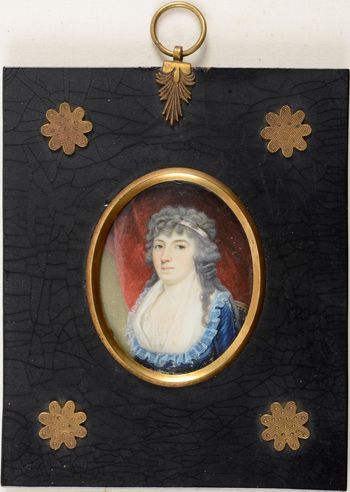
The giving of music could contain a romantic dimension as well, and music was a key part of Sally’s courtship with Charles Frederick Herreshoff. Charles was a cultured German immigrant, the son of a Prussian military officer and ten years older than Sally. He sang well and was a capable flautist. But despite his charm he was not very successful in his work as an engineer (the tragic consequences of which are discussed below). Sally’s father disapproved of the match, and relented only after Sally threatened to run off with Charles without her father’s consent (after eight years of waiting).Footnote 56 During their courtship, Charles wrote regularly to her about his missions to find music he thought she would enjoy, as well as repertory she specifically requested. ‘That you were pleased with the little pieces of music I sent you, I was glad to hear,’ Charles wrote in an undated letter. His letters suggest that Sally requested he find specific repertory for her: ‘I could not find Hooks [sic] grand lessons,’ he wrote from New York on 9 November 1798 (referring to pieces by the popular English composer James Hook). ‘I shall try to get them in Philadelphia: in the mean while, I send you some new songs and some music of Pleyel,’ he promised.Footnote 57 As they grew more intimate, and more impatient, Charles’s messages convey the desire and pleasure he hoped to stoke through their musical connection. ‘I collected a few songs, and hope that you may find something amongst them that pleases you,’ he wrote from New York in December 1799, noting that he took care to locate a German song she had admired.Footnote 58 Charles also carried a miniature portrait of Sally with him (‘Though it is an imperfect one, I cannot help looking at it ten times a day. I think the mouth is the best part of it, and therefore I use to kiss it in preference,’ he wrote; see Figure 1).Footnote 59 After they married, Charles’s influence remained apparent in Sally’s library. She acquired a book of Haydn songs in German and Italian with piano accompaniment, imported from Leipzig, and also collected German repertory translated into English.Footnote 60
Miniature portrait of Sarah Brown [Herreshoff] by Edward Greene Malbone, 1795. Courtesy of the Rhode Island Historical Society.

The connection between music and courtship is well known to musicologists, and although it is unknown whether Sally and Charles enjoyed playing music together, it is certainly possible. The licit thrill of young women and men communing chastely through domestic performance, a socially sanctioned form of intimacy, was normative in the USA in the eighteenth century. Such behaviour was depicted in bestselling novels, where fictional characters acted out appropriate modes of sociability (which contrasted with the dangerous sexual liaisons to which the female characters often fell victim). The titular character of Hannah Webster Foster’s bestselling novel The Coquette; or, the History of Eliza Wharton describes a day spent with her suitor and others in which ‘the ladies sung, and played by turns on the Piano Forte; while some of the gentlemen accompanied with the flute, the clarinet, and the violin, forming in the whole a very decent concert’.Footnote 61 Later in the novel she engages in an affair with a different, now-married ex-suitor, and her resulting pregnancy and death serve as the moral to the story.
In fact, a high level of physical, even sexual, intimacy was not unusual in courtship; but musical connections were safer.Footnote 62 Charles and Sally were often separated, however, and thus their connection was nurtured through paper media – printed music and letters. Not only did Charles purchase music for Sally, but his many letters to her reveal his longing as their courtship extended. Sally’s side of the correspondence is lost, but Charles’s epistles are filled with emotional, intimate pronouncements. ‘My love is too powerful for my reason,’ he wrote the year before they finally wed.Footnote 63 The philosophical and cultural discourse of sensibility surfaced in Charles’s letters. Sensibility, or the acute responsiveness to external stimuli, including music, was a dominant framework for many Americans, and in the post-Revolutionary period it took on political undertones, tied to the idea of a virtuous citizenry that brought sympathy and mutual awareness to civic participation.Footnote 64 The very vibrations of musical sounds might set individuals resonating with each other in a corporate body.Footnote 65 Charles was seemingly trying to bring Sally into attunement with his emotional (if not necessarily political) resonance, using gifts of music to do so. The urgency of this romantic musical transaction was underscored in his letters. ‘Yes you dear angel, that unites every thing to make a sensible man the most happy creature in the world,’ Charles wrote in 1798, ascribing to Sally the traits needed to complement his own heightened feeling.Footnote 66 For Charles, the ability to procure specific repertory for his beloved was not a luxury at all, but a necessity. For Sally, however, accustomed to possessing the finest commodities money could buy, luxury and utility were less significant than the personal ties her collection emblematized.
‘The feelings I most delight in’: family intimacy and the labour of pricking tunes
While Charles Herreshoff visited emporia on his travels, Sally Brown stayed at home in Rhode Island. Although the domestic realm is by no means shrouded from historical enquiry, gendered ideologies about domesticity and labour stripped the work done there of its meaning and value. Plenty is known about musical performance in the home, but other forms of musical activity, particularly copying music, are less well understood.Footnote 67 For eighteenth-century people of all stations, the house was a primary site of industriousness, no mere space for leisurely private consumption; production was constant in American homes. The supreme comforts of a wealthy domicile belie not only the amount of effort that went into housekeeping and maintenance (work performed by free and enslaved servants in Sally’s house, although she also kept a garden herself), but also the work involved in the routine business of producing a variety of material goods at home. Recognizing Sally’s music collection as one of the goods produced at home means recontextualizing amateur musical labour as part of a broader regime of gendered domestic activity, the value of which was contested. Worth was measured not just in currency; personal satisfaction and emotional intimacy were two important outcomes of musical labour, results that were hard to detect because of the prevailing tendency, both historical and historiographical, to associate the home with an immutable private sphere, and to relegate all that transpired with the amorphous designation ‘feminine’.Footnote 68 The domestic realm was no separate female sphere of demure, gentle industry; such imagery is the residue of sentimental nineteenth-century nostalgia that masks manual and affective labour.Footnote 69 Assessing Sally’s habit of copying music by hand helps to recover the social and economic significance of such work.
Sally’s father built a majestic house in 1786–8. Nothing confirmed a family’s position as convincingly as their home, and undertaking such a project was expensive and time-consuming.Footnote 70 Although life for elite Americans in the post-Revolutionary generation was comfortable (overall, the standard of living improved in the eighteenth century as people built less primitive houses, filled the houses with furniture to sit and lie down on, and decorated those houses with carpets, curtains and bed linens that made domestic environments more pleasant), mansions were rare.Footnote 71 Many people did not live in single-family units at all, and instead occupied ‘housefuls’ (houses that included multiple families and individuals, the transient and less financially secure men and women whose labour provided services that drove urban economies).Footnote 72 By contrast, the Browns’ 12-room mansion sat atop a hill that overlooked the Providence River and was designed in the latest Georgian fashion. John Brown filled the family house with the finest furniture: mahogany tables of all sizes with elegant bowed legs, numerous chairs with fashionable claw-feet, four-poster beds, mirrors, portraits and paintings, silver and Chinese porcelain. Visitors ascended two sets of steps to reach the large front door, which brought them into a grand, high-ceilinged foyer. To the left of the foyer was an informal sitting room that served as a sanctuary for the female members of the family. Large windows provided front and side views, allowing occupants to see who approached the house, who walked by and what was happening down the hill towards the river. In this informal sitting room Sally sat with her mother and sisters as they read, sewed, conversed, wrote letters and drew. This was also probably where Sally practised the harpsichord and copied music.
Musical labour was folded into a wide array of work, from maintenance chores and everyday tasks to the production of goods to the social demands of polite entertainment. The physicality of such work was intense, and in cities such as Providence, households were locations for demanding chores such as spinning, sewing, cooking, washing and gardening. Women made the clothes, food and amenities that kept urban societies functioning. Increasingly after the Revolution, this domestic labour was paid for in cash (rather than trade). A woman running a boarding house, for example, could itemize her services and extract various fees on the basis of what she offered, from room and board to mending, providing specialized food or nursing. ‘Putting out’, or taking in piecework such as spinning or sewing, was another form of paid labour. Hiring out enslaved men and women extended the labour further down the social ladder, sometimes but not necessarily always bestowing greater economic agency on those individuals. And overall, those white women with greater skills and expertise could charge more, resulting in a hierarchy of specialization to which real cash amounts were put.Footnote 73 The knowledge of how to handle money through budgeting and record-keeping was considered an essential part of domestic labour, one that was supported by prescriptive and educational literature.Footnote 74 Even shopping was a form of labour, one in which women could demonstrate expertise by knowing the qualities they were seeking and being cognizant of what a fair price was.Footnote 75 Women’s work was being bought and paid for, and some of its end results, such as homespun cloth (which was a symbol of patriotism during the Revolution and subsequently could be used for bartering when cash was short), was quite visible. But much of it was not – a great deal of women’s industry, including ornamental accomplishments, as well as all the budgeting and shopping already mentioned, were unpaid by definition. When it came to musical accomplishments in particular, whether or not the work was remunerated depended on gender.
Copying music, an activity considered to be at once both leisured and a chore, was part of the broader domestic economy of the early republic.Footnote 76 Presumably amateurs such as Sally wrote out pieces willingly (or rather, with no more coercion than was ordinary for accomplished young women), and in copying she participated in a cultural economy that was explicitly non-monetary.Footnote 77 Such recreational labour was one layer of the increasingly stratified economy of domestic work. However, copying music was a job that could be hired out: not unlike the ‘putting out’ that women did, male music copyists took in piecework for pay.Footnote 78 In Philadelphia, John Gualdo advertised that he could hire out his servant, a ‘boy who copies music; therefore if any gentleman or lady should want a particular song, sonata, trio, duet, solo, minuet or country dance, they may be supplied with [it], without buying the whole book, in which such song, sonata, &c., might be printed’.Footnote 79 Augustus Storr worked as a copyist in Mansfield, Connecticut, producing a volume in 1797 that he inscribed ‘A Storr scribe’ under the elegant title page that listed the item as belonging to his patron, Eleazer Cary. Storr even noted the price.Footnote 80 Sally’s own first book shows the fluent hand of an anonymous teacher before her own crude (but improving) script takes over.Footnote 81 In the same way that one might hire a secretary to write letters, a copyist could be had to compile music into manuscript books, indicating that copying music was not simply a matter of education or self-fashioning, but sometimes merely the available mode of reproducing repertory.
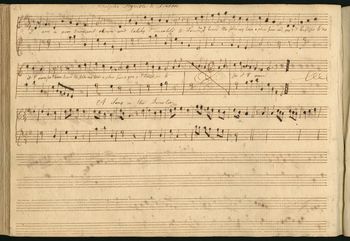
Copying was significant toil, even drudgery, whether or not one did it for pay. Sally’s many pages of manuscript music, diligently written, demanded expertise with the pen. In her earliest manuscript book her initial attempts to write are evident as an amateurish, awkward hand enters on the eleventh leaf of manuscript music, making errors but gradually improving over the subsequent pages. In ‘Ralph’s Ramble to London’, a song Sally copied in her earliest volume, she accidentally entered the same bar twice (see Figure 2). In the early 1790s, she copied music into another volume (Adieu), displaying traits of careful planning, occasional frugality and, most of all, painstaking work. We can track her progress in copying, for in some manuscripts she entered dates with several of the pieces she copied. As Sally entered music starting in 1791, she began with the sentimental songs, comic opera and dances she loved. ‘Adieu thou dreary Pile’ from Duenna is the first full song she copied, the four pages of music dated 9 November 1791. The next spring she resumed copying, the nib of her pen scratching out songs such as ‘Henry’s Cottage Maid’ on 18 April 1792 and ‘Greenwich Hills’ two days later.Footnote 82 That summer in the resort town of Newport, Connecticut, she continued to copy music, not dating all of it, but using the same thick-nibbed pen, and marking the ends of each piece with a decorative squiggle. The following two summers saw Sally copying more music into the book. She went back over her pages in 1796 and 1797, finding spaces in which to copy out more music. In her first pass through the music book she was haphazard with her use of space, but a few years later she made up for her casualness by carefully using much of the page area she had left free.
‘Ralph’s Ramble to London’, copied by Sally Brown, c.1788–1791, subsequently bound with the score to Rosina, p. [21]. Courtesy of the Rhode Island Historical Society.

Sally’s control over page layout calls attention to the other forms of handiwork with which music could be aligned, which in turn highlights how copying music was gendered. Drawing and embroidery were feminine accomplishments which, like music, resulted in aesthetic objects that were literally embellished and which also required the scrupulous harnessing of materials, control over the hand, a good eye and careful planning.Footnote 83 Women and men described ‘pricking’ melodies, using an antiquated term drawn from early polyphonic music that, coincidentally, conjured needlework (although pricking songs had nothing to do with the actual practice of sewing). ‘I Pricked some Tunes out of Holyokes singing Book,’ wrote one young woman in 1791.Footnote 84 Yet copying music might just as easily be compared to spinning. The diary of the young woman who ‘pricked’ hymns from a Samuel Holyoke tunebook spent most of her waking hours spinning, a task that also required fine motor control and had a high quotient of drudgery. Additionally, both homespun cloth and hand-copied music persisted alongside commercially available goods. Yet unlike spinning, copying music was not perceived to be an exclusively female pursuit: men copied music as well. Their efforts fell under a different paradigm of expectations, masculinity being constructed through self-assured penmanship, the selection of martial music (many men copied marches) and indications of homosocial musicking (evident through instrumental duets and drinking songs).Footnote 85 That men’s efforts were not put into the same framework as women’s ornamental accomplishments underscores the entrenched gendered association of such handiwork generally. When women copied music, the work’s value – both economic and cultural – was easily dismissed. Nevertheless, the ability to undertake such projects was significant for women.Footnote 86
In Sally’s case, the domestic production of music manuscripts was not simply a matter of occupying her time and supplementing goods available in shops. Rather, her musical activities fostered familial relationships, and her collection bears signs of her close connections with her children and husband. Sally conceived, gave birth to and raised five children in seven years, leaving her with little time for music. But in 1813, when her youngest child was four, Sally began to share her love of music with her oldest child, Anna, to whom she gave her own copy of a harpsichord instruction manual, inscribing it ‘from her affectionate Mother’.Footnote 87 In 1816, when Anna was 14, she was permitted to copy music into Sally’s own book.Footnote 88 Much as a mother would teach her daughter to spin and sew, Sally taught her daughter the handiwork she found meaningful and useful.
Sally’s collection also reflects the importance of music in times of strife. In December 1819, Charles Herreshoff died suddenly while alone on a tract of land owned by the Browns in upstate New York, some 250 miles from his family. He shot himself in the head. Charles had been suffering for some time – he had lived apart from the family sporadically for years, and permanently since 1818, and his expensive business failures alienated him from his in-laws (except for his sister-in-law, Abigail Brown Francis, who called him ‘a friend who had from my 1st acquaintance been interesting to me’).Footnote 89 His letters to Sally intimated his growing desperation. ‘My dear wife,’ he wrote on 3 April 1818, ‘Could I give you an exact account of my pain vicissitudes and troubles, you would not blame me for wishing my existence to be forgot by all my friends.’Footnote 90 The historian Terri Snyder notes that suicide was not an uncommon response by men to embarrassment about their ‘circumstances’.Footnote 91 Suicide was prominent in newspapers and novels; tales of men succumbing to overwhelming feelings fed the culture of sensibility. Yet while ‘self-murder’ was viewed with greater compassion in the early nineteenth century than it had been 150 years before, when it was considered a diabolical crime, Charles’s action still shook the family.Footnote 92 Sally’s older sister Abigail was the first in the family to learn of the tragedy, and immediately went with their brother James and two of Sally’s daughters to deliver the news to Sally. Abigail wrote in her diary that Sally knew ‘from the appearance of [her daughter] Anna that something painful had occurred’. Abigail told her, staying with ‘the afflicted family’ for a week.Footnote 93
Sally’s music books bear no direct evidence of this tragedy, except through absence: no music appears to have been copied in her books for two years after Charles’s death. In general, little of Sally’s interior life is documented. Her two diaries are terse and focused on external events, and most of her letters are lost.Footnote 94 Her music books, however, bear some clues. In particular, a binder’s volume contains a series of quotations that reflect Sally’s mindset in the early nineteenth century. The volume itself is the fancier item described above, a tall book bound in red leather and marbled paper, with attractive gold inlay and a spine bearing the embossed title Select Musick. Inside are bound high-quality engraved folio sheet music – the European instrumental music and British sentimental songs that were typical of Sally’s taste. On the back of the pages of music, Sally copied out extracts from a variety of publications. She did not date her inscriptions, and the range of time in which she might have copied spans four decades.Footnote 95 Nature captured her attention, and she gravitated towards first-person quotations, one of which was extracted from The Letters of Charlotte during her Connexion with Werter, a popular epistolary novel by a British author, Walter James, first published in 1786.Footnote 96 James’s novel was one of the numerous responses to Goethe’s Die Leiden des jungen Werthers, which first appeared in English translation in 1779. The Sturm und Drang of the German work aligned with an articulation of British sensibility focusing on melancholia that reached its apotheosis with suicide. (Thomas Chatterton, a poet associated with British sensibility, killed himself in 1770.Footnote 97) But as an anti-sensibility backlash took hold in Britain in the 1780s and 1790s, the main character’s ultimate fate alarmed British moralists.Footnote 98 James’s novel condemned the suicide for which Goethe’s work is famous, claiming that not only was ‘the horrible crime of Suicide […] justified and recommended!’ by Goethe, but that ‘the author, not satisfied with recommending a specific crime, has aimed a violent blow at all religion’.Footnote 99
The Letters of Charlotte during her Connexion with Werter was quite successful in the USA, where it appeared in several editions, including three different printings in New York in 1797. (Ironically, in 1807 a Boston edition of Goethe’s novel appeared with James’s Letters appended.Footnote 100) Sally’s choice of extract is suggestive, as is its placement in her binder’s volume. From one of Charlotte’s letters, she copied a segment that situated death as a minor matter compared with the grandeur and gravity of nature. She wrote out the following:
The feelings I most delight in are those I experience when in a fine morning, I ascend a mountain that commands an extensive prospect of woods and waters. My mind expands with the prospect before me, and I forget the petty distractions of mortality, by contemplating the whole Globe as one spot, as a little Paradise, diversified with innumerable beautiful objects, which receive additional splendor and cheerfulness from the rays of a refulgent sun.Footnote 101
This extract overflows with visceral and emotional imagery. The prospect of nature with a profusion of scenery – mountains, woods, a glade, water – verges on the fantastical (a point driven home by the reference to a location as ‘a little Paradise’). This superabundance of nature’s vistas is complemented by affective and aesthetic pleasures, the vague ‘beautiful objects’ and the happy illumination. Positivity bursts from the page, dampened only passingly by the reference to mortality. And yet, mortality is impossible to avoid, for Goethe’s novel and the many spin-offs it inspired were famous for foregrounding suicide. Whether Sally’s copying of these lines preceded or followed Charles’s death we do not know, but the act of highlighting and preserving these lines suggests a willingness and desire to frame mortality – an all-too-present fact in Sally’s world, as both her mother and her sister Abby (Abigail) died in the six years following Charles’s demise – as an issue of lesser concern when compared with the glories of nature, an attitude that might have provided emotional support in the harsh months following her husband’s suicide.
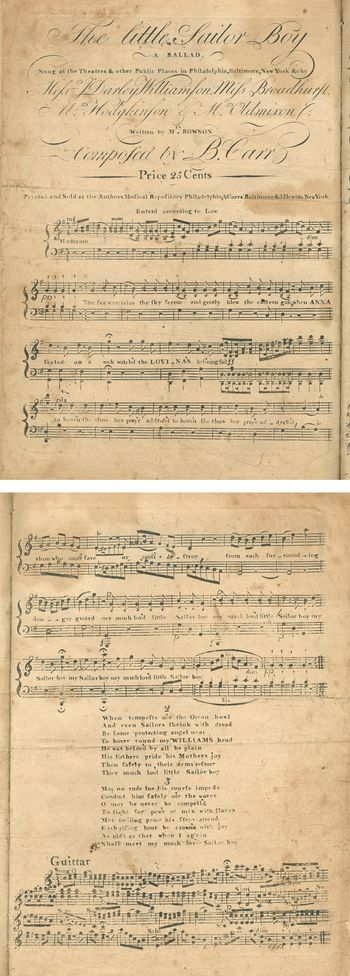
Bolstering the connection between the quotation and the death of Sally’s husband is the piece of music onto which she copied it. ‘The Little Sailor Boy’ is a sentimental song with music composed by Benjamin Carr and lyrics by Susanna Rowson (see Figure 3). Both were British immigrants to the USA who became significant figures in early American publishing: Carr a successful printer-publisher and music dealer, Rowson a famous author and playwright.Footnote 102 ‘The Little Sailor Boy’ is a strophic ballad that depicts a young woman waiting for her lover by the sea, dramatizing her distress as a gale picks up and threatens her sailor’s ship. The verses end with the repeated phrase ‘my much lov’d little Sailor boy’, climbing with each iteration until the melody pauses, first on a high g'', then on an a'', allowing the singer to ornament the word ‘boy’. The emphasis on this word resonated with specific intimacies they shared – Charles referred to himself as her ‘little boy’ in his affectionate, flirtatious letters during their courtship.Footnote 103 The anxiety and longing of the song chimes with their relationship, in which long periods of separation caused great angst.
‘The Little Sailor Boy’ by Benjamin Carr and Susanna Rowson. In Select Musick, a binder’s volume owned by Sally Brown Herreshoff, pp. [34]–[35]. She copied an extract from The Letters of Charlotte during her Connexion with Werter onto p. [36]. Courtesy of the Rhode Island Historical Society.

The intimacy that surfaces in Sally’s music books pushes the consideration of her library beyond consumer luxury or manuscript self-fashioning. Sally laboured to understand profound changes in her life circumstances, turning in part to the materials with which she was comfortable – music books. Sally lived in a pre-psychological world and would have had no notion of our contemporary discourse of ‘affective labour’ and ‘emotional work’. What she did experience, however, was the powerful pull of sympathy and the desire to express herself in terms both respectable and sensible through music. Such experiences and historical evidence have been considered private or personal, but rather than be sequestered because of their affective charge, they must be understood in the broader terms of the creation, circulation and collection of music books.
Global trade, exploitation and the raw supplies of music
If Sally Brown’s music collection requires an intimate level of focus, it also demands a much broader perspective, for it is impossible to understand amateur musicians’ experiences without considering larger patterns of trade. American ports were just one destination in a global network that linked British companies with the slave trade on Africa’s west coast, colonial plantations (particularly in the British West Indies) and the North American mainland.Footnote 104 Colonists relied heavily on English imports of groceries (tea, rum, sugar, spices), durable goods (cloth) and semi-durables (paper, glassware), including items they could produce themselves but chose to import (spending a considerable percentage of their budgets to do so).Footnote 105 Such patterns persisted after the British regime collapsed following the American Revolution. Indeed, more so than ever before, Americans such as Sally were connected to Britain and to global trade. They were denizens of a commercial empire.
The importance of acquiring goods from abroad was self-evident to those living in eighteenth-century America. Access to basic commodities, such as paper, could be erratic.Footnote 106 For music collectors, supplies were imported and refined into the finished product: music books. Music scores, whether print or manuscript, were made from several key products, many of which were not easy to come by, and which often relied on forced labour.Footnote 107 The need for paper was urgently felt in eighteenth-century America. The perennial stress of maintaining an adequate and affordable paper supply is well known to book historians, but the colonies faced exacerbated conditions, for even with the establishment of paper mills, the quality of rags and the ability of the workers to produce paper of sufficiently high quality fell short.Footnote 108 Colonial paper was often coarse, uneven and not white enough to please printers and consumers until after 1800. Instead, fine grades of paper were imported from England and particularly from Holland for much of the colonial and early national period.Footnote 109 Ink, another component of music books, drew on further-flung trade and exploited labourers. Crucial components of long-lasting smudge-proof ink came from Africa and the Levant. Gum arabic, needed to achieve the proper viscosity and to make the ink adhere to the page, was procured at high human and some environmental cost from acacia trees that grew in the sandy soil at the south-western edge of the Sahara desert.Footnote 110 (The gum oozed out when the bark cracked in the hot, dry wind. Labourers took to scoring the trees to create additional wounds; in return, the trees’ dense, spiny foliage scraped the arms of the labourers.) Difficult overseas labour was also necessary to produce oak gall, which provided acidity that was essential for ink. Small growths formed in response to secretions from wasps’ larvae, galls could form on any oak, although Syrian trees were most highly prized (ink made from these galls was called Aleppo or blue ink).Footnote 111 These raw supplies found their way into the homes of Americans who had little knowledge of the scars their consumer demand left on Saharan and Syrian tree branches and on human arms.
Transactions insulated the consumer from the extractive and exploitative labour that supplied their stationery goods, from the English, French and Dutch traders to local shopkeepers. When the Providence printer and shopkeeper Carter advertised ‘Aleppo Galls’, it was an announcement about availability of goods, abstracted from the human cost required to procure them.Footnote 112 No American could claim ignorance about slavery in general, of course, since the system of forced, unpaid labour was integral to the American economy. Sally had less of a buffer between herself and the workers who supplied amateur musicians with raw supplies, however. Her musical activities were supported by the family merchant business, and that business included the slave trade.Footnote 113 It was her father who encouraged his uncle and brothers to buy, transport and sell human beings, arguing that the trade was a vital part of Atlantic world commerce and thus represented a decided opportunity for profit. At least twice, John Brown sent ships filled with rum to West Africa to trade for stolen men and women.Footnote 114 On a voyage in 1764, 107 of the 196 women and men on board John’s ship died from suicide or disease. (This deadly ship was called Sally, and one wonders if the memories of its horrid fate did not haunt him when naming his daughter a decade later.Footnote 115) The deadliness and gross immorality of the trade did little to dissuade him, and when Rhode Island began to lead the nation in condemning the trade, John became a pro-slave trade activist. Disagreement about slavery split his family in two, for his brother, Moses Brown, became an abolitionist and pushed the General Assembly of Rhode Island to pass an act in 1774 that prohibited bringing slaves to the colony. (He also worked to bring about an act in 1784 that required the gradual abolition of slavery.Footnote 116) It became illegal for US citizens and residents of Rhode Island to take part in the transatlantic trade in any way in 1787, and Moses helped to establish the Providence Society for Promoting the Abolition of Slavery in 1789, an organization that became the main enforcement body for the law. This put him in direct opposition to John, whose continued involvement in the trade resulted in his prosecution in 1797. John paid the penalty, but not before complaining petulantly to his brother that it was not fair for American merchants to be shut out of a lucrative business enjoyed by their European counterparts.Footnote 117
It is hard to imagine that Sally and her siblings were oblivious to their father’s work in the slave trade, given the public nature of their uncle’s activism and their father’s prosecution.Footnote 118 Moreover, enslaved people lived and worked at the Browns’ house.Footnote 119 Thus, when Sally bent over her music paper to copy repertory, and when she sat at her keyboard practising, she did so because her leisure time was afforded by the forced labour of those both in her home and abroad.Footnote 120 For Sally’s leisurely labour as an amateur musician did not simply transpire in a genteel domestic economy that was separate from women and men who toiled for cash; it also stood apart from the unpaid, stolen labour of enslaved people. Sally and other accomplished amateurs’ efforts have been less than fully acknowledged in the historical record, but invisibility is not the same as erasure.Footnote 121
Minor histories
Sally Brown’s music collection resides in two sturdy archival boxes at the Rhode Island Historical Society. With their decaying bindings, crumbling pages and antiquated repertory, they appear forlorn, but are also alluring. In their 1980 published inventory of eighteenth-century American music manuscripts, James J. Fuld and Mary Wallace Davidson expressed the pleasure of working with manuscript books. ‘The manuscripts have been charming to examine,’ they wrote. ‘The personality of the compiler is evident from the selection and arrangement of pieces, the spelling mistakes, the occasional musical comments, the sentimental dedications, the precision or imprecision of the writing for emphasis, and the unanticipated crowdings at the ends of pages.’Footnote 122 Such an affectionate assessment is familiar to book historians, for whom working with material texts means considering the labour of another human being from whom one is separated by the distance of time. Scrutinizing how a book came to be the way it is – methodologically related to close work with other primary sources – breeds a deep sense of familiarity with the object itself but also, wistfully, with the person who made it.Footnote 123
To pore over Sally’s music collection, reconstructing how and why she copied repertory, ascertaining when and where she acquired printed music, is to plot out a narrative whose material evidence is anything but straightforward. The problem of putting her music library in a linear, historical narrative is that her materials ramify far beyond the specific contexts of her life. Not to account for the enslaved labour that supported her leisure activities is to perpetuate erasure. To ignore the emotional elements represented directly and obliquely in her music collection – the romantic connection with Charles and resistance from her father, the closeness to her children and older sister, the tragedy of loss – is to write off (or to banish to the ‘private’) the importance of sensibility and affect. These individual, personal and emotional aspects of music history fit with what the anthropologist Ann Laura Stoler calls ‘minor histories’. Stoler notes that even people and events considered to be insignificant when compared with a main historical narrative are not simply incidental: ‘“Minor” histories should not be mistaken for trivial ones. Nor are they iconic, mere microcosms of events played out elsewhere on a larger central stage.’Footnote 124 Minor histories expose elements that may have been forced out of larger historical narratives, elements such as emotion or, in the case of amateur music collecting, women’s work and enslaved labour. Because these aspects do not fit easily with more customary arguments about book history, luxury and consumerism, they must be located via different perspectives, the microhistorical and global, from which new vantage points can bring such ‘displaced histories’ and their dynamics into focus.Footnote 125
The intimate scope of this microhistory of Sally’s music collection brings into focus the significance of labour and affect. Personal connections were central to her musical life. She received printed music as gifts, and shared manuscript and printed music with her family. At a deep level, one that is elusive and hard to access, her music collection provides glimpses of her interiority – of what she thought and felt. Many elite eighteenth-century Americans conceived emotion through the discourse of sensibility, which prioritized sympathetic connection to others and heightened responsiveness to sensory experiences, including aesthetic ones. Sally’s approach to music collecting harboured both these aspects of sensibility, revealing her closeness to her husband and family and signalling her musical pleasure. Although this article focuses on the acquisition of repertory rather than the music itself, it is worth noting that the contents of her collection display traits of sensibility as well. Her books are filled with sentimental songs and arias arranged for keyboard and voice in the galant style popular on the eighteenth-century British stage. Dances and short keyboard pieces also fill her volumes, but her annotations show a preference for sentimental songs.Footnote 126 She marked Tommaso Giordani’s ‘Let Not Age thy Bloom Ensnare’ as ‘S. B.’s favorite song’, and a song entitled ‘The Kiss’ was subtitled ‘A favorite Song as sung by Miss Brown and Mr. Harrel’.Footnote 127 With simple, tuneful melodies and harmonies free of chromaticism, the predictable phrases of these songs foreground the lyrics, which recount in flowery language the minutiae of romantic attachment. Sally collected music that she enjoyed, and the affective dimension of music collecting – collecting as the pursuit of pleasure – was an important, if historically contentious, part of consumerism and the music-book trade.Footnote 128
Beyond the intimate domain of emotion, but connected to it, is the social and economic worth of Sally’s musical efforts, and of labour more broadly. Hers was an era when the overall value attributed to women’s work was declining. During the Revolution, women participated in political events, made homespun cloth to replace British imports and managed farms and businesses for their absent male relatives; but after the war, Revolutionary mothers and their daughters found themselves occupying a diminishing space outside the home. In an economy that increasingly used cash and evaluated labour by an hourly wage system, men’s work came to be seen as more valuable than women’s task-based work, such as sewing, cooking or, in Sally’s case, copying music and practising.Footnote 129 Between the discursive ambivalence about accomplishments and the changes to domestic economy, the effort of female amateur musicians such as Sally was readily demeaned and discounted. Nevertheless, she enjoyed enormous privileges as a member of the social and economic elite. Significantly, her status depended on the immiserated labour of others. The intersection of gender and race in the construction of the leisured amateur musician deserves closer scrutiny.Footnote 130 Much like the sugar used to sweeten her tea or the mahogany out of which her furniture was made, Sally’s consumption of music relied on others’ forced toil.Footnote 131 The very materials out of which her music books were made were implicated in a brutal system of enslaved labour and extractive global trade.Footnote 132 Unlike Sally, these women and men did not have the resources to leave a detailed historical record and are far less visible today than Sally herself, yet the centrality of their work in her story is irrefutable.Footnote 133
I have intentionally juxtaposed these different scales of work, from Sally’s careful copying to the global exploitation of enslaved women and men, in order to advance the idea that these scales are intimately connected. My choice of the term ‘intimacy’ stems from the work of Lisa Lowe, who uses it to consider underexamined connections across the multiple regions and peoples brought together by slavery and colonialism. ‘Intimacies’ refers not only to the connective tissue that strung together global networks, but also to personal ties that were part and parcel of the workings of these systems.Footnote 134 As a keyword, ‘intimacy’ also highlights the importance of personal taste and the affective dimension of music collecting. Although presented sequentially in this article, these various scales of perspective – intimate, local and global – are, like the types of labour, incommensurable in nature and significance and do not easily conform to a linear narrative. The discontinuities and incongruities are important; as Michel Foucault noted, from two perspectives, the micro and the macro, ‘events and their consequences are not arranged in the same way […] on each of the two levels, a different history is being written’.Footnote 135
This article is mostly a history of Sally Brown, but her story is bound together with those that are irrecoverable.Footnote 136 It is easier to conjure the local conditions of trade and the intimate realm in which Sally’s collection was created than to glean from its pages hints about the enormity of the global systems of exchange, extraction and manufacture that went into the creation of music books. In fact, on that topic the books themselves are mute, for without forensic analysis the origins of her ink, paper and bindings is unknowable, and without that knowledge the names and faces of the women and men whose efforts produced the raw supplies are blank. At the macrohistorical scale, gaps and silences remain. Yet uncertainty filters into the microhistorical level as well, for despite the fact that she came from an illustrious family and thus enjoyed a fairly prominent place in the archival record, Sally’s personal voice is not particularly present.Footnote 137 With the exception of a few letters and two brief diaries, few of her thoughts and experiences survive. She emerges instead through how she was seen by others, through the letters written to her and one miniature portrait. Her most significant archival presence is her music collection, the material form of which reveals not only her engagement with music consumption and gendered modes of production, but also the intersection of music gathering and interpersonal intimacy. However, considering her music collection from a radically different viewpoint (that is, from the perspective of the raw materials and labour regime on which she relied) has made more visible the historical actors rendered obscure in the historical record. Sally’s case reveals the ease with which US consumers who sought cosmopolitan musical products after the Revolution were drawn, whether wittingly or not, into trade networks whose tendrils curled around lives all over the world. Through its contrast with global trade, Sally’s music collecting emphasizes the privilege – the leisurely labour – of amateur musicians.
APPENDIX 1 HERRESHOFF MUSIC COLLECTION,
RHODE ISLAND HISTORICAL SOCIETY, MSS 490
| Item | Date | Number of items and pieces | Format and size | Number of pages |
|---|---|---|---|---|
| printed sheet music | undated (n.d.) | 2 pieces | oblong | 1 + 12 |
| printed sheet music | 1793–1867 and n.d. | 74 pieces | folio | 1–4 |
| binders’ volumes a | 1820–56 and n.d. | 6 items, 10–55 pieces each | portrait | 43–193 |
| miscellanies b | c.1790–1839 | 4 items | oblong and portrait | 11–125 |
| printed scores | 1784–1815 and n.d. | 17 items | oblong and portrait | 5–127 |
| printed score + manuscript | c.1788, c.1790 | 2 items | oblong | 76 + 100 |
| manuscript sheet music | c.1790–1867 | 25 items | assorted | 1–5 |
| manuscript books | c.1790–c.1830 | 6 items | assorted | 8–120 |
APPENDIX 2
SALLY BROWN HERRESHOFF’S COLLECTION
Note: These are the items in the Herreshoff Music Collection that can confidently be ascribed to Sally Brown’s library. Untitled items are identified by the first piece.
| Item | Date | Number of pieces | Format and size | Number of pages | Notes |
|---|---|---|---|---|---|
| MANUSCRIPT BOOKS | |||||
| The Nativity | c.1801–c.1830 | 45 | oblong, 23.3 × 29 cm | 112 | Marbled paper with leather spine, clumsily stitched to repair. First page inscribed ‘Sally Brown April 20th 1801’. |
| Adieu | 1791–7 | 43 | oblong, 23 × 28.5 cm | 80 | Pre-lined paper (10 staves/page), boards covered in leather, spine fallen off, reinforced with string tied through holes punched through board. Inside cover inscribed ‘Charles Frederick Herreshoff Jun. was born July 26th 1809’, marking the birth of Sally and Charles’s fifth and last child. |
| MIXED MANUSCRIPT AND PRINT | |||||
| Rosina | c.1788–1791 | 60 | oblong, 31 × 20.5 cm | 76 | Score of William Shield’s Rosina (London: Printed for Willm Napier, n.d.) bound with manuscript. Inscribed ‘Eliza Otis 1788 died about 20 years of age’ and ‘1788 presented S Brown by H. G. Otis Esq of Boston’. First page of manuscript inscribed ‘Sally Brown Boston 1786. L’aimable fille’. Manuscript: assorted songs and keyboard music. Pages trimmed, titles partially obscured. Annotations by Sally in manuscript. |
| Institutes of Music | c.1790 | portrait, 23 × 34 cm | 100 | Instructional volume for keyboard by Edward Miller (London: Longman and Broderip, n.d.). Inscribed ‘A. F. Herreshoff from her affectionate Mother S H.’; three pieces of manuscript music and three additional pieces of printed sheet music bound at the end of the volume. | |
| HYMNAL | |||||
| Oliver Shaw, The Providence Selection | 1815 | 110 | portrait, 14 × 22 cm | 127 | Pub. Dedham, MA: Printed by H. Mann & Co. Inscribed ‘Sarah Herreshoff presented by her affectionate [daughter] A[nna] Francis Dec. 23’. |
| PRINTED SCORES | |||||
| Oeuvres de J. Haydn. Cahier VIII, XV Airs et Chansons | 1799 | 16 | oblong, 33 × 24.5 cm | 91 | Pub. Leipzig: Breitkopf & Härtel; bright orange cover with elaborate border. Contains songs for keyboard and voice, a scene from Ariadne auf Naxos. |
| The German Erato, or A Collection of Favourite songs translated into English with their original music | 1800 | 66 | portrait, 21 × 26 cm | 125 | Pub. Berlin: H. Frölich, 3rd edn. Inscribed ‘S Herreshoff August 5th 1806’. |
| Six sonatines pour le clavecin by Thomaso Giordani | SB autograph 1794 | 6 | portrait, 34 × 24 cm | 26 | Pub. Berlin: J. J. Hummel. Lacks covers. Title page has three autographs: ‘Sally C. Brown, March 18th 1794’, ‘Sally Brown Herreshoff’ and ‘S Heresshoff’. |
| The Volunteers by Alexander Reinagle and Susanna Rowson | n.d. | 14 | portrait | 20 | Pub. Philadelphia, PA: A. Reinagle. Three autographs: ‘C. F. H.’ (Charles F. Herreshoff), ‘S. Herreshoff’ and ‘Sally Br’. |
| ‘French Air’ | after 1806 | 43 | 22.2 × 26.3 cm | 40 | Marbled paper over leather. Inscribed ‘Point Pleasant 23d 1845 S Herreshoff’. (Point Pleasant was the location of the Brown Family’s water-front estate in Bristol, Rhode Island). Songs and dances, bound with A Favourite Selection of Music; Adapted to the Piano Forte by O. Shaw and H. Mann (Dedham, MA: H. Mann, 1806). |
| ‘Oh ever in my bosom live’ | c.1800 | 8 | portrait, 24.5 × 34 cm | 16 | One gathering of a larger volume of comic opera songs. Inscribed ‘Sally Brown 5 Sept. 1800, P. Pleasant’. |
| Periodical Overtures for the Harpsicord, Piano-Forte &c. | c.1787 | 12 | oblong, 33 × 24 cm | 51 | Pub. London: Longman, Lukey & Co. Inscribed ‘Sally Brown 1787’. |
| Collection of Canzonettas | c.1801 | 7 | portrait, 25.5 × 34.5 cm | 26 | Bound in paper, inscribed ‘Sarah Herreshoff Presented by F. G.’ on cover. Inside inscribed ‘Francis Goch New York, 1801’. No composer or publisher given. Canzonetta IV is annotated ‘a very favorite song of C. F. H.’ (Charles Frederick Herreshoff). |
| Overture de Blaise et Babel, arrangée pour le Clavecin Ou le Forte-Piano | n.d. | 1 | portrait, 25.5 × 33 cm | 7 | Pub. Paris: Chez Mr. Boyer. Lacks covers. Title page signed ‘Sally Brown.’ |
| BINDER’S VOLUMES | |||||
| Select Musick | n.d. | 14 | portrait, 23.2 × 31 cm | 14 | Marbled paper over red leather with gold inlay; spine intact, ‘Select Musick’ stamped on spine. Contains three Ignace Pleyel sonatas, miscellaneous songs. Numerous handwritten quotations within. |
| Jeffersons March | c.1818 | 26 | portrait, 32.3 × 24.3 cm | 100 | Marbled paper and brown leather over boards, missing back cover. Two autographs: ‘Sally Brown’ and ‘Sally Brown Herreshoff, March 1st 1818’. |