Introduction
The selection of suitable natural enemies for modern arthropod classical biological control programmes depends primarily on pre-release assessments of their efficacy and host/prey specificity. While the potential risk is typically addressed using various forms of host range tests (Bigler et al., Reference Bigler, Babendreier and Kuhlmann2006), the potential efficacy is often not evaluated in an experimental manner on a field scale prior to release (Van Driesche & Hoddle, Reference Van Driesche, Hoddle, Gurr and Wratten2000). The pre-introduction evaluation of a candidate agent's potential impact on the target pest, when it has been done, has typically involved either laboratory experiments that measure fecundity and functional response (e.g. Zhang et al., Reference Zhang, Toepfer, Riley and Kuhlmann2004; Varone et al., Reference Varone, Bruzzone and Logarzo2007) or surveys of natural populations in the area of origin (e.g. Jenner et al., Reference Jenner, Kuhlmann, Cossentine and Roitberg2004; Abera-Kalibata et al., Reference Abera-Kalibata, Hasyimb, Gold and Van Driesche2006). While field observations are much more likely to yield accurate population-level data, they may fail to represent the situation as it would occur in the proposed area of introduction. For instance, the donor and receiving environments may differ in several ways, such as habitat structure (e.g. plant species, cropping system), climate, photoperiod, and pest and agent genotypes and population sizes.
In this study, we conducted field efficacy trials with a candidate classical biological control agent in its native range. Rather than surveying natural populations, however, the study sites were manipulated to produce population sizes that were more typical in the proposed area of introduction. The target pest was the leek moth, Acrolepiopsis assectella (Zeller) (Lepidoptera: Acrolepiidae), which is a problem in cultivated Allium spp. (Asparagales: Alliaceae). First recognized in Canada in 1993 (Landry, Reference Landry2007), this multivoltine pest has been a growing concern for the Allium industry and wild Allium conservation as it continues to spread throughout northeastern North America. Given the leek moth's wide distribution in Europe (Jary & Rolfe, Reference Jary and Rolfe1945; Frediani, Reference Frediani1954; Markula, Reference Markula1981), Asia (Velitchkevitch, Reference Velitchkevitch1924) and North Africa (Labeyrie, Reference Labeyrie and Balachowsky1966), it could eventually colonize most or all areas of Allium production in North America. Classical biological control is considered to be a potential management option to minimize the impact and spread of this pest.
Densities of leek moth in cultivated Allium crops are often many times higher in Canada than in its Eurasian native range (Jenner & Kuhlmann, Reference Jenner and Kuhlmann2005; Mason et al., Reference Mason, Appleby, Callow, Allen, Fraser and Landry2006). A life table study on leek moth in its area of origin demonstrated that larval and pupal parasitism in the third leek moth generation appeared to be very low to non-existent (Jenner et al., Reference Jenner, Kuhlmann, Mason and Cappuccino2009). In contrast, wider-ranging surveys for parasitoids over all three leek moth generations revealed a parasitoid community consisting of at least six species (Jenner, Reference Jenner2008). Of these, Diadromus pulchellus Wesmael (Hymenoptera: Ichneumonidae) was considered the most promising candidate for classical biological control of leek moth in North America. This pupal parasitoid was believed to be quite host-specific and was the species most often reared from leek moth (Jenner & Kuhlmann, Reference Jenner, Kuhlmann, Mason, Gillespie and Vincent2008). Moreover, a congener, D. collaris (Gravenhorst), has already been used for classical biological control of a related pest, Plutella xylostella (L.) (Lepidoptera: Plutellidae), with proven efficacy (Sarfraz et al., Reference Sarfraz, Keddie and Dosdall2005).
The relatively low populations of leek moth and D. pulchellus in Switzerland made it possible to conduct agent efficacy trials by simulating releases that could one day take place in the affected regions of North America. Hence, this was a test of a release protocol developed for eventual introduction into the affected area. While certain abiotic (e.g. climate) and biotic (e.g. pest genotype) factors were impossible to reproduce, we created densities of the pest and biological control agent that could be expected in North America during agent releases. First, the natural pest populations were augmented to reproduce the conditions observed in Canada. Subsequently, inundative releases of D. pulchellus were conducted in the experimental plots. The assessment of laboratory-reared parasitoids was considered more valuable than observations of feral populations since introductions into North America would likely also involve large numbers of mass-reared parasitoids. Since there was typically little or no parasitism by natural D. pulchellus populations, it was possible to measure the impact of the released parasitoids. We were particularly interested in determining (i) whether mass-reared agents would establish in the release plots, (ii) what impact they would have on leek moth mortality when introduced inundatively and (iii) how pest density at the plant level would affect parasitoid performance. Successful ‘establishment’ of biological control agents can be measured in many different ways. For instance, it might require evidence of one or more viable descendant generations and it may include winter survival. For the current study, we deal with establishment in the short term and define it as successful production of an F1 generation by the released parasitoids.
Methods
Experimental insects
A large leek moth culture was maintained on potted leeks in cages at the CABI Europe-Switzerland centre (CABI EU-CH) in Delémont. This colony had been reared continuously since 2004 and received numerous wild specimens each summer. Similarly, a D. pulchellus culture, established in 2005, was supplemented with field-collected specimens each summer. The parasitoids were housed in cubical BugDorm-1 cages 30 cm on a side (BioQuip Products, Inc, Rancho Dominguez, California, USA) and provided with a 20% sucrose solution. They were provided daily with fresh leek moth hosts (<24 h-old pupae), which, once parasitized, were stored in Petri dishes (9 cm diameter, 2.5 cm depth) until parasitoid or moth emergence. All insect rearing was done at 22±2°C with a 16L:8D photoperiod. However, prior to field release, D. pulchellus adults were subjected to fluctuating daytime and night-time temperatures (16 h at 22±2°C, 8 h at 12.5±1°C) to condition them for natural temperature variation. The parasitoids selected for field release were between three and ten days of age, mated, sugar-fed and host-experienced. This range of ages covers the period of greatest daily fecundity (Labeyrie, Reference Labeyrie1960) and represents approximately the first quarter to third of the adult longevity.
Effect of host age on suitability for parasitism
Prior to our field trials, we ran an experiment to delineate the period of leek moth development that is suitable for parasitism by D. pulchellus. This was important for determining the optimal timing of parasitoid releases in the field, relative to pest phenology. Labeyrie (Reference Labeyrie1960) stated that D. pulchellus females will attack both pre-pupae and pupae, and show a preference for the younger of two hosts when given a choice. However, the age at which hosts become unsuitable for parasitoid development was not known. To determine the window of opportunity for parasitism once a leek moth pupates, we measured the survival and development time of D. pulchellus in hosts of different ages. Four cages were prepared, each containing approximately 100 host-experienced female D. pulchellus of varying ages and two vials of 20% sucrose solution with cotton wicks. The parasitoids in all cages were deprived of hosts for two days. Following this host-deprivation period, approximately 100 leek moth pupae were placed into each cage for three hours to allow parasitism to occur. Each cage was allocated to a different host age treatment group, such that females were presented with only 1-, 3-, 5- or 7-day-old host pupae. The parasitoids received a new cohort of host pupae each day for three days. The age of pupae assigned to a particular cage was held constant over the three days to minimize host rejection that could occur if hosts of significantly different quality were offered sequentially (Browne & Withers, Reference Browne and Withers2002). Following parasitism, the pupae were placed into marked Petri dishes (9 cm diameter, 2.5 cm depth) and stored at 20±1°C, 16L:8D. The dishes of pupae were then checked daily to record the emergence and development time of parasitoid offspring.
Site preparation
Two experimental plots, separated by a distance of 120 km, were prepared near the Swiss villages of Galmiz, Canton of Fribourg, and Steinmaur, Canton of Zürich, in both 2007 and 2008 (see table 1 for specific coordinates). All plots were planted with approximately 4000 leek seedlings (Hilari variety) in late spring and weeded by hand as needed. In Galmiz, the 2007 site consisted of 18 rows (20 m length) while the 2008 site had ten rows (30 m length). In contrast, the Steinmaur sites consisted of three long rows (80–90 m length) in both years and, due to their smaller area (ca. 30% smaller than the Galmiz sites), had leeks planted at a slightly higher density. The experimental plots were situated in areas of intensive vegetable production, including Allium crops (leeks and onions) and were not bordered by forest. The Galmiz sites were approximately 100 m away from the nearest commercial Allium crop, whereas the Steinmaur sites were immediately adjacent to Allium crops.
Release site information and schedule for preparation and execution of field release trials.

The experimental field plots were manually infested with late fourth and recently-moulted fifth instar leek moth larvae obtained from the laboratory culture. This approach enabled us to manipulate the distribution and density of leek moth in the experimental plots. Within a plot, every row of leeks received an identical number of larvae; however, the leeks to be infested within each row were selected using a random number generator. Mason et al. (Reference Mason, Appleby, Callow, Allen, Fraser and Landry2006) showed that leek moth densities in Allium crops around Ottawa, Ontario, Canada typically ranged from 0.5–6.0 larvae per plant. To simulate these numbers and at the same time test the effect of host density on parasitism, we placed either two or four larvae on each selected leek. Every infested leek was labelled with the number of larvae it contained. In 2007, 1134 larvae were transferred to the release plots to infest 378 leeks, half of which were assigned to each density treatment. In 2008, 1200 larvae were used to infest 400 leeks, 200 for each density treatment.
The use of pesticides was neither permitted nor necessary prior to or during the study. The field release trials commenced in mid- to late-August, which coincides with the third leek moth generation. We selected the third generation to facilitate a meaningful comparison of leek moth pupal mortality between the current trials and the life table study of Jenner et al. (Reference Jenner, Kuhlmann, Mason and Cappuccino2009), which was also conducted during the third generation. In case of colonisation of the field sites by naturally occurring leek moths, we ensured that our artificial populations were developmentally more advanced than wild leek moth populations. Placing final instar larvae in the plots in mid-August meant that the lab-reared larvae pupated at least ten days prior to any wild larvae that might be present. Thus, following parasitoid releases, only laboratory-reared hosts were recollected. One exception was the Galmiz 2008 site, due to a delay in preparing the plot (see table 1).
In addition to the pupae that would form from the larvae placed in the plots, a cohort of 100 sentinel cocoons was put into each experimental plot immediately prior to the release of D. pulchellus. This was done to augment the final numbers of pupae in the field since the mortality and disappearance of larvae and pupae were expected to be high (Jenner et al., Reference Jenner, Kuhlmann, Mason and Cappuccino2009). These sentinel cocoons were obtained from the leek moth mass-rearing cages on the same day as the scheduled releases. When collected from the cages, each cocoon was left attached to a small section (3 cm2) of the leek leaf on which it had been spun. These hosts were then placed in the experimental plots by pinning the excised leaf sections onto randomly selected field leeks (excluding plants that had previously been manually infested with larvae). As these cocoons were less than 24 h old, they all contained pre-pupae, which then pupated at some point during the first or second day in the field, depending on temperature.
Parasitoid release
Field releases were conducted when the first leek moth larvae began spinning cocoons (i.e. approximately four days following infestation of the field sites). To minimize the risk of failed parasitoid establishment due to adverse weather (Etzel & Legner, Reference Etzel, Legner, Bellows and Fisher1999), two releases were made at each site. The initial release consisted of 225 females and 135 males. The second consisted of 375 females and 225 males, for a total of 600 females and 360 males per site. The parasitoids were transported by car from CABI EU-CH to the field sites (1.5 h) in 1-l plastic release cages with a 20% sucrose solution. The release cages each contained 25 female and 15 male D. pulchellus and were sealed inside insulated boxes with several infested leek leaves to stimulate host search behaviour. At the field site, the release cages were placed on the ground at regular intervals throughout the experimental plots. The lids were then removed to allow the parasitoids to disperse into the crop.
Pupa recollection
The effect of the released agents on leek moth survival was estimated by recollecting the leek moth cocoons from the infested plants and rearing them through to adult emergence in containment. All the sentinel and naturally formed pupae were recollected 9–10 days after the first parasitoid release. Removing the hosts from the field as soon as possible once they were no longer suitable for parasitism reduced the number of hosts lost to predation and other mortality factors. This, in turn, provided a stronger estimate of parasitoid impact. In addition, it avoided any overlap between the experimental and naturally occurring hosts. The pupae from each leek were stored separately in Petri dishes in order to generate a database with the following information for every infested plant: (i) initial density of larvae on the leek, (ii) final number of pupae on the leek and (iii) number of available hosts parasitized. All the recollected pupae were reared in the laboratory at 22±2°C, 16L:8D to record the fate of each specimen.
Estimation of background parasitism
Although wild populations of D. pulchellus were suspected to be very low, it was possible that these naturally occurring parasitoids could colonize the experimental plots and confound the parasitism estimates for the released animals. Since it was not possible to determine whether a parasitoid emerging from a particular host was the offspring of a lab-reared or wild female, the efficacy of released parasitoids was calculated by adjusting the total observed parasitism to account for background parasitism levels. We measured this background parasitism by placing 82 to 114 sentinel hosts on leeks in the field plots and an additional 35–88 hosts on potted leeks within 20 m of the field plots for eight days prior to the parasitoid releases. These sentinel hosts were prepared as described above under ‘Site preparation’. On the first release date, just prior to liberating the parasitoids, the sentinel pupae were recollected. The pupae were returned to the laboratory and reared in Petri dishes at 22°2°C, 16L:8D to obtain adult leek moths and parasitoids.
Statistics
Univariate GLMs were used to detect effects of host age on parasitoid emergence rates and the effects of host age and parasitoid sex on development time in the laboratory. For the release trials, both apparent and marginal attack rates by D. pulchellus were determined for each field site. Paired t-tests were used to make pre- and post-release comparisons of marginal percent parasitism and total pupal mortality. All sites were pooled for these analyses. To estimate the impact of the mass-reared parasitoids in cases where natural populations of D. pulchellus were already present at the field sites, Abbott's formula (Abbott, Reference Abbott1925) was used to separate background parasitism from the estimate of impact by the released agents:

where n is the number of survivors after the test.
The influence of pest density on parasitism was evaluated using parametric tests on arcsine-transformed frequency data. Density was always treated as the number of hosts per plant. Since the final number of pupae collected from infested leeks often varied from the original number of larvae put on the plant, separate analyses were made for the effects of initial and final host densities. A single parasitism rate was calculated for each density category and site by pooling all hosts from plants with the same pest density. These means were then compared using paired t-tests for initial host density (two or four larvae) and one-way ANOVA for final host density (one, two, three or four pupae). All statistics were computed using SPSS version 14.0 (SPSS Inc, 2005).
Results
Effect of host age on suitability for parasitism
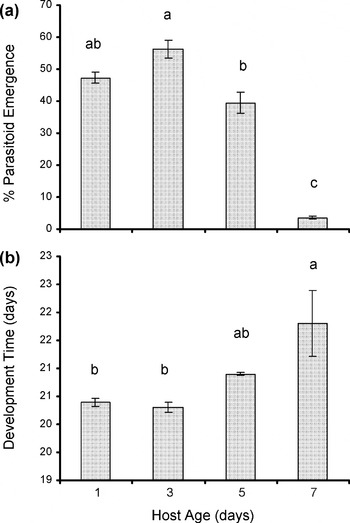
Emergence of D. pulchellus from leek moth was highest from one-day-old and three-day-old hosts, declined slightly in five-day-old hosts and then dropped drastically in seven-day-old hosts (fig. 1a; F=100.985; P<0.001). The development time of parasitoids was influenced by both host age as well as parasitoid sex (fig. 1b; F=9.106; P<0.001). Again, younger hosts appeared to be of higher quality, with parasitoids developing most rapidly in the one- and three-day-old hosts (F=6.072; P<0.001). On average, male parasitoids emerged 0.6 days earlier than females (F=11.961; P=0.001), and there was no significant interaction between host age and parasitoid sex (F=0.787; P=0.502) Thus, host quality appears to decline significantly by four to five days after pupation.
Effect of Acrolepiopsis assectella age on (a) emergence rates and (b) development times (males and females pooled) of the parasitoid, Diadromus pulchellus. Error bars show ±1 S.E. Bars with different letters are statistically different (P<0.001).

Field parasitism
The experimental plots were colonized to varying degrees by wild leek moth populations prior to the release trials. In 2007, both sites had very minor infestation (<3% of plants). In contrast, there was no sign of natural infestation at the Steinmaur 2008 site while the Galmiz 2008 site had the highest infestation rate overall. The Gamiz 2008 site had visible feeding damage on approximately 15% of the leeks throughout the plot. Because the parasitoid releases at this site were delayed, there were both laboratory-reared and wild pupae present during recollection. At that time, a survey of 80 leeks that had not been infested manually turned up only three pupae (3.8%), indicating there was only a very low presence of wild pupae during the trial.
At all sites, there was a high rate of total leek moth mortality in the cocoon phase. Between 35% and 55% of all cocoons recollected could not be used in the assessment of pupal parasitism due to disappearance of pupae and unknown mortality factors. For instance, 7–17% of all cocoons obtained were empty. As it was not clear what had caused the leek moth to become separated from its cocoon in each case or whether it occurred more among larvae or pupae, it was not possible to know the fate of pupae that had disappeared. While the process of moth eclosion can also cause the emptying of a cocoon, this was not a confounding factor in our study as we recollected pupae before the emergence of adults.
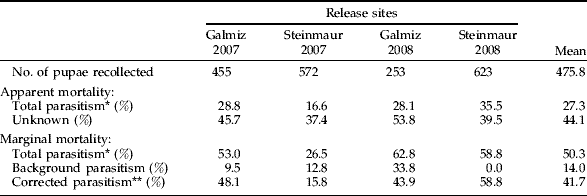
As with leek moth, natural populations of D. pulchellus were detected at all sites except Steinmaur 2008, and were highest at the Galmiz 2008 site (33.8% parasitism in sentinel pupae prior to release). Despite the presence of natural populations in most cases, the corrected values (table 2) clearly demonstrate that the mass-produced parasitoids did indeed establish in all of the experimental plots. Moreover, they contributed to significant increases in parasitism (t 3=–3.749; P=0.033) and total pupal mortality (t 3=–5.965; P=0.009) based on before and after comparisons. At the moment of release, most parasitoids exhibited very low flight activity, landing on leeks nearest to the release containers. Thus, there appeared to be only minimal immediate dispersal from the plots.
Site-specific release and recollection data, including parasitism rates by Diadromus pulchellus following a two-phase release of agents into artificially infested leek plots.
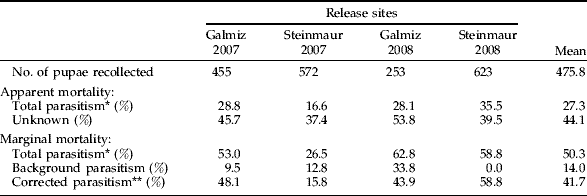
* Total parasitism includes parasitism by both wild and mass-released D. pulchellus.
** Corrected parasitism uses Abbott's (Reference Abbott1925) formula to calculate impact by released agents only.
Following mass-release, apparent mortality caused by D. pulchellus at the four release sites was, on average, 27.3% (includes parasitism by both released and naturally occurring parasitoids). Given that, on average, 44.1% of recollected pupae died prematurely due to unknown factors, the overall marginal attack rate was substantially higher at 50.3%. Total marginal parasitism varied between 53.0% and 62.8% at three of the release sites, but was substantially lower (26.5%) at the Steinmaur 2007 site (table 2). In all of the release trials, the sex ratio of F1 parasitoids was slightly male-biased (1:1.2).
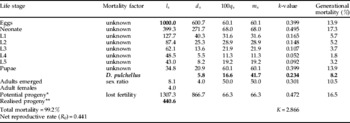
To assess how a release of D. pulchellus would affect leek moth survival in a generational context, our parasitism data were inserted into a generalized leek moth life table (table 3) derived from the three-year study conducted by Jenner et al. (Reference Jenner, Kuhlmann, Mason and Cappuccino2009). Because this parasitoid attacks the final immature stage of leek moth, its effect is quite simply a 41.7% reduction in the number of pupae that would have otherwise escaped mortality and yielded healthy adult moths. This means that from a starting number of 1000 leek moth eggs, approximately eight moths would emerge instead of 14. This reduction in survival translates to a change in total mortality from 98.6% to 99.2%, which, in turn, means a reduction in the net reproductive rate from 0.76 to 0.44.
Life table of Acrolepiopsis assectella in its area of origin with the inclusion of additional pupal mortality caused by field releases of Diadromus pulchellus. All other mortality and fecundity estimates are three-year averages obtained from Jenner et al. (Reference Jenner, Kuhlmann, Mason and Cappuccino2009).

* Potential progeny=(# of surviving females)×(mean potential fecundity).
** Realised progeny=(# of surviving females)×(mean realised fecundity).
l x, number entering stage; d x, number dying in stage; q x, apparent mortality; m x, marginal mortality.
Host density effects
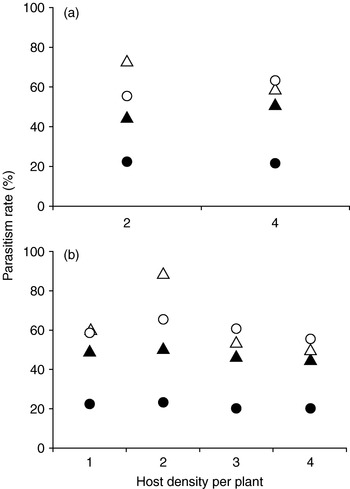
Neither the starting number of larvae per plant, which affects the degree of plant damage (t 3=0.067; P=0.951), nor the final number of pupae per plant (F=0.372; P=0.774) had any significant effect on the parasitism rate by D. pulchellus. Parasitism within each release site remained relatively unchanged across the different host density categories (fig. 2).
Effect of (a) initial number of Acrolepiopsis assectella larvae per leek and (b) final number of A. assectella pupae per leek on percent parasitism by Diadromus pulchellus. The data from all sites were pooled for a single analysis on each variable tested. Triangles, Galmiz sites; circles, Steinmaur sites; black symbols, 2007 sites; open symbols, 2008 sites.

Discussion
The current study used field experiments in the area of origin of an invasive species, the leek moth, to evaluate the performance of a parasitoid that is under consideration for use in classical biological control. Our inundative release trials demonstrated that the laboratory-reared D. pulchellus adults were consistently capable of establishing (i.e. remaining and reproducing) in the release plots using the designed release protocol. They were important mortality factors, significantly reducing the number of surviving leek moth pupae. At three of the four release sites, for example, marginal attack rates exceeded 50%. The mean total pupal mortality from all four sites was 71.4% (range: 54.0–81.9%). This is greater than the total pupal mortality reported by Jenner et al. (Reference Jenner, Kuhlmann, Mason and Cappuccino2009) for experimental sites in their life table study. When the mortality contribution of D. pulchellus is added to the generalized life table from Jenner et al. (Reference Jenner, Kuhlmann, Mason and Cappuccino2009), the total pupal mortality increases from 60.1% to 76.7%. This use of existing life tables for leek moth, particularly ones that do not originally include a pupal parasitoid mortality factor, provides an excellent opportunity to demonstrate the potential impact of the parasitoid on intergenerational population change. In this case, the addition of D. pulchellus to the leek moth system would cause a 41.7% decrease in the net reproductive rate of the pest.
It is important to note that measuring parasitoid impact based on F1 emergence certainly underestimates the full impact of D. pulchellus, since these parasitoids can often kill their hosts without producing offspring. Although D. pulchellus does not exhibit destructive host feeding, mechanical injury from ovipositor insertion and pseudoparasitism can be lethal for leek moth hosts. For instance, pupae parasitized multiple times in the laboratory often failed to produce any moth or parasitoid adults despite the absence of signs of the cause of death. Or even a solitary parasitoid may die after having killed its host but before it has developed sufficiently for its remains to be identified visually. In addition, D. pulchellus can sometimes cause a leek moth host to wriggle so violently when attacked that it falls out of its cocoon. Although there was no direct evidence of this phenomenon during the release trials, numerous unoccupied cocoons were discovered in all of the release sites. In the laboratory, leek moth pupae and larvae are regularly observed to abandon their cocoons when attacked by D. pulchellus, whereas none has been observed to desert its cocoon without being disturbed. In this way, parasitoids and predators attacking the cocoons may have an indirect, but significant effect on leek moth survival. While larvae are often capable of spinning a second cocoon, pupae that fall out of the protective cocoon and onto the ground are unlikely to survive.
The low recovery rate of leek moth pupae likely resulted from predation of larvae and pupae, and from larvae walking or falling off the plant prior to spinning a cocoon. The consequence of the low recollection numbers was that the post-release parasitoid-to-pest ratio in the experimental plots could have been very high. It is not known how D. pulchellus females respond to the presence of conspecifics; however, the high density may have increased dispersal rates from the experimental plots, as demonstrated for other parasitoids (e.g. French & Travis, Reference French and Travis2001; King, Reference King2007). Thus, it is possible that similar parasitism results could have been achieved with a lower parasitoid:host ratio.
Similarly, the parasitoids may have been equally effective with a single release instead of a two-phase schedule. While staggered releases are typically preferable to minimize the risk of missing a window of parasitism opportunity or losing animals due to adverse weather (Etzel & Legner, Reference Etzel, Legner, Bellows and Fisher1999), this is not always feasible if resources or time are limited. Because D. pulchellus adults are long-lived with a long reproductive period (Labeyrie, Reference Labeyrie1960), the timing of release should be more flexible compared to, for example, Trichogramma spp. Particularly when the window of opportunity for parasitism is brief and easy to predict, a single large release may be more effective. Given that leek moth hosts are suitable for parasitism for only 5–6 days following pupation, it is important to release parasitoids when the first pupae are observed.
Over the course of our study, all leek moth pupae faced a roughly equivalent risk of being parasitized, independent of the larval or pupal density on the plant. The pattern of uniform parasitism across all host patches fits the ideal free distribution (Fretwell & Lucas, Reference Fretwell and Lucas1970; Hubbard & Cook, Reference Hubbard and Cook1978). While D. pulchellus may have initially demonstrated a density-dependent foraging response, the trial period was long enough that parasitoids would have begun foraging in patches with fewer hosts as the best patches became depleted of host resources. The parasitism of leek moth pupae at all host densities indicates that D. pulchellus is an effective forager when its hosts are either rare or abundant.
As in any biological control programme, the number of individuals released into the environment is a major determinant of establishment and impact (Gurr et al., Reference Gurr, Barlow, Memmott, Wratten, Greathead, Gurr and Wratten2000). It is not yet clear what parasitoid:host ratio would be necessary to achieve satisfactory control of leek moth in North America. It is unlikely that the maximum attack rates observed here would be possible following establishment of D. pulchellus without supplementary releases at key times. However, as observed at the Galmiz 2008 site, parasitism by wild or previously established parasitoids (33.8%) may approach the mean level that was observed after mass releases in this study (41.7%). The introduction of D. pulchellus into North America is inherently a classical biological control approach; nonetheless, given the ease with which high-quality D. pulchellus can be mass-produced, Allium producers may one day have access to it for targeted, inundative releases.
In conclusion, we have demonstrated the substantial impact that mass releases of laboratory-reared D. pulchellus can have in Allium crops infested with leek moth. While this study examined establishment and impact in the short term, it remains to be seen how that impact would endure over multiple leek moth generations and years. Measuring the long-term impact of a released natural enemy in its native range would be considerably more difficult. Molecular tools (Greenstone, Reference Greenstone2006) or other vertically transmitted markers (e.g. Wanner et al., Reference Wanner, Gu, Hattendorf, Günther and Dorn2006) may enable one to distinguish between mass-released and wild natural enemies; however, these technologies would not halt mating between laboratory-reared and wild individuals, and this inevitable interbreeding would have significant consequences on the natural enemy population at the release sites.
In general, this project demonstrates how manipulated field trials in a natural enemy's area of origin can provide valuable insight into the establishment potential of the agent in the area of introduction. Our specific approach would apply only to cases where the natural enemy is absent or exists at low levels. The larger the wild population, the more difficult it is to estimate and account for background parasitism. Nonetheless, there may be spatial or temporal solutions to overcome the confounding effects of background parasitism. First, colonisation of the field site by wild natural enemies may be prevented by selecting a location that is sufficiently far from the natural habitat of the agent. The required distance will depend heavily on the mobility of the natural enemy. Alternatively, it may be possible to conduct release trials at a time of year when the natural populations of the agent are in a life stage that will not interfere with the tests. Both of these approaches would require mass-rearing of the agent for release as well as the pest to create experimental populations in the desired location or time. Thus, the options available for native range efficacy trials are far greater when the host plant, pest and agent are easy to culture. For many classical biological control programmes, native range studies of candidate agents would likely be a powerful tool for pre-release, population-level research without quarantine restrictions.
Acknowledgements
The authors owe a debt of gratitude to Lars Andreassen, Favio Corlay, Tim Haye, Emma Hunt, Li Hongmei, Jenny Lazebnik, Samantha Magnus, Patrick Turko, Mike Wogin and Amber Zabarauskas for their valuable assistance in this study. Additional thanks go to the Swiss agricultural collaborators, Roland Fasnacht (Bio Gemüse, Sugiez) and Stefan Müller (BioLand Agrarprodukte AG, Steinmaur), and two anonymous reviewers of the original manuscript. The work was funded by Agriculture and Agri-Food Canada and the Natural Sciences and Engineering Research Council of Canada.