Introduction
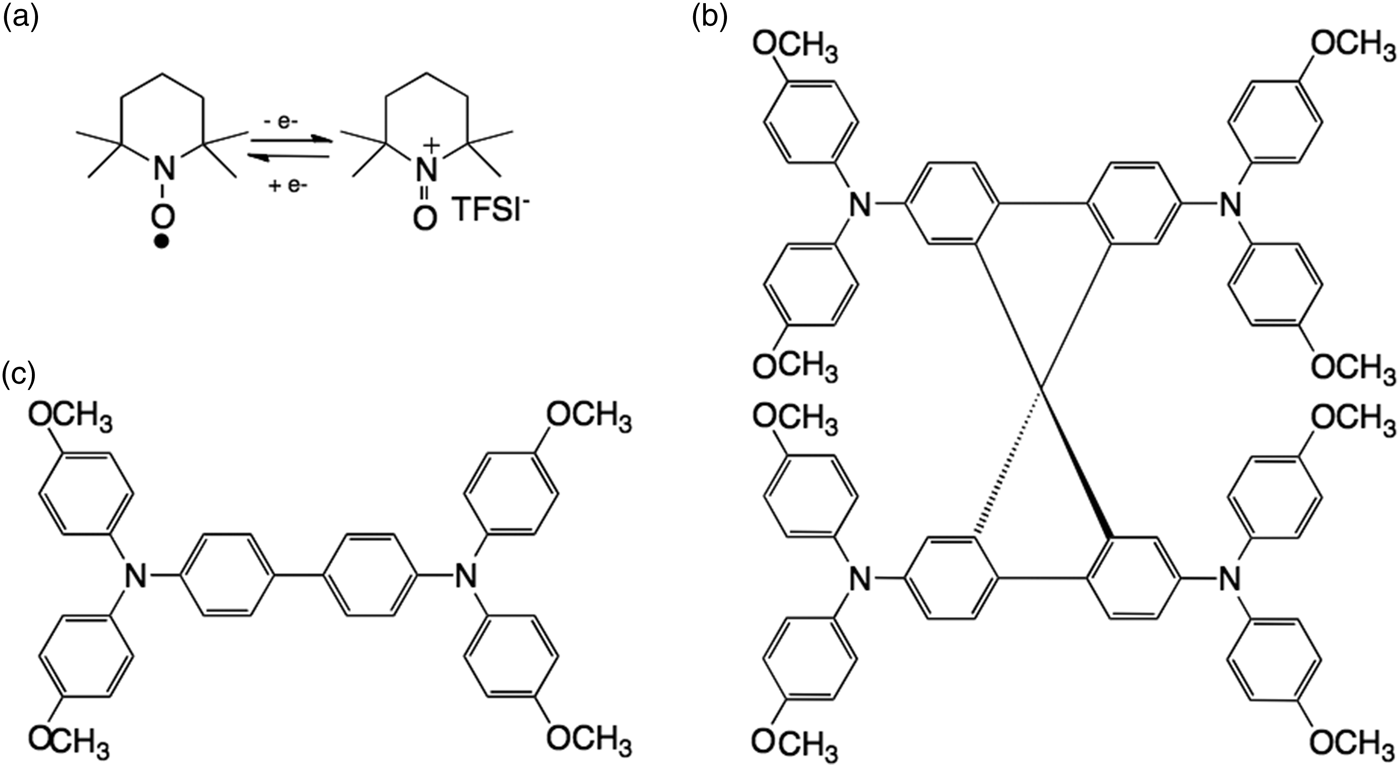
Nitroxide radical molecules, such as 2,2,6,6-tetramethylpiperidin-1-oxyl (TEMPO), have attracted considerable interests[ Reference Oyaizu, Nishide, Chatgilialoglu and Studer 1 ] as a metal-free oxidizing catalyst, especially in synthesis of pharmaceutical products and modification of biomass,[ Reference Isogai, Saito and Fukuzumi 2 , Reference Iwabuchi 3 ] while they have been also extensively studied in living radical polymerization,[ Reference Hawker, Bosman and Harth 4 , Reference Otsuka 5 ] molecular magnetism,[ Reference Nishide, Suga and Matyjaszewski 6 , Reference Seber, Freitas, Mague, Filho, Gratens, Bindilatti, Oliveira, Yoshioka and Lahti 7 ] cathode-active materials in rechargeable batteries,[ Reference Nishide and Oyaizu 8 ] and hole-transporting materials (HTMs) in dye-sensitized solar cells.[ Reference Kato, Kikuchi, Okuyama, Oyaizu and Nishide 9 , Reference Suzuka, Hayashi, Sekiguchi, Sumioka, Takata, Hayo, Ikeda, Oyaizu and Nishide 10 ] In the catalytic cycle, the oxoammonium cation of TEMPO (TEMPO+) acts as the oxidizing species involving redox reaction between the TEMPO+ and the neutral TEMPO [Fig. 1(a)]. The TEMPO+ cation performs excellent oxidizing reactivity because of both highly positive redox potential and tremendously high kinetics in the redox reaction compared with other redox reagents.[ Reference Suga, Pu, Oyaizu and Nishide 11 , Reference Yonekuta, Oyaizu and Nishide 12 ]
Redox reaction of (a) TEMPO/TEMPO+ and chemical structures of the triaryl amines, (b) spiro-OMeTAD, and (c) MeO-TPD.

Organic HTMs have been successfully exploited in electric and photo-electric devices such as transistors, electroluminescent devices, and photovoltaic cells.[ Reference Cheng, Yang and Hsu 13 , Reference Koch 14 ] The typical compounds are triaryl amine derivatives because of their thermal stability or high glass-transition temperature, amorphous layer-forming capability, and robustness. The hole-transporting characteristics to enhance the device performance require both appropriate hole-carrier density and high hole-carrier mobility to decrease internal device resistance.[ Reference Ong, Bayley, Jensen and Jensen 15 ] Doping of HTMs is a well-known method to enlarge the carrier density, using oxidizing chemical reagents as the dopant such as iodine, sulfonic acid, and metal complexes.[ Reference Kojima, Teshima, Shirai and Miyasaka 16 ] Dopant species and amount significantly affected the hole-transporting property so that appropriate doping procedure on HTMs is crucial.[ Reference Ong, Bayley, Jensen and Jensen 15 ]
Organo-lead halide perovskite-based solar cells are emerging as a new class of photovoltaics,[ Reference Burschka, Pellet, Moon, Baker, Gao, Nazeeruddin and Grätzel 17 , Reference Cojocaru, Uchida, Takumi, Jayaweera, Kaneko, Nakazaki, Kubo and Segawa 18 ] and their photo-conversion efficiency has reached beyond 20% in a short period of time.[ Reference Li, Bi, Yi, Dècoppet, Luo, Zakeeruddin, Hagfeldt and Grätzel 19 , Reference Saliba, Matsui, Domanski, Seo, Ummadisingu, Zakeeruddin, Correa, Tres, Abate, Hagfeldt and Grätzel 20 ] Although tremendous efforts have been devoted to improve HTMs for hole-transporting layers (HTLs) of the cells, 2,2′,7,7′-tetrakis(N,N-di-p-methoxyphenylamine)-9,9′-spiro-bifluorene (spiro-OMeTAD)[ Reference Bach, Lupo, Comte, Moser, Weissörtel, Salbeck, Spreitzer and Grätzel 21 , Reference Saragi, Spehr, Siebert, Lieker and Salbeck 22 ] exhibited the best performance in the photo-conversion or has been recognized as the standard HTM for the perovskite solar cells.[ Reference Anaraki, Kermanpur, Steier, Domanski, Matsui, Tress, Saliba, Abate, Grätzel, Hagfeldt and Correa-Baena 23 ] As the oxidizing dopant for spiro-OMeTAD, N(PhBr)3SbCl6 had been employed, which was a stoichiometric dopant for N,N,N′,N′-tetrakis(4-methoxy-phenyl)benzidine (MeO-TPD), because of reproducibility in the device performance via tuning of its doping ratio.[ Reference Bach, Lupo, Comte, Moser, Weissörtel, Salbeck, Spreitzer and Grätzel 21 ] Cobalt(III) complexes with a series of organic ligands, tris[2-(1H-pyrazol-1-yl)-4-tert-butylpyridine]cobalt(III) tris-[bis(trifluoromethylsulfonyl)imide] (FK209)[ Reference Burschka, Kessler, Nazeeruddin and Grätzel 24 ] as the typical complex used, have been studied as the dopants of HTMs including spiro-OMeTAD to yield effective HTMs.[ Reference Hagfeldt, Boschloo, Sun, Kloo and Pettersson 25 ] The combination of spiro-OMeTAD and FK209 was successfully applied to the HTLs of the perovskite solar cells to enhance their conversion efficiency.[ Reference Li, Bi, Yi, Dècoppet, Luo, Zakeeruddin, Hagfeldt and Grätzel 19 ] However, the residual dopant in HTLs, such as the cobalt(II) complex, often migrated to the photoactive perovskite layer and tremendously degraded the cell performance with the passage of time,[ Reference Hawash, Ono, Raga, Lee and Qi 26 ] to which limited the practical development of the perovskite solar cells.
We anticipated here that the metal-free and highly reactive oxidant, the TEMPO+ cation, acts as an effective dopant of triaryl amine HTMs, because the TEMPO formed after doping could be completely removed with very facile sublimation (sublimation temperature of TEMPO = 41 °C) or warming the HTL to yield a metal contamination-free HTL. In this paper, the TEMPO+ cation was applied as the dopant of HTMs including spiro-OMeTAD, and their hole-transporting property was described. Perovskite solar cells were fabricated with the TEMPO+-doped HTLs to demonstrate the effects of the doping agent of HTM on the photovoltaic performance of perovskite solar cells.
Materials and methods
Bis(trifluoromethanesulfonyl)imide salt of 2,2,6,6-tetramethylpiperidin-1-oxoammonium cation (TEMPO+TFSI−) was prepared via one-pot one-electron oxidation of TEMPO. TEMPO (3.4 g) and TFSI acid (48% aqueous solution, 5.2 mL) were stirred at room temperature for 2 h. Sodium hypochlorite aqueous solution (14.5 mL) was added to the mixture to yield the TEMPO+ salt of TFSI. The precipitate was washed with acetone to give a slightly yellowish powder (5.7 g, yield 60%). The product was ESR-inactive, which supported the conversion of TEMPO radical to the corresponding cation. 1H NMR (TM, ppm): 1.84 (s, 12H, CH3); 2.48 (m, 2H, CH2); 2.56 (m, 2H, CH2); 2.60 (m, 2H, CH2) ESI-MS (m/z): found 280.0, calcd for M+ 280.1.
1H NMR, mass, UV-vis, and ESR spectra were recorded on a JEOL ECX 500, JMS-GCMATE II, JASCO V-550, and JEOL JES-TE200 spectrometer, respectively. DSC was measured with a TA instrument Q200 calorimeter. Cyclicvoltammogram was measured with an ALS700 electrochemical analyzer.
Perovskite solar cells were fabricated according to the previously reported literature.[ Reference Burschka, Pellet, Moon, Baker, Gao, Nazeeruddin and Grätzel 17 , Reference Saliba, Matsui, Domanski, Seo, Ummadisingu, Zakeeruddin, Correa, Tres, Abate, Hagfeldt and Grätzel 20 , Reference Anaraki, Kermanpur, Steier, Domanski, Matsui, Tress, Saliba, Abate, Grätzel, Hagfeldt and Correa-Baena 23 ]
TiO2 compact layer was sprayed using titanium acetylacetonate in ethanol solution (1/4 vol) on FTO substrate which was etched with Zn powder and HCl aqueous. After soaking in 200 mM TiCl4 aqueous solution at 70 °C for 45 min and sintered at 500 °C for 30 min, TiO2 nanoparticle dispersion (PST-18NM, Nikki Shokubai Kasei Co., Japan) was casted on the substrate and spin-coated at 4000 rpm for 20 s. The substrates were heated at 70 °C for 1 h and sintered at 500 °C for 30 min and soaked with 10 mM TiCl4 solution. After sintering at 500 °C for 30 min, the perovskite precursor solution was spin-coated. For methylammonium lead iodide perovskite (MAPbI3), lead iodide (507.1 mg) was dissolved in N,N-dimethylformamide (DMF) (1 mL). The solution was spin-coated at 6500 rpm for 10 s. After annealing at 70 °C for 30 min, the isopropylalcohol solution of methylammonium iodide (10 mg/mL) was spin-coated at 2000 rpm for 30 s on the substrates. The substrates were annealed at 70 °C for 30 min. For cesium containing perovskite, lead iodide 507.1 mg, lead bromide 74.3 mg, formammidinium 172.0 mg, methylammonium bromide 22.4 mg, cesium iodide 42 µL [1.5 M in dimethylsulfoxide (DMSO)] in DMF (800 µL) and DMSO (158 µL) mixed solvent. The precursor solution was spin-coated at 1000 rpm for 10 s and 6000 rpm for 20 s. Chlorobenzene was dropped onto the substrate after spinning for 28 s. The substrates were annealed at 100 °C for 90 min.
Spiro-OMeTAD (42.9 mg) was dissolved in the chlorobenzene (500 µL) solution of lithium bis(trifluoromethanesulfonyl)imide (9.7 µL of 520 mg/mL in acetonitrile), tert-butylpyridine (16.9 µL), and acetonitrile solution of the TEMPO+ salt was added. The mixed solution (40 µL) was spin-coated on the perovskite layer at 4000 rpm for 20 s. Before Au deposition (thickness approximately 100 nm), the substrate was put in vacuo for 1 h.
Results and discussion
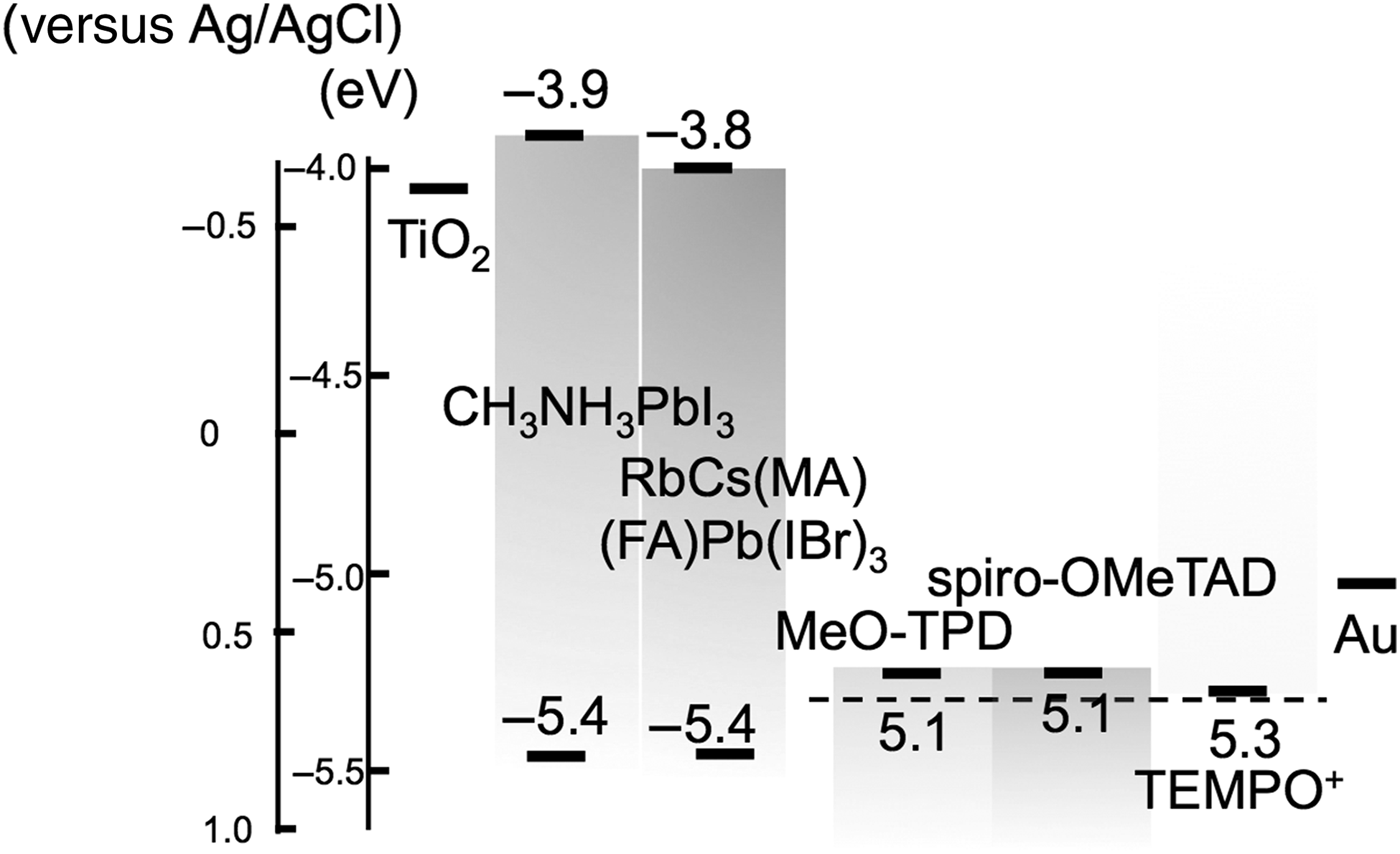
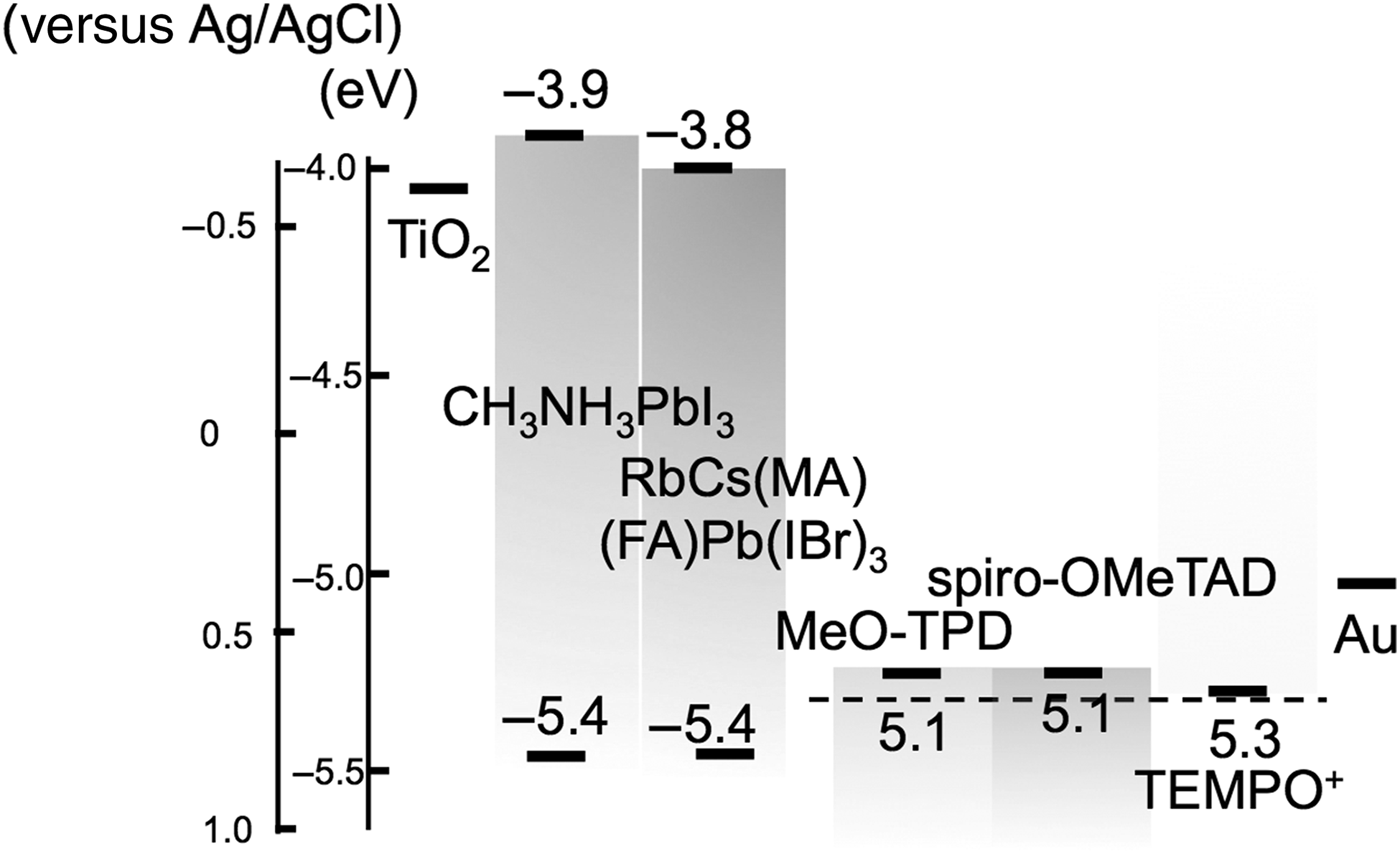
The TEMPO+ salt was highly soluble in polar solvents such as acetonitrile and THF. The acetonitrile solutions of TEMPO and TEMPO+ of the TFSI− salt gave a reversible redox peak at 0.69 V (versus Ag/AgCl) in their cyclic voltammogram as previously reported,[ Reference Yonekuta, Oyaizu and Nishide 12 ] which agreed with the redox potentials of TEMPO [Fig. 1(a)]. The electrochemical redox potential corresponded to almost 5.33 eV, which was appropriately more positive or deeper than those of MeO-TPD, spiro-OMeTAD, and other hole-transporting triaryl amines,[ Reference Ameen, Rub, Kosa, Alamry, Akhtar, Shin, Seo, Asiri and Nazeeruddin 27 ] and suggested a charge transfer from TEMPO+ to the amines or an effective doping of the amines with TEMPO+ (Fig. 2).
Redox potential or energy level of TEMPO+, MeO-TPD, spiro-OMeTAD, and the CH3NH3PbI3 and RbCs(MA)(FA)Pb(IBr)3 perovskite.
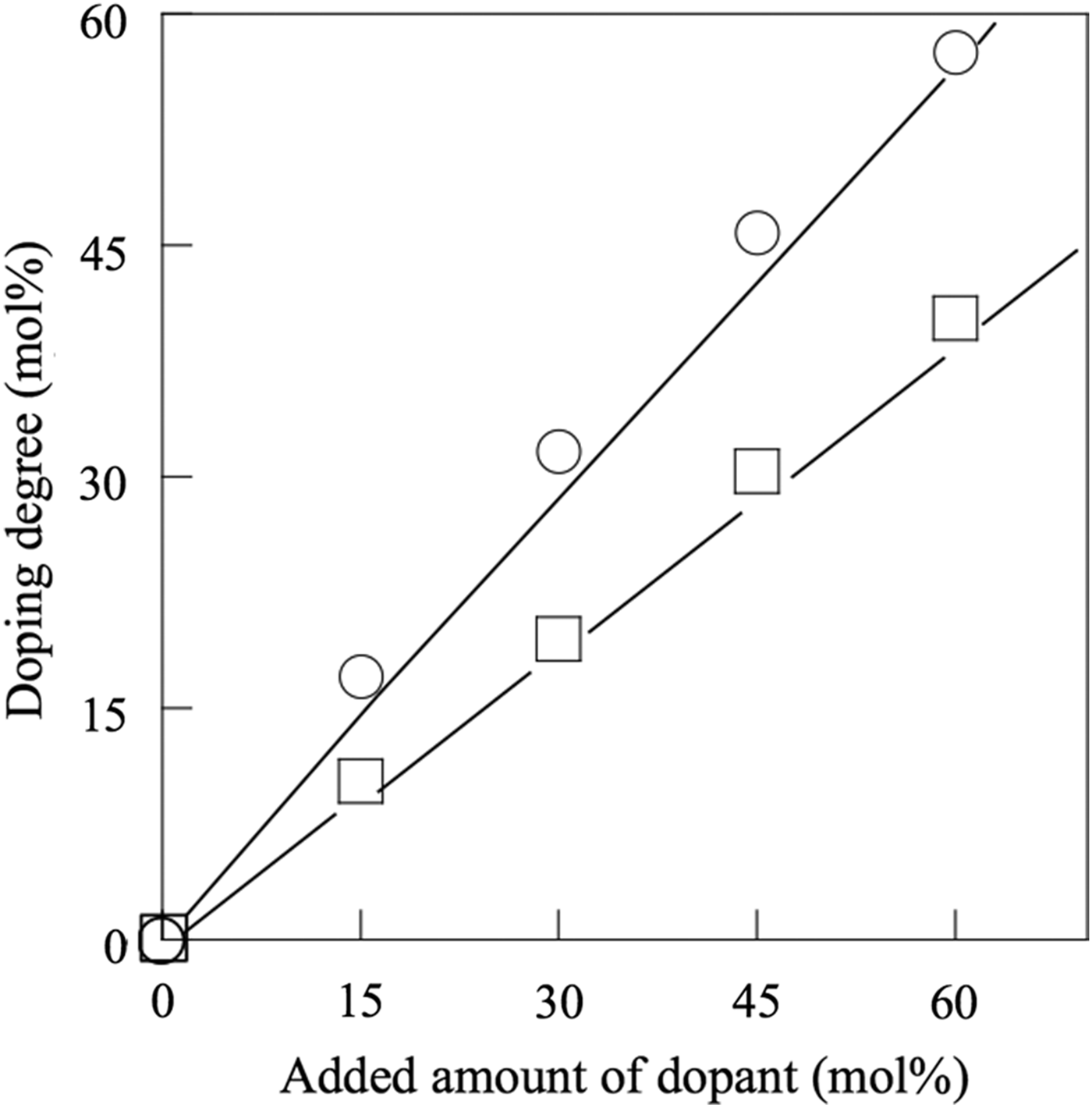
The charge transfer or the relationship between the doping degree and the dopant amount was examined with UV-vis spectroscopy. The addition of TEMPO+ to the triaryl amines, spiro-OMeTAD, and MeO-TPD enhanced the absorbance at 490–520 nm which was ascribed to the radical cation formation of the amines such as the cation of spiro-OMeTAD (see Fig. S1 in Supporting Information, where the decreasing peak at 360–390 nm was attributed to that of the amines). The proportionally increased doping degree meant a quantitative doping of the triaryl amines with TEMPO+. The doping degree of spiro-OMeTAD and MeO-TPD was estimated with the absorption coefficient of 3.4 × 10⁴ and 1.5 × 10⁵ L/mol·cm, respectively (Fig. 3). For example, the doping degree of spiro-OMeTAD with the TEMPO+ (added amount of 60 mol% versus spiro-OMeTAD) was 96%, which was significantly higher than that (62%) using the conventional Co-dopant.[ Reference Koh, Dharani, Li, Prabhakar, Mathews, Grimsdale and Mhaisalkar 28 ] The strong oxidizing and side-reaction-free capability of TEMPO+ resulted in the high conversion yield or quantitative doping of the triaryl amines. The doping with TEMPO+ also proceeded efficiently for the methoxy-substituted derivatives, such as 4-methoxytriphenylamine and 3-methoxythiophene.
Doping degree of spiro-oMeTAD (○) and MeO-TPD (□) with additional amount of the dopant TEMPO+TFSI−.

Upon doping process, the oxidant TEMPO+ converted itself to the neutral TEMPO molecule: TEMPO sublimates at room temperature and is easily removed by warming under reduced pressure. Elimination of the residual TEMPO+ and/or TEMPO from the doped-triaryl amines layer was proven for the TEMPO+-doped spiro-OMeTAD layer (thickness 500 nm) upon a glass plate by FTIR spectroscopy. The absorption peaks in the fingerprint region at 970–1350 cm−1 attributed to the TEMPO and TEMPO+ completely disappeared after heating the layer at 25 °C under reduced pressure for 1 h. Differential scanning calorimetry of the TEMPO+-doped spiro-OMeTAD specimen supported the removal of the residual TEMPO+ through the elimination of TEMPO (no peak at 41 °C derived from TEMPO in Fig. S2 in Supporting Information).
Hole-transporting mobility of the TEMPO+-doped spiro-OMeTAD layer was estimated with impedance spectroscopy on a hole-only device with the configuration of ITO/spiro-OMeTAD/Au, as in the previously reported procedure.[ Reference Bisquert 29 ] Diffusion- and recombination-limited carrier transport allowed to calculate the hole mobility using the equation μ = eD/k B T. Diffusion coefficient D was given as D = L 2 / τ d by means of time constant τ d 0.018 and 0.024 ms for the TEMPO and FK209-doped layer, respectively, using the time constant for the reciprocal of frequency under 0.5 V bias voltage and the 100 nm diffusion layer thickness. The calculated hole-transporting mobility μ = 2.1 × 10⁻⁴ cm2/Vs for the TEMPO+-doped spiro-OMeTAD was higher than that of the FK209-doped one (1.6 × 10⁻⁴ cm2/Vs), probably because of the residual dopant-free state, which supported the TEMPO+ as the effective dopant to give high hole-transporting capability to the triamines. These results were not in conflict with those previously reported.[ Reference Abate, Leijtens, Pathak, Teuscher, Avolio, Errico, Kirkpatrik, Ball, Docampo, Mcpherson and Snaith 30 ]
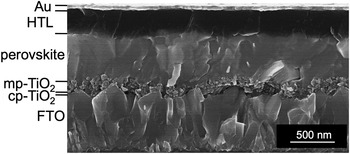
An organo-lead halide perovskite-based solar cells were fabricated to demonstrate that hole-transporting triaryl amine plays an important role in the device. A cross-sectional SEM image of the cell (Fig. 4) displayed the TEMPO+-doped spiro-OMeTAD HTL as a homogeneous layer of approximately 250 nm thickness without any void and pinhole and disordered interface upon the perovskite layer (300 nm thickness) even after the sublimation of TEMPO molecule under reduced pressure.
Cross-sectional SEM image of the perovskite solar cell using the TEMPO+-doped spiro-OMeTAD as the hole-transporting layer. Perovskite, Cs(MA)(FA)Pb(IBr)3; mp, mesoporous; cp, compact; FTO, fluorine-doped tin oxide.

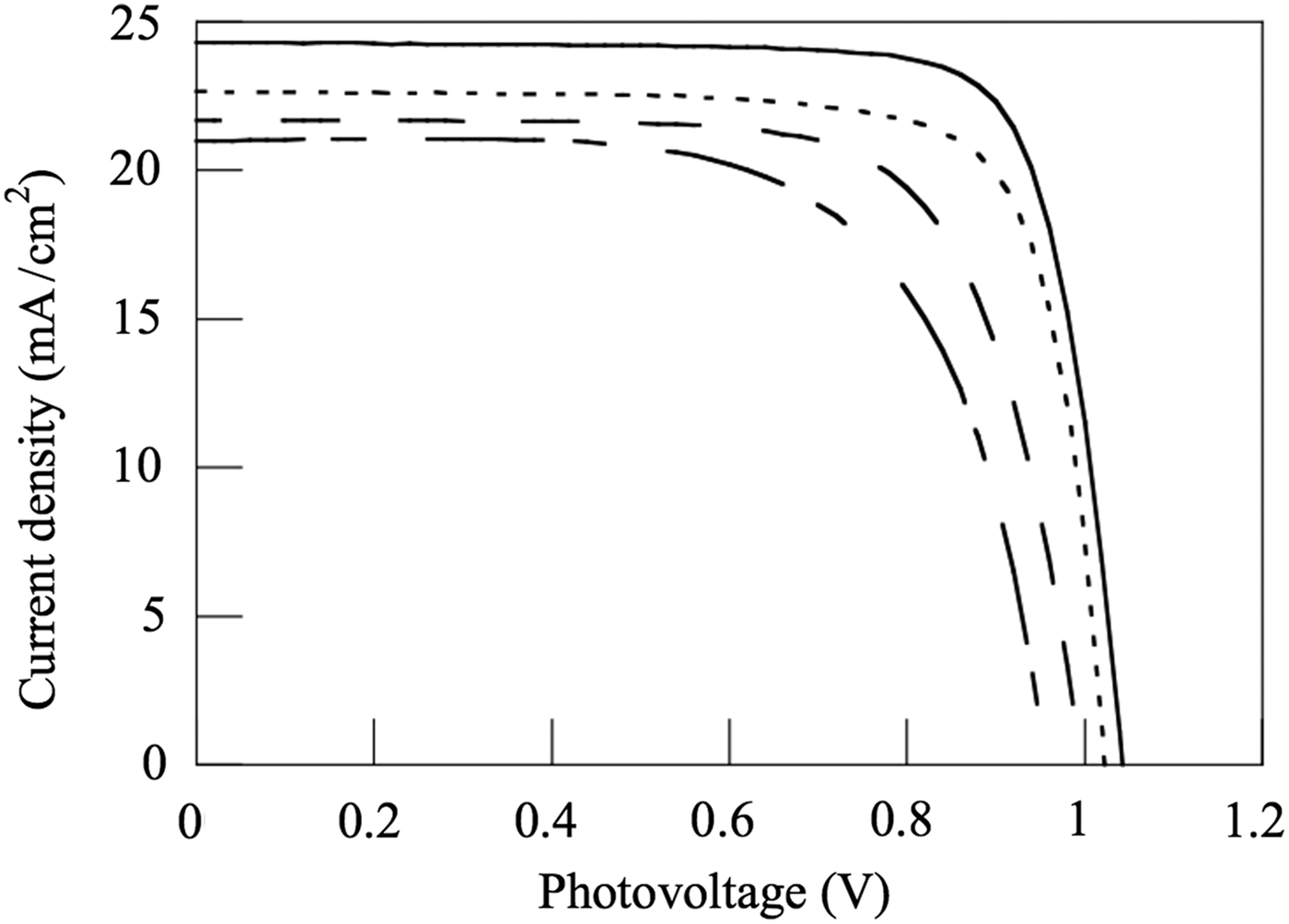
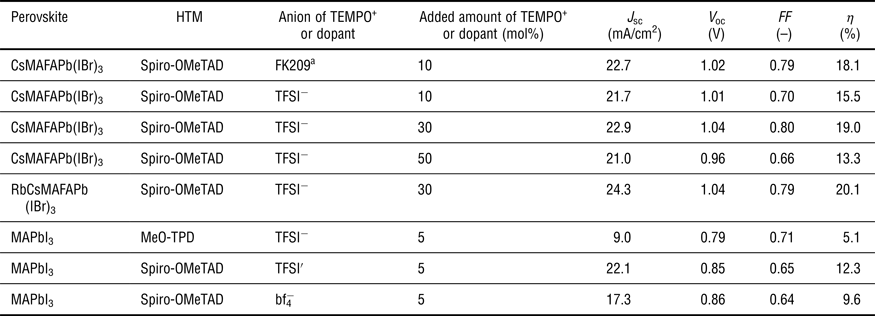
Photovoltaic performance of the cells using the TEMPO+-doped triaryl amines as HTL was preliminarily examined for the simple CH3NH3PbI3 perovskite photo-absorption layer (Table I). The performance of the cell with the TEMPO+-doped spiro-OMeTAD was higher than that of the TEMPO+-doped MeO-TPD, as has been ascribed, for the FK209-doped Spiro-OMeTAD,[ Reference Ameen, Rub, Kosa, Alamry, Akhtar, Shin, Seo, Asiri and Nazeeruddin 27 ] to the appropriate HOMO energy level, high hole mobility, and/or high film-forming property. Counter anion of TEMPO+, which remained in the HTL after the elimination of TEMPO, affected the performance, especially current density. The cell fabricated with the TEMPO+TFSI−-doped HTL displayed low series resistance, to improve the fill factor to be often 0.80. On the other hand, the TEMPO+BF4 − did not, probably because BF4 − anion may cause a trap state due to its high dissociation degree upon the hole transportation. Mixed cation perovskite Cs(MA)(FA)Pb(IBr)3 [MA (methylammonium) and FA (formamidinium)] which was reported as one of the most efficient photo-absorbing layers,[ Reference Burschka, Kessler, Nazeeruddin and Grätzel 24 ] was used to fabricate the cells with the TEMPO+-doped HTL (Fig. 5, Table I). The photo-conversion efficiencies were similar to or beyond (19%) that of the control cell (18.1) fabricated with the conventional FK209-doped spiro-OMeTAD HTL after tuning the dopant amount. The added amount of the TEMPO+ dopant in the HTL affected the photo-conversion performance probably due to the appropriate carrier density in HTL. For the perovskite of mixed four cations RbCs(MA)(FA), combined with the HTL of 30 mol% TEMPO+TFSI−-doped spiro-OMeTAD, the conversion efficiency η reached 20.1% with J sc = 24.3 mA/cm2, V oc = 1.04 V, and FF = 0.79.
J-V curves of the Cs0.05(MA0.17FA0.83)0.95Pb(I0.83Br0.17)3 perovskite solar cells fabricated with the TEMPO+-doped HTL. Added amount of TEMPO+TFSI−: 10(- -), 30 (—), and 50 (— -) mol% and FK209 (---) 10 mol%.

Photovoltaic performance, current density (J sc), open circuit potential (V oc), fill factor (FF), photovoltaic performance (η) of the perovskite solar cells fabricated with the TEMPO+-doped hole-transporting layer (HTL).

MA, methylammonium; FA, formamidinium.
a FK209: tris[2-(1H-pyrazol-1-yl)-4-tert-butylpyridine]cobalt(III)-tris-[bis(trifluoromethylsulfonyl)imide].
The photo-conversion efficiency of 20% was almost maintained even after 3 weeks. Metal-free or residual dopant-free HTL could improve robustness of the highly efficient perovskite solar cells.
Supplementary material
The supplementary material for this article can be found at https://doi.org/10.1557/mrc.2017.135.
Acknowledgments
This research was partially supported by “Research and Development of Innovative New Structure Solar Cells” from NEDO, Japan, and by the Research Institute for Science and Engineering, Waseda University. H.M. acknowledges the Leading Graduate Program in Science and Engineering at Waseda University from MEXT, Japan.