Low back pain (LBP) is one of the most common and expensive causes of work-related disability. While LBP is mostly resolved by 3 months, a patient is less likely to recover spontaneously from LBP lasting for more than 3 months, termed chronic LBP (Reference Andersson1). LBP often requires comprehensive management to reduce pain and improve functioning. Treatment approaches can involve medications, other noninvasive interventions, nonsurgical invasive interventions, and surgical interventions (Reference Chou and Huffman2). The usage of nonsurgical interventions including injection therapy has increased rapidly and steroid and/or local anesthetics are mainly used for the injections.
Epidural steroid injection (ESI) is commonly used for treatment of LBP, although controversy surrounds the appropriate uses of injection therapies (Reference Cohen3). Generally, ESI therapy is primarily intended to provide pain relief. However, it may also be considered to allow a patient to progress with their exercise and rehabilitation program, and in doing so, the patient's resulting status is expected to improve over the longer term as well, although this has not been appropriately studied. Most studies have evaluated outcomes in the immediate post-treatment period or shortly afterward. Although the intervention may be expected to act quickly by the anti-inflammatory agent, it is advantageous if any positive effects on pain and disability also stand over the longer term. Because the natural course of subacute or chronic LBP can be described as consisting of spontaneous remissions and exacerbations, the short-term effects of injections do not necessarily reflect a successful treatment result (Reference Staal, de Bie, de Vet, Hildebrandt and Nelemans4;Reference Croft, Macfarlane, Papageorgiou, Thomas and Silman5).
The question of whether ESI results in long-term pain relief has been addressed by only a few studies (Reference Chou, Atlas, Stanos and Rosenquist6–Reference Watts and Silagy8). In the reviews providing specific information by follow-up duration, a recent systematic review also identified fair evidence that ESI is moderately effective for short-term symptom relief but not for long-term symptom relief of more than 3 months in patients with radiculopathy (Reference Chou, Atlas, Stanos and Rosenquist6). On the other hand, a meta-analysis of placebo-controlled trials up to the early 1990s concluded that ESIs are effective for short-term (up to 60 days) and long-term (up to 12 months) pain relief for patients with sciatica (Reference Watts and Silagy8). Another study using a descriptive review suggested that caudal or transforaminal ESIs had an effect on long-term pain relief for more than 6 months (Reference Manchikanti, Singh and Derby7).
The discordant conclusions led us to investigate the long-term effect of corticosteroid injection. Here, we evaluated the long-term effectiveness of ESI for LBP patients through a meta-analysis of longer-term outcomes of at least 6 months.
METHODS
Objectives
To assess the long-term benefits of ESI for patients with LBP.
Data Sources and Searches
We searched the following electronic databases to identify potentially relevant articles: MEDLINE (1950 to Sep 2011), EMBASE (1980 to Sep 2011), and the Cochrane Library. The search strategy, as described in Appendix 1, was devised on the basis of those used in the guideline by the American Pain Society (Reference Chou and Huffman2). The following MeSH terms or keywords were used to search the databases for eligible articles: back pain, LBP, injections, and epidural injections. We applied no language restriction.
Study Selection
Two authors (H.C., B.C.) independently screened the title and abstracts from among the articles found. The full text version of an article was obtained if the title and abstract seemed to fulfill the inclusion criteria or if the eligibility of the study was unclear. The eligible articles were selected by each reviewer independently. Any disagreements on study eligibility were resolved by discussion and a consensus meeting.
We included only randomized controlled trials with at least 6 months of follow-up. Patients should have LBP including radiculopathy regardless of disease duration. We excluded trials of LBP associated with acute major trauma, cancer, infection, spondyloarthropathy, and pregnancy, and pain after back surgery. ESIs were considered to be the experimental intervention. Studies that used steroid injection or surgery as controls were excluded. At least one of the following outcomes had to be reported in the included studies: pain status, back-specific disability index, or number of patients who underwent subsequent surgery. Status in pain or back-specific disability was evaluated on a long-term basis of 6 months to 12 months.
Risk of Bias Assessment
The risk of bias of eligible studies was assessed using items based on the criteria developed by the Cochrane back group, which consist of eleven items consistent with those by Chou et al.: the methods used for randomization, allocation concealment, and blinding; the similarity at baseline of the groups compared; the use of co-interventions; compliance to allocated therapy; adequate reporting of dropouts; loss to follow-up; non-differential timing of outcome assessment; and the use of intention-to-treat analysis (Reference Chou and Huffman2;Reference van Tulder, Furlan, Bombardier and Bouter9). Each item was scored as “Yes” if it fulfilled the criteria, as “No” when there was a risk of bias, and as “Unclear” if there was insufficient information. A total score was calculated by using the number of items scored as “Yes”.
Data Extraction
The data extracted from each trial were the characteristics of patients, the type and frequency of intervention and control, the outcome measures, and the follow-up duration. We collected data on pain scores measured on a visual analogue scale (VAS) and back-specific disability expressed by the Oswestry Disability Index (ODI) or the Roland-Morris Disability Questionnaire (RMQ) at 6 months and 12 months of follow-up. We standardized the VAS on a 10-point scale. In cases where only graphs were reported, the mean scores and standard deviations were estimated from those graphs. If standard deviations were not reported, we tried to derive the values from other relevant statistical information as far as possible. The data from the studies that were included were extracted by the first reviewer and the extracted data were crosschecked by the second author. Any differences in assessment were resolved by discussions between the authors.
Data Analysis
A meta-analysis was performed for each intervention if the results of the outcome measure could be pooled. The analyses followed the intent-to-treat principle. If the intervention group of the study was compared with two or more control groups, the intervention group was split into smaller groups to match to the controls to include independent comparisons in the analysis. For pain and disability, in case of data represented by means and standard deviations, meta-analysis was conducted using the weighted mean difference (WMD) for pain and the standardized mean difference (SMD) for disability. Considering potential confounding due to differences in baseline status of pain and disability for individual trials, we calculated the baseline score-adjusted weighted mean difference between groups using a multilevel meta-regression (Reference Trowman, Dumville, Torgerson and Cranny10). A relative risk (RR) was calculated from the proportion of patients who underwent subsequent surgery among the study subjects (event/total). The overall relative risks, WMD or SMD, and corresponding 95 percent confidence intervals (CIs) were presented, using the random effect model. The test for statistical heterogeneity was performed based on chi-squared statistics, and I-squared (I2) values were also presented. Publication bias was assessed by visual inspection for funnel plot asymmetry and Egger's test. The analyses were done using the Stata statistical package (version 12, Stata Corp, College Station, TX) and MLwiN (version 2.02, Multilevel Models Project Institute of Education).
RESULTS
Study Selection
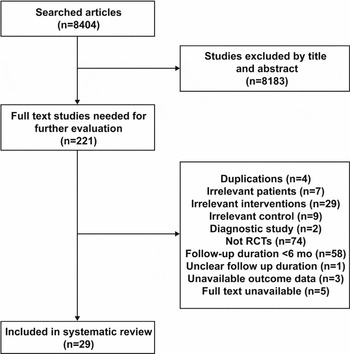
Figure 1 presents a flow diagram of the study selection. A total of 8,404 articles were identified through electronic searches. A total of 221 studies appeared potentially relevant and were retrieved for full-text review. We were unable to locate two studies which appeared relevant (Reference Li, Wang, Gao and Hou11;Reference Li, Gao, Wang and Hou12), even though we directly contacted the authors. Overall, 192 of the 221 studies were excluded due to the irrelevance of patients (healthy volunteers, postoperative pain, or pain related with fracture), interventions (radiofrequency, intradiscal injection, sacroiliac joint injection, deep fascia injection, ligament injection, no steroid injection, perioperative sedatives, sympathetic ganglion block, local steroid injection), or the controls (steroid injection, discectomy, disc coablation). Many studies were excluded because of an insufficient follow-up period (N = 58) or for not being randomized controlled trials (N = 74). Three further studies were excluded due to insufficient data provided. Twenty-nine articles remained to be included in this review.
Flow diagram of study selection. RCTs, randomized controlled trials.

Study Summary
The characteristics of the included studies are presented in Supplementary Table 1, which can be viewed online at www.journals.cambridge.org/thc2013105. The epidural injections were performed by the caudal approach (N = 8) (13–20), the interlaminar approach (N = 10) (Reference Koc, Ozcakir, Sivrioglu, Gurbet and Kucukoglu21–Reference Laiq, Khan, Iqbal and Khan30), or the transforaminal approach (N = 9). The route was not described in two studies (Reference Buchner, Zeifang, Brocai and Schiltenwolf31;Reference Teske, Zirke and Trippe32). The subjects of most of the ESI trials were patients suffering from radicular pain. Most of the studies involved mainly patients with subacute or chronic pain, and ten studies exclusively included patients with chronic LBP (Reference Manchikanti, Cash, McManus, Pampati and Abdi15–Reference Dashfield, Taylor, Cleaver and Farrow17;Reference Iversen, Solberg and Romner19–Reference Koc, Ozcakir, Sivrioglu, Gurbet and Kucukoglu21;Reference Manchikanti, Singh, Falco, Cash and Pampati29;Reference Teske, Zirke and Trippe32–Reference Burgher, Hoelzer, Schroeder, Wilson and Huntoon34). Seventeen randomized trials compared ESI with epidural saline or local anesthetic injection, and ten studies compared it with other treatments such as conservative treatment, epiduroscopy, or interspinous ligament injection. Two studies had multiple control groups (Reference Iversen, Solberg and Romner19;Reference Ghahreman, Ferch and Bogduk35). Seventeen studies measured pain on a long-term basis. Eleven studies reported back-specific disability on the ODI and two used RMQ (Reference Koc, Ozcakir, Sivrioglu, Gurbet and Kucukoglu21;Reference Vad, Bhat, Lutz and Cammisa36). Seventeen ESI trials reported the number of patients who had to receive surgery. One study reported the number of patients who received surgery at 2.3 and 6 years of follow-up in two separate papers, among which the article that provided the results of the longer-term follow-up was included in the analysis (Reference Riew, Park and Cho37;Reference Riew, Yin and Gilula38).
Results of Meta-analysis
Pain
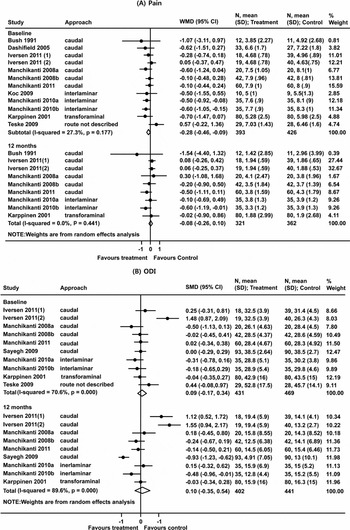
Of seventeen studies that measured pain on a long-term basis, twelve trials that reported pain intensity were available for meta-analysis (Figure 2A) (Reference Bush and Hillier13;Reference Manchikanti, Cash, McManus, Pampati and Abdi15–Reference Dashfield, Taylor, Cleaver and Farrow17;Reference Koc, Ozcakir, Sivrioglu, Gurbet and Kucukoglu21;Reference Arden, Price and Reading24;Reference Buchner, Zeifang, Brocai and Schiltenwolf31;Reference Teske, Zirke and Trippe32;Reference Vad, Bhat, Lutz and Cammisa36;Reference Karppinen, Malmivaara and Kurunlahti39;Reference Murata, Kato, Miyamoto and Takahashi40).
Result of meta-analysis of pain score and Oswestry disability index at baseline and 12 months of follow-up. CI, confidence interval; WMD, weighted mean difference; ODI, Oswestry disability index; SMD, standardized mean difference. Iversen 2011(1): Epidural steroid injection versus Epidural saline injection; Iversen 2011(2): Epidural steroid injection versus Subcutaneous saline injection

The mean baseline pain score was lower among the patients enrolled in the intervention group in most of the studies and the pooled difference between the groups was significant (WMD, −0.28; 95 percent CI, −0.46 to −0.09). The patients in better condition tended to be enrolled in the intervention group rather than the control group.
Most of the trials showed no significant difference in the pain score between ESI and the control at 6 or 12 months of follow-up. The overall difference was statistically significant at 6 months, although the magnitude was small (WMD, −0.41; 95 percent CI, −0.67 to −0.16). However, at 12 months of follow-up, no longer was such a difference observed (WMD, −0.08; 95 percent CI, −0.26 to 0.10). No significant statistical heterogeneity was observed.
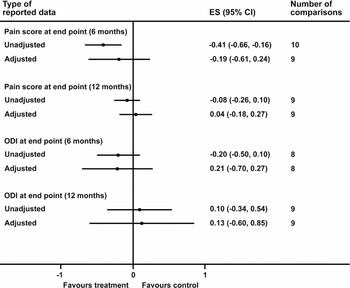
We also calculated the baseline pain score-adjusted mean differences, which resulted in a pooled difference closer to the null value (at 6 months: WMD, −0.19; 95 percent CI, −0.61 to 0.24; at 12 months: WMD, 0.04; 95 percent CI, −0.18 to 0.27) (Figure 3).
Summary of results of meta-analysis of pain score and Oswestry disability index. CI, confidence interval; ODI, Oswestry disability index.

Five studies were not included in the meta-analysis because the outcome measures in those studies were not combinable. One study reported the pain score at 6 months follow-up as a mean and range, and the baseline pain score in the ESI group was a little higher than the conservative treatment group; however, the pain score of the treatment group at 6 months of follow-up was lower, although the difference was not statistically significant (Reference Buchner, Zeifang, Brocai and Schiltenwolf31). Another study found that the proportion of patients reporting an adequate therapeutic effect at 24 weeks did not differ between the transforaminal ESI group and intramuscular injection group (Reference Murata, Kato, Miyamoto and Takahashi40). In one other study comparing the effect of transforaminal ESI with trigger point injection, they reported that transforaminal ESI in radiculopathy showed significantly higher success after an average follow-up of 1.4 years. However, the mean baseline pain score was also 0.6 of a point lower in the ESI group in that study (Reference Vad, Bhat, Lutz and Cammisa36).
The other two studies reported a pain score change from baseline. One study comparing transforaminal ESI with plasma disc compression reported a significantly better pain score change at 6 months from the baseline, after adjusting for some covariates, in the plasma disc compression group (Reference Gerszten, Smuck and Rathmell41). It should be noted that the plasma disc compression group, which was in fact the treatment of interest in that study, had better pain status when enrolled. The other study reporting a pain score change from baseline at 12 months of follow-up regarding interlaminar ESI compared with interspinous ligament saline injection showed no significant treatment effect (Reference Arden, Price and Reading24).
Disability
Nine trials with the ODI scale provided data available for meta-analysis. The overall pooled treatment difference was significant neither at 6 months nor at 12 months (SMD, −0.20; 95 percent CI, −0.50 to 0.09; and SMD, 0.10; 95 percent CI, −0.35 to 0.54, respectively) (Figure 2B). In both the meta-analyses of results at 6 and 12 months of follow-up, a significant heterogeneity was observed (p < .001). There were two studies showing a significant treatment benefit at 6 months while the others showed nonsignificant differences between the groups (Reference Sayegh, Kenanidis, Papavasiliou, Potoupnis, Kirkos and Kapetanos14;Reference Manchikanti, Singh, Falco, Cash and Pampati29). One trial showing a significant benefit involved patients with subacute LBP, while the subjects of all the other trials had chronic LBP (Reference Sayegh, Kenanidis, Papavasiliou, Potoupnis, Kirkos and Kapetanos14). Two further comparisons were added to the analysis of outcomes at 12 months, which showed fairly different results from those of others largely contributing to the heterogeneity by demonstrating an opposite effect significantly favorable toward the control groups (Reference Iversen, Solberg and Romner19). In those cases, the baseline disability status was also better in the control groups.
Although there was some heterogeneity present among the baseline ODI values, there was no overall difference suggested between the groups (SMD, 0.09; 95 percent CI, −0.17 to 0.34), and the baseline-adjusted mean differences did not differ from the unadjusted ones (at 6 months: SMD, −0.21; 95 percent CI, −0.70 to 0.27; at 12 months: SMD, 0.13; 95 percent CI, −0.60 to 0.85) (Figure 3).
Of the four studies that were not included in the meta-analysis due to noncombinability of outcomes, two studies reported changes in scores from baseline. Both studies had similar baseline ODI values between groups. One study evaluating plasma disc compression compared with transforaminal ESI also reported a significantly better result at 6 months in the plasma disc compression group (Reference Gerszten, Smuck and Rathmell41). The other study reporting ODI change from baseline at 12 months of follow-up found that there was no significant difference between the treatment and control groups (Reference Arden, Price and Reading24).
Two trials reported the RMQ for back-specific disability. In one study, the mean baseline RMQ was a little lower in the interlaminar ESI groups and the ESI group did not decrease the RMQ significantly compared with physical therapy at 6 months of follow-up (SMD, 0.31; 95 percent CI, −0.60 to 1.21) (Reference Koc, Ozcakir, Sivrioglu, Gurbet and Kucukoglu21). The other study compared the effect of transforaminal ESI with trigger point injection. At the end of the study, the intervention group showed a significant treatment effect after an average follow-up of 1.4 years (SMD, −2.05; 95 percent CI, −2.75 to −1.34) (Reference Vad, Bhat, Lutz and Cammisa36).
Surgery After Injection Treatment
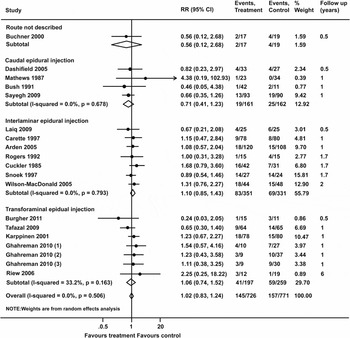
Overall, nineteen comparisons were included in the analysis on receiving subsequent surgery (Figure 4). No other results except one showed a significant difference in the proportions of patients receiving surgery between ESI and a control, and the overall effect of the intervention was not significant (RR 1.02, 95 percent CI 0.83 to 1.24) with no significant statistical heterogeneity (p = .851). In the subgroup analysis, according to the three routes of administration, no significant effect was observed either (caudal approach: RR, 0.71; 95 percent CI, 0.41 to 1.23; interlaminar approach: RR, 1.10; 95 percent CI, 0.85 to 1.43; transforaminal approach: RR, 1.06; 95 percent CI, 0.74 to 1.52). No relation was observed between the tendency toward treatment effects and the follow-up duration. Twelve randomized trials compared ESI with epidural saline or local anesthetic injection, and the other studies compared it with other treatments such as conservative treatment, epiduroscopy, or interspinous ligament injection but no particular effect by any of the control treatments was observed (Reference Dashfield, Taylor, Cleaver and Farrow17;Reference Mathews, Mills and Jenkins18;Reference Wilson-MacDonald, Burt, Griffin and Glynn23;Reference Arden, Price and Reading24;Reference Laiq, Khan, Iqbal and Khan30;Reference Buchner, Zeifang, Brocai and Schiltenwolf31;Reference Burgher, Hoelzer, Schroeder, Wilson and Huntoon34).
Result of meta-analysis of surgery after injection treatment. CI, confidence interval; RR, risk ratio. Ghahreman 2010(1): Epidural steroid injection versus Epidural bupivacaine injection; Ghahreman 2010(2): Epidural steroid injection versus Epidural saline injection; Ghahreman 2010(3): Epidural steroid injection versus Intramuscular saline injection

Assessment for Risk of Bias
Twenty-three of the twenty-nine studies included met more than five internal validity criteria (Supplementary Table 1). Adequate methods of allocation concealment and randomization were the most common unfulfilled criteria. Fourteen studies did not describe the process of allocation concealment. Of them, four studies were included in the meta-analysis of pain outcome (Reference Bush and Hillier13;Reference Koc, Ozcakir, Sivrioglu, Gurbet and Kucukoglu21;Reference Teske, Zirke and Trippe32;Reference Karppinen, Malmivaara and Kurunlahti39), and all of those studies had a slightly biased baseline pain status to one side or the other while most of them included patients in better condition in the intervention group, which resulted in an overall baseline imbalance (p = .003). Of the four studies, three studies did not describe the method of random sequence generation either. From the studies included in the meta-analysis of disability index, the method of allocation concealment was unknown in three studies (Reference Sayegh, Kenanidis, Papavasiliou, Potoupnis, Kirkos and Kapetanos14;Reference Teske, Zirke and Trippe32;Reference Karppinen, Malmivaara and Kurunlahti39). However, the overall ODI values differed little between the groups at the baseline (SMD, 0.09; 95 percent CI, −0.17 to 0.34). The study by Iversen et al. (Reference Iversen, Solberg and Romner19) used an adequate method of allocation concealment and reported that there was no significant difference in baseline status between groups, but there was in fact a notable difference between the intervention group and one of the control groups observed in the baseline ODI.
Assessment of Publication Bias
For pain outcome, the supposed missing studies did not appear to be in areas of nonsignificance in the contour enhanced funnel plot, and asymmetry was not significant with Egger's test either (at 6 months of follow-up; p = .367, at 12 months of follow-up; p = .170). In the case of the ODI, the funnel plot showed a significant asymmetry at 12 months of follow-up (at 6 months of follow-up; p = .488, at 12 months of follow-up; p = .030), which may be due to poorer quality in small studies or due to true heterogeneity. A funnel plot assessment of surgery after injection treatment, where a sufficient number of trials were included for this approach, did not show an indication of asymmetry (Egger's test p = .508).
DISCUSSION
We conducted a systematic review with a focus on the long-term effects of ESI for LBP. There was no overall evidence that ESI was more effective than the controls in improving pain or back-specific disability in the long-term. Although the pain score at 6 months of follow-up was significantly lower in the ESI group, the treatment difference was also no longer significant after adjusting for the baseline pain score. As a result of our meta-analysis, the overall summary suggested that ESI did not decrease the number of patients who underwent surgery significantly in the long term—at least 6 months or longer—compared with conservative treatment, placebo injection, or injection at another site.
Studies included in our analysis were heterogeneous regarding characteristics of patients (i.e., duration of pain, characteristics of pain, etc.), the method of intervention (i.e., caudal epidural injection, transforaminal epidural injection), and the comparison (i.e., placebo injection, other site injection.). ESIs are usually indicated for patients with radiculopathy; however, some trials also included patients with nonradicular LBP (Reference Manchikanti, Cash, McManus, Pampati and Smith20;Reference Manchikanti, Cash, McManus, Pampati and Benyamin28;Reference Murata, Kato, Miyamoto and Takahashi40). The results of those studies did not differ from those in the trials for patients with radiculopathy to justify a separate analysis. Although the studies included in the meta-analysis were also heterogeneous in the injection approach and injection frequency, no noticeable differences were observed according to the method of injection. No significant statistical heterogeneity across the study results was present in our meta-analyses of the pain score and surgery after injection treatment. For disability, however, a significant statistical heterogeneity was evident, and there was some disagreement over the treatment effect observed within the same approach, which could be mainly related to the difference in the baseline scores or disease status, which we noted previously in the results section. An investigation of the heterogeneity was illustrated in more detail (Supplementary Table 2, which can be viewed online at www.journals.cambridge.org/thc2013106). There was a subgroup difference found only when we tried to stratify trials by the type of control. There was one study (Reference Iversen, Solberg and Romner19) that compared ESI with soft tissue injection and showed a superior ODI result in the control group at the 12-month follow-up. The observed superiority was due to the baseline difference (Figure 2), and the difference became insignificant after baseline adjustment.
In the studies that reported pain as an outcome, the pain may have been measured at rest, during movement, at predetermined points in time, as an average during the day, etc. The varying ways of measuring pain from one study to another could make the results of the meta-analysis unreliable. However, detailed information regarding how the pain was measured was usually not provided in the studies. Although we were not able to investigate how this might affect the results of the meta-analysis, this did not seem to affect the results, as there was no statistical heterogeneity present in the meta-analysis of pain.
We used subsequent surgery after injection therapy as an outcome. While this is an important outcome that is rarely considered in meta-analyses, there are potential difficulties in interpretation of this outcome as evidence of treatment failure in certain studies. In some studies, surgery may not be an option for all of the patients being studied. For example, patients with acute radiculopathy and no motor findings would not be candidates for surgery. For patients with low back pain without radicular symptoms, surgery itself is controversial and using this as an outcome may be problematic. However, all the studies included in our meta-analysis of need for subsequent surgery have involved patients with radicular pain. Even if the indications for surgery may vary largely among the studies and the surgeons, the outcome showed at least fairly homogeneous results among studies.
Previous systematic reviews have usually not attempted to quantitatively combine the results using a meta-analysis due to the clinical heterogeneity; although some of the reviews actually had research designs that indicated a plan for statistical pooling, they did not perform it (Reference Staal, de Bie, de Vet, Hildebrandt and Nelemans4;Reference Henschke, Kuijpers and Rubinstein42). With an acceptable extent of statistical homogeneity, nevertheless, statistical pooling may still be considered, and it will be useful for suggesting whether ESIs would be beneficial for LBP in general over the long term.
Most of the studies reported that the baseline status of enrolled patients did not differ significantly between treatment groups and comparability was achieved. However, our assessment of the risk of bias of the included studies revealed that the majority of the studies did not use an adequate process of randomization or the process as not clearly described. It might have been the lack of rigor in conducting these studies that actually resulted in a significant imbalance in the overall baseline pain score. One older meta-analysis concluded that transforaminal ESI was associated with lower pain scores compared with a control at 3 months follow-up (SMD, 0.2; 95 percent CI, −0.41 to 0.00) with inclusion of three trials, each of which also reported lower baseline pain scores in the ESI group than in the control group (Reference Quraishi43). If they had taken the imbalanced baseline values into account for the analysis, the conclusion might have been altered.
Our meta-analysis is based on pairwise treatment comparisons focusing on ESIs versus controls. Our primary intention was to draw an overall picture of the general efficacy of ESIs over controls while allowing for some uncontrollable heterogeneity to a certain extent. Because the comparisons involve various types of interventions and controls, a network meta-analysis may also be considered as an option for deciding upon the best treatment in the class of ESIs by indirectly comparing treatments across different interventions, as an extension to meta-analysis. Compared with the traditional meta-analysis, the extensional method combines all available evidence from a network of trials. Diversity in treatment effects may exist across comparisons in a network, so trials directly comparing two treatments may systematically differ from trials comparing two other treatments. It should be noted that investigation for the comparability is critical when using such an approach.
When a substantial benefit of ESIs for LBP was not proven, a potential impact of the findings on budgets should also be considered. Some cost differential of different methods of intervention (i.e. caudal epidural injection, transforaminal epidural injection) should also better be taken into account in decision making for using ESIs. In particular, transforaminal epidural injections generally require more elaborate procedures than other methods and the relative costs are higher. Whether such incremental costs are worth paying for in the long term when the long term effect is very uncertain should be assessed in terms of cost-effectiveness. Such information might be helpful from a decision-maker perspective.
In summary, a benefit of ESIs for LBP was not proven at 6 months or over longer terms. It is also significant to note that there have apparently been selection biases introduced in the majority of studies on LBP and rigorous study conduct is a very important factor in the evaluation of clinical endpoints whose performance likely relies on its baseline status. Assessment of the risk of bias should play an important role in reviewing outcomes such as pain or functional status, and appropriate statistical methodologies should be considered to take such issues into account in the analysis.
It is important to note that there has been lack of literature in which long-term outcomes are reported. The studies that were included were mainly designed to evaluate the short-term effect of ESI in terms of pain and disability. Because the duration of effectiveness of ESI is a clinically relevant issue in the decision to use ESI in patients with LBP, particularly those with chronic pain, further randomized controlled trials focusing on possible long-term beneficial effects are recommended to guide the appropriate use of ESI.
SUPPLEMENTARY MATERIAL
Supplementary Table 1: www.journals.cambridge.org/thc2013105
Supplementary Table 2: www.journals.cambridge.org/thc2013106
CONTACT INFORMATION
Hyun Jin Choi, MD, Graduate student of Preventive Medicine, Seoul National University College of Medicine, Seoul, Korea
Seokyung Hahn, MSc, PhD, (hahns@snu.ac.kr) Associate Professor of Medical Statistics, Seoul National University College of Medicine, Seoul, Korea, Head of Medical Statistics Division, Medical Research Collaborating Center, Seoul National University Hospital, Seoul, Korea
Chi Heon Kim, MD, PhD, Associate Professor of Neurosurgery, Seoul National University College of Medicine, Seoul, Korea
Bo Hyoung Jang, OMD, MPH, PhD, Senior Researcher, National Evidence based Healthcare Collaborating Agency, Seoul, Korea, Assistant Professor of Preventive Medicine, College of Korean Medicine, Kyung Hee University
Soyoung Park, MD, Graduate student of Preventive Medicine, Seoul National University College of Medicine, Seoul, Korea
Sang Moo Lee, MD, PhD, Senior Researcher, National Evidence based Healthcare Collaborating Agency, Seoul, Korea, Senior Researcher, LIgHT, Seoul, Korea
Jung-Yul Park, MD, PhD, Professor of Neurosurgery, Korea University College of Medicine, Seoul, Korea
Chun Kee Chung, MD, PhD, Professor of Neurosurgery, Seoul National University College of Medicine, Seoul, Korea
Byung-Joo Park, MD, MPH, PhD, Professor of Preventive Medicine, Seoul National University College of Medicine, Seoul, Korea, Director of Medical Research Collaborating Center, Seoul National University Hospital, Seoul, Korea
CONFLICTS OF INTEREST
Hyun Jin Choi, Seokyung Hahn, and Soyoung Park report a grant to their institute; Chi Heon Kim, Jung-Yul Park, and Chun Kee Chung have received a consulting grant from NECA for this work. The other authors report they have no potential conflicts of interest.