The present research draws on studies of narrative production in bilingual children and studies of bilingual children with language impairment in an attempt to characterize some of the unique aspects of language impairment in bilingual children. Narrative abilities have been investigated widely in school-age children (e.g., Berman & Slobin Reference Berman and Slobin1994; Peterson & McCabe Reference Peterson and McCabe1983), and there is now a rapidly growing literature on narratives elicited from bilingual children (Fiestas & Peña, Reference Fiestas and Peña2004; Gutiérrez-Clellen, 2004; Lanza, Reference Lanza, Verhoeven and Stromqvist2001; Montanari, Reference Montanari2004; Pearson, Reference Pearson, Verhoeven and Lundquist2001, Reference Pearson, Oller and Eilers2002; Pearson & de Villiers, Reference Pearson, de Villiers, Brown and Lieven2005; Ucelli & Páez, Reference Uccelli and Páez2007) and from children with language impairment (e.g., Anderson, Reference Anderson2006; Dodwell & Bavin, Reference Dodwell and Bavin2008; Graybeal, Reference Graybeal1981). But the number of papers addressing the interface of bilingualism and language impairment in narrative production is still relatively limited (e.g., Cleave, Girolametto, Chen & Johnson, Reference Cleave, Girolametto, Chen and Johnson2010; Gutiérrez-Clellen, Simon-Cereijido & Erickson Leone, Reference Gutiérrez-Clellen, Simon-Cereijido and Erickson Leone2009; Simon-Cereijido & Gutiérrez-Clellen, Reference Simon-Cereijido and Gutiérrez-Clellen2009). Of particular interest here is the phenomenon of code-switching, a phenomenon unique to bilingualism which lends itself to investigation in the context of narrative production and may shed light on the relationship between bilingualism and language impairment.
Narratives offer a number of advantages as an entry point to the study of bilingualism and language impairment. First, they allow a look at multiple linguistic levels in a single task, including: lexis, morphosyntax, discourse structure and fluency. Second, the structure of children's narratives is relatively invariant across languages (Fiestas & Peña, Reference Fiestas and Peña2004; Gutiérrez-Clellen, Reference Gutiérrez-Clellen2002; Pearson, Reference Pearson, Oller and Eilers2002). Thus, narrative structure offers a baseline for looking at other more language-specific phenomena. In addition, narratives allow one to assess parallel measures across languages not susceptible to the disadvantages of standardized tests (Simon-Cereijido & Gutiérrez-Clellen, Reference Simon-Cereijido and Gutiérrez-Clellen2009) in order to get at cross-language comparisons. Finally, narratives are capable of spontaneously eliciting phenomena that are unique to bilingual performance, i.e., code-switching.
Structural and functional approaches to narrative
Research on narrative is informed by a wide range of disciplines, including but not limited to linguistics, psychology, sociology, literature, history and philosophy. Models from linguistics and experimental psychology (Berman & Slobin, Reference Berman and Slobin1994; Ravid & Berman, Reference Ravid and Berman2006; Stein & Glenn, Reference Stein and Glenn1979) tend toward the structural, while those from sociolinguistics, discourse analysis and qualitative approaches to psychology are more functional (e.g., Bamberg, Reference Bamberg1997; Bruner, Reference Bruner1990; Tomasello, Reference Tomasello2003). Labov (Reference Labov1972, Reference Labov1997; Labov & Waletzky, Reference Labov, Waletzky and Helm1967) takes the best from both worlds. While he is sometimes accused of being overly structural (by Bamberg) and as seeing narrative only as a platform for other interests, such as the collection of naturalistic data, Labov's framework and methods of analysis are among the most comprehensive, encompassing both structural and pragmatic features of narrative. This section first presents some of the structural and functional elements of the story grammar framework, then outlines Berman's (Reference Berman2008) model, and finally gives an overview of Labov's model and illustrates one of its functional aspects, viz. evaluation.
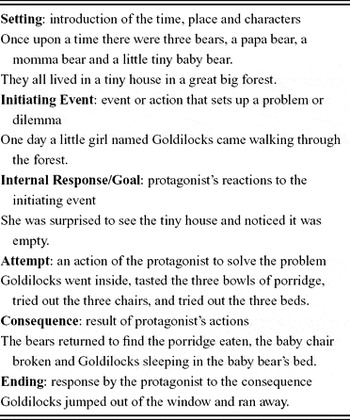
Story grammars were first explored (e.g., Stein & Glenn, Reference Stein and Glenn1979) in the tradition of transformational grammars in order to show the hierarchical and generative nature of discourse beyond the sentence level of analysis. The basic framework consists of six categories of information, outlined in Table 1, along with an illustration from an abridged version of Goldilocks and the Three Bears.
Outline and illustration of story grammar categories.

Not all story grammars fit this framework precisely, some categories including more information, others less. Some narratives involve embedding of story grammar categories, where two plots might be sequenced one after the other or interwoven (e.g., Stein & Trabasso, Reference Stein, Trabasso and Glaser1982). Research on story comprehension has made use mainly of retelling and recall procedures, and findings have consistently shown better recall of settings, initiating events and consequences for adults, children and language impaired participants alike.
Berman (Reference Berman2008), drawing on previous work and a cross-linguistic research program with Ravid (Ravid & Berman, Reference Ravid and Berman2006) presents a model of “global text construction” based on four sources of information, two of which have strong roots in structural aspects of linguistics, the other two in semantics and discourse. The four sources are: (1) referential content, distinguishing eventive, descriptive and interpretive information, measured by the relative proportion of content and ‘ancillary’ material (e.g., reiterations, false starts, dysfluencies and discourse markers; (2) clause-combining complex syntax labeled ‘syntactic packaging’ (Berman & Slobin, Reference Berman and Slobin1994), which links local level units (clauses) to “thematic, topic-based” constituents; (3) lexical and lower-level syntactic information, including word length, lexical diversity, density and abstractness, and clause internal complexity (viz. density, noun phrase heaviness, embedding, passive voice, utterance length, frequency of prepositional phrases); and (4) discourse stance, proposed as the integrative component of the model and consisting of orientation or perspective (i.e., “speaker–writer, hearer–reader or text-oriented”), attitude (specified as affective, prescriptive or epistemic) and “generality of reference” (deictic or anaphoric, specific or generic, concrete or abstract). Structural information is assessed in terms of clause-combining, lexical and morphosyntactic features, while the components describing referential content and discourse stance are functionally based. Of particular interest to the work described later in this article are the lexical measures of diversity, density and abstractness.
Labov, who came to his work on narratives from an interest in gathering authentic data for research on language variation and sound change in sociolinguistics (Labov, Reference Labov1972), provides scrupulous detail on both structural and functional aspects of narrative. His model specifies four structural components (abstract, orientation, complicating action and resolution/coda) along with eight functional categories: temporal organization, evaluation, reportability, credibility, causality, assignment of praise and blame, viewpoint and objectivity. By way of illustration, Labov's notion of ‘evaluation’ illustrates some of the similarity in various narrative approaches. He defines ‘evaluation’ as “information on the consequences of the event for human needs and desires” and as instantiated in clauses/structures involving emphasis, parallelism and comparatives, especially modals, negatives and futures. This definition has superficial similarity to the ‘consequence’ category of story grammars and cuts across the referential (eventive information) and discourse stance components in Berman's model, but takes us far beyond in its specification of the link between form and function and in its appreciation for the social role narratives play. Labov's model also provides a means to use narratives as a window to children's understanding of social roles and relationships.
Telling stories in two languages: discourse structure, lexis and grammar
The theoretical interest which emerges from the literature and which guided the first study reported here is grounded in language use and processing. The working hypothesis is that story structure should be invariant across a bilingual child's two languages and should lead readily to cross-linguistic transfer, while lexical and morphosyntactic abilities should be more language-specific and less predisposed to transfer.
Pearson (Reference Pearson, Oller and Eilers2002) investigated whether oral language skills and narrative skills are ‘distinct’. She and her colleagues analyzed “Frog Story” narratives of 240 monolingual English speakers and English–Spanish bilingual children from grades 2 and 5, scoring the narratives for ‘language’ elements (based on fluency, vocabulary and morphosyntax) and ‘story/narrative’ elements (story structure, orientation, flow of information, evaluative/affective information, metacognitive statements and temporal links). Results focused largely on monolingual–bilingual differences, showing:
• Overall better performance in English than Spanish
• Overall higher Narrative scores than Language scores
• Moderate to high correlations between Vocabulary and Narrative abilities
• Monolingual–Bilingual differences for Vocabulary but not for Story skills
• Bilingual–Monolingual similarities for Complex Syntax (elaborated VPs, complex adverbials, sentence embeddings), but not for Vocabulary and Morphosyntax, on which bilinguals performed much worse than monolinguals.
Of greatest interest to the present study was the within-subject, cross-linguistic comparisons among the bilingual children. In this context, the composite narrative score showed high correlations across languages, while the ‘language’ score did not. Pearson (Reference Pearson, Oller and Eilers2002) concludes that whereas children seem to be able to transfer story elements and complex syntax from one language to another, there is little transfer of knowledge of lexis or morphosyntax. In practical terms, narrative skills in one language seem to benefit from their acquisition in another, while “vocabulary seems to be learned item by item and has to be done in each language separately” (p. 172). Pearson's research presents a more complex picture, showing strong support for cross-linguistic transfer of narrative skills but lack thereof for vocabulary and morphosyntax.
Fiestas and Peña (Reference Fiestas and Peña2004) focused primarily on bilingual–monolingual differences, reporting that bilingual preschool children (N = 12) told stories of equal length and complexity, as measured by the number of C-units, MLC-unit, words and story elements. Story grammar analyses showed, however, cross-language differences in the story grammar categories used in each language, with more initiating events and attempts emerging in Spanish narratives and more consequences in English narratives. Nevertheless, the authors conclude that for their bilingual preschool children the amount of information in a narrative is an “interrelated skill in both languages” (p. 163).
Uccelli and Páez (Reference Uccelli and Páez2007) used a picture-elicitation task to examine relationships among lexical abilities (lexical diversity/Total different words; productivity/Total number of words and standardized vocabulary), storytelling abilities (as assessed by story grammar elements, story sequencing and perspective/affect) and narrative quality (based on Pearson, Reference Pearson, Oller and Eilers2002), which combined storytelling (story grammar elements, story sequencing and perspective/affect) and language abilities (complex syntax, noun lexicon and reference clarity). Lexical and narrative measures showed moderate to high within-language correlations for both kindergarten and first-grade children. In terms of cross-language effects, however, Spanish language scores did not correlate significantly with either English storytelling scores or English narrative quality nor did the English language scores correlate significantly with Spanish story scores or Spanish narrative quality at kindergarten. At Grade 1, English language scores only correlated with Spanish story scores but not with Spanish narrative quality. Overall, these data show strong support for the interdependence of language abilities and narrative abilities within language and independence of these skills across languages.
More qualitatively, bilingual preschoolers are reported to use more ‘light’ verbs such as make, get, do (Kaufman, Reference Kaufman, Verhoeven and Stromqvist2001; Viberg, Reference Viberg, Verhoeven and Stromqvist2001). This phenomenon may be related to lexical access in early bilinguals or to their developmental stage, which underscores the difficulty in distinguishing bilingual from monolingual development. In addition, Kaufman reports that bilingual children who did not remember/use a particular lexical item in one language at the outset of a narrative may at a later stage use that word (Kaufman, Reference Kaufman, Verhoeven and Stromqvist2001, p. 335).
One of the issues addressed in the framework of bilingual narratives is the relationship of lexis and grammar in narrative production. In one of the few studies involving bilingual children with and without language delay, Simon-Cereijido and Gutiérrez-Clellen (Reference Simon-Cereijido and Gutiérrez-Clellen2009) collected retellings and spontaneous renderings of “Frog Stories” in both Spanish and English in order to examine relationships between lexical (number of different words/verbs) and grammatical abilities (as measured by MLU in words). Moderate to high correlations (r = .44 – .71) were reported for lexical–grammatical relationships ‘within language’ for both Spanish and English. For monolingual language-delayed children, however, lexis and grammar were not related (r = .08), supporting research on monolingual LI (Rice, Redmond & Hoffman, Reference Rice, Redmond and Hoffman2006). Findings for cross-language interdependence of lexis and grammar were weak and non-significant (r = .15 – .18) in Simon-Cereijido and Gutiérrez-Clellen (Reference Simon-Cereijido and Gutiérrez-Clellen2009) as well as in Gottardo (Reference Gottardo2002), where correlations were .22 and .01, respectively, for English vocabulary (Peabody Picture Vocabulary Test/PPVT) and Spanish grammar (plurals, N–V agreement, verb tense, adjectives) and for Spanish vocabulary (Test de Vocabulario en Imagenes Peabody/TVIP) and English grammar. On the other hand, Castillo, Restrepo and Perez-Leroux (Reference Castilla, Restrepo and Perez-Leroux2009) found moderate to high cross-language correlations for measures of morphosyntax (cloze task, sentence repetition) and semantics (categorization, semantic associations), indicating there are aspects of language which may transfer cross-linguistically.
Bilingual code-switching
Code-switching (CS) research has followed several, relatively independent tracks. Poplack's (Reference Poplack, Amastae and Elias-Olivares1980) equivalence and bound morpheme constraints, Sankoff's (2002) mathematical model of bilingual discourse, and generative approaches to CS (e.g., MacSwan, Reference MacSwan1999, 2005; Myers-Scotton, Reference Myers-Scotton2002) all focus on representation of the structural constraints of two grammars. Code-switching from this perspective is concerned with the representation of lexical categories and syntactic relations between the first (L1) and second (L2) language. Psycholinguistic research has looked at the temporal ‘cost’ of code-switching (Kroll & de Groot, Reference Kroll, De Groot, de Groot and Kroll1997; von Studnitz & Green, Reference von Studnitz and Green2002), language selection and cross-language activation (Kroll, Bobb, Misra & Guo, Reference Kroll, Bobb, Misra and Guo2008; Schwartz & Kroll, Reference Schwartz and Kroll2006), primarily for lexical processing. Several discourse approaches have addressed structural as well as processing issues (e.g., Auer, Reference Auer1998; Matras, Reference Matras2000). Functional approaches to code-switching have focused on social motivations which underlie the phenomenon. Among the most prominent functions of CS are setting, participants and topic. Pragmatically, CS has been shown to express focus, emphasis, clarification and contrast (e.g., Gardner-Chloros, Charles & Cheshire, Reference Gardner-Chloros, Charles and Cheshire2000; Zentella, Reference Zentella1997).
Research on children's code-switching has followed a similar pattern, including studies motivated by generative theory. Thus, for example, Toribio's (Reference Toribio2001) work on the development of the Functional Head Constraint distinguished between what Meisel (Reference Meisel1994) calls early stage, less systematic “mixing” and “codeswitching.” Ervin-Tripp and Reyes (Reference Ervin-Tripp and Reyes2005) review research on children's code-switching from infancy (Jisa, Reference Jisa2000; Lanza, Reference Lanza1997) to later childhood, distinguishing ‘borrowing’ of single lexical items from “discursive uses of codeswitching motivated by social and pragmatic factors” (e.g., Zentella, Reference Zentella1997). Finally, Gutiérrez-Clellen, Simon-Cereijido and Erickson Leone (Reference Gutiérrez-Clellen, Simon-Cereijido and Erickson Leone2009) collected narratives and conversational speech from forty typically developing (mean age 6;1) and eighteen language-impaired (mean age 5:11) Spanish–English bilingual children. In their frequency counts of CS, the authors excluded phonologically, morphologically and syntactically integrated borrowing as well as proper names and place names, resulting in only 6.5% of all utterances involving CS. They also found differences between Spanish-dominant and English-dominant children in the direction and amount of CS, but from the more dominant language to the less dominant language no differences were found in the amount of CS nor the amount of atypical CS for children with LI.
Following Paradis and Nicoladis (Reference Paradis and Nicoladis2007), the present studies examined CS of single lexical items as well as longer segments (what Paradis and Nicoladis called nonce borrowing and syntactic CS, respectively). We also included what Gutiérrez-Clellen et al. (Reference Gutiérrez-Clellen, Simon-Cereijido and Erickson Leone2009) classified as atypical CS (e.g., CS of the noun without the determiner in a noun phrase) in an effort to determine which type of CS would be most effective in distinguishing speech data from the narratives of bilingual children with and without language impairment. The two studies presented below were designed to take advantage of both the wide scope of skills in narrative production as well as some of the unique features of bilingual narratives. Study 1 looks at discourse structure, lexis and morphosyntax as well as code-switching. Story structure is predicted to be intact for both language-impaired and typically developing children and to be invariant across languages. Lexis and morphosyntax, however, are expected to show differences between children with typical language development (TLD) and those with language impairment (LI) and to differ across languages. Study 1 further explores whether code-switching can contribute to an understanding of differences between typical language development and language impairment. Study 2 pursues this question explicitly, experimentally manipulating sociolinguistic features of the setting of the narrative and the directionality of code-switching in a retelling procedure. This study took code-switching as one of the unique features of bilingual discourse, distinguishing lexical code-switching from CS on longer segments in children with TLD and LI.
Study 1. Production of familiar narratives in bilingual children with TLD and LI
The main questions addressed in this study were: To what extent do the narratives of children with typical language development differ from those with LI in terms of narrative structure, lexis, morphosyntax and code-switching? To what extent do these same features differ in L1/English versus L2/Hebrew?
Method
Participants
Seventeen children, eight girls and nine boys, ages 5;0–7;5 (M = 5;11), all sequential bilinguals from English-speaking homes who had been exposed to L2 Hebrew in Hebrew-speaking preschool programs for more than two years, participated. All children were recruited from preschools in the same middle-class city and neighborhood in central Israel. Eight children with TLD were drawn from regular preschools, and nine from special “language preschools”. In addition to school placement, children were screened prior to the study by certified clinicians with standardized language tests in both languages, the CELF-Preschool 2 for English (Wiig, Secord & Semel, Reference Wiig, Secord and Semel2004) and the Goralnik Diagnostic Test (Goralnik, Reference Goralnik1995) for Hebrew. All eight children with TLD scored within the norms on the standardized tests in both languages, and all nine children with LI scored more than one standard deviation below norm on the CELF-P2 and more than 1.5 standard deviations below norm on the Goralnik. The Goralnik Diagnostic Test is not normed for children above age 6. Among the nine children with LI, two were aged 6:9 and 7;0 but reached the norms of children age 5;0. On this basis, they were included in the group designated as LI. The children with LI for this study were drawn from a larger sample of fifty children tested with these two instruments and selected for their deviation from norms in both languages and for their conformity to accepted exclusionary criteria for LI, i.e., no emotional or neurological disorders and no known visual or auditory impairment (Tallal & Stark, Reference Tallal and Stark1981). A summary of the number of children, their gender, age range, mean age and standardized language test scores in English and Hebrew is presented in Table 2.
Background information about participants in Study 1.

note: *SS = Standard score for CELF-II Preschool.
Narrative elicitation materials and procedure
Data were collected in separate language sessions conducted by native speakers of each language. Participants were tested individually in a quiet area in their preschool on separate days for each language. Each child was shown one of two children's books depicting familiar stories with different picture stimuli for English and Hebrew (Jungle Book and Goldilocks and the Three Bears). After allowing the child an opportunity to look through the pictures, the child was asked by the research assistant to tell the story following the pictures displayed in the book. The corpus consisted of a total of forty-eight narratives, twenty-nine renderings of Jungle Book and nineteen of Goldilocks and the Three Bears, with two to four stories per child (due to absence of some children on the days of data collection) and twenty-four stories in each language.
Data analyses
A total of thirty-two measures were coded and examined for the following domains:
• Narrative structure: overall proportion of story grammar categories and frequency of each of seven story grammar categories
• Lexis: frequency of words, word types, type/token ratio, frequency of content and function words, different content/function words, frequency and percent of verb-based utterances, MLU
• Morphosyntax: omission/substitution of verb inflections, prepositions, pronouns and articles; gender, number and complex syntax errors
• Bilingualism: frequency and proportion of code-switching.
Results
Overall findings showed similarity between groups (TLD/LI) and languages (L1/L2) for narrative structure but differences for a variety of lexical, morphosyntactic and bilingual (code-switching) measures, primarily in distinguishing the two groups of children (see Tables 4–6). Findings are presented first for narrative structure in terms of Story Grammar categories (Stein & Glenn, Reference Stein and Glenn1979), next for lexical measures, for morphosyntax and for code-switching. Finally, correlations among the domains of narrative structure and language abilities are presented.
Narrative structure
Story structure was examined by transcribing and coding each of the child's utterances for the main story grammar components outlined in Table 1. For analyses here, frequencies of story grammar categories elicited were converted to proportions and divided by the number of target categories. Internal response and Goal were coded separately, yielding seven story grammar categories. Analyses of variance were conducted for overall production as well as for each story grammar category separately.
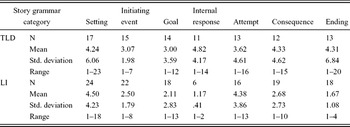
The number of story grammar categories ranged from three to seven for both groups of children. Story grammar categories with the highest frequencies were Settings and Initiating Events; Internal Responses were produced least. Table 3 presents these frequencies.
Frequency (N), Mean, Standard Deviation, and Range of story grammar categories produced by children with TLD and LI.

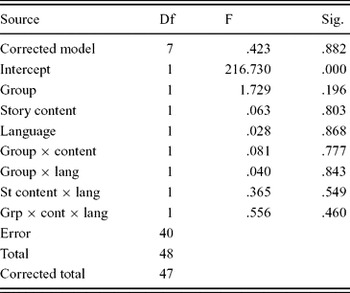
An ANOVA for the proportion of Story Grammar categories yielded no significant main effects for Group, for Story Content or for Language, (F(1,40) = 1.729, .063 and .028), respectively and no significant interactions. Comparison of mean frequency of production for each story grammar category also yielded non-significant differences for each category as well as for overall production (see Table 4).
ANOVA summary table for Group (TLD/LI) by Story Content (JB/G3B) by Language (L1/L2) effects for proportion of Story Grammar categories produced.

Thus, overall there were no differences in narrative structure for children with TLD and those with language impairment, replicating Pearson's (Reference Pearson, Oller and Eilers2002) finding. In addition, no differences emerged in overall proportion of story grammar categories elicited for L1/English and L2/Hebrew.
Lexical measures
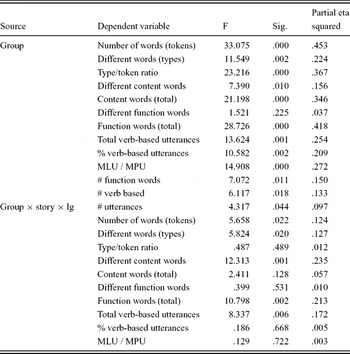
Table 5 presents a summary ANOVA table for the ten lexical measures examined. Main effects for Group (LI/TLD) were found for nine of the ten measures: number of words, word types, type/token ratio, number of content words, different content words, number of function words, total and percent of utterances which contained verbs, and MLU. In all cases, children in the TLD group outperformed children in the LI group. In addition, three-way interactions emerged for five of the ten lexical measures: total words, word types, different content words, number of function words, and number of utterances which contained verbs. Scheffe post-hoc tests revealed that for number of words, TD children produced significantly longer renderings of the Three Bears (G3B) narrative in Hebrew (M = 253.5 words, SD = 36.06) than the children with LI did in either of their languages for both stories (M/SD = 103.4/35.5, 102.2/34.7, 93.6/32.3, 67.4/40.8) for Jungle Book (JB)/English, G3B/English, JB/Hebrew and G3B/Hebrew, respectively. Similar patterns emerged for the other four significant lexical measures.
ANOVA summary table for significant main effects and interactions for ten lexical measures.

However, these interactions can be considered an artifact of the small number of children with TLD who rendered the Three Bears story (only three in English and two in Hebrew) and prior exposure to an English video of Jungle Book, which apparently led to their longer narratives in English. When the Jungle Book data are removed from the data, all interaction effects disappear, leaving the expected result of longer narratives in L2/Hebrew, the expected pattern for sequential bilinguals in the Israeli context.
Morphosyntax
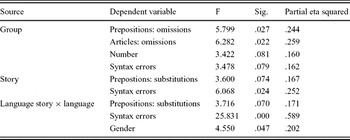
Error rates for use of verb inflections, prepositions, pronouns, articles (omissions and substitutions for all structures) and complex syntax (questions, passive, relative clauses) were submitted to a series of ANOVAs for group, story content and language. Omission of prepositions and articles yielded main effects for group (F(1,47) = 5.799 and 6.282, p < .05), respectively. Complex syntax errors yielded main effects for story content and language (F(1,18) = 6.068 and 25.831, p = .024 and .001), respectively, where a greater proportion of errors occurred for Jungle Book (M = 1.23, SD = 1.57) than for Goldilocks (M = .58, SD = .79) and more in L1/English (M = 1.76, SD = 1.56) than L2/Hebrew (M = .23, SD = .44). Gender errors led to an interaction between story content and language (F(1,18) = 4.55, p < .047). The ANOVA summary data for these effects are displayed in Table 6.
ANOVA summary table for significant and near-significant morphosyntactic measures.

Bilingual code-switching measures
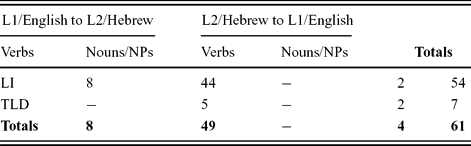
Code-switching, the use of Hebrew in English narratives or English in Hebrew narratives, was not expected to be very frequent, since narratives in English sessions were elicited by native English speakers and narratives in Hebrew sessions were collected by native Hebrew speakers, neither of whom revealed to the children that they knew the other language. This prediction was confirmed, and the directionality and locus of code-switching followed the prevailing pattern for sequential bilinguals in the communities from which the children were recruited, i.e., more L1-to-L2 code-switching with the overwhelming majority of code-switches centering on nouns and noun phrases. A total of 61 instances of code-switching emerged in the 48 narratives, 53 instances (87%) involving nouns and noun phrases and 8 (13%) involving verbs. Of the 61 instances, 57 were code-switches to Hebrew found in English narratives. The overwhelming majority of code-switching (54 out of 61 instances) were produced by children with LI. In addition, all of the instances of CS involving verbs were produced by children with language impairment. These data are summarized in Table 7.
Frequency and locus of code-switching in English and Hebrew narratives in language-impaired (LI) and typically developing (TLD) children.

Data on frequency of code-switching were converted to proportions by dividing the number of switches by the number of words, and these scores were submitted to a Group × Story × Language ANOVA, which resulted in no main effects and no interactions. Only Group and Language main effects approached significance (p < .10), children with LI showing a higher proportion of code-switching than children with TLD (M = .030 vs. .002) and more CS emerging in English than in Hebrew narratives (M = .034 vs. .002).
Relations among story structure, lexis and morphosyntax
Significant correlations were most prevalent for morphosyntax and lexis and least prevalent for story grammar and morphosyntax/lexis measures. Children with TLD and LI generated similar patterns of significant correlations overall (40 vs. 39, respectively). Both groups of children also had many more significant correlations for English morphosyntax and lexis (15 and 12 for children with TLD and LI, respectively) than they did for Hebrew morphosyntax and lexis (4 and 2 significant correlations for children with TLD and LI, respectively).
The most salient differences which resulted from these correlational analyses were the differences between L1/English and L2/Hebrew. Overall, significant correlations were more numerous in English than in Hebrew (55 vs. 24). This argues for a more integrated language system in L1/English than in L2/Hebrew (to the extent that the measures investigated here reflect each of the linguistic domains).
Beyond these quantitative differences, the correlations which did emerge as significant in Hebrew, both for children with TLD and for children with LI, involved story grammar categories. For example, for children with TLD, percent of story grammar categories recalled correlated with the number of function words (r = .607, p = .025) and verb-based utterances (r = .669, p = .034). For children with LI, percent of story grammar categories recalled correlated with number of words (r = .551, p = .014), word types (r = .600, p = .023), number of content words (r = .577, p = .031) and number of different content words (r = .588, p = .027). For English, the only significant correlations between story grammar production and morphosyntactic and lexical measures were found for pronoun substitution errors (r = –.951, p < .001 and r = –.724, p = .012 for children with TLD and LI, respectively) and for type token ratios for children with TLD (r = .804, p = .009).
In conclusion, morphosyntactic and lexical measures correlate more with each other than do story grammar measures with each of them, leading to the conclusion that story structure is a relatively independent source of knowledge. Moreover, when story structure did correlate with lexical or morphosyntactic measures, it did so most often in Hebrew, the child's second language. It may be the case, then, that story structure could serve as a platform on which acquisition of more linguistic features of the language are acquired. Finally, despite the overall similarity for correlations between story structure and lexical measures across language (L1/L2) and group (TLD/LI), the large number of significant relationships for these measures in English for children with LI may be indicative of a less differentiated system, i.e., less independence between story structure and lexical ability.
Summary and conclusions
The findings of this first study show that narrative structure, as represented by use of story grammar categories, is basically similar across languages, across two sets of story content and for children with both typical development and language impairment. This finding confirms research with Spanish–English bilingual children in the United States (Fiestas & Pena, Reference Fiestas and Peña2004; Pearson, Reference Pearson, Oller and Eilers2002). In addition, the study examined a uniquely bilingual measure: code-switching. The directionality and locus of code-switching were shown to follow the expected pattern for sequential bilinguals, with more L1-to-L2 code-switching and more switching on nouns and noun phrases. But most crucial for this study was the finding that the overwhelming majority of code-switching occurred in the narratives of language-impaired children.
These results show the importance of examining language data in both of a bilingual child's languages. Bilingual children with language impairment exhibited some of the same phenomena as those with typical language development, including difficulties with verb inflections, prepositions as well as articles, pronouns, gender marking and lexical retrieval. Disentangling impairment from typical development in bilingualism requires a wide range of linguistic features in order to arrive at bona fide indicators of language impairment. The findings regarding code-switching here led us to look at this question from a more uniquely bilingual perspective. The second study conducted examined directionality and locus of code-switching in a retelling narrative task.
Study 2. Code-switching in bilingual retelling among preschool children with TLD and LI
The present study took from a variety of perspectives on CS (e.g., Clyne, Reference Clyne2003; Myers-Scotton, Reference Myers-Scotton2002; Walters, Reference Walters2005; Zentella, Reference Zentella1997) in an attempt to better understand code-switching abilities in bilingual preschool children. Sociolinguistically, we made use of setting, topic and interlocutor's language background as the primary motivations for code-switching in designing the study and developing the stimulus narratives. Psycholinguistically, language preferences were taken into account in developing the procedures, which involved puppets of different monolingual and bilingual backgrounds. And structurally, data analyses involved looking at the locus of code-switching in terms of nouns/noun phrases as well as larger segments of speech.
We designed narratives which attempted to reflect the environment of English–Hebrew bilingual children, where more L1/English is spoken at home and more L2/Hebrew is spoken at preschool. We also wanted to maximize the amount of code-switching elicited in order to be able to discern patterns in terms of frequency, directionality and structural locus. Thus, in two conditions we asked the children to retell the narratives in a language other than the one in which they heard the narrative, i.e., a narrative in the L1/home setting was to be retold in L2 and a story in the L2/preschool setting was to be retold in L1. In a third condition, a code-switched story set in a doctor's office was retold to a bilingual puppet in whatever language the child preferred.
We predicted more CS for children with LI, regardless of setting/topic and the language preference of the interlocutor. We also predicted more CS in retelling the code-switched stimulus narrative to a bilingual puppet than in retelling the narratives in the other settings. Finally, we predicted an interaction between group and directionality of CS, with more code-switching into L2/Hebrew for children with TLD and more CS into L1/English for children with LI.
Participants
Twenty children, nine girls and eleven boys, mean age 5;3, all sequential bilinguals from English-speaking homes who had been exposed to L2 Hebrew in Hebrew-speaking preschool programs for more than two years, participated. All children were recruited from preschools in the same middle-class neighborhoods in central Israel. Fourteen children with TLD were drawn from regular preschools and one from a special “language preschool”. Four children with LI were drawn from special “language preschools” and two from regular preschool programs. Table 8 presents the number of children, their gender, age range, mean age and standardized language test scores in English and Hebrew for the two groups. As in the previous study, children were first screened with standardized tests of language in both languages, the CELF-Preschool 2 for English (Wiig et al., Reference Wiig, Secord and Semel2004) and the Goralnik Diagnostic Test (Goralnik, Reference Goralnik1995) for Hebrew. All fourteen children with TLD scored within norms on the standardized tests in both languages, and all six children with LI scored more than one standard deviation below norm on the CELF-Preschool 2 and more than 1.5 standard deviations below norm on the Goralnik.
Background information about participants in Study 2.

note: *SS = Standard score for CELF-II Preschool.
Narrative elicitation materials and procedure
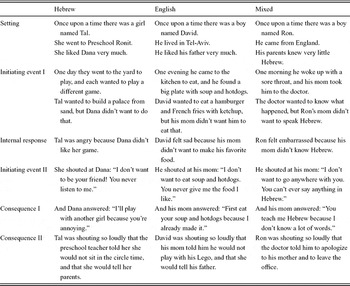
Three stories, grounded in different sociolinguistic settings, were developed to capture differences in linguistic choice: (1) home (English); (2) preschool (Hebrew); and doctor's office (bilingual setting) (Iluz-Cohen, Reference Iluz-Cohen2009). In addition, the characters in each of these stories depicted different language preferences: mother (English speaker) in the home setting; friend in the preschool (Hebrew speaker); and a Hebrew-speaking doctor with an English-speaking mother (in the bilingual setting). Finally, the stories for the present study were structured according to the basic elements of the story grammar framework (Stein & Glenn, Reference Stein and Glenn1979) and included the following categories: (1) Setting, (2) Initiating event I, (3) Internal response, (4) Initiating event II, (5) Consequence I, and (6) Consequence II. The full text of the stories is provided in Appendix A.
The task was administered in three conditions. In one condition an English (L1) story which takes place in the home at dinner time was told to the child from a picture booklet, and the child was asked to retell the story in Hebrew (L2) to a Hebrew-speaking monolingual puppet. In a second condition, a Hebrew (L2) story set in the preschool was told to the child, and the child was asked to retell the story in English (L1) to an English-speaking monolingual puppet. In a third condition, a story about a child and mother in a doctor's office was told to the participant in a code-switched manner (alternating utterances in English and Hebrew), and the child was asked to retell it to a bilingual puppet, where the child was free to choose the language of retelling. Thus, each child told three stories, one from each condition, yielding a total of sixty narratives.
Results
Following a comparison of the two groups for productivity (Table 9), data are presented for overall frequency and directionality of code-switching (Table 10) and for these parameters as a function of the three narrative conditions for children with TLD and LI (Table 11). Finally, a more focused examination of the frequency, directionality and domain of CS separately for N/NP code-switching and code-switching of longer segments of speech is presented. Examples (1)–(4) illustrate CS for nouns/noun phrases and larger segments of speech, respectively.
(1) she'll tell ima and aba, and she won't sit in the mifgash [circle].
(2) then the ganenet [preschool teacher] said that that that she will tell it to her ima and aba
(3) David gar ah at Tel-aviv. . .david gar ba-tel-aviv ve ve-yesh lo aba, ve-yesh lo soup ve-ve- ve-hotdogs. He wants eh hamburgers and snicel ve-qetchop.
[David lives ah at Tel-aviv. . .david lives in Tel-aviv and and he has a father, and he has soup and- and- and-hotdogs. He wants eh hamburgers and schnitzel and-ketchup.]
(4) Ima amar eh shouted out . . .she shouted shouted you are not gonna play with lego and you call his father.
[Mother said eh shouted out . . .she shouted shouted you are not gonna play with Lego and you call his father.]
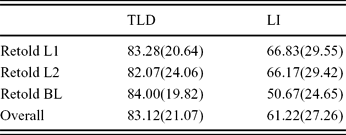
Means (SD) for length of stories for children with TLD and LI in three story conditions.

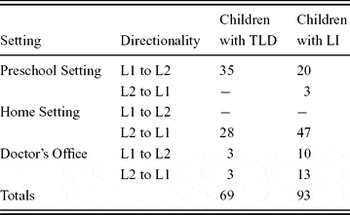
CS per thousand words on nouns/NPs for three settings (Preschool/Home/Doctor's Office) and two directions (L1 to L2 and L2 to L1) for children with TLD (N = 14) and LI (N = 6).

CS per thousand words on larger segments of discourse for three settings (Preschool/ Home/Doctor's Office) and two directions (L1 to L2 and L2 to L1) for children with TLD (N = 14) and LI (N = 6).

Productivity
Table 9 presents the mean length of retold stories for children with TLD and LI. The children with TLD retold longer stories (M(SD) = 249.36(53.74) vs. 183.67(80.27) for children with TLD and LI, respectively). The largest difference emerged for the Code-switched story condition in the Doctor's office setting (M(SD) = 84.00(19.82) and 50.67(24.25), respectively for children with TLD and LI).
Frequency of CS per utterance
The overall rate of CS in this study was 30% (CS instances divided by total number of utterances) and 25% when calculating the percent of utterances which contained one or more instances of CS. These rates of CS are far higher than in Study 1, where separate sessions were conducted for each language, far more than what has been reported in spontaneous child–adult conversation (Genesee, Reference Genesee and deWaele2003) and more than in Guttierez et al.'s (2009) study of narratives in bilingual children with TLD and LI (6–8%), but similar to a previous narrative retelling study among Russian–Hebrew bilingual children, which also manipulated language of elicitation and listener background (Raichlin, Reference Raichlin2008). In order to attain comparable scores for CS frequency, due to the variability in the length of the narratives, CS ratios were calculated by dividing the number of instances of CS by the total number of words. These CS ratios are also empirically motivated by the fact that single words and phrases (primarily nouns and noun phrases) constituted the overwhelming number of instances of CS. Descriptive data are presented here, since the number of data points (164) was too few to conduct even non-parametric tests for effects of group × setting × directionality.
Group differences
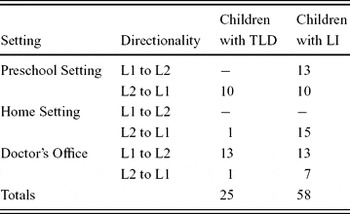
Table 10 presents CS ratios for three settings (Preschool/L2, Home/L1 and Doctor's Office/Bilingual) as a function of the directionality of the child's CS (L1 to L2 vs. L2 to L1). The data show that overall children with LI produced more CS than children with TLD. The difference in frequency of code-switching between children with LI and children with TLD was found in all experimental conditions except the Preschool setting, where children with TLD generated more CS from L1 to L2. In addition, for children with LI, twice as much CS was found for N/NPs than for larger segments of discourse (32 vs. 19 per thousand), while children with TLD had more than three times as much CS on for N/NPs than for larger segments (23 vs. 8 per thousand). The ratios for CS on nouns and noun phrases are presented in Table 10.
Setting/Topic differences
It was expected that more code-switching would occur in the Doctor's Office setting, since it was presented in a mixed language format, and the child was instructed to retell the story to a bilingual puppet. Contrary to expectation, both the Preschool and Home settings elicited more CS than the Doctor's Office setting, for both children with TLD as well as those with LI. This finding suggests that something more than the sociolinguistic setting influenced the rate of code-switching in this experiment.
Directionality and CS
For CS on nouns and noun phrases, when overall frequencies of CS were broken down for directionality, an interaction of social setting and directionality of CS resulted. Higher rates of CS for children with TLD emerged in the Preschool/L2 setting, but higher rates for children with LI resulted in the Home/L1 setting. These sociolinguistic differences were accompanied by a difference in the directionality of the CS, children with TLD code-switching more from L1-to-L2 and children with LI code-switching more from L2-to-L1.
Setting and directionality were intentionally confounded in the experimental manipulation in order to maximize code-switching. At the same time, asking the child to retell an L1 story in L2 and vice versa may have placed increased processing demands on the child. For the children with TLD, these demands led to: (a) CS only into L2 in the L2/preschool setting even though the interlocutor puppet was presented as a monolingual L1/English speaker; and (b) CS only into L1 in the L1/home setting even though the interlocutor was a monolingual L2/Hebrew speaker. Thus, their sociolinguistic sensitivity to the setting apparently influenced the direction of their code-switching. Similarly, the children with LI showed more sensitivity to setting than to interlocutor, code-switching predominantly to L2 in the L2/preschool setting and only to L1 in the L1/home setting.
When comparing the relative amount of CS in these two settings, another insight emerges, i.e., that children with LI had more than twice as much L2-to-L1 than L1-to-L2 code-switching (63 vs. 30 times per thousand words), while children with TLD had relatively similar amounts of CS in each direction, with the balance tipped slightly in favor of L1-to-L2 CS, the prevalent pattern for sequential bilinguals (38 vs. 31 CS per thousand words). Finally, individual data was found to closely reflect these patterns, with all but one of the children in each of the two groups showing these patterns of directionality in the Preschool and Home setting.
Structure/Locus of CS
In order to clarify whether these same patterns exist in CS beyond the noun/noun phrase level, setting and directionality were examined for CS on larger segments of speech. As seen in Table 11, the children with LI accounted for the bulk of the CS here (70% of all code-switching, 58 vs. 25 times per thousand words for children with LI vs. children with TLD, respectively).
This finding for overall frequency of CS replicates the finding for group differences reported for nouns and noun phrases. With regard to directionality of CS, children with LI produced more L2-to-L1 (than L1-to-L2) code-switching in the L1/home setting, relatively equal amounts of L2-to-L1 and L1-to-L2 CS in the L2/preschool setting and more CS from L1-to-L2 for the doctor's office setting. The finding here for the L1/home setting shows the same sociolinguistic sensitivity that children with LI showed above for CS on N/NPs. For the L2/preschool setting, however, the relatively equal amounts of CS in the two directions was not indicative of sensitivity to social setting and may be due to limited control of the statistical properties and sociolinguistic constraints on CS.
General Discussion
Two studies were conducted in an attempt to examine bilingualism in narrative production in typically developing and language-impaired children. Study 1 was in part an attempt to replicate Pearson's (Reference Pearson, Oller and Eilers2002) finding that knowledge of narrative structure is largely independent of ‘linguistic’ knowledge in bilingual preschool children. In Study 1 narrative structure was examined via story grammar categories, and ‘linguistic’ abilities focused on measures of lexis, morphosyntax and bilingualism, viz. code-switching. It was found that bilingual children with language impairment showed virtually no differences from bilingual children with typical development in terms of narrative structure (as defined by story grammar categories), but differed significantly on a variety of lexical and morphosyntactic measures, thus replicating Pearson's argument that narrative structure and ‘linguistic’ knowledge are relatively independent abilities.
In addition, Study 1 showed that frequency of CS distinguished children with TLD from those with LI, the latter children showing proportionally more CS despite the fact that separate elicitation sessions were conducted with native speaker research assistants for each language. This finding contrasts with that of Gutiérrez-Clellen et al. (Reference Gutiérrez-Clellen, Simon-Cereijido and Erickson Leone2009), who found no differences in frequency of CS between six-year-old children with language delay and TLD. These researchers also reported similar patterns of CS in terms of grammaticality, arguing that despite grammatical difficulties, children with LI “did not demonstrate a deficit in their knowledge of CS constraints”.
Other studies on code-switching in children from different language pairs (Spanish–English, French–English, Russian–Hebrew, English–Hebrew) have reported frequency of CS to vary as a function of a variety of factors, including: the language of elicitation, language(s) of the interlocutor, task (conversation/narrative) and the child's language dominance (Ervin-Tripp & Reyes, Reference Ervin-Tripp and Reyes2005; Jisa, Reference Jisa2000; Lanza, Reference Lanza, Verhoeven and Stromqvist2001; Raichlin, Reference Raichlin2008). Thus, Study 2 aimed to identify different patterns of bilingual code-switching which could help distinguish typical development in bilingual children from language impairment. A story retelling experiment was conducted which manipulated the language and social setting of the story and the language(s) of the listener in three conditions: (1) a preschool-based story narrated in L2 and retold to an L1 monolingual, (2) a home based/dinner time story narrated in L1 and retold to an L2 monolingual, and (3) a doctor's office story narrated in code-switched speech retold to a bilingual listener. The main findings can be summarized as follows:
• Bilingual children with TLD produced longer narratives than children with LI.
• Children with LI produced proportionately more CS than children with TLD.
• An interaction of social setting and directionality of CS resulted, with higher rates of CS for children with TLD in the Preschool setting from L1 to L2, but higher rates of CS for children with LI in the Home setting from L2 to L1.
The remainder of this article argues for use of a wide range of lexical, morphosyntactic, sociolinguistic and psycholinguistic measures as a means to distinguish bilingual children with TLD from those with LI. In particular, the discussion focuses on code-switching, a phenomenon unique to bilinguals, as a way to distinguish typical and impaired bilingual development. In this discussion, we look first at overall rate of CS, then focus on lexical CS and its difference from CS of larger segments of speech, and finally at sociolinguistic sensitivity and directionality of CS.
Frequency and structure of CS
Study 1 showed that bilingual children with TLD differed from bilingual children with LI on a wide range of lexical parameters despite fundamental similarities in performance on narrative structure. These lexical measures were able to distinguish TLD from LI as well as distinguish performance in L1 from L2. Study 2 took these findings, which showed a dissociation of lexical and narrative performance, as a jumping-off point for an interest in lexical and syntactic code-switching. Overall rates of CS in Study 2 were high in comparison to other studies (25.6% of all utterances contained one or more instances of CS), due in part to the experimental manipulation of elicitation language and interlocutor. Moreover, overall CS rates were much higher for children with LI than for those with TLD. This finding contrasts with Gutiérrez-Clellen et al.'s (Reference Gutiérrez-Clellen, Simon-Cereijido and Erickson Leone2009) finding for Spanish–English bilingual children who narrated Frog Stories in both languages. In that study, which was comparable to Study 2 reported here in terms of the age of the children (age 5), the data elicitation method (narratives), and inclusion of children with both TLD and LI, the authors reported CS in 1–12% of utterances, but children with TLD and LI did not differ in rates of CS (6.2% vs. 7.9%, respectively). It should be noted that the overall CS rates differed due to the fact that Gutiérrez-Clellen et al. excluded many single noun switches counted in the present study. These authors did, however, find a high degree of variation as a function of the language of elicitation (1.2% in English sessions and 11.4% in Spanish sessions) and the language dominance of the child (3.6% code-switched utterances for Spanish-dominant children and 19.4% for English-dominant children in Spanish sessions but virtually no variation in the English sessions).
Due to the robust variation in overall rates of CS across other studies cited here, as well as Guttierez et al.'s (2009) finding that rate of CS did not yield differences between children with TLD and LI, the fact that this measure does distinguish the two diagnostic groups here needs further clarification in order to pursue one of the primary interests of this article, i.e. to disentangle TLD from LI. We look next at the structure/locus of CS as a potential indicator of TLD/LI differences.
The structure/locus of CS as a potential indicator of TLD/LI differences
Lexical code-switching on nouns and noun phrases differed for the two groups in Study 2. Of the 164 instances of CS in the corpus, 70% occurred on nouns and noun phrases. Moreover, the data on lexical CS (Table 10) clearly distinguished children with TLD from those with LI, while the data on CS across larger segments of speech (Table 11) did not. The overall rate of lexical CS reported here was higher than the rates found in other studies: 31% noun CS (112/357) reported by Stephens (Reference Stephens1986), 14% nouns reported by Zentella (Reference Zentella1997) for adults and children in her corpus, and 3.2% code-mixed utterances (ranging from .45% to 9.8% across eight children) reported by Paradis and Nicoladis (Reference Paradis and Nicoladis2007) for younger French–English bilingual children (ages 3;6–4;11). For the two children in Paradis and Nicoladis (Reference Paradis and Nicoladis2007), who were most comparable to the children in the present study (in that they were sequential bilinguals from L1/French-speaking homes in L2/English-speaking daycare programs), the lexical CS rates were under 3%, in contrast to the 25.6% code-switching for the individual children in Study 2. Paradis and Nicoladis (Reference Paradis and Nicoladis2007) operationally defined nonce borrowing as “single lexeme insertion into a phrase in a clause where all other elements come from the other language” (p. 284) and distinguished this type of CS from syntactic CS, “insertion of an entire phrase into a clause in the other language”, or a “switch at a phrase boundary within a clause from one language to the other”. But, as mentioned above, lexical CS was highly variable across the studies reviewed (from less than 1% to 70% of all switches in the present corpus). Thus, structure/locus of CS itself is not a sufficient indicator to identify bilingual language impairment.
A closer look at the motivations for both lexical and syntactic CS in the present study showed that both lexical and syntactic CS were motivated by what Zentella (Reference Zentella1997) called “crutch-like” code-mixing (25% in her adult and child corpus) and what Walters (Reference Walters2005) called psycholinguistic reasons to compensate for lexical retrieval difficulties and maintain fluency. In Study 2, the only difference which did emerge between the groups in this regard was that children with TLD showed more variety in the syntactic category of their lexical switches, using verbs (shouted, forgot) and discourse markers (and, so) as well as nouns and noun phrases. This similarity between the groups is useful as background for looking at sociolinguistic sensitivity and directionality as a means to distinguish CS in typical and impaired-language development.
Sociolinguistic sensitivity and directionality of code-switching
Design of the retelling tasks was informed by a bias that language includes both psycholinguistic and sociolinguistic dimensions, and the resulting interaction of sociolinguistic (language of the setting and listener) and psycholinguistic information (directionality of code-switching, L1-to-L2 vs. L2-to-L1) was seen as a potentially useful way to distinguish typical development from language impairment in bilingualism. Since sequential bilinguals, i.e., those successfully acquiring their L2, show better skill and a preference for L2, that preference usually shows up as more CS from L1 to L2. This preference for L2 switching was found for children with TLD in both settings outside the home (preschool and doctor's office), regardless of interlocutor and for both NPs as well as for larger segments of CS. In contrast, bilingual children with language impairment had overall higher levels of CS, particularly across larger segments of speech as well as a preference for CS in the other direction, i.e., from L2-to-L1.
Paradis and Nicoladis (Reference Paradis and Nicoladis2007) concluded that “preschool-aged bilingual children can achieve discourse separation in language choice, but whether they do so depends on an interaction of their dominance and their sensitivity to the bilingual speech patterns of the greater community”. The present study found strong evidence for sociolinguistic sensitivity. But language dominance was not a factor, since both groups of children were relatively balanced bilinguals, as confirmed by similar performance on standardized tests in both languages. Further research should examine dominant as well as balanced bilinguals.
Summary and conclusions
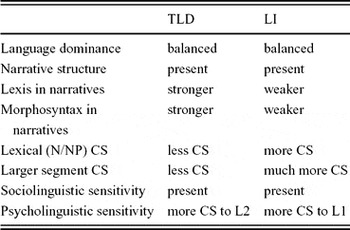
Table 12 summarizes profiles of the children with TLD and LI for the linguistic, sociolinguistic and psycholinguistic features in the two studies reported above. The pattern which emerged showed comparable, intact abilities on narrative and sociolinguistic features and differential performance on lexis, morphosyntax and the frequency and directionality of code-switching. In other words, the two groups of bilingual children have similar abilities to reconstruct narrative structure and are sensitive to sociolinguistic factors such as setting and interlocutor. However, children with LI show weaker performance in lexis and morphosyntax, as well as (1) more overall CS, (2) more CS in longer segments of speech, and (3) somewhat more CS to L1, all of which distinguish them from TLD sequential bilingual children in the present study.
Profile of distinguishing features.

The issues of bilingualism and language impairment are complex, and studies of bilingual children with LI are still too few to draw definitive conclusions. The present studies have cast a wide net, arguing that it is important to take into account a range of features, across a large linguistic spectrum in the quest for answers to the questions posed here.
Stimulus narratives for Study 2