

1. Introduction
Deforestation is one of the major sources of anthropogenic greenhouse gas (GHG) emissions, contributing about 15 per cent to total global emissions. This percentage even outstrips that of emissions from transportation. The Eliasch Review (Reference Eliasch2008) estimates that by 2100 the economic cost due to deforestation could be around US$1 trillion per year; achieving stabilization at concentrations keeping warming below 2°C would be impossible if deforestation continued at the current pace. The question arises as to why the Kyoto Protocol was not designed to account for deforestation emissions. One of the concerns had to do with the fear of negotiators – at the time when the Protocol was ratified – that low-cost credits granted for avoided deforestation could flood the market, thus driving down the price for carbon allowances and thereby undermining the effectiveness of cap-and-trade by, e.g., destroying the incentives to develop, test and install modern, less carbon-intensive technology. Even though the need to include reduction of emissions from deforestation and degradation (REDD) in international agreements was identified as early as the 9th Conference of the Parties (COP9), it was only at COP13 when this was officially recognized. Furthermore, many additional benefits have been emphasized: for example, compliance costs will be lower if REDD is included in the next agreement, so an even more ambitious target could be achieved at a comparatively lower cost provided REDD is included in global carbon markets (Eliasch Review, Reference Eliasch2008).Footnote 1
In this paper, we are concerned with finding a way of implementing REDD and investigating its potential effects on energy investments. In addition, we aim to shed some light on the debate over whether REDD should be integrated into carbon markets and whether it complements or undermines cap-and-trade in its intentions to promote low carbon technology. The latter has been opposed by stakeholders and decision makers in many countries due to the instability of CO2 permit prices that are associated with new, immature markets, which are also influenced by policy uncertainty. Such price volatility could, for instance, be observed when the European Emissions Trading Scheme (ETS) started. We find that the inclusion of REDD in existing carbon markets can help to smooth out such fluctuations, thereby reducing the risks that producers might be exposed to.
For the analysis of these problems we design a real options model. Real options are a suitable tool to assess the optimal timing of investment decisions under uncertainty when there is irreversibility involved and the investors enjoy a certain degree of flexibility with respect to their actions (see, e.g., Dixit and Pindyck, Reference Dixit and Pindyck1994). The basic idea is that it pays off to wait for the arrival of more information in the face of uncertainty if a large amount of resources has to be committed to a project. In the case of an energy investor, a less carbon-intensive power plant or equipment designed to mitigate the emissions from combustion require such an irreversible investment. The real options model used in this paper focuses on a coal-fired power plant, which can be retrofitted with a carbon capture and storage (CCS) module, which will reduce a major part of the emissions generated by the combustion of coal in the power plant. The CCS module is therefore an example of a carbon-saving investment, which is suspected to be negativelyFootnote 2 affected by the availability of REDD credits. The investor also has another possibility to meet his or her CO2 obligations: options on REDD (subsequently called ‘REDD options’) can be purchased at the beginning of the planning period and exercised at any point of time in the future in our framework. To clarify, the option on using REDD for offsetting CO2 obligations is a financial one to the firm but is backed by tropical forest, which is a real asset.Footnote 3 From the point-of-view of the tropical country, conserving the forest thus provides a real option by maintaining a potentially valuable source of emissions mitigation, but this is beyond the scope of the model developed in this paper. We focus on the option facing the firm, which guarantees the investor the right, but not the obligation, to offset emissions at some point of time in the future at a prespecified strike price. Note that this analysis could apply to options on any low-cost abatement source, but that REDD is a particularly relevant case: we choose REDD credits as an offset mechanism because it is a good example of an actual low-cost abatement opportunity that could generate a supply of options up-front. Another reason that makes REDD an interesting example is the current debate on its effect on carbon prices and thus on the incentives to develop clean technologies.
The reason for allowing the purchase of the REDD options only in the beginning is to account for the fact that tropical countries will require some compensation up-front rather than agreeing to wait for firms in industrialized countries to purchase offsets over the course of time as they need them. While the idea that options on REDD can offer flexibility in the face of uncertainty has been brought up before (Golub et al., Reference Golub, Greenberg, Anda, Wang, Golub and Markandya2010), this paper is the first to implement this in a model explicitly and use it to look at policy-relevant questions such as the impact on investment in carbon-saving technology.
For all emissions not offset or captured, permits must be purchased at the current ETS priceFootnote 4 in €/ton of CO2 in each respective year. In summary, there are thus two decisions to be made on a yearly basis: (a) the number of purchased REDD options (if any) to be exercised each year and (b) the timing of the adoption of the CCS module. CO2 permit prices follow a stochastic process, where the volatility is estimated from the spread of CO2 permit price scenarios in the future.
An important difference from other REDD studies is that we take the perspective of the firm in this paper. This implies that the option on REDD is treated as an offset opportunity only. If we took the view of the forest owners as well, we would also have to take into account the option value from delaying deforestation in order to preserve the option of selling REDD credits. This is beyond the scope of this paper, but it will be briefly discussed in the final section. Another implication of the firm-level focus is that we assume that the firm is only a small part of the market thus facing an unlimited supply of REDD options at the beginning of the planning period.
The REDD options are priced as derivatives of permits, but we also compare outcomes for lower option prices as, for example, derived from carbon supply curves for global forests and other land uses (see, e.g., Sedjo et al., Reference Sedjo, Sohngen and Mendelsohn2001 or Kindermann et al., Reference Kindermann, Obersteiner, Sohngen, Sathaye, Andrasko, Rametsteiner, Schlamadinger, Wunder and Beach2008). We find that the pricing of REDD options is crucial in determining its impact on CCS investment and that integrating it in global carbon markets would ensure a high enough price to avoid such negative effects that are suspected to materialize by critics of REDD.
The rest of the paper is organized as follows: Section 2 explains the basic ideas of real options modeling and sets it in the context of permit trading and REDD, affecting a representative coal-fired power plant owner. Section 3 provides a detailed description of the model, the data used, and the pricing mechanism applied to the valuation of the REDD options. Section 4 presents the results and discusses the implications for future carbon markets. Finally, section 5 concludes and extracts recommendations for policy-makers from the analysis previously conducted.
2. Real options, permit trading, and REDD
While options theory has long been established in finance, real options are a relatively new concept, where the opportunity to invest into a ‘real’, nonfinancial asset is considered as an option or, in other words, as the right, but not an obligation, to commit resources to the project at a future point in time. According to Dixit and Pindyck (Reference Dixit and Pindyck1994) among others, real options modeling is a suitable framework to analyze investments under uncertainty, which involve irreversibility with respect to the resources spent (most often large costs in terms of capital) and flexibility to postpone the project on behalf of the investor. In contrast to ‘standard’ net present value (NPV) investment rules, real options take into account the value of waiting for more information to be revealed; the investor can thus base the optimal decision on the value of immediate profits seized from an investment and the value of investing at a later point in time, where the latter is often called the option value of the investment. The basic idea behind real options is that it takes into account the flexibility of the investor to act later when he can make different decisions for different outcomes of the uncertain factors. There are many applications to investment problems (see, e.g., Pindyck, Reference Pindyck1993, for an early application to sequential investment).
In energy planning, real options have been used in many theoretical applications already (see, e.g., Reinelt and Keith, Reference Reinelt and Keith2007). Related to the topic of permit trading and the vulnerability of producers' profits to CO2 permit price fluctuations, Szolgayová et al. (Reference Szolgayová, Fuss and Obersteiner2008) use a real options model to investigate the impact of a price cap, which has been suggested as a form of protection against upward price spikes for power plant operators. The authors find that too low a price cap depresses investment in less carbon-intensive technologies and benefits companies with high emissions asymmetrically, as similar protection is not provided for the owners of clean technology through, for example, a CO2 permit price floor.
In this paper, we seek to suggest an alternative instrument to assist producers in hedging their risks: the integration of REDD options in an existing carbon market. We find that this combination of instruments (permit trading and REDD) can, indeed, help to smooth out fluctuations in profits and thus reduce the investor's exposure to risk. This shows that the provision of REDD options represents additional flexibility to the investor, the value of which depends on the development of CO2 permit prices.
Also, we want to address the policy dimension of adopting REDD and the design of the underlying mechanisms. To date, there are still many unresolved scientific and technical issues (REDD mechanisms, climate sensitivity, REDD potential, etc.) and also political difficulties (commitment of different countries) with respect to implementation. However, our suggestions point to the usefulness of going ahead with REDD already at this stage, even if many issues are not solved yet and many technicalities remain unclear at the moment. The reason for this is that the exercise of the REDD options will have to be decided upon in the future and not now, so the payment in terms of the option price has to be made today, but it is low compared to the strike price and the price of CO2 permits. So, even if some problems can only be resolved in the future, it is still possible to act optimally and with access to better information later. Furthermore, the option price could be set equal to the break-even price of REDD-backed carbon credits. This payment is critical to cover the opportunity cost of avoided deforestation. The strike price could be calculated taking into account upfront payments, but also various risks associated with delivery and fungibility of REDD-backed carbon credits. Therefore, we treat the option price as exogenous in this study and consider different scenarios for the price setting.
3. Modeling REDD and CCS options
3.1 Model description and methodology
The model derived in this section includes a real investment option and an option on REDD. The only ways for the firm to comply with the emissions targets are to buy permits (or fungible REDD credits) or to mitigate emissions through investment in mitigation technology. In our specific case, we consider the option to retrofit an existing coal-fired power plant with a CCS module. The REDD option is an additional way of offsetting CO2 emissions. By including it into the same framework as the option on CCS investment, we can value one option in the presence of the other. In this way, we can determine the impact of the availability of REDD options on deployment decisions concerning mitigation technology.
As already motivated in the previous sections, we model the incorporation of REDD credits (e.g., for projects avoiding deforestation) into the carbon markets by options on REDD. This means that owning one option on REDD gives the investor a right but not an obligation to offset 1 ton of CO2 at any time now or in the future for a given strike price E. Both the strike price E and the price of the option P REDD are considered exogenous and are an input to the model. This means the option is an American call option from the point of view of the producer.
Let us now explain the model structure and the mathematical formulation of the problem. The planning horizon of the model is 50 years, which is equal to the considered power plant's lifetime. The producer (or planner) owns a coal-fired power plant, which can be retrofitted to include a CCS module. Adding this module will capture part of the emitted CO2, but the cost of installing the module is relatively high and will be sunk ex post. Note that the power plant is assumed to have a fixed output and associated quantity of emissions each year that do not vary. Let us assume the investor also owns as many options on REDD as can offset the CO2 emissions of the power plant for N years. This implies that the options can be purchased only at the beginning of the planning period. Although this is indeed a simplification, we believe it is not a significant one. As already mentioned in the previous section, one of the major issues that led us to model the REDD offsets as call options was the need to raise some of the funds for the REDD suppliers already now. Therefore, it is reasonable to assume that some options would be available for purchase at the beginning of the planning period. This assumption enables us to decrease the dimension of the model, which is crucial for numerical efficiency. Even more importantly, REDD is a good example where options might at least be available at the beginning of the planning period. For simplicity, the effect of options being available throughout the planning horizon is not modeled, though the availability of such options would only add further risk hedging benefits.
The investor is risk neutral and wants to maximize the sum of the discounted expected future profits over the whole lifetime of the power plant. He needs to decide on the optimal operation plan of the power plant during its lifetime. In particular, he has to decide on whether and when to add the CCS module, and whether and how to exercise the options on REDD. We assume the decisions can be taken on a yearly basis.
The investor is facing stochastic CO2 permit prices. We assume that the price of CO2 will follow a geometric Brownian motion,Footnote 5

where μ is the drift parameter, σ is the annualized volatility parameter, and dWt is the increment of a Wiener process.
Let us denote xt the state of the power plant at time t, describing whether the CCS module has been built yet (xt equal to 1 in case the CCS module is installed, and equal to 0 otherwise). Let nt express the amount of the options on REDD that the investor still has not exercised at time t. The amount is given in the number of years for which the options on REDD can offset the emissions of the power plant. Both variables together describe the state of the investment. The set of the feasible actions at that the investor can choose from at time t, given he is in state (nt, xt) is the following. He can decide either to continue as before without any action (at = 0),Footnote 6 to invest in the CCS module if xt = 0 (at = 1), or to exercise the option on REDD if nt > 0 (at = − 1). We assume the investor can only offset all the yearly emissions, i.e., it is not possible to offset a fraction by offsets and the rest by permits in one particular year. The investor can choose the action in each year based on the information on the CO2 permit price and the state of the system, i.e., the optimal action in each year will be a function of both state and price realized that year.
Given these assumptions, the investor's problem can be formulated as an optimal control problem in a following way:

where A(nt, xt) denotes the set of feasible actions as defined earlier, r is the discount rate, P 0 is the starting CO2 permit price, and π and c denote the yearly profit and costs associated with the chosen action, respectively.
The yearly profit π consists of the revenues from selling electricity less the cost of fuel, CO2-related expenses, annual operations and maintenance (O&M), and costs associated with the decision undertaken that year. CO2-related expenses consist of payments for the CO2 permits needed to be purchased for all emissions that are not offset by REDD or captured through the CCS module. Therefore, they depend on the existence of the CCS module and on the action performed that year. The cost of both capital and O&M is assumed constant and deterministic, which abstracts from possible capital-saving technical change. See section 3.2 on data for further discussion on this topic. We also ignore stochasticity in coal prices for now. Thus the yearly profit is equal to

where Pe, Pf, and P denote the price of electricity, coal, and CO2, respectively, and OC is the operational cost per year. Note that OC also includes the costs of transporting and storing the captured CO2. The annual amounts of produced electricity and consumed fuel and released CO2 emissions are exogenous quantities and denoted, respectively, qe, qf, qc.
By c(x, a) we denote the costs of the chosen action, where the costs are equal to the capital costs of the CCS module for a = 1, and equal to zero for a = 0. In the case when a = −1, the costs consist of the payments for exercising the option on REDD. In the case when the CCS module has already been built, exercising the REDD options will offset more emissions than necessary. In that case, we assume that the producer is able to sell his surplus permits and thus retrieve what was paid in excess.
The investor's problem is to determine the optimal investment strategies {at}50t = 1, where the optimal decision in each year depends on xt, nt, and Pt.
As already mentioned, the problem is a discrete stochastic optimal control problem on a finite horizon and can be solved by dynamic programming. This means that the optimal actions can be derived recursively by the Bellman equation for the value function V (·):

where the value function is equal to zero at the end of the lifetime of the plant. The Bellman equation enables us to derive the value function backwards, determining the optimal actions at the same time; the first part of the value to be maximized is the immediate profits one would obtain upon undertaking action at, while the second part of the sum is the so-called continuation value, which represents the value of the power plant from time t until the end of the planning horizon, when it is managed optimally.
Since we assume the decisions can be made only at prespecified points in time, the state does not change in between them. Therefore, path dependence is not present and we can solve this problem numerically by the discretization of carbon price, computing the estimate of Et[V t + 1(n t + 1, x t + 1, Pc t + 1)|Pct] by Monte Carlo simulation.Footnote 7
Together with the terminal condition, dynamic programming can then be used to derive not only the value function, but also the optimal action a in each time step for every possible state, and for each of the discretized price values. This endows us with a strategy for all possible circumstances and price realizations in terms of the optimal action, which will maximize expected profits.
For a fixed strike price E and the price of the option P REDD, the model derives the value of the power plant assuming the investor purchases N options at the beginning of the planning period. The optimal amount of options on REDD to purchase is then found as the amount that maximizes the derived plant value decreased by the cost of those options.
When analyzing the results of the model, we are interested to learn about the frequency distributions with which the actions are undertaken. Therefore, we simulate (10,000) possible CO2 permit price paths and extract the corresponding decisions from the output matrix. In this way, we cannot only derive the optimal amount of REDD options to be bought, but also when they will be exercised, as well as the frequency of investment in the CCS module.
Since the option on REDD is modeled as an American call option on the CO2 permit price in this model, we can derive the appropriate price of the option. And because the price of an American call option for an asset without dividends is the same as the price of a European call option, we can use the Black and Scholes (Reference Black and Scholes1973) formula:

where N denotes the cumulative distribution function of the standard normal distribution. This means that if the option on REDD were priced as a financial option on the CO2 permit price, which evolves according to equation (1), its price should be equal to  .
For the analysis, the strike price is fixed at US$15/ton and the model is run for a range of prices of the option on REDD, analyzing both extremely low and high values. More specifically, we examine cases where the option prices are determined in the market (according to the Black and Scholes formula) as a derivative of the CO2 permit price and also for a range of alternative cases, where the price is lower and determined exogenously according to the REDD supply curve. One could imagine that lower prices could emerge from competition for buyers between supplier countries. In other words, both option price and strike price are subject to negotiations and may reflect several factors not accounted for in the model described above. On the one hand, the option price should be sufficiently high to attract countries to the REDD framework. The strike price would reflect several factors, too, including the fungibility of REDD-backed credits. In the future, we intend to endogenize option and strike prices.
3.2 Data: technology costs and CO2 permit prices
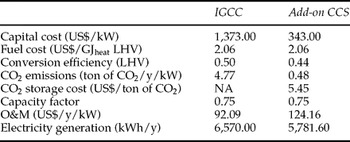
Table 1 lists the data that have been used in the analysis. They have been gathered from the International Energy Agency's survey on power plants in 2005 and its technological outlook from 2006. The technology focused on is an Integrated Gasification Combined Cycle Plant (IGCC), which is more modern than many existing, standard pulverized coal-fired power plants, and which will be more interesting for new installations, since it has a higher conversion efficiency. This implies that this technology uses less coal and generates fewer emissions at the same time, which will be an advantage in the light of rising CO2 permit prices. Retrofitting the IGCC plant with a CCS module requires an additional outlay in terms of capital costs, but also the efficiency of the plant will be lower and so the yearly output for the same amount of inputs will be lower as well. Operations and maintenance costs will be higher for the plant including CCS. This has also to do with the fact that the CO2 does not only need to be captured, but it also needs to be transported to a suitable site, where it can be stored. However, the savings in terms of CO2 through capturing are large and a sufficiently high CO2 permit price level can provide an incentive for CCS investment.

Note that O&M and capital costs are assumed to be deterministic and constant in this study. This is a simplification abstracting from potential cost reductions. Including learning curves is, however, not an option in the model framework, since an investment is made once and for all and the firm has no opportunity to benefit from any cost reduction brought about by cumulative installed capacity. In another paper, Szolgayová et al. (Reference Szolgayová, Golub, Fuss and Obersteiner2010) consider R&D as a possibility to reduce costs and uncertainty about technical change. This adds another real option and thus a further dimension to the problem, which is however not the focus of this paper.
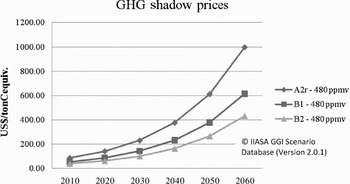
For the CO2 permit price, there are no reliable long-term data available for calibration. There is only one established carbon market so far, which is the European Trading Scheme and prices have not been stable throughout the beginning phase. However, there are multiple sources using scenario analysis to produce a range of forecasts for future emission paths and they also compute the corresponding GHG shadow prices. One example is the GGI Scenario Database (International Institute for Applied Systems Analysis, 2010). We can use the trend implied for GHG shadow prices. For the volatility parameter, it is possible to base the estimate on the spread of the different scenarios involved, as is further explained below. Figure 1 shows the forecasts and trend lines for two scenarios, where B1 (solid line) is the most optimistic one in terms of assumptions about population growth, technological progress, diffusion of efficient technology, and many other factors. B2 (dashed line) is in the middle of B1 and A2r, where the latter one is the most pessimistic scenario. All scenarios are computed for a stabilization target of 480 ppm, and we choose B2 as our starting price. The trend is almost 5 per cent for all three scenarios. Note again that the GGI scenarios are based on different assumptions on socioeconomic factors, such as demographic transformations, technological developments, and regional integration and are simulated for a given stabilization target. Thus, each scenario in itself does not span uncertainties relating to climate change. To estimate these uncertainties, we assume that the GGI scenarios span the relevant states of the world that would govern the volatility in the long term. Therefore, we base the estimate of the long-term volatility parameter on the spread of the different scenarios involved.Footnote 8 For the trend estimate, we use the trend implied for GHG shadow prices taking the projections up to 2060 from the database for our computations. For more information on the scenarios, see Riahi et al. (Reference Riahi, Grübler and Nakicenovic2007).
http://www.iiasa.ac.at/Research/GGI/DB/, generated: 2010-07-02 19:00:36 International Institute for Applied System Analysis (IIASA), GGI Scenario Database.

As mentioned above, there is no good ‘forecast’ for carbon prices. There are several political factors and uncertainties like undefined future policy: what emission target the developed world commits to in the future, to what extent developing countries adopt emission targets, what rules are negotiated for offsets, etc. In addition, there are several economic factors like uncertainties in BAU emissions, unknown patterns of abatement cost reductions as a result of learning processes, uncertainty about allocation mechanisms depending on policy proposals, etc. Our estimate of 5 per cent annual volatility is on the conservative side, higher volatility would make the results more pronounced.
4. Results and implications for REDD
The model developed and calibrated in the previous section was solved, and we have conducted 10,000 simulations of CO2 permit price paths in order to extract the statistics of interest from the optimal solution. It was run with a strike price fixed at US$15/ton and for a range of REDD option prices to analyze the impact of adding REDD on energy investment.
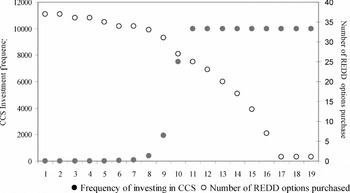
Figure 2 shows that in all 10,000 cases, the CCS module is added to the coal-fired power plant, as long as the price of acquiring a REDD option does not fall below US$2/ton. For US$1/ton, the investment frequency drops by about 25 per cent, and below US$1/ton, the CCS module is almost never adopted. It is important to emphasize that the reader should not be misled to interpret the curve as having a jump: a finer grid on the price of the option on REDD (i.e., conducting more experiments for smaller intervals) would make the transition much smoother. The message from this result is that energy investments could indeed be negatively affected by the availability of low-cost REDD options, but this depends on the pricing of the option in a framework like ours: if REDD is included in existing carbon markets and options on REDD are sold, where these options are priced as derivatives of the permits, then the resulting price is sufficiently high to still allow for investment into new technology, here CCS. On the other hand, if the price of a REDD option were equal to what the cost would be in a segmented market (according to existing carbon supply curves), then this price could be too low to entice investment in CCS and thus reduce the investment frequency in carbon-saving technology. This difference has been indicated by labeling the corresponding price levels with tags in figure 2.Footnote 9 Note that the model was run for a range of REDD option prices, i.e., the prices of US$2/ton and lower were not explicitly derived from existing REDD supply curves; we only compare the magnitudes to existing estimates. For example, a study by Woods Hole finds that 90 per cent of the reductions available at less than US$1.37/ton of CO2 (Nepstad et al., Reference Nepstad, Soares-Filho, Merry, Moutinho, Rodrigues, Bowman, Schwartzman, Almeida and Rivero2007). It should be noted, however, that the study presents results for the Brazilian Amazonian region only, and does not provide worldwide data. The idea is to pay this price for holding an option. The fee should be sufficient to keep the standing forest and therefore prevent emission attributed to deforestation long enough until maturity of a contract.
Number of REDD Options Bought & CCS Investment Frequency, with prices above US$10/ton potentially justified according to the Black and Scholes formula and prices below compatible with opportunity cost estimates.

The right y-axis of figure 2 measures the amount of REDD options, which are bought in the beginning of the planning period and which can be exercised at a given strike price of US$15/ton of CO2 at a later point in time when there is demand for offsetting emissions. It can be seen that there is a negative relationship between the number of REDD options purchased and their option price. Obviously, a very low option price will make the way of offsetting via REDD more attractive compared to CCS investment, where larger sums have to be committed to achieve a reduction in CO2. This attractiveness diminishes, however, as the option price increases. For a price of US$8 or higher, the CCS module becomes the less expensive solution and zero offset options are bought in the beginning. An option price around US$2/ton of CO2 will not harm CCS investment and will instead be likely to generate part of the up-front investment funds needed to start prevention of deforestation.
Now that we have investigated the general impact on the investment decision and the decision on the amount of REDD options bought, we are also interested in a more detailed analysis of the situation of the producer.
If options on REDD are available, they are exercised if a threshold CO2 permit price is exceeded, i.e., in cases of price spikes. If the options on REDD were not available, price spikes exceeding the threshold price would lead immediately to CCS investment. If such a price spike were only temporary, the CCS investment would have been premature. Therefore, the availability of the options on REDD enables the investor to better time the investment in the CCS module and to smooth out the temporary price spikes. In reality, the flexibility offered by such options may also enable the producers to wait until a more advanced technology is available in the future. This does not affect the expected profit of the producer if the options are priced as permit derivatives, but it influences the volatility of the profit distribution.
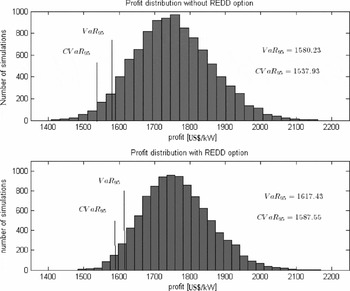
To analyze this effect, profit distributions have been computed for the case where the REDD options can be bought and for the case where they are not available. Figure 3 shows that the inclusion of REDD, indeed, has a positive effect on profits: even though the average level of profits remains unchanged, the risk associated with the profit flows decreases. This result can be confirmed for three risk measures: the variance, the Value-at-Risk (VaR), and the Conditional Value-at-Risk (CVaR).Footnote 10
Profit histogram with (lower panel) and without (upper panel) REDD options [US$/kW], based on 10,000 Monte Carlo simulations.

The numbers in figure 3 can be interpreted as follows: with a probability of 95 per cent, the producer can be sure that the profits will exceed the VaR value, i.e., the higher the VaR, the lower the risk. A similar argument holds for CVaR, which is not about the amount at risk at the 95 per cent threshold, but the conditional expectation of that amount. Note that the standard deviation or variance does not take into account these moments and therefore implicitly assumes that (the amount of) losses do not matter, only deviations from the expected value. This makes CVaR a suitable risk measure when distributions have fat tails, which can be the case with loss distributions when there is the possibility of catastrophic events, for example.
In the case at hand, the distributions have a relatively normal shape, so the variance is also an informative risk measure. It is obvious that the variance is larger in the optimization without REDD options, so all three risk measures indeed confirm that including REDD helps producers react to price spikes in CO2 permit prices and thus reduce their exposure to risk.Footnote 11 REDD is thus complementary to permit trading and does not reduce the investment in less carbon intensive technologies, as long as the options are priced in the same framework, i.e., not sold at too low a price.
5. Conclusion and policy recommendation
This paper has presented a real options model where there are two ways to reduce emissions from ongoing operations of a coal-fired power plant in the face of a rising carbon price based on permit trading. On the one hand, the producer can decide to retrofit the plant and add a carbon capture module, which will dampen the amount of CO2 generated by the combustion of coal considerably (see table 1). On the other hand, CO2 options can be purchased in the beginning of the planning period, which can be exercised to buy emission offset credits at a later point in time. We suggest that REDD, especially in the near term, could be used as a source of such options, where the buyer acquires the right, but not the obligation to offset emissions at a given strike price in the future. In this framework, we have investigated some questions central to the current debate on REDD, its mechanisms, and implementation – the most important one obviously being the potentially negative impact that the availability of low-cost REDD credits could have on investment in new and less carbon-intensive (or even carbon-saving in the case of CCS) technology.
The analysis has shown that the inclusion of REDD does not necessarily have negative consequences for energy investments, even though there can be short delays in the adoption of CCS in the face of policy uncertainty. The point is that the adoption can be better timed, as REDD offsets buy flexibility to wait and see.Footnote 12
This result hinges on the pricing of the REDD options, however. Some estimates for carbon supply curves find prices as low as US$5/ton of carbon from marginal cost calculations, which would reduce the frequency of retrofitting the coal-fired power plant with CCS by about 25 per cent in our framework. However, if the REDD options are priced as CO2 permit derivatives, the price will be sufficiently high, so as not to distort incentives to add CCS. This implies that the inclusion of REDD in existing carbon markets does not affect technology deployment negatively, as the necessary investments in new technology will still be triggered 100 per cent of the time if the price is sufficiently high (see figure 2). Only for very low option prices will REDD be the more attractive alternative to reduce emissions and thus affect energy investments negatively. In addition, we have investigated the effects on the producer's ongoing operations in more detail. This has led to the finding that the average level of profits remains unchanged, but at the same time the risk associated with profit volatility is substantially lower if REDD is made available. Three risk measures have been used (variance, VaR, CVaR), and all three suggest that REDD options help the producer in smoothing out fluctuations arising from permit trading (see figure 3). Therefore, REDD represents a source of flexibility to the producer or to the investor, which is comparable to other forms of flexibility allowing for a costly decision to be postponed until better information becomes available. Bosetti et al. (Reference Bosetti, Lubowski, Golub and Markandya2011), for example, investigate the effects of linking REDD with existing carbon markets in an integrated assessment model, where they compare scenarios where banking of permits is allowed to scenarios without banking. They show that REDD has modest impacts on technological innovation and even enhances some types of investments in that area. They also show that REDD combined with the flexibility of banking helps hedge against risks associated with potential of unexpectedly more stringent future climate targets. Cap-and-trade and REDD are thus complementary and should be considered in one and the same market to ensure stability and avoid distortion of incentives.
It is furthermore important to note the shortcomings of our analysis: a strong assumption that has been made is that tropical countries are willing to back REDD options with forests by receiving an option payment now and the strike price at a later stage. Further research is obviously needed to verify this rationale and should conduct an options analysis from the point-of-view of those countries issuing REDD options. These actors face uncertainties as well: not only about carbon markets, but also about their future opportunity costs. In addition, large-scale deforestation bears irreversibility of a different kind, since regrowing forests in order to use them as carbon sinks takes a substantial amount of time that should be taken into account when valuing REDD options.
With respect to implementation issues, numerical simulations demonstrate the feasibility of a mutually beneficial agreement on REDD. There are several ‘moving’ parts in the climate negotiations puzzle, which may be more easily solved step by step. According to a Woods Hole Research Center study (Nepstad et al., Reference Nepstad, Soares-Filho, Merry, Moutinho, Rodrigues, Bowman, Schwartzman, Almeida and Rivero2007), the opportunity cost of avoided deforestation is around US$2/ton of carbon to prevent up to 95 per cent of all deforestation. This is negligibly small compared to all available estimates of allowance prices at a carbon market. However, due to scale effects, the required capital inflow is sizable (see Golub et al., Reference Golub, Greenberg, Anda, Wang, Golub and Markandya2010). These investments are vitally important to save tropical forests. The option approach allows raising those funds first and solving other issues later.
A main contribution of this paper is thus is to examine the fact that REDD could help in terms of reducing risks associated with the timing of capital-intensive investments. This risk hedging benefit is a motivation for further work beyond risk-neutral real options modeling including risk aversion in the decision-making framework. Note that this also could benefit the REDD countries.
Appendix: List of variables and indices