Their torsos bent over from the waist, sixteen dancers clad in Keds sneakers, black tights, and casual tops take turns to roll upright, snapping their fingers as they sway side to side until all are standing in formation. Moving in front of scrims that evoke a city landscape and urban energy, their angular gestures and parallel positions punctuate rhythmic accents in the jazzy score. Groupings change across the five sections of N.Y. Export: Opus Jazz, the relationships shifting between sexy, loving, competitive, aggressive, and playful camaraderie.Footnote 1 Jerome Robbins's first commission for his small company, Ballets: U.S.A., conveys vibrant visions of youth, love, modernity, and conflict in the urban United States, with clear echoes of the 1957 West Side Story. Ballets: U.S.A. premiered N.Y. Export at the inaugural Festival of Two Worlds in Spoleto, Italy, in 1958 and toured internationally in 1959 and 1961. Six decades later, some of the dances toured by the company remain in performance, attesting to a rare ability for the choreography to be both of its age and transcend it.
During its first year, Ballets: U.S.A. appeared in Italy at the Spoleto Festival, the Maggio Festival in Florence, and performances in Trieste. The company also represented the nation at the Brussels Universal and International Exhibition prior to a limited tour in the United States, which was cancelled due to poor ticket sales. Rapturous reviews led to a more extensive international performance lineup in 1959 with an expanded company of twenty dancers. Two years of US State Department support was allocated through “The President's Emergency Fund for International Affairs,” set in place in 1954 (Prevots Reference Prevots1998), with additional funding from Philadelphia's Catherwood Foundation in 1958. The final tour in 1961 was funded by the Rebekah Harkness Foundation when government policies shifted to support artists who had not previously received support. In researching international dance company performances at European arts festivalsFootnote 2 during the second half of the 1950s (Prickett and Tsintziloni Reference Prickett and Tsintziloni2016), the reception of Robbins's repertory throughout Europe, Israel, and Iceland stood apart from other dance examples of cultural diplomacy at the time. During its brief existence, Ballets: U.S.A. achieved specific cultural diplomacy objectives in ways that differed from other funded artists in the late 1950s and early 1960s.
What “American” aspects were required in order to receive US government funding for performances? Such questions are examined in significant Cold War dance scholarship (Kowal Reference Kowal2010; Croft Reference Croft2015), however, Robbins's choreography and Ballets: U.S.A. tours are not analyzed in depth. Robbins achieved mainstream acceptance in dances integrating Africanist aesthetics, social dance, vernacular movement, classical ballet, musical theater vocabularies, and comic theatricality. Key characteristics that appealed to the US government and European viewers are seen in dual claims of universality and national identity; avant-garde modernity and accessible entertainment; hegemonic values and racial integration. “America” was “cool,” “jazzy,” and vibrant; avant-garde, innovative, and progressive; and it advanced social equality values that reinforced concepts of democracy and freedom, promoting an “American” way of life in contrast to one under communism. Significantly, Robbins's use of popular elements in music and movement also contributed to the integration of Black artistic expression into mainstream culture at a crucial period in the rise of the civil rights movement and a wider Black Arts movement. These themes are explored below in relation to five dances the company toured, including three commissioned for the company.
Reviews, biographies (Jowitt Reference Jowitt2005; Lawrence Reference Lawrence2007), archival records, and readings of dances from filmed documentation underpin consideration of the diverse ways in which the nation was represented and what was unique about the company. Minutes of the American National Theatre and Academy (ANTA) Dance Panel meetings offer new detail of debates on the quality and appropriateness of applicants and their repertory, expanding on existing scholarship on Cold War dance diplomacy (Prevots Reference Prevots1998; Croft Reference Croft2015; Kodat Reference Kodat2015).
Debates about aesthetic concerns and the choreographer's responsibilities to the US government that arose during the funding allocation process are explored in relation to the critical reception of the dances at home and abroad. An extensive US State Department analysis of the 1959 tour provides excerpts from embassy reports, theater administrator updates, and local press coverage, and reinforces positive perceptions of the company by international audiences. The 1959 tour cost $248,000 for 88 performances in 19 cities, with audiences totaling 145,965 people. Twenty dancers travelled with two conductors and six musicians who were supplemented by local musicians in each city (Ballets: U.S.A. Tour Analysis 1960, 5).Footnote 3
Why examine Robbins at this historical moment? Why do his dances remain relevant today? Writing in 1979 about American dance, dance critic Marcia B. Siegel analyzes Robbins's ballets alongside dances by Twyla Tharp and Anna Sokolow. The mix of choreographers offers an intriguing juxtaposition, linked through their work with images and the “power of their dance language” which “supersedes their topicality” (Siegel Reference Siegel1979, 244). A recognition of these qualities is evidenced by the 2018–2019 New York City Ballet Jerome Robbins season, curated to mark the centenary of the choreographer's birth (1918–1998). The series contained nineteen of Robbins's dances, including two created for Ballets: U.S.A. At the time of writing this article, all of the preexisting dances the company toured remain the repertory of international dance companies. N.Y. Export: Opus Jazz was restaged in a film version set in New York City locations (Joost and Lipes Reference Joost and Lipes2010), bringing a twenty-first-century interpretation of the dance in urban landscapes and relationships. The longevity of the choreography invites consideration of the extent to which Robbins's dances achieved Cold War diplomatic objectives in ways that are distinctive. The stylistic diversity offered a link between a vision of postwar optimism and the rebellious aesthetic of the swinging 1960s. As the overseas publicity machine for the US government, the United States Information Agency's (USIA) motto, “Taking America's Story to the World,” offers a starting point for analyzing the unique intersection between political and artistic imperatives in Robbins's repertory. The organization publicized performances and exhibitions, and produced films, seminars, and radio shows on the Voice of America network, which helped shape the national narrative abroad (Cull Reference Cull2008). Analysis of Ballets: U.S.A.'s repertory reveals that the company offered multiple stories rather than a singular one.
Defining the Nation for Export
Reflecting on the 1959–1960 touring season, Director of the Office of Cultural Exchange R. Gordon Arneson praised Ballets: U.S.A. as “one of the most successful attractions of all” due to what he described as traditional classical ballet with its connection to “tradition” and its “modern and American” elements (Current Report on Cultural Presentations Program 1961, 1; hereafter Current Report). The American label encompasses the cultural and political construction of national identity perpetuated during the Cold War and is often used uncritically, disregarding Mexico and Canada, which share the continental space. An “American Century” was proclaimed in 1941 by Henry Luce who called on the population to support the nation's mission to rise to its potential as a dominant power, reinforcing the claims on the national label. The United States emerged as one of two postwar superpowers, pitting the ideology of democracy against that of autocracy and communism, requiring “popular mobilization, in which the idea of freedom played a central role” (Foner Reference Foner and Seagull2008, 851). Fundamental values, including freedom against oppression, ensured that the national mission and racial politics were integrally linked, shaping an ideological stance inseparable from the concept of America and its defining battle against communism. The “primacy of anticommunism” resulted in a constrained commitment to civil rights policies, however, as Mary Dudziak (Reference Dudziak2000, 13) explores: “The narrow boundaries of Cold-War era civil rights politics kept discussions of broad-based social change, or a linking of race and class, off the agenda.” Limited legislative successes were heralded as major shifts, while underlying inequities and violence continued and remain iconic moments in the civil rights struggle more than half a century later. References to the impact of the Supreme Court's decision in the Brown v. Board of Education (1955) desegregation case (Savit Reference Savit2019), disenfranchisement of minority voting rights (Casey Reference Casey2019), and the murder of fourteen-year-old Emmett Till in 1955 (Ortiz Reference Ortiz2019) continue to populate news headlines in 2019. Using the arts during the 1950s and 1960s, the US government strived to shape the narratives circulating abroad to counter the reality of social injustices that seeped through even as critical voices were often silenced, as detailed below.
Post–World War II cultural diplomacy policies developed in response to fluctuating tensions between the reigning superpowers with the rise in Cold War rhetoric. As David Caute (Reference Caute2003) explores, positive reception of international tours by Soviet companies helped prompt the US government cultural policies to use the arts to improve its image in the “battle for hearts and minds” against the communist threat. Clare Croft (Reference Croft2015) investigated dance as a form of soft power, a type of cultural diplomacy, with tours funded to help affect positive perceptions of American society and culture. Significantly, a primary objective with public diplomacy is to reach the public abroad, not merely influence governments (Nye Reference Nye2008). The growth of cultural touring programs coincided with the spread of European arts festivals and expositions in cities such as Spoleto, Paris, Salzburg, Dubrovnik, and Berlin, joining the Edinburgh Festival that was established in 1947, and the Athens Festival that began in 1955. The new performance opportunities had multiple functions, counteracting the devastation of war for the viewers and offering ready venues and audiences for international artists. Festivals were perceived as catering to “specialists, critics, and international audiences” ( Ballets: U.S.A. Tour Analysis 1960, 3), thus reaching influential viewers. Ballets: U.S.A. appeared at international festivals in seven out of the sixteen countries on the trip, making 1959 a unique festival tour.
Ballets: U.S.A. emerged out of specific diplomatic objectives, invited to open the inaugural Spoleto Festival in 1958. As Robbins explained:
The program of Ballets: U.S.A. was planned to show Europeans the variety of techniques, styles and theatrical approaches that are America's particular development in dance. Its repertory was chosen to extend from the classical ballet danced in tights, tutus, and toe shoes to our own current jazz style, performed in sneakers and knee guards. (Robbins n.d.a, 3)
Although the company name had “ballet” in the title, Ballets: U.S.A. comprised dancers who crossed between dance styles, including creators of roles in Robbins's Broadway productions. The mixed-race cast chosen from open auditions included a Black male dancer (John Jones) and a Korean-American female dancer (Patricia Dunn). Robbins made the grand claims that the dancers were “typically American, not only in style, but in that the individual members represented almost every national trait, strain, and background” (Robbins n.d.a, 2).
Robbins occupied a unique position of privilege and power that contrasted with aspects of his personal history. As a former Communist Party member and first-generation American of Jewish heritage who was a closeted homosexual at the time, Robbins's identity challenged hegemonic values that defined the nation. Art and politics offered the means to circumvent some of the constraints determined by minority ethnicity. As Rebecca Rossen (Reference Rossen2014) discusses, ethnic boundaries were not fixed in the early twentieth century, and dance training offered new generations of Jewish Americans a means of “Americanizing” their bodies. Although Rossen does not investigate ballet or musical theater choreographers, she analyzes how modern dancers such as Anna Sokolow and Sophie Maslow converted a secular Jewishness into “American universalism” (Rossen Reference Rossen2014, 8). As explored below, critical responses to Robbins perceived universal and distinctly “American” values in his work.
Politically, the emergence of the Communist Party out of Socialist Party factions had support from immigrant communities in the North and East of the United States and helped shape “an inclusive, progressive politics in the late 1930s” (Iton Reference Iton2000, 118). A universal ideology during the interwar years underpinned the appeal of communism as well as “functioning as a form of sanctuary for the alienated whose ranks included blacks and Jewish intellectuals and workers” (121). By the 1950s, however, religious piety and Christianity in particular became aligned with ideals of American national identity, in contrast to the atheism of the communist Soviet Union (Whitfield Reference Whitfield1996, 87). In 1954, the phrase “one nation under God” was added to the Pledge of Allegiance, whereas the words “In God We Trust” were added to coins two years later. Overt expressions of faith through church attendance helped reinforce ideological alignment among prosperity, progress, and American values. Intense backlash to leftist ideologies culminated in the House Un-American Activities Committee (HUAC) and the anti-communist hearings led by Senator Joseph McCarthy that ended in 1953. Under pressure to avoid public revelations about his homosexuality, Robbins's testimony revealed the names of eight people associated with the Communist Party (Scholick Reference Scholick2018).
Despite some personal backlash in response to the hearings (Jowitt Reference Jowitt2005), Robbins's career took on a phenomenal rising trajectory in the 1950s. A performance versatility influenced by an eclectic dance background started with his training and performance experience at the Neighborhood Playhouse, an influential community theater in New York's Lower East Side. His initial choreographic forays occurred at the Tamiment Camp, a socialist and predominantly Jewish summer residential escape in the Poconos Hills outside New York City, where he worked on revue style variety shows with a quick turnaround. He developed his performing career during the 1940s in the newly established Ballet Theatre (later American Ballet Theatre), creating roles in Anthony Tudor's psychologically driven ballets and engaging with the legacy of Diaghilev's Ballets Russes in Michel Fokine's and Leonide Massine's dances, which integrated character work or strong narrative approaches. Robbins continued classical ballet training and danced in works by George Balanchine at the New York City Ballet, where he also choreographed in his post as Associate Artistic Director. Ballets ranged from the predatory female protagonists in The Cage (1951) to the celebration of US servicemen on leave in Fancy Free (1944) for American Ballet Theatre and the musical On the Town (1947), demonstrating Robbins's ability to cross between popular art forms and ballet. Numerous Broadway successes also left Robbins financially secure. Significantly, a strong technical proficiency, vibrant musicality, and lessons learned from weekly revue shows at summer camp, on Broadway stages, and in the innovative dances by ballet masters underpinned his prolific choreographic craft.
Each year of Ballets: U.S.A.'s existence, new commissions appeared alongside existing works. Movement versatility was accompanied by eclectic musical choices: Robert Prince's “Jazz Concert” for N.Y. Export; Claude Debussy's symphonic poem in Afternoon of a Faun (1953); Chopin's piano etudes for the comedic The Concert or The Perils of Everybody (1956); and no accompaniment in Moves: A Ballet in Silence about Relationships (1959). As explored below, Interplay (1945), danced to Morton Gould's composition “American Concertette,” replaced Moves in some cities and became the source of an extended debate between the Dance Panel and the company. Two new commissions were not restaged after the company closed: Events (1961), danced to another score by Prince, and a short curtain raiser, 3 × 3 (1958), accompanied by George Auric's music. The choreographic analysis begins with a focus on Moves as the most abstract of the Ballets: U.S.A. repertory, considering demands for universal legibility that circulated around its creation and performance.
Avant-Garde Objectivity
On the surface, Robbins's choreography can be situated within dominant narratives of Cold War history, which reinforce the concept of the culture of containment that took shape after World War II. The nation was striving for leadership in the global struggles against instability, which were seen to foment dissent that would facilitate the growth of communism, policies which underpinned political and cultural diplomacy for decades (Foner Reference Foner and Seagull2008, 842–845). At home, expressions of dissent were suppressed as artists took fewer artistic and political risks, as constraining conservative ideologies resulted in art adopting “the Technicolor blandness of the age” with an emphasis on “an exploration of the ordinary” (Monod Reference Monod2001, 275). Rebekah Kowal (Reference Kowal2010) highlights the emphasis on consensus, of upholding hegemonic values in the dances of the 1950s. Concepts of universalism were also advanced in relation to national identity by other modern dancers through an emphasis on consensus, on reinforcing the status quo, such as traditional gender relationships and hegemonic values that impacted funding decisions (2010). An objectivist aesthetic also developed in postwar modern dance through an emphasis on formalism seen in the work of Merce Cunningham (Morris Reference Morris2006), for example, although he was initially denied state funding for being too avant-garde (Prevots Reference Prevots1998).
Analyzing Cold War tours, Croft (Reference Croft2015, 66) identifies “dance modernism” as a dominant characteristic for ballet and modern dance in which the element of abstraction was crucial: “In dance, this meant framing bodies as forms in motion, not necessarily as people, and, even more so, not as in people who came to the stage to share movements from specific historical, cultural, or geographical contexts.” The objective was “universal accessibility” (Reference Croft2015, 66). Kowal (Reference Kowal2010) interrogates the tensions between “universality” and the national narratives required to receive funding. Artists were matched to particular locations based on individual identity or repertory. For example, the José Limón Dance Company was the first to be sponsored under the President's Emergency Fund in 1954. Limón travelled to Mexico and Brazil, his Mexican heritage and fluency in Spanish contributing factors for the choice (Prevots Reference Prevots1998, 5). Martha Graham's 1955–1956 government-funded tour of Asia and Iran fulfilled particular diplomatic objectives; her work was deemed to hold particular resonance for viewers because of connections between Eastern influences and modern dance (Geduld Reference Geduld2010; Phillips Reference Phillips2020). The repertory included the “Americana” piece Appalachian Spring (1945), while a “universal” ideal was promoted through the inclusion of dances based on Greek myths: Cave of the Heart (1946) and Night Journey (1947). The combination “created a message consistent with [President] Eisenhower's ‘universal’ humanism: they promoted Americanism as an enduring and civilizing force” (Geduld Reference Geduld2010, 63).
In Robbins's Moves: A Ballet in Silence about Relationships (Reference Robbins and Brinson1959), the absence of music brought debates about abstraction to the fore among those making funding decisions. The choreography was commissioned with a new score by Aaron Copland, however, the dance was ultimately performed without accompaniment. Robbins was working on the Gypsy musical production when Copland sent him the composition, leaving inadequate time to choreograph a new dance at an appropriate standard (Robbins 1959a). Initial discussions with Copland included ideas for a waltz but without the finished score; Robbins experimented with phrases in silence and liked the way the movement looked without accompaniment (Jowitt Reference Jowitt2005, 306–307). In contrast to the intensive interactions with others (such as directors, production managers, and costume designers) in creating the Gypsy choreography, Robbins described how he worked with “the dancers, myself and the space,” completing a large portion of Moves in record time (Vaill Reference Vaill2019, 224). The lack of music proved highly controversial, with its suitability for the touring program challenged in telegrams and letters between ANTA General Manager Robert Schnitzer and Leland Hayward, the Ballets: U.S.A. producer. Schnitzer insisted that the 1945 ballet Interplay be performed instead of Moves in all but five of the more cosmopolitan locations of the 1959 tour. The older ballet was deemed to be more acceptable to “countries such as Yugoslavia, Poland, Scandinavia, the Iberian Peninsula and Greece [where] the audiences are not prepared to appreciate or enjoy an innovation like Moves no matter how brilliant as an experiment” (Schnitzer Reference Schnitzer1959). As explored below, the countries Schnitzer lists had significant geopolitical borders, had unstable political regimes, or were under authoritarian control. Robbins resisted requests to replace the new ballet, setting out specific objections including: (1) the strain that additional rehearsal time would cause; (2) production responsibilities such as “the ability to get scenery, costumes and make arrangements for rights and royalties …”; (3) unhappiness created by replacing the dance, since Moves was created on the “particular talents of new members of the company”; and (4) problems with “embassies and local impresarios” created by the change (Robbins 1959b). Schnitzer (Reference Schnitzer1959) reiterated the need to adhere to the requests of the Dance Panel, however, the final decisions were ultimately left up to Robbins because there was no way to control changes once the tour began. Copland watched a rehearsal of the new ballet in New York and told Robbins “that ‘Moves’ was exactly the kind of work we should show all over Europe because it's so different and provocative and controversial for a European audience” (Robbins 1959b).
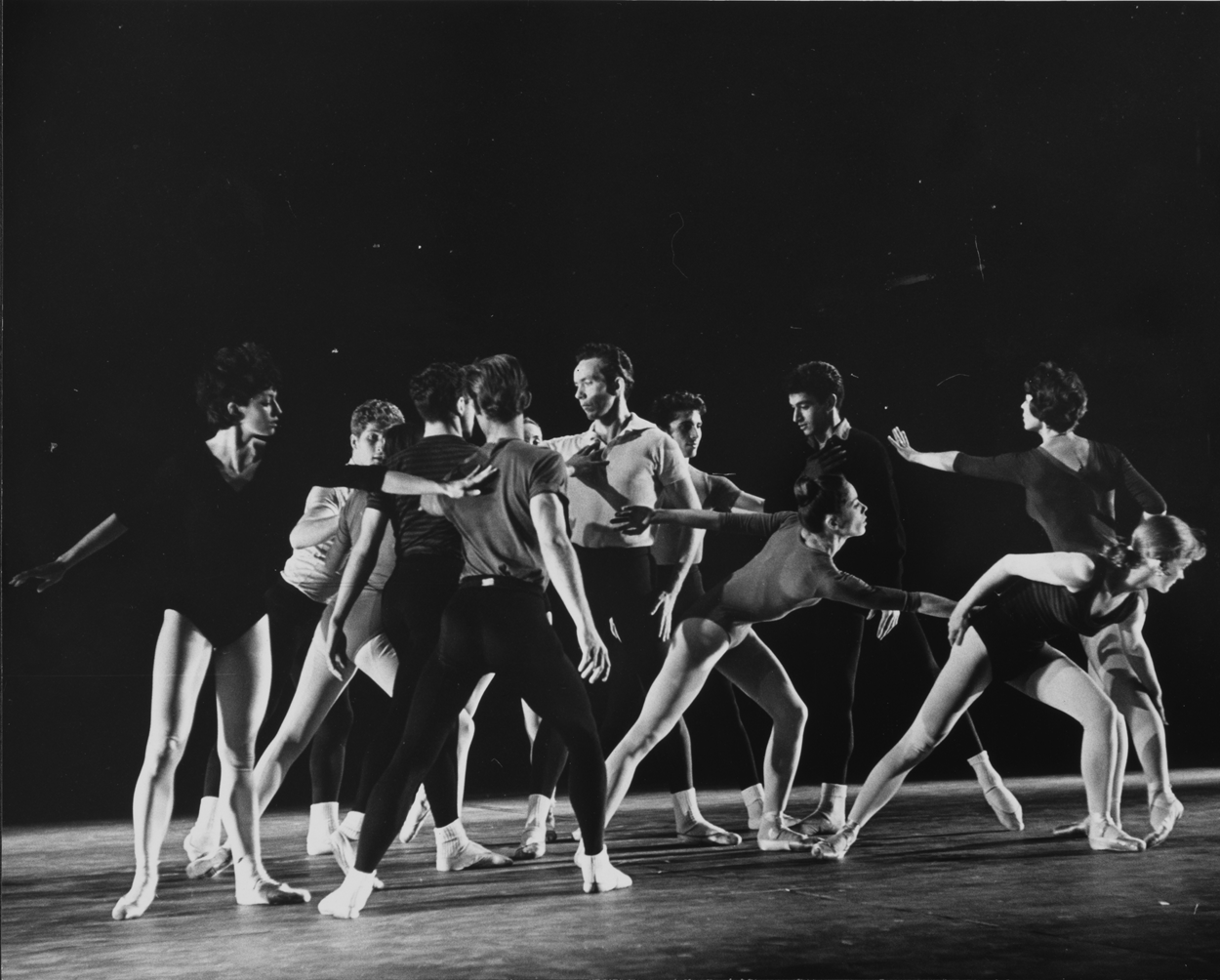
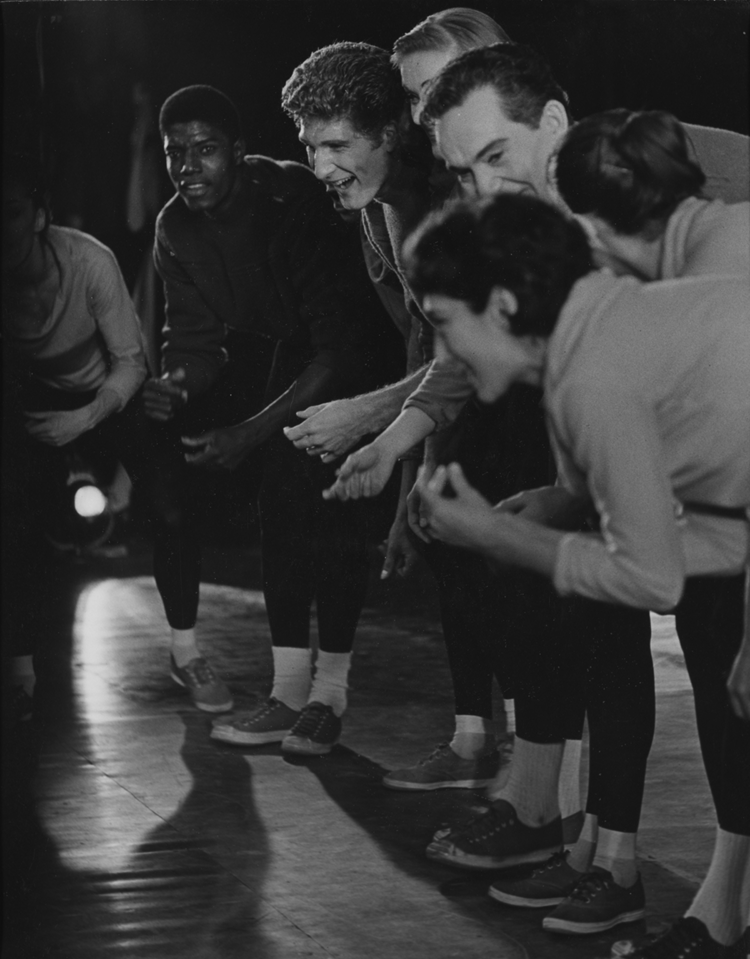
Other debates about abstraction centered on George Balanchine and Merce Cunningham. As Lynn Garafola describes, their choreography stressed use of the legs, with “clarity, precision, continuous energy, rhythmic variety and subtlety” (Reference Garafola2005, 249). In contrast, even in his most abstract dances such as Moves, Robbins's dancers are “humanized” (249). In a 1990 New York City Ballet performance recording, rhythmic accents emerge as feet hit the floor, with pointe shoes particularly audible; the sound of a hand against a thigh or clapped against another person's body resonates (Robbins [1959] 1990). The dancers face the audience in a line, moving forward in grand battements, and then break into a pedestrian walk to move downstage. The dancers re-form into quartets, trios, or duos, as the action shifts around the stage. A recurring structure is seen in Robbins's style, in which the entire cast dances to open and close the work, framing soloists, duets, and smaller group phrases. In the third section, five men perform basic ballet steps, such as jumps in and out of second position, interspersed with entrechats six, tours en l'air. The classical look is modified by straight arms out to the side with flexed palms and a rhythmic stomping pattern before moving back into the technically recognized ballet. A sense of friendly competition ensues, with a playground game of tag in a group section. Dancers partner up briefly without establishing romantic connections, working through supported turns, lifts, and drops into splits on the ground. The action breaks from a dance vocabulary as everyone gathers into a tight clump in the center, breaking from the huddle to raise an arm overhead while the other hand covers the mouth in a wide silent scream. The ballet ends with a reverse of its opening as the dancers walk upstage into a blackout. Although devoid of fixed narrative, rich relationships and movement dynamics convey multiple emotional qualities.
Interplay, ANTA's preference for the Ballets: U.S.A. tour, was created fourteen years prior to Moves. Interplay combined phrases of social dance partnering, folk dance steps, and virtuosic ballet vocabulary performed by eight dancers who trade flashy steps in competition with each other between unison phrases that reinforce a sense of community. Gould's lighthearted music reflects the ballet's origin as part of a Broadway show, Billy Roses's Concert Varieties (Siegel Reference Siegel1979, 248). Croft (Reference Croft2015, 48) labelled it a “quintessential post-war American ballet” embodying optimism and growth. In an early film of the eighteen-minute dance (Robbins n.d.b), the use of canon and call-and-response relationships in the music are emulated in the movement. Virtuosic ballet steps—tours en l'air, chassés, tours jetés, and multiple pirouettes—establish a danse d’ école competence. Breaking from upright, taut ballet postures, the dancers adopt casual stances to watch each other show off. The spectacular alternates with the popular, in partnered social dance moments reinforcing individual relationships that soon break apart to blend back into the larger group or other small gatherings. Folk styles appear as the four women traverse across the back of the stage, their arms linked at shoulder height, and flexed feet lead their sideways steps. A short vignette momentarily situates the dancers in a playground as they are selected to join one team or another. Their competitive displays of a series of entrechats are celebrated with handshakes from fellow dancers. Jowitt's (Reference Jowitt2005) summary of the dance highlights childhood games such as hopscotch and cartwheels, echoed in the later Moves.
As the 1959 tour progressed, the debate over Moves became a moot point as it was danced in Yugoslavia, Poland, Scandinavia, and Spain to critical acclaim. In Greece, the fifth country Schnitzer expressed reservations about, Interplay was performed due to a dancer's injury. Each of the nations on Schnitzer's list had a complex relationship to the two sides of the Cold War, sitting outside the communist/anti-communist power binary. A Belgrade critic described how Robbins “bases his style of dance on the foundations of classical ballet technique which is adapted through unusual and unforeseen transformations to modern ballet expression” (Ballets: U.S.A. Tour Analysis 1960, 16–17). The company reached audiences of approximately eight thousand in live performances in Dubrovnik and Belgrade, while another ten thousand Yugoslavians viewed a television broadcast of N.Y. Export (12). A Copenhagen critic wrote: “There is a shock effect in the very silence, it makes you lose your breath, it is like having lost one sense and having another sharpened” (21). Important contrasts to existing work was noted by a Polish critic: “The ballet, performed in complete silence, constructed only by the rhythm of the moving bodies of the dancers, is almost entirely free of the influence of sentiment, of the unfortunate post-romantic metaphors and misty atmospheres so traditional in the ballet and pantomime” (29). The comedic treatment of Chopin's music in The Concert proved more controversial to Polish audiences than the lack of accompaniment in Moves. The parody was perceived as demeaning to the composer, who was a beloved national icon (30), the ballet's slapstick gestures juxtaposed against the revered pianist occupying the corner of the stage. As explored below in publicity and critical responses, jazz more than avant-garde abstraction emerges as a significant marker of American identity for the Ballets: U.S.A. tours.
Jazz Diplomacy
Jazz art forms were central to the construction of an American national identity and highlighted in Ballets: U.S.A. publicity. A fifteen-minute long documentary film about the company from 1958 opens on a New York City landscape, the voiceover proposing a version of universality rooted in dance:
… [that] builds through a simple sequence of jazz variations to a final fugue, it is a basic ballet technique, one which combines the classical European forms with the contemporary contribution of the United States. Here is a token of the enduring values that are born when men and nations work together, sharing a common heritage. [The dancers] bring a vigor and freedom of modern ballet in America … the American dimension to an art that is universal, a true reflection of their natural life. (Wolf and Farrell Reference Wolf and Farrell1958)
The documentary script celebrates qualities of freedom and vigor inherent in the national character, and central to the message was jazz. Prince's N.Y. Export score integrated what the dance critic John Martin (Reference Martin1958) described as “progressive jazz,” which “subjects the improvisational textures of the medium to a more objective musical discipline.” Martin's language evokes racist and derogatory stereotypes of African-American expressive forms as being out of control. Versions of jazz acceptable to a more mainstream, and therefore “white” audience, included “third stream jazz.” Classical composer Gunther Schuller defined the style as scores played by a mix of jazz and classical instrumentalists in which “ensemble passages alternate with simpler improvised sections involving one or more jazz soloists” (Teachout Reference Teachout and Kichner2000, 353). Six musicians travelled with Ballets: U.S.A., specializing in alto sax, tenor sax, baritone sax, solo trumpet, timpani, and percussion (“Miscellaneous” n.d.), providing a layer of jazz instrumentality supported by local orchestras in each location.
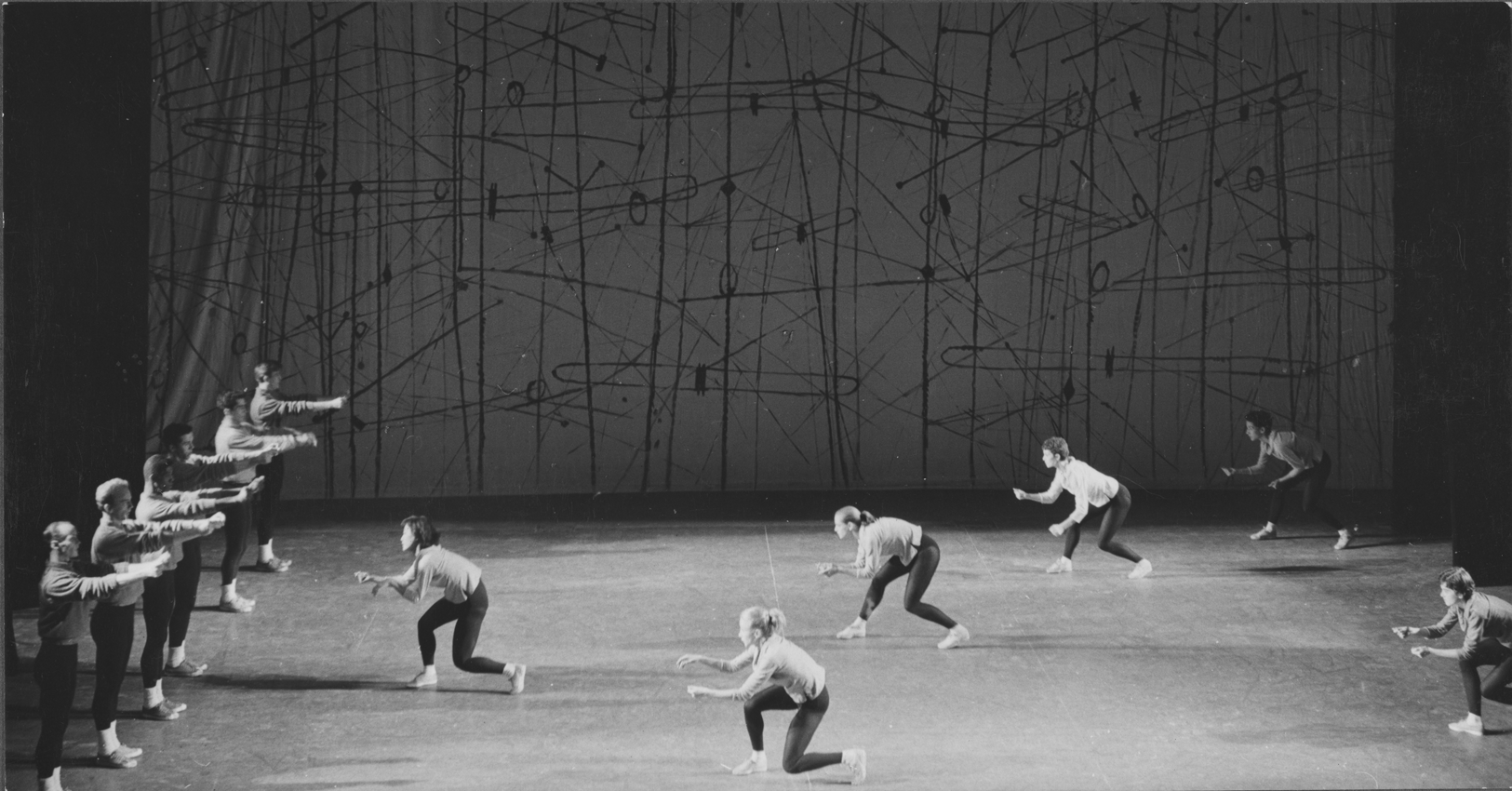
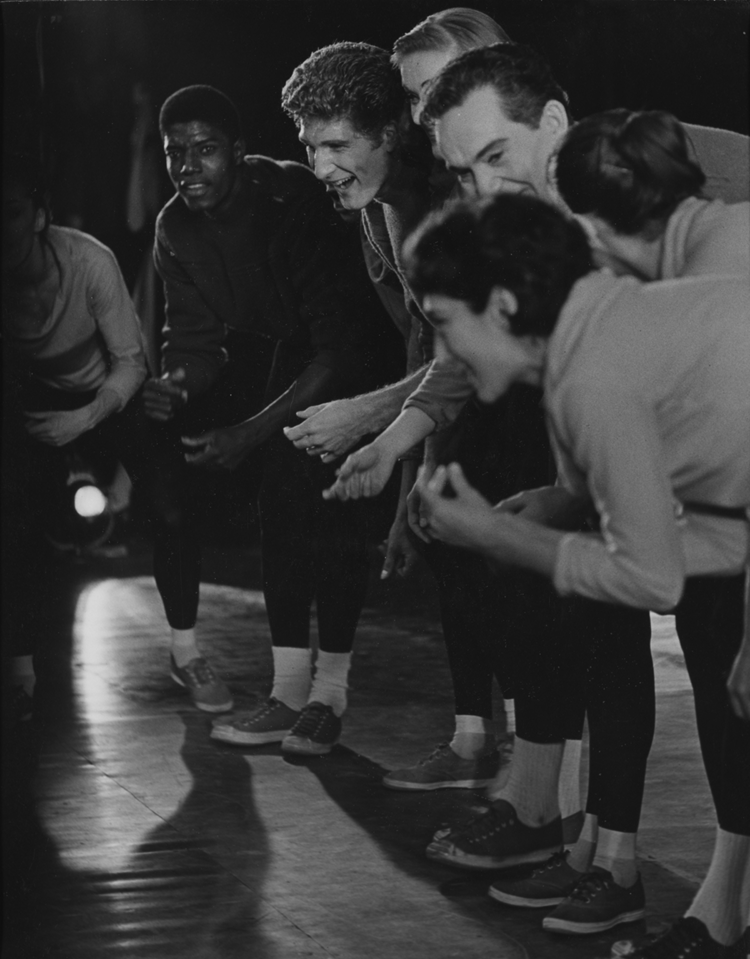
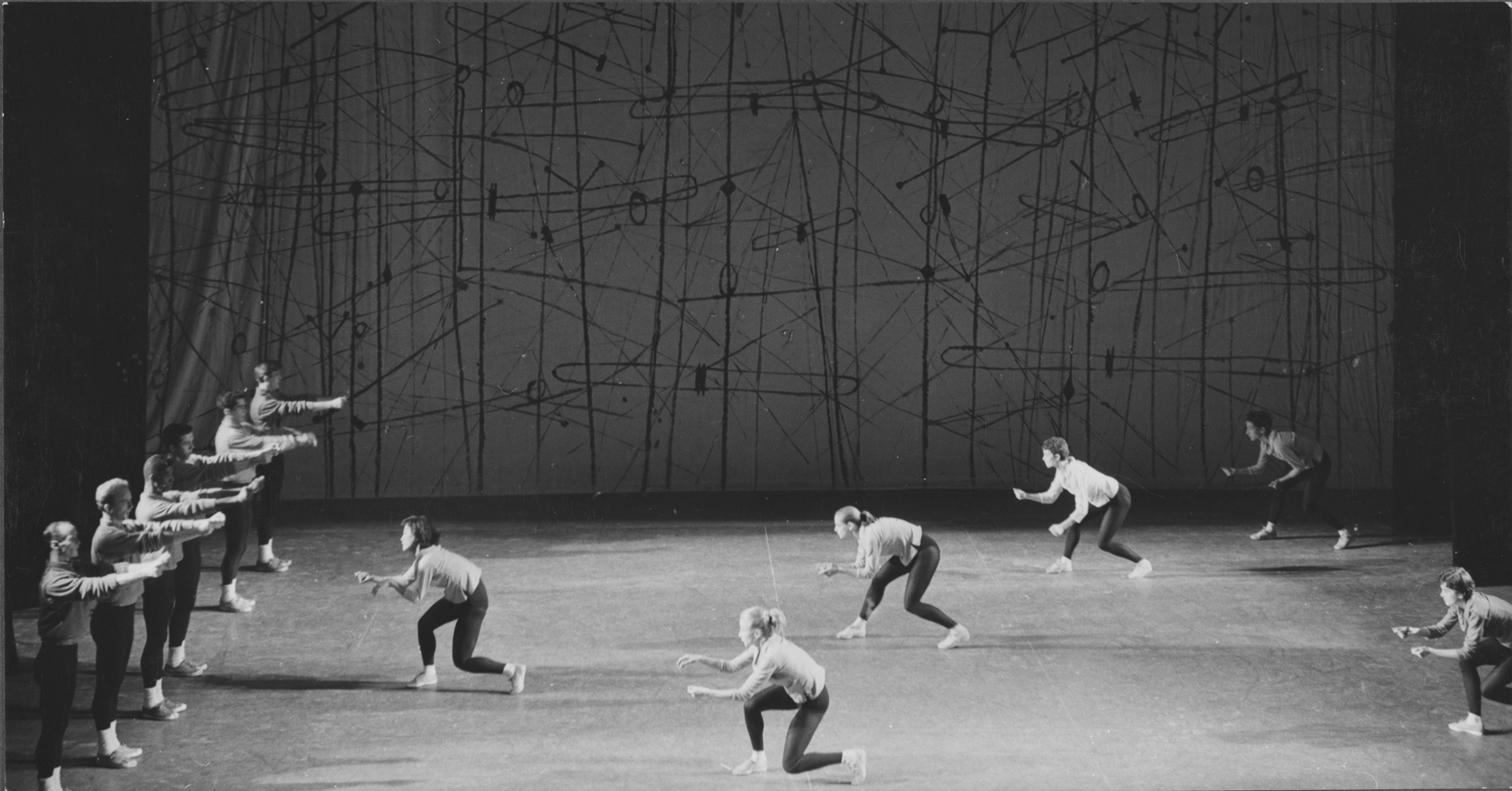
The blend of Prince's music, streetwear (Keds sneakers and either black tights and a casual top, or T-shirts and jeans), and Ben Shahn's urban landscapes of abstracted television antennae, skyscrapers, and blocks of color established a strong atmosphere. Key movement motifs include shifting in and out of a low stance with pelvis leading while relaxed knees support a smooth rhythmic pulse. Partnered social dance vocabulary (swing outs from jitterbug) blended with the low bounces into the ground, flexed wrists, parallel turns, hips leading, and torso bent forward off the central axis of the body. Upper arms are held close to the torso, with the lower arms parallel to the ground; relaxed wrists exude nonchalance, contrasting at times with arms that cut sharply through space to the side or above the dancers’ heads. Opening the dance with “Entrances,” interweaving formations have moments of individual break outs, culminating in a modified round dance. The dancers face inward, steps moving sideways, with relaxed feet, arms on each other's shoulders, before reaching up and then collapsing onto the floor. The second section, “Statics,” was much darker, as one woman is confronted by a group of men, as explored in more detail below. “Improvisations” followed, dominated by friendly competition and flirtatious duets that blend back into the group action. “Passage for Two” is a meditative duet, which Siegel (Reference Siegel1979, 254–255) describes as sensual, despite the lack of eye contact. The company gathers together in “Theme, Variations, and Fugue,” responding to the complexities of the music, the adolescent competitiveness (254) that characterized the earlier group sections absent.
Program notes for the 1959 London Piccadilly Theatre performances cite popular dancing as Robbins's inspiration, making particular reference to how the dance draws on the “form and style from the major and basic contributions of the Negro [sic] and Latin-American.” The text highlights how teenagers have a
strong unconscious emotional kinship with those with minority roots.… Feeling very much like a minority group in this threatening and explosive world, the young have so identified with the dynamics, kinetic impetus, the drives and “coolness” of today's jazz steps that these dances have become an expression of our youth's outlook and their attitudes toward the contemporary world around them. (Jerome Robbins’ Ballets: U.S.A. Program 1959)
In response to British dance critic Peter Brinson's question about meaning in the dances, Robbins described how the dancers embody a “cool” aesthetic:
it is about the “cool” way in which we dance… play it cool is what we say … don't show what you're really feeling, play it without showing your effect … there may be a lot going on underneath, a lot of emotion, a lot of passion, perhaps even a lot of sexuality, but don't, don't show it. (Robbins and Brinson 1959, 8)
All the dancers were trained in classical ballet and some had performed in Robbins's Broadway shows, however, Robbins argued that the term “’jazz ballet’ is a misnomer,” although “it is danced to jazz music” (8). Robbins's evocation of cool resonates with the discourse around appropriation of African-American culture. Brenda Dixon Gottschild's (Reference Gottschild1996) seminal analysis locates Africanist aesthetics in George Balanchine's style as comparable to “the African American social or street dancer [which] share a remarkable quality—the juxtaposition and balance of hot and cold … [in] the intensity of a speedy, complex combination … balanced by the radical opposition of a cool, masklike face” (63–64). Whereas Robbins's style was distinct from that of Balanchine, he was advocating a “cool” attitude, mixing dance vocabularies and Africanist components such as off-center actions, syncopations, and isolations (Gottschild Reference Gottschild, Dils and Albright2001).
Ballets: U.S.A., 1961, one of the more playful sections of Moves: A Ballet in Silence about Relationships, choreography by Jerome Robbins. Photograph by Friedman-Abeles, courtesy of Billy Rose Theatre Division, New York Public Library for the Performing Arts.

Robbins's vocabulary also drew from folk dance in the grapevine step and circle dances, while social dance elements can be traced back to the Lindy Hop, which evolved into the Jitterbug. As Marshall and Jean Stearns discuss in relation to N.Y. Export, Robbins uses the “kick and hop three times on each foot” and “syncopated two-step or ‘box’ step, accenting the offbeat” (Stearns and Stearns [Reference Stearns and Stearns1968] 1978, 323). The style flows, however, rather than manifesting the up and down of swing, air steps, “truck,” or strut (329), and pelvic movement with the shoulders “level and the feet glide along the floor” (329). For Stearns and Stearns, N.Y. Export is “not particularly authentic … [lacking] the rhythmic propulsion which is at the heart of jazz … it could create additional force and flavor” (357). Although Robbins did not choreograph “authentic” jitterbug steps in his dances, there are moments when individual dancers break out of a closed hold that conveys the sense of improvisation seen in a “breakaway.” The presence of the vernacular in Robbins's choreography has dissipated over time. For example, former Ballets: U.S.A. dancer Eddie Verso (Reference Verso2018) set the ballet Moves on the New York City Ballet, commenting in an interview that they danced it as “ballet” as opposed to embodying the originating ethos.
N.Y. Export's portrayal of youth culture echoed aspects seen on television in the Saturday afternoon hit dance show from Philadelphia, American Bandstand. W. T. Lhamon ([Reference Lhamon1990] 2002, 39) investigates various ways in which African-American cultural forms were increasingly integrated into mainstream music and dance while, paradoxically, its influences were not recognized. On American Bandstand, for example, dance moves were appropriated and modified to make them safe for its all-white dancer/spectators. Black migration to the urban and industrial centers in the North had helped spread musical tastes, as technological advances in radio transmitters supported portability, facilitating listening to music outside the home (3). In the mid-1950s, Black culture moved from the South to become part of national culture, integrated into the mainstream in areas such as music through blues and jazz (39). The popularity of a mainstream jazz spread, one that did not integrate the improvisatory edginess of artists like John Coltrane. Black authors also gained widespread acclaim in works that focused on African-American experiences but crossed racial boundaries, seen in Richard Ellison's novel from 1952, Invisible Man, and James Baldwin's literary essays. Ellison's story of a young Black man's experience “shows the youth reconstructing a new sense of the world and a new sense of identity” (Lhamon [Reference Lhamon1990] 2002, 51). Their work challenged the invisibility and second-class status of Blacks and helped inspire the Black Arts Movement. Robbins's integration of African-American cultural elements, in movement, jazz music, and a Black dancer in the company can be read as being impacted by this shift.
Funding decisions dictated what styles toured to different parts of the world, and Robbins's standing put him at the top of the list for touring in 1959, in particular. Jazz “ambassadors” such as Louis Armstrong, Dizzy Gillespie, and Duke Ellington led cultural delegations to new African nations and the Middle East due to how “they identified so deeply with global struggles for freedom” (Von Eschen Reference Von Eschen2004, 252). The Dance Panel proposed sending Ballets: U.S.A. as the first American dance company to tour under a Soviet-US cultural exchange program that started in 1958. After reviewing the performances, the Soviet representative from the diplomatic touring agency Gostkoncert declined the offer, in line with Soviet oppression of jazz music (Cull Reference Cull2008). As summarized in the Cultural Presentation Report, the Russians “related them to jazz orchestras, large and small. They are afraid of them” (Current Report 1961, 2). Robbins's ballets were in the repertory for tours to the USSR by American Ballet Theatre in 1960 and the New York City Ballet in 1962, however, not the dances infused with jazz elements. Performances in Israel were added to the 1959 tour to fill the proposed Soviet dates, enhancing Robbins's connections to the country and his Jewish heritage. During multiple visits, Robbins worked with artists in Israel and supported the development of its dance field, while also being exposed to traditional dance forms that shaped later work, such as Fiddler on the Roof (1964).
Although Robbins's version of jazz was praised by the Dance Panel, there was resistance to supporting other dancers working with jazz and tap styles (Prevots Reference Prevots1998). Double standards and racialized discourses were evident in the panel's rejection of artists such as Katherine Dunham in the late 1950s and early 1960s (Das Reference Das2017, 148–150). Dunham's work was described as a “nightclub” show or classified as a musical rather than dance (ANTA Dance Panel Minutes 1959a, 4). Applicants were scrutinized on the content and form of their choreography, the proficiency of the performers, with judgments predicated on the aesthetic preferences of the panelists and perceptions of what best represented the nation, which were rarely stated. Decisions on Robbins's work circumvented criteria placed on others, including Ballet Theatre, which required approval of the cast list (3). In contrast, the Panel claimed it “could rely on the artistic judgment’ of Robbins in choosing dancers (ANTA Dance Panel Minutes 1957, 4; see also 1959a), although all performers required administrative approval from the State Department to determine their suitability for touring (ANTA Dance Panel Minutes 1958b). Anna Sokolow's work was deemed to be “confusing and depressing” and “inaccessible to foreign audiences,” (ANTA Dance Panel Minutes 1958a) despite sharing many similarities with Robbins's. Hannah Kosstrin discusses how the two choreographers used jazz scores, integrated gestural vocabularies, and social dance–partnered moments (Kosstrin Reference Kosstrin2018). Sokolow remained politically aligned with the left and under investigation by the FBI, which had artistic repercussions (Kosstrin Reference Kosstrin2018, 4). In contrast, Robbins politically redeemed himself with his HUAC trial testimony, and subversive elements in his dances were balanced by affirmative portrayals of social relationships, as examined below.
Robbins's Ballets: U.S.A. repertory also stood outside the derogatory category of “entertainment” that doomed other artists’ funding requests. The Dance Panelists were committed to choosing work perceived as “culture with a capital C (ballet and modern dance).” Other styles fell into the category of “culture with a small c (‘entertainment,’ musical comedy, recreational dance styles)” while the program's “original purpose” was to export “Culture with a capital C …” (ANTA Dance Panel Minutes 1958b). Robbins received international exposure through tours of musicals, such as West Side Story in 1958, although the 1961 film and more extensive tour of the stage show enhanced awareness of Robbins's choreography (Wells Reference Wells2011, 210). West Side Story was particularly significant in redefining the popular, with Steven Sondheim's lyrics set to Leonard Bernstein's operatic score, creating a groundbreaking blend. Choreographically, ballet was mixed with the vernacular and elements of jazz styles. At home, two appearances on The Ed Sullivan Show by Ballets: U.S.A. demonstrated the filmic vibrancy of N.Y. Export choreography and how it was adapted for camera by Robbins, with two days of rehearsal to set the camera shots (Shanley Reference Shanley1960).
Representations of Race and Identity Politics
The ethnic diversity of the Ballets: U.S.A. cast generated extensive press commentary, following other productions featuring African-American performers, including the opera Porgy and Bess, which toured between 1954 and 1957 (Monod Reference Monod2001), and Martha Graham's company with African-American and Japanese-American dancers, which toured Asia in 1955 (Geduld Reference Geduld2010) and Europe in 1957. Perceptions of American race relations were a major concern to the US government, exemplified by the controversy that arose over a photography exhibition in the American Pavilion at the 1958 Brussel's World Fair. Three themes dominated the exhibition, titled “Unfinished Business: The American Negro [sic], The Alliance with Nature, and The Crowded City” (“Attendance of More than 30,000,000 …” 1958). George V. Allen, the Director of the US Information Agency, described the themes as “unsatisfactory race relations, unsatisfactory housing, and waste of natural resources” (Allen Reference Allen1958). Halfway into the six-month event, the exhibition was replaced by one on public health, due to complaints by constituents at home who felt that it was “airing dirty linen in public,” as discussed during a US Senate session (Congressional Record 1958, 17388). Michael Krenn (Reference Krenn1996) reinforces how domestic pressures shaped the content of the exhibition, despite positive reactions from viewers in Brussels. Implementation of desegregation policies brought racist resistance to the awareness of the world, alongside boycotts and civil disobedience actions that empowered the growth of the civil rights movement throughout the years of Ballets: U.S.A.'s existence. The USIA prioritized circulating positive images to challenge international negative press on events such as the desegregation confrontation on the steps of a high school in Little Rock, Arkansas, in 1957 and the sit-in at the Woolworth lunch counter in Greensboro, North Carolina, in 1960, among a long list of resistive actions (Dudziak Reference Dudziak2000). The appearance of a mixed-race dance company, therefore, had rich potential to shift perceptions abroad.
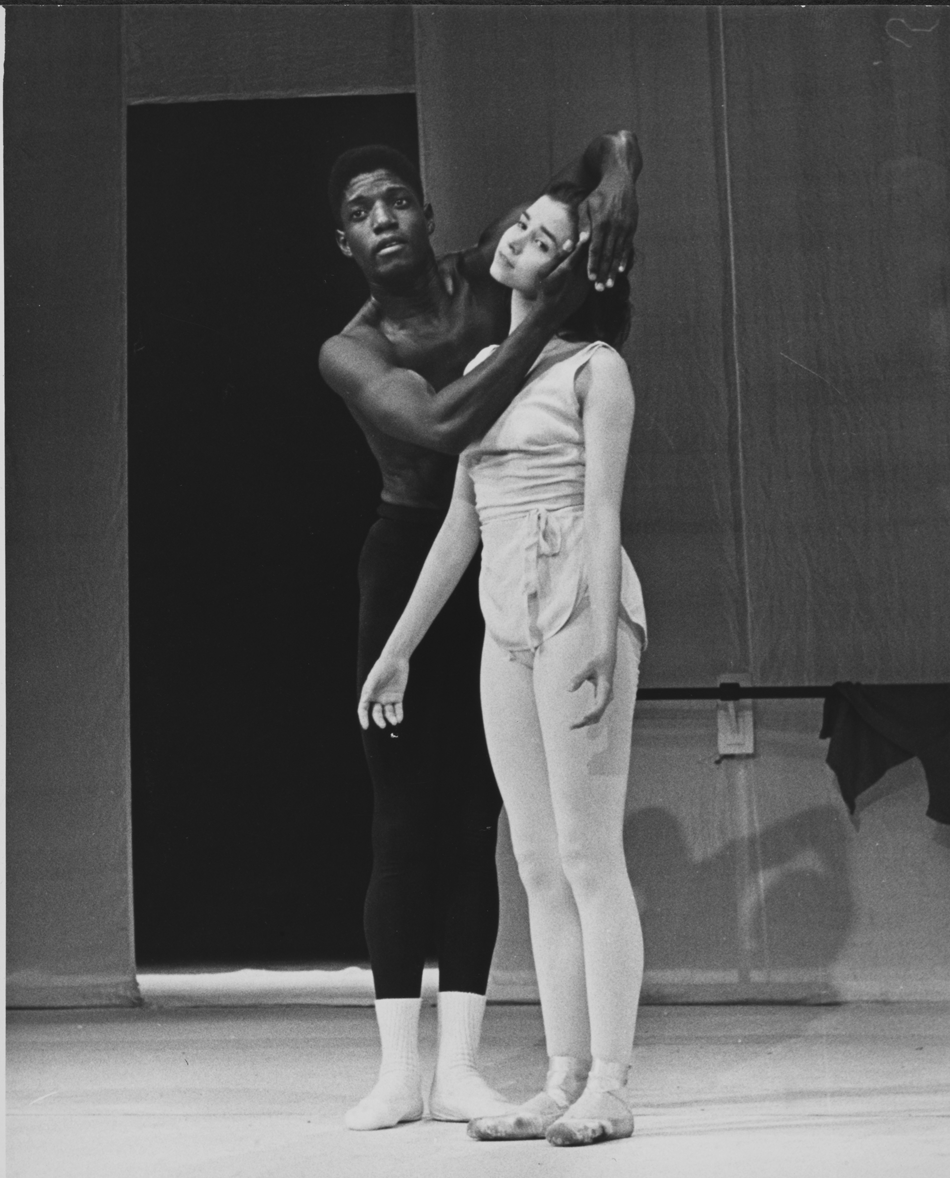
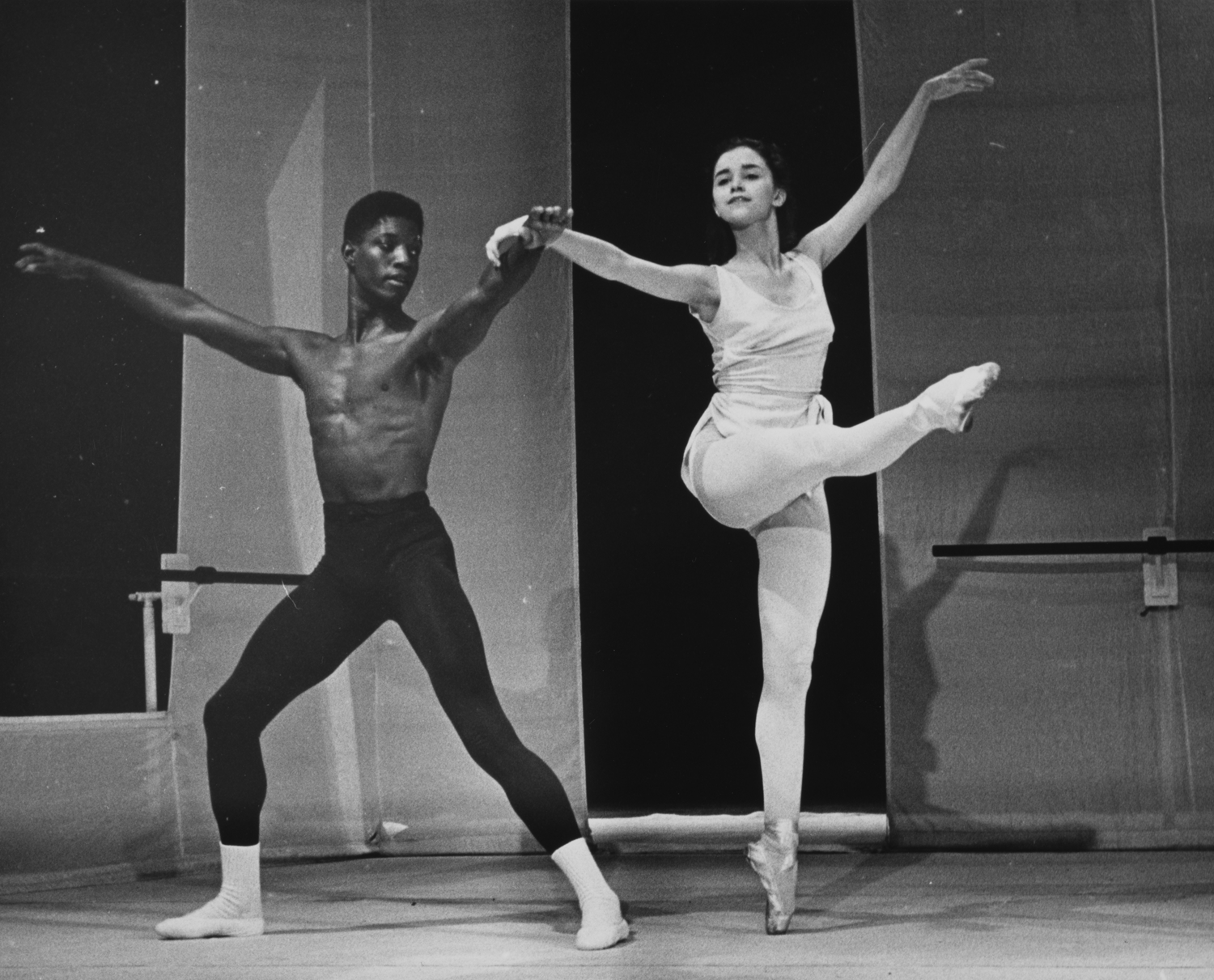
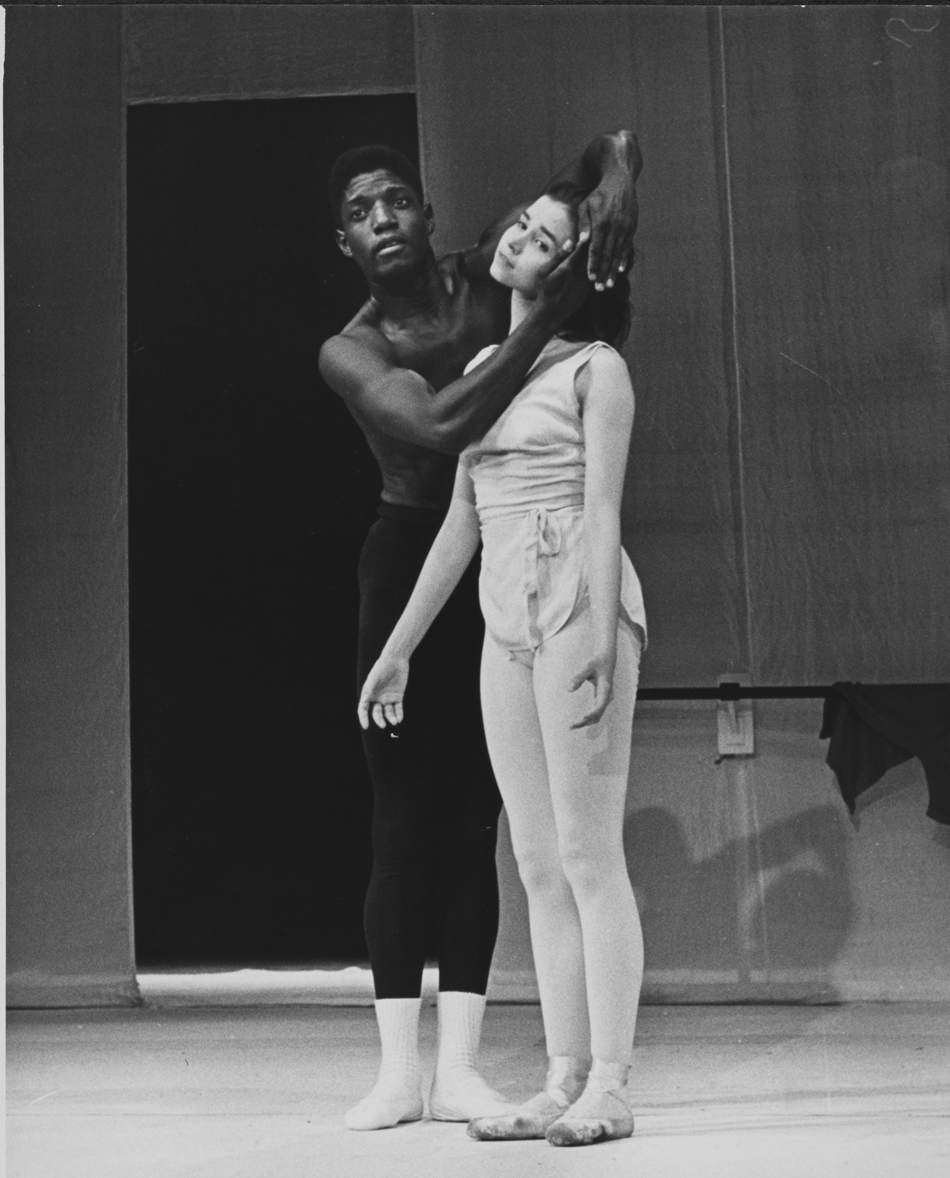
Press coverage of Ballets: U.S.A. can be scrutinized for how dancers of color were perceived in a predominantly white company and how the language reinforced racial stereotypes. African-American John Jones's diverse training was well suited to the Robbins repertory. Jones was among a small group of African-American dancers who studied ballet with Anthony Tudor (Gottschild Reference Gottschild2012, 45–48), and he performed with Dunham and in Broadway shows before joining Robbins's company (“John Jones” n.d.). Jones was repeatedly featured in mainstream periodicals and specialist dance journals in Britain, both as an individual and in his duets. Jones partnered with Wilma Curley in 1958 and 1959, while in 1961 he danced with then-fifteen-year-old Kay Mazzo in the duet Afternoon of a Faun. Set in a ballet studio, the work echoes themes of narcissism explored in Debussy's music and Stéphane Mallarmé's poem, which inspired Vaslav Nijinksy's L'Apres midi d'une Faune (1912). Numerous photographs of Robbins's dance evoke the iconic images of Diane Adams and Arthur Mitchell in George Balanchine's Agon (1957). At times, an emotional intimacy is conveyed in Faune, when Jones caresses Curly's cheek, while others picture more conventional ballet relationships, as in a supported arabesque.
Ballets U.S.A., 1961, scene from N.Y. Export, Opus Jazz (choreography by Jerome Robbins) with set by Ben Shahn. Photograph by Jerome Robbins, courtesy of Jerome Robbins Dance Division, New York Public Library for the Performing Arts.
A. H. Franks wrote about Faun in the Dancing Times:
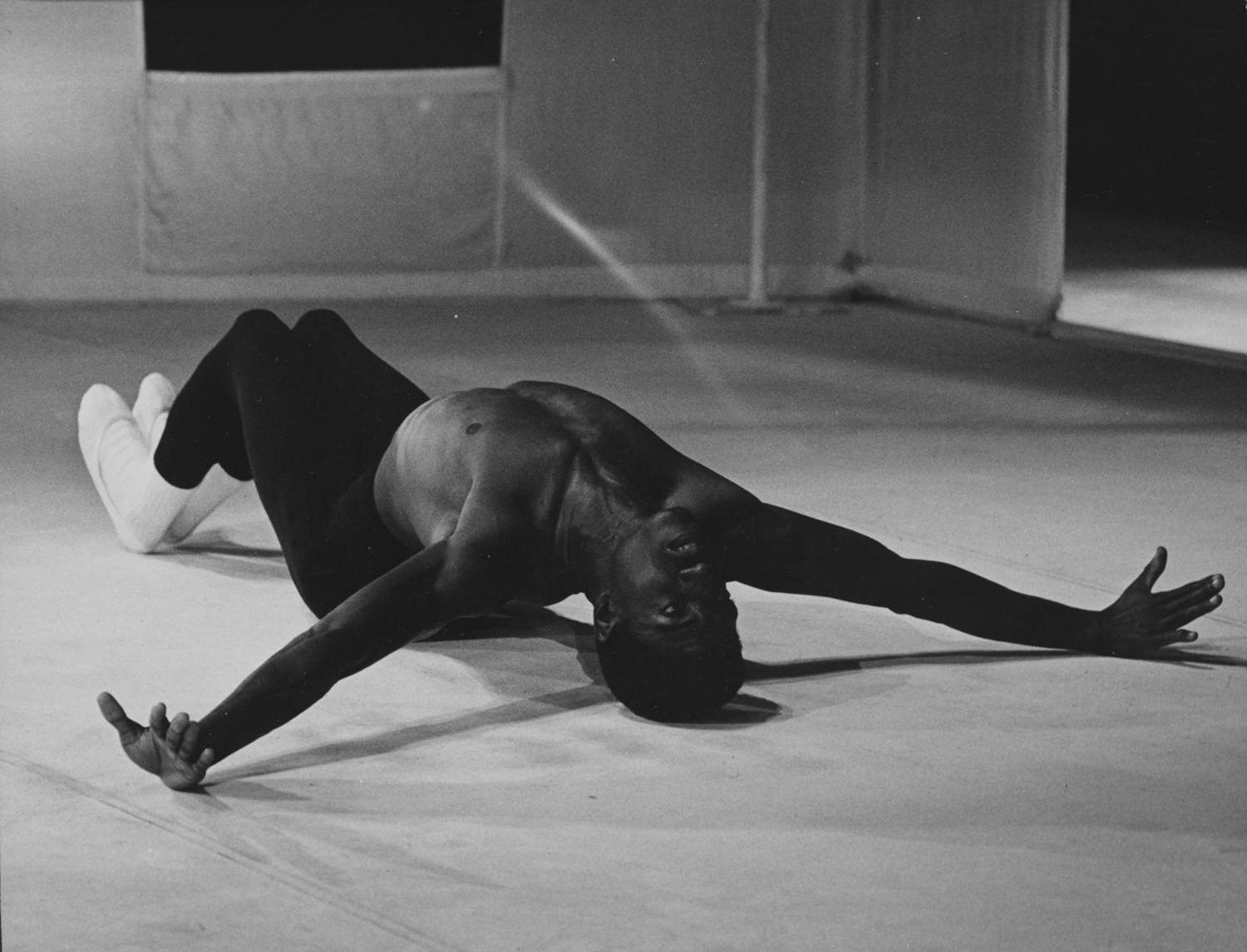
Wilma Curly as the girl is charming enough, but the negro [sic], John Jones, is absolutely outstanding. With a tall, spare build and the infinite rhythm of his kind, he dances with overwhelming expressiveness while retaining the seemingly indifferent “cool” expression. (Reference Franks1959, 12–13)
Racialized terminology perpetuated stereotypes of Black dancers by emphasizing a “natural” rhythm, reinforcing primitivist perceptions or focusing on aspects of the body based on racist assumptions (Gottschild Reference Gottschild2003), observations that sat alongside high praise of Jones's dancing.
The Athenian dance critic compared Jones to ancient symbols, animals, and African art:
The afternoon sun shines into a gym hall, on the floor a sad Negro [sic] athlete, an unforgettable figure. The young dancer, with his perfect bronze body, his curved strong muscles, with his torso expanded as an exotic instrument was like a sculpture of classical Nigerian art. His head with the two big, melancholic eyes standing still as if watching at an imaginary screen the moves of the body. His eyes, like the eyes of an antelope, reminded me of the heads of Ife. How wonderful was the art of this black Kouros! (“Athens Festival …” 1959, 5)
Jones also danced with Curly in the N.Y. Export duet “Passage for Two,” which had extensive partner work. Reflecting on his time with the company, Verso believed that Robbins was “making a statement” with the interracial casting (Verso, cited in Kisselgoff Reference Kisselgoff2005). An image of Jones was used to illustrate the use of space, flexibility, and strength of the torso in an article on dance technique by prominent British choreographer Gillian Lynne for The Dancing Times (Lynne Reference Lynne1961). Writing in the Dancing Times, Mary Clarke described Jones's character in the 1961 Events as a “child-like negro [sic] boxer, at first feted then ignored by society” (1961, 748). Press coverage of Jones parallels Thomas DeFrantz's analysis of Black masculinity perceived in the characterizations Alvin Ailey created, described as “simmering hyper-masculinity” (Reference DeFrantz, Dils and Albright2001, 345). Thomas notes that stereotypes included “savage, hyper-masculine, aggressively heterosexual and naïve-primitive roles which catered to traditions about the black male body …” (348). Faun was choreographed for the New York City Ballet in 1953, however, the interracial performance by Jones and Mazzo evoked scathing commentary from Martin (Reference Martin1961) in the New York Times. He asked: “Has this ballet suddenly become a social study, or are we to pretend we do not notice that he is a Negro [sic] on peril of being bigoted? In either case, it has inevitably raised an issue to be met by the spectator.”
Ballets: U.S.A., 1961, N.Y. Export: Opus Jazz, choreography by Jerome Robbins. Photograph © Anthony Crickmay, Victoria and Albert Museum, London.
Foreign press praised the inclusiveness of the company, with an Israeli critic commenting that in “many localities of the US, the troupe would have been stoned for this performance” (I Azaryahu 1959, 3). Jowitt recounted a single incident when Jones was refused entry to his “digs” on tour in Italy (2005, 299), which appears to be an anomaly. This stands in contrast to numerous instances of segregation and discriminatory actions encountered by African-American dancers touring through the American South (Gottschild Reference Gottschild1996; Das Reference Das2017).
The US press also focused on the ethnicity of another dancer, with a Pittsburgh, Pennsylvania, newspaper article questioning Patricia Dunn's Korean-American heritage. The journalist asserted that Dunn's looks did not match her name, leading the dancer to provide details about her family history (“Ballets: U.S.A. Scheduled” 1958). Dunn danced with the San Francisco Ballet, on Broadway and in films choreographed by Jack Cole (“Patricia Dunn” 1990). The publicity circulated on the company's behalf glossed over the mixed-race cast, and little was made of Dunn's ethnicity in reviews in Europe, in contrast to Jones. Dunn was the female dancer in the “Statics” section of N.Y. Export featured on the Ed Sullivan Show in the 1959 broadcast, while Jones performed in two group sections. The interracial duet was not part of the show. Reactions to the interracial performances by American audiences were limited, as the 1958 US tour was cancelled while it was in progress due to low ticket sales.
Robbins's choreography challenged aesthetics in theme and movement vocabulary. In the New York Times, Martin praised his musicality, integration of jazz isolations, and rhythmic impulses, while later questioning the extent to which a homogenous nation could be appropriately represented by the repertory:
In this country, we know perfectly well that if there is such a thing as “Ballets: U.S.A.” it is certainly not danced in sneakers with the pelvis leading. We are also unlikely to think of jazz as a New York export: it is fundamentally for immediate consumption on the premises and Harlem (another name, no doubt, for New York); has no monopoly on its manufacture. Though we are well aware that jazz dancing exists as a phenomenon of our time on a certain level, we would be disinclined to accept it as a definitive example of our national culture. (Martin Reference Martin1961)
Martin found that the dancers’ techniques were “contaminated by acceptance of the jazz techniques as a norm” (1961). While the USIA was celebrating the vibrancy of the company in part because of its jazz components, it was met at home with some resistance.
Subversive Elements
Most of the contemporaneous accounts of the tour gloss over subversive aspects of Robbins's works. Writing of a Brussels performance Harold Taubman described how N.Y. Export offered an evocation of “the beat generation. In terms of movement the ballet seems more than ever to capture the despair and loneliness underneath the group rituals. There is laughter but it is nearly always tinged with bitterness, and the toughness is unmistakably a cover for vulnerability” (Taubman Reference Taubman1958). Few reviews mention violent undertones in the section Statics, in which five men confront a female dancer in highly sexualized exchanges. Deborah Jowitt labelled the interaction as an assault when the female dancer is thrown between the men before they “hurl her offstage” (Reference Jowitt2005, 302). Dancer James Moore describes how they “toss her roughly away … ‘like she was a piece of garbage’” (Moore, quoted in Jowitt Reference Jowitt2005, 302). A heightened sense of danger corresponds to the “juvenile delinquent” stereotype that had entered the cultural mainstream, marked in 1955 by the James Dean film Rebel without A Cause. West Side Story further developed the characterizations, with the rivalry between the Sharks and Jets gangs (Wells Reference Wells2011). While Robbins's adaptation of Romeo and Juliet was permeated with loss and unrealized love, N.Y. Export circled back through danger to a positive sense of community and power. The two group sections, “Improvisations” and “Theme, Variations and Fugue” were compared to West Side Story in movement vocabulary, but conveyed comradery rather than confrontation.
Jowitt notes how some viewers perceived a reference to the atomic bomb in N.Y. Export, in which the dancers all fall to the floor in the first section (2005, 315). Such allusions were even stronger in Events, created for the 1961 tour. Events integrated pedestrian movement and social dance partnering with the jazz characteristics of low center of weight, pelvic action, flexed hands, and parallel turns performed to another score by Prince. Robbins (1961b) mentioned “non-radioactive fallout” in his choreographic notes. The threat of nuclear war increased during the years of Ballets: U.S.A.'s tours, and its last ballet was seen to embody this period of heightened anxiety as well as introduce more overt themes of violence, sexuality, and racism (Lawrence Reference Lawrence2007).
Events also brought sexuality to the fore in a duet between two men (Clarke Reference Clarke1961; Siegel Reference Siegel1979), although Verso, who danced in the duet, told me in an interview that there was a female replacement ready to step in if it proved too controversial (Reference Verso2018). Analysis of an archival recording (Robbins 1961a) reveals how tensions were built between Black and white, rather than perpetuating an image of racial harmony, when Jones appears as an equal among a group of dancers or in a duet. In multiple sections of Events, Jones is the “other,” dancing apart from the group or responding to confrontations by a group of white dancers. A solo by Jones shifts between a jazzy movement vocabulary with a grounded bounce and a cakewalk step, developing into convulsive gestures accompanied by manic facial expressions. Jones picks up a chair and swings it around him to keep other dancers away until four men eventually overpower him and try to calm him down by stroking him. In contrast, Jones was well integrated into the group in N.Y. Export and Moves, and often featured in partnered lifts, especially in “Passage for Two.”
Events and, to an extent, N.Y. Export broke away from the culture of consensus that historians such as Stephen J. Whitfield (Reference Whitfield1996) have argued dominated the 1950s, reinforcing hegemonic values in the fight against communism. The dances celebrated youth, particularly in N.Y. Export, which develops the notion of the everyday to encompass contemporary urban life and relationships, but with an edge, at times rebellious but independent and confident. The initial costumes (by Shahn and Florence Klotz) were casual tops or sweaters worn with black tights, while Keds donated “tennis” shoes for the tour. Moves was danced in leotards and tights, and Events echoed N.Y. Export's visual style. The women in Interplay and Moves danced on pointe, whereas Chopin was given comedic treatment in The Concert, demonstrating a choreographic and performance versatility that differed from the other ballet companies touring from both sides of the Iron Curtain. Despite the dark visions in Events, Robbins continued to be listed as a priority for funding by the Dance Panel up through 1963, however, the US government only supported the 1958 and 1959 tours. In 1960 a decision was made to support companies that had not received funding in the past, resulting in a break in continuity (ANTA Dance Panel Minutes 1959b, 5). The company was disbanded permanently after the 1961 tour.
Kay Mazzo and John Jones in Afternoon of a Faun, 1961, choreography by Jerome Robbins. Photograph by Friedman-Abeles, courtesy of Billy Rose Theatre Division, New York Public Library for the Performing Arts.
Critical Responses
Historian W. Scott Lucas contends that in Cold War cultural diplomacy, “Americanization is presented as a squeaky clean, as a one-way process in which foreign peoples welcomed the commodities as well as the values of American democracy” (Reference Lucas, Kabbendam and Smith2003, 54). The Ballets: U.S.A. Tour Analysis (1960) reinforces the perception of nations welcoming the American offerings, citing the amount of column inches in each country to validate the tour's successes. For example, in France, 522 column inches across fifteen publications were devoted to Ballets: U.S.A. performances, while 199 press representatives from ten countries attended the Spoleto Festival performances (1).
The Ballets: U.S.A. Tour Analysis identifies diplomatic or propaganda successes in specific locations, with explicit commentary on the political situations in Italy, Poland, Germany, and Yugoslavia, which were either communist nations, aligned with Germany or under occupation during World War II. For example, N.Y. Export, featured in a “Festival Populare” event that closed the 1959 Spoleto Festival, attracted an additional 20,000 viewers beyond the regular performances. The tour commentary emphasized how the dances reached across ideological barriers, through communicating successfully “to audiences who had been living under Communist control for ten years” (Ballets: U.S.A. Tour Analysis 1960, 7). The tour report highlighted some interactive events that took the exchanges beyond the stage. In Yugoslavia, lecture-demonstrations explored the structure of a fugue, a component of the music and choreography in N.Y. Export, offering educational insight into the choreographic process. Discussion of union rules brought in a more overtly political focus on workers’ rights, which reinforced democratic ideals circulated through cultural diplomacy. Yugoslavia was a communist state but outside the immediate control of the Soviet Union. A lengthy excerpt from a US embassy report explained how the company demonstrated modernity and innovation to Yugoslavian audiences, in contrast to the usual fare of classical ballet from the Soviet Union (15). For one local critic, the memory of the dances remained strong three years later, praised above Graham's 1962 appearances in Belgrade (Lenart Reference Lenart2016, 211).
Kay Mazzo and John Jones in Afternoon of a Faun, 1961, choreography by Jerome Robbins. Photograph by Friedman-Abeles, courtesy of Billy Rose Theatre Division, New York Public Library for the Performing Arts.

The tours were physically grueling, and in at least one instance, the itinerary changed to avoid diplomatic tensions. Rather than a scheduled refueling stop in East Berlin, the company was rerouted from Stockholm through Hamburg to avoid a potential propaganda coup. The dancers would have had to walk through the Brandenburg Gate on foot to reach the busses in West Berlin, and such a situation was unacceptable to US Embassy and State Department personnel (Ballets: U.S.A. Tour Analysis 2016, 27). In another event, the plane carrying the costumes, sets, and personal effects crashed upon leaving Athens on its way to Edinburgh, fortunately without causing death or serious injury. The plane and its contents were lost at sea, however, costumes and shoes were donated, and the scenery recreated, although the first Edinburgh performances were danced on a bare stage (3; See also Jowitt Reference Jowitt2005 and Lawrence Reference Lawrence2007).
Although N.Y. Export was seeped in expressions of urban youth, British critic Clive Barnes read something existentially universal that spoke of the particular moment in time that reached beyond New York's borders. He found that:
the ballet conveys the spirit not just of a specific generation but the whole age in which we live. The stylised world of these shook up kids, with its fears and hopes and conflicting anxieties about conformity and individualism and its stress and rat-race pulse, this is the microcosm of our own jungle. (Barnes Reference Barnes1959, 13)
Similar assessments resonated in the reviews across Europe, with the Swedish critic also noting the lack of principal dancers in the company: “It is truly democratic: it has not a single prima donna. But to be quite fair, it should be said that they are all prima donnas. The whole ensemble is of soloist class, with technical virtuosi and in the highest degree artistically disciplined …” (22). A Finnish critic proclaimed that Ballets: U.S.A. conformed to democratic principles because “the dancers are all of equal value …” (25), reinforcing positive images of American ideals.
Conclusion
Ballets: U.S.A. emerges as a unique case study through which to interrogate Cold War cultural diplomacy. The company was formed to fulfil soft diplomacy objectives that circulated unique visions of American life and culture. The recognition of the power of the arts and education as a propaganda tool coincided with the growth of arts festivals in Europe, which offered production support and ready audiences for the dance companies. At the time of the tours, Robbins drew together particular qualities that shaped or reinforced perceptions of the superpower as young, vital, and innovative. Democratic ideals were embedded in a staged nonchalance and proficiency that drew on classical ballet technique but did not overshadow the other styles. The dancers broke into everyday gestures, their stances like people off the streets, as they cheered each other on or observed competitive moments. Although distinctly American, the individualized people on stage offered a universal message that differed from the other versions of nation toured by the US State Department. Educational and political outcomes were particularly celebrated in assessments of the performances in those nations on the borders of the iron curtain or under pressure to align more closely with the Soviets.
Image of John Jones used to illustrate article on flexibility of the torso in jazz styles. Photograph © Anthony Crickmay, Victoria and Albert Museum, London.

Analysis of the funding process reveals significant debates over representation and national identity, and documents how Robbins was treated differently to other applicants. In multiple ways, his biography did not conform to the hegemonic values that shaped a sense of nation at the time. Jewish, gay, with former Communist Party affiliations, Robbins's choreographic talent overrode the personal. Musical theater and classical ballet experiences were interwoven. Garafola's analysis of twentieth-century American dance highlights how its content moved from Americana subjects to “leotard ballets” between the 1930s and the 1960s (Reference Garafola2005, 232–239). Citing dance critic Edwin Denby, Garafola explains how Robbins offered a new version of Americana, starting with Fancy Free in 1944 (240–241). The Ballets: U.S.A. repertory during the Cold War portrayed a different generation of young urban Americans, a marked contrast to the celebration of the American West in Agnes DeMille's Rodeo (1942) or Graham's myths of the frontier. Robbins's choreographic style, ballet infused with isolations of the body, rhythmic syncopation, and a confident nonchalance that exuded coolness, was characterized as jazzy. Combined with versions of jazz music acceptable to the mainstream, his choreography offered cutting edge visions of the new superpower. The dances integrated aspects of African-American cultural forms and helped achieve wide acceptance. Critical reactions to the ethnic diversity of the cast demonstrated the efficacy of the cultural diplomacy efforts, even as the civil rights movement was gaining strength and news of oppression and racial prejudice were circulated widely. Accounts of the tours reinforce the extent to which racial politics were integrally linked to the construction of nation in the “battle for hearts and minds” against communism. Across its three years of touring, Ballets: U.S.A. offered multiple images of American culture, telling more than one story to the world, some of which still transcend the time of their creation.