Introduction
YOD, with an onset before 65 years of age, presents challenges to the patient, caregivers, and healthcare services. Research has demonstrated that YOD differs from late-onset dementia in the following areas: (1) patients often receive the diagnosis at a later stage of the disease and are more often misdiagnosed, and symptoms are more heterogeneous and may show a more rapid progression (Withall, Reference Withall2013); (2) the family situation may be more complex; patients may have children who are still living at home, and if spouses are caregivers, they frequently experience higher levels of burden than those of older patients (Arai et al., Reference Arai, Matsumoto, Ikeda and Arai2007); (3) YOD patients may still be working when dementia occurs, which often causes early retirement followed by economic and social burden (Withall, Reference Withall2013); (4) psychological and behavioral problems, especially anxiety and depressive symptoms, were reported to occur more frequently in a large sample of patients with YOD (Panegyres et al., Reference Panegyres and Chen2014).
To cope with the specific challenges associated with YOD, such as depressive symptoms, psychotherapy tailored to meet the specific needs of these patients may be useful. Research has shown that cognitive behavioral therapy (CBT) is effective in treating depression in older persons with dementia (Teri et al., Reference Teri, Logsdon, Uomoto and McCurry1997; Orgeta et al., Reference Orgeta, Qazi, Spector and Orrell2014). Moreover, cognitive rehabilitation (CR) has been demonstrated to have beneficial effects on memory function and mood (Clare et al., 2010). To our knowledge, there is no literature describing whether psychotherapy may benefit YOD. Thus, the aim of the present study was to explore if a multimodal psychotherapy approach that combines CBT and CR could be used to manage depressive symptoms in patients with YOD. Describing a patient process will be used as background for a discussion in order to expand the understanding of the treatment needs of this population.
Case report
“Susan,” a 63-year-old single woman who was living independently in her own apartment, was diagnosed with early-onset Alzheimer's disease at the Memory Clinic of Oslo University Hospital, Norway. The diagnosis was based on neurocognitive testing, along with results of MR neuroimaging, which showed hippocampus atrophy, and cerebrospinal fluid which demonstrated abnormal amyloid beta, total tau and phosphorylated tau. In addition, Susan had difficulties with activities of daily living, and needed support to buy groceries, take her medication and handle economics. She went into early retirement seven years ago, due to cognitive difficulties, but at that time dementia was not considered because of her young age. Susan's primary caregiver was her daughter, who was 43-years old. In addition to helping her mother, the daughter had a full-time job and young children to take care of, and she reported that she felt burdened by the responsibilities associated with taking care of her mother.
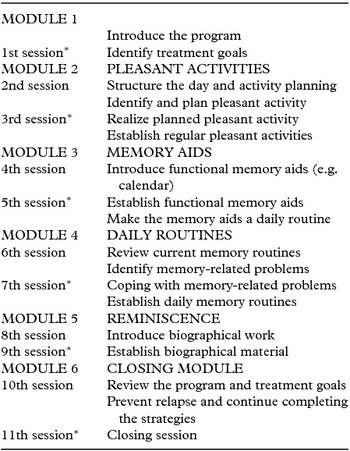
The treatment was based on the CORDIAL study (CR and CBT for people with Alzheimer's disease) (Kurz et al., Reference Kurz2012). The therapy is based on basic CBT principles consisting of structured sessions with a clear agenda focusing on how to reduce depressive symptoms, psychoeducation about the disease and in-between homework. In addition to CBT, the treatment consists of memory aids and reminiscence therapy. The main goal of the intervention is to reduce depressive symptoms. The treatment is based on a manual and consisted of 11 structured sessions. For an overview of the sessions, see Table 1.
Overview of the intervention

*Both the caregiver and patient participate in these sessions.
For details of the intervention, see Kurz et al. (Reference Kurz2012).
The sessions that focused on pleasant activities proved to be of great importance, as before therapy, Susan reported being more passive, with few activities and depressive feelings due to her cognitive deficits. The “list of pleasant activities” was used to identify activities that Susan would like to do, as well as possible obstacles. All activities had to be planned in detail. Therefore, she picked out one pleasurable activity from the list every evening, which helped her to focus on it the following day. Additionally, weekend meetings with her friends were organized. Nevertheless, Susan found it frustrating that she could not regularly meet her friends during the daytime on weekdays, as they were occupied with their work and families. She was therefore offered participation in a day-care center twice a week. This served as a regular organized activity that she did not have to initiate herself. As the majority of the other users were older than her, she initially disliked the day-care center. After they were presented with Susan's list of pleasurable activities, the staff managed to organize activities that were adapted to Susan's needs.
In the sessions focusing on memory aids, it turned out that Susan did not use her pocket calendar regularly. After discussing the pro and cons of using a calendar, she started to use it. She wrote down future assignments, as well as previous activities, as she often forgot activities she had completed. This proved to be particularly useful, as she often had negative dysfunctional thoughts, like “I am doing nothing while all my friends are working.” Rather than restructuring these thoughts, which were difficult due to her cognitive impairment, it was easier for Susan to see that she had completed daily meaningful activities by examining her calendar.
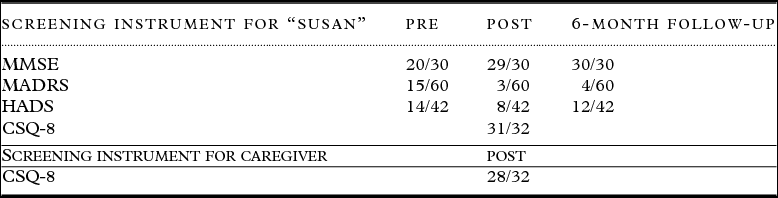
Susan completed the 11 sessions in accordance with the intervention program (Table 1). Both Susan and her daughter reported satisfaction with the treatment, as seen in Table 2. Moreover, Susan reported that her mood was improved. The caregiver stated that the written home assignments had been especially useful, because they made it easier for her to support her mother in the treatment process. At the 6-month follow-up for the patient and her caregiver, Susan reported that she was less depressed (Table 2) and still participated in the activities that were started. However, Susan had stopped using her pocket calendar, as she forgot to use it in everyday situations.
Overview of questionnaires for patient and caregivers

MMSE, Mini-Mental State Examination; measures current level of cognitive functioning (Folstein et al., Reference Folstein, Folstein and McHugh1975).
MADRS, Montegomery and Åsberg Depression Rating Scale; measures depressive symptoms (Montegomery and Asberg, Reference Montegomery and Asberg1979).
HADS, Hospital Anxiety and Depression Score; measures anxiety and depressive symptoms (self-rated) (Zigmond and Snaith, Reference Zigmond and Snaith1983).
CSQ-8, Client Satisfaction Questionnaire-8; measures global satisfaction after treatment completion (self-rated) (Larsen et al., Reference Larsen, Attkisson, Hargreaves and Ngyen1979).
Discussion
People with YOD often have to accept early retirement due to their dementia symptoms, and they may find it distressing to see their partner and friends working. Therefore, it is important to find meaningful and pleasant daytime activities to prevent passivity and depression. The therapy program, especially the “Pleasant Activities” module, helped Susan to achieve this. Filling out the worksheet of pleasant activities with the support of the therapist helped her to identify activities she enjoyed doing. Furthermore, it is noteworthy that pleasurable activities are not necessarily helpful if the patient does not remember having completing them. Thus, this case illustrates how useful it can be for patients to examine the calendar in the evening to remember completed activities.
According to the literature, there is a need for individualized formal help adapted to YOD, because these individuals are more physically fit and may have preferences that differ from those of older persons (Whithall, Reference Withall2013). In this case report, the CBT intervention helped the day-care staff to find pleasurable activities for Susan by providing them with a worksheet of pleasant activities. Thus, it seems that this intervention may be used to guide health staff to ease patient management with a person-centered perspective. An increased ability to aid Susan was also reported by Susan's caregiver, who stated that the homework and activities were a framework that facilitated her helping her mother. This is in accordance with the findings of Teri et al. (Reference Teri, Logsdon, Uomoto and McCurry1997), who found that behavioral treatment targeted to patients with dementia can also benefit caregivers by increased patient management.
Due to the progressive decline in dementia illnesses, it is important to examine the possible long-term gains of an intervention. In this case, Susan reported that she had stopped using her calendar after six months, as it was no longer part of her daily routine. This could possibly have been resolved by a booster session for both the patient and caregiver after the intervention. Therefore, further studies should examine the possible effects of booster sessions on patients with YOD and their caregivers. Nevertheless, it seems that the intervention had a long-term effect on Susan's daily living, as she still participated in the majority of the activities that were introduced in the therapy. Susan had a decrease in depressive symptoms according to the Montegomery and Åsberg Depression Rating Scale (MADRS) where she reported a decrease on the domains of lassitude, inner tension and pessimistic thought, and on the Hospital Anxiety and Depression Score (HADS) where there was an increase in the domains of interest in appearance, looking forward to things and enjoying books, radio or TV. The changes in these domains seemed to have led to more energy for Susan, which may have initiated the increased test results on the cognitive assessments. Another explanation for the improvement on MMSE could be that Susan started with cholinesterase inhibitors four months prior to the intervention, and this could have enhanced her performance on the cognitive assessment. However, it is impossible to conclude about the general effectiveness in a single case study. Therefore, further studies should examine the effect of psychotherapy on depression in a larger patient sample of YOD. Nevertheless, this study may illustrate a successful example of treating the affective symptoms that are frequently intricate in YOD.
Conflict of interest
The authors declare that no conflicts of interest exist. They have not entered into an agreement with a funding organization that has limited their ability to complete the research as planned and publish the results. The authors had full control of the primary data and are willing to allow the journal to review their data if requested.
Description of authors’ roles
J.B. Tonga collected the data, performed the psychotherapy, and wrote the paper. E. Arnevik, K. Werheid, and I. Ulstein assisted with writing the paper. I. Ulstein and J.B. Tonga translated and culturally adapted the CORDIAL manual to Norwegian, while K. Werheid developed the original German version of the CORDIAL program and counseled during the translation process.
Acknowledgments
This study was supported by Oslo University Hospital, the Norwegian Health Association and Old Age Psychiatry Research Network Telemark Hospital Trust, and Vestfold Trust. Thanks to A.I. Thoene-Otto, who conjointly developed the CORDIAL program with K. Werheid, and to A. Kurz and Beltz Verlag for agreeing to the Norwegian translation of the manual for study purposes. Thanks to V. Gordner for helping with the translation of the manual into Norwegian.