Introduction
Across the world's communities, infants produce their first words at roughly their first birthdays. This achievement, one that is greeted with special joy by parents, has also attracted considerable research attention. Decades of research has been dedicated to identifying the content of infants’ earliest vocabularies and the mechanisms by which they are acquired. For example, based on considerable evidence that infants’ earliest words are predominantly nouns, researchers went on to identify the mechanism underlying this phenomenon. Some argued that the early advantage for learning nouns over verbs is a universal feature of human language (Gentner, Reference Gentner, Hirsh-Pasek and Golinkoff2006; Gentner & Boroditsky, Reference Gentner, Boroditsky and Gathercole2009; Gleitman, Cassidy, Nappa, Papafragou, & Trueswell, Reference Gleitman, Cassidy, Nappa, Papafragou and Trueswell2005; Golinkoff & Hirsh-Pasek, Reference Golinkoff and Hirsh-Pasek2008; Golinkoff, Hirsh-Pasek, McDonough, & Tardif, Reference Golinkoff, Hirsh-Pasek, McDonough and Tardif2009; McDonough, Song, Hirsh-Pasek, Golinkoff, & Lannon, Reference McDonough, Song, Hirsh-Pasek, Golinkoff and Lannon2011), but others propose instead that the noun advantage is a consequence of the particular native language being acquired (Tardif, Reference Tardif1996; Tardif, Gelman, & Xu, Reference Tardif, Gelman and Xu1999; Tardif, Shatz, & Naigles, Reference Tardif, Shatz and Naigles1997). Current research offers evidence for adopting a more nuanced approach, focusing on the relative contributions of both factors inherent in the child and in the input to lexical acquisition (see Bornstein et al., Reference Bornstein, Cote, Maital, Painter, Park and Pascual2004; Imai et al., Reference Imai, Li, Haryu, Okada, Hirsh-Pasek and Golinkoff2008, and Waxman et al., Reference Waxman, Fu, Arunachalam, Leddon, Geraghty and Song2013 for a review). In addition, there is growing recognition that the evidence regarding early lexical acquisition comes from an exceptionally narrow base. There are between 6,000 and 7,000 known spoken languages in the world, but in only 2% is there at least one study of language acquisition (Stoll, Reference Stoll and Bavin2009). As a result, we have a limited vantage point from which to view the content and process of lexical acquisition.
Here, we seek to broaden the empirical base by reporting new evidence on early lexical acquisition in Wichi, an under-studied indigenous language spoken in the Gran Chaco regions of Argentina and Bolivia. In Wichi, verbs predominate over nouns in adult language use, in which both nouns and verbs are characterized by complex morphology. Early lexical acquisition in infants who are acquiring a verb-heavy language with complex inflectional morphology remains sparse (Kelly, Wigglesworth, Nordlinger, & Blythe, Reference Kelly, Wigglesworth, Nordlinger and Blythe2014).
The Wichi language
The term wichi, roughly translated as ‘people’, refers to both the Wichi people and the language they speak. The Wichi language, also known as Matacoan (Greenberg, Reference Greenberg1987; Kaufman, Reference Kaufman and Payne1990; Loukotka, Reference Loukotka1968; Tovar, Reference Tovar1964), is one of four Mataguayan language families (Fabre, Reference Fabre2005; Najlis, Reference Najlis1984). In the Gran Chaco region, the locus of our fieldwork, Wichi is acquired naturally as a first language.
More specifically, in the Wichi community in which we work, Wichi is the exclusive language spoken in the home. Children are not introduced to Spanish, the national language of Argentina, until they enter public school at roughly five or six years of age. Even at school, children speak exclusively in Wichi with Wichi teachers and children. Moreover, in their curriculum, Spanish is introduced gradually and co-exists with Wichi in lessons on a range of academic subjects. Within the broader community, few Wichi adults are conversant in Spanish.
In sum, because Wichi is the sole language used within the family and broader community context, children's early language input is comparable to the input of other infants acquiring a single language.
Specifying the input characteristics: morphology and the prevalence of nouns and verbs in Wichi
Morphology
Typologically, nouns and verbs in Wichi are polysynthetic and agglutinative under all possible interpretations of those terms (for phonological and grammatical evidence from Wichi, see Nercesian, Reference Nercesian2010, Reference Nercesian2011, Reference Nercesian2014; Vidal & Nercesian, Reference Vidal and Nercesian2005). Therefore, as in other such languages featuring such extensive morphological complexity, a single noun or verb can express information that would otherwise be expressed in an entire phrase in other languages.
For example, the single Wichi verb in (1a) covers the meaning conveyed by the entire phrase in (1b).
(1a) N’-y'aj-hila-’am-ej=hen. (Wichi)
1suj-to hit-fut-2obj-ins = pl
(1b) ‘I will hit you (pl.) with something.’ (English)Footnote 1
This morphological complexity, also evident for nouns, as can be seen in (2a) and (2b), appears to be especially pronounced for verbs. For any given verb, the root may be combined with up to five different morphological markers and fifteen grammatical categories.Footnote 2
The same is true for nouns; the root may be combined with up to eight different grammatical categories.Footnote 3 Among these, one category – possession – divides nouns into two major classes: alienable vs. inalienable nouns. Alienable nouns have no inherent possessor, including nouns that typically refer to particular artifacts, animals, and plants. In contrast, inalienable nouns do have an inherent possessor, including nouns referring to kinship relations (e.g., my mother) and body parts (e.g., your nose, his arm), among others. This alienable/inalienable distinction is marked on the surface of the input in many ways. For example, inalienable noun roots (like ‘Mother’ or ‘nose’) cannot be produced alone; instead, they require a pronominal prefix to indicate the speaker's possessive relation to the referent. In examples (2–5), the inalienable noun root (e.g., -ku, or ‘mother’) appears consistently, but takes different possessor prefixes depending on the relation between the speaker and the referent object: n’- if the possessor is the speaker (i.e., first grammatical person) and a- (or zero) if the possessor is the listener (i.e., second grammatical person):
(2a) n'ku [n’-ku] ‘my mother’
(2b) aku [a-ku] ‘your mother’
(3a) n'tkwey [n’-tkwey]Footnote 4 ‘my arms’
(3b) atkwey [a-tkwey] ‘your arms’
(4a) n'tset [n’-tset] ‘my walking stick’
(4b) atset [a-tset] ‘your walking stick’
There are two ways in which this morphological complexity may bear on early lexical acqusition. First, because words appear in such highly inflected forms, it may be challenging for young children to identify instances of the same root across diverse utterances. Interestingly, a cross-linguistic analysis of languages varying in morphological complexity suggests that children learning morphologically complex languages are not hampered by this ‘challenge’ (Xanthos et al., Reference Xanthos, Laaha, Gillis and Stephany2011). Second, because Wichi nouns and verbs share some inflectional morphology, some obligatory (e.g., pronominal subject prefixes, n’ka toto ‘my toy’; n’yenlhi ‘I do something’) and some optionalFootnote 5 (e.g., tense, atsinane’ yik ‘the woman that was recently here is gone’; y'umetne’ itoj ‘the fire has just gone out’), it may be challenging for young children tease apart the nouns from the verbs on the surface of a Wichi utterance.
This matter remains unresolved. Some argue that morphological complexity does indeed present just such a challenge for children acquiring Chintang, another language with complex morphology (Stoll et al., Reference Stoll, Bickel, Lieven, Banjade, Bhatta, Gaenszle, Paudyal, Pettigrew, Rai, Rai and Rai2012). But others interpret the evidence from the Maya languages, Tzotzil (de León, Reference de Léon, Fox, Jurafsky and Michaelis1999) and Tzeltal (Brown, Reference Brown1998) as evidence against this view. Moreover, based on a cross-linguistic analysis of languages varying in morphological complexity, Xanthos and colleagues (Reference Xanthos, Laaha, Gillis and Stephany2011) argue that children learning morphologically complex languages acquire words more rapidly than their counterparts learning less richly inflected languages.
Relative salience of nouns and verbs in the Wichi input
In Wichi, verbs tend to occupy a more privileged position than nouns. First, verbs can appear alone, as bare stems, in the third person and imperative. Second, verbs often occur in the salient, phrase-final position. Third, verbs are used to refer not only to events, activities, and states, but also to properties of objects. This is because in Wichi, as in Navajo and other languages, adjectives do not constitute an independent word class. Finally, in Wichi, an entire clause can be indexed with a verb. This is because arguments are indexed on the verb following a nominative–accusative alignment in the first and second person and a neutral alignment in the third person (zero for both subject and object).
Socialization factors
There is also intriguing preliminary evidence that Wichi mothers engage their children in socialization practices that favor labeling actions (khel ‘come’; chuma ‘take it’) rather than objects (kusala, ‘a spoon’) (Taverna, Reference Taverna2019).
In sum, the Wichi language – acquired as a first language in an indigenous Amerindian community – represents a language type in which verbs occupy a relatively privileged position in the input; it is also a language characterized by complex and rich morphology for both nouns and verbs.
The current research
This project represents the first investigation of the developmental trajectory underlying early lexical acquisition in Wichi. We report here on data from a small group of one- to three-year-old Wichi children, collected by the first author in a series of field stays from August 2012 to April 2017. Certainly, like others working within small indigenous language communities (Brown, Reference Brown1998; Gómez López & Itorroz, Reference Gómez López, Itorroz and de León Pasquel2013; Pfeiler & Carrillo Carreón, Reference Pfeiler, Carrillo Carreón and de León Pasquel2013; Schneidman & Goldin-Meadow, Reference Shneidman and Goldin-Meadow2012; Stoll et al., Reference Stoll, Bickel, Lieven, Banjade, Bhatta, Gaenszle, Paudyal, Pettigrew, Rai, Rai and Rai2012, among others), our sample is smaller than those reported in investigations of more widely spoke languages. Nonetheless, if the goal is to represent language acquisition from a broader perspective that incorporates more language diversity, evidence like that reported here is essential.
We adopted a two-pronged approach. First, we developed a Wichi Vocabulary Checklist (Study 1), based on other parental report measures used in the field (e.g., a recent ongoing research effort in Hñañhú language; Jackson-Maldonado, Reference Jackson-Maldonado2019). We applied this measure to 22 mothers with children ranging from 12 to 47 months to identify the words in each child's lexicon. Second, we followed three children longitudinally, gathering naturalistic language corpora, including the language production of the target child and the elders surrounding them. We then derived, for each child and each speaker present in the recorded sessions, the words produced in each recording cycle. By comparing each child's production data from the checklist and the naturalistic speech sample, we gain a more comprehensive index of the content of Wichi children's lexical knowledge. By comparing each child's production data with that of their elders at each recording cycle, we assess whether and how well their production of nouns and verbs mirrors that of their own language input.
Armed with the checklist and naturalistic data, we test two hypotheses. First, that in Wichi, as in other verb-heavy languages, children's early lexicons should favor nouns over verbs. And second, that the early advantage for learning nouns over verbs should decline over developmental time, bringing children's lexical production into closer alignment with that in the language input.
Study 1: The Wichi checklist – development and application
Method
Participants
We recruited 22 Wichi mothers with children of three age groups: one-year-olds (9 total, 5 girls, Rangeage 1;0–1;9; M = 1;3; SD = 0;2); two-year-olds (6 total, 3 girls, Rangeage 2;5–2;11; M = 2;7; SD = 0;3); three-year-olds (7 total, 3 girls, Rangeage 3;6–3; 11; M = 3;8; SD = 0;2), to complete the Wichi Vocabulary Checklist. All were living in the Wichi Lawet Community in Laguna Yema, Formosa, Argentina. Children came from large families, had on average 3.7 siblings (SD = 1; range = 2–5); roughly 2/3 of the children in our sample are the youngest in their families.
As in our prior work in this community, we trained native Wichi-speaking women from the community (who were bilingual in Spanish) to serve as research collaborators. We relied upon them to recruit Wichi mothers and to maintain contact with them throughout the investigation. To recruit mothers, the native research collaborators explained our interest in studying the language of Wichi children. The community chief, Luisa Pérez, provided written consent for this investigation. Because most of the mothers were barely literate, they gave consent verbally (for more details about this population and our investigations, see Baiocchi, Waxman, Pérez, E.M., Pérez, A., & Taverna, Reference Baiocchi, Waxman, Pérez, Pérez and Taverna2019; Taverna, Waxman, Medin, Moscoloni, & Peralta, Reference Taverna, Waxman, Medin, Moscoloni and Peralta2014; Taverna, Waxman, Medin, & Peralta, Reference Taverna, Waxman, Medin and Peralta2012; Taverna, Medin, & Waxman, Reference Taverna, Medin and Waxman2016, Reference Taverna, Medin, Waxman, Marshal and Brenneman2018).
Procedure
Developing the Wichi checklist
We devoted almost a full year to developing a vocabulary checklist that would be comparable to those used in prior cross-linguistic investigations, but that would also be tailored to reflect the distinct charateristics of the Wichi language. The checklist was developed in two stages, working in close collaboration with two native speakers (our local research collaborators) and a trained linguist.
Stage 1. Since our native collaborators were bilingual Wichi and Spanish, we first translated the Spanish version of the MacArthur Communicative Development Inventory (MCDI) (Jackson-Maldonado et al., Reference Jackson-Maldonado, Al, Marchman and Bates1993; López Ornat et al., Reference López Ornat, Gallego, Gallo, Karousou, Mariscal and Martínez2005; Resches, Kohan Cortada, & Picón Janeiro, Reference Resches, Kohan Cortada and Picon Janeiro2018) into Wichi. In this process, we considered both (a) the MCDI communicative categories, and (b) the words within them. Regarding communicative categories, we retained those on the Spanish MCDI, with a few exceptions. To accommodate the experience of Wichi children, we omitted three categories entirely (‘sounds effects and animal sounds’; ‘vehicles’; ‘toys’) since Wichi does not include the words in these categories. We also omitted other words that have no counterpart in this Wichi community (‘household items’; ‘furniture/room’; ‘outside things’; ‘places to go’). In the case of ‘body parts’, ‘actions and processes’, and ‘properties’ we made grammatical adaptations.
Stage 2. Researchers and local collaborators convened a focus group with three native-speaking mothers who were not in our sample. Our goals were to fine-tune the checklist, to insure that we had identified correctly each word's grammatical category assignment and, perhaps most importantly, to build trust for this child-focused research within the community. The group met on three occasions, each for approximately 2 hours in duration. Meetings were audio-recorded. All suggestions made in these meetings were reviewed by the linguist in conjunction with the first author. The final checklist included 340 Wichi words (168 nouns, 119 verbs) (see ‘Appendix’ in the Supplementary materials, available at <https://doi.org/10.1017/S0305000919000898>).
Administering the Wichi checklist
Because most mothers in our sample (and in this community) do not read, a trained research collaborator read each checklist word aloud, asking the mother to indicate whether her child: (a) understood the word, (b) produced the word, and if so, (c) how the child pronounced it.Footnote 6
Coding
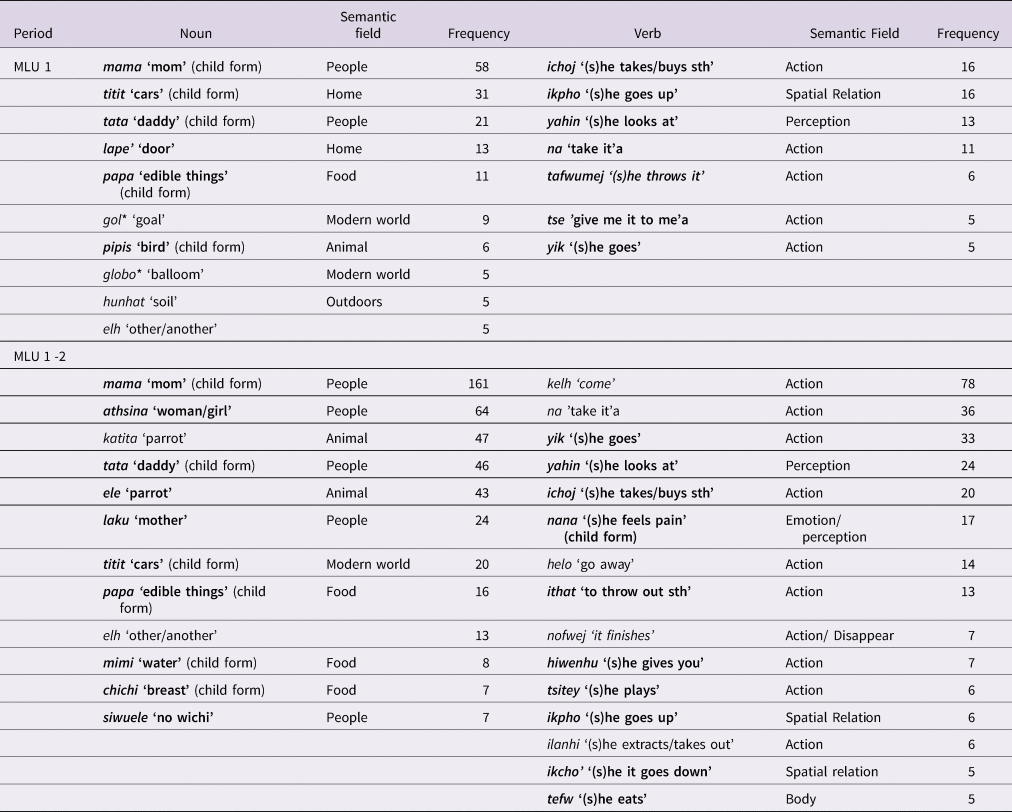
We tabulated the words most frequently understood and produced by children at each age (Table 1). With this as a foundation, we derived for each child (1) the total number of words in her vocabulary, (2) the total number of nouns and verbs, and (3) the noun-to-verb ratio (total number of nouns / total number of nouns + total number of verbs). This yields a bounded scale, ranging from 0 (no nouns, all verbs) and 1 (all nouns, no verbs).
Study 1. Vocabulary checklist. Most frequently produced words in each age-group. *For Spanish loanwords, we note here the Spanish word from which the Wichi word evolved.

Results and discussion
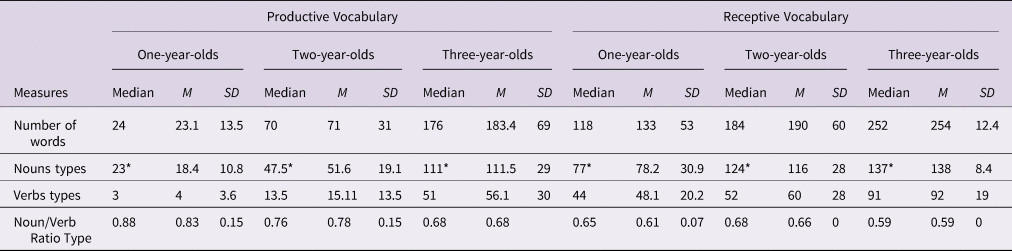
We highlight three main findings (see Table 2). First, mothers reported that their children had learned more nouns than verbs at all ages in both production (one-year-olds: z = 2.6, p < .05; two-year-olds: z = 2.2 , p < .05; three-year-olds: z = 2.3, p < .05) and comprehension (one-year-olds: z = 2.5, p < .05; two-year-olds: z = 2.2, p < .05; three-year-olds: z = 2.2, p < .05). Second, this learning advantage for nouns decreased reliably with age; children's productive vocabulary was inversely related to their noun–verb ratio over time (r = –0.55, p < .05, n = 22).
Study 1. Vocabulary checklist. Productive and receptive measures, based on maternal report using the Wichi check list at each age group.Footnote 7

* p < .05
Third, in an additional analysis, we were able to assess whether this early noun-advantage was an artifact of the sheer number of nouns (N = 168) and verbs (N = 119) included on the checklist. Following Caselli, Casadio, and Bates (Reference Caselli, Casadio and Bates1999), we calculated, for each child, the ‘percentage opportunity filled’ for both nouns and verbs produced, dividing the total number of nouns (and verbs) reported for that child by the total number of nouns (and verbs) available on the checklist. The mean percentage opportunity filled for nouns (0.32) was significantly higher than that for verbs (0.19) (z = 2.6, p < .001). This rules out the possibility that the observed noun advantage in the early Wichi lexicon merely reflected the raw number of nouns and verbs on the checklist.
Thus, the results of the Wichi checklist reveal an advantage for learning nouns over verbs in Wichi acquisition. This converges with previous findings in other verb-heavy langauges with complex morphology. Moreover, the evidence that this early noun bias wanes with age likely reflects the shaping role of the linguistic input.
Study 2: Naturalistic corpus of child and adult language
Our next goal was to advance these findings, supplementing the analysis based on the Wichi checklist with an analysis of naturalistic corpus data of child and adult speech. This permits us to move beyond relying on retrospective parental report as an index of the early lexicon (Au, Dapretto, & Song, Reference Au, Dapretto and Song1994; Gentner & Boroditsky, Reference Gentner, Boroditsky and Gathercole2009; Pine, Lieven, & Rowland, Reference Pine, Lieven and Rowland1996; Tardif et al., Reference Tardif, Gelman and Xu1999; Waxman et al., Reference Waxman, Fu, Arunachalam, Leddon, Geraghty and Song2013). It also permits us to examine the morphology present in the naturalistic speech of both adults and young children. We adopted a longitudinal design, gathering naturalistic speech samples when infants ranged from one- to three-year-olds. This let us identify the extent to which children's lexical production begin to match those of the adult input that surrounds them.
Method
Participants
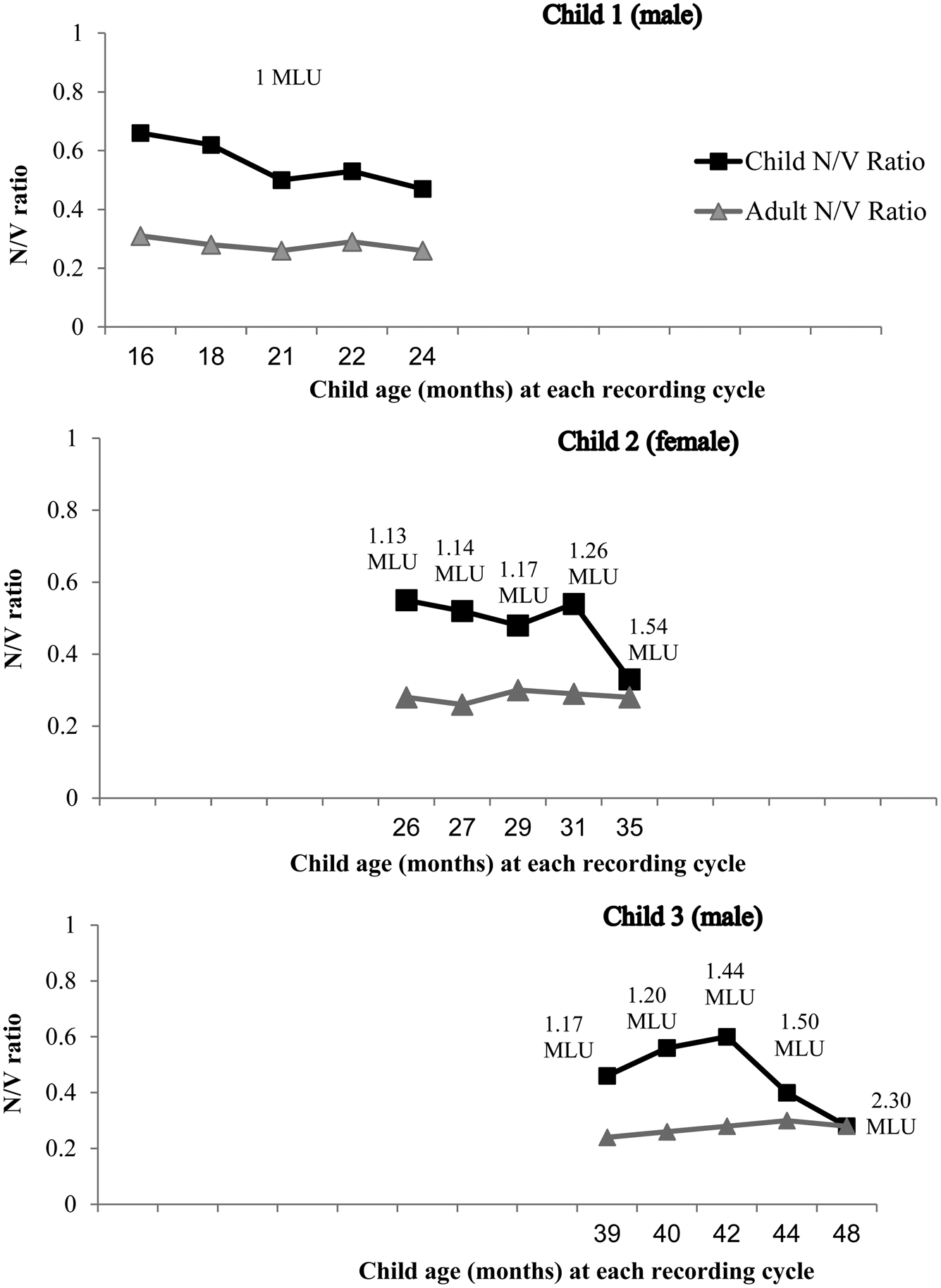
For this longitudinal corpus of naturalistic speech, we selected three parent–child dyadsFootnote 8 from Study 1, with one child from each targeted age period, to participate in the longitudinal corpus of naturalistic speech (see Figure 1 for a description of the children's age at each recording cycle).
Study 2. Noun-to-verb ratio in child and adult production, expressed as a function of child age and MLU.
Materials
We employed a Zoom H4N audio-recorder as well as a Countour + 2 Camera positioned on a tripod and equipped with an external uniPdirectional microphone with windscreen.
Procedure
At each age, we audio- and videotaped two 45 min visits in a recording cycle within a single week. In an effort to capture a representative sample of speech in daily life, one visit took place in the morning and the other in the afternoon. In this community, life takes place outside the house, in the yard or the surrounding areas, people often eat outside, women weave and wash clothes (women), or are just sitting drinking mate;Footnote 9 children are often playing around and interactions that take place in those contexts include more than the target child and mother: other children and adults are usually present, interacting either with the child or with one another. Typically, many people were present during the recordings, some talking a lot and others rarely. All were instructed to act as they would if the camera were not present.
Transcription and coding
In the current analysis, we use the first 30 mins of each visit (yielding a total of 1 hour) for each of the five recording cycles within a single year. This yielded a total of 10 visits and 900 mins of recordings (see Figure 1).
All recordings were transcribed in Wichi and then translated into Spanish by trained native speakers of Wichi (Elan 4.7.3). Then, each entire transcript and translation was reviewed by the linguist. Next, all utterances produced by the three target children (a total of 900 utterances) and the adults (3,000 utterances) were coded to identify every noun and verb either produced by the target child or in the input speech.Footnote 10 In addition, for each noun and verb produced by each child we also encoded any affixes. Coding was completed by two trained coders; half of the transcriptions and translations were checked for reliability by a third native speaker; inter-rater agreement was 90%. All cases of disagreement were resolved by discussion. The nouns and verbs most frequently produced by each child are presented in Table 3.Footnote 11
Study 2. Production data. List of most frequently produced words between child MLU 1 and 2. In bold, the words that match with words in maternal reports. *For Spanish loanwords, we note here the Spanish word from which the Wichi word evolved.

Notes. a According to native speakers, na and tse are used in interpersonal interaction when someone gives something to another by hand (na ‘take it’) or when someone asks somebody for something by hand (tse ‘give it to me’). Since both terms denote actions, we codified them as ‘events’.
We then derived four measures, including (1) the nouns and verbs (types and tokens) produced by each target child, (2) the nouns and verbs (types and tokens) produced by any adult or child older than six years of age present during the recording, and (3) the noun-to-verb ratio (number of nouns divided by number of nouns + number of verbs) in both child and input data, and (4) the nominal and verbal affixes (types and tokens) produced by each target child.
Results
The analysis of naturalistic speech converges well with the evidence from the checklist (see Figure 1). The number of verbs far outstrips the number of nouns in the adult input for all three children (Child 1, 2, 3, M noun/verb ratio = .28, .28, and .27, respectively), yet this ratio is not reflected in the children's own productions where nouns outstrip verbs (M noun/verb ratio = .55, .48, and .46, respectively). Children's noun–verb ratio is twice that of their input.Footnote 12 Moreover, the noun–verb ratio for each child declines reliably over time (Child1: ρ = –0.965, p < .05, n = 5; Child 2: ρ = –0.932, p < .05, n = 5; Child 3: ρ = –0.88, p < .05, n = 5). Interestingly, the timing of this decline is better predicted by a child's MLU than age. More precisely, the child's noun–verb ratio comes into better aligment with their input when they reach an MLU of 1.5 (Child 2: r = –0.99, p < .05, n = 5; Child 3: r = –0.93 p < .001, n = 5).
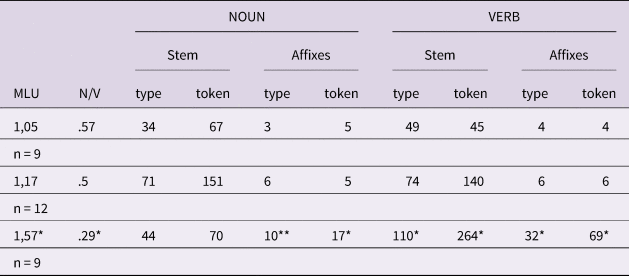
Second, an analysis of children's naturalistic productions reveals increasing productivity of inflectional and derivational morphology of nouns and verbs (see Table 4).
Number of stems and affixes for nouns and verbs in child production at each MLU period

Notes. * p < .001; ** p < .05.
As we have pointed out, the noun–verb ratio declines reliably as the MLU increases (r = 0.662, p < .05). But to be more precise, as a child's MLU increases, so does the number of verbal stems, verbal affixes (type and token), and nominal affixes (type and token) (verbal stems: r = 0.801 p < .001 (type); r = 0.532 p < .05 (token); verbal affixes: r = 0.879, p < .001 (type); r = 0.854 p < .001(token); nominal affixes r = 0.479 p < .05 (type); r = 0.736 p < .001(token)). This finding – that as they advance beyond an MLU of 1, children produce more verb stems, verb affixes, and noun affixes, but not an increase in the number of noun stems – is consistent with evidence that learners require and build upon an initial repertoire of nouns to acquire verbs and other relational meanings (Gleitman et al., Reference Gleitman, Cassidy, Nappa, Papafragou and Trueswell2005; see Waxman et al., Reference Waxman, Fu, Arunachalam, Leddon, Geraghty and Song2013, for a review). These relational meanings, often expressed in Wichi morphosyntactically within the word level for both nouns and verbs, increase as children approach a 1.5 MLU. More specifically, when the MLU barely exceeds 1 (1.05–1.17), nominal and verbal affixes (type and token) represent only 4% of the total number of nouns and verbs produced in this period, suggesting that most first nouns and verbs have the forms of stems stripped of affixes. However, as soon as children approach an MLU of 1.50, both nominal and verbal affixes (type and token) represent 20% of the total of the nouns and verbs, five times more than the previous period. For instance, at this stage, among nominal affixes, we observed possesive pronominal prefixes for: (5) alienable and (6) inalienable nouns, (7) deixis refering to space orientation of the entity expressed by the noun, and evaluative morphology in the form of augmentative (8). As for verbal affixes, we observed evidence of pronominal pronouns for both subject (9) and object (10). In addition, hortative, and prohibitive mood (11 and 12, respectively) were also observed.

Overall, children's own morphosyntactic development for nouns and verbs predict the timing when their own –verb ratio comes into closer alignment to that of their linguistic input.
General discussion
The results reported here provide the first evidence of early lexical acquisition in Wichi, an indigenous language characterized by complex and rich morphology on both nouns and verbs. In 1989, Mithun noted that the opportunities to study the acquisition of morphologically complex languages were diminishing due to the death of those languages and that “there is much to discover in a short time” (p. 286). Now, three decades later, when this call is even more imperative (Kelly et al., Reference Kelly, Wigglesworth, Nordlinger and Blythe2014), the current results offer three main findings. First, infants acquiring Wichi reveal a noun advantage, one that is not mirrored in the input they receive. Second, this noun advantage in the early lexicon, evident in both checklist (Study 1) and naturalistic data (Study 2), is attenuated over developmental time, as learners’ production comes into closer aligment with the noun–verb ratio of their linguistic input. Third, this transition is well predicted by the inflexional productivity of grammatical categories for both nouns and verb.
The data from Study 2 takes us one step further, suggesting that during the 1 MLU period, Wichi-acquiring infants are building a foundational repertoire of words, a preponderance of which are nouns that will provide the foundation for acquiring other kinds of words, including verbs and other relations (Arunachalam, Excovar, Hansen, & Waxman, Reference Arunachalam, Excovar, Hansen and Waxman2013; Arunachalam & Waxman, Reference Arunachalam and Waxman2010, Reference Arunachalam and Waxman2011; Gleitman et al., Reference Gleitman, Cassidy, Nappa, Papafragou and Trueswell2005; Klibanoff & Waxman, Reference Klibanoff and Waxman2000; Snedeker & Gleitman, Reference Snedeker, Gleitman, Hall and Waxman2004). In addition, it also reveals that Wichi learners begin to produce a shift to productive inflectional and derivational morphology of both nouns and verbs as soon as they reach a 1.5 MLU. This is earlier than has been observed in other languages, such as English (Brown, Reference Brown1973; Tomasello, Reference Tomasello1992, Reference Tomasello2000; but see Fisher, Reference Fisher2002), but in line with evidence from other typologically related languages such as several Maya languages (Brown, Reference Brown1998; de León, Reference de Léon, Fox, Jurafsky and Michaelis1999; Pfeiler & Carrillo Carreón, Reference Pfeiler, Carrillo Carreón and de León Pasquel2013).
Certainly, there are limitations to the current work. First, like others working within small communities of people speaking indigenous or minorized languages (Brown, Reference Brown1998; Courtney & Saville-Troike, Reference Courtney and Saville-Troike2002; Leon Pasquel, Reference León Pasquel2005; Schneidman & Goldin-Meadow, Reference Shneidman and Goldin-Meadow2012; Stoll et al., Reference Stoll, Bickel, Lieven, Banjade, Bhatta, Gaenszle, Paudyal, Pettigrew, Rai, Rai and Rai2012, among others), our sample size is small. Second, although we devoted almost a year of sustained work with native and trained linguists to create the Wichi checklist, this list has not been validated on a large number of Wichi children. And even though our approach resembles that of many others who work on checklists within small communities (see Jackson-Maldonado, Reference Jackson-Maldonado2019, for an ongoing parental report in Hñañhü), it would indeed be advantageous in future work to increase its size, not just for its research purpose, but for the potential application that this checklist could have as a diagnostic tool in Wichi-speaking children as well.
These limitations bring into sharp focus that research with small groups of under-studied languages is a double-edged sword. On the one hand, the evidence we report here broadens the range of languages included in studies of early acquisition. But, on the other hand, working within a small community like this one necessarily sets firm limits on the number of available participants, especially at young ages and in longitudinal studies. Nonetheless, if the goal is to represent language acquisition from a broader perspective that incoprorates more language diversity, evidence like that reported here is essential.
These results broaden the window through which one can see how lexical development takes place in the first years, which underscores the importance of its examination from an inter-cultural and linguistic perspective. They also open several routes for a more extensive investigation.
First, since Wichi is a language with a complex morphology, and since much of the focus on the acquisition of morphology has tended to focus on isolating languages – languages with a low morpheme to word ratio – (Mandarin, English, and other Indo-European languages are prototypical examples) – it would be relevant to focus more attention on how Wichi-acquiring children deal with its morphology and how it interacts with other levels – syntactic, semantic, etc. – of language acquisition. This work also raises questions about naturally occuring cross-cultural variation in adult–child interactions. We are currently pursuing this issue, focusing too on pragmatic aspects of Wichi acquisition (Taverna, Reference Taverna2019).
Finally, the current results have strong implications for designing education in cross-cultural and bilingual contexts (see Pérez, A. Pérez, E. M., Taverna, & Baiocchi, Reference Pérez, Pérez, Taverna and Baiocchi2017a, Reference Pérez, Pérez, Taverna and Baiocchi2017b, Reference Pérez, Pérez, Taverna and Baiocchi2017c, Reference Pérez, Pérez, Taverna and Baiocchi2017d, Reference Pérez, Pérez, Taverna and Baiocchi2017e, for an example of how we have begun to do so in Wichi). Understanding how language acquisition unfolds in Wichi may also be instrumental in supporting positive developmental outcomes for Wichi children when they enter primary school and face the challenge of acquiring Spanish in their classrooms.
Acknowledgment
This research was supported by grants from Argentina (PICT 2254 from the National Agency of Scientific Promotion) to the first author, from the United States (NSF – BCS 0745594) to the second author, and from Coop Internacional (CONICET-NIH) to both authors. We thank the mothers and children who participated. Special gratitude goes to Aurelia Pérez, Margarita Pérez, and María Segundo for transcriptions and annotations. We are also grateful to Veronica Nercesian for her worthy comments on the data on early versions of this paper and to Alejandra Vidal for her support. Finally, we also thank to two anonymous reviewers for their invaluable contributions and suggestions.
Supplementary materials
For Supplementary materials for this paper, please visit <https://doi.org/10.1017/S0305000919000898>.