INTRODUCTION
The most recent comprehensive overview of alien taxa in Greek waters lists 237 species (Zenetos et al., Reference Zenetos, Katsanevakis, Poursanidis, Crocetta, Damalas, Apostolopoulos, Gravili, Vardala-Theodorou and Malaquias2011). Sixty taxa have been recorded from the Ionian Sea and 76 from the south Aegean Sea, including the fangtooth moray eel Enchelycore anatina (Lowe, 1839) (Muraenidae). This species is widely distributed in the Atlantic Ocean but seems to be primarily limited to island waters (Böhlke, Reference Böhlke and Carpenter2002), including the Canaries (Sangil et al., Reference Sangil, Clemente, Martín-Sosa, Concepción, Hernández, Falcón, Martín-García, Di Lorenzo, González-Lorenzo, Fernández de León, Cansado and Brito2009), Madeira (Wirtz et al., Reference Wirtz, Fricke and Biscoito2008), and St Helena (Edwards & Glass, Reference Edwards and Glass1987). The species was initially recorded in 1979 from the eastern Mediterranean Sea in Israeli waters (Ben-Tuvia & Golani, Reference Ben-Tuvia and Golani1984). The history of published records in the Mediterranean suggests a westward expansion in the range for E. anatina (e.g. records summarized in Guidetti et al., Reference Guidetti, Causio and Licchelli2012).
The first record in Greece is from Elafonisos Island (in 1990; Golani et al., Reference Golani, Orsi-Relini, Massutí and Quignard2002). Enchelycore anatina is considered an established alien species in the eastern Aegean and north-western Levantine Seas, which has been corroborated by numerous sightings in the area and surveys by local fisheries (Bilecenoglu, Reference Bilecenoglu, Golani and Appelbaum-Golani2010; Kalogirou, Reference Kalogirou2010).
However, since the true mode of dispersion for this Atlantic moray eel remains unresolved, it is still unknown whether it is a true ‘alien species’ in the Mediterranean. The aim of the current paper was to record two new sightings in a previously undocumented area and to discuss the range expansion in relation to the modified Atlantic water (MAW) flow in the Mediterranean.
MATERIALS AND METHODS
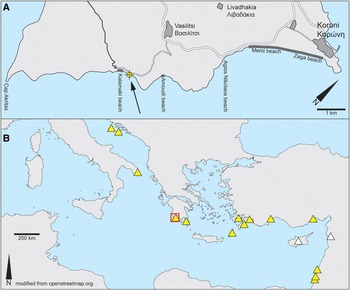
The research area was situated on the eastern coast of the Messinian Peninsula, south of the town known as Koroni (Peloponnese, Greece; Figure 1A). The research area comprised highly structured rocky shores, which transitioned to sandy bottoms at a water depth of 3–10 m, and interspersed sand and shingle beaches. Habitats included sandy bottoms, Posidonia meadows, highly structured underwater cliffs and reefs with abundant crevices and caves, and large boulders. Depending on water-wave and human activities, algal growth ranged from thin films to highly diverse meadows. The water was generally clear, with visibility up to 20–30 m. Data was obtained by in situ observations and analyses of underwater photographic material (Olympus TG-1) during repeated free diving and snorkelling surveys at depths up to 10 m in August 2013. The recent taxonomic status of the study species was verified by Eschmeyer (Reference Eschmeyer2013).
(A) Research area and occurrence of Enchelycore anatina on the coast south of Koroni (Messinia, Greece); (B) overview of published records of Enchelycore anatina in the Mediterranean Sea. Red square, research area; white triangle, occurrence without exact position, yellow triangle, localized record; assembled from Ben-Tuvia & Golani, Reference Ben-Tuvia and Golani1984; Golani et al., Reference Golani, Orsi-Relini, Massutí and Quignard2002; Saad, Reference Saad2005; Katsanevakis et al., Reference Katsanevakis, Tsiamis, Ioannou, Michailidis and Zenetos2009; Bilecenoglu, Reference Bilecenoglu, Golani and Appelbaum-Golani2010; Kalogirou, Reference Kalogirou2010; Lipej et al., Reference Lipej, Furlan, Antolović, Golani and Dulčić2011; Guidetti et al., Reference Guidetti, Causio and Licchelli2012; this study.

RESULTS
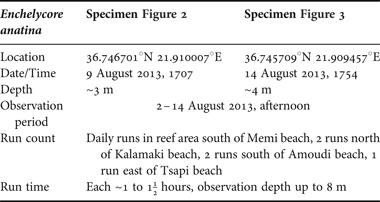
Two specimens of Enchelycore anatina (Figures 2 & 3) were recorded from the northern coast of Kalamaki beach (Figure 1A). Both specimens showed differences in colouring and tooth arrangement; the findings negate the possibility that the same (i.e. one) individual was observed on two separate occasions.
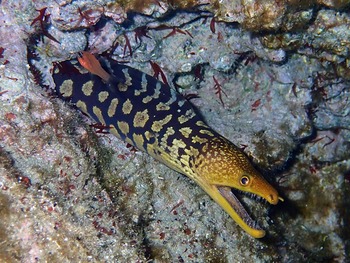
First specimen of Enchelycore anatina from the coastal boulder habitat north of Kalamaki beach (for geo-reference see Table 1).

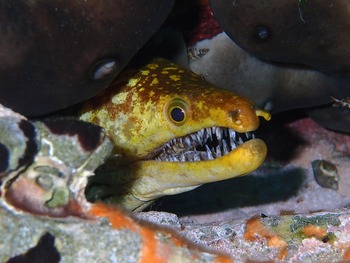
Second specimen of Enchelycore anatina from an isolated rock outcrop north of Kalamaki beach (for geo-reference see Table 1).

General survey data, localities and record data of Enchelycore anatine.

The observed morphological traits included the following: relatively slender, pointed head. Gape extending well behind the eye socket. Gaping jaws exposing large, glassy, elongated teeth (of varying sizes and in several rows) visible even when closed. Long tubular anterior nostrils. Posterior nostril with a small rounded opening close to the intersection of the dorsal and anterior margins of the eye socket. A livery of large, variable yellow blotches on a dark-brown background arranged in irregular rows (body). Light-brown head dappled with small yellow spots, a yellow lower jaw, and inconspicuous jaw pores. The morphology of the observed specimens, thus, conforms to the description by Ben-Tuvia & Golani (Reference Ben-Tuvia and Golani1984) and Böhlke (Reference Böhlke and Carpenter2002) and agrees with other sightings in the Mediterranean (Lipej et al., Reference Lipej, Furlan, Antolović, Golani and Dulčić2011; Guidetti et al., Reference Guidetti, Causio and Licchelli2012). Since both specimens were partly concealed, the length was difficult to estimate but appeared to conform to the lengths (73–91 cm) given in Ben-Tuvia & Golani (Reference Ben-Tuvia and Golani1984).
The first specimen was found hiding at a water depth of ~3 m and was associated with the cardinalfish Apogon imberbis (Figure 2). The habitat consisted of closely packed, smooth boulders and very large, conglomeratic allochthonous blocks close to the shore, which provided an abundance of hiding spaces. In general, these boulders are only overgrown by thin algal films; larger algae are a lot less common (e.g. Acetabularia acetabulum). The boulders were colonized, in high densities, by the non-indigenous grapsid crab Percnon gibbesi (Pirkenseer, Reference Pirkenseer2012). Co-occurring fish included Parablennius sanguinolentus, Sarpa salpa, Lithognathus mormyrus, Chromis chromis, juvenile Pagellus acarne, juvenile Sphyraena sphyraena, and non-indigenous Siganus luridus, among others. The second specimen (Figure 3) was spotted ~100 m offshore in a crevice at a water depth of 4 m on an isolated rock outcrop surrounded by an extensive sandy bottom.
DISCUSSION
The observation of two specimens of Enchelycore anatina on the south-eastern Messinian coast, together with an older record from Elafonisos Island (Laconian Gulf), bridges the findings of this species from the eastern Aegean–Levantine Sea and northern Ionian–Adriatic Sea (Figure 1B).
Although the westward expansion in the range of E. anatina has been observed in recent years (Lipej et al., Reference Lipej, Furlan, Antolović, Golani and Dulčić2011; Guidetti et al., Reference Guidetti, Causio and Licchelli2012), no records from the western Mediterranean Sea west of the Straits of Messina and Sicily have been published to date. The origin of the allopatric distribution of E. anatina in the Atlantic Ocean and eastern Mediterranean has been speculated by Ben-Tuvia & Golani (Reference Ben-Tuvia and Golani1984), indicating it is an artefact due to missing observations of a rare, clandestine species, or the extinction of the species in the western Mediterranean. A similar discrepancy for Atlantic fish (tropical) recorded for the first time in the Levantine Basin, which has also been discussed by Ben Rais Lasram et al. (Reference Ben Rais Lasram, Tomasini, Romdhane, Do Chi and Mouillot2008), hints at the possibility that the species had gone previously undetected or was transported via ballast waters. Although exclusive colonization of the eastern Mediterranean by means of discharged ship ballast water can be neither proven nor disproven, it seems unlikely.
Range expansions of ‘exotic’ Atlantic fish species in relation to global warming and the related rise in sea surface temperature in Mediterranean waters have been investigated by Ben Rais Lasram & Mouillot (Reference Ben Rais Lasram and Mouillot2009). Progressively lower temperature/latitude species thresholds during the 20th Century were reported. The latitudinal threshold (northernmost occurrence at ~38°N; Santos et al., Reference Santos, Porteiro and Barreiros1997) of E. anatina was crossed in the mid-1950s and 1960s, which may indicate the initial eastward expansion in the range for this species. The restricted circulation of MAW along the Algerian, Tunisian, and Libyan coasts through the Sicilian channel (Font et al., Reference Font, Millot, Salas, Julià and Chic1998; Poulain & Zambianchi, Reference Poulain and Zambianchi2007) may explain the transport of long pelagic larval stages (Golani et al., Reference Golani, Orsi-Relini, Massutí and Quignard2002) of an otherwise sedentary taxon into the Levantine Basin. However, since part of the MAW also enters the Tyrrhenian Sea, the absence (as yet) of the species in that region needs to be explained.
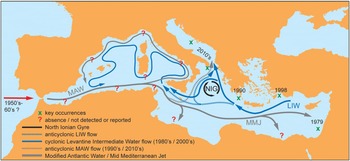
One possible explanation for the contradictory ‘lessepsian migrant’-type range expansion might be the result of undetected/not reported occurrences of E. anatina along the northern African coast in combination with a seemingly north- and westward dispersion of the species by the Levantine intermediate waters (LIW), radiating out from the point of its first recorded occurrence on the Israeli coast in 1979. According to Civitarese et al. (Reference Civitarese, Gačić, Lipizer and Eusebi Borzelli2010) the increased presence and/or arrival of ‘Levantine’ taxa in the northern Ionian and Adriatic Seas is related to the direct inflow of the LIW (cyclonic North Ionian Gyre [NIG]), whereas a direct inflow of part of the MAW (anticyclonic NIG) introduces western Mediterranean and Atlantic species. Since E. anatina was only recently recorded in this area, an expansion in distribution caused by an anticyclonic (in the 1990s and 2010) NIG current pattern seems plausible (Figure 4). However, since the reproductive biology of Muraenidae is still poorly understood (Matić-Skoko et al., Reference Matić-Skoko, Tutman, Petrić, Skaramuca, Đikić, Lisičić and Skaramuca2011; e.g. spawning periods and depth), the depth and dimension of passive larval transport by surface, intermediate, or deep currents requires further investigations. Considering the Mediterranean flow regimes and long-lasting larval stages in Muraenidae (e.g. 1 year in Muraena helena; Matić-Skoko et al., Reference Matić-Skoko, Tutman, Petrić, Skaramuca, Đikić, Lisičić and Skaramuca2011) the geographically restricted distribution of E. anatina remains puzzling.
Simplified main Mediterranean surface and intermediate circulation systems (after Poulain & Zambianchi, Reference Poulain and Zambianchi2007; Robinson et al., Reference Robinson, Leslie, Theocharis, Lascaratos, Steele, Thorpe and Turekian2009; Civitarese et al., Reference Civitarese, Gačić, Lipizer and Eusebi Borzelli2010) and key occurrences of Enchelycore anatine.

The provenance discussion raises issues regarding the status of E. anatina in the Mediterranean as an ‘alien’ species. According to Galil (Reference Galil2012), range expansion through the Gibraltar Strait by ‘natural’ means does not qualify a species for classification as an ‘alien’ species. Indeed, in their updated survey of Mediterranean alien marine species, Zenetos et al. (Reference Zenetos, Gofas, Morri, Rosso, Violanti, García Raso, Çinar, Almogi-Labin, Ates, Azzurro, Ballesteros, Bianchi, Bilecenoglu, Gambi, Giangrande, Gravili, Hyams-Kaphzan, Karachle, Katsanevakis, Lipej, Mastrototaro, Mineur, Pancucci-Papadopoulou, Ramos Esplá, Salas, San Martín, Sfriso, Streftaris and Verlaque2012) removed tropical Atlantic taxa from the list and classified them as species showing ‘range expansions’, including E. anatina. This is, however, contradictory to the classification of ‘spreading aliens’ (because of rapid changes in environmental conditions) or ‘introduced aliens’ (via human activities) as proposed by Occhipinti-Ambrogi & Galil (Reference Occhipinti-Ambrogi and Galil2004).
Thus far, the effect of E. anatina on local Mediterranean prey and/or native moray populations has not been assessed because, despite the unambiguous establishment of this species, recorded numbers remain low (Kalogirou, Reference Kalogirou2010).
ACKNOWLEDGEMENTS
The author is indebted to Mrs Mira Kauranen and Mr Martin Kalscheuer (Munich) for spotting ‘specimen 2’. Two anonymous referees are thanked for providing insightful suggestions.