Introduction
Arsenic (As) is an element that has natural toxicity and metalloid characteristics (Jaishankar et al., Reference Jaishankar, Tseten, Anbalagan, Mathew and Beeregowda2014; Awasthi et al., Reference Awasthi, Chauhan, Srivastava and Tripathi2017). It is semi-metallic and widely found in soils, rocks, sediments and metal ores in the form of oxide and sulphide or salt of calcium, sodium or copper (Singh et al., Reference Singh, Kumar and Sahu2007). Arsenic builds up in soil due to either human or geogenic factors. Geogenic processes include soil biological, chemical and mechanical processes (Galán et al., Reference Galán, Romero–Baena, Aparicio and González2019; Hussain et al., Reference Hussain, Bibi, Niazi, Shahid, Iqbal, Shakoor, Ahmad, Shah, Bhattacharya, Mao, Bundschuh, Ok and Zhang2021), while anthropogenic processes include mining (iron ore mining) (Yuan et al., Reference Yuan, Wan, Huang, Chen, He, Gustave and Xu2021) or industrial activities such as coal burning, smelting of metals and the use of fertilizers and pesticides that could contain As (Xie and Huang, Reference Xie and Huang1998; Singh et al., Reference Singh, Kumar and Sahu2007; Galán et al., Reference Galán, Romero–Baena, Aparicio and González2019). In nature, arsenic may be found in both organic and inorganic forms. Inorganic As, arsenate (As5+) and arsenite (As3+), are more hazardous and abundant in soil than their organic forms (Khan et al., Reference Khan, Cao, Zheng, Huang and Zhu2008; Zheng et al., Reference Zheng, Sun and Zhu2013; Jaishankar et al., Reference Jaishankar, Tseten, Anbalagan, Mathew and Beeregowda2014; Perera et al., Reference Perera, Dayananda, Dissanayake, Rathnasekara, Botheju, Liyanage and Kularathne2021). Organic forms persist as monomethyl arsenic acid, dimethylarsinic acid and trimethylarsine.
Elemental As is not soluble in water. However, as a labile element, it is subjected to several chemical processes including oxidation, reduction, absorption, desorption and volatilization under varying soil conditions (Woolson, Reference Woolson1977). The soil’s pH, redox potential, microbial activity, organic matter, clay type, clay content and the retention and release of aluminium, iron and manganese oxides or hydroxides along their surfaces affect the mobility of As in soil (Masscheleyn et al., Reference Masscheleyn, Delaune and Patrick1991; Zheng et al., Reference Zheng, Sun and Zhu2013; Syu et al., Reference Syu, Huang, Jiang, Lee and Lee2015; Suriyagoda et al., Reference Suriyagoda, Dittert and Lambers2018a). Therefore, it would be important to investigate the variability of bioavailable As concentration in agricultural soils impacted by the aforementioned variables.
For about half of the world’s population, rice (Oryza sativa L.) is their main diet and one of the most significant cereal crops (Baroudy et al., Reference Baroudy, Ali, Mohamed, Moghanm, Shokr, Savin and Lasaponara2020). Food security is threatened by the absorption of As by rice plants and its accumulation in grains, which affects both the quantity and quality of rice harvest (Meharg, Reference Meharg2004; Saha et al., Reference Saha, Durand-Morat, Nalley, Alam and Nayga2021). In aerobic soil, arsenate (AsO4−3) is the dominant form, and it bound firmly to mineral compounds such as Fe and Al oxides in soil (Li et al., Reference Li, Cao, Wu, Ge and Song2011; Hussain et al., Reference Hussain, Bibi, Niazi, Shahid, Iqbal, Shakoor, Ahmad, Shah, Bhattacharya, Mao, Bundschuh, Ok and Zhang2021). Arsenite (AsO3−3) is the readily available form of As and is more available in the saturated, anaerobic soil conditions (Brammer, Reference Brammer2009). Alteration of the oxidative status of As under different water management regimes in lowland paddy cultivation influences the solubility and availability of As in soil (Masscheleyn et al., Reference Masscheleyn, Delaune and Patrick1991; Wang et al., Reference Wang, Huang, Li, He, Yan, Wang, Wu, Yin and Xing2019). Apart from the reduction of As5+ to As3+ under anaerobic conditions, iron oxide minerals undergo reductive dissolution by Fe3+ reducing bacteria and release the solid phase As into an aqueous solution (Li et al., Reference Li, Cao, Wu, Ge and Song2011; Zheng et al., Reference Zheng, Sun and Zhu2013). In aerobic conditions, oxygen (O2) secreted from rice aerenchyma forms an ideal microenvironment around the roots which allows As3+ and Fe2+ to reoxidize into As5+ sorbing particulate hydrous Fe3+ oxides and oxy-hydroxides which are termed as iron plaque (Yu et al., Reference Yu, Wang, Li, Li, Liu, Wang and Lei2017; Wang et al., Reference Wang, Huang, Li, He, Yan, Wang, Wu, Yin and Xing2019). It is a strong sink for As5+ and a potential barrier to the absorption of As into the root (Zheng et al., Reference Zheng, Sun and Zhu2013; Wang et al., Reference Wang, Huang, Li, He, Yan, Wang, Wu, Yin and Xing2019). Once the paddy is harvested, As sequestrated by iron plaque may be released under anaerobic decomposition and act as an As hotspot for the subsequent crops. Further, dead roots with iron plaque may release As into the soil (Zheng et al., Reference Zheng, Sun and Zhu2013). Besides, rice is a high silicon accumulator and As3+ can enter into roots through silicic acid transporters (Awasthi et al., Reference Awasthi, Chauhan, Srivastava and Tripathi2017). As a result, the method of water management adopted in paddy cultivation greatly influences the bioavailability of As.
Sri Lanka has different climatic and soil conditions and water sources affecting the bioavailability of As. When considering climate, Sri Lanka has three Climatic Zones (CZs); Dry Zone (DZ), Wet Zone (WZ) and Intermediate Zone (IZ). This classification is being made based on the total annual rainfall. When considering both the total annual rainfall and elevation, Sri Lanka is divided into seven agro-climatic zones (ACZs); Dry zone Low country (DL), Intermediate zone Low country (IL), Intermediate zone Mid country (IM), Intermediate zone Upcountry (IU), Wet zone Low country (WL), Wet zone Mid country (WM) and Wet zone Upcountry (WU). Rice is widely cultivated in all the ACZs except WU due to topographical limitations.
In Sri Lanka, rice is being cultivated either using rainwater only (i.e. rainfed) or using both rainfall and irrigation (i.e. supplementary irrigated). Irrigation schemes are categorized based on their capacity to provide irrigation water, i.e. major irrigation schemes have a cultivable area more than 80 ha and minor irrigation schemes have a cultivable area less than 80 ha (Imbulana et al., Reference Imbulana, Wijesekera and Neupane2006; Kadupitiya et al., Reference Kadupitiya, Madushan, Gunawardhane, Sirisena, Rathnayake, Dissanayaka, Ariyaratne, Marambe and Suriyagoda2022). Soil orders that are being used for rice cultivation are also diverse. Major soil orders include Alfisols, Entisols, Histosols, Inceptisols, Ultisols and Vertisols (Indraratne, Reference Indraratne2020). Exchangeable As concentration in lowland paddy fields in Sri Lanka may have influenced by the variations in climate, soil and water availability. However, this has not been tested. Accordingly, this study aimed to (1) ascertain the current level of exchangeable As in Sri Lankan paddy fields and (2) investigate the interactions between ACZ, soil order and water supply on exchangeable As in lowland paddy fields in Sri Lanka.
Materials and methods
Soil sample collection and preparation
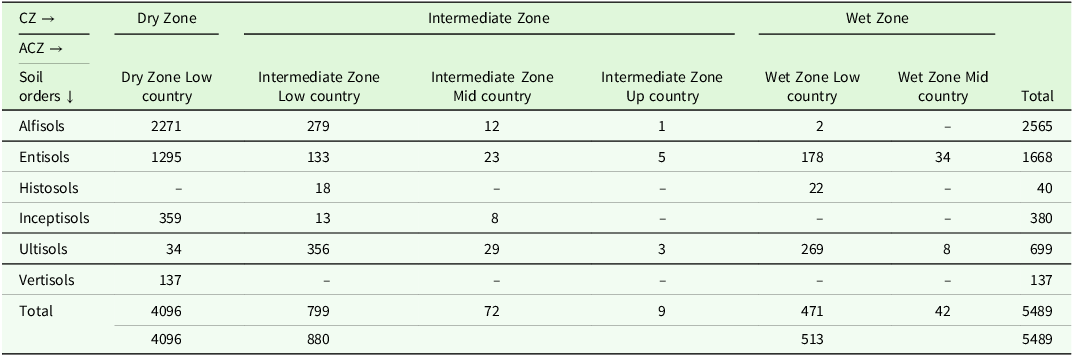
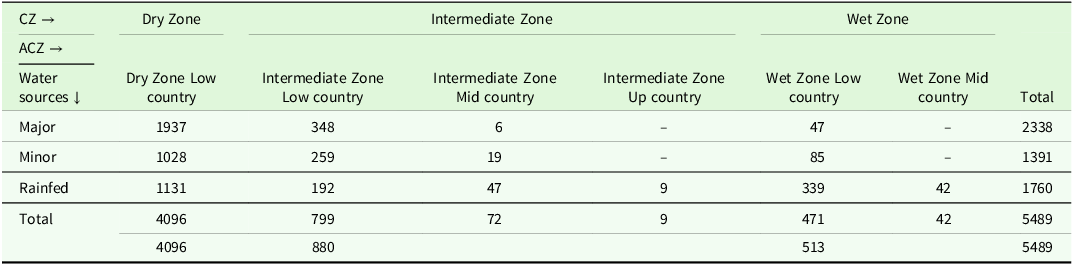
A total of 7,154 soil samples were collected, representing six ACZs and six soil orders (Table 1). The selection of sampling locations and soil sample collection followed the methodology described in earlier studies (Kadupitiya et al., Reference Kadupitiya, Madushan, Rathnayake, Thilakasiri, Dissanayaka, Ariyaratne and Suriyagoda2021, Reference Kadupitiya, Madushan, Gunawardhane, Sirisena, Rathnayake, Dissanayaka, Ariyaratne, Marambe and Suriyagoda2022). Briefly, Sri Lanka was segmented into 1 km2 grids using vector operations in QGIS (version 3.16.0-Hannover, https://qgis.org). Each grid was assigned a unique identification number by combining latitude and longitude values based on the projected coordinate system EPSG: 5234 Kandawala/Sri Lanka Grid. This process divided the whole country into 65,610 grids. Overlaying these grids with the paddy land map (1:50000, Survey Department of Sri Lanka) identified 35,537 grids in which paddy lands were occupied. From these, 7,154 grids were selected for the study using a stratified random sampling approach. Soil sample collection took place during October and November 2019. For each sample, details such as grid ID, ACZ, district, divisional secretariat division (DSD) and the village name were documented. In each village, a paddy track, i.e. a geographically confined lowland area owned and managed by a group of farmers, was randomly selected for sampling. To represent field-level variability, one composite sample was prepared by combining six subsamples collected from a depth of 0–15 cm within a selected paddy track. Soil samples were then air-dried, cleared of debris, homogenized and sieved through a 2 mm mesh. The CZ, ACZ, soil order and water source used for paddy cultivation relevant to each sampling location were extracted by overlaying relevant GIS map layers in QGIS software (Tables 1 & 2). Additionally, rice yield from the most recent cropping season (t/ha) was recorded from the farmers during sample collection.
The number of soil samples collected from each climatic zone (CZ), agro-climatic zone (ACZ) and soil order to test exchangeable arsenic (As) concentration in paddy soils

Note: soil order of some samples was not known, therefore the sample size stated in this table is less than the total number of samples collected, i.e. <7,154.
The number of soil samples collected from each climatic zone (CZ), agro-climatic zone (ACZ) and water source to test exchangeable arsenic (As) concentration in paddy soils

Note: the water source of some samples was not known, therefore the sample size stated in this table is less than the total number of samples collected, i.e. <7,154.
Laboratory analysis of soil samples
Exchangeable As was extracted using 0.01 M CaCl2 solution, following methodologies outlined by Houba et al. (Reference Houba, Temminghoff, Gaikhorst and Vark2000), van Erp et al. (Reference Van Erp, Houba, Reijneveld and Van Beusichem2001), and Zbíral and Němec (Reference Zbíral and Němec2005). The extraction was conducted with a soil-to-solution ratio of 1:10 (w/v). Detailed protocols for extracting As with CaCl2 solution, detecting As using inductively coupled plasma mass spectrometry (ICP-MS), measuring soil pH and the preparation of spatial maps are provided in Chandrasekara et al. (Reference Chandrasekara, Rajapaksha, Dissanayake, Kadupitiya, Sirisena, Chandrajith, Dittert and Suriyagoda2024). For quality control, ICP-MS was calibrated using 1 g/l single-element standard solution (AccuStandard®; New Haven, CT, USA), and internal drift was corrected using 75Re and 103Rh as internal standards. In addition, certified reference material TM 25.4, trace elements in water from Environment Canada was analysed with samples, and the recovery of the tested element yielded RSD of ±5% (1σ). Duplicate samples and blank samples were also analysed to ensure quality control and assurance. The calculated method detection limit was 0.01 ng/g. In each analytical round, 40 samples were tested, consisting of 36 samples, two laboratory standard soil samples and two blanks with 0.01 M CaCl2 solution without soil samples. In addition to exchangeable As, the concentrations of other essential mineral elements required for plant growth were determined using the same extract.
Statistical analysis
The exchangeable As concentration was log-transformed to achieve normal distribution (Fig. 1). Analysis of variance was performed to evaluate the effects of ACZs, soil orders, water sources and their interactions on exchangeable As concentration. Mean comparisons were made using Duncan’s New Multiple Range Test with a statistical significance (α) set at 0.05. All statistical analyses were performed using SAS 9.1 software.
Box plot (a), histogram (b), and log-10 transformed values (c) of exchangeable As concentration of paddy soil samples collected from Sri Lanka.

Results
The mean and median of exchangeable As concentrations were 24.6 and 14.5 µg/kg, respectively, and the mean ranged from 0.01 to 392.9 µg/kg (Fig. 1). Due to the existence of a vast majority of soil samples with low As concentrations and a low percentage of soil samples with exceptionally high As concentrations, the distribution was right-skewed. Consequently, the most accurate approximation to achieve normality was log-10 transformed As concentrations.
The pH of the soil samples ranged widely from 3.5 to 8. The highest concentration of soil exchangeable As was in the pH range of 3.5–6.0. As a result, the concentration of soil exchangeable As and pH had a negative correlation (Fig. 2a). The concentration of exchangeable As and rice yield also had a negative correlation (Fig. 2b).
Relationships between (a) exchangeable As concentration and pH of lowland paddy cultivated soils, and (b) grain yield and exchangeable As concentration.

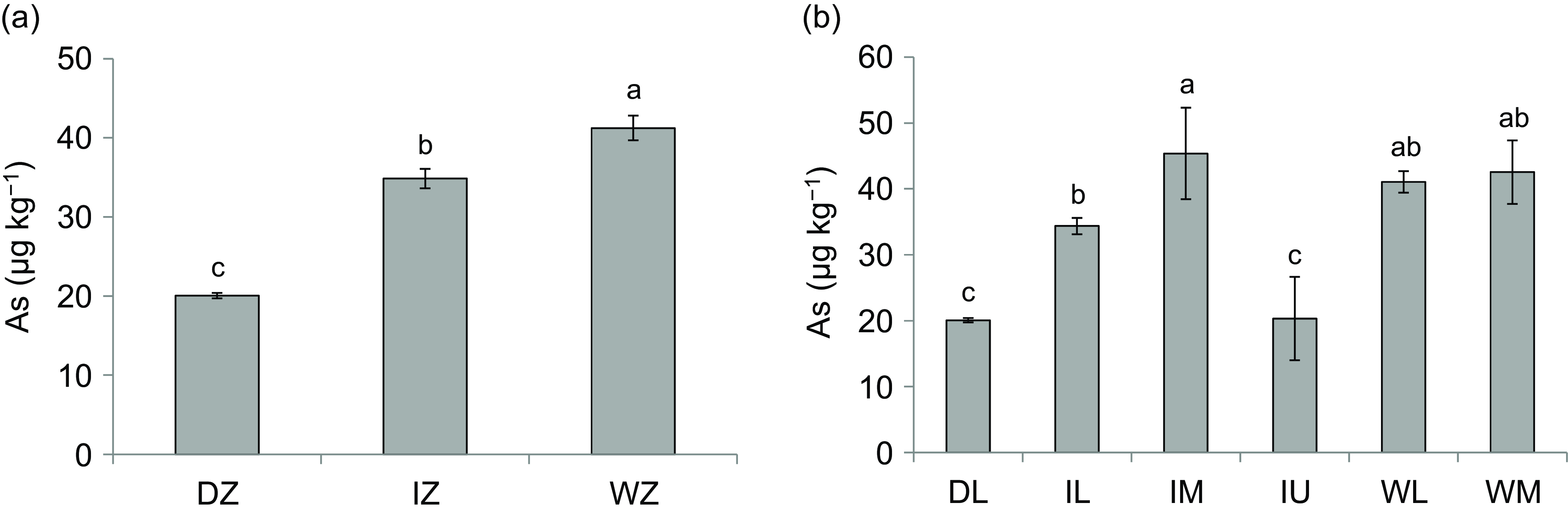
Exchangeable As concentration differed among CZs (P < 0.05). The WZ had the highest As concentration followed by IZ and DZ (Fig. 3a). Exchangeable As concentration differed among ACZs (P < 0.05) (Fig. 3b). The concentration of exchangeable As in the soils of IM, WL and WM was comparable and was higher than those observed in DL and IU (P < 0.05) (Fig. 3b). Moreover, DL and IU exhibited similar levels of exchangeable As concentrations (P > 0.05). The DL covers roughly 2/3 of the country’s land area (Fig. 4). As a result, there was a large spatial heterogeneity in the distribution of As concentration in DL, e.g., the northern region and some areas in the north-central region had higher As concentrations, whereas the eastern coastal region of DL had lower concentrations (Fig. 4).
The concentration of exchangeable As in paddy fields used to cultivate rice in different climatic zones (a) and agro-climatic zones (b) of Sri Lanka. Means followed by the same letters are not significantly different at P < 0.05. Error bars represent the standard error. DZ-Dry Zone, IZ-Intermediate Zone, WZ-Wet Zone, DL-Dry zone Low country, IL-Intermediate zone Low country, IM-Intermediate zone Mid country, IU-Intermediate zone Up country, WL-Wet zone Low country, WM-Wet zone Mid country.

Spatial distribution of exchangeable arsenic (As) concentration in the paddy fields used to cultivate rice in different agro-climatic zones of Sri Lanka. DL-Dry zone Low country, IL-Intermediate zone Low country, IM-Intermediate zone Mid country, IU-Intermediate zone Up country, WL-Wet zone Low country, WM-Wet zone Mid country.

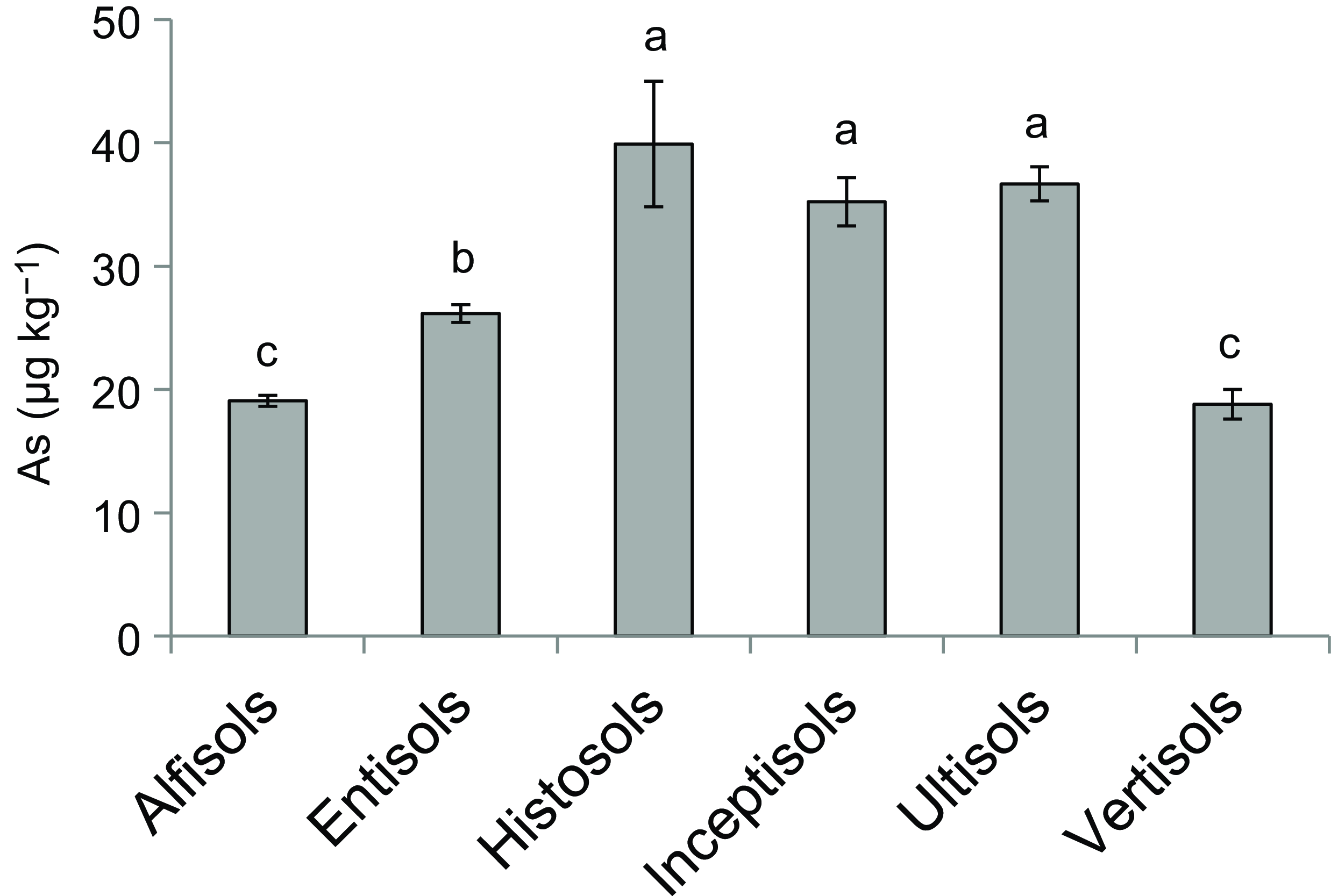
Among the different soil orders, Histosols, Inceptisols and Ultisols exhibited the highest levels of soil As concentration, while Alfisols and Vertisols had the lowest levels (P < 0.05) (Fig. 5). There was a notable interaction between ACZs and soil orders affecting soil exchangeable As concentration (P < 0.05). Dry zone Low country and IL contained five soil orders each, IM and WL had four and IU and WL had three and two soil orders, respectively (Fig. 6). Entisols and Ultisols were present across all ACZs, whereas Vertisols were confined to a specific region in the DL (Figs. 6 and 7). Furthermore, Alfisols were identified in four ACZs (Fig. 6). In DL, Inceptisols showed higher soil As concentrations compared to the other soil orders in that area (P < 0.05) (Fig. 6). Entisols were predominantly found in low-lying flat terrain near the coastal regions of DL, while Alfisols were the most common soil order in the DL (Fig. 7). In IL, WL and WM, soil As concentrations were consistent among the various soil orders (Fig. 6). The primary soil orders in IL were Ultisols and Alfisols, while in WL, Ultisols and Entisols were dominant (Fig. 7). In IM and IU, Inceptisols and Ultisols had the highest As concentrations, respectively (Fig. 6). There were no significant differences in As concentration among the soil orders in WL and WM (Fig. 6).
The concentration of exchangeable As in the paddy fields used to cultivate rice under different soil orders of Sri Lanka. Means followed by the same letters are not significantly different at P < 0.05. Error bars represent the standard error.

The concentration of exchangeable arsenic (As) in paddy fields used to cultivate rice in different soil orders and agro-climatic zones (ACZ) of Sri Lanka. Means followed by the same letter in each ACZ are not significantly different at P < 0.05. Error bars represent the standard error. DL-Dry zone Low country, IL-Intermediate zone Low country, IM-Intermediate zone Mid country, IU-Intermediate zone Up country, WL-Wet zone Low country, WM-Wet zone Mid country.

Spatial distribution of exchangeable arsenic (As) concentration in the paddy fields used to cultivate rice under different soil orders of Sri Lanka.

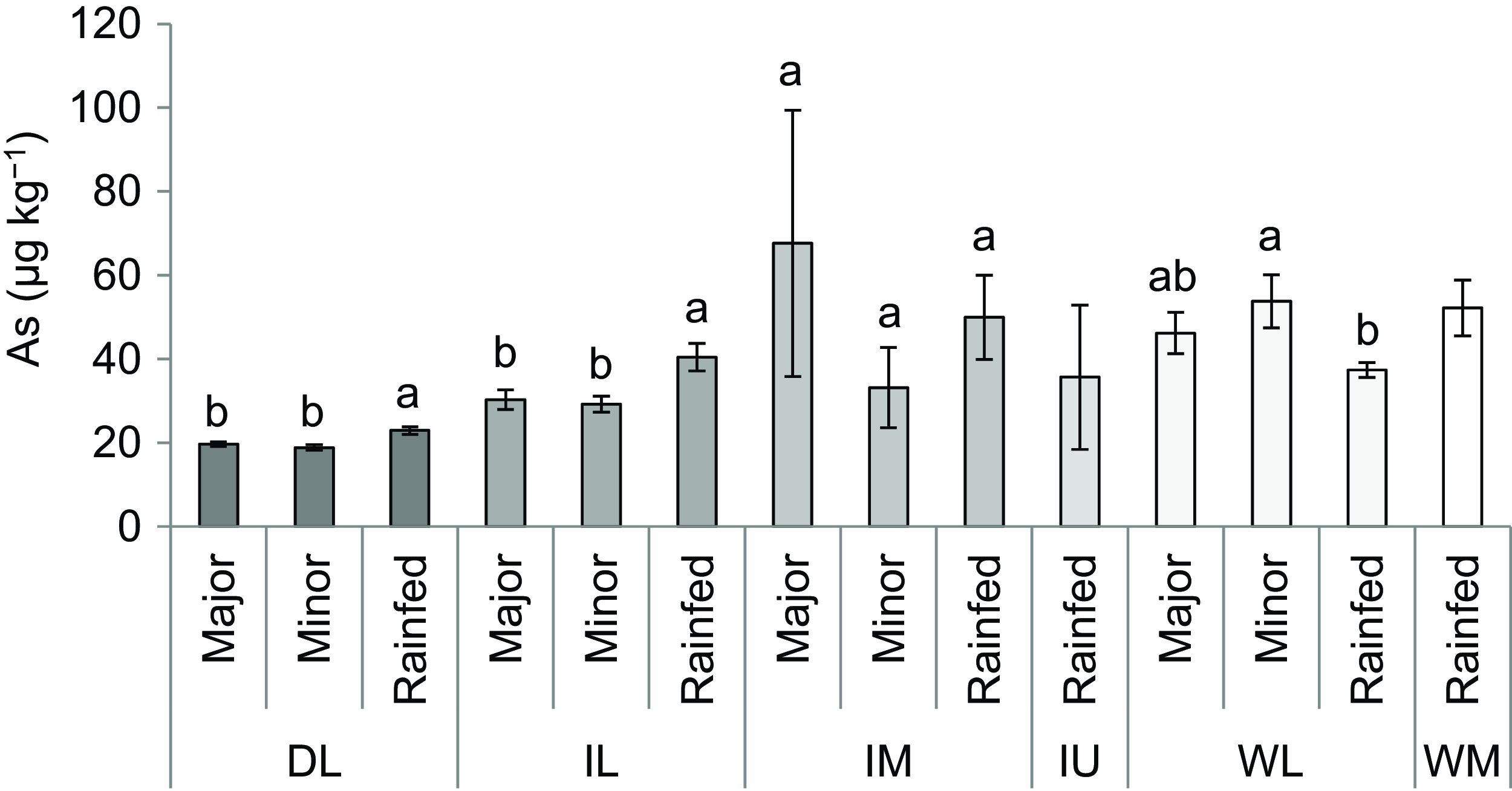
When estimating the soil exchangeable As concentration, there was a significant interaction (P < 0.05) between the ACZ and the water source (Fig. 8). Four ACZs had access to major and minor irrigation systems that supplied water for paddy farming, and all six ACZs had rainfed paddy fields (Fig. 8). Paddy fields that were only supplied with water by rainfall in both DL and IL had higher As concentration than those supplemented with irrigation water from major and minor irrigation systems (P < 0.05). Similar As concentrations were found in paddy fields located in IM that received water from all three sources (P > 0.05). In WL, rainfed rice fields had a lower As concentration than those irrigated by minor irrigation schemes (P < 0.05).
The concentration of exchangeable arsenic (As) in paddy fields used to cultivate rice using different water sources and agro-climatic zones (ACZ) of Sri Lanka. Means followed by the same letter in each ACZ are not significantly different at P < 0.05. Error bars represent the standard error. DL-Dry zone Low country, IL-Intermediate zone Low country, IM-Intermediate zone Mid country, IU-Intermediate zone Up country, WL-Wet zone Low country, WM-Wet zone Mid country.

Discussion
Current level of exchangeable As in Sri Lankan paddy soils
Various thresholds have been implemented to manage As pollution in the food chain. Accordingly, the maximum level of total As in agricultural soils is set at 20 mg/kg (Alloway, Reference Alloway and Alloway2013; Kumarathilaka et al., Reference Kumarathilaka, Seneweera, Meharg and Bundschuh2018; Hussain et al., Reference Hussain, Bibi, Niazi, Shahid, Iqbal, Shakoor, Ahmad, Shah, Bhattacharya, Mao, Bundschuh, Ok and Zhang2021) while in rice grain, it is 0.2 mg/kg (WHO, 2016). Even though numerous research studies have identified the critical limit of soil total As concentration, exchangeable As concentration is the most relevant for plant uptake and its accumulation in edible crop parts. However, to date, a critical limit of exchangeable As in soil has not been proposed in the literature which made it difficult to compare the exchangeable As concentration recorded in this study with previous findings. However, dampening As content in rice soils below the toxicity threshold is crucial to ensure the quantity and quality of rice grains produced for human consumption (Diyabalanage et al., Reference Diyabalanage, Navarathna, Abeysundara, Rajapakse and Chandrajith2016; Suriyagoda et al., Reference Suriyagoda, Dittert and Lambers2018b; Wang et al., Reference Wang, Huang, Li, He, Yan, Wang, Wu, Yin and Xing2019).
Impact of ACZ, soil order and water supply on soil exchangeable As
Effects of climate
Exchangeable As concentration decreased in the order of WZ>IZ>DZ. This would be due to several reasons, e.g., the relatively higher amount of annual rainfall received to the WZ causes reduced soil conditions and leaching of most of the basic cations under which As bioavailability gets increased (Chandrajith et al., Reference Chandrajith, Dissanayake and Tobschall2005; Balasooriya et al., Reference Balasooriya, Diyabalanage, Yatigammana, Ileperuma and Chandrajith2022). Furthermore, Fe-rich soils in WZ behave as As accumulators by binding As with the clay fraction of soils and creating Fe-plaque (Oremland and Stolz, Reference Oremland and Stolz2003; Rubasinghe et al., Reference Rubasinghe, Gunatilake and Chandrajith2021; Chandrasekara et al., Reference Chandrasekara, Rajapaksha, Dissanayake, Kadupitiya, Sirisena, Chandrajith, Dittert and Suriyagoda2024). It has also been demonstrated that when pH decreased and the amounts of free Fe and organic matter increased in the paddy-growing soils, the exchangeable fraction of As gets increased (Huang et al., Reference Huang, Gao, Wang, Staunton and Wang2006). These factors may have interactively contributed to increase exchangeable As levels in WZ soils. On the contrary, a slower rate of soil weathering due to the lower annual rainfall, higher evaporation and lesser soil moisture availability in DZ have slowed down the release of As from parent materials into the developing soils (Punyawardena, Reference Punyawarden and Mapa2020). Moreover, alkaline soil in DZ that creates negative surface charges can increase the release of As into the soil solution leading to leaching (Ahmed et al., Reference Ahmed, Panaullah, Gauch, McCouch, Tyagi, Kabir and Duxbury2011; Rubasinghe et al., Reference Rubasinghe, Gunatilake and Chandrajith2021). The DZ soils tend to have the lowest As content due to these circumstances (Fig. 3a).
The highest As concentration observed in IM cannot be explained using climatic and soil properties alone as IM is located between Dry and Wet Zones. In IM, the rice–vegetable cropping system is dominant, and farmers apply a wide range and high rates of agrochemicals, including organic and inorganic fertilizers, fungicides and insecticides (Dissanayake and Chandrajith, Reference Dissanayake and Chandrajith2009; Jayawardana et al., Reference Jayawardana, Pitawala and Ishiga2014; Sirisena and Suriyagoda, Reference Sirisena and Suriyagoda2018; Perera et al., Reference Perera, Carey, De Silva, Meharg and Meharg2022). Moreover, it has already been documented that fertilizers and agrochemicals used in this region contain significant quantities of As (Jayawardana et al., Reference Jayawardana, Pitawala and Ishiga2014; Diyabalanage et al., Reference Diyabalanage, Navarathna, Abeysundara, Rajapakse and Chandrajith2016). Thus, in contrast to other ACZs, human activity has contributed to the accumulation of As in IM soils (Fig. 3b).
Effects of soil orders
Soils in WZ and Semi-Wet IZ of Sri Lanka consist of Ultisols, Inceptisols, Histosols and Entisols, whereas soils in DZ and Semi-Dry IZ consist of Inceptisols, Alfisols, Entisols and Vertisols (Mapa et al., Reference Mapa, Somasiri and Nagarajah1999). In this study, soil samples representing Alfisols, Histosols, Inceptisols, Ultisols and Vertisols were collected. Inceptisols that are young and less weathered (Mapa, Reference Mapa1992; Indraratne, Reference Indraratne2020) retained higher As concentration than most of the soil orders in different ACZs (Fig. 6) showing the potential of creating As toxicities with long-term build-up of As.
Ultisols are characterized by low CEC, base saturation and pH (Indraratne, Reference Indraratne2006), which have facilitated the release of As from parent materials, particularly in WZ and IZ. In comparison to Ultisols, Alfisols have a higher pH and base saturation (Indraratne, Reference Indraratne2020). As pH increased, the solubility of As decreased (Fig. 2). Furthermore, the most prevalent soil mineral in the Dry zone, Gibbsite has a weak affinity with As (Navaratne et al., Reference Navaratne, Dissanayake and Perera1996; Weerasooriya et al., Reference Weerasooriya, Tobschall, Wijesekara, Arachchige and Pathirathne2003). Therefore, As can be easily leached into the deeper soil layers reducing the exchangeable As concentration in upper soil layers. Vertisols are found only in a few patches in the DZ (Mapa et al., Reference Mapa, Somasiri and Nagarajah1999) and exhibit high levels of base saturation, CEC, pH and Ca and Mg concentrations. These conditions have resulted in the lowest concentration of exchangeable As in Vertisols.
Effects of water sources
The reason for retaining higher exchangeable As concentration in the rainfed paddy fields than that observed in supplementary irrigated paddy fields in DL and IL could be due to the lesser leaching losses encountered in rainfed paddy fields. Moreover, as irrigation water moves through rice fields, dissolved Fe+2 and Mn+2 undergo oxidation due to ambient oxygen diffusion, while As3+may partially oxidize into As5+ in the soil–water system (Roberts et al., Reference Roberts, Hug, Ruettimann, Billah, Khan and Rahman2004) and precipitate as Fe(OH)3 and MnO2 (Dittmar et al., Reference Dittmar, Voegelin, Roberts, Hug, Saha, Ali, Badruzzaman and Kretzschmar2007). In irrigated paddy fields, this might lead to co-precipitation of As5+ with metal hydro-oxides and decrease exchangeable As concentration (Ma et al., Reference Ma, Shen, Wu, Tang, Shen and Zhao2014; Kumarathilaka et al., Reference Kumarathilaka, Seneweera, Meharg and Bundschuh2018).
Possible interventions and applications
Numerous agronomic interventions have been proposed in literature either to remove As from soil or reduce the exchangeable fraction of As. One of the approaches to minimize As input is to allow the development of plough-pan through mechanical manipulations by farmers, animals and large machines. Consequently, the ability of ploughed soils to retain water has increased (Kögel-Knabner et al., Reference Kögel-Knabner, Amelung, Cao, Fiedler, Frenzel, Jahn, Kalbitz, Kölbl and Schloter2010). This has reduced the requirement for irrigation water, especially in areas with As contamination (Kumarathilaka et al., Reference Kumarathilaka, Seneweera, Meharg and Bundschuh2018). Therefore, repeated ploughing can be practised to reduce As accumulation in paddy soils by minimizing the supply of contaminated irrigation water. However, clay minerals get lost due to surface runoff brought on by heavy rainfall and the consequent destruction of soil structure by ploughing (Kögel-Knabner et al., Reference Kögel-Knabner, Amelung, Cao, Fiedler, Frenzel, Jahn, Kalbitz, Kölbl and Schloter2010). This has impacted negatively on As immobilization (Sahoo and Kim, Reference Sahoo and Kim2013). Therefore, managing rainwater, without allowing it to get lost through surface runoff, and minimizing the dependency on irrigation water may bring numerous benefits to the system such as preventing the accumulation of As, reducing the dependency on irrigation water and improving the use efficiency of rainwater. Additionally, rice cultivation under aerobic, intermittent flooding or alternate wetting and drying reduces As input into paddy fields and rises in the fraction of As+5 that is less water soluble (Stroud et al., Reference Stroud, Norton, Islam, Dasgupta, White, Price, Meharg, McGrath and Zhao2011; Yamaguchi et al., Reference Yamaguchi, Nakamura, Dong, Takahashi, Amachi and Makino2011).
Numerous studies have found a negative correlation between grain As concentration and soil organic matter content (Das et al., Reference Das, Sur and Das2008; Fu et al., Reference Fu, Chen, Bi, He, Ren, Xiang, Qiao, Yan, Li and Ma2011; Kar et al., Reference Kar, Das, Jean, Chakraborty and Liu2013). When the soil is saturated with metal cations, organic acids can limit As mobility by acting as binding agents and/or by producing insoluble complexes (Wang and Mulligan, Reference Wang and Mulligan2006; Das et al., Reference Das, Sur and Das2008). Furthermore, through percolation, dissolved organic carbon (DOC), which is produced when organic matter in the soil breaks down, can move As from the top layers of the soil to deeper layers, by lowering the As concentration in the root zone (Farooq et al., Reference Farooq, Chandrasekharam, Berner, Norra and Stüben2010). Through these processes, exchangeable As concentration in the upper soil layers can be reduced. Therefore, the application of organic matter into the paddy soils according to the requirements can be a mitigation method for As toxicity in the soil as well as could potentially lead to a reduction of As accumulation in rice grains. The practicality of this approach is evident from very recent research findings by Hu et al. (Reference Hu, Zhang, Xu, Ren, Zhao, Qiu and Cao2023) showing that rice grown in Histolsols rich in soil organic matter content and slightly alkaline pH had relatively low As concentrations in rice grain.
Increased P, Si and biochar applications are known to reduce As uptake by rice plants (Li et al., Reference Li, Ago, Liu, Mitani, Feldmann, McGrath, Ma and Zhao2009; Kumarathilaka et al., Reference Kumarathilaka, Seneweera, Meharg and Bundschuh2018; Suriyagoda et al., Reference Suriyagoda, Dittert and Lambers2018b). The application of P and Si increases the competition between P and As, and Si and As on the root surface and P and Si are selectively taken up by rice roots making As less available to plants (Seyfferth et al., Reference Seyfferth, Morris, Gill, Kearns, Mann, Paukett and Leskanic2016). Biochar increases the immobilization of As in soil (Samsuri et al., Reference Samsuri, Sadegh-Zadeh and Seh-Bardan2013; Agrafioti et al., Reference Agrafioti, Kalderis and Diamadopoulos2014). In addition to the various agronomic measurements to reduce the solubility and mobility of As in soil, considerable genotypic variation for As uptake and its subsequent translocation and accumulation in grains could exist among rice varieties (Römkens et al., Reference Römkens, Guo, Chu, Liu, Chiang and Koopmans2009; Zeng et al., Reference Zeng, He, Bai, Li and Su2011). Therefore, the development of As-tolerant rice varieties which take up and transport less As into rice grains has been identified as one of the best long-term sustainable strategies to minimize As accumulation in rice grains (Arunakumara et al., Reference Arunakumara, Walpola and Yoon2013; Pan et al., Reference Pan, Wu, Xue and Hartley2014; Punshon et al., Reference Punshon, Jackson, Meharg, Warczack, Scheckel and Guerinot2017; Suriyagoda et al., Reference Suriyagoda, Dittert and Lambers2018b). These are some of the mitigating strategies that are possible to minimize the negative effects of As on rice production. Growing plant species capable of absorbing and accumulating large quantities of As (phytoremediation) is another option to remove As from paddy fields (Ye et al., Reference Ye, Khan, McGrath and Zhao2011; Upadhyay et al., Reference Upadhyay, Singh, Singh and Rai2016). Some of these approaches could be better adopted in regions such as IZ where the highest exchangeable As concentration in paddy growing soils was observed.
Conclusion
The concentration of exchangeable As in lowland paddy soils across Sri Lanka was influenced by ACZs, soil orders, water sources and their interactions. Additionally, higher soil pH corresponded to lower exchangeable As concentration. Among the ACZs IM, WL and WM exhibited higher exchangeable As concentration compared to DL and IU. Among soil orders, Inceptisols, Ultisols and Histosols had higher exchangeable As levels, whereas Alfisols and Vertisols showed lower concentrations. Furthermore, exchangeable As levels were higher in rainfed rice fields than those in irrigated fields. The spatial maps generated in this research can assist in identifying regions with varying As levels in paddy growing areas, aiding in tailored agronomic and administrative decisions and recommendations.
Author contributions
Conceptualization, UR, RC, BM and LS; methodology, HK, UR and LS; software, HK; formal analysis, AN, NT, SD and LS; resources, HK, UR, RC, LS; data curation, LS; writing – original draft preparation, AN, NT; writing – review and editing, SD, BM and LS; visualization, HK; supervision, LS, all authors reviewed the manuscript. The authors read and approved the final manuscript.
Funding statement
This research received funding from the World Bank through the Accelerating Higher Education Expansion and Development (AHEAD) initiative (Grant No AHEAD/RA3/DOR/AGRI/PERA-No16).
Competing interests
The authors declare there is no conflict of interest.
Ethical standards
Not applicable.