Introduction
Involvement of the pre-epiglottic space has been known for many years to be an important prognostic factor. The pre-epiglottic space is located anterolateral to the epiglottis. It is bounded by the hyo-epiglottic ligament superiorly, the conus elasticus inferiorly, the thyrohyoid membrane and thyroid cartilage anteriorly, and the epiglottic cartilage and thyro-epiglottic ligament posteriorly.Reference De Santo1 Supraglottic infrahyoid carcinomas can easily involve the pre-epiglottic space by direct invasion through multiple fenestrations of the epiglottic cartilage or via the quadrangular membrane.Reference Dursun, Keser, Aktürk, Akiner, Demireller and Sak2 Zeitels and VaughanReference Zeitels and Vaughan3 reported that early supraglottic carcinomas staged as tumour (T) one or T2 frequently invaded the pre-epiglottic space. Due to poor blood supply, supraglottic carcinomas with pre-epiglottic space invasion are relatively resistant to radiotherapy.
Supracricoid partial laryngectomy is one of the most popular methods for the treatment of laryngeal cancer cases requiring total laryngectomy by resection of the tumour together with the pre-epiglottic space. Nearly 50 years have passed since the first report of the procedure, by Majer and Rieder,Reference Majer and Rieder4 in Vienna in 1959. Subsequent studies have confirmed that the procedure is highly successful in selected supraglottic and glottic cancers. Supracricoid partial laryngectomy involves resection of the entire thyroid cartilage and paraglottic space, as well as the epiglottis and pre-epiglottic space.Reference Labayle and Bismuth5–Reference Bron, Brossard, Monnier and Pasche7 The objectives of the procedure are organ preservation in extended laryngeal cancer cases, together with improvement in local control, compared with standard conservative treatment.Reference Laccourreye, Brasnu, Merite-Drancy, Brasnu, Chabardes and Cauchois6, Reference Bron, Brossard, Monnier and Pasche7 The indications and contraindications for supracricoid partial laryngectomy, as regards oncological laryngeal surgery, have been outlined in recent reports.Reference Laccourreye, Brasnu, Merite-Drancy, Brasnu, Chabardes and Cauchois6–Reference Chevalier and Piquet9 In 1993, Laccourreye et al. Reference Laccourreye, Brasnu, Merite-Drancy, Brasnu, Chabardes and Cauchois6 had stated that gross invasion of the pre-epiglottic space was not a contraindication for supracricoid partial laryngectomy. However, many subsequent studies reported that massive pre-epiglottic space invasion should be accepted as a contraindication.Reference Bron, Brossard, Monnier and Pasche7–Reference Chevalier and Piquet9
No previous publications have addressed the prognostic value of the degree of pre-epiglottic space invasion (i.e. none, minimal or gross) as regards the outcome of supracricoid partial laryngectomy. The aim of our study was to clarify this debate and to evaluate the oncological suitability of supracricoid partial laryngectomy, by analysing several clinical and histological variables, in a series of 52 patients treated with supracricoid partial laryngectomy with cricohyoidopexy for supraglottic and glotto-supraglottic laryngeal carcinoma.
Materials and methods
We retrospectively reviewed clinical records for 1992 to 2001 and analysed data from 52 consecutive patients with supraglottic or glotto-supraglottic carcinoma treated with supracricoid partial laryngectomy. There were 50 men and two women. The median age was 50 years (range 36–67 years). Pre-operative endoscopic evaluation had been carried out in all patients in order to assess possible involvement of the anterior commissure, the pre-epiglottic space, the ventricles and the infraglottic region. All patients had undergone chest radiography and computed tomography of the head and neck in order to detect any invasion of the pre-epiglottic space. Hyoid bone infiltration had not been detected in any patient. None of the patients had demonstrated evidence of distant metastasis at the time of admission.
Treatment of the neck had been carried out in all patients: selective neck dissection in 44 patients (20 bilateral), modified neck dissection in 10 and ipsilateral radical neck dissection in six. Supracricoid partial laryngectomy with cricohyoidopexy had always been performed as described by Labayle and Bismuth.Reference Labayle and Bismuth5 En bloc resection of overlying strap muscles had been combined with supracricoid partial laryngectomy when there was gross invasion of the pre-epiglottic space. Our approach to the arytenoid cartilage had varied according to pre-operative laryngeal motility and intra-operative assessment of the exact tumour extent. In 33 patients, one arytenoid cartilage had been totally resected. In the remaining 19 patients, both the arytenoids had been spared. Resection margins had been positive in one patient, doubtful in two patients and free of tumour in 49 patients. Completion total laryngectomy had been refused by one patient with positive margins.
Fourteen patients had undergone post-operative radiotherapy. This treatment had been indicated by nodal status and external capsular spread in 13 cases, and by positive surgical margins in one. All patients had been followed up for a minimum of five years or until death.
Statistical analysis
Overall and cause-specific survival curves were developed using the Kaplan–Meier method, and the difference in patients' survival was compared using the log-rank test. Various prognostic factors were investigated for their unadjusted association with survival, by univariate analysis using the chi-square test. Multivariate analysis was performed using Cox stepwise regression analysis in order to determine the independent contribution of each prognostic factor. The following prognostic factors were analysed: T stage, N stage, adjuvant radiotherapy, infiltration of the anterior commissure (i.e. presence or absence), involvement of the pre-epiglottic space (i.e. absent, minimal or gross), and involvement of the thyroid cartilage (i.e. presence or absence). Statistical significance was set at p < 0.05.
Results
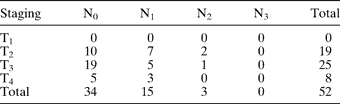
Post-operative histopathological examination had shown that 28 (53.8 per cent) of the tumours were confined to the supraglottis and 24 (46.2 per cent) had involved both the glottis and supraglottis. The distribution of patients, according to the 1998 American Joint Committee on Cancer Staging, is shown in Table I.
Patients' T and N CategoriesFootnote *

* By the 1998 staging system of the American Joint Committee on Cancer Staging. Data shown represent patient numbers. T = tumour; N = node
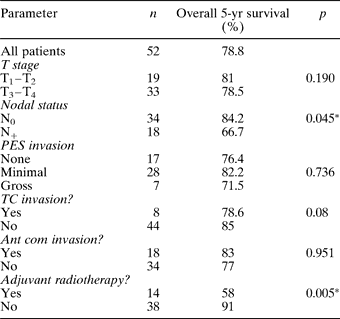
Histopathological review of the specimens had shown neoplastic invasion of the anterior commissure in 18 (34.6 per cent) patients, thyroid cartilage involvement in eight (15.4 per cent) and pre-epiglottic space involvement in 35 (67.3 per cent). No neoplastic spread into the extralaryngeal tissues had been seen. The results of histopathological examination are shown in Table II.
Univariate Analysis of 52 Patients

* Statistical significance. Yr = year; T = tumour; N = node; PES = pre-epiglottic space; TC = thyroid cartilage; ant com = anterior commissure
The five-year overall and cause-specific survival rates were 78.8 and 82 per cent, respectively. Causes of death had been nodal recurrences (two cases), second primary tumours (four cases), distant metastasis (three cases) and intercurrent disease (two cases).
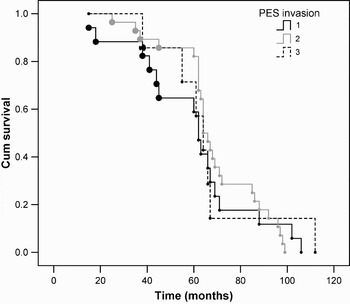
Pre-epiglottic space invasion had been absent in 17 (32.7 per cent) patients, minimal in 28 (53.8 per cent) and gross in seven (13.5 per cent). It was observed that gross or minimal pre-epiglottic space invasion did not have a statistically significant effect on five-year overall survival (p = 0.735) (Table II). Survival curves, stratified according to degree of pre-epiglottic space invasion, are shown in Figure 1.
Overall survival rates calculated according to degree of pre-epiglottic space (PES) invasion (1 = absence; 2 = minimal; 3 = gross). Large dots = death; small dots = censored (still alive patient)

Nodal metastasis had been found to be in 18 patients, including 14 (40 per cent) with pre-epiglottic space invasion and four (23.5 per cent) without such invasion. Univariate analysis showed that an N+ status was associated with a poor prognosis (p = 0.045). Univariate analysis also showed that post-operative radiotherapy had a statistically significant effect on cause-specific survival (p < 0.005). Six (42 per cent) of the 14 patients who had undergone post-operative adjuvant radiotherapy had been lost during follow up. None of the other parameters analysed showed a statistically significant relationship with survival (Table II).
Four (7.6 per cent) patients had developed local recurrence at the primary site. Laryngeal recurrences had required total laryngectomy in all patients. Salvage treatment had controlled local recurrence in all patients affected (i.e. 100 per cent). Two patients who had developed nodal recurrence had been treated with radical neck dissection and radiotherapy, although they had been lost during follow up. Distant metastasis and second primary tumour had been detected in three (5.8 per cent) and four (7.6 per cent) patients, respectively. All patients with distant metastasis and second primary tumour had been lost during their five years' follow up.
Discussion
The main objective of conservative laryngeal surgery for supraglottic tumours is to achieve the same local control as that gained by total laryngectomy, while preserving the functions of the larynx. Supraglottic carcinomas have a propensity to invade the pre-epiglottic space, paraglottic space, petiole of the epiglottis, anterior commissure and thyroid cartilage.Reference Robbins and Michaels10 In such cases, safe resection margins are difficult to achieve with supraglottic laryngectomy, but can be obtained with supracricoid partial laryngectomy.
Since the report by Majer and RiederReference Majer and Rieder4 describing supracricoid partial laryngectomy with cricohyoidopexy for selected glottic and supraglottic carcinomas, numerous published reports have documented good oncological and functional results achieved with these partial laryngeal resection techniques.Reference Dursun, Keser, Aktürk, Akiner, Demireller and Sak2, Reference Laccourreye, Brasnu, Merite-Drancy, Brasnu, Chabardes and Cauchois6–Reference Chevalier and Piquet9
The base of the tongue is located superiorly to the pre-epiglottic space. The pre-epiglottic space is fully excised in supracricoid partial laryngectomy, but the hyoid bone is preserved. Hyoid bone invasion is very rare in cases of supraglottic carcinoma, and it has been reported that there was no vallecula involvement in cases with any hyoid bone invasion.Reference Kirchner and Carter11 Oncologically, supracricoid partial laryngectomy can safely be used in patients who show no hyoid bone invasion. In our study, hyoid bone invasion was not demonstrated in any patient. However, the pre-epiglottic space must be resected, including a careful dissection of the periosteum of the hyoid bone, when supracricoid partial laryngectomy is performed. Tumour becomes adjacent to the thyrohyoid membrane in cases of gross invasion of the pre-epiglottic space. The thyrohyoid membrane is a strong barrier to tumour invasion. From a surgical point of view, the superior and antero-lateral resection margins of a supracricoid partial laryngectomy are the same as those for total laryngectomy (TL), and both types of surgery have the same chance of achieving safe margins in these areas.
In 1993, Laccourreye et al. Reference Laccourreye, Brasnu, Merite-Drancy, Brasnu, Chabardes and Cauchois6 reported their experience with supracricoid partial laryngectomy with cricohyoidopexy in a series of 19 patients affected by gross supraglottic carcinoma invading the pre-epiglottic space. They reported their five-year overall survival and local control rates as 84.2 and 94.4 per cent, respectively. These authors reported that supracricoid partial laryngectomy with cricohyoidopexy was oncologically as safe as total laryngectomy in patients with gross pre-epiglottic space invasion not amenable to supraglottic laryngectomy. However, recent, consecutive studies have proposed that massive pre-epiglottic space invasion, with bulging vallecula or thyrohyoid membranes, should be accepted as a contraindication for supracricoid partial laryngectomy.Reference Laccourreye, Brasnu, Merite-Drancy, Brasnu, Chabardes and Cauchois6–Reference Targa, Grandi, Chiarello, Farina, Carinci and Merlo8, Reference De Vincentis, Minni and Gallo12, Reference Schwaab, Kolb, Julieron, Janot, Le Rinant and Mamelle13 Seven (13.5 per cent) patients with gross pre-epiglottic space invasion and 28 (53.8 per cent) with minimal invasion had been treated with supracricoid partial laryngectomy with cricohyoidopexy in our clinic. Five-year overall survival was 71.5 per cent for patients with gross pre-epiglottic space invasion, 82.2 per cent for those with minimal pre-epiglottic space invasion and 76.4 per cent for those without pre-epiglottic space invasion (p > 0.05). In contrast to the methodology of Laccourreye et al.,Reference Laccourreye, Brasnu, Merite-Drancy, Brasnu, Chabardes and Cauchois6 we did not administer neoadjuvant chemotherapy to patients, and all patients with supraglottic carcinomas were included in our study. It can be inferred from our findings that the degree of pre-epiglottic space invasion (i.e. gross, minimal or absent) made no difference to patients' survival rates.
• Involvement of the pre-epiglottic space is an important prognostic factor for laryngeal carcinoma
• This study included 52 patients with squamous cell carcinoma of the supraglottic and glotto-supraglottic larynx, treated with supracricoid partial laryngectomy–cricohyoidopexy between 1992 and 2001
• Gross or minimal pre-epiglottic space invasion did not appear to have a statistically significant effect on survival
• Supracricoid partial laryngectomy with cricohyoidopexy can safely be performed in supraglottic and glotto-supraglottic carcinomas with minimal or gross invasion of the pre-epiglottic space which do not have any extralaryngeal spread
• Nodal status is an important predictor affecting survival
There is no inner perichondrium in the anterior commissure region. The mucosal surface is very close to the thyroid cartilage in this area. Furthermore, the presence of Broyle's ligament enables rapid neoplastic spread into the pre-epiglottic space. Ossification of the thyroid cartilage in the glottic region may cause confusion when evaluating muscle and cartilage infiltration.Reference De Vincentis, Minni and Gallo12 That is why a T1 lesion may be T4 (due to cartilage invasion in the anterior commissure) owing to cartilage invasion. In our study, the presence of neoplastic infiltration of the anterior commissure, despite its seriousness, did not appear to significantly influence patients' survival.
Many authors have reported that supracricoid partial laryngectomy is suitable for patients with thyroid cartilage invasion.Reference Laccourreye, Brasnu, Merite-Drancy, Brasnu, Chabardes and Cauchois6–Reference Targa, Grandi, Chiarello, Farina, Carinci and Merlo8, Reference Schwaab, Kolb, Julieron, Janot, Le Rinant and Mamelle13 There is still agreement that external perichondrial invasion and extralaryngeal invasion together constitute a contraindication for supracricoid partial laryngectomy.Reference Bron, Brossard, Monnier and Pasche7, Reference Targa, Grandi, Chiarello, Farina, Carinci and Merlo8 In our study, eight patients had evidence of thyroid cartilage invasion, and the presence of thyroid cartilage infiltration did not appear to have any significant influence on survival.
The local recurrence rate was 7.6 per cent in our study, similar to previous studies.Reference Laccourreye, Brasnu, Merite-Drancy, Brasnu, Chabardes and Cauchois6, Reference Chevalier and Piquet9, Reference Schwaab, Kolb, Julieron, Janot, Le Rinant and Mamelle13 Nevertheless, in the present study, regular follow up allowed early diagnosis of four cases of local recurrence. Four patients underwent salvage total laryngectomy, and their five-year overall survival rate was 100 per cent. The data suggest that, in cases of supraglottic carcinoma invading the anterior commissure and thyroid cartilage and even grossly invading the pre-epiglottic space, supracricoid partial laryngectomy with cricohyoidopexy is as effective as radical surgery in controlling disease.
Cervical lymph node metastasis is well known as a negative prognostic factor for survival for head and neck cancer patients. De Vincentis et al. Reference De Vincentis, Minni and Gallo12 stated that N2 cervical lymph node metastasis should be accepted as a contraindication for supracricoid partial laryngectomy. In the present study, univariate analysis showed that N+ status was associated with a poor prognosis. Also in the present study, statistical analysis showed a significant difference in mortality rates, comparing the 14 patients who received adjuvant radiotherapy with the 38 who did not. Of the patients who died, six had undergone adjuvant radiotherapy for cervical nodal involvement. The neck is usually the site of failure in supraglottic cancer.Reference De Santo1, Reference De Vincentis, Minni and Gallo12, Reference De Santo, Magrina and O'Fallon14 Our patients subjected to adjuvant radiotherapy had advanced N stage disease and their life expectancies were low.
The five-year survival rate of 78.8 per cent obtained in our study of 52 patients was comparable both with the survival rate of 79 per cent at five years reported by Chevalier and PiquetReference Chevalier and Piquet9 for 61 patients, and with the survival rate of 88 per cent at five years reported by Schwaab et al. Reference Schwaab, Kolb, Julieron, Janot, Le Rinant and Mamelle13 for 146 patients treated with supracricoid partial laryngectomy with cricohyoidopexy for supraglottic cancer. We demonstrated that invasion of the thyroid cartilage and anterior commissure, and gross or minimal pre-epiglottic space invasion, did not significantly increase the risk of local recurrence. Moreover, we were able to salvage all of the local recurrences by a salvage total laryngectomy, with an ultimate overall local recurrence rate of 7.6 per cent.
Conclusion
The results of the present study suggest that supracricoid partial laryngectomy with cricohyoidopexy is oncologically effective in controlling supraglottic and glotto-supraglottic carcinomas that present with gross or minimal pre-epiglottic space invasion. Supracricoid partial laryngectomy with cricohyoidopexy is oncologically safe to perform in patients with supraglottic or glotto-supraglottic carcinoma, even if they have thyroid cartilage or anterior commissure invasion. Survival is poor for patients with neck nodal involvement.