INTRODUCTION
Parrots (Psittacidae) constitute a high proportion of the biomass of canopy granivores in tropical forests (Terborgh et al. Reference TERBORGH, ROBINSON, PARKER, MUNN and PIERPONT1990), and consume a large number of seeds of canopy trees (Francisco et al. Reference FRANCISCO, LUNARDI, GUIMARÃES and GALETTI2008, Galetti Reference GALETTI1993, Renton Reference RENTON2001, Reference RENTON2006). This, combined with the tendency to form large feeding flocks, high mobility, and the ability to track fluctuations in food resource availability (Renton Reference RENTON2001), means that parrots may be effective pre-dispersal predators on canopy seed resources.
However, few data exist on the intensity of pre-dispersal seed predation by parrots, and only a few studies in humid forests provide estimates of 6.4–10% pre-dispersal seed predation for various parrot species (Galetti & Rodrigues Reference GALETTI and RODRIGUES1992, Howe Reference HOWE1980, Trivedi et al. Reference TRIVEDI, CORNEJO and WATKINSON2004). By comparison, in fragmented habitats, where food resources may be limited, parrots damage 20–67% of fruit crops (Coates-Estrada et al. Reference COATES-ESTRADA, ESTRADA and MERRITT1993, Francisco et al. Reference FRANCISCO, LUNARDI, GUIMARÃES and GALETTI2008, Galetti & Rodrigues Reference GALETTI and RODRIGUES1992). Furthermore, no studies have compared seed predation by parrots to other sources of pre- and post-dispersal seed predation, particularly insects, which are important, specialist pre-dispersal seed predators (Janzen Reference JANZEN1980).
Studies in tropical moist forests that have evaluated the relative roles of insects and vertebrates in pre- and post-dispersal seed predation found insects to be the main pre-dispersal seed predators (Curran & Leighton Reference CURRAN and LEIGHTON2000, Forget et al. Reference FORGET, KITAJIMA and FOSTER1999, Nakagawa et al. Reference NAKAGAWA, TAKEUCHI, TANAKA and NAKASHIZUKA2005), while predation by arboreal vertebrates was sporadic (Curran & Leighton Reference CURRAN and LEIGHTON2000, Nakagawa et al. Reference NAKAGAWA, TAKEUCHI, TANAKA and NAKASHIZUKA2005). However, vertebrates appear to play a greater role in post-dispersal seed predation, with rodents removing more seeds than insects (Anderson & MacMahon Reference ANDERSON and MACMAHON2001, Curran & Leighton Reference CURRAN and LEIGHTON2000, Westerman et al. Reference WESTERMAN, HOFMAN, VET and VAN DER WERF2003).
In contrast with humid forest, tropical dry forest presents a marked seasonality in rainfall and plant phenology, where many tree species fruit during the dry season (Bullock & Solis-Magallanes Reference BULLOCK and SOLIS-MAGALLANES1990, Janzen Reference JANZEN1967). Furthermore, the biomass of canopy arthropods in dry forest decreases by an average of 92% in the dry season compared with the rainy season (Lister & García-Aguayo Reference LISTER and GARCÍA-AGUAYO1992), including Coleoptera, which are among the main pre-dispersal seed predators (Janzen Reference JANZEN1980). Therefore, seed predation patterns in tropical dry forest during the dry season may differ from those of humid forests.
Furthermore, dry-forest tree species tend to be clumped in distribution (Hubbell Reference HUBBELL1979), and present high synchrony in fruit production (Janzen Reference JANZEN1967), affecting seed-resource abundance and dispersion. It has been found that either fruit-crop size or the local abundance of fruiting trees may influence foraging by parrot seed predators (Cameron & Cunningham Reference CAMERON and CUNNINGHAM2006, Coates-Estrada et al. Reference COATES-ESTRADA, ESTRADA and MERRITT1993, Francisco et al. Reference FRANCISCO, LUNARDI, GUIMARÃES and GALETTI2008, Howe Reference HOWE1980). However, crop size of an individual tree may be less effective in attracting canopy vertebrates where there is high fruit production (Ortiz-Pulido & Rico-Gray Reference ORTIZ-PULIDO and RICO-GRAY2000).
The dry-forest tree Astronium graveolens fruits at the end of the dry season (Pennington & Sarukhán Reference ORTIZ-PULIDO and RICO-GRAY2005, Renton Reference RENTON2001), when insect abundance is low (Lister & García-Aguayo Reference LISTER and GARCÍA-AGUAYO1992), and its seeds are predominant in the diet of the lilac-crowned parrot (Renton Reference RENTON2001). Therefore, we hypothesize that canopy vertebrates, in particular the lilac-crowned parrot, rather than insects, will be the principal seed predators for A. graveolens, and tested this by comparing seed predation by vertebrates and insects at both the pre- and post dispersal stages. Furthermore, fruiting of A. graveolens occurs when few other food resources are available for the lilac-crowned parrot (Renton Reference RENTON2001), therefore we expect seed predation by the lilac-crowned parrot to be consistent between years. Finally, given the highly synchronized fruiting of dry-forest trees which may limit effectiveness of crop size, and clumped distribution of tree species creating resource patches, it may be expected that in tropical dry forest the local aggregation of fruiting trees has a greater influence on foraging by canopy vertebrates. We therefore predict that the intensity of pre-dispersal seed predation by parrots will be related to the aggregation of fruiting trees, rather than fruit-crop size, being highest where fruiting trees are more clumped in distribution.
STUDY SITE
We conducted the study during April to July of 2007 and 2008 in the tropical dry forest of the 13 142-ha Chamela-Cuixmala Biosphere Reserve (19°22′N–19°35′N, 104°56′W–105°03′W), on the Pacific coast of Jalisco, Mexico. Mean annual precipitation at the study site is 748 mm, with 85% of rainfall occurring from June to October, and a prolonged drought from mid-February to late May (Bullock Reference BULLOCK1986). The reserve has a hilly topography varying in elevation from 20 m to 520 m asl. The dominant vegetation type on the slopes is seasonally deciduous forest, with the great majority of trees dropping their leaves for 5–8 mo of the year (Rzedowski Reference RZEDOWSKI1994). Small areas of semi-deciduous vegetation, in which tree species are evergreen or drop leaves for only 1–3 mo (Rzedowski Reference RZEDOWSKI1994), occur along watercourses, known locally as ‘arroyos’, and in larger valleys (Lott Reference LOTT1993).
Astronium graveolens is a common tree species of semi-deciduous forest at the study site (Lott et al. Reference LOTT, BULLOCK and SOLIS-MAGALLANES1987), and has a wide range from Mexico to South America (Pennington & Sarukhán Reference PENNINGTON and SARUKHAN2005). Fruiting occurs during March to June at the end of the dry season when food resources are limited (Renton Reference RENTON2001, Reference RENTON2002), and coincides with the period when the lilac-crowned parrot is raising young (Renton Reference RENTON2002, Renton & Salinas-Melgoza Reference RENTON and SALINAS-MELGOZA1999). Fruits are 1–1.5 cm long, containing a single seed of 9–10 mm long, and are wind-dispersed.
METHODS
Pre-dispersal seed predation
At the initiation of fruiting of A. graveolens, we set up four fruit-traps beneath the canopy of each of 19 trees in 2007, and 10 trees in 2008, seven of which were sampled in both years. Each fruit-trap was constructed of 1-mm nylon mesh with an area of 0.5 m2, and was supported 1 m from the ground by aluminium posts (Nakagawa et al. Reference NAKAGAWA, TAKEUCHI, TANAKA and NAKASHIZUKA2005). We checked fruit-traps weekly throughout the fruiting period, and collected all fruits or remains of fruits that had fallen into the fruit-traps, placing them in separate paper bags for each fruit-trap by tree and collection date.
Each sample was then analysed in the laboratory to determine the number of ripe and immature whole fruits, and the number of fruits attacked by vertebrates (such as parrots), insects, or fungi. We discounted any fruits of <0.5 mm length as these had not yet formed a seed kernel that would be used by vertebrate or invertebrate seed predators. Ripe fruits of A. graveolens have a light-brown colour, in which the remains of the petals are open in a star-shape, with a yellow-coloured seed kernel. By contrast, immature fruits are green, with closed petals, and a green-coloured seed kernel. Immature whole seeds collected in the fruit-traps represent a waste of seed resources for the tree as they are unlikely to germinate.
Fruits attacked by parrots were easily identified by the characteristic half-moon beak bite-mark used to open the fruit and extract the seed kernel. The fruit remains are then dropped whole by the foraging parrot to fall in the fruit-traps below. Each A. graveolens fruit contains only one seed, therefore we could quantify the number of seeds predated by parrots by the number of complete fruit remains collected in the fruit-traps.
All whole fruits were analysed under a stereoscopic microscope, and cut open to determine whether they contained healthy seeds, were empty, or had been attacked by invertebrates or fungi. We identified insect predation by small holes made on the outside of the fruit, or by the presence of insect faeces. Based on this analysis we determined the number and proportion of whole, ripe fruits with potential to germinate, as well as the number of complete, immature fruits wasted and dropped beneath the maternal tree, and the proportion of fruits attacked by vertebrates, insects, or fungi, or that had not produced a seed.
Fruit-crop size and aggregation of fruiting trees
We estimated initial fruit abundance for 18 focal trees in 2007 by visual counts of the number of fruits in the canopy, following the method described by Chapman et al. (Reference CHAPMAN, CHAPMAN, WANGHAM, HUNT, GEBO and GARDNER1992). Visual counts were made of the number of fruits on each of five racemes in different areas of the canopy, using a 60× magnification telescope. We corroborated these estimates by counting the number of fruits on whole racemes collected from the tree. We then calculated the mean number of fruits per raceme, and estimated the number of racemes per branch of the tree, multiplied by the number of fruiting branches in the tree.
To determine the local aggregation of fruiting conspecifics around the focal tree, we calculated a neighbourhood fruiting index for 17 focal trees in 2007, and 10 focal trees in 2008. We established a circular plot of 50-m radius around the focal tree, based on the largest area in which it was logistically feasible to evaluate resource availability (Saracco et al. Reference SARACCO, COLLAZO and GROOM2005), and the fact that semi-deciduous forest tends to occur in narrow bands along stream-beds at the study site (Lott Reference LOTT1993). Within each circular plot, we measured the distance from the focal tree to every other fruiting tree of A. graveolens, as well as the diameter at breast height (dbh) of each fruiting tree. We then calculated the neighbourhood fruiting index for each circular plot as: (1/mean distance to fruiting trees) × number of fruiting trees × mean dbh of fruiting trees. Hence, a focal tree with few or distant neighbours will have a low neighbourhood fruiting index, while a focal tree close to a number of other fruiting trees will have a high neighbourhood fruiting index.
Post-dispersal seed predation
We established an exclusion experiment in six quadrats to evaluate the probability of post-dispersal survival of seeds of A. graveolens, and determine the intensity of post-dispersal seed predation by insects or vertebrates. Three quadrats were located in semi-deciduous forest within the Chamela area of the reserve, while the other three quadrats were located along the Arroyo Limbo in the Cuixmala area of the reserve, which presents deciduous forest vegetation with elements of semi-deciduous vegetation.
Each quadrat contained 18 lots consisting of an area of 30 cm2 of bare soil cleared of leaf-litter, with 10 A. graveolens fruits placed in each lot. The 18 lots represented six replicates of three treatment conditions: open, exclusion and closed. In the open treatment, intact fruits were placed on the bare soil patch without any physical protection to permit access by either insects or vertebrates. In the exclusion treatment, fruits were protected by a cylindrical, 1.5-cm-diameter wire-mesh of 40 cm high by 15 cm wide, to permit access by insects but restrict vertebrate access. In the closed condition, lots were covered by a plastic case of 10 cm wide × 4 cm high to prevent animal access to the fruits. The base of the plastic case was buried into the soil to prevent potential predators entering from below the base.
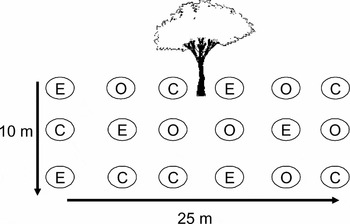
Each experimental quadrat was positioned around an existing A. graveolens tree that was not fruiting during the experimental period, and was separated by a mean 1.17 ± 0.08 km (range = 1.06–1.24 km) from another quadrat. Each quadrat comprised an area of 25 × 10 m, with the 18 lots organized in six lines and three columns. Each lot was separated by 5 m, and the three treatment conditions were randomly allocated to lots, giving six replicates of each treatment condition (Figure 1).
Plan of experimental quadrats for post-dispersal seed predation, with six replicates of three treatment conditions: O, Open; E, Exclusion; C, Closed.

Experimental quadrats were checked daily during the first 2 wk, and thereafter were checked every 2 d. At each inspection, we recorded the number of fruits present or removed from each of the lots. The experiment was run for 45 d until the onset of the rainy season, when many fruits were either washed away in the rainfall or began to germinate.
Statistical analyses
We conducted preliminary analysis using the Kolmogorov–Smirnov test with Lilliefors significance level, to evaluate normality of distribution for the number and proportion of seeds predated by parrots (number: K-S = 0.11, n = 29, P = 0.20; proportion: K-S = 0.10, n = 29, P = 0.20) and by insects (number: K-S = 0.13; n = 29, P = 0.20; proportion: K-S = 0.09; n = 29, P = 0.20). To evaluate the relative importance of vertebrates and invertebrates in pre-dispersal seed predation, we applied a paired t-test comparing the number and proportion of seeds predated by parrots and by insects, paired by focal tree. We also applied paired t-tests to compare the intensity of parrot seed predation between years for the number (K–S = 0.17, n = 14, P = 0.20) and proportion (K–S = 0.21, n = 14, P = 0.08) of seeds predated by parrots in seven trees that were sampled in both 2007 and 2008.
We applied linear regression to determine whether pre-dispersal seed predation by parrots and insects was related to the abundance of fruits in the focal tree, or to the neighbourhood fruiting index. The dependent variables were total number and proportion of seeds predated by parrots and insects in each tree. Independent variables were the initial number of fruits in the tree estimated by visual counts, and the neighbourhood fruiting index for the focal tree. We plotted the residuals against the predicted values of the linear regression to confirm homogeneity of variances (Quinn & Keough Reference QUINN and KEOUGH2002). We also calculated the leverage hi values, and Cook's Di from the standardized deleted residuals, and did not detect outliers with undue influence on the regression fit (Quinn & Keough Reference QUINN and KEOUGH2002).
We applied a two-way ANOVA to determine whether the number of fruits remaining at the end of 45 d post dispersal differed between the two sites of Chamela and Cuixmala, and among the experimental treatments. We evaluated the pattern of daily survival of fruits post dispersal using the Kaplan–Meier probability of survival (Pollock et al. Reference POLLOCK, WINTERSTEIN, BUNCK and CURTIS1989) for the open and exclusion treatments in the two sites of Chamela and Cuixmala. We used the log-rank test to compare the pattern of survival for each treatment condition between the two sites (Pollock et al. Reference POLLOCK, WINTERSTEIN, BUNCK and CURTIS1989). Where there was no difference in treatments between sites, we pooled the data for the two sites to obtain an overall survival probability for the open and exclusion treatments.
In order to estimate the potential rate of removal of fruits by vertebrates alone, for each sampling interval we subtracted the number of fruits removed by insects in the exclusion treatment from the total number of fruits removed in the open treatment (Kelt et al. Reference KELT, MESERVE and GUTIÉRREZ2004). Where more fruits were removed in the exclusion treatment we left the estimate for vertebrate removal at zero. We then conducted log-rank analysis to determine whether the pattern of survival varied between fruits subjected to insects in the exclusion treatment, and the estimated removal by vertebrates alone. Data are presented as mean and SD, and range values, and we applied the P < 0.05 significance level for all statistical tests.
RESULTS
Pre-dispersal seed predation
Duration of fruiting for the 29 focal trees had a mean 5 ± 1.4 wk (range = 3–8 wk); with a mean total of 2028 ± 1047 fruits (range = 546–4920 fruits) per tree collected in the fruit-traps. Of the total number of fruits collected in all the fruit-traps, 42.6% had their seeds predated by parrots, while only 1.3% of fruits were damaged by insects and 2.7% by fungi. In addition, 13.8% represented immature fruits discarded by foraging parrots, while 19.2% of the fruits did not contain a viable seed, and may have been aborted. Hence, of all the fruits collected in the fruit-traps only 21.3% were mature fruits capable of germinating. Considering both direct seed predation and waste of immature fruits discarded below the tree, the foraging activity of parrots resulted in a loss of germination potential for 56.5% of the fruits collected in the traps.
As predicted, in each tree there was significantly more pre-dispersal seed predation by parrots compared with insects in both number (paired t28 = 8, P < 0.001), and proportion (paired t28 = 14, P < 0.001) of seeds predated. Parrots predated a mean 40% ± 14.7% (range: 4–65%, n = 29) of the seeds collected in the fruit traps per tree, whereas insects predated only 1.5% ± 0.8% (range: 0.01–2.7%, n = 29) of the fruits. The level of seed predation by parrots also did not vary between years for those trees that were sampled in 2007 and 2008 (number: paired t6 = 0.09, P = 0.93; proportion: paired t6 = 0.66, P = 0.53).
Influence of fruit-crop size and aggregation of fruiting trees
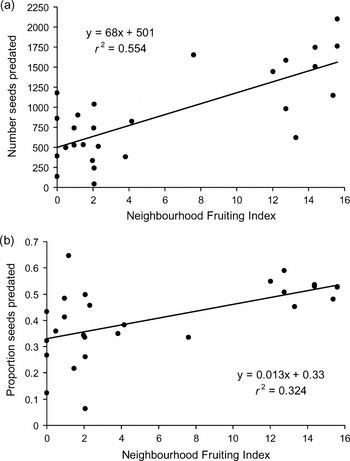
Visual estimation of initial abundance of fruits in the crown of each tree varied from 11 000 to 939 000 fruits (mean: 283 000 ± 295 000, n = 18), and focal trees had a mean neighbourhood fruiting index of 5.9 ± 6.1 (range: 0–15.6, n = 27). The intensity of pre-dispersal seed predation by parrots was significantly related to the neighbourhood fruiting index of the focal tree (Figure 2), for both total number (r2 = 0.55, F1,25 = 31, P < 0.001), and proportion (r2 = 0.32, F1,25 = 12, P = 0.002) of seeds predated. In contrast, initial fruit abundance did not influence either the number (r2 = 0.11, F1,16 = 2.0, P = 0.18) or proportion (r2 = 0.15, F1,16 = 2.8, P = 0.12) of seeds predated by parrots. Hence, resource dispersion influenced the intensity of pre-dispersal seed predation by parrots, with parrots predating a mean 52% ± 3.9% of seeds for nine trees with a high number of conspecifics fruiting nearby, whereas parrots predated only 26% ± 14.8% of seeds for six trees with no fruiting neighbours (Figure 2). By comparison, intensity of pre-dispersal seed predation by insects was not related to either initial fruit abundance (number: r2 = 0.09, F1,16 = 1.5, P = 0.23; proportion: r2 < 0.01, F1,16 < 0.01, P = 0.97), or the neighbourhood fruiting index (number: r2 = 0.04, F1,25 = 0.90, P = 0.35; proportion: r2 = 0.05, F1,25 = 1.4, P = 0.24).
Relationship of number (a) and proportion (b) of seeds of Astronium graveolens predated by parrots collected in fruit-traps with the neighbourhood fruiting index of the focal tree.

Post-dispersal seed predation
During our inspections of the experimental quadrats, we occasionally found remains of A. graveolens seeds in the open treatments, with bite marks indicating attack by rodents. However, we never found seed remains in the exclusion treatments, suggesting that seeds had been removed whole through the wire mesh by invertebrates, possibly ants.
The number of fruits remaining at 45 d post dispersal differed significantly between open and exclusion treatments (F1,1 = 14.2, P < 0.001), with greater survival in the exclusion treatments. There was no variation between the two sites of Chamela and Cuixmala in the number of fruits remaining at 45 d post dispersal (F1,1 = 0.12, P = 0.73), and treatment effects were the same at both sites with no significant interaction site × treatment (F1,1 = 0.09, P = 0.76). The Kaplan–Meier probability of survival to 45 d post dispersal also did not differ between the two sites for either the open treatments (Log rank: χ21 = 1.4, P > 0.05) or the exclusion treatments (Log rank: χ21 = 0.003, P > 0.05). We therefore combined data from the two sites for survival probability analysis between treatments.
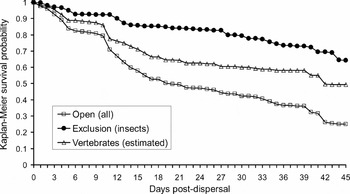
The Kaplan–Meier probability of survival of A. graveolens fruits up to 45 d post dispersal differed significantly between treatments (Log rank: χ21 = 109, P < 0.001), with an overall survival of 0.25 for the open treatment, compared with 0.64 for the exclusion treatment (Figure 3). Hence, we estimate that insects predated 36% of the seeds of A. graveolens post dispersal in the exclusion treatment. By subtracting seed removal in the exclusion treatment from that in the open treatment (Kelt et al. Reference KELT, MESERVE and GUTIÉRREZ2004), we obtained an estimated 0.49 Kaplan–Meier survival probability, suggesting a potential 51% post-dispersal predation by vertebrates. The pattern of seed removal estimated for vertebrates differed significantly from that estimated for insects in the exclusion treatment (Log rank: χ21 = 16, P < 0.001). In particular, seed survival declined more rapidly at 10 d post dispersal when subjected to potential vertebrate predation, but when subjected to removal by insects, seed survival maintained a steady rate of decline increasing slightly towards the end of the post-dispersal period (Figure 3).
Kaplan–Meier survival probability for Astronium graveolens fruits by day post-dispersal in open treatments permitting access to vertebrates and insects, exclusion treatments with access only to insects, and the estimated survival when subjected only to vertebrate removal.

DISCUSSION
Pre-dispersal seed predation
The 43% pre-dispersal seed predation of A. graveolens by the lilac-crowned parrot was higher than pre-dispersal predation attributed to canopy vertebrates in other studies of insect and vertebrate predation (Curran & Leighton Reference CURRAN and LEIGHTON2000, Nakagawa et al. Reference NAKAGAWA, TAKEUCHI, TANAKA and NAKASHIZUKA2005), as well as that estimated for other parrot species in humid forests (Galetti & Rodrigues Reference GALETTI and RODRIGUES1992, Howe Reference HOWE1980, Trivedi et al. Reference TRIVEDI, CORNEJO and WATKINSON2004). High pre-dispersal seed predation by parrots has previously only been recorded in fragmented habitats where parrots may experience food-resource limitation (Coates-Estrada et al. Reference COATES-ESTRADA, ESTRADA and MERRITT1993, Francisco et al. Reference FRANCISCO, LUNARDI, GUIMARÃES and GALETTI2008, Galetti & Rodrigues Reference GALETTI and RODRIGUES1992), though Haugaasen (Reference HAUGAASEN2008) reports that macaws damaged 62% of the fruit crop of Couratari guianensis in Amazonian forest. The lack of research in this area may underestimate the impact of parrots on pre-dispersal seed loss. In addition to the direct predation of seeds, the lilac-crowned parrot also discarded immature fruits below the tree, causing a total 56% loss for the tree as a result of parrot foraging activity.
Furthermore, the intensity of pre-dispersal seed predation by parrots was consistent between the two years of study for those trees that were sampled in both years. This contrasts with pre-dispersal seed predation by arboreal vertebrates in tropical moist forest, which tends to be sporadic and of short duration (Curran & Leighton Reference CURRAN and LEIGHTON2000, Nakagawa et al. Reference NAKAGAWA, TAKEUCHI, TANAKA and NAKASHIZUKA2005). The consistent, high level of pre-dispersal seed predation by the lilac-crowned parrot may be due to the fact that A. graveolens fruits during the months of March to June at the end of the dry season when there are few food resources available for parrots (Renton Reference RENTON2001), and coincides with the period when parrots are raising young (Renton Reference RENTON2002). The seeds of A. graveolens also present a high protein and lipid content (Gutiérrez-Pérez Reference GUTIÉRREZ-PÉREZ2005), which are important for nestling growth (Klasing Reference KLASING1998). Hence, in addition to providing an abundant food resource, the seeds of A. graveolens may also provide a valuable nutritional contribution to parrot diets.
Compared with the high pre-dispersal seed predation by parrots, insects predated only 1.3% of the seeds of A. graveolens. This is contrary to that found by Nakagawa et al. (Reference NAKAGAWA, TAKEUCHI, TANAKA and NAKASHIZUKA2005) for six species of dipterocarp in the tropical moist forest of Malaysia, where pre-dispersal seed predation by insects ranged from 25% to 78%, while vertebrate predation was only 1.4% to 25%. The limited insect predation of A. graveolens seeds may be due to the sharp decline in both biomass and abundance of canopy insects during the dry season (Lister & Garcia-Aguayo Reference LISTER and GARCÍA-AGUAYO1992). Furthermore, the leaves of A. graveolens contain a volatile monoterpene hydrocarbon which is repellent to leafcutter ants (Chen et al. Reference CHEN, WIEMER and HOWARD1984), though it is not known whether the seeds also contain deterrent secondary compounds.
Finally, 19% of the fruits collected in the fruit-traps did not contain viable seeds, and appeared to have been aborted. Seeds may be aborted as a result of insect attack or unfavourable environmental conditions (Forget et al. Reference FORGET, KITAJIMA and FOSTER1999), or may not have developed due to failures in pollination or resource limitation (Leimu et al. Reference LEIMU, KIMMO, EHRLÉN and LEHTILÄ2002). This reduction in effective seed-crop size of A. graveolens further increases the relative impact of parrot pre-dispersal seed predation.
Fruit-crop size and resource aggregation as predictors of pre-dispersal predation
In our study, both the number and proportion of A. graveolens seeds predated by the lilac-crowned parrot were significantly related to the neighbourhood fruiting index of focal trees, being greater where the resource of fruiting trees was clumped in distribution, but was not related to the initial abundance of fruits in the tree. Other studies have indicated that macaws and cockatoos forage more frequently in areas with a higher concentration of fruiting trees (Berg et al. Reference BERG, SOCOLA and ANGEL2007, Cameron & Cunningham Reference CAMERON and CUNNINGHAM2006). However, the explanatory power of our neighbourhood fruiting index, which gives greater weight to the distance of fruiting trees from the focal tree, suggests that it is not only the number of fruiting trees within a given area but the distance between fruiting conspecifics which influences intensity of seed predation. Coates-Estrada et al. (Reference COATES-ESTRADA, ESTRADA and MERRITT1993) also found that total loss of fruit crop from the foraging activity of the red-fronted parrot (Amazona autumnalis) was negatively correlated with distance to the nearest fruiting neighbour, seed loss being highest in trees closer to a conspecific. This proximity of fruiting conspecifics may facilitate the movement of foraging parrots between trees, leading to greater foraging efficiency, rather than travelling distances between potentially isolated trees, even though they have high fruit abundance.
It may be that both the local aggregation of fruiting trees and fruit-crop size play a role in avian resource selection within a hierarchical or temporal process (Cameron & Cunningham Reference CAMERON and CUNNINGHAM2006, Sallabanks Reference SALLABANKS1993). However, the interplay of these two aspects of resource abundance and dispersion in influencing pre-dispersal seed predation by large-bodied canopy granivores may vary depending on the generalist or specialist nature of the seed predator (Leimu et al. Reference LEIMU, KIMMO, EHRLÉN and LEHTILÄ2002), and characteristics of the habitat (Forget et al. Reference FORGET, KITAJIMA and FOSTER1999). In landscapes that do not present high concentrations of fruiting trees it may be more efficient for parrots to forage on trees with the most abundant fruit (Francisco et al. Reference FRANCISCO, LUNARDI, GUIMARÃES and GALETTI2008). The influence of resource dispersion on the intensity of seed predation by mobile, canopy vertebrates has implications for forest dynamics. Increased seed predation by parrots in areas where fruiting trees are aggregated means that the lilac-crowned parrot may play a role in regulating local dominance of A. graveolens.
Post-dispersal seed predation
Considering all sources of seed loss, the 75% post-dispersal seed predation uncovered here was higher than pre-dispersal seed predation, as determined for other systems (Hulme Reference HULME, Levey, Silva and Galetti2002, Hulme & Benkman Reference HULME, BENKMAN, Herrera and Pellmyr2002). Nevertheless, pre-dispersal predation and waste of immature seeds by foraging parrots was the single greatest contributor to seed loss for the tree. Vertebrate post-dispersal removal of A. graveolens seeds was most probably carried out by rodents, which are the principal post-dispersal seed predators (Crawley Reference CRAWLEY and Fenner1992). At our study site, the spiny rat (Lyomis pictus) is the most abundant vertebrate post-dispersal seed predator (Briones-Salas et al. Reference BRIONES-SALAS, SÁNCHEZ-CORDERO and SÁNCHEZ-ROJAS2006), removing seeds that are small and easily transported, such as A. graveolens.
The role of insects was greater at the post-dispersal stage than pre-dispersal, and was most likely carried out by ants or beetles (Kelt et al. Reference KELT, MESERVE and GUTIÉRREZ2004, Kerley Reference KERLEY1991, Westerman et al. Reference WESTERMAN, HOFMAN, VET and VAN DER WERF2003). Vertebrates removed seeds faster than insects, though there was a slight increase in seed removal by insects in the exclusion treatment towards the end of the post-dispersal period. Insects such as ants range over shorter distances than rodents (Anderson & MacMahon Reference ANDERSON and MACMAHON2001); hence it may take longer for insects to locate seeds post-dispersal. There may also be an increase in insect activity towards the end of the post-dispersal period with the onset of the rainy season. Nevertheless, the fact that seed predation by insects was greater at the post-dispersal, rather than pre-dispersal stage warrants further research.
Despite the high levels of pre- and post-dispersal seed predation, trees of A. graveolens may ensure the survival of sufficient seeds for propagation by producing a high number of fruits. We estimated a mean crop size of 283 000 fruits per tree. Considering the proportion of 21% of mature fruits in the fruit-traps, we estimate about 59 000 fruits per tree may potentially be dispersed. Furthermore, the 25% survival of fruits post-dispersal in the open treatments means that of the dispersed fruits, approximately 15 000 fruits per tree have the potential to germinate. As proposed by Janzen (Reference JANZEN1967, Reference JANZEN1969), the high synchrony in fruit production by trees of A. graveolens, as well as a high abundance of fruit per tree, may serve to satiate potential seed predators, ensuring the survival of sufficient seeds for dispersal.
Implications for plant–animal interactions
The intensity of pre-dispersal seed predation by the lilac-crowned parrot in tropical dry forests was within the range of the average 36–47% pre-dispersal seed predation in tropical systems, usually carried out by insects (Hulme Reference HULME, Levey, Silva and Galetti2002, Hulme & Benkman Reference HULME, BENKMAN, Herrera and Pellmyr2002). Hence, it may be that canopy seed predators such as parrots adopt the functional role of insects as the main pre-dispersal seed predators in dry habitats, particularly during the dry season when arthropod abundances may be low.
While the present study focuses only on one tree species, the lilac-crowned parrot consumes the seeds of a variety of other tree species during the dry season. In particular, the seeds of tree species such as Brosimum alicastrum, Piranhea mexicana, Erythrina lanata and Comocladia engleriana are predominant in the diet of the lilac-crowned parrot in the dry season (Renton Reference RENTON2001). The lilac-crowned parrot also consumes the seeds of a variety of tree species in the rainy season (Renton Reference RENTON2001), and may be an important pre-dispersal seed predator for many of these trees. Very few studies have quantified pre-dispersal seed predation by parrots, or compared this with other sources of pre- and post dispersal seed predation. Further research is needed in this area to elucidate the functional importance of parrots as pre-dispersal seed predators in tropical forests. Many parrot species of seasonally dry forests are currently threatened or endangered (Collar & Juniper Reference COLLAR, JUNIPER, Beissinger and Snyder1991). As in the case of defaunation of animal herbivores (Dirzo & Miranda Reference DIRZO, MIRANDA, Price, Lewinsohn, Fernandes and Benson1991), the loss of parrot populations in these forests may have consequences for the overall process of pre-dispersal seed predation and the recruitment of canopy trees.
ACKNOWLEDGEMENTS
We are grateful for logistical support provided by the Fundación Ecológica de Cuixmala, and the Estación de Biología Chamela of the Instituto de Biología, Universidad Nacional Autónoma de México. EIV-S was supported by a postgraduate grant from the Consejo Nacional de Ciencia y Tecnología. The Secretaría del Medio Ambiente y Recursos Naturales granted permits for the research. We are especially grateful to F. Dentressangle, A. C. Mont and D. Vilchis for assistance in the field, and thank the anonymous reviewers for constructive comments on the manuscript.