I. INTRODUCTION
Dyes discharged by the textile, paper, and tannery industries are primary pollutants of water source. Reference Shter, Behar‐Levy, Gelman, Grader and Avnir1,Reference Ahmad and Kumar2 The major limitation in treating textile wastewater is their resistance to conventional biological treatment processes. Reference Zou, Chen, Liu and Xu3 Several methods have been developed to remove the synthetic dyes from the wastewaters, including coagulation and flotation, Reference Liakos and Lazaridis4 ozonation, Reference Turhan, Durukan, Ozturkcan and Turgut5 membrane separation, Reference Yu, Liu, Ma, Qi, Lü and Gao6 photocatalysis, Reference Gao, Xiao, Yang, Wang and Su7 and adsorption. Reference Hao, Yang, Rao, Wang, Niu and Su8 Among them, the adsorption method is a simple and effective method due to its advantages in terms of energy savings and ease of operation.
Up to now, nanomaterials used for the adsorption of dye have gained considerable interest because of their large surface areas, numerous active sites, and unusual adsorptive properties. Reference Wang, Wu, Yu, Xu and Lim9,Reference Cheng, Le, Cai and Yu10 Among the nanomaterials that are currently being developed, Mg(OH)2 and MgO nanoparticles are extensively exploited in wastewater treatment due to their nontoxic, abundance, economy, and environmentally friendly nature. Reference Kumari, Li, Vannoy, Leblanc and Wang11,Reference Hu, Song, Chen, Yang, Li and Richards12 Different methods have been utilized to prepare Mg(OH)2 and MgO nanostructures, such as the electrodeposition, Reference Zou, Chen, Liu and Xu3 sol–gel, Reference Todan, Dascalescu, Preda, Andronescu, Munteanu, Culita, Rusu, State and Zaharescu13 precipitation, Reference Bouberka, Bentaleb, Benabbou and Maschke14 hydrothermal, Reference Nga, Hong, Lam and Huy15 and solvothermal process. Reference Cao, Qu, Wei, Liu and Song16 However, the as-obtained samples usually have larger size, inhomogeneous morphology, and relatively poor adsorption performance.
Recently, a general two-phase strategy for the synthesis of monodisperse nanoparticles has been developed by our group. Reference Li, Yang, Ge, Sun, Wang and Su17 In this present work, we report a phase-transfer method for the synthesis of Mg(OH)2 nanosheets and a subsequent adsorption–calcination process to obtain lamellar MgO nanostructures. The process is shown in Scheme 1. This strategy involves the transfer of Mg(II) ions from aqueous solution to hexane, and then subsequent hydrothermal treatment at elevated temperature. The as-prepared Mg(OH)2 nanosheets exhibit high adsorption properties for Congo red (CR) and the maximum adsorption capacity is estimated to be 1820 mg g−1 at the CR concentration of 1000 mg L−1. Furthermore, the lamellar MgO nanostructures calcined from Mg(OH)2 show a higher adsorption capability for CR. And the maximum adsorption capacity is as high as 2650 mg g−1 at the CR concentration of 1600 mg L−1. To the best of our knowledge, this is much higher than indicated in previous reports for the removal of CR. The CR adsorption capacity of the lamellar MgO nanostructures does not decrease at all even after five cycles, revealing their excellent recycling performance. We believe that our method provides a facile route to prepare magnesium-based nanomaterials, which could be potentially used for the treatment of textile dye wastewater.
Schematic illustration of the synthesis process of the Mg(OH)2 nanosheets and lamellar MgO nanostructures: (i) phase-transfer process; (ii) solvothermal process; and (iii) adsorption–calcination process.

II. EXPERIMENTAL
A. Starting materials
All the reagents were of analytical grade and used without any further purification. Magnesium(II) nitrate [Mg(NO3)2 .6H2O, 99.0%] and sodium hydroxide (NaOH, 96.0%) were obtained from Tianjin Fuchen Chemical Reagents Co. Ltd. Sodium oleate (C18H35COONa or NaOA, technical grade) was purchased from Aladdin Reagents Company. Hexane and absolute ethanol were of analytical grade and purchased from Tianjin Zhiyuan Chemical Reagents Co. Ltd. CR was purchased from Shanghai Shanpu Chemicals Co. Ltd. (Shanghai, China).
B. Synthesis of Mg(OH)2 nanosheets
To prepare the Mg(OH)2 nanosheets, 2 mmol of Mg(NO3)2 .6H2O (0.51 g) and 4 mmol of NaOA (1.217 g) were added to the solution containing 10 mL of deionized water, 20 mL of ethanol, and 30 mL of hexane. After stirring for 60 min, 4 mmol of NaOH (0.16 g) was added to the two-phase mixture. Finally, the two-phase mixture was transferred into a Teflon-lined stainless steel autoclave and heated at 120 °C for 12 h. After cooling to room temperature, the resulting precipitates were washed several times with hexane and ethanol and then dried at 50 °C in air for 12 h.
C. Synthesis of lamellar MgO nanostructures
CR (C32H22N6O6S2Na2), an azo dye commonly used in the textile industry, is selected as a model organic pollutant. In this work, the as-prepared Mg(OH)2 nanosheets were used for CR adsorption. The detailed process is described in Sec. II. E. After adsorption, the Mg(OH)2 adsorbents were centrifuged from the CR solution and dried at 60 °C. Then, the samples were heated in air at 450 °C for 2 h to obtain lamellar MgO nanostructures.
D. Characterization
The obtained samples were characterized by x-ray diffractometer (XRD) using a Rigaku D/max-ga XRD at a scanning of 2 min−1 in 2θ ranging from 10° to 80° with Cu Kα radiation (λ = 1.54178 Å). Transmission electron microscopy (TEM) images were obtained on a Hitachi H-600 (Japan) with an accelerating voltage of 75 kV and a FEI Tecnai G2 T20 electron microscope (USA) operated at 200 kV. Brunauer–Emmett–Teller (BET) specific surface areas were determined from the nitrogen adsorption apparatus (JW-BK, China) at 77 K.
E. Adsorption experiment
50 mg of the as-prepared samples [Mg(OH)2 and MgO] were well-dispersed into 100 mL of CR solution (100 mg L−1) with a constant stirring in the dark. The samples were collected by centrifugation after different time intervals to measure the CR removal by UV–vis spectra (Shimadzu UV2450, China) at λmax = 498 nm. To evaluate the adsorption capacity, 10 mg of adsorbent was added to 20 mL of CR solutions of different concentrations [20–1200 mg L−1 for Mg(OH)2, 20–1600 mg L−1 for MgO] with stirring in the dark. The adsorption isotherm was obtained by varying the initial CR concentrations with stirring for 12 h at room temperature.
F. Adsorbent recycling
The recycling adsorption experiments (lamellar MgO nanostructures) were carried out by repeating adsorption/calcination steps with the same solid. The same adsorption procedure as mentioned above was followed for recycling test. After completing equilibrium adsorption experiments, the suspensions were recovered and calcined at 400 °C (5 °C/min) for 3 h in air. The calcined material was redispersed in CR solutions at the concentration of 100 mg L−1. This procedure was repeated five times and the amount of CR adsorbed after each dispersion–calcination cycle was determined.
III. RESULTS AND DISCUSSION
A. Characterizations of Mg(OH)2 nanosheets and lamellar MgO nanostructures
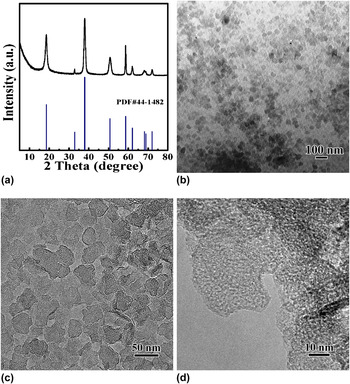
The crystal phase and morphology of Mg(OH)2 nanosheets were characterized by XRD and TEM, as shown in Fig. 1. The crystal phase of the Mg(OH)2 nanosheets is confirmed by XRD analysis in Fig. 1(a). All diffraction peaks of the XRD pattern in Fig. 1(a) can be perfectly indexed to a pure hexagonal phase [space group
 $P\bar 3m1$
(164)] of Mg(OH)2 with calculated lattice constants a = 3.15 Å and c = 4.78 Å, in agreement with the reported data (JCPDS No. 44-1482). Figure 1(b) shows an overview TEM image of the dispersed nanosheets at low magnification. The sample consists of a large number of highly uniform, ultrathin nanosheets with a lateral dimension of about 50 nm, which can be better seen in the image at higher magnification [Fig. 1(c)]. The high magnification TEM image [Fig. 1(d)] demonstrates that the thickness of a Mg(OH)2 nanosheet is less than 5 nm.
(a) XRD pattern and (b-d) TEM images of the Mg(OH)2 nanosheets: (b) low magnification; (c) middle magnification; and (d) high magnification.

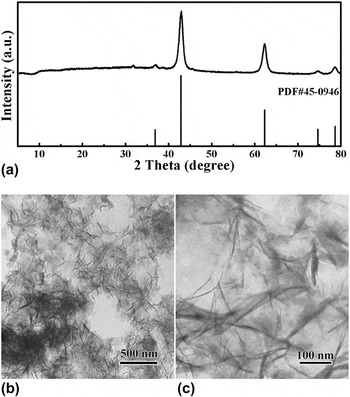
After the adsorption process, the Mg(OH)2 nanosheets were collected, dried, and calcined in air to remove the organic dyes. The detailed procedure was illustrated in the Experimental section. Figure 2 shows the XRD pattern and TEM images of the annealed product. As shown in Fig. 2(a), the XRD diffraction peaks can be assigned to the cubic structure of MgO (JCPDS No. 45-0946). Moreover, all peaks are broad, indicating a small crystallite size. From Figs. 2(a) and 2(b), the lamellar MgO nanostructures consist of ultrathin nanosheets with a thickness of less than 10 nm. Since these ultrathin nanosheets are overlapping and connected to each other, their dimensions cannot be precisely evaluated by TEM. From the above results, it can be inferred that the lamellar nanostructures are formed and aggregated during the combustion process. A possible mechanism may be proposed as follows:
(a) XRD pattern and (b, c) TEM images of the lamellar MgO nanostructures.

During the combustion process, the muffle furnace provided a sufficient amount of heat at 450 °C, which may lead to the formation of lamellar MgO nanostructures. The following reactions may be initiated. Reference Shter, Behar‐Levy, Gelman, Grader and Avnir1,Reference Giauque and Archibald18
 $${{\rm{C}}_{32}}{{\rm{H}}_{22}}{{\rm{N}}_6}{{\rm{O}}_6}{{\rm{S}}_2}{\rm{N}}{{\rm{a}}_2} + {{\rm{O}}_2} \to {\rm{C}}{{\rm{O}}_2} + {{\rm{H}}_2}{\rm{O}} + {\rm{NO}} + {\rm{S}}{{\rm{O}}_2} + {{{\rm{N}}{{\rm{a}}_2}{\rm{O}}} \mathord{\left/ {\vphantom {{{\rm{N}}{{\rm{a}}_2}{\rm{O}}} {{\rm{N}}{{\rm{a}}_2}{\rm{C}}{{\rm{O}}_3}}}} \right. \kern-\nulldelimiterspace} {{\rm{N}}{{\rm{a}}_2}{\rm{C}}{{\rm{O}}_3}}}\quad ,$$
 $${\rm{Mg}}{({\rm{OH}})_2} \to {\rm{MgO}} + {{\rm{H}}_2}{\rm{O}}\quad {\rm{.}}$$
We assume that CR may act as a fuel to produce heat and generate a variety of gas, such as NO, SO2, CO2, and H2O. During the calcination process, the in situ formed gases act as dynamic templates and hence contribute to the formation of the multilayer structure. Reference Zhang, Deng, Liu, Wu, Zhang, Meng and Gao19 A similar phenomenon occurred in the microwave-assisted combustion process proposed by Selvam et al. Reference Selvam, Kumar, Kennedy and Vijaya20
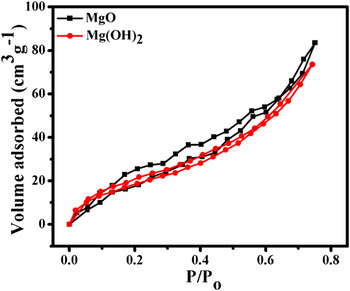
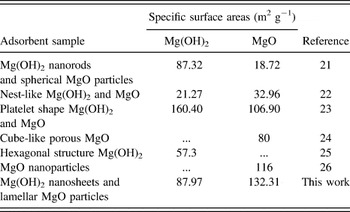
The surface area of the as-prepared Mg(OH)2 and MgO nanoparticles was determined by nitrogen adsorption–desorption measurements (Fig. 3). Each isotherm shows a distinct hysteresis loop, which is characteristic of porous adsorbents. Table I shows the specific surface area of the as-prepared Mg(OH)2 and MgO samples and some previously reported results. The BET surface area of the as-prepared Mg(OH)2 and MgO samples was calculated to be 87 and 132 m2 g−1, respectively, which is obviously higher than many previously reported results.
N2 adsorption and desorption isotherms of the Mg(OH)2 nanosheets and lamellar MgO nanostructures.

Specific surface areas of various Mg(OH)2 and MgO samples.

B. Adsorptive properties for CR
Generally, nanomaterials with high specific surface area can be used as adsorbents in wastewater treatment. Reference Nga, Hong, Lam and Huy15–Reference Li, Yang, Ge, Sun, Wang and Su17,Reference Li, Xiao, He, Zheng, Yu and Tan27 Compared with other adsorbents like activated carbon or polymers, metal oxide or hydroxide will be more promising because they can be readily regenerated by a simple calcination process. In the present study, CR was selected as the representative dye material to evaluate the adsorption performance of Mg(OH)2 nanosheets and lamellar MgO nanostructures.
1. Adsorption rate
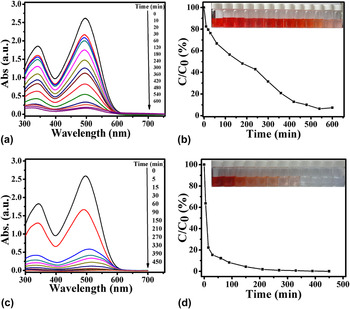
Figure 4 shows the adsorption rates of the CR on Mg(OH)2 nanosheets and lamellar MgO nanostructures. It can be seen that the CR adsorption increased with an increase in contact time. As shown in Figs. 4(a) and 4(b), over 94% dye removal was attained by the as-prepared Mg(OH)2 nanosheets within 540 min. After calcination, the as-prepared lamellar MgO nanostructures exhibit a fast absorption rate (85% of CR was removed within 30 min), and the final removal efficiency of CR was up to 100% within 450 min [Figs. 4(c) and 4(d)].
(a, c) Absorption spectra and (b, d) absorption rate of an aqueous solution of CR (100 mg L−1, 100 mL) after treatment with the as-prepared Mg(OH)2 and MgO (50 mg) at different time intervals.

2. Adsorption capacity
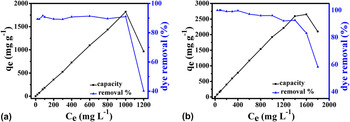
The relations between the adsorption capacities of the adsorbents and the initial concentrations of CR are shown in Figs. 5(a) and 5(b). It could be observed that the adsorption capacities of the adsorbents increased with an increase in the initial dye concentration, and the maximum adsorption capacity of CR by Mg(OH)2 nanosheets and lamellar MgO nanostructures was 1820 and 2650 mg g−1, respectively. The removal of CR by the as-synthesized Mg(OH)2 nanosheets remained the same (about 90% CR removal) with an increase in the initial dye concentration and start to decrease after reaching the maximum adsorption capacity. Approximately 100% CR removal was achieved by the lamellar MgO nanostructures in the initial stage, and then gradually decreased with increase in the initial dye concentration.
Adsorption isotherm and dye removal of CR as a function of initial concentration: (a) Mg(OH)2 and (b) MgO.

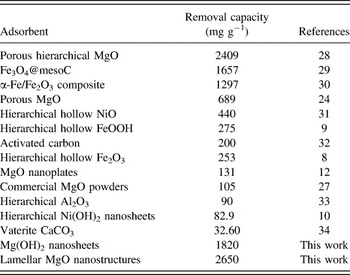
The maximum capacity (q m) of CR on the as-prepared samples [Mg(OH)2 and MgO] was compared with those reported in the previous literature (as shown in Table II), such as porous hierarchical MgO (2409 mg g−1), Fe3O4@mesoC (1657 mg g−1), α-Fe/Fe2O3 composite (1297 mg g−1), porous MgO (689 mg g−1), and hierarchical hollow NiO (440 mg g−1). It is obvious that the q m of the lamellar MgO nanostructures toward CR (2650 mg g−1) is higher than those of many previously reported adsorbents. It is believed that the special morphology and high surface area of the as-prepared Mg(OH)2 and MgO are responsible for excellent performance in CR adsorption.
Adsorption capacities of CR on various adsorbents.

3. Regeneration capacity
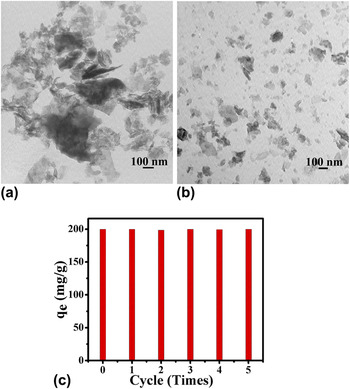
The possibility of recycling the MgO sorbent was evaluated by repeating adsorption/calcination experiments with the same solid. Figures 6(a) and 6(b) show the TEM images of the first and the fifth regenerated MgO nanoparticles. Although the morphology of the regenerated MgO has changed from lamellar to fragmented structure, the thickness of the MgO fragments is no change, which verified the good reusability of regenerated MgO nanoparticles. Figure 6(c) shows the recycling adsorption capacity test of the regenerated MgO nanoparticles. It is clearly shown that the removal rate of CR by MgO nanoparticles can still reach nearly 100% even after five cycles. These results mean that the as-prepared MgO nanoparticles possess a superior recycle and regeneration performance, which is vital for their practical application.
TEM images of the regenerated MgO nanoparticles: (a) the first and (b) the fifth; (c) the maximum adsorption capacity of CR treated by the as-prepared and the regenerated MgO nanoparticles.

4. Adsorption kinetics
The kinetics of CR removal on the Mg(OH)2 nanosheets and lamellar MgO nanostructures were further investigated. The pseudo-first-order kinetic models [Eq. (3)] and pseudo-second-order kinetic models [Eq. (4)] were applied to describe this adsorption process, respectively:
 $$\log \left( {{q_{\rm{e}}} - {q_t}} \right) = \log {q_e} - {{{k_1}t} \over {2.303}}\quad ,$$
 $${t \over {{q_t}}} = {1 \over {{k_2}\mathop {{q_{\rm{e}}}}\nolimits^2 }} + {t \over {{q_t}}}\quad ,$$
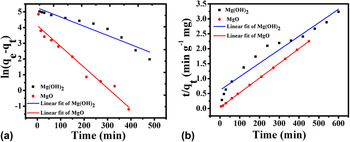
where q e and q t (mg g−1) are the adsorption capacities at equilibrium and at time t (min), respectively. k 1 (min−1) and k 2 (g mg−1 min−1) are the pseudo-first-order and pseudo-second-order rate constants, respectively. The kinetic parameters and the correlation coefficients (R 2) were obtained and are shown in Table III. Figures 7(a) and 7(b) reveal that all the experimental data can fit well to the pseudo-second-order mode. The theoretical q e values, calculated from the pseudo-second-order rate model, were very consistent with the experimental q e values indicating that the adsorption process of CR on the adsorbents works well with this model.
Adsorption parameter of kinetics for the adsorption of CR on Mg(OH)2 and MgO.

(a) The first order and (b) the second order pseudo kinetics for adsorption of CR by the as-prepared Mg(OH)2 and MgO.

5. Adsorption isotherms
The adsorption process can be generally expressed by two isotherm equations, namely, the Langmuir and the Freundlich equations, which are represented by the following equations, respectively:
 $${{{C_{\rm{e}}}} \mathord{\left/ {\vphantom {{{C_{\rm{e}}}} {{q_{\rm{e}}}}}} \right. \kern-\nulldelimiterspace} {{q_{\rm{e}}}}} = {1 \mathord{\left/ {\vphantom {1 {b{q_{\rm{m}}}}}} \right. \kern-\nulldelimiterspace} {b{q_{\rm{m}}}}} + {{{C_{\rm{e}}}} \mathord{\left/ {\vphantom {{{C_{\rm{e}}}} {{q_{\rm{m}}}}}} \right. \kern-\nulldelimiterspace} {{q_{\rm{m}}}}}\quad ,$$
 $${q_{\rm{e}}} = {K_{\rm{f}}}{C_{\rm{e}}}_{}^{{1 \mathord{\left/ {\vphantom {1 n}} \right. \kern-\nulldelimiterspace} n}}\quad .$$
Here, q m (mg g−1) and b (L mg−1) are Langmuir isotherm coefficients. The value of q m represents the maximum adsorption capacity. K f (mg g−1) and n are Freundlich constants.
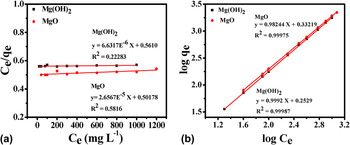
The linear plots of the Langmuir model and Freundlich model of the adsorption of CR are given in Figs. 8(a) and 8(b). The values of R 2 of the Langmuir model for the as-prepared Mg(OH)2 and MgO were 0.2228 and 0.5816, while the values of R 2 of the Freundlich model for those materials were 0.9998 and 0.9997, respectively. Therefore, the adsorptions of the as-prepared Mg(OH)2 and MgO followed the Freundlich isotherm model closely. The results revealed that the CR adsorption on the as-prepared Mg(OH)2 and MgO might take place through surface exchange reaction until the surface function sites were fully occupied. Then, the dye molecules diffused into the space for further adsorption reactions, i.e., complexation interactions.
The linear (a) Langmuir and (b) Freundlich adsorption isotherms for CR adsorption by the as-prepared Mg(OH)2 and MgO.

IV. CONCLUSION
In summary, monodisperse Mg(OH)2 nanosheets have been successfully synthesized by a facile phase-transfer method. The as-prepared Mg(OH)2 nanosheets were used for CR adsorption and then transformed to lamellar MgO nanostructure by calcination. The as-prepared Mg(OH)2 nanosheets and lamellar MgO nanostructures showed superior performance for CR adsorption (the maximum adsorption capacity was 1820 mg g−1 for Mg(OH)2, and 2650 mg g−1 for MgO), which can be attributed to their high surface area and specific structural properties. Kinetics of adsorption was found to follow the pseudo-second-order rate equation and Freundlich adsorption model. The super-high adsorption capacity and good recycling performance for CR adsorption make the lamellar MgO a promising candidate for wastewater treatment of dyes.
ACKNOWLEDGMENTS
This work was supported by the National Natural Science Foundation of China (51174174), Excellent Talents in Xinjiang Province (2013721015), and Postgraduate Education Innovation Project of Xinjiang Province (XJGRI2014016).