Core supporters will not long tolerate a
party that delivers benefits to outsiders.
3.1 Introduction
Poverty-stricken places are seldom transformed by growth- and welfare-enhancing policies steadfastly applied by government actors. Instead, politicians opt to target the poor with private, excludable benefits which tend to peak at election time. In many developing countries without a propoor bias in social spending, clientelism is often the only safety net available to them. In turn, they frequently reward political parties that engage in these practices. The poorer the voters are, the more they are trapped in this relationship of material dependence. Classic studies of political clientelism emphasize that this form of exchange thrives where voters are poor. For example, James Scott (Reference Scott1972a) argued that patron-client links are based on poverty and inequality and the fact that the “patron is in a position to supply unilaterally goods and services which the potential client and his family need for their survival and well-being” (p. 125).
This chapter provides a formal model of machine politics. We build on existing theories of distributive politics, originally developed for understanding the determinants of discretionary welfare transfers in consolidated democracies (Dixit and Londregan, Reference Dixit and Londregan1996; Cox and McCubbins, Reference Cox and McCubbins1986) and on more recent models of clientelism (Stokes, Reference Stokes2005; Nichter, Reference Nichter2010).
Most of these models focus on what Nichter (2010) calls short-term electoral clientelism. We define clientelism as the voluntary exchange of discretionary private transfers for votes, whose continuation is contingent upon demonstrable political support.Footnote 1 That transfers be discretionary is key to our definition of clientelism, making the allocation criteria explicitly political. Since most of a party’s electoral investment strategies are embedded in ongoing relationships and programs that translate into accumulated benefits that accrue beyond elections, our theory is not focused on campaign handouts and vote buying on the spot market.
Our theory departs from the literature in two fundamental ways. First, we conceive of parties and voters as engaged in strategic interactions that extend indefinitely into the future. Second, we posit that partisan loyalties are conditional – a product of past political exchanges that are embedded in a relational network. Prior models of distributive politics rest on the assumption that a core or loyal voter’s proximity to a party remains unaffected by the party’s performance. Given this assumption, the loyal voter is captive, disposed to support her party no matter what, even after being cut off from the stream of patronage benefits (Stokes, Reference Stokes2005; Stokes et al., Reference Stokes, Dunning, Nazareno and Brusco2013).
This assumption is problematic. It implies that core voters are unresponsive to welfare benefits, which is particularly difficult to argue for developing societies. When voters are poor, they tend to base their decisions critically on material considerations – for example, what will provide for the next meal, a leak-free roof, medicine, or clothes and scholarships for their children. Ideology and other symbolic appeals are secondary considerations at best.
Our model posits that voters‘ partisan loyalties are constructed through a history of interaction with a party’s brokers and organizational networks.Footnote 2 Material exchanges play a fundamental role in this relational history. Voter loyalty is also conditional on whether the party can credibly signal that these exchanges will continue into the future. This is one critical reason why particularistic transfers usually spike at election time, as we will empirically show in subsequent chapters.
The theory allows us to understand, for example, why the Peronist party in Argentina funnels jobs and patronage to its own supporters, why the rules-of-thumb for political machines in the United States were to “hold what you’ve got” and “take care of your own” (Holder, 1975, cited in Cox and McCubbins, Reference Cox and McCubbins1986: 383), and why the PRI disproportionately delivered benefits to its loyal voters.
Our theoretical approach further answers some fundamental questions of strategy. When do politicians choose to buy votes with discretionary private goods and when with patronage for public goods provision? To what types of voters are these benefits targeted? The literature on distributive politics has for the most part ignored the fact that politicians have at their disposal a large basket of potential transfers to build and mobilize electoral support. This chapter develops a theory and the next one provides empirical evidence for a portfolio diversification logic driving the relative shares of private and public goods distributed in a given district. We provide expectations of how voters should respond to the different strategies of vote buying – namely, how many votes do particularistic transfers provide compared to public goods provision. We thus provide a more comprehensive picture of electoral investment strategies than that available in most studies of distributive politics.
In our view, party machines deliver particularistic benefits to their core voters and public goods to the population at large. Machines favor the exchange of particularistic and excludable benefits to core voters because these can be targeted with precision, rewarding supporters and punishing opponents. The targeting is critical because it solves problems of voter opportunism and reduces the costs of vote buying, allowing the machine to appropriate more rents. The clientelistic contract further allows the machine to deter voter exit through a credible threat of punishment (Magaloni, Reference Magaloni2006; Diaz-Cayeros et al., Reference Diaz-Cayeros, Magaloni and Weingast2001). Clientelism is self-sustaining, in our theoretical claim, because party and voters expect to interact into the future and can sanction each other for breaking the contract.
But political machines also rely heavily on public goods or pork-barreling projects. Public infrastructure projects, we demonstrate, are employed for electoral purposes when the politician’s base of electoral support falls below a certain threshold and the votes of a larger and more heterogeneous electorate are needed to win elections. Of course, there might be nonelectoral uses for both private and public goods transfers. In a classic article, Shepsle, Weingast, and Johnsen (Reference Sen1981) stress the private consumption gains that business or contract patronage entails for firms, labor, suppliers, and other interests, usually within the district but possibly outside it as well. Local public goods are rarely if ever “pure” public goods. We know that politicians and parties derive electoral benefits from pork-barrel spending, but our model provides an account of how it is used as a complementary strategy to clientelism in the face of stiffer electoral competition.
Our approach to machine politics is compatible with Calvo and Murillo (2011), who argue that voter-party linkages are not spot exchanges, but rather based on long-term interactions with partisan organizations and public officials. Machine politics is embedded in organizational networks where parties employ brokers, bosses, and patrons to acquire knowledge about local voters – their political predispositions, their reference groups and social networks, their patterns of political participation and their partisan affinities. Voters also develop distributive expectations as a result of their prior interactions with political networks (Calvo and Murillo, 2011). In their study, Stokes et al. (Reference Stokes, Dunning, Nazareno and Brusco2013) also emphasize long-term linkages in their broker-centered account of machine politics.
This chapter unfolds as follows. The next section highlights the two dimensions of government transfers relevant for the study of distributive politics. Section 3.3 places our theoretical approach within the core-versus-swing voter debate and studies of clientelism. Section 3.4 develops a formal model answering the core voter “puzzle”: why do parties invest in voters that are already likely to support them? Section 3.5 develops our theory of portfolio diversification to account for public goods provision. Machines that are under pressure from competition are caught in a dilemma: sustaining their electoral coalitions over time by taking care of their core voters, or maximizing their chances of reelection by catering to swing voters. The latter strategy can be advantageous in the short term, but is destabilizing over time. To solve this dilemma, we argue that machines can diversify their portfolio of electoral investments by targeting discretionary private benefits to their core voters and spending on public goods to attract the support of a wider set of citizens.
3.2 Discretionary Private and Public Goods
We classify distributive policies conceived as “instruments of electoral investment” according to two dimensions: whether their benefits are private or public goods and the degree to which there is formal government discretion, or leeway, to decide who benefits, when transfers are given, and when they are withdrawn. Private goods can be targeted to individuals and exhibit excludability of consumption, whereas public goods can be targeted only to localities or districts and their consumption is generally nonexcludable. Instruments of electoral investment are nondiscretionary when the program defines ex ante, in legal and abstract terms, those who can receive benefits and under what conditions. This programmatic redistribution differs from discretionary transfers or what Dixit and Londregan (Reference Dixit and Londregan1996) call “tactical redistribution,” which can take a variety of forms, including campaign handouts, subsidies, tariff protection, and pork-barreling projects. The focus here is on tactical redistribution – investments in discretionary private and public goods.
Discretionary private goods are excludable and reversible. Excludability allows parties to target benefits, rewarding and punishing voters according to their political loyalties. Many public works exhibit some degree of excludability because they are targeted to specific localities. Magaloni (Reference Magaloni2006) shows, for example, that Pronasol‘s social infrastructure projects generally bypassed municipalities governed by opposition parties. Nevertheless, when a bridge is built or a public clinic or school constructed, it is not feasible to exclude opposition voters in that locality from consuming their benefits. Public goods cannot be targeted with precision to punish opponents.
The second fundamental difference is their reversibility. Discretionary private transfers can be made for any length of time and can be withdrawn when the politician so decides. In contrast, public goods once in place are harder to withdraw: infrastructure projects such as roads and highways, bridges and canals, sewage and irrigation systems, public service facilities and power plants are fixed investments. In some cases, however, politicians may intentionally choose to forego maintenance of fixed investments. For example, in their study of Peru, Paxton and Schady (Reference Paxson and Schady2002) find that incumbents sometimes purposely neglect to maintain public infrastructure.
In the introduction we classified discretionary private goods as clientelistic transfers. Discretionary public goods transfers spent on infrastructure constitute what is often referred to in the literature as “pork-barrel” politics (Shepsle and Weingast, 1980; Ferejohn, Reference Ferejohn1974). Pork differs from clientelism in that its principal benefits cannot be targeted to the individual. Public goods, therefore, are subject to a commitment problem, since their benefits are widely shared, even by opposition backers. Yet public goods are more effective at reaching a larger share of the population and, consequently, building more encompassing electoral coalitions (Bueno de Mesquita et al., Reference Bueno de Mesquita, Smith, Siverson and Morrow2003; Chhibber and Noorudding, 2004; Magaloni et al., Reference Magaloni, Diaz-Cayeros, Estévez, Kitschelt and Wilkinson2007).
3.3 Core versus Swing Voters
There are two opposed models of discretionary transfers that focus on what Dixit and Londregan (Reference Dixit and Londregan1996) call “tactical redistribution.” The first model is the core-voter model, developed by Cox and McCubbins (Reference Cox and McCubbins1986), hereafter CM. Their theory begins by defining the conditions under which distributive politics will generate stable electoral coalitions. CM divide the electorate into three groups – core supporters, swing voters, and opposition backers – and ask which of these voting groups would reelection-minded politicians choose as the main beneficiaries of targeted transfers. These groups differ in what the authors call an “adherence dimension” – how responsive they are to transfers from a given party. In their model, core supporters are the most electorally responsive group because parties know their preferences and desires well, while swing voters and opposition backers are less well identified and less likely to be trustworthy. CM predict that risk-averse candidates trying to maximize electoral support will deliver redistributions first and foremost to their core voters.
The result of the CM model hinges on the assumption of risk-aversion on the part of politicians, on the one hand, and on the notion that core voters are less risky than other voters because politicians are in “frequent and intensive contact with them and have relatively precise and accurate ideas about how they will react” (Cox and McCubbins, Reference Cox and McCubbins1986: 379). It has become commonplace to critique the core-voter model for this depiction of politicians investing scarce resources in a voter group that is likely to vote for them regardless. We will address this critique and its premises in the following sections.
A second set of models predict that politicians should benignly neglect loyal supporters and instead target swing voters, who can be decisive for election outcomes and for whom a benefit transfer may incline their vote choice in favor of the incumbent (Lindbeck and Weibull, Reference Lindbeck and Weibull1987; Dixit and Londregan, Reference Dixit and Londregan1996; Stokes, Reference Stokes2005 and Reference Medina, Stokes, Kitschelt and Wilkinson2006). The Dixit and Londregan (Reference Dixit and Londregan1996) model, hereafter DL, begins by asking whom politicians running for office would target with discretionary transfers. Voter utility is a function of issue positions and private consumption; the parties’ issue positions are assumed to be fixed; and tactical reallocations of the budget are relatively flexible. Under the assumption that a politician’s transfers are feasibly and equally targetable to all voters (i.e., the “leaky bucket” is the same for each voter group) and that any incumbent will seek to maximize his probabilities of reelection (the key premise also for Lindbeck and Weibull, Reference Lindbeck and Weibull1987), the model predicts that politicians should favor swing voters, defined as those close to the point at which voters are ideologically indifferent to the alternatives.Footnote 3
The literature has attempted by various means to identify swing-voter groups. One way is to employ surveys, as in Stokes’ various contributions (Reference Stokes2005, Reference Medina, Stokes, Kitschelt and Wilkinson2006, and Reference Stokes, Dunning, Nazareno and Brusco2013). The other is to use aggregate vote returns.Footnote 4 “Under some assumptions about the distribution functions (i.e., symmetry and single peakedness) and parties’ objective functions, there will be a one-to-one correspondence between the density at the cutpoint and the closeness of the last election” (Dahlberg and Johansson, Reference Dahlberg and Johansson2002: 30). This is the reason swing voters are commonly credited with deciding a tight race at the district level.
Stokes (Reference Stokes2005) critiques these models for not taking commitment problems into account. “Both assume by caveat that the party will not renege on its offer of particularistic rewards once it has won the election. And they don’t deal adequately with the fact that a voter once in the voting booth can also renege by voting his or her conscience or preference ignoring the reward he or she received” (p. 316). To deal with commitment problems, she proposes a repeated interaction game in which parties can monitor voters’ actions and both sides foresee their interaction extending into the future. Her model builds on DL in that voters presumably are swayed by both the issue positions of the parties and the income and consumption transfers received from them. Stokes’ model generates predictions akin to those of the swing voter model. Loyal voters do not extract private rewards because they cannot vote against the party. “Such a threat would lack credibility: the party knows that the loyal voter, even without rewards, is better off cooperating forever than defecting forever” (p. 320). Weakly opposed voters and indifferent voters are the target of vote buying because, in her approach, only they can credibly threaten to vote against the incumbent in the absence of a transfer.
Nichter (Reference Nichter2008) departs from these approaches by arguing that parties buy turnout rather than votes. With the secret ballot, he asks, what prevents individuals from accepting rewards and then voting as they wish? He offers an alternative explanation, which he terms “turnout buying,” suggesting that parties will reward supporters for showing up at the polls in order to activate their otherwise passive constituencies. Whereas Stokes’s vote-buying model predicts that parties will target swing voters, Nichter’s turnout-buying theory predicts that they will target strong supporters.
Stokes et al. (Reference Stokes, Dunning, Nazareno and Brusco2013) provide an account of machine politics that stresses the importance of party brokers in targeting benefits to loyal voters. The model predicts that benefits will flow to core supporters because party brokers prefer to invest in them. Investment in the core can be very wasteful but generates opportunities for rent-seeking by brokers. The party leadership would prefer to direct investments to swing voters, an electorally more efficacious strategy, but cannot control their local agents nor their decisions over transfers. Thus, the core-voter model by this account is the product of misaligned incentives within parties that sustain strong agency losses. Investment in core supporters, in other words, is perverse.
The models discussed focus on short-term electoral clientelism and hence take party loyalty as exogenous. However, party’s investment strategies are embedded in ongoing decisions whose benefits extend well beyond election time. Our approach departs from the existing literature by conceiving of parties and voters as engaged in enduring strategic interactions. We further distance ourselves by positing that partisan loyalties are conditional – a product of the history of political exchanges and tactical redistributions tying voters to parties.
Most theories of distributive politics rest on the assumption that a loyal voter’s ideological proximity to a party remains unaffected by the retrospective tally of the party’s behavior. Given this assumption, the loyal voter is captive. Even when cut off from the stream of patronage benefits, she is assumed to continue to vote for her party because her ideological proximity remains unaffected (Dixit and Londregan, Reference Dixit and Londregan1996; Stokes, Reference Stokes2005; Stokes et al., Reference Stokes, Dunning, Nazareno and Brusco2013). This assumption is, at the very least, questionable. If the loyal voter is routinely ignored or disdained by her party, while other voter groups receive the party’s discretionary favors, she may well begin to distrust the party, avoid turning out, and even consider switching support to an alternative.
The literature on core and swing voters ignores this strategic dilemma because it takes partisan loyalties as exogenous. A party that exclusively targets swing voters would not be viable in the long run. In their classic study on social democracy, Przeworski and Sprague (Reference Przeworski and Sprague1986) emphasize this strategic dilemma. They argue that socialist parties that needed to mobilize the support of middle-class allies in order to win alienated their working-class core, which became available for political mobilization by other political parties on the basis of different political identities (religious or ethnic) or more extremist appeals (communist). The problem we consider here is analogous to the socialist party’s dilemma: machines risk losing their core supporters when they attempt to build broader coalitions by delivering transfers to voter groups outside the core.
Partisan loyalties cannot be modeled independently from welfare transfers. CM put this idea succinctly: if a “politician’s core supporters are those who will stick with him through thick and thin … then core support groups will be totally unresponsive and will be given nothing (in pure redistributive terms)” (Cox and MCubbins, Reference Cox and McCubbins1986: 380). However, as the authors note, “it seems irrational in the long-run for any group to be totally unresponsive to redistributions of welfare” (p. 382). Hence, swing-voter models generate the paradoxical result that core voters are unresponsive to welfare benefits and unmolested by their withdrawal.
Moreover, the common assumption that core voters will support a party no matter what is difficult to sustain in developing societies. Poor voters are typically more responsive to the delivery of pocketbook benefits. DL consider this possibility by positing a parameter that measures the relative importance of income and consumption gains to the voter. The higher the parameter, the more voters focus on transfers and the more “apolitical” they become (Weitz-Shapiro, Reference Trejo2014; Magaloni, Reference Magaloni2006; Stokes et al., Reference Stokes, Dunning, Nazareno and Brusco2013).
The swing-voter model is hence unable to explain machine politics in developing societies and their residual survival in developed ones, because it seems disingenuous to think that a political party succeeds by ignoring its core base. This is particularly questionable when a party’s core base is disproportionately composed of poor voters, as occurred with the PRI in Mexico and the PJ in Argentina and so many other party machines around the world.
Our working assumption diverges from these models. We posit that the poor’s partisan loyalties are constructed through material inducements rather than symbolic or ideological appeals. It is not that poor voters in the developing world do not exhibit strong partisan loyalties. The argument is that their partisan identities are constructed through a history of interactions in which material exchanges play a fundamental role.
To put an example, it is evident that few voters can be thought of as PRIístas or Peronistas because of ideological or programmatic considerations or because of a personal attachment to caudillos like Lázaro Cárdenas and Juan Domingo Perón. These parties, in fact, have no sharp programmatic platform and draw support from many social groups, although disproportionately from the poor (Gibson, Reference Gibson1996; Magaloni, Reference Magaloni2006; Calvo and Murillo, 2011). Moreover, most of their supporters were not alive when the caudillos held the stage.
Loyalty to these parties stems from the steady treatment of their loyal supporters as their core clienteles. This simply means that their supporters have repeatedly interacted with the party’s brokers to collect favors and transfers in the past, and that they hold expectations to continue to benefit from its spoils system into the future. Party loyalty in these settings is the product of on-going relations between voters and brokers within the party’s networks, in which the exchange of material benefits and political support plays a central role. In this context, loyalty reflects a voter’s sense of belonging to the relational network rather than like-mindedness.
We hence model the strategic interaction between a core voter and her party as a dynamic game in which her attachment to the party is a function of their history of political exchanges. Partisan loyalties are anchored in that history. We call this conditional party loyalty. The corollary is that partisan loyalty is weakened when a party neglects its core constituencies and delivers benefits mainly to nonloyalists.
3.4 A Theory of Vote Buying with Conditional Partisan Loyalty
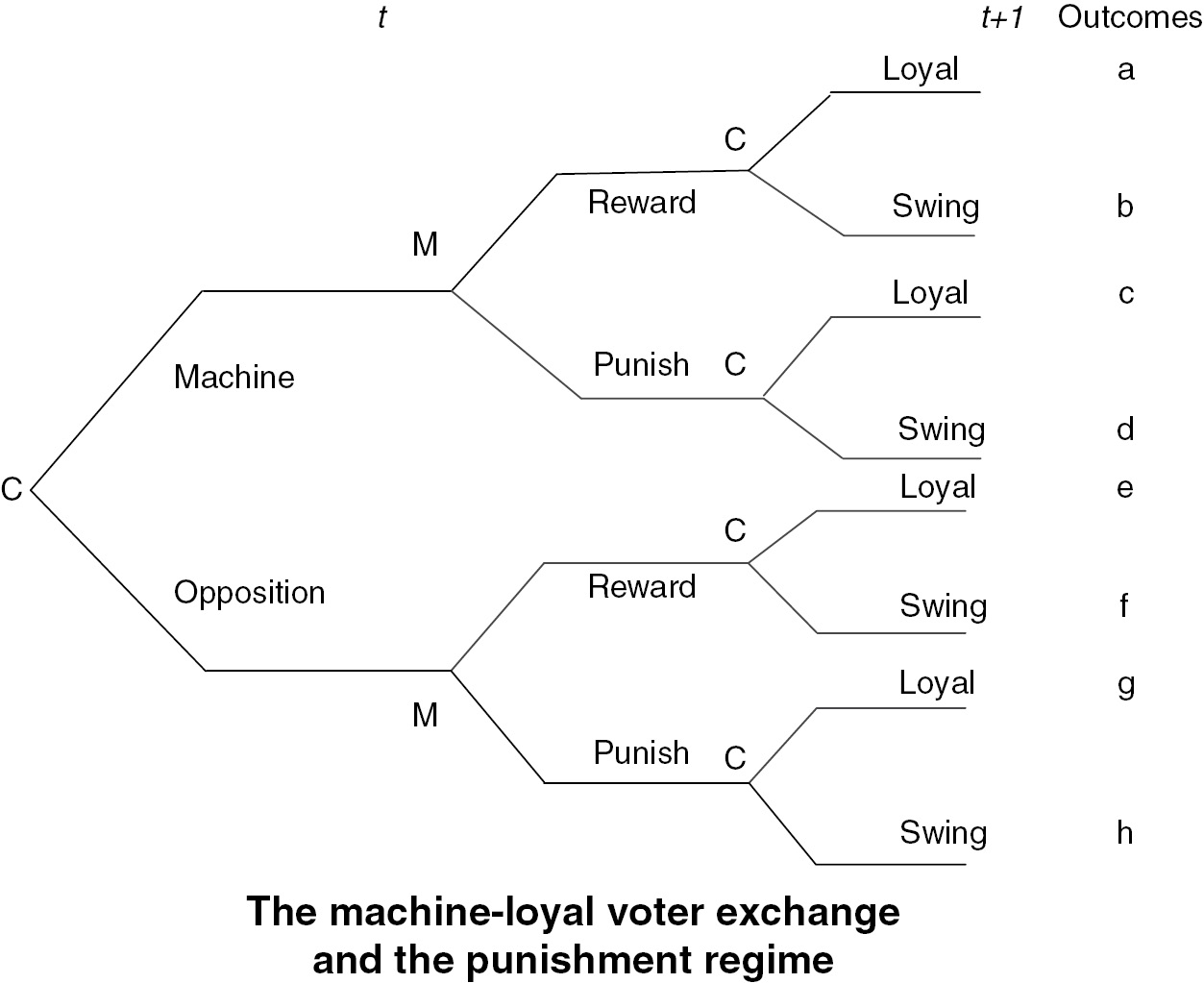
To illustrate our theory of conditional party loyalty, consider the following game tree. A core voter must decide in the first period between voting for the machine or the opposition. The machine then decides to target side payments, rewarding or punishing voters according to their electoral choice. The core voter in the second period must decide whether to remain loyal to the party or change into a swing voter. The game results in eight possible outcomes, which we label a–h. The representation of the sequential game is presented in Figure 3.1.
A model of ongoing vote buying.

This game is an extension of Magaloni’s (Reference Magaloni2006) and Diaz-Cayeros et al.’s (Reference Diaz-Cayeros, Magaloni and Weingast2001) “punishment regime.” Their game has only one subgame in which the machine moves last. If the game is not repeated, the machine possesses no incentives to reward the loyal voter. Hence, an important difference between the “punishment regime” model and this one is that voters here are given a second move at time t+1. After the machine rewards or punishes, the voter can opt to remain loyal or not. The model assumes that voters reciprocate a party with loyalty only when they are rewarded and otherwise they become swing voters. A swing voter is not attached to any political party either by personal reciprocity developed through a history of interaction or through ideology. Hence swing voters are open to political mobilization. By adding this last move to the punishment regime game, we can better uncover why a machine decides rationally to fulfill its part of the agreement by rewarding its core voters.
In the lower subgame, the core voter defects to the opposition and the machine needs to decide whether to reward or to punish her. Following the logic in the punishment regime game, we posit that the machine prefers to punish defectors because otherwise it would generate perverse incentives for disloyalty. Once the machine punishes, the voter must decide whether to recuperate her loyal status, and be rejected again, or remain disloyal. The off-the-path equilibrium outcome in the lower subgame is, hence, that the machine punishes the voter who will remain opportunistic thereafter. In other words, disloyal voters who defect are never “bought back.”Footnote 5
In the upper subgame, the machine needs to decide whether to reward a loyal core voter or to betray her. This choice has no bearing on the current election because the core voter has already voted. In line with the swing-voter logic, the machine still has incentives to disappoint core voters. Yet in our model there is a clear benefit in catering to the core because party opportunism undermines the strength of political loyalties in future contests (outcome d). Worse, reneging on loyal voters helps to create the conditions in which a buyer’s market is changed into the opposite, a seller’s market in which a vote inevitably grows more and more expensive.
Hence, the machine needs to compare the utility from outcomes a and d when making its choice in the upper subgame. If the machine continually delivers transfers to its core voters, this reflects its concern to preserve and strengthen political loyalty into the future. Just how valuable this reserve of voter loyalty is for the machine needs to be evaluated against the temptation to betray the core voter in this period and the expected value of buying swing voters in future elections. To answer this question, we develop an infinite game of vote buying that formalizes these intuitions, which is explained in the following pages in detail.
Consider this scenario: a voter must decide between supporting the incumbent or the opposition, and the incumbent must in turn decide to reward the voter with a transfer, t > 0, or to punish her (t = 0). Stokes (Reference Stokes2005) highlights the commitment problem in this interaction. She solves the dilemma by repeating the game infinitely and positing that the players follow a grim-trigger strategy: cooperate until the other player defects and then defect forever. However, in her approach, loyal voters do not get transfers at all because their ideological proximity remains unaffected should the incumbent renege on his promises in the previous move, in any number of times the game is repeated.
We propose a different formulation of the problem. In our view, partisan loyalties are defined as a function of the history of interactions. Imagine that the incumbent party has to decide whether to buy a particular voter through a monetary pay-off. This voter can be characterized either as a core or a swing voter. The core voter will vote for the incumbent party today, even if she does not get a transfer. But if her party shirks, she will become detached from her party and begin to act like a swing voter tomorrow. Hence, core-voter support is apparently unconditional today, but tomorrow it is conditioned by the changing history of tactical redistribution.
Core-voter loyalty translates into certain electoral support, so that the probability of voting for the machine is equal to 1. The risk of core-voter opportunism is negligible. This is because core voters, once at the ballot box, have no reason to renege on the contract after having accepted the patron’s transfers. Money, transport, and other benefits might still be needed to mobilize core voters to the polls (Nichter, 2011),Footnote 6 but their vote choice is not in question. Swing voters are less proximate to the incumbent party and are not tied to it by a sense of obligation and mutual trust developed through a personalized history of exchanges. However, a transfer to a swing voter may convince her to support the incumbent according to a random variable s∼[0,1]. The expected value of swing-voter support (E[s]) is less than the certain value of the core voter because swing voters are riskier investments and can behave opportunistically. They can renege without serious consequence and, thus, are the true source of commitment problems in vote buying.
Following CM, our model assumes that it is less costly to buy off core voters because they are more responsive to transfers, given that the party knows their needs and desires better than those of voters not tied to the party’s organization. In other words, it is significantly less expensive to entice a voter to support you when he or she is personally tied to you, trusts you, and expects to interact with you into the future. Party brokers often know their core supporters by name, where they live, how many children they have, where they attend school, and what their needs and desires are. This informational advantage, Zarazaga (Reference Zarazaga2011) claims, allows party brokers to be aware of voters’ “reservation value,” or opportunity cost, and accordingly pay core voters the minimal amount necessary. Less attached to the party and its brokers, swing voters need more expensive favors to be convinced to rally to the vote buyer.
Let the transfer for the core voter be denoted by t. The transfer used in the effort to buy off the swing voter is set at t̄ > t. This means that the core-voter strategy is less expensive, allowing party elites to capture some rents: r = t̄ − t.Footnote 7
The choice for the party is restricted to the allocation of funds to either the core or the swing voter.Footnote 8 Given our formulation of the problem, the party may be tempted to exploit core voters whose support is guaranteed in the current election in order to pursue swing voters. Note, however, that the swing-voter strategy entails the following costs: (1) it erodes core voters’ loyalty for future rounds; (2) the party can appropriate fewer rents because it needs to spend more on transfers to buy swing voters; and 3) it is riskier due to the higher likelihood of swing-voter opportunism.
Suppose the party’s utility function is simply the difference between a benefit measured in votes, minus the cost of the transfer used to induce the vote. The party cares about future elections, but at the discounted rate 0>δ>1:
 (1)
We can describe the value of catering to swing or core voters assuming that the party’s decision in this election defines the stream of utility over time. To simplify, the party sticks to the same strategy – core or swing – in all subsequent rounds, and voters respond accordingly. This means that if the party chooses the swing-voter strategy, the core voter supports it in this election, but becomes a swing voter in all subsequent elections. If the party chooses the core-voter strategy, the party continues to deliver transfers to this voter and this voter remains loyal forever as she continues to receive transfers. The party’s utility functions of following a swing strategy, Us, and of following a core strategy, Uc, are given by:
 (2)
and
 (3)
The first utility function defines the benefits of betraying the core voter’s loyalty in this election by giving the transfer to the swing voter. The swing-voter strategy clearly condemns the party to buying votes on the spot market every time elections are held, which is a far riskier, more costly, and very inefficient strategy over the long run.
The second one shows the steady support of the core voter that is obtained by delivering transfers to her. This strategy is significantly less costly over the long run and entails a smaller amount of transfers to voters. The party will follow the swing-voter strategy if its utility is higher than what it obtains from favoring its core. Solving the infinite temporal horizon and substituting the transfers expressed as rents for the incumbent yields the following condition:
 (4)
This basically states that the party will shirk its commitment to the core voter when the expected value of the swing voter (the left-hand side of the expression) is larger than the present value of two different opportunity costs. The first is the gap between the certain support of the core voter and the unreliable support of the swing voter. The larger this gap (i.e., the greater the likelihood the swing voter will behave opportunistically), the more likely the party will pursue the core-voter strategy. This gap is discounted from the second interaction or move onward.
The second opportunity cost, accruing over time, is the discounted value of the stream of rents that would be obtained from investing in buying the vote of the less expensive core voter. The larger the stream of rents, the stronger the party’s incentive to choose the core-voter strategy. The core-voter strategy allows the machine to survive in office over the long run at lower expense. The machine, then, has strong and perduring incentives to construct and preserve partisan loyalties, generate rents, and minimize electoral risk. These are compelling reasons for parties to continue to invest in their loyal cores.
Clientelism entails a durable and stable relationship between a patron party and its core voters. When party and voter expect to interact into the future, it can be a self-sustaining contract. Loyal voters anticipate continued access to the spoils system and reciprocate the party with steadfast electoral support. Clientelism is also self-sustaining because both sides can sanction reneging on the contract: parties punish voters who defect and voters are unfaithful to parties that do not honor loyalty.
Robinson and Verdier (2003) argue that clientelism involves a strong commitment problem: what prevents individuals from accepting rewards and then voting as they wish? In their approach, the commitment problem is solved by privileging the distribution of jobs, which ties the political machine to the voter in a long-term relationship of mutual convenience. Voters will support the machine to protect their jobs, while the party will create and sustain jobs to keep its power over clients.
However, clientelism as a mode of vote buying encompasses many more transferable goods than job patronage. Politicians in the developing world often resort to the distribution of credit and cash handouts, production subsidies, food baskets, grain and livestock, fertilizer and other farming inputs, construction materials, household appliances, medicines, and so forth, because they are easy to distribute. Our explanation of how parties deal with the commitment problem is through repeated investment in established relationships with their core supporters.
The literature has overemphasized the violation of the secret ballot as a primary means of enforcing the patron-client relationship. Although direct observation of voting is advantageous, it is by no means necessary (Stokes, Reference Stokes2005; Magaloni, Reference Magaloni2006; Nichter, Reference Nichter2008 and Reference Nichter2009). Clientelism can be self-sustaining even with the secret ballot. In our view, machines do not need to monitor votes on the day of the election, but they should distinguish allies from enemies by tracking voter loyalties ex ante, an effort that requires dense party organization.
Voters are loyal to the machine because they expect to receive benefits today and in the future, and because they need these to survive. Voter loyalty to a machine is, so to speak, a form of insurance for its core voters, a ticket to a continuous stream of benefits. Normally, at election time the machine signals with the transfer of particularistic benefits to its core supporters that the clientelistic contract remains valid. Although partisan loyalties may involve a moral sense of obligation (Greene and Lawson, 2011), these loyalties and the consequent sense of reciprocity (Finan, 2010) are essentially conditional. If the machine fails to dispense expected favors, core voters will soon cease to feel obliged to reciprocate.
The core voter strategy is an equilibrium strategy under certain conditions that we discuss in turn. First, political parties need to be long-lived organizations that expect to last into the future. This presupposes certain stability in the party system, or at least that parties able to compete and survive over the course of several elections.
Second, our approach presupposes that party loyalty is not anchored in ideology, affect or symbolic appeals, but is conditioned by personal exchanges of material inducements and support. The model could be extended to accommodate different “tolerance thresholds” on the part of core voters and these thresholds can be made to vary inversely with the strength of some primordialist basis of party identification or with a voter’s ideology. The more captive the core voter is to ideology or to an affective source of partisan identification, the more parties can abuse them by catering to swing voters.
Third, the swing-voter strategy has one clear and undeniable advantage: it can make the difference in winning or losing the current election. The swing-voter strategy responds to short-term imperatives but is destabilizing over time because it undermines core-voter loyalties. Just how valuable those reserves of loyalty can be is clear when one considers that the alternative is to build more expensive, fickle, and uncertain electoral coalitions for every election and thus to encourage growing voter opportunism.
Finally, in the model the core-voter strategy is associated with higher rent extraction. Political machines capture more rents because core voters are presumed to be “cheaper” (or easily maintained), as long as they consistently receive the discretionary payments to which they have grown accustomed. Hence, the larger the price difference between swing voters and core, the stronger the incentives to maintain a core base of loyal voters through the delivery of particularistic transfers.
This approach allows us to generate several empirical predictions to be tested in subsequent chapters. The central empirical proposition emerging from our model is that a party will target particularistic transfers mostly to its core base, here defined as voters who regularly support the party who are linked to the party organization and have access to the system of spoils. Hence we evaluate the following hypothesis:
Hypothesis 1: Particularistic excludable transfers should be disproportionately directed to core voters.
A further empirical implication of our approach relates to core-voter leverage. Machines in our model offer transfer to their core to prevent their disloyalty. Machines then should intensify their clientelistic practices or delivery of private goods to prevent their core from eroding. If core voters cannot credibly threaten to exit, they retain little leverage to entice their party to cater to them. In the presence of a credible alternative to the machine, core voters are more likely to receive attention from their party. From this argument we derive the following two hypotheses:
Hypothesis 2: Higher levels of core erosion across electoral cycles should be associated with intensified efforts at retaining core-voter support through clientelism.
Hypothesis 3: If electoral markets are monopolistic, core voters may suffer benign neglect relative to places where electoral competition is stronger.
With respect to the opposition, the machine must issue credible threats to punish defection. This involves avoiding all attempts to reward disloyalty by “buying back” former supporters who have defected to the opposition.
Hypothesis 4: The machine should punish voters who defect to the opposition by withdrawing transfers from them.
Finally, we also expect to find effects for the electoral cycle. The machine fulfills its part of the bargain when it rewards core voters whose support is certain; it does so in order to reaffirm its commitment to them into the future and to prevent erosion of party loyalties. We expect parties to increase particularistic transfers prior to elections as a way of signaling these commitments.Footnote 9
Hypothesis 5: Machines should increase particularistic transfers prior to elections.
The temptation to buy swing votes on the spot necessarily increases in highly competitive elections when these votes can tilt the outcome. Machines under pressure from competition are hence caught in a dilemma. They can maximize their chances of victory by catering to swing voters, but at the cost of undermining core-voter loyalties. Machines can diversify their portfolio of electoral investments to solve this dilemma. We move now to the discussion of portfolio diversification and public goods provision.
3.5 Portfolio Diversification and Public Goods Provision
The literature portrays the investment decision between core and swing voter as an either/or strategy. The empirical record is mixed at best (Londregan, Reference Londregan2007). There are empirical studies that support the swing-voter logic (Schady, Reference Schady2000; Dahlberg and Johansson, Reference Dahlberg and Johansson2002; Stokes, Reference Stokes2005); others are consistent with the core-voter logic (Calvo and Murillo, Reference Calvo and Murillo2004; Hiskey, Reference Hiskey2003; Levitt and Snyder, Reference Levitt and Snyder1995; Nichter, Reference Nichter2008), and yet others who argue that not all core voters are alike and that machines target core voters in more competitive places while punishing the opposition (Magaloni, Reference Magaloni2006). Many studies conflate private and public goods.Footnote 10
Parties can devise strategies that allow them simultaneously to lock in their core and seek to expand their electoral coalitions beyond the core. Portfolio diversification, we contend, allows parties to accomplish this. Our approach is similar to Bueno de Mesquita et al. (Reference Bueno de Mesquita, Morrow, Sieverson, Smith, Bueno de Mesquita and Root2000) in that we argue that transfers for public goods can be used to expand the size of the coalition, while private goods can be employed to reward the core.
Most of the core-versus-swing voter debate has been conducted without paying much attention to broader patterns of political competition. Party systems, electoral rules, and levels of electoral competition shape incentives for engaging in vote buying. Some studies have examined these issues. Chhibber and Nooruddin (Reference Chhibber and Nooruddin2004) investigate the impact of subnational party system configurations on the propensity of parties to invest in private or public goods provision in their study of India. Drawing on Bueno de Mesquita et al. (Reference Bueno de Mesquita, Morrow, Sieverson, Smith, Bueno de Mesquita and Root2000), they predict that the relative importance of private versus public goods will be a function of the effective number of political parties. Using data from Indian states from 1967 to 1997, they show that public goods are more important in bipartisan contexts, where a larger size of the electorate is needed to win elections. In contrast, private goods provision is more prevalent in multiparty systems because politicians can retain power by delivering particularistic benefits to a smaller group of supporters.
Our theory of portfolio diversification was developed in Magaloni et al. (Reference Magaloni, Diaz-Cayeros, Estévez, Kitschelt and Wilkinson2007). We summarize it here and use it to derive our hypotheses on public goods provision. Political parties must decide how to allocate a basket of discretionary transfers to voters that range from private, excludable outlays that can be individually targeted, to nonexcludable public goods that are targeted to districts and consumed by all voter groups. As instruments of electoral investment, these transfers differ in their relative budgetary cost, their expected electoral return defined as the number of voters they benefit, and their level of electoral risk.
Our theory of portfolio diversification assumes a positive correlation between expected yields and risks: risky investments yield higher expected electoral returns. Public goods are risky electoral investments, we claim, because they can’t be targeted – everyone, including opposition backers, can enjoy them. Private, excludable transfers, if properly targeted to a party’s core base, are risk-free but they may not yield the highest electoral return, since fewer voters can normally be targeted through clientelism. Moreover, governments face budget constraints, which means that they might not be able to buy every necessary vote with particularistic, excludable benefits.
The problem of finding the politically optimal allocation of public versus private transfers is determined by budget constraints, the size of the core base of support, and the incumbent’s risk aversion. These conditions in turn depend on how cheap it is to buy votes from core constituencies. Hence, the central feature of the socioeconomic theory of clientelism, namely, the association between poverty and clientelism, is accounted for in this model by the demand-side assumption that it is cheap to buy votes from the poor.
A party’s optimal strategy, then, is to diversify its allocation of funds between public and private goods, devoting a proportion of the budget to public goods, and the remainder to private ones. This mixed-basket strategy yields a higher overall return, taking advantage of the electoral opportunities afforded by public goods provision, while hedging risks through an optimal combination with the risk-free investment.
The proportion of public goods allocations will be higher:
1. The smaller the size of the party’s core base.
2. The higher the costs of vote buying through clientelistic transfers.
3. The higher the vote threshold necessary to obtain victory.
4. The smaller the difference in yield between the two types of goods.
5. The lower the risk of the public good.
6. The less risk-averse the politician with respect to the risk-hedging function of clientelism within his investment portfolio.
Hence, we expect that political machines will diversify their portfolio of electoral investment and deliver public goods when the size of their core is not certain to sustain them in power. Public goods provision in our approach results from competitive pressures, pushing machines to cater to a wider set of voters. We evaluate the following hypothesis:
Hypothesis 6: Machines should spend more in public goods when pressed by electoral competition.
Machines diversify their portfolio of electoral investments to solve the perpetual dilemma of catering to core-versus-swing voters. Our approach highlights the virtues of political competition for the provision of public goods, but does not predict that clientelism will disappear with it. Clientelism can serve as a risk-hedging strategy under conditions of political competition and hence we do not expect politicians to abandon it altogether.
Finally, the expected yield of private goods provision varies inversely with income. It would be exceedingly costly to establish a solid base of core support on the basis of particularistic transfers when voters are wealthier. Politicians face budget constraints that compel them to find a combination of public and private goods that is electorally optimal and feasible. Moreover, rich voters are not likely to respond to particularistic transfers the way poor voters do.
Hypothesis 7: Public goods provision should be higher at higher levels of development.
3.6 Conclusion
Much of the extant theory on distributive politics has portrayed investments in core supporters as irrational. Yet strong empirical evidence in comparative studies points to the hard fact that parties target core constituencies. This chapter has developed a model of distributive politics that makes sense of this empirical regularity. Our argument that parties must invest in loyal voters is consistent with CM, although we derive these results from a different formulation of the problem that, we believe, better portrays the strategies of vote buying in the developing world.
Our model departs from the notion that partisan loyalty is exogenous. Where ideology and other symbolic appeals are but feeble sources of partisan identity, political parties are compelled to construct voter loyalty through relational networks and a history of exchange in which material inducements play a fundamental role. Partisan loyalty so constructed is essentially conditional.
Our conditional loyalty theory allows us to derive a logic of why machines devote a disproportionate amount of resources to their core supporters. We have claimed that machines target their core voters with particularistic, excludable transfers to keep them loyal over the long run. Our model demonstrates the benefits of owning a reserve of core voter loyalty. Voter loyalty serves to mitigate the perpetual risk of voter opportunism that vote buying on the spot entails.
Honoring core-voter loyalty also translates into clear material benefits for political machines. The core voter strategy allows the machine to appropriate rents because it can survive without having to transfer as many resources to core voters as it would in order to create new support coalitions with every election.
Although beneficial to each individual core voter, the clientelistic linkages trap them in a relationship based on material dependence and is sustained through a credible threat of punishment. Voters who defect to the opposition will be excluded from the stream of present and future benefits. This means that voters are loyal to the machine in part because of their access to a stream of welfare benefits, and in part because of fear of punishment. The dilemma is one of voter coordination. Each voter acting alone has powerful reasons to remain loyal to the machine because if she does not, she will be excluded from the spoils system. But if everyone reasons likewise, the machine can be sustained in equilibrium.
The following chapter will evaluate our empirical predictions through an analysis of the six-year duration of the Pronasol program in Mexico.